Minarets
You’d think I would pick up on things sooner, but here’s the problem. When you don’t know something, you often don’t even know you don’t know. In a recent post on an Al Ahmadi minaret one of my commenters asked if I couldn’t tell it was a Shiite minaret. At first, I thought he was being funny, but it nagged at me, so I started asking around.
It turns out almost everone except me can tell the difference. Most say, as I would, “oh you just kind of know, it looks more Iranian” but occasionally someone will say something concrete, like “if it has a green roof on the minaret, it is Shiite” or “if the windows look like keyholes, it is Shiite.”
Who would know? Not me! But I am learning.
So, help me out here. This mosque near City Center on 5th ring. Definitely Shiite?

This mosque is in Qurain – I love the very purpleness of it. Is this a Sunni mosque? I ask because the windows look kind of like keyholes.
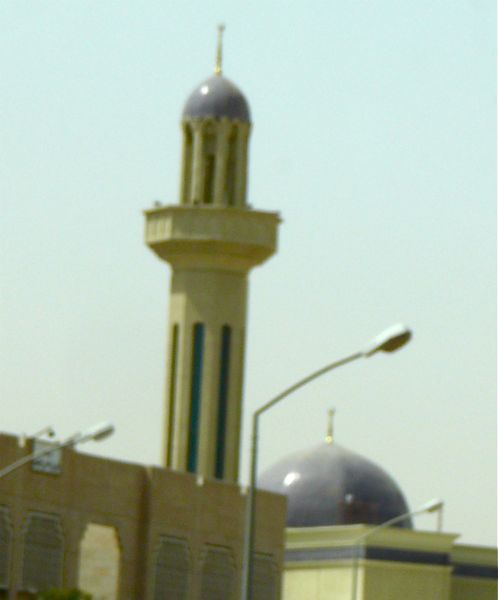
Now – services. I’m an Episcopalian, a sub-sect of Christianity, and I can walk into almost any Anglican/ Lutheran/ Catholic church in the world and even if it is in another language, I have a pretty good idea what is going on, because we are liturgical, we follow a pattern of worship, and the three services are very similar, with very subtle difference. In fact so subtle I probably couldn’t even tell you what the differences are. Islamic services are also considered liturgical – having a set pattern of worship.
So if you were Sunni or Shiia, and walked into a service, could you tell a Sunni service from a Shiia service? Are there differences?
I am sorry to be so ignorant; help me be less so!
A Long Way Gone: Ishmael Beah
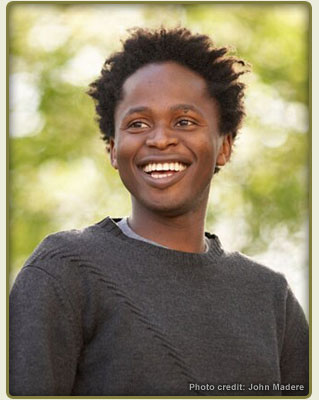

Back when I wrote an update on Dharfur, my blogging friend Chirp recommended a book, A Long Way Gone; Memoirs of a Boy Soldier by Ishmael Beah. I ordered it that very day, and read it this last week.
It is a truly heartbreaking autobiographical book about a young mischievous boy growing up in Sierra Leone, leading a relatively simple and carefree life in his village with his family. It is very African. He talks about the games he and his friends play, his fascination with rap music and the simple joys of the life he is leading.
Then the rebels come. The invade the villages, hopped up on dope, their dead eyes with no pity, raping, killing, chopping off limbs, stealing all the village food and burning the village behind them, often with people locked inside their huts.
Ishmael escapes once with friends, eventually returning to the village to find his entire family gone. Most of the book has to do with what he has to do to survive. Many villages are very afraid of groups of boys, even boys as young as these are – in their early adolescence – and will hurt them. At the very least, most of the villages hurry them along. At one point Ishmael is hiding out in the jungle forest on his own, hiding from lions, giant feral pigs, sleeping up in trees and looking for the rare fruit or grass that he can eat without getting sick.
Finally, after meeting up with some other boys and continuing to try to find his family, a village takes him in, a village run by the state soldiers. As they are attacked by rebels, the boys are forced to make a choice – go out on their own again (where the rebels will also try to recruit them, and if they refuse, will kill them) or agree to be soldiers. These are kids 12, 13, 14 carrying AK 47’s. As part of their training they are given drugs on a regular basis which keep them hopped up, full of energy, and not sleeping for days. The young boys learn to kill without pity. He becomes the very people he was fleeing.
This is a book about redemption. At the center where the boy soldiers are taken, they are constantly told “none of this was your fault.” It is a very African approach, a very human and loving approach to redemption of lives that might have been totally lost to the horrors they have witnessed and inflicted. The author is now nearly 30, and sounds – unlikely as it might be – happy.
Thank you, Chirp, for recommending this wonderful book.
A.Word.a.Day: Karuna
I love A.Word.A.Day. You will see it down there at the very top of my blogroll. They send me an e-mail every day with a new word, where it came from and how it is pronounced and used. I’m pretty good with words, and AWAD challenges me to keep growing. Love it. You can subscribe by clicking the blue words above or clicking on A.Word.A.Day in the Blogroll. Today’s word:
karuna (KUH-roo-na) noun
Loving compassion.
[From Sanskrit karuna (compassion).]
“Once we experience and feel this inter-dependence of all living beings,
we will cease to hurt, humiliate, exploit and kill another. We will want
to free all sentient beings from suffering. This is karuna, compassion,
which in turn gives rise to the responsibility to create happiness and
its causes for all.”
Suresh Jindal; Interdependence of All Living Beings; The Times of India
(New Delhi); Nov 13, 2003.
Church Blocking the Way
I can’t help being a little cynical and a little sad. I have often wondered how long a very visible church could last in a very visible location. It always made me proud that Kuwait was so tolerant to allow Christian worship to take place side by side with Islam in Kuwait. So now the church is impeding progress, and has to go?
From the Arab Times:
Church, cafe blocking way
KUWAIT CITY, March 17: ‘Minister of Public Works and State Minister for Municipal Affairs Mussa Al-Sarraf is determined to remove all obstacles facing the First Ring Road expansion project,’ Al-Rai daily quoted Assistant Undersecretary for Road Engineering Affairs at the Ministry of Public Works Hussein Al-Mansour as saying. The Minister instructed officials to find solutions to the problems, especially for buildings which block the road’s expansion like the church near Jahra roundabout and a cafe, he added.
According to Al-Mansour, the ministry will not be able to complete the project due to these obstacles and ‘it is likely to cost the ministry a lot of money as the contractor will ask for compensation for the delay.’ He said the ministry is waiting for a temporary location for the church and is trying to find alternate arrangements for the cafŽ to hasten the execution of the project ‘which will help in easing the traffic problems in the country.’
St. Patrick and the Wearing of the Green
Growing up in the USA, everyone knows, as a kid, that on St. Patrick’s Day you wear green. It doesn’t mean you are Catholic, or Christian, it means you don’t want to get a pinch, because that is what happens to kids who don’t wear green. (You know how mean kids can be!)
Later on, maybe in high school, a few people will wear orange and explain that they are Irish protestants. Most of us, as kids, don’t really know a whole lot about St. Patrick other than that he went to Ireland to convert the heathens to believe in the church, and that he cast the snakes out of Ireland.
When you get older, St. Patrick’s Day is often a rollicking night in local taverns with Irish names, where they serve stew, and soda bread, and potatoes, and lots of green beer and live music singing old Irish songs.
There are references below to the short version of St. Patrick’s life, and a longer version. The longer version is the Catholic version and, while less documented, is longer and more interesting.
This is from Wikipedia, and is a short summary of the life of St. Patrick:
Saint Patrick (Latin: Patricius[2], Irish: Naomh Pádraig) was a Christian missionary and is the patron saint of Ireland along with Brigid of Kildare and Columba. Patrick was born in Roman Britain. When he was about sixteen he was captured by Irish raiders and taken as a slave to Ireland, where he lived for six years before escaping and returning to his family. He entered the church, as his father and grandfather had before him, becoming a deacon and a bishop. He later returned to Ireland as a missionary, working in the north and west of the island, but little is known about the places where he actually worked and no link can be made with Patrick and any church. By the eighth century he had become the patron saint of Ireland. The Irish monastery system evolved after the time of Patrick and the Irish church did not develop the diocesan model that Patrick and the other early missionaries had tried to establish.
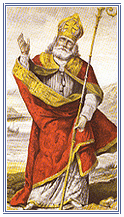
(From Who Was St. Patrick?)
The available body of evidence does not allow the dates of Patrick’s life to be fixed with certainty, but it appears that he was active as a missionary in Ireland during the second half of the fifth century. Two letters from him survive, along with later hagiographies from the seventh century onwards. Many of these works cannot be taken as authentic traditions. Uncritical acceptance of the Annals of Ulster (see below) would imply that he lived from 378 to 493, and ministered in modern day northern Ireland from 433 onwards.
Dharfur: The Janjaweed are Back
Lynsey Addario for The New York Times:
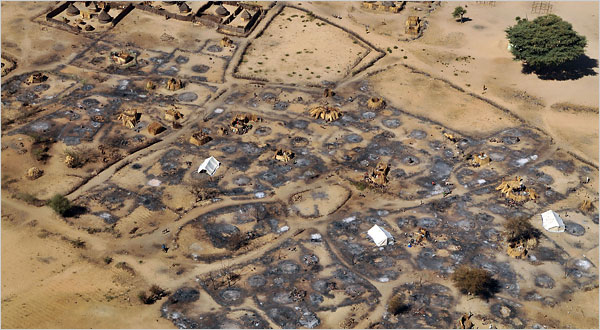
SULEIA, Sudan — The janjaweed are back.
They came to this dusty town in the Darfur region of Sudan on horses and camels on market day. Almost everybody was in the bustling square. At the first clatter of automatic gunfire, everyone ran.
The militiamen laid waste to the town — burning huts, pillaging shops, carrying off any loot they could find and shooting anyone who stood in their way, residents said. Asha Abdullah Abakar, wizened and twice widowed, described how she hid in a hut, praying it would not be set on fire.
“I have never been so afraid,” she said.
The attacks by the janjaweed, the fearsome Arab militias that came three weeks ago, accompanied by government bombers and followed by the Sudanese Army, were a return to the tactics that terrorized Darfur in the early, bloodiest stages of the conflict.
Such brutal, three-pronged attacks of this scale — involving close coordination of air power, army troops and Arab militias in areas where rebel troops have been — have rarely been seen in the past few years, when the violence became more episodic and fractured. But they resemble the kinds of campaigns that first captured the world’s attention and prompted the Bush administration to call the violence in Darfur genocide.
Aid workers, diplomats and analysts say the return of such attacks is an ominous sign that the fighting in Darfur, which has grown more complex and confusing as it has stretched on for five years, is entering a new and deadly phase — one in which the government is planning a scorched-earth campaign against the rebel groups fighting here as efforts to find a negotiated peace founder.
The government has carried out a series of coordinated attacks in recent weeks, using air power, ground forces and, according to witnesses and peacekeepers stationed in the area, the janjaweed, as their allied militias are known here. The offensives are aimed at retaking ground gained by a rebel group, the Justice and Equality Movement, which has been gathering strength and has close ties to the government of neighboring Chad.
Government officials say that their strikes have been carefully devised to hit the rebels, not civilians, and that Arab militias were not involved. They said they had been motivated to evict the rebels in part because the rebels were hijacking aid vehicles and preventing peacekeepers from patrolling the area, events that some aid workers and peacekeepers confirmed.
Please read the rest of the article HERE.
My husband and I have long supported an organization called Medecins Sans Frontiers / Doctors Without Borders. Wherever there is human misery, these brave doctors go and serve those suffering, and their life-saving work is performed under the worst possible conditions. They don’t look at politics. They look at human suffering, and do their best to alleviate it, or to do what they can. These heroic doctors are serving in Dharfur – while they can. When Medicins Sans Frontiers have to pull out, you know that the situation is as bad as it can be.
The accept donations from anyone, anywhere. Be generous.
How Good People Turn Evil
This is a subject that fascinates me – how even “good” people can do very very bad things . . . The article and interview is from Wired.com science/discoveries and you can read the entire article and view a videotape by clicking on the blue type.
TED 2008: How Good People Turn Evil, From Stanford to Abu Ghraib
By Kim Zetter 02.28.08 | 12:00 AM
MONTEREY, California — Psychologist Philip Zimbardo has seen good people turn evil, and he thinks he knows why. Zimbardo will speak Thursday afternoon at the TED conference, where he plans to illustrate his points by showing a three-minute video, obtained by Wired.com, that features many previously unseen photographs from the Abu Ghraib prison in Iraq (disturbing content).
In March 2006, Salon.com published 279 photos and 19 videos from Abu Ghraib, one of the most extensive documentations to date of abuse in the notorious prison. Zimbardo claims, however, that many images in his video — which he obtained while serving as an expert witness for an Abu Ghraib defendant — have never before been published.
The Abu Ghraib prison made international headlines in 2004 when photographs of military personnel abusing Iraqi prisoners were published around the world. Seven soldiers were convicted in courts martial and two, including Specialist Lynndie England, were sentenced to prison.
Zimbardo conducted a now-famous experiment at Stanford University in 1971, involving students who posed as prisoners and guards. Five days into the experiment, Zimbardo halted the study when the student guards began abusing the prisoners, forcing them to strip naked and simulate sex acts.
His book, The Lucifer Effect: Understanding How Good People Turn Evil, explores how a “perfect storm” of conditions can make ordinary people commit horrendous acts.
He spoke with Wired.com about what Abu Ghraib and his prison study can teach us about evil and why heroes are, by nature, social deviants.
Wired: Your work suggests that we all have the capacity for evil, and that it’s simply environmental influences that tip the balance from good to bad. Doesn’t that absolve people from taking responsibility for their choices?
Philip Zimbardo: No. People are always personally accountable for their behavior. If they kill, they are accountable. However, what I’m saying is that if the killing can be shown to be a product of the influence of a powerful situation within a powerful system, then it’s as if they are experiencing diminished capacity and have lost their free will or their full reasoning capacity.
Situations can be sufficiently powerful to undercut empathy, altruism, morality and to get ordinary people, even good people, to be seduced into doing really bad things — but only in that situation.
Understanding the reason for someone’s behavior is not the same as excusing it. Understanding why somebody did something — where that why has to do with situational influences — leads to a totally different way of dealing with evil. It leads to developing prevention strategies to change those evil-generating situations, rather than the current strategy, which is to change the person.
You can read the rest of the article and view the video HERE.
“So Many Christians!”
My Kuwaiti friend was shaking his head in disbelief. He had been to the old city to pay a condolence call on a Friday, and happened by the Lighthouse compound near the Sheraton circle on a Friday morning, just as some of the services were getting out.
“I had NO idea!” he looked at me in absolute amazement.
I just laughed. When we first got here, we attended church on that compound; our church moved off only months ago, when the road construction work got seriously under way and parking increasingly became a problem. It was the most amazing experience on earth – there were the Indian Men’s Catholic services and the Philipine Evangelical service and the rock-music evangelical service and the staid Anglican services and the family Philipine Catholic services and . . . well, you get the picture. There are an amazing number of expatriate Christians in Kuwait. At any one time on the compound, there are about twelve different services going on, and no sooner does one finish and the participants exit, than the new group is coming in.
Now, churches meet all over Kuwait. They met in villas, they meet in schools, they meet in every neighborhood. Today, in our church, we asked for blessings on Kuwait, on the Emir and his family, and those in leadership positions in Kuwait. We prayed for the leaders of all the countries in our congregation (English, Irish, Scottish, South African, Chinese, Indian, Nigerian, Kenyan, Dutch, Egyptian, Ethiopian, American, Australian {I have forgotten a few, I am sure} . . . lots and lots of blessings!) Most of all, we thank God for the freedom to worship in Kuwait.

(This is not our church in Kuwait. This is the Church of the Holy Sepulcher, in Jerusalem. I was looking for a church that looked more Middle Eastern than Western, and this is what I could find!)
Our pastor also has a blog, q8bridge about which he says “The purpose of this blog is to enable a bridge to be built between Christians and Muslims, especially those living in Kuwait. Through questions and dialogue we hope to promote deep friendships and mutual understanding.”
He examines the beliefs we have in common, and where we differ, and some of the reasons why we differ. I urge you to have a look.
Children Damaged by Materialism
A recent study discussed in BBC Health News:
Children ‘damaged’ by materialism
Some 89% of adults think children are more materialistic than ever
Most adults in the UK believe that children’s well-being is being damaged because childhood has become too commercial, a lifestyle poll has found. Some 89% of adults in the GfK NOP survey of 1,255 people believed today’s children were more materialistic than previous generations.
The poll is one of the contributions to a continuing inquiry into childhood.
The Children’s Society said adults had to “take responsibility for the current level of marketing to children”.
Bob Reitemeier, chief executive of the society, said: “A crucial question raised by the inquiry is whether childhood should be a space where developing minds are free from concentrated sales techniques.
“To accuse children of being materialistic in such a culture is a cop-out,” he said.
Mr Reitemeier said: “Unless we question our own behaviour as a society we risk creating a generation who are left unfulfilled through chasing unattainable lifestyles.”
The children’s market is worth an estimated £30 bn a year.
As chief executive of the National Schools Partnership, Mark Fawcett brings business and marketing into schools, and he believes you cannot shield children from the real world.
“We have to live in the current communications era where children can see a huge amount of information,” he told BBC TV news. “We have to use our judgement and we have to, as an industry, make sure we are working with children and families, and not exploiting them.”
Selling lifestyles
The evidence on lifestyle is part of a six-part series of investigations published by the Children’s Society for a continuing inquiry into childhood in the UK which brings together the views of academics, religious communities, teachers, local authorities and authors.
Dr. Rowan Williams, the Archbishop of Canterbury, who is patron of the inquiry, said: “Children should be encouraged to value themselves for who they are as people rather than what they own. “The selling of lifestyles to children creates a culture of material competitiveness and promotes acquisitive individualism at the expense of the principles of community and co-operation.”
Comment: It’s not just children. We are ALL damaged when we start to measure ourselves by what we own. You can read the entire article Here.
“Whirling Chaff”
From Psalm 83
Verse 13
O my God, make them like whirling dust,*
like chaff before the wind.
Reading the Lectionary readings for today I came across this verse in the very first reading. It brought a grin to my face.
Lent continues. The Lord sends me out in my car almost daily, in spite of my best laid plans. I struggle to keep my resolution not to call – not to even THINK – bad names at the fools on the road who cause disruption, chaos and pain. It helps to have a substitute in mind, so I have something I CAN say instead of just struggling NOT to say the words that immediately come to mind.
The above verse will do nicely – don’t you think?
Recent Comments
ExpatAlien on What Country am I Living … intlxpatr on Yellowstone: Old Faithful to C… Michelle on Yellowstone: Old Faithful to C… Cathy on No Grown-Ups in Charge intlxpatr on Waiting for Snow Wikipedia Donate Button

Amazina


Early Voting in Florida


 Here There and Everywhere