‘Lost Boy’ Casts Vote for Independence
I found this today on NPR News and it delights me for a number of reasons. For one thing, I didn’t know David Eggars (you remember him from Zeitoun) had helped with the writing of ‘What Is The What?’. Second, who knew that any of these kids would survive? Survive, write a book, thrive, go back to the Sudan, give to the country – and vote. Every now and then in this sad world you hear a good story. This is one.
January 10, 2011
During Sudan’s civil war, in which some 2 million people died, Valentino Achak Deng fled to Ethiopia on foot. Separated from his family for 17 years, Deng is one of Sudan’s so-called Lost Boys, children who were orphaned or separated from their families during the brutal war.
Now, voting is under way in Southern Sudan in a referendum that is expected to split Africa’s largest country. Among those voting this week are the Lost Boys, including Deng, whose life became a best-selling novel in America and who has returned to his homeland to build a school.
After a peace agreement between north and south, Deng returned to Juba, the capital of Southern Sudan, in 2006. He says when he got there, the place was still a wreck.
“On some of these roads, you could see old war tanks. On some of these roads, in some neighborhoods you could see the bones and skulls of dead people,” he recalls now, driving around Juba.
Now, as Southern Sudan appears headed for independence, Deng is optimistic — and Juba looks a lot better. Paved roads, now lined with hotels and restaurants, arrived for the first time in 2007.
Juba is a booming city, one of incredible contrast: Barefoot women selling piles of gravel by the side of the road sit next to a Toyota dealership.
Peace is spurring investment and consumer demand. Juba’s growth is driven by Southern Sudan’s oil revenue as well aid from foreign governments and nongovernmental organizations.
Deng grew up in a tiny village called Marial Bai. In the 1980s, northern bombers and Arab militias came.
“They bombed Marial Bai, destroyed it, killed everything, burned crops and livestock,” he says.
Deng was there when the fighting came. He says he “ran away with the rest.” He was 9 years old.
Deng joined thousands of Lost Boys, who spent months trekking across Sudan to refugee camps in Ethiopia. His experience is captured in What Is the What, a novel by Dave Eggers, which reads like a modern-day story of Job.
The boys, some naked, march across an unforgiving landscape, facing Arab horsemen, bombing raids, lions and crocodiles.
Deng eventually resettled in the U.S., where he attended college and was mentored and sponsored by ordinary Americans.
In 2007, he returned to start a high school in Marial Bai, where there was none.
“We have 250 students. Our annual budget now stands at about $200,000 because the school is free,” he says.
The school is funded by Deng’s private foundation. He says most donations come from Americans touched by his story and the plight of Southern Sudan.
Deng, now 32, has just cast his vote for independence. He says that for a Sudanese child of war, his life’s journey is almost inconceivable.
“I never imagined I would be the person I am right now,” he says.
Sudan Journalist Escapes Flogging, Chooses Jail
This spunky journalist has chosen to go to jail in the Sudan instead of paying the fine. Her lawyer is aghast, but Lubna Hussein says it will give her material to do a series on Sudanese jails, LOL! The judge had the option of sentencing her to flogging, but, wisely, abstained. You can read the entire story on AOL News
This is a follow up to an earlier story Whip Me if you Dare
Journalist Escapes Flogging in Sudan
By MOHAMED OSMAN and SARAH EL DEEB, AP
KHARTOUM, Sudan (Sept. 7) – A Sudanese judge convicted a woman journalist on Monday for violating the public indecency law by wearing trousers outdoors and fined her $200, but did not impose a feared flogging penalty.
Lubna Hussein was among 13 women arrested July 3 in a raid by the public order police in Khartoum. Ten of the women were fined and flogged two days later. But Hussein and two others decided to go to trial.
The female journalist on trial in Sudan for wearing trousers in public was convicted Monday for violating the country’s indecency law. A judge ruled that Lubna Hussein, seen above outside the courthouse after the verdict in Khartoum, will not be flogged, but must pay a $200 fine. The case has made headlines around the world.
“I will not pay a penny,” she told the Associated Press while still in court custody, wearing the same trousers that had sparked her arrest.
Hussein said Friday she would rather go to jail than pay any fine, out of protest of the nation’s strict laws on women’s dress.
“I won’t pay, as a matter of principle,” she said. “I would spend a month in jail. It is a chance to explore the conditions in jail.”
The case has made headlines in Sudan and around the world and Hussein used it to rally world opinion against the country’s morality laws based on a strict interpretation of Islam.
Galal al-Sayed, Hussein’s lawyer, said he advised her to pay the fine before appealing the decision. She refused, he said, “She insisted.”
The lawyer said the judge ignored his request to present defense witnesses.
“The ruling is incorrect,” he said, adding that the prosecution witnesses gave contradictory statements.
Al-Sayed said the judge had the option of choosing flogging, but apparently opted for fine to avoid international criticism. “There is a general sentiment in the world that flogging is humiliating.”
Ahead of the trial, police rounded up dozens of female demonstrators, many of them wearing trousers, outside the courtroom.
The London-based Amnesty International on Friday called on the Sudanese government to withdraw the charges against Hussein and repeal the law which justifies “abhorrent” penalties.
Human rights and political groups in Sudan say the law is in violation of the 2005 constitution drafted after a peace deal ended two decades of war between the predominantly Muslim north and the Christian and animist south Sudan.
The Amnesty statement said Sudan had been urged to amend the law which permits flogging, on the grounds that it is state-sanctioned torture, after eight women were flogged in public in 2003 with plastic and metal whips leaving permanent scars on the women. The women had been picnicking with male friends.
“Whip Me if You Dare” Sudan Woman Wears Pants
This woman doesn’t have to take the whipping – she was a UN employee, and could claim diplomatic immunity. She wears a headscarf, she wears modest clothing. She could have quietly escaped. But like Rosa Parks, the black woman in segregated America, who refused to give up her seat and move to the back of the bus, Lubna Hussein has chosen to take a stand, even take a whipping, rather than back down.
Do you think it is un-Islamic for women to wear pants?
‘Whip me if you dare’ says Lubna Hussein, Sudan’s defiant trouser woman
Lubna Hussein, the Sudanese woman who is daring Islamic judges to have her whipped for the “crime” of wearing trousers, has given a defiant interview to the Telegraph.

As the morality police crowded around her table in a Khartoum restaurant, leering at her to see what she was wearing, Lubna Hussein had no idea she was about to become the best-known woman in Sudan.
She had arrived at the Kawkab Elsharq Hall on a Friday night to book a cousin’s wedding party, and while she waited she watched an Egyptian singer and sipped a coke.
She left less than an hour later under arrest as a “trouser girl” – humiliated in front of hundreds of people, then beaten around the head in a police van before being hauled before a court to face a likely sentence of 40 lashes for the “sin” of not wearing traditional Islamic dress.
The officials who tried to humiliate her expected her to beg for mercy, as most of their victims do.
Instead she turned the tables on them – and in court on Tuesday Mrs Hussein will dare judges to have her flogged, as she makes a brave stand for women’s rights in one of Africa’s most conservative nations.
She has become an overnight heroine for thousands of women in Africa and the Middle East, who are flooding her inbox with supportive emails. To the men who feel threatened by her she is an enemy of public morals, to be denounced in the letters pages of newspapers and in mosques.
As she recounted her ordeal in Khartoum yesterday Mrs Hussein, a widow in her late thirties who works as a journalist and United Nations’ press officer, managed cheerfully to crack jokes – despite the real prospect that in a couple of days she will be flogged with a camel-hair whip in a public courtyard where anyone who chooses may watch the spectacle.
Her interview with The Sunday Telegraph was her first with a Western newspaper.
“Flogging is a terrible thing – very painful and a humiliation for the victim,” she said. “But I am not afraid of being flogged. I will not back down.
“I want to stand up for the rights of women, and now the eyes of the world are on this case I have a chance to draw attention to the plight of women in Sudan.”
She could easily have escaped punishment by simply claiming immunity as a UN worker, as she is entitled to under Sudanese law. Instead, she is resigning from the UN – to the confusion of judges who last Wednesday adjourned the case because they did not know what to do with her.
“When I was in court I felt like a revolutionary standing before the judges,” she said, her eyes blazing with pride. “I felt as if I was representing all the women of Sudan.”
Like many other women in the capital, Mrs Hussein fell foul of Sudan’s Public Order Police, hated groups of young puritans employed by the government to crack down on illegal drinkers of alcohol and women who, in their view, are insufficiently demure.
Despite their claims of moral superiority, they have a reputation for dishonesty and for demanding sexual favours from women they arrest.
Mrs Hussein was one of 14 women arrested at the Kawkab Elsharq Hall, a popular meeting place for the capital’s intellectuals and journalists, who bring their families. Most of them were detained for wearing trousers. The police had difficulty seeing what Mrs Hussein was wearing under her loose, flowing Sudanese clothes. She was wearing green trousers, not the jeans that she said she sometimes wears, and wore a headscarf, as usual.
“They were very rude,” she said. “A girl at a table near mine was told to stand up and told to take a few steps and then turn around, in a very humiliating way. She was let off when they ‘discovered’ she was not wearing trousers.”
After her arrest, on the way to a police station, she tried to calm the younger girls.
“All the girls were forced to crouch on the floor of the pick-up with all the policemen sitting on the sides,” she said. “They were all very terrified and crying hysterically, except me as I had been arrested before during university days by the security services.
“So I began to try to calm the girls, telling them this wasn’t very serious. The response of the policeman was to snatch my mobile phone, and he hit me hard on the head with his open hand.
“On the way I felt so humiliated and downtrodden. In my mind was the thought that we were only treated like this because we were females.”
Christian women visiting from the south of Sudan were among the 10 women who admitted their error and were summarily flogged with 10 lashes each. But Mrs Hussein declined to admit her guilt and insisted on her right to go before a judge.
While waiting for her first court appearance, she said she was surprised to find herself held in a single cramped detention cell with other prisoners of both sexes. “How Islamic is that?” she asked. “This should not happen under Sharia.”
Mrs Hussein is a long-standing critic of Sudan’s government, headed by President Omar al-Bashir, the first head of state to face an international arrest warrant for war crimes. Sudan has been accused of committing atrocities in the Darfur region.
Before her arrest she had written several articles criticising the regime, although she believes she was picked at random by the morality police.
The regime has often caused international revulsion for religious extremism. In 2007 British teacher Gillian Gibbons was briefly imprisoned for calling the classroom teddy bear Mohammed.
The government is dominated by Islamists, although only the northern part of the nation is Muslim. Young women are frequently harassed and arrested by the regime’s morality police.
Mrs Hussein said: “The acts of this regime have no connection with the real Islam, which would not allow the hitting of women for the clothes they are wearing and in fact would punish anyone who slanders a woman.
“These laws were made by this current regime which uses it to humiliate the people and especially women. These tyrants are here to distort the real image of Islam.”
She was released from custody after her first court appearance last week, since when she has appeared on Sudanese television and radio to argue her case – which has made headlines around the world.
She is not only in trouble with police and judges. A day after her court appearance she was threatened by a motorcyclist, who did not remove his helmet. He told her that she would end up like an Egyptian woman who was murdered in a notorious recent case.
Since then she has not slept at home, moving between the houses of relatives. She believes her mobile telephone has been listened to by the security services using scanners.
But she has pledged to keep up her fight. “I hope the situation of women improves in Sudan. Whatever happens I will continue to fight for women’s rights.”
Kuwait to Provide Assistance in Dharfur
From today’s Arab Times:
Kuwait Red Crescent ready to fill aid agencies gap in Darfur
KUWAIT CITY, March 7, (KUNA): Kuwait Red Crescent Society (KRCS) said Saturday it was ready to fill the aid agencies gap caused by the withdrawal of a number of humanitarian organizations from Darfur.
KRCS Chairman Barjas Al-Barjas said in a letter he sent to Secretary-General of the International Federation of Red Cross and Red Crescent Societies (IFRC) Bekele Geleta, that KRCS believed the federation should cover the needs caused by the withdrawal of 16 non-governmental organizations from Darfur due to bad security conditions. He called IFRC to urge all humanitarian and charitable bodies, national societies, and the International Committee of the Red Cross (ICRC) to contribute to ending the deterioration of the humanitarian situation in Darfur. Al-Barjas said KRCS was ready to provide aid, as it always did to the needy around the world.
Meanwhile, the Arab League Council has decided to send an Arab-Afro delegation to the UN Security Council (UNSC) to defer the International Criminal Court’s (ICC) arrest warrant against Sudanese President Omar Al-Bashir. The council, meeting urgently at the foreign ministers’ level to discuss ICC arrest warrant, expressed dismay for the ICC decision and said it did not consider justice, stability and peace in Sudan. The council voiced solidarity with Sudan against any plans undermining the sovereignty, unity and independence of Sudan.
The foreign ministers underlined in a statement importance of the independence of the Sudanese judiciary. They refused any attempt to politicize the principles of the international justice which would jeopardize the unity, sovereignty and independence of countries around the world. They regretted the fact that article 16 of the Rome statute of the ICC was not provoked thus delay the arrest warrant for 12 months. They asserted that heads of state enjoy immunity in accordance with the 1961 Vienna agreement.
The arrest warrant does not consider the implementation of the peace agreement in Southern Sudan and preparation for the general elections in the second half of this year, said the ministers. The Arab foreign ministers urged the UN Security Council (UNSC) to live up its responsibility to preserving peace and stability in Sudan. They called on regional and international parties to provide suitable atmosphere for the political settlement between the Sudanese government and rebel groups in Darfur.
May God bless the work of their hands and their hearts.
Confessions of a Sudanese deserter
“Khalid”, a member of the Janjaweed tells about the Sudanese scorched earth policy in today’s BBC News:

The International Criminal Court is set to announce whether or not it is to issue a warrant for the arrest of the President of Sudan President al-Bashir, for alleged war crimes in Darfur.
The Sudanese government has always said the accusations are political but now one of the country’s former soldiers, who served in Darfur, has been telling his story to the BBC’s Mike Thomson.
Khalid (not his real name), a polite and softly spoken man from Darfur, seems reluctant to talk about his past. It is soon clear why.
“The orders given to us were to burn the villages completely,” he says.
“We even had to poison the water wells. We were also given orders to kill all the woman and rape girls under 13 and 14.”
Khalid, who is of black African origin, says he was forcibly recruited into President Omar al-Bashir’s Sudanese army in late 2002.
He and several other men where he lived were taken to the headquarters of his regiment which was based near the north-western Darfur town of Fasher.
He admits to having taken part in seven different attacks on Darfur villages with the help of Janjaweed militia.
The first one was in the Korma area in December 2002 several months before the conflict in Darfur officially began.
He claims to have been extremely reluctant to carry out the savage orders he was given.
“When they asked me to rape the girl, I went and stood in front of her,” he said.
“Tears came into my eyes. They said: ‘You have to rape her. If you don’t we will beat you.’ I hesitated and they hit me with the butt of a rifle.
“But when I went to the girl I couldn’t do it. I took her into a corner and lay myself on top of her as if I was raping her for about 10 to 15 minutes.
“Then, I jumped up and came out. They said: ‘Did you rape her?’ I said: ‘Yes, I did’.”
Khalid says that soon after this he and the other soldiers went back to base.
When they got there he was told to join another patrol immediately.
When he refused they beat and tortured him, inflicting severe burns on his legs and back.
He spent five weeks in a military hospital recovering from his injuries.
Before long, he said, he was ordered to join other brutal raids on Darfur villages.
I asked him what he was told to do with unarmed civilians who did not resist in any way.
“They told us, don’t leave anybody, just kill everybody,” he said.
“Even the children, if left behind in the huts, we had to kill them,” he said. “People would cry and run from their huts.
“Many couldn’t take their all their children. If they had more than two they had to leave them behind. If you saw them you had to shoot and kill.”
Khalid insists that he always fired over the heads of civilians and didn’t kill anyone himself despite the orders he was given.
He says he could do this without his fellow soldiers noticing but he admits that there was no way he could avoid carrying out orders to torch peoples homes.
The six-year conflict has spawned more than two million refugees
“I did take part,” he admitted. “They forced me. We had no choice. If you didn’t they would kill you.”
Did anyone refuse?
“Two of my colleagues refused and they were shot dead.”
You can read the entire article by clicking BBC NEWS: Dharfur
Dharfur: The Janjaweed are Back
Lynsey Addario for The New York Times:
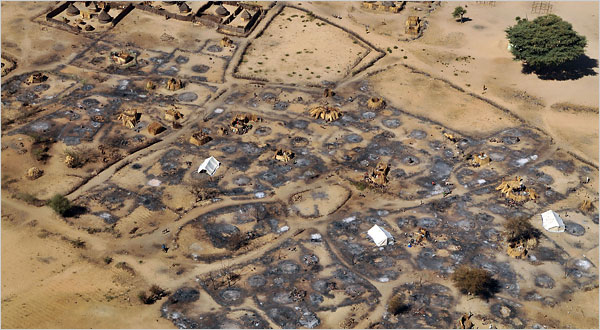
SULEIA, Sudan — The janjaweed are back.
They came to this dusty town in the Darfur region of Sudan on horses and camels on market day. Almost everybody was in the bustling square. At the first clatter of automatic gunfire, everyone ran.
The militiamen laid waste to the town — burning huts, pillaging shops, carrying off any loot they could find and shooting anyone who stood in their way, residents said. Asha Abdullah Abakar, wizened and twice widowed, described how she hid in a hut, praying it would not be set on fire.
“I have never been so afraid,” she said.
The attacks by the janjaweed, the fearsome Arab militias that came three weeks ago, accompanied by government bombers and followed by the Sudanese Army, were a return to the tactics that terrorized Darfur in the early, bloodiest stages of the conflict.
Such brutal, three-pronged attacks of this scale — involving close coordination of air power, army troops and Arab militias in areas where rebel troops have been — have rarely been seen in the past few years, when the violence became more episodic and fractured. But they resemble the kinds of campaigns that first captured the world’s attention and prompted the Bush administration to call the violence in Darfur genocide.
Aid workers, diplomats and analysts say the return of such attacks is an ominous sign that the fighting in Darfur, which has grown more complex and confusing as it has stretched on for five years, is entering a new and deadly phase — one in which the government is planning a scorched-earth campaign against the rebel groups fighting here as efforts to find a negotiated peace founder.
The government has carried out a series of coordinated attacks in recent weeks, using air power, ground forces and, according to witnesses and peacekeepers stationed in the area, the janjaweed, as their allied militias are known here. The offensives are aimed at retaking ground gained by a rebel group, the Justice and Equality Movement, which has been gathering strength and has close ties to the government of neighboring Chad.
Government officials say that their strikes have been carefully devised to hit the rebels, not civilians, and that Arab militias were not involved. They said they had been motivated to evict the rebels in part because the rebels were hijacking aid vehicles and preventing peacekeepers from patrolling the area, events that some aid workers and peacekeepers confirmed.
Please read the rest of the article HERE.
My husband and I have long supported an organization called Medecins Sans Frontiers / Doctors Without Borders. Wherever there is human misery, these brave doctors go and serve those suffering, and their life-saving work is performed under the worst possible conditions. They don’t look at politics. They look at human suffering, and do their best to alleviate it, or to do what they can. These heroic doctors are serving in Dharfur – while they can. When Medicins Sans Frontiers have to pull out, you know that the situation is as bad as it can be.
The accept donations from anyone, anywhere. Be generous.
Google Earth Adds New Layers
Google earth, according to OogleEarth has just added some new layers, one in particular of which highlights what is going on in Dharfur, and ties it to the United States Holocaust Memorial Museum, which tracks deaths, attacks, and refugees in the Dharfur region.
Many thanks to my source at GoogleEarth and greetings, Earthling! (I love saying that!)
Mediawatch: Covering the new Darfur default layer in Google Earth
Wednesday, April 11, 2007 (10:38 UTC)
Hundreds of media organizations carried news about the new Darfur layers in Google Earth — and that’s just in English. In Sweden alone, over 40 papers ran the news (an example). In the US, many local news organizations and papers ran the AP or Reuters story. Here’s a rundown of links to some of the larger and/or more interesting ones, with some observations at the end:
Using their own correspondents: The Los Angeles Times (business), BBC (front page feature), CNET (front page, and as a top headline for media 2.0), CNN (technology), Washington Times (business), PC World, ABC News (world news) and a good article/blog in Wired.
Reuters: Australia’s The Age (under technology), New Zealand Herald (world news), The Australian (world news) and Scientific American (science news).
AP: Seattle Post Intelligencer (business), MSNBC (technology), The Guardian (world news), Sydney Morning Herald (technology), the Houston Chronicle (markets), Seattle Times (world news), CBS News (technology), Baltimore Sun (world news), Washington Post (technology), San Jose Mercury News (breaking news), San Francisco Chronicle (business), Denver Post (world news), International Herald Tribune (Americas??) and the Sudan Tribune (which is a great resource for Darfur news, it turns out — pity they don’t have RSS).
AFP: Times of India (world news), iAfrica (technology) and Baku Today (technology).
IDG News service: IT World and InfoWorld.
What’s interesting is that there is no consensus among news editors as to where such a story belongs: Is the story’s most important news component the fact that there is a genocide being perpetrated in Darfur (world news), that new technologies are being employed to educate people about Darfur (technology), or that Google is involved (business)? In a sense, the situation in Darfur is not itself a “news” story, in that we all already (should) know what’s going on there. (If anything, the news is that it’s getting worse at the moment, and people I know who work there are doing so without much hope of a resolution anytime soon.) But putting the story in the technology section relegates it to a spot not followed by the people that the technology is most aiming to reach.
I think this is above all a story about how new technology is letting us all be witnesses to a genocide in progress, and how that raises our own responsibilities — so perhaps this is a story best also told in the glossy Sunday newspaper magazines, read when people have more time to play with Google Earth and where there is more room for long-form stories about larger technology trends coupled to humanitarian crises such as Darfur, but also Katrina/New Orleans and the Pakistan quake from 2005. How about it, New York Times?
My opinion: This has got to be one of the greatest blogs on earth. And he emphasis added in the above paragraph is mine.
Arabesk and Jon Courtenay Grimwood
I am blessed with friends and family who share books, and Pashazade came into my life courtesy of Little Diamond, my globe-trotting glamourous niece. She always leaves a trail of books as she wanders hither and yon. Some of them are just too deep for me, or need too much attention. This series, the Arabesk Trilogy by Jon Courtenay Grimwood almost fell in that category.
I missed a clue. I kept trying to start the first volume, Pashazade, but was having a problem keeping up with the plot and the technology. I would go back and read again, trying to figure out what I was missing. I know I’m living in Kuwait, but I read! I keep up with the news! When did all this new stuff happen?
And then I just happened to look at the cover of the book and it all became clear – it is a parallel world, it is science fiction, and once I started reading and accepting all the strange words and implants as literary license, the book became fun, and intriguing, and very very hard to put down. And then I had to wait while the second and third volumes (Effendi and Felaheen) because the series is that much fun.
The main character, Ashraf al-Mansur has a complicated past. The plot is complex enough, but Ashraf doesn’t know who he is, we don’t know who he is, and we have to take time out from the plot now and then to get another piece of the puzzle. Fortunately, the puzzle pieces are in all kinds of cool places – Alexandria (but a different Alexandria from current day Alexandria) and the Sudan) but a slightly different Sudan, with a prophetic edge to it) and Seattle and a mental institution, and Tunis and the desert oases . . . oh, this is a lot of fun.
So Ashraf starts out in Alexandria, with his Aunt Nafisa who lives in this marvelous old madresa in Al Iskandriya, but then his aunt is killed, Ashraf becomes guardian to an exceedingly bright and introverted young girl, and falls in love with a young woman with whom he refused an arranged marriage.
Ashraf has friends in high places, is believed to have relations in high places, and although he gets into the worst situations, he has WASTA and a lot of problems just disappear. (For my non-Kuwaiti readers, wasta is sort of like the-power-of-connection-and-who-you-know-and-maybe-who-owes-you-a-favor-or-might-be-open-to-a-little-encouragement). These connections get people killed in the Arabesk trilogy, threaten chaos and mutilation and disaster, and take you on a great ride. Oh! Did I mention this is also a mystery, romance and has political intrigue, too?
It’s modern day – or maybe a year or two in the future – and with a huge twist in the universe here and there, so that it seems familiar, but it isn’t. There are dark shadows and differences that can be critical. And it has a whole raft of “who’s your ally?” kind of situations. It is a richly textured romp, and you are along for the ride. Don’t fight it, just lean back and hang on.
It is pure escapism, no great deep thoughts here. When the trilogy ends, however, you remember the characters, you remember the plots, and you still grin about them months later.
Pashazade, the first volume, is available through Amazon in hardcover and paperback. Paperback starts under $5.00, through used vendors.
Effendi is available from $10.20, new paperback edition.
Felaheen is available new and used from $8.99

Dharfur: We can No Longer Pretend We Don’t Know
Today, in his blog, Ogle Earth, which discusses new developments with Google Earth, Stefan Geens says the following about the new hi-res maps of the Sudan made public today in Google Earth:
Those circles aren’t animal pens. They’re burned-down gottias, circular mud huts that had straw roofs, and they’re what’s left of Dalia, a village in Sudan’s Darfur region, one of hundreds of villages that have been destroyed by the Janjaweed in a program of depopulation that has killed perhaps 400,000 civilians since 2003.
Today, Google added recent high resolution imagery of Darfur to Google Earth, taken by DigitalGlobe in January-March 2006. It serves as an unequivocal indictment of the Janjaweed, and of the Sudanese government whose implicit support it has enjoyed, because in these new images each and every burned-out gottia is visible. This is the kind of evidence that puts paid to the claims still coming out of Khartoum that the ethnic cleansing is not widespead, and that accusations of genocide are a mere pretext to wrest sovereignty away from Sudan with the deployment of UN peacekeepers.
Read the blog entry for yourself here.
He goes on to say “we can no longer pretend we don’t know.”
He’s right. It’s there, in high resolution, for all to see.
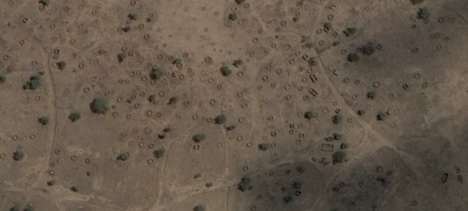
Props to the hard working young man at Google Earth who has been slaving to get all the detailed maps together. It’s a fine mission, ibn uckti, and we are all so proud of you and the hours you put in to make this possible.
Recent Comments
ExpatAlien on What Country am I Living … intlxpatr on Yellowstone: Old Faithful to C… Michelle on Yellowstone: Old Faithful to C… Cathy on No Grown-Ups in Charge intlxpatr on Waiting for Snow Wikipedia Donate Button

Amazina


Early Voting in Florida


 Here There and Everywhere