Manyang: Our Friend in South Sudan
God willing, in life, people cross paths and share their stories. I told you about Manyang, how he visited us near Christmas in 2012 and how his story changed our lives. Now, when we hear stories of the South Sudan, it is immediate, it is real, because we know the story of a young boy grown to be a very fine man, who survived the chaos and horrors of the janjaweed invasions and tribal conflicts before his country attained nationhood.
I recently wrote to Manyang, hoping he is still alive. It was that basic. I asked him, if he could, just to let us know he was alive, and that whether he could respond or not, our prayers were with him, for him, his family and his country.
This morning, by the grace of God, I received this wonderful response. Please, join your prayers with ours for Manyang/David, and his country, South Sudan, for peace, safety and prosperity, for justice and equitable distribution of resources.
I am glad to hear from you again. I have been talking of the nice people I was able to meet in Pensacola. Whenever, I talk about these people you are the first people I talk about. I still remember the nice dinner we had in your house.
I think God touched you to worry about my safety. You might have heard from news report the critical condition my country – South Sudan is going through. It is just like the story of my childhood to many other children now.
A political row in the ruling party here, turned violent in Juba, the capital of this country on December 15, 2013. Heavy artillary were fired and sporadic gunfire broke out in most part of the city. it was a genesis of another war which is now going on. Thousands of people were killed only in Juba.
I was in Bor, the captal of Jonglei State, about 125 miles north of Juba. The violent in Juba quickly spread to us in Bor and I was forced to flee to the bush with my family and the rest of the civil population as the town was quickly seized by anti-government forces. I carried my back on my head, walk long distant and drink dirty water again and eat grains when I was in the bush for seven days.
(This is a screenshot from Google Maps; Bor is the “A” north of Juba)

(These are photos from Manyang’s BBC blog, referenced below. Please go there to read more in his own words about the terrors of the South Sudan chaos.)

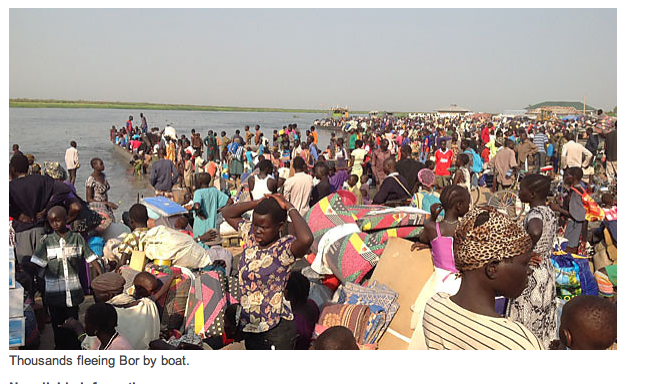
The government forces recaptured the town and we returned to the town. Many more people were killed and bodies were lying everywhere and there was a terrible smell. The rebels killed everyone they found in the town including old women, lame, deaf and all vulnerable people. And I was wounded in the upper left arm by a stray bullet of soldiers celebrating. The wound has healed and I am fine now.
It did not take long for the rebel to recaptured the town of goverment forces for a second time. And I was force to flee, this time cross the River Nile by boat to a makeshift camp across the river. This was where I got an access to go to Juba which was abit calm at the time. I am now in Juba staying in fear, not knowing where else to go.
God was speaking to you those conditions I was in in December and part of January. We spent Christmas and New Year Day on the run. I am glad for your prayers were able to lead me out of that mess. I still have hope that your prayers will continue to press political leaders to reach a peaceful solution to this crisis.
I have a live blog where I am sharing my bush experiences. You may have a look.
http://www.bbc.co.uk/blogs/bbcmediaaction/posts/Pens-down-in-South-Sudan
Share my message with the rest of the great people of Pensacola. My heart is always there with you.
Blessings
Manyang
Ghost of Christmas Past
I remember Thanksgiving. It was yesterday. The season has never gone so fast, with Thanksgiving being so close to Christmas. Taking care of my sweet little granddaughter in the afternoons was a wonderful, quiet interlude in an otherwise swirling-with-events December, complicated by AdventureMan and I both catching terrible colds and lacking energy during the middle part leading up to Christmas.
I wouldn’t pass up the babysitting part for anything. My little granddaughter is the sweetest little baby ever. If she fusses, she doesn’t fuss much, and it is easily covered by “change my diaper” or “feed me” or “I really need to sleep” or I’m bored, walk me around a little until I fall asleep” or “Now I really really need to go to sleep!” Every now and then she fools you with an “I’m too hot! Take some clothes off!” but that makes me laugh, because once you do she is so grateful she just gurgles and coos. She is also beautiful 🙂
We had a wonderful Christmas, colds gone, great houseguests, fun family times, including taking our grandson to his first Nutcracker. Just after Christmas we rushed off to a family wedding in south Florida – a horrid 13 hour drive down – so I grabbed a few Christmas photos before it all gets taken down:
Here’s what I love. We have so many decorations loaded with Christmas baggage – you know the kind. “Oh! We got those candlesticks the year we moved to Wiesbaden!” “Oh! Remember that palm tree from our CENTCOM years?” “Look! Our creche!” “Oh! Our Damascus ornaments!” It is wonderful, and it is time consuming, and with a short Christmas this year, and a lot going on, I did something I have never done before. I saw some ornaments in WalMart, I call them “bang-for-your-buck” ornaments, sparkling snowflakes and stars, 20 for $2.98.
I bought a lot. Maybe about $25 worth. A lot of twinkling little stars and snowflakes.
The tree was all silver balls and silver stars this year, with an ivory cross on top.

The stairwell was all silver snowflakes. It was magical. It was also quick and easy and inexpensive – I grinned every time I saw it.
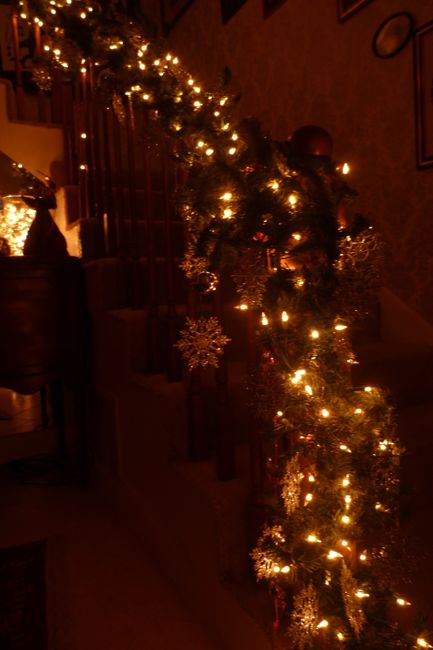
I did pull the Nurnburg angel out; I don’t think I can do Christmas without her and she provided a pop of red against all the greenery and silver and white.

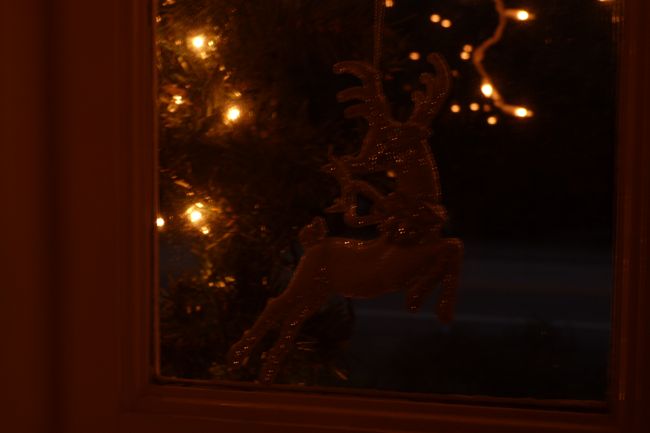
The little silver reindeer are easy; stored all together in a box that says “Early Christmas” right along with the suction cups that hold them up – if it takes me five minutes, it’s a slow year, LOL.
Zabbaleen Cave Church in Cairo
My friend Hayfa sends me the most amazing things. Her mind is another Here, There and Everywhere Kind of mind. 🙂
This article resonates with me because when we moved to Tunis, the garbage collectors would fight over our trash. I felt horrible, we had an infant, and there were diapers in the trash. 😦 Our maid would take cans and jars and especially jars with lids out of the trash, and ask if she could take them. We learned before throwing anything away to see if she wanted it first. They used, and re-used, everything. We learned to look at our consumption in a whole new way. It was one of the best things about living in an ‘alien’ community; we learned to see ourselves with different eyes.
Thank you, Hayfa, for this fascinating article.
The Cave Church of the Zabbaleen in Cairo
The Monastery of Saint Simon, also known as the Cave Church, is located in the Mokattam mountain in southeastern Cairo, Egypt, in an area that is known as ‘garbage city’ because of the large population of garbage collectors or Zabbaleen that live there. The Zabbaleen are descendants of farmers who started migrating from Upper Egypt to Cairo in the 1940s. Fleeing poor harvests and poverty they came to the city looking for work and set-up makeshift settlements around the city. Initially, they stuck to their tradition of raising pigs, goats, chickens and other animals, but eventually found collecting and sorting of waste produced by the city residents more profitable.
The Zabbaleen would sort through household garbage, salvaging and selling things of value, while the organic waste provided an excellent source of food for their animals. In fact, this arrangement worked so well, that successive waves of migrants came from Upper Egypt to live and work in the newly founded garbage villages of Cairo.
For years, the makeshift settlements of the Zabbaleen were moved around the city trying to avoid the municipal authorities. Finally, a large group of Zabbaleen settled under the cliffs of the Mokattam or Moquattam quarries at the eastern edge of the city, which has now grown from a population of 8,000 in the early 1980s, into the largest garbage collector community in Cairo, with approximately 30,000 Zabbaleen inhabitants. Egypt is a Muslim-majority country, but the Zabbaleen are Coptic Christians, at least, 90 percent of them are. Christian communities are rare to find in Egypt, so the Zabbaleen prefer to stay in Mokattam within their own religious community even though many of them could afford houses elsewhere.
The local Coptic Church in Mokattam Village was established in 1975. After the establishment of the church, the Zabbaleen felt more secure in their location and only then began to use more permanent building materials, such as stone and bricks, for their homes. Given their previous experience of eviction from Giza in 1970, the Zabbaleen had lived in temporary tin huts up till that point. In 1976, a large fire broke out in Manshiyat Nasir, which led to the beginning of the construction of the first church below the Mokattam mountain on a site of 1,000 square meters. Several more churches have been built into the caves found in Mokattam, of which the Monastery of St. Simon the Tanner is the largest with a seating capacity of 20,000. In fact, the Cave Church of St. Simon in Mokattam is the largest church in the Middle East.
 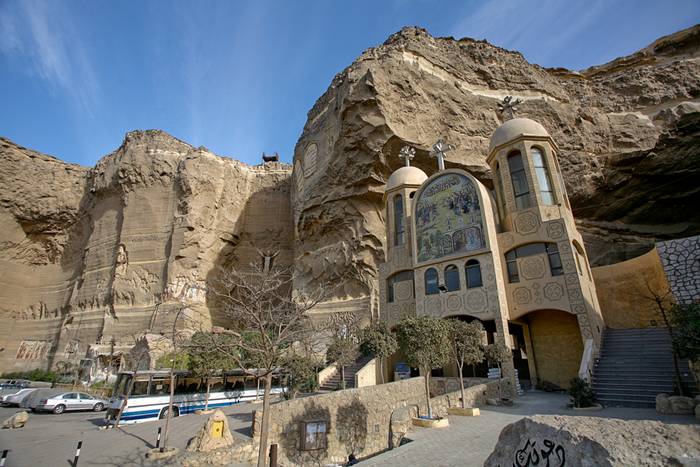 Photo — Link
 Photo — Link
 Photo — Link
 Photo — Link
 Photo — Link
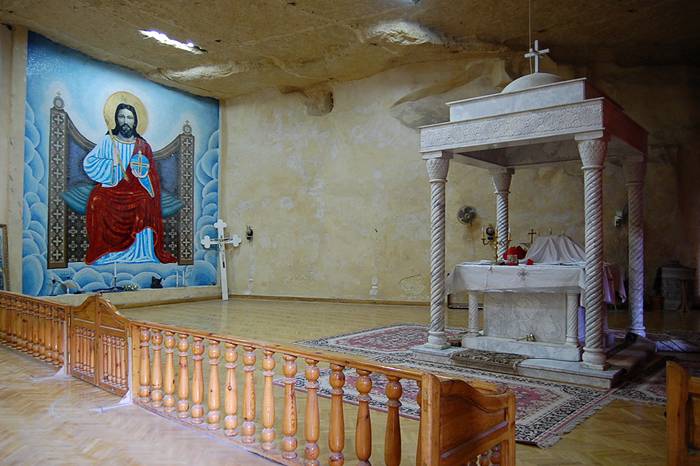 Photo — Link
 Photo — Link
 Photo — Link
 Photo — Link
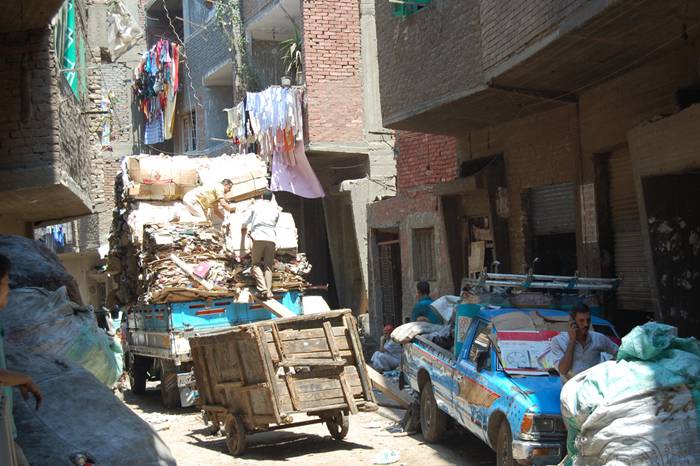 Photo — Link
|
Not The Day We Expected . . .
And once again, we have to laugh at God’s perfect timing.
I love Thursdays. Thursdays are the only day I have unscheduled. Once a month on a Thursday I have a meeting, but other than that, Thursdays are mine, and I luxuriate in them.
This morning I slept in an hour, then went leisurely through my Lectionary readings and scanned my e-mail. AdventureMan had other plans, but as we talked over our day, decided he wanted to come with me to the commissary. It’s fine with me. We have always had some of our best conversations in the car, and he doesn’t follow me around in the commissary asking questions like “do we really need this?” the kinds of questions that drive wives to homicidal thinking. There are some benches in the commissary, AdventureMan calls them the Old Farts benches, and he picks up his specialty bird seeds and supplies, then settles in to watch for me coming down the last lane.
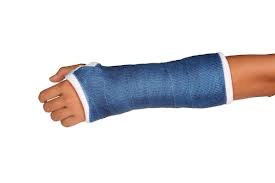
Four minutes after we left the house, we got a call from our son, tied up on a case, that little Q broke his arm on the playground, could we go pick him up? We were only about five minutes from his school and were there in a flash. AdventureMan/BaBa rode in the ambulance while I drove over to our son’s home to care for the baby while Q’s Mom zipped to meet them at the hospital emergency room.
It took all day. Between the transporting and the paperwork and the x-rays and the setting of the bones (yep, two bones broken), by the time we all met up again, I no longer had any interest in hitting the commissary. I will try again tomorrow, God willing.
Meanwhile, we marvel at how wonderful it is to be here in Pensacola, to be on call for emergencies like this, and that we were just minutes from his school when our son’s call came. We love it that we can be useful in these emergencies, that we are here to help and that we can be helpful. Once again, we thank God for his perfect timing.
Meanwhile, Mom called and gave me no sympathy whatever. She laughed! “Remember your sister broke both her arms before she was six, and you both broke legs skiing!” she chortled. Ouch! I guess little boy Q comes from a family of risk-takers. His dad broke exactly the same arm in the same place jumping to grab on to a high bar once. His son said “I thought I could fly. . . but I can’t.” It’s in the genes. :-}
My Travel Must-Have
I don’t like large handbags. I am small; a large bag is disproportionate. At the same time, I wanted a bag big enough to stick my computer in without looking like a briefcase. I wanted to be able to take my computer to Alaska with me.
I looked and looked, searching for the right bag. I looked in Pensacola, I looked online, I looked in Seattle. It had to be the right size, a nice heavy leather, a sturdy leather carry strap, and a neutral color as I was only taking one bag. Finally, at the very last minute I found this wonderful bag, and the computer fit beautifully, leaving room for my camera and wallet – what more do I need, right?

Then, me being me, the night before leaving for Alaska I decided I really did not need to carry a full sized computer, that the iPad had enough capacity and besides, it had books and Sudoku on it. But I still liked the purse; I stuck a nightshirt inside in case my luggage got lost, it has a side zip pocket for tickets, car rental brochures and car keys, and with everything inside, it was still roomy and not too heavy. It is wonderful boarding airplanes with just a purse!
By the end of the trip, I was in love. It is a great bag, goes everywhere, can be filled or used with little, it is versatile. I love this bag!
Recipe For Life
Thank you, Renee, for sending this lovely little reminder of how to lead a happy life:
Great Recipe (one of the best that you will ever read)
1. Take a 10-30 minute walk every day. And while you walk, smile. It is the ultimate antidepressant.
2. Sit in silence for at least 10 minutes each day.
Talk to God about what is going on in your life.
3. When you wake up in the morning complete the following
statement, ‘My purpose is to__________ today. I am thankful for______________’
4. Eat more foods that grow on trees and plants and eat less food that is manufactured in plants.
5. Drink green tea and plenty of water. Eat blueberries, wild
Alaskan salmon, broccoli, almonds & walnuts.
6. Try to make at least three people smile each day.
7. Don’t waste your precious energy on gossip, issues of the
past, negative thoughts or things you cannot control. Instead
invest your energy in the positive present moment.
8. Eat breakfast like a king, lunch like a prince and dinner like a college kid with a maxed out charge card.
9. Life isn’t fair, but it’s still good.
10. Life is too short to waste time hating anyone.
11. Don’t take yourself so seriously. No one else does.
12. You are not so important that you have to win every argument. Agree to disagree.
13. Make peace with your past so it won’t spoil the present.
14. Don’t compare your life to others. You have no idea what their journey is all about
.
15. No one is in charge of your happiness except you.
16. Frame every snowballed disaster with these words: ‘In five years, will this matter?’
17. Forgive everyone for everything.
18. What other people think of you is none of your business.
19. GOD heals everything – but you have to ask Him.
20. However good or bad a situation is, it will change.
21. Your job won’t take care of you when you are sick. Your
friends will. Stay in touch!!!
22. Envy is a waste of time. You have everything you need.
23. Each night before you go to bed, complete the following statements: I am thankful for__________.
Today I accomplished_________.
24. Remember that you are too blessed to be stressed.
25. When you are feeling down, start listing your many blessings. You’ll be smiling before you know it.
26. Send this to everyone you care about.
“);
Justin Cronin: The Twelve
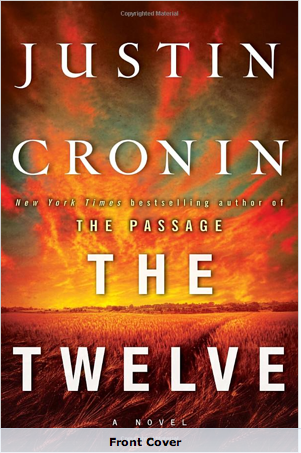
I had downloaded The Twelve to my iPad for a trip, but didn’t get to it, and sort of forgot it was there until my son mentioned he was listening to it on audio-books, and it was good, maybe even better than the first book in the trilogy, The Passage. He had loaned me The Passage several years ago when it came out, and as soon as I finished, I got on the list to download as soon as the next book came out – it was that good.
Cronin’s gift is an ability to create a future world entirely different from our own, with a devastating enemy – the virals – who, literally, are us, transformed. Cronin can make the enemy terrifying, destructive, truly horrifying – and can make them also captive to their repugnant nature and even pitiable. I think that is an amazing dance for an author to accomplish.
The setting is post-apocalyptic USA; the government had a sector working on a secret weapon which – of course – was not able to be contained, creating 12 super vampire-like creatures called Virals, who in turn create hordes of minions. This volume, The Twelve, is set more than 100 years later, but shifts back to earlier times to help us understand how this disaster occurred, and how characters relate back to the earliest times of the disaster. The populations live in fear of sudden attacks; one family, out on a picnic, are almost totally wiped out by an eclipse for which the Virals were prepared – and the families were not.
As I read his books, I find them very cinematic, but, as my son and I discussed, too complex for a movie; it would need a gritty HBO series like The Wire, or OZ, or Deadwood to capture the subtleties, the nuances that make this a best-selling series. The heroes and heroines are all make for the screen, their relationships – and inter-relationships – make them interesting, and then, as we learn more, interesting again. We never know enough to make a final judgement on any character; the characters are complex and the relationships obscure until the author chooses to reveal. It makes it fun to try to spot them before he tells us. I missed a couple!
Although it can be read as a great-adventure stand-alone, you’ll be happier if you read The Passage before you read The Twelve. If you have a problem with postponing gratification, you might want to wait until the third and conclusive volume of the trilogy is published – and that may be a year or so.
World War Z
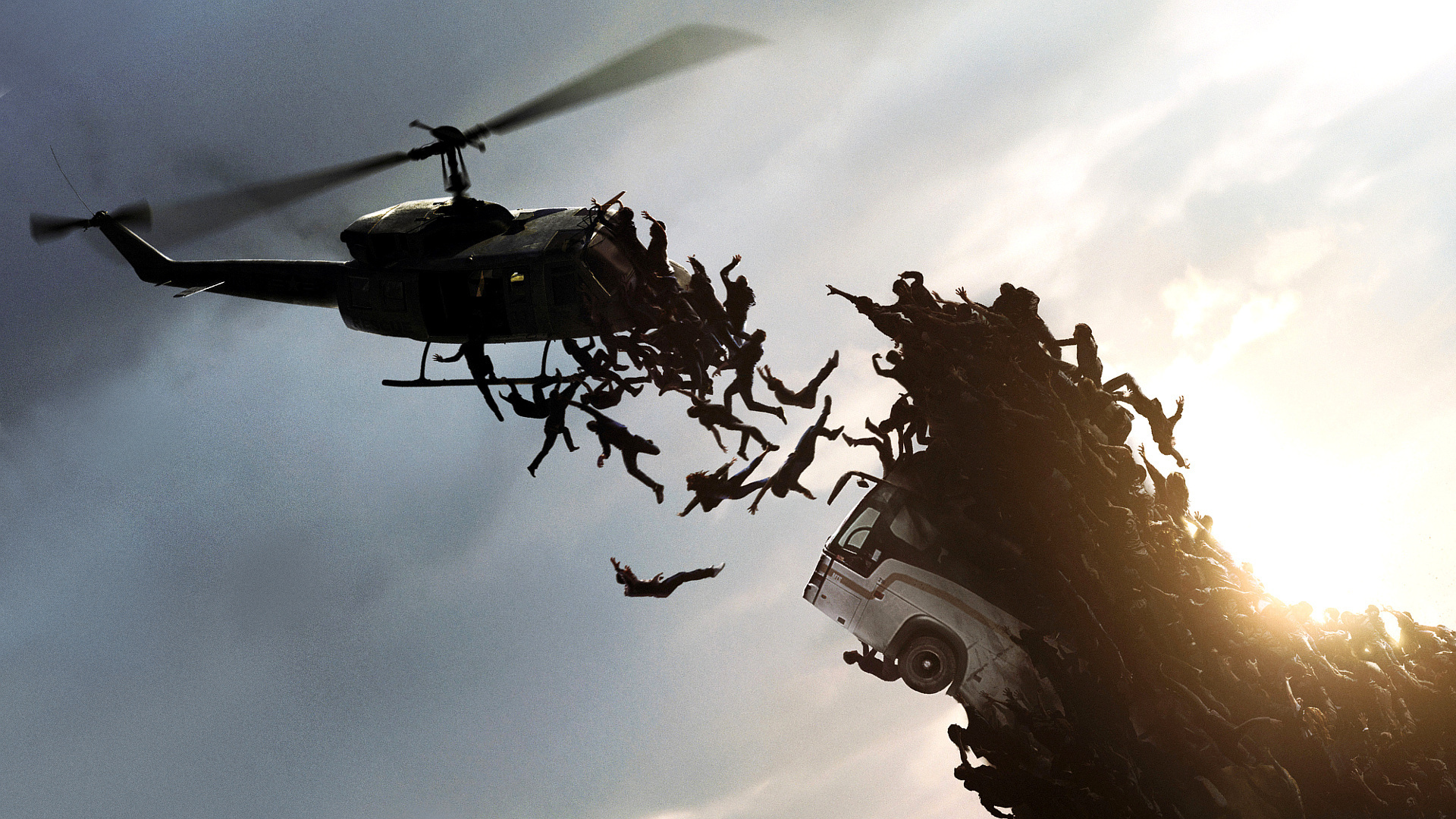
I talked AdventureMan into going to see World War Z with me – us and half of Pensacola showed up for the early matinee, and we got the last two seats. I had thought it’s been out for a while and people would be going to see something else, but all the theaters showing it in Pensacola are selling out every show. That doesn’t mean every seat was already filled – a lot of people had bought tickets online but weren’t there. On the other hand, while we got two good seats – they were – LOL – at opposite ends of the row!
World War Z is not a movie where you want to be sitting on opposite ends of the row.
World War Z is Contagion on steroids.
Did you ever see Romero’s 1968 Night of the Living Dead? I used to love scary movies, until I saw that movie. The scary movies were funny, not so scary at all – and George Romero changed all that with this low-budget horror classic. I think I liked it because it had a scientific kind of origin – a virus.
World War Z takes a similar approach, a scientific approach, and it is also very scary because it is hard, very hard, to be scientific and observant when your entire world becomes unsafe, when everything you known has turned to chaos. The zombies aren’t so damaged and tattered as Romero’s zombies, but they have the same herd mentality, a frenzied mob mentality, and an Alien-like skittering and swarming that makes my skin crawl.
I love seeing Brad Pitt as a responsible family man. He does it well. He has to make some very tough decisions in this movie, and you get to see that this sweet family man has another, tougher side.
AdventureMan was glad we went; he also thinks this will be a great computer game. We agreed it was scary because it had some things in it that truly can make life dangerous – you know, political leaders dying en masse, political and social systems dissolving and life becoming a brute struggle for survival with scarce resources . . . having swarming zombies kicks all that up a notch.
Not a movie for anyone under five. Maybe not even ten, if the kids are sensitive, or prone to bad dreams . . .
Our son said we need to read the book; it’s only sort-of like the movie, and has a lot of very edgy things to say about our current political system and leaders. Hmmmm. . . might have to do that.
Recent Comments
intlxpatr on Shampoo Ginger tigerbutterya0c5ff1d… on Shampoo Ginger intlxpatr on British Soldier Kidnapped, Esc… John on British Soldier Kidnapped, Esc… intlxpatr on British Soldier Kidnapped, Esc… Wikipedia Donate Button

Amazina


Early Voting in Florida


