I got an e-mail from Amber Johnson today, part of online college, and she asked if I would refer my readers to this article, 100 Ways You Should Be Using FaceBook in your Classroom. I always check these things out, and I was really impressed with the creative ways they have come up with making the classwork exciting, fresh and expedient.
(I love it when someone else writes my blog!) Because I use StatCounter, I know a lot of my readers come from schools and universities around the world, and I am happy to share a part of this article and to ask you to click on the blue type above to read the rest of it. It is full of great information.
100 Ways You Should Be Using Facebook in Your Classroom
October 20th, 2009
Facebook isn’t just a great way for you to find old friends or learn about what’s happening this weekend, it is also an incredible learning tool. Teachers can utilize Facebook for class projects, for enhancing communication, and for engaging students in a manner that might not be entirely possible in traditional classroom settings. Read on to learn how you can be using Facebook in your classroom, no matter if you are a professor, student, working online, or showing up in person for class.
Class Projects
The following ideas are just a starting point for class projects that can be used with Facebook in the classroom.
1. Follow news feeds. Have students follow news feeds relevant to the course material in order to keep current information flowing through the class.
2. Share book reviews. Students can post their book reviews for the instructor to grade and other students to read. If it’s a peer-reviewed project, then students can more easily access each other’s papers online.
3. Knighthood. Playing this game promotes strong reading skills. This teacher explains how he used it with his ESL class.
4. Poll your class. Use polls as an interactive teaching tool in class or just to help facilitate getting to know one another with the Poll app for Facebook.
5. Practice a foreign language. Students learning a foreign language can connect with native speakers through groups or fan opportunities such as this one.
6. Create your own news source. A great way for journalism students to practice their craft, use the Facebook status update feed as a breaking news source for sports results, academic competition results, and other campus news.
7. Follow news stories. Keep up with news through Facebook on groups like World News Webcast that provides video clips of world news.
8. Keep up with politicians. Political science students can become fans of politicians in order to learn about their platforms and hear what they have to say first hand.
9. Create apps for Facebook. A class at Stanford started doing this in 2007 and still has a Facebook group profiling their work. A class at Berkeley also did the same.
10. Participate in a challenge. Look for challenges like the one held by Microsoft and Direct Marketing Educational Foundation that challenges undergrads and grad students to create usable products for Microsoft in return for experience and, in some cases, certification.
11. Bring literature to life. Create a Facebook representation of a work of literature like this class did.
Facilitate Communication
An excellent way to ensure students are more engaged in the learning experience is by strengthening the communication between students and student-to-teacher. These are just a few ideas to do just that.
12. Create groups. You can create groups for entire classes or for study groups with smaller subsets of students that allow for easy sharing of information and communication, without students even having to friend each other.
13. Schedule events. From beginning of semester mixers to after-finals celebrations, easily schedule events for the entire class using Facebook.
14. Send messages. From unexpected absences to rescheduling exams, it’s easy to send messages through Facebook.
15. Share multimedia. With the ability to post videos, photos, and more, you can share multimedia content easily with the entire class.
16. Post class notes. Post notes after each class period for students to have access for review or in case they were absent.
17. Provide direct communication with instructors. Instructors and students can contact each other through Facebook, providing an opportunity for better sharing of information and promoting better working relationships.
18. Allows shy students a way to communicate. Shy students who may not want to approach their teacher after class or during office hours can use Facebook to communicate.
Read the rest of the article here, by clicking on the blue type.
October 22, 2009
Posted by intlxpatr |
Blogging, Community, Education, Interconnected, Technical Issue, Tools, Work Related Issues |
1 Comment
I love this story – using the internet is good for aging brains!
Internet Use Changes Older Brains
LiveScience
posted: 14 HOURS 46 MINUTES AGOcomments: 10filed under: SCIENCE NEWS
(Oct. 19) — Adults with little internet experience show changes in their brain activity after just one week online, a new study finds.
The results suggest Internet training can stimulate neural activation patterns and could potentially enhance brain function and cognition in older adults.
As the brain ages, a number of structural and functional changes occur, including atrophy, or decay, reductions in cell activity and increases in complex things like deposits of amyloid plaques and tau tangles, which can impact cognitive function.
UCLA/LiveScience
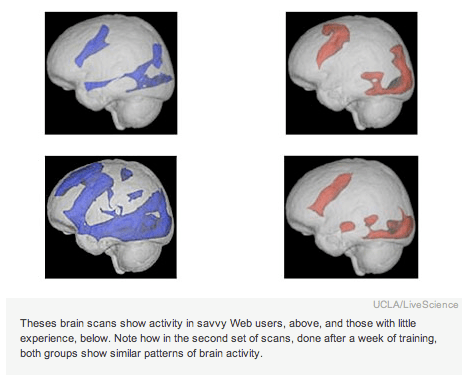
Research has shown that mental stimulation similar to the stimulation that occurs in individuals who frequently use the Internet may affect the efficiency of cognitive processing and alter the way the brain encodes new information.
“We found that for older people with minimal experience, performing Internet searches for even a relatively short period of time can change brain activity patterns and enhance function,” Dr. Gary Small, study author and professor of psychiatry at the Semel Institute for Neuroscience and Human Behavior at UCLA, said in a statement.
The UCLA team worked with 24 neurologically normal volunteers between the ages of 55 and 78. Prior to the study, half the participants used the Internet daily, while the other half had very little experience. Age, educational level and gender were similar between the two groups.
The participants performed Web searches while undergoing functional magnetic resonance imaging (fMRI) scans, which recorded the subtle brain-circuitry changes experienced during this activity. This type of scan tracks brain activity by measuring the level of blood flow in the brain during cognitive tasks. While the study involves a small number of people and more research on this topic is needed, small study sizes are typical of fMRI-based research.
After the initial brain scan, subjects went home and conducted Internet searches for one hour a day for a total of seven days over a two-week period. These practice searches involved using the web to answer questions about various topics by exploring different websites and reading information. Participants then received a second brain scan using the same Internet simulation task, but with different topics.
The first scan of participants with little Internet experience showed brain activity in the regions controlling language, reading, memory and visual abilities. The second brain scan of these participants, conducted after the home practice searches, demonstrated activation of these same regions, but there was also activity in the middle frontal gyrus and inferior frontal gyrus – areas of the brain known to be important in working memory and decision-making.
Thus, after Internet training at home, participants with minimal online experience displayed brain activation patterns very similar to those seen in the group of savvy Internet users.
“The results suggest that searching online may be a simple form of brain exercise that might be employed to enhance cognition in older adults,” Teena D. Moody, the study’s first author and UCLA researcher, said in a statement.
You can read the rest of this article from Live Science on AOL News by clicking here.
October 20, 2009
Posted by intlxpatr |
Aging, Health Issues, Living Conditions, News, Social Issues, Technical Issue |
Leave a comment
Today, on my way home from a marathon-fun day, even though it was full of errands, I got to thinking great thoughts – in my car. Some of my best ideas come when I am sitting in traffic, something about the enforced nothing-to-do frees up my unconscious to tackle things I don’t otherwise think about.
One of the things I was thinking about was what, when I studied it, was called The Decision Making Process. It’s something you study in Political Science, and, although I can’t say this for sure because I haven’t specialized in these other areas, I am betting you would also study the process in Business, in Economics, in Engineering . . . when you know the process by which decisions are made, so the theory goes, you can get better at predicting how the decision making will go, what people will decide.
Or so the theory goes. . .
My personal observation is that human beings are highly unpredictable, and sometimes will make an opposite decision, even an irrational decision, in order not to be so predictable. I hate to be so cynical, but I think we are not so rational as we like to think we are.
In my Kuwait life, I remember being at a not-so-important meeting, more just a gathering, but at one point, I saw four people – influential people – meeting off in a corner, very casually, probably no one else even noticed, but they were deciding an outcome of an election, I realized later that day. OOps – not THE Kuwait election, my friends, no no no, a much lesser election. But that was where the decision was really made. These four quiet people were people who had the respect of others, and once they decided, they quietly shared their opinion with others, who shared their opinion with others and on it went, until the deed was done.

I have seen decisions made in a swimming pool. I know decisions are made on golf courses. I was hired for one job once after attending a concert, and for another because I had a responsible position in my church (it had nothing to do with the job I was hired for, but the skills were transferable.) I was hired once because my hair and eyes matched another woman working in the front office, and the boss wanted a “matched pair.” (I didn’t know that until later.)
I know that at one time AdventureMan helped lay out a military base. He said they were in a truck, and as they drove along someone dropped big stones out the back to mark the boundaries. Don’t you love it?
Gulf women tell me that weddings are important; young women are often spotted by future mother-in-laws, so moms try to make sure that their daughters are well appointed for major weddings, major events where they may be on display . . . and then they ask around checking on character and personality and suitability. But I wonder on what basis those decisions are really made, deep down? Family alliances? Securing a future? Business connections? I know there are rare alliances based on true and lasting love; I wonder how often that happens?
I know there are matrixes, and even simple two-column + – lists by which people can rationally work out what to decide. What I am cynical about – after all the matrixes are filled out, after all the plusses and minuses are totaled – I think that the decision can go counter to rationality, because we are – if not irrational – then intuitive, we are people who make decisions with other than our conscious minds. I think our hearts get involved, and you KNOW that feelings/emotions get involved. Sometimes we have “a gut feeling”; sometimes we know something on an unconscious level that we don’t know on a conscious level. If we all acted in our own rational self interest, there would not be young drivers dying on our roads, people would not be irrationally exuberant about investments, young people would not fall in love with the wrong people and life would sure a lot more dull, wouldn’t it?

I am cynical even about decisions made at the highest levels, because even decisions made by boards and after studies – even these decisions are ultimately based by human beings, and sometimes on “hunches.”
So I am wondering if YOU have had similar experiences? Have you seen major decisions made irrationally?
All this because I was stuck in traffic . . . .
October 20, 2009
Posted by intlxpatr |
Character, Community, Cultural, ExPat Life, Financial Issues, Friends & Friendship, Kuwait, Leadership, Living Conditions, Marketing, Mating Behavior, Technical Issue, Work Related Issues |
4 Comments
I love my family. There is Earthling, and his darling wife, who keep me up to date on trends and the newest coolest things in GoogleEarth, there is Sporty Diamond and her family who are my go-to people for the newest in child raising and urban trends, Law and Order Man and EnviroGirl, who keep us up to date on media – books, music and television they think we need to know about, as well as keeping the smallest possible footprint as we exercise our stewardship of the planet Earth, and then adorable Little Diamond, who speaks fluent Arabic in about 20 dialects, who lives comfortably in Damascus, or Beirut, or Rabat, and who sends me these articles, this one from the Oxford Business Group, that tell me more about the countries I live in.
Thank you, little Diamond, especially since public transportation is one of my pet projects. 🙂
Kuwait: Working on the Railway
8 October 2009
Kuwait was one of the first countries in the region to float the idea of a metropolitan rapid transit network, and attention is once again returning to public transport projects in the country.
While there has long been talk of developing a rapid transit system in Kuwait, the proposal has been taken further by the private Kuwait Overland Transport Union through a detailed feasibility study completed last year that included setting out routes and estimating the cost of the project.
The plan called for a four-line metro grid to be built, with some two-thirds of the network to be elevated and the remainder below ground. According to government projections, when the 165-km network is fully operational, it will carry 69m passengers a year.
However, the scheme was soon sidetracked, even though there had been an announcement that tenders would be called for the project before the end of 2008. In January, the government said it would conduct a comprehensive study of Kuwait’s land transport needs, with the metro project to be incorporated into a wider national transport strategy.
Enthusiasm for the rail network may have got a timely boost from the opening of the initial stage of Dubai’s metro network on September 9, the much-touted answer to the emirate’s traffic congestion and pollution problems.
In its first two weeks of operations, more than 1m passengers rode the Dubai metro. Although it will be some time before a full assessment of the Dubai metro can be made,. the launch and apparent popularity of the line could encourage Kuwait to push ahead with its own project.
Supporters of the Kuwaiti scheme say the transit system will reduce pollution and traffic congestion in Kuwait City, encourage more decentralised residential development, and promote economic growth in outlying areas that will be opened up by quick rail access.
Though all this will likely be true, as is the case with most such major public transport schemes, there are almost as many cons as there are pros. In particular, the cost of constructing and operating the metro could weigh against the project.
While the development should ease Kuwait’s traffic congestion and could prove popular with commuters, it is unlikely to turn a profit. In its current form, the metro grid is expected to cost around $7bn. While this may change following the broad review of the country’s transport needs and the type of rail system needed – underground, raised or ground level – the outlay will be high.
Added to this is the fact that there is little chance this initial outlay will be recovered though earnings once the network is up and running. Even with the projected 69m passengers a year, in order to make a return on investments and then turn a profit, ticket prices will have to be high, defeating the objective of a low-cost transport system.
Most of the proposals put forward for the metro scheme involve a mix of public and private capital to fund the project. One version of the partnership arrangement put forward by the Ministry of Communications would see the state providing 24% of the project funding, contractors putting in 26% and the remaining 50% coming via an initial public offering (IPO).
Another suggested funding breakdown has the state contributing 50% of the capital required and the other half coming from the private sector, with several companies to be set up to undertake different parts of the projects, each being subject to an IPO.
Though these formulas would restrict the state’s exposure to the project and serve to encourage greater private participation in the economy, the question remains as to whether either the lead contractor or other investors would commit to a scheme that is a potential loss-maker.
However, at least some of the running costs of the metro could be offset by the lower use of subsidised petrol by commuters. With Kuwait having some of the cheapest fuel in the world, there is less inducement for locals to find an alternative to the automobile to get around. Raising the price of petrol at the pump could induce some motorists to abandon their cars and adopt the metro as their transport of choice, with the higher cost of fuel and more revenue from ticket sales combining to reduce any potential losses.
While the slow pace of the metro project may be frustrating for some, there could be advantages to adopting a methodical approach. By not being the first train out of the station, Kuwait’s planners will be able to learn from the experiences of Dubai and other cities, taking the best and avoiding the worst in the planning and construction process and also developing a sound funding model acceptable to all.
By all accounts, it is not a case of if but when for Kuwait’s urban rail transit network. The extended planning and development process may well result in a project that can combine versatility and popularity with profitability, a rare combination in public transport.
October 9, 2009
Posted by intlxpatr |
Bureaucracy, Community, ExPat Life, Interconnected, Kuwait, Living Conditions, News, Technical Issue, Travel, Work Related Issues | public transportation |
9 Comments
On my Christmas wish list, LLOOOLLLL!

From BBC News
One of the largest, high quality diamonds discovered to date has been found at a mine in South Africa, mining group Petra Diamonds has revealed.
The 507 carat stone, which could be worth in excess of $20m (£12.5m), was found with three other large diamonds.
They were discovered at the famous Cullinan mine, where the largest diamond in history was found more than 100 years ago.
The new find is being analysed by experts to determine its true value.
A 480 carat diamond found at the end of last year fetched $18m.
“The Cullinan mine has again given the world a spectacularly beautiful and important diamond,” said Petra’s chief executive Johan Dippenaar.
“Initial indications are that it is of exceptional colour and clarity, which suggest extraordinary potential for its polished yield.”
Petra said the stone is one of the 20 biggest, high quality diamonds to have been found.
A 168 carat stone was also discovered, alongside one of 58 carats and another of 53 carats.
The largest diamond to be discovered, named the Cullinan, was 3,106 carats. It was cut into nine separate stones, many of which are in the British Crown Jewels.
September 30, 2009
Posted by intlxpatr |
Adventure, Africa, Arts & Handicrafts, Beauty, Christmas, Shopping, Technical Issue |
4 Comments
I found this story in Time Magazine where you can read the rest of the story by clicking on the blue type. Wikipedia has been a great source of information for me, and I am fascinated to know Wikipedia’s growth is slowing – and why . .
Is Wikipedia a Victim of Its Own Success?
By FARHAD MANJOO
Looking back, it was naive to expect Wikipedia’s joyride to last forever. Since its inception in 2001, the user-written online encyclopedia has expanded just as everything else online has: exponentially. Up until about two years ago, Wikipedians were adding, on average, some 2,200 new articles to the project every day. The English version hit the 2 million — article mark in September 2007 and then the 3 million mark in August 2009 — surpassing the 600-year-old Chinese Yongle Encyclopedia as the largest collection of general knowledge ever compiled (well, at least according to Wikipedia’s entry on itself).
But early in 2007, something strange happened: Wikipedia’s growth line flattened. People suddenly became reluctant to create new articles or fix errors or add their kernels of wisdom to existing pages. “When we first noticed it, we thought it was a blip,” says Ed Chi, a computer scientist at California’s Palo Alto Research Center whose lab has studied Wikipedia extensively. But Wikipedia peaked in March 2007 at about 820,000 contributors; the site hasn’t seen as many editors since. “By the middle of 2009, we realized that this was a real phenomenon,” says Chi. “It’s no longer growing exponentially. Something very different is happening now.”
What stunted Wikipedia’s growth? And what does the slump tell us about the long-term viability of such strange and invaluable online experiments? Perhaps that the Web has limits after all, particularly when it comes to the phenomenon known as crowdsourcing. Wikipedians — the volunteers who run the site, especially the approximately 1,000 editors who wield the most power over what you see — have been in a self-reflective mood. Not only is Wikipedia slowing, but also new stats suggest that hard-core participants are a pretty homogeneous set — the opposite of the ecumenical wiki ideal. Women, for instance, make up only 13% of contributors. The project’s annual conference in Buenos Aires this summer bustled with discussions about the numbers and how the movement can attract a wider class of participants.
At the same time, volunteers have been trying to improve Wikipedia’s trustworthiness, which has been sullied by a few defamatory hoaxes — most notably, one involving the journalist John Seigenthaler, whose Wikipedia entry falsely stated that he’d been a suspect in the John F. Kennedy and Robert F. Kennedy assassinations. They recently instituted a major change, imposing a layer of editorial control on entries about living people. In the past, only articles on high-profile subjects like Barack Obama were protected from anonymous revisions. Under the new plan, people can freely alter Wikipedia articles on, say, their local officials or company head — but those changes will become live only once they’ve been vetted by a Wikipedia administrator. “Few articles on Wikipedia are more important than those that are about people who are actually walking the earth,” says Jay Walsh, a spokesman for the Wikimedia Foundation, the nonprofit that oversees the encyclopedia. “What we want to do is find ways to be more fair, accurate, and to do better — to be nicer — to those people.”
Yet that gets to Wikipedia’s central dilemma. Chi’s research suggests that the encyclopedia thrives on chaos — that the more freewheeling it is, the better it can attract committed volunteers who keep adding to its corpus. But over the years, as Wikipedia has added layers of control to bolster accuracy and fairness, it has developed a kind of bureaucracy. “It may be that the bureaucracy is inevitable when a project like this becomes sufficiently important,” Chi says. But who wants to participate in a project lousy with bureaucrats?
There is a benign explanation for Wikipedia’s slackening pace: the site has simply hit the natural limit of knowledge expansion. In its early days, it was easy to add stuff. But once others had entered historical sketches of every American city, taxonomies of all the world’s species, bios of every character on The Sopranos and essentially everything else — well, what more could they expect you to add? So the only stuff left is esoteric, and it attracts fewer participants because the only editing jobs left are “janitorial” — making sure that articles are well formatted and readable.
Read the rest of the article Here
September 25, 2009
Posted by intlxpatr |
Experiment, Interconnected, News, Technical Issue |
2 Comments
10 Cities Facing The Next Real Estate Bust
Rick Newman, U.S. News & World Report
From AOL News: Real Estate
The worst of the housing bust might finally be over, but another real estate tsunami is about to swamp many American cities. This time, it will be office buildings and retail space going vacant and facing foreclosure.
Like housing, commercial real estate goes through booms and busts, and the coming wipeout is likely to be a doozy. Commercial developers went on their own spending spree earlier this decade, racing to cash in on the hot economy with new office towers, hotel complexes, and retail projects. Banks supplied hundreds of billions of dollars in loans, often assuming that rents paid by tenants would keep going up. “The assumption was that the good times would go on forever,” says Victor Calanog, director of research for REIS, a real-estate-research firm.
If that mistaken assumption sounds familiar, so will the ramifications. Instead of going up, commercial rents have begun to plunge as companies downsize, warehouses empty, merchants go out of business, and huge retailers like Starbucks and Macy’s close underperforming stores and demand rent reductions. Office and retail vacancy rates are near record levels and going higher, and developers are about to face crunch time as billions in loans come due for repayment or refinancing over the next three years. Like homeowners who are “under water” on their mortgages, many of those developers owe more than their buildings are now worth.
The commercial crunch won’t hit consumers as directly as the housing bust, but they’ll still feel it. A resurgence in construction spending is often the springboard out of a recession, but in dozens of overbuilt areas, it won’t be. Many shopping centers could close completely. Urban development projects have been put on hold or canceled, giving blight a reprieve instead of chasing it out of town. As many as 3,000 banks may face significant losses on commercial real estate loans, according to economist Gary Shilling, which could crimp other lending and even threaten the banks’ solvency as losses start to pile up.
To determine which cities are most vulnerable, U.S. News analyzed data from REIS covering retail and office vacancy rates in the 79 biggest metro areas. At our request, REIS combined its retail and office data into a single commercial vacancy rate for each city, for several time periods. The research firm also provided its 2010 projections for each city.
To gauge the impact on each city over the coming year, we measured the difference between the commercial vacancy rate in 2008 and the projected rate in 2010. So the cities that landed on our list won’t necessarily have the highest vacancy rates next year, but they’ll experience the biggest increase over a two-year period. In most of these cities, commercial real estate woes are likely to hamper a recovery. In a few, they’ll compound a set of problems that’s already profound. Here’s where the next real estate bust is likely to hit hardest:
In Las Vegas (above), the real estate market could go from bad to worse, while Charleston (below) has been relatively stable until recently.
Las Vegas (projected commercial vacancy rate, 2010: 18.1 percent, up 6.8 percentage points from 2008). What happens in Vegas depends on the rest of the American economy, and until Americans start to feel wealthy again, travel (and gambling) budgets will remain crimped. Southern Nevada already suffers from one of the worst housing busts in the nation and a 12.3 percent unemployment rate. Vegas had a hot hand earlier this decade, which led to lots of commercial construction. But nearly one fifth of Sin City’s commercial space will stay vacant until tourists, conventioneers, and their cash start to return.
Baltimore (15.8 percent, up 6.5 points). Several large universities and proximity to recession-resistant Washington, D.C., have propped up Baltimore’s economy, but the city is still exposed to many economic strains. With the nation’s retail sector in a tailspin, shipments in and out of the Port of Baltimore have tanked, leaving acres of vacant warehouses. Other development programs have stalled as businesses have cut back on spending. Mayor Sheila Dixon has also been indicted for suspicious dealings with area developers, casting a pall over Baltimore’s business climate.
Detroit (24.8 percent, up 6.3 points). What else could go wrong in Motor City? Two of the area’s biggest employers, General Motors and Chrysler, declared bankruptcy this year, and the whole auto industry is undergoing severe cutbacks amid the biggest sales plunge in decades. So many companies have left Detroit that there’s barely a rush hour in this once bustling metropolis. If there’s any good news, it’s that prime office space is cheap: Rents have fallen eight years in a row and are likely to drop an additional 13 percent through 2010, according to REIS.
San Bernardino/Riverside, Calif. (15.9 percent, up 6.3 points). The availability of land once made Southern California’s “inland empire” a housing hotbed, with hundreds of mortgage brokers and a booming retail sector. No more. A vicious housing bust could ultimately drive home prices down 65 percent from peak values, and the unemployment rate could hit 16 percent next year. That’s knocked many of the mortgage brokers out of business and devastated the area’s ubiquitous strip malls. Even government jobs have been disappearing, thanks to California’s budget crisis.
Hartford, Conn. (20.2 percent, up 6 points). A recent survey identified Hartford as one of the first cities to bounce back from the recession, but local economists are doubtful. Many of the city’s insurance firms have slashed jobs in response to the financial meltdown. Aircraft-engine maker Pratt & Whitney may close two local plants, and the Obama administration’s push to end production of the F-22 fighter jet would hurt defense contractors in the area. With little new construction over the past year, most of the increase in vacancies is coming from businesses scaling back or shuttering their operations completely.
Dayton, Ohio (22.8 percent, up 5.9 points). After 125 years in Dayton, NCR is closing up its headquarters and moving to Georgia, taking 1,300 jobs with it and leaving more than a million square feet of office space behind. The collapse of the auto industry has also hurt the area, with several local parts suppliers dependent upon the Detroit automakers. In a survey of the 100 biggest cities, the Brookings Institution ranks Dayton near the bottom in terms of lost jobs and economic output.
New York (12 percent, up 5.9 points). Those lavish Wall Street bonuses you’ve been hearing about are going to a lot fewer bankers. The financial industry, Manhattan’s mainstay, has contracted by about 7 percent over the past year. Other industries have lost even more jobs, causing a sharp reversal in what used to be one of the world’s hottest real estate markets. Office rents skyrocketed in 2006 and 2007, when Wall Street was at its peak, but REIS expects them to fall 28 percent between 2008 and 2010. REIS’s vacancy data for New York include only office space, so the combined vacancy rate including retail space is probably higher than 12 percent.
Charleston, S.C. (16.6 percent, up 5.8 points). The antebellum charm has worn thin as this low-country mecca hopes for tourists to return and trade at its port to pick up. Several ambitious downtown hotel and redevelopment projects have stalled while developers wait for the economy to revive. Elsewhere in the state, manufacturing, retail, and construction companies have shed thousands of jobs, many of them gone for good. When not addressing his extramarital affair, Gov. Mark Sanford attempts to woo new businesses to the state.
Tacoma, Wash. (13.6 percent, up 5.8 points). Shipments are down at the city’s port, one of the nation’s biggest, which has left warehouses vacant and hammered the many area businesses that depend on trade. And many of the region’s most prominent companies, including Microsoft, Boeing, Starbucks, and Washington Mutual — taken over last year by JPMorgan Chase — have been laying off workers, helping push Tacoma’s unemployment rate higher than the state average.
New Haven, Conn. (17.2 percent, up 5.8 points). Education and healthcare have helped stabilize New Haven’s economy, but even Yale University has scaled back development plans and laid off workers, after its famed endowment dropped by $6 billion because of market losses. And a long-term shift away from manufacturing toward financial services and other white-collar industries has left the city exposed to the financial meltdown. That means New Haven’s recovery will probably lag the nation’s.
August 29, 2009
Posted by intlxpatr |
Financial Issues, Interconnected, Living Conditions, Marketing, Technical Issue, Work Related Issues |
7 Comments
Holy Cow! I thought there was a dispensation during Ramadan for those who are travelling, pregnant, sick, etc. But no, Qaradawi says even people living in high rises can not break the fast at the same time as those on the ground, and those in the air must watch for the sun to actually go down!
Sunset, not clock, decides Iftar time, says Qaradawi
Web posted at: 8/25/2009 4:19:40
Source ::: THE PENINSULA
DOHA: Islamic scholar Dr Yousuf Al Qaradawi has urged people while travelling to follow the sun’s position for breaking the fast. Most air travellers currently break their fast as per the timings on the ground.
“The people on flights should break the fast according to sunset, not according to the ground timings,” an Arabic daily reported Qaradawi as saying.
Qaradawi was shocked when a pilot on a Qatar Airways flight from Cairo to Doha announced Iftar time when the sun had still not set. The reason given was that it was prayer time on
the ground.
Qaradawi told his co-passengers that the time for Iftar was yet to come and asked them whether they could offer Maghreb prayers at that time. Most of the people on board agreed with him. The first class passengers did not break their fast but many in the economy class had had their Iftar. When he told them they need to compensate for the day’s fast, some started to cry.
“The mistake is not of the people, it was because the airline had announced it. People should not blindly follow any direction while fasting, they should ensure the right time has come,” he said.
He said that even people living in elevated areas, including highrises, should not follow what people on the ground do.
August 25, 2009
Posted by intlxpatr |
News, Ramadan, Spiritual, Technical Issue |
10 Comments
You can visit this very cool site, Islamic Crescents’ Observation Post, “to know the crescent visibility of the current month, the locations from which you can see the crescent, where the crescent was actually seen, the official month start in different Islamic countries and much more….”
August 19, 2009
Posted by intlxpatr |
Ramadan, Spiritual, Statistics, Technical Issue |
2 Comments
When I took the photo of this, I thought it was a lot funnier than it is. When I took the photo, I thought it said “Civil Defiance” and thought it was a great entry for the Fail Blog. Once I uploaded the photo and saw that it was just a mis-spelling, it was much less interesting.

August 15, 2009
Posted by intlxpatr |
Bureaucracy, Doha, ExPat Life, Humor, Technical Issue |
4 Comments


 Here There and Everywhere