Old Cars
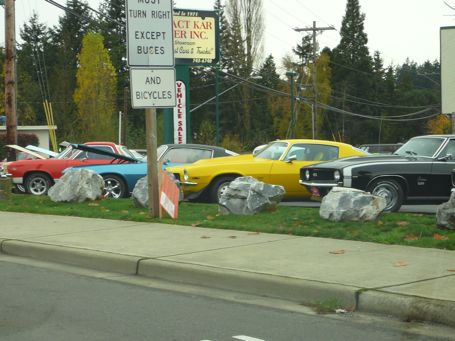
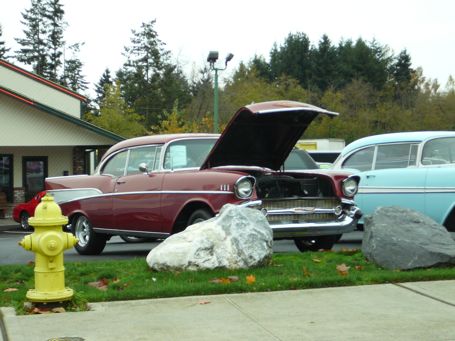
Several years ago, some friends were visiting Seattle and returned, saying “I have never seen so many OLD cars anywhere else.”
(They had never been to Turkey, where they have an art of keeping old cars running.)
I had never really noticed, but there truly are a lot of older cars in this area, and I don’t know why. Maybe one reason is that Seattle had a few leaded gas pumps longer than other states, and most of these old cars ran on leaded gas. You still see them – a lot of them – still on the roads.
Big Statistics Change
Two months ago, one of my regular readers Elementary Teacher who has a fascinating blog about teaching elementary school in a Middle Eastern country, wrote to me and told me that when I set up my blog page, I forgot to add back in the widget for Meta, which contained the RSS feed.
The truth is, I still don’t know entirely what that means, but I did as she suggested, and added the Meta back in.
And watched as my visitors nearly doubled overnight.
Who knew?
There is so much I am still learning, and I thank all of you who write to be, back channels, and give me hints. Thank you, especially, Elementary Teacher for your kindness in sharing such good information. I really enjoy reading your blog!
Cretan Olive Oil
This response is to a post I wrote October 25th on The Olive Oil scandal, that even when you buy a brand you have thought is reliable, you may not be getting what you paid for. For me, it was particularly horrifying to discover they were adulterating the olive oil with hazlenut oil – I don’t have a severe allergy to hazlenuts, but they make the insides of my ears itch. I avoid hazlenuts!
I keep getting such good responses to the post – and I have a partiality (disclaimer!) to small producers of anything, from olive oil to soap to pecans . . . I love buying from the entrepreneur.
Which is why I have taken this response from the comments page and made it an entry. Thank you, Mr. Sassone, for your thoughtful addition to this subject:
It is indeed a shame that the majority of the olive oil on the American and world market has been adulterated by unscrupulous sellers looking for enormous profits.
That is why I started growing olives on the island of Crete, making extra virgin olive oil-EVOO, and importing it to the US. I personally observe all steps in the process from the time the olive flowers bud on the tree until the EVOO goes in the can. I know it is the cleanest, freshest, highest quality, and most healthful EVOO you can buy at any price.
I also offer all customers copies of test reports from independent laboratories that show the exact quality. Acidity is 0.17%. Total polyphenols are 165ppm. Peroxide value is 6. Nothing can compare at any price.
When people buy EVOOs that are labeled as a mix of oil from several countries, they must take this into account: How clean was process to gather the olives? How clean was the factory that processed the oil? How clean were the trucks that transported the oil to the ship? How clean was the ship that transported the oil? You can see where this is going. At any one or more of dozens of steps in the process, contamination can occur. Some of the olive producing countries do not have food the safety standards like the European Union or US Food and Drug Administration.
My curiosity got the best of me. Recently, I sent samples of 13 EVOOs sold in the US for lab testing to find out just how good or bad they are. I dont have a web site just yet, but will publish the results as a comparison to my oil. So long as I keep complete control of the entire process, I can improve the quality of my oil each year.
My EVOO is now available in the US. It is the finest quality and most healthful EVOO you can buy at any price. Send me and email if interested. kretareserve@cox.net Thanks. Tony
Time for a new Mac
Last night, as I checked this blog, all of a sudden everything froze. Now and then that might happen. I turned it off, and rebooted. Nothing.
You know that feeling of sheer panic when you think you might be cut off?
I let it rest – sometimes when you walk away, it fixes itself. And sure enough it came back on, and I could log on and even picked up some e-mail. Maybe four minutes in, it froze again.
I bought this Mac in April of 2004 – I know, because I was back in the US for Sporty Diamond’s wedding, and I uploaded my first photos into iPhoto. I was IN LOVE. iPhoto lets me manage all my photos so easily, lets me organize, helps me in so many ways.
I have never had a moment’s problem with this computer. I’ve upgraded the operating system a couple times, tweaked things here and there, and never had a problem.
When the new Macs came out recently with the new operating system, I was feeling envious, but honestly, my current Mac is running so well . . .
Now, however, Adventure Man says “hey, this sounds like a great time for a new computer!”
He he he he he – I think so, too!
I hate to leave my current Mac behind – he has worked so hard, we’ve been partners, we’ve had so much fun together! Seems like he’s had enough, though, and it’s time to move on.
Wind Up Lights for African Homes
My husband gave me a wind-up flashlight (British English = torch) and I love it. In movies like The Blair Witch Project or crime movies, the flickering and dying of a flashlight always foretells something really really bad is about to hapen. I love it that I have a flashlight I can keep winding up.
In our national legends, we have Abraham Lincoln doing his schoolwork on the back of a shovel, next to a flickering fire. That must have taken real dedication. Imagine what your own life would be like if we had no light after sundown. . .
From BBC News AFRICA:
The technology behind the wind-up radio could soon be helping to light up some of the poorest homes in Africa.
The Freeplay Foundation is developing prototypes of a charging station for house lights it hopes will improve the quality of life for many Africans.
The Foundation said the lights would replace the expensive, polluting and unhealthy alternatives many Africans currently use to light their homes.
Field testing of the prototypes will start in Kenya in the next few months.
Light and life
Kristine Pearson, director of the Freeplay Foundation, said few Africans in the continents most vulnerable areas had access to electricity to light homes.
“Their life stops or is very narrowed when the sun goes down,” she said. “Two extra hours of light would make a big difference to their life.”
You can read the rest of this article about developing this technology for Africa HERE
(Gasp!) I Lied!
I didn’t mean to lie, and I sincerely apologize.When I printed Gas Tank Mystery Solved I believed what I was saying was true. It would be cool if it were true – but it’s not.
I didn’t even bother checking. It made such good sense, you know?
So when I hit the gas station yesterday, just for grins, I took a look at the little gas tank symbol, which looks EXACTLY like the one in the gas tank article. That would indicate my gas tank is on the right.
It is NOT on the right. It is on the left.
I was so embarrassed. I lied to you! I am so sorry! What it shows on your gas guage may NOT be where your tank is.
There is only one good thing. Kinan shared a tip from his Dad – pop your gas tank using the inside lever, and use your side view mirrors to see which side opens. Pretty easy, huh? and you still don’t have to get out of the car.
Gas Tank Mystery Solved
Thank you to my good e-mail friend for sharing this secret!
In and out of many countries, as you lug your bags to the car, do you make it a point to figure out which side of the car the gas tank is on? Or do you get to the service station and then realize that you don’t know?
I am one of those who forget, until it is time to gas up. I get to the gas station, and then when I go to fill the tank (yep, there are no friendly helpers there, so I have to do it myself) and often I have to back up or drive out and drive in again so I have the gas tank facing the pump.
There is a secret on your dashboard, one I never noticed and I bet you haven’t, either.
If you look at your gas gauge, you will see a small icon of a gas pump.

The handle of the gas pump will extend out on either the left or right side of the pump. If your tank is on the left, the handle will be on the left. If your tank is on the right, the handle will be on the right. It is that simple!
Am I the only one who didn’t know this secret?
UPDATE: On my car, this is NOT TRUE! On my car, the gas tank is on the opposite side of the car. My bad!
The Olive Oil Scandal

A good friend gave me a subscription several years ago to The New Yorker, and at the time I didn’t know how lucky I was. First, I loved the cartoons. A couple magazines later, I got pulled in by some of their excellent travel and political writing. Later, the fiction issues pulled me in and introduced me to authors I had never read before. In no time at all, I was totally addicted.
Now, when The New Yorker arrives, Adventure Man and I fight to see who gets to read it first! Often he wins; he skims it. He knows I will take too long getting through it.
It was the New Yorker magazine who informed me about the great olive oil scandal.
I love olive oil. I only use other oils in baked goods, where the olive oil might give an odd taste, we use olive oil almost exclusively. Or so I thought.
In the August 13 Issue of the New Yorker, Tom Meuller starts like this:
On August 10, 1991, a rusty tanker called the Mazal I docked at the industrial port of Ordu, in Turkey, and pumped twenty-two hundred tons of hazelnut oil into its hold. The ship then embarked on a meandering voyage through the Mediterranean and the North Sea. By September 21st, when the Mazal II reached Barletta, a port in Puglia, in southern Italy, its cargo had become, on the ship’s official documents, Greek olive oil. It slipped through customs, possibly with the connivance of an official, was piped into tanker trucks, and was delivered to the refinery of Riolio, an Italian olive-oil produce based in Barletta. There it was sold—in some instances blended with real olive oil—to Riolio customers
Between August and November of 1991, the Mazal II and another tanker, the Katerina T., delivered nearly ten thousand tons of Turkish hazelnut oil and Argentinean sunflower-seed oil to Riolio, all identified as Greek olive oil.
Riolio’s owner, Domenico Ribatti, grew rich from the bogus oil, assembling substantial real-estate holdings, including a former department store in Bari. He bribed two officials, one with cash, the other with cartons of olive oil, and made trips to Rome, where he stayed at the Grand Hotel, and met with other unscrupulous olive-oil producers from Italy and abroad. As one of Italy’s leading importers of olive oil, Ribatti’s company was a member of ASSITOL, the country’s powerful olive-oil trade association, and Ribatti had enough clout in Rome to ask a favor—preferential treatment of an associate’s nephew, who was seeking admission to a military officers’ school—of a high-ranking official at the Finance Ministry, a fellow-pugliese.
However, by early 1992 Ribatti and his associates were under investigation by the Guardia di Finanza, the Finance Ministry’s military-police force. One officer, wearing a miniature video camera on his tie, posed as a waiter at a lunch hosted by Ribatti at the Grand Hotel. Others, eavesdropping on telephone calls among Riolio executives, heard the rustle of bribe money being counted out. During the next two years, the Guardia di Finanza team, working closely with agents of the European Union’s anti-fraud office, pieced together the details of Ribatti’s crime, identifying Swiss bank accounts and Caribbean shell companies that Ribatti had used to buy the ersatz olive oil.
The investigators discovered that seed and hazelnut oil had reached Riolio’s refinery by tanker truck and by train, as well as by ship, and they found stocks of hazelnut oil waiting in Rotterdam for delivery to Riolio and other olive-oil companies.
The investigators also discovered where Ribatti’s adulterated oil had gone: to some of the largest producers of Italian olive oil, among them Nestlé, Unilever, Bertolli, and Oleifici Fasanesi, who sold it to consumers as olive oil, and collected about twelve million dollars in E.U. subsidies intended to support the olive-oil industry. (These companies claimed that they had been swindled by Ribatti, and prosecutors were unable to prove complicity on their part.)
You can read this entire fascinating article here: Tom Meuller: Slippery BusinessGive yourself plenty of time. It is an article well worth reading.
There is another good reference here: The Great Olive Oil Scandal from PalestinianOliveOil.org
Investigators have gathered evidence indicating that the biggest olive oil brands in Italy — Bertolli, Sasso, and Cirio — have for years been systematically diluting their extra-virgin olive oil with cheap, highly-refined hazelnut oil imported from Turkey. [1]
A 1996 study by the FDA found that 96 percent of the olive oils they tested, while being labeled 100 percent olive oil, had been diluted with other oils. A study in Italy found that only 40 percent of the olive oil brands labeled “extra-virgin” actually met those standards. Italy produces 400,000 tons of olive oil for domestic consumption, but 750,000 tons are sold. The difference is made up with highly refined nut and seed oils. [2]
EVEN THE BIGGEST OF THEM WILL MISLEAD THE PUBLIC…
“In 1998, the New York law firm Rabin and Peckel, LLP, took on the olive oil labeling misnomer and filed a class action suit in the New York Supreme Court against Unilever, the English-Dutch manufacturer of Bertolli olive oil. The firm argued that Bertolli’s labels, which read “Imported from Italy,” did not meet full disclosure laws because, even though the oil had passed through Italian ports, most of it had originated in Tunisia, Turkey, Spain or Greece. “Bertolli olive oil is imported from Italy, but contains no measurable quantity of Italian oil,” according to court documents.”
Curezone lists manufacturers of adulterated olive oil and marketers of the same oil. It is disgusting. We pay high prices for junk-olive oil. From Curezone.com/forums
The Guilty
Below is a list of known adulterated brands and dishonest distributors with links to information about their cases.
Adulterated brands of extra virgin olive oil
with country of origin
Andy’s Pure Olive Oil (Italy)
Bertolli (Italy)
Castel Tiziano (Italy)
Cirio (Italy)
Cornelia (Italy)
Italico (Italy)
Ligaro (Italy)
Olivio (Greece)
Petrou Bros. Olive Oil (California)
Primi (Italy)
Regale (Italy)
Ricetta Antica (Italy)
Rubino (Italy)
San Paolo (Italy)
Sasso (Italy)
Terra Mia (Italy)
Distributors caught selling adulterated olive oil
Altapac Trading
AMT Fine Foods
Bella International Food Brokers
Cher-Mor Foods International
D&G Foods
Deluca Brothers International
Gestion Trorico Inc.
Itaical Trading
Kalamata Foods
Les Ailments MIA Food Distributing
Lonath International
Mario Sardo Sales, Inc.
Petrou Foods, Inc.
Rubino USA Inc.
Siena Foods Ltd.
Vernon Foods
So who do we trust? How do we know that we are getting a quality, unadulterated product? This is fraud in an international scale!
Staph Fatalities Alarming
This is from AOL Health News but it is also featured on Good Morning America today. The government says there has been “an alarming increase” in staph infections, and the number of deaths due to these common infections could soon be overtake death from AIDs infection.
My own father spent a year dying, fighting of MRSA, which is common in many hospitals – even here in Kuwait. The old are particularly vulnerable, but so are all those with open wounds, recent hospitalizations, and compromised immune systems.
CHICAGO (Oct. 17) – More than 90,000 Americans get potentially deadly infections each year from a drug-resistant staph “superbug,” the government reported in its first overall estimate of invasive disease caused by the germ.
Deaths tied to these infections may exceed those caused by AIDS, said one public health expert commenting on the new study. Tuesdays report shows just how far one form of the staph germ has spread beyond its traditional hospital setting.
The overall incidence rate was about 32 invasive infections per 100,000 people. That’s an “astounding” figure, said an editorial in Wednesday’s Journal of the American Medical Association, which published the study.
Most drug-resistant staph cases are mild skin infections. But this study focused on invasive infections – those that enter the bloodstream or destroy flesh and can turn deadly.
Researchers found that only about one-quarter involved hospitalized patients. However, more than half were in the health care system – people who had recently had surgery or were on kidney dialysis, for example. Open wounds and exposure to medical equipment are major ways the bug spreads.
In recent years, the resistant germ has become more common in hospitals and it has been spreading through prisons, gyms and locker rooms, and in poor urban neighborhoods.
The new study offers the broadest look yet at the pervasiveness of the most severe infections caused by the bug, called methicillin-resistant Staphylococcus aureus, or MRSA. These bacteria can be carried by healthy people, living on their skin or in their noses.
Your best protection? Wash your hands frequently, and stay out of hospitals.
You can read the rest of the article HERE.
Paranoia: Locked Out
Yesterday was bizarre. The blog has become a part of my routine – I get up, grab a cup of coffee, pick up my e-mails, take care of any business that needs be taken care of, read my daily Lectionary readings (see blogroll) and then – I get to visit with YOU!
Imagine how I felt when I could see my blog, but couldn’t log on to it. I don’t know what the problem was.
I tried it on my computer. It kept telling me my password was wrong. Since I have worn the letters off many of the keys on my keyboard, it COULD be wrong, but you know your fingers have this kind of mechanical memory, you know how you can type and your fingers know where the letters are and you don’t even think about it, just think about what you want to say?
So I asked for a new password, thinking oh well, I could change it back to something I might be able to remember. The new password didn’t work. Three times I tried with new passwords, and nothing worked.
I went back and used Adventure Man’s computer, and still couldn’t access.
I have a life, so I went on with my life, and later in the day tried again, with the same results.
Paranoia kind of kicked in. I wondered if I was being blocked? If WordPress was being blocked?
This morning, same story, except this time I prayed and tried all the passwords, promising God if he would just help me get on, just once, I would post my problems (in case it happens again) and change my password, (in case someone has messed with me) and do all the admin work I need to get done.
I haven’t backed up the blog for a long time. I don’t really have time to do it today. Aaaarrrrgh.
But my first, paranoid though was wondering if I had annoyed someone and if I was being blocked.
Then common sense kicked in, thank God, and I figure it was just some kind of technical anomaly. . . it’s like medicine, and political “science”, and all this computer wizardry – there are a lot of black holes, information we just don’t have yet, and I am guessing that this was just one of those anomalies.
I thank you all for bearing with me, and continuing to comment and check on me!
And no, I am not blogging from Syria. The visa never came through. 😦
Recent Comments
ExpatAlien on What Country am I Living … intlxpatr on Yellowstone: Old Faithful to C… Michelle on Yellowstone: Old Faithful to C… Cathy on No Grown-Ups in Charge intlxpatr on Waiting for Snow Wikipedia Donate Button

Amazina


Early Voting in Florida


 Here There and Everywhere