Ramadan Statistical Anomaly
Ramadan Mubarak! May God Almighty bless your sacrifices and lighten your burdens during your holy month of Ramadan. May you love God with all your heart, and love your neighbor as yourself. 🙂
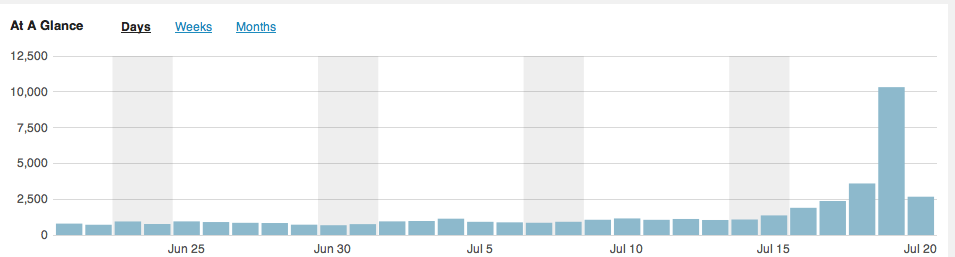
Because I’ve been wishing you well for six years, I had a surge in stats this week, climaxing with what will probably be my all-time high for one day, even if I blog until I am 104 years old, which could happen; my grandmother lived to be 104. Only God knows. 🙂
Here is what my stats look like:
And here are the primary posts:
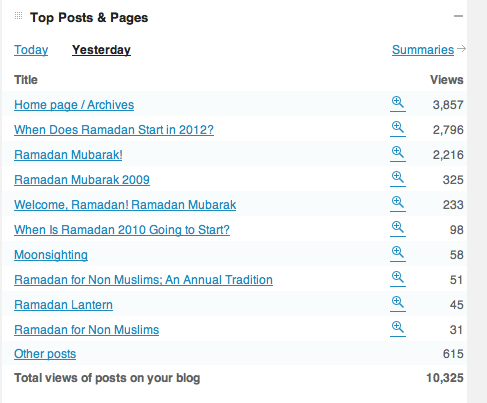
WordPress gives you an hourly count indicator; the highest was 778 per hour. There have been Saturdays when I would have bee thrilled with 778 total for the day, LOL.

I try not to live by stats. I try not to pander to ratings. I try to write this blog with integrity, focusing on issues and news and goodwill to all. There is a little part of me, however, who stayed up late last night to see if the statistical count for the one day would top 10,000 . . . not a part I’m proud of, but hey, I’m human.
Zambia Black and White
I suspect this is true of most people, and I suspect this due to the fact it is true of me and was true of the three people with whom I traveled – even if you buy a new camera months before a major trip, you spend a lot of time on the trip exploring what your camera can do. You’d think that we would spend some major time educating ourselves before we go, but life intrudes, with demands and time consuming errands, and the focus just isn’t on learning your camera and its capabilities.
For me, the truth is even worse. AdventureMan gave me the new Lumix for Christmas, and I took a few photos with it, and really used the earlier Lumix with which I am now very familiar. I could always count on it to get great shots.
There are two things I love about this camera. I used to carry a big huge Nikon everywhere – Kenya, Tanzania, Botswana, Nabimia – backpack full of lenses and cleaning supplies, having to change lenses, and often not having enough light. . . the Lumix fits in my purse, and is easily cleaned. You don’t switch lenses; it has a lot of versatility, and it takes photos in very low light. In fact, I often have two in my purse; I bought a smaller one for everyday-in-a-hurry photos. I use it when you might use your phone camera.
This time, early on, I discovered the Scenic mode: sunset. It allowed me to shoot exactly what I was seeing, those stunning colors of the African sunset (LOL, during burning season, the atmosphere is full of particulate, and that gives it those amazing colors.)
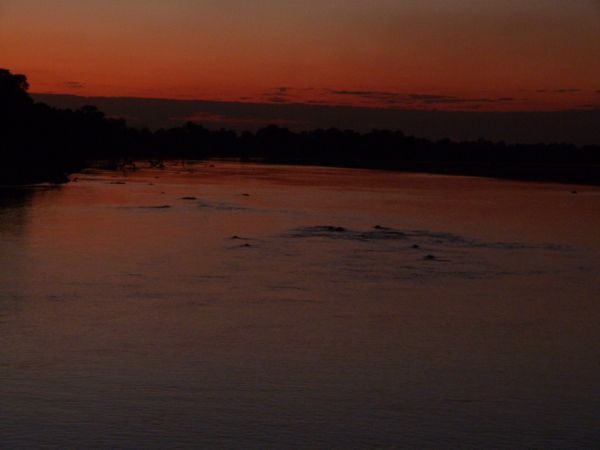
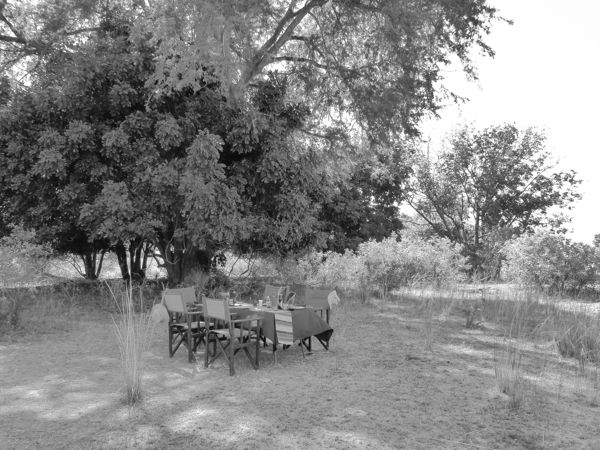
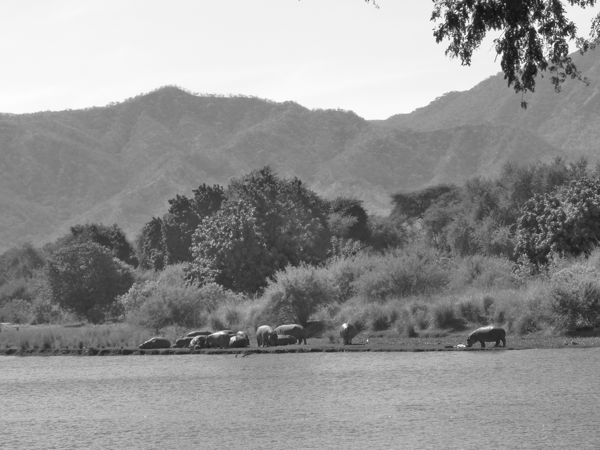
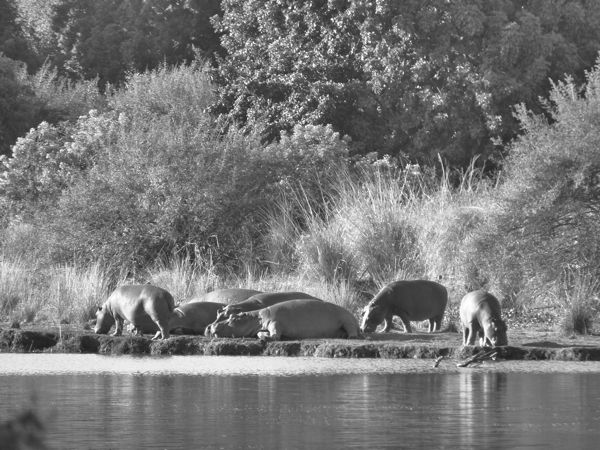
At Nsefu Camp, the oldest Robin Pope Camp, they have decorated with old black and whites, and there is a romance to some of those very old photos that intrigued me. I have a wall in my office, a wall no one else can see, and I think it would be fun to have a romantic Africa series, black and white, so I decided to use my Color Mode: Dynamic Black and White. It gave me exactly what I was looking for, and I also learned that to get that old time look, I needed NOT to use the zoom, but to take the photos in context.
The bright sun, reflecting off the tusks, the backs of the hippos, the water, palm leaves, contrasting with the deeper darks of the green bushes, trees and foliage, is what makes them pop. I took a lot of mediocre shots; I won’t bore you with them, it’s a lot like the leopard, bad things can happen, or there just isn’t enough contrast to make it a good photo.
These are the ones I am enjoying. I’ll probably choose 4 – 6 of them to have printed 🙂
This is where we had coffee/tea in Chongwe; doesn’t it look early 1900’s to you?


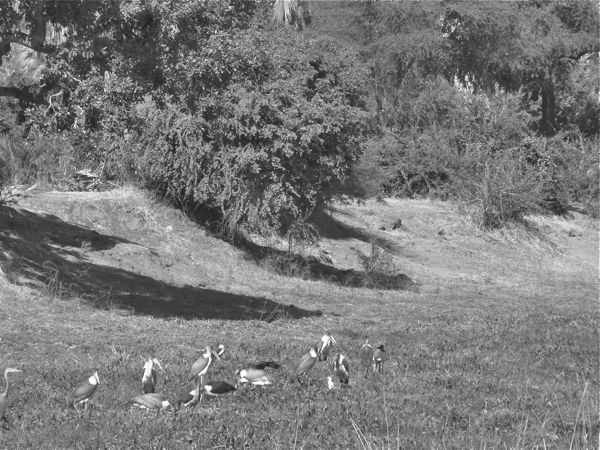



I love this one; I think it is a matter of perspective:
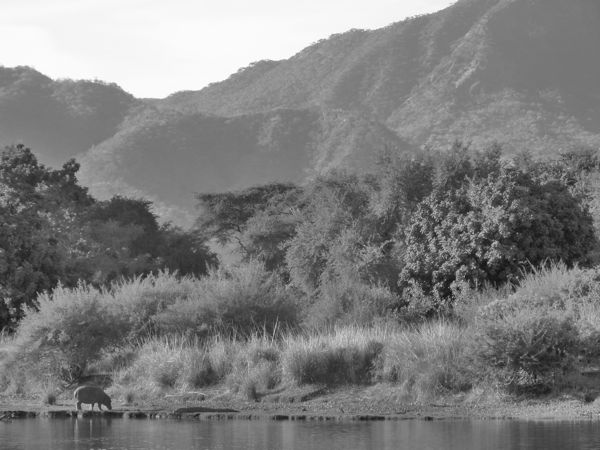
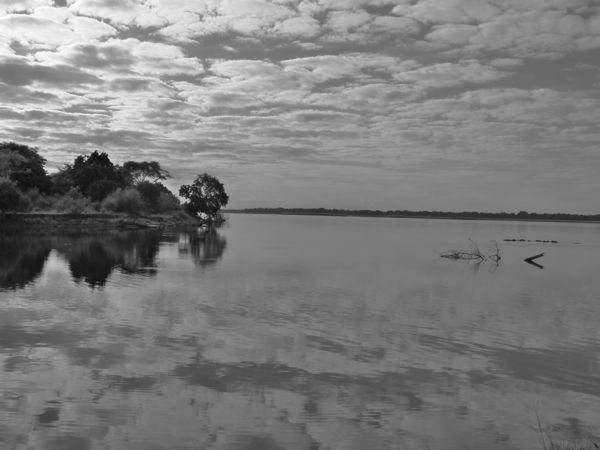
It sounds funny, but it helps to be a quilter. When you are doing a quilt, you have to have a focus, and you need contrast to make the quilt effective.
Saturday Stat Anomaly
I’m sitting here in my office, organizing some photos and verbiage into another entry to be time-shifted and I notice my stat page looks very strange. Like, it’s Saturday. It’s pretty steady, and the lowest day of the week. What I see is this:

It keeps blogging fun. Every now and then something weird happens, and there is nothing I know that can explain it. Someone has shared a minor article I wrote over a year ago, and in one hour, it’s sent my stats totally out of whack.
When Does Ramadan Start in 2012?
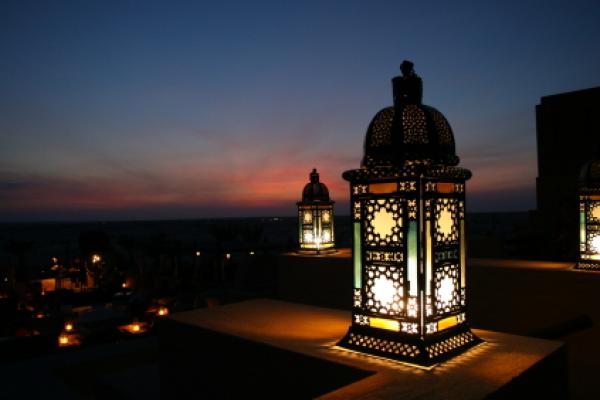
The Islamic Calendar website Godweb says Ramadan in 2012 will start July 20th. Time and Date (which is where I found this beautiful photo) agrees.
Sometimes it depends on the country where you are living. Wikipedia tells us this:
Many Muslims insist on the local physical sighting of the moon to mark the beginning of Ramadan, but others use the calculated time of the new moon or the Saudi Arabian declaration to determine the start of the month. Since the new moon is not in the same state at the same time globally, the beginning and ending dates of Ramadan depend on what lunar sightings are received in each respective location. As a result, Ramadan dates vary in different countries, but usually only by a day. This is due to the cycle of the moon. When one country sees the moon, mainly Saudi Arabia, the moon travels the same path all year round and that same moon seen in the east is then seen traveling towards the west. All the countries around the world see the moon within a 24 hour period once spotted by one country in the east.
Each year, Ramadan begins about eleven days earlier than in the previous year.[3] Astronomical projections that approximate the start of Ramadan are available.[4] It takes about 33 years for Ramadan to complete a twelve month move across the yearly calendar plus 5 days. As Ramadan March 28, 1990 to Ramadan March 22, 2023.
Long Legs and Blogging
“Your posts have long legs.”
Every now and then, WordPress sends a critique, a kind of how you’re doing on your blog sort of thing, and I kind of like it that my blog has ‘long legs.’
My stats are inching back up. At one time, blogging out of Kuwait and Qatar, I averaged around 1200 – 1500 visitors a day, now I am happy to see 800 – 1000 a day. This year I had my highest all time day on this blog 3931 visitors in one day. I don’t really have the kind of blog that attracts that kind of visitor count often; mine is quirky and focused mostly on small things – and great ideas.
But I love the ‘long legs.’ Today the post attracting attention is one I wrote back in March of 2008 about bathroom plumbing in Kuwait. It just always gives me a grin to see an old post attract a little attention. 🙂
Petroglyphs in the Petrified Forest
So here we segue back to the Petrified Forest, and it may not seem logical in a linear, chronological sense, like time-as-pearls-strung-together-on-a-string sort of thing, but in terms of like things, the next chronological entry is going to be on 700 years of culture, the Ancestral Puebloans who used to be called the Anasazi, but before I go there, I want to show you some petroglyphs.
(I’m putting in a lot of links in case you are as big a petroglyph nerd as I am, and want to read more)
I always imagine the problems with being early man. Imagine they are smart, and spend a lot of their days figuring things out, most important being 1. What are we going to eat? 2. How are we going to keep dry/warm? 3. How do we protect ourselves from our enemies? They have the same problems we have, only on a much more basic level, and with fewer resources.
Have you ever thought about how easy it is to get information now? (The hard part being sifting through so you get the most reliable, most relevant information). Imagine a world where you have to figure it out for yourself, every day.
Early civilizations fascinate me. I am always interested in little tiny things that can be very important, like how did they fasten skins together to keep themselves warm? How do you poke a hole in a sharp bone so you can use it as a needle? How do you make a button, or make strips that can be used to tie clothing together?
How do you fasten a spear head onto a spear, or an arrowhead onto an arrow?
Early man was a problem solver, and I am fascinated by petroglyphs, which are either early attempts at documentation, or early attempts at communication, or maybe both? The first petroglyphs and cave paintings I ever visited were the Font de Gaume Caves near Les Eyzies-de-Tayac-Sireuil, and they took my breath away. I didn’t even hesitate because it was a cave, I wanted to see them so badly.
I want you to look at this photo of a fairly early dwelling in Les Eyzies de Tayac-Sireuil and hold it in your mind before we move on:

Later, living in Saudi Arabia, one of the most fun day trips ever was to a rock formation called Graffiti Rock, which had no protection, so very old petroglyphs mingled with modern carvings, but some of the older carvings were so interesting, so intriguing.
Coming across petroglyphs in the Petrified Forest was a delight.
Here is part of what the national parks website has to say about petroglyphs found in the Petrified Forest:
In 1977 a spiral petroglyph at Chaco Canyon National Monument was discovered which displayed a precise interaction with sunlight at the time of summer solstice by means of a narrow shaft of sunlight that moved down a shadowed rock face to bisect the center of a large spiral petroglyph. Subsequent observations found that on winter solstice and equinoxes there were intriguing interactions of sunlit shafts with the large spiral and a smaller spiral nearby. No other example of a sunlight interaction with prehistoric or historic petroglyphs was known at this time. However, there was a tradition of Pueblo sun watching in historic times, particularly of the varying sunrise and sunset positions throughout the year, to set the dates for ceremonies.
As a result of the Chaco Canyon find, Bob Preston initiated a research project to determine whether other petroglyph sites in the Southwest functioned as solar “observatories.” Over the last 16 years he has identified about 120 examples of similar solstice events at more than 50 petroglyph sites in Arizona, New Mexico and southern Utah. Evidence indicates that the phenomenon may have been spread over as much as a 1000-km region. These findings show clearly that certain petroglyphs were used by early pueblo cultures to function as calendrical markers for the winter and summer solstices. Petrified Forest National Park contains the greatest known concentration of solar calendars, with 16 of the sites being in or immediately adjacent to the park, and has been key to understanding their nature.
Shadows and sunlit images are found to move across petroglyphs due to other rocks being in the path of the sun’s rays. As the sun’s path across the sky changes throughout the year, the positions of the shadows and sunlit images change on the petroglyph panels. In many cases the petroglyphs have been placed on the rock faces in just the right position so that specific interactions occur on the solstices. The most common types of petroglyphs on which solsitial interactions have been identified are spirals and circles. The key to determining that these were intended and not by chance is that interactions are seen from site to site, and occur on the solstices more frequently than on other days of the year. These consistent interactions may involve a point of sunlight or shadow piercing the center or tracing the edge of a spiral or circular petroglyph; or shadow lines may suddenly appear or disappear at the center or edges of the petroglyph; or they may move up to the center or edge and then retreat. It is not uncommon for a single petroglyph to display multiple interactions of this type, either on the same solstice or on each of the solstices. In fact, at one site, there are five circular and spiral petroglyphs that show 15 interactions on the both solstices.
An intriguing question is whether types of petroglyph images were involved with specific dates. In several cases similar sunlight and shadow interactions occur on spiral and circular petroglyphs on the equinox, and distinctive interactions occur with other petroglyphs on the solstices and other dates. Clearly much of the puzzle remains to be unraveled.
There was a WEALTH of petroglyphs. I’m just going to show you a few of those we found:
This one makes me laugh; it looks so much like our modern day stork-who-brings-babies (LOL, where did that legend/story start anyway??)

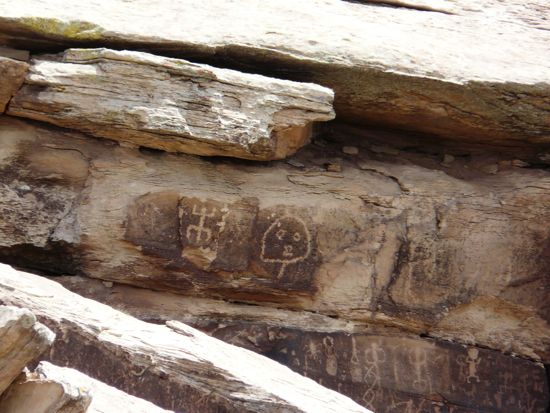
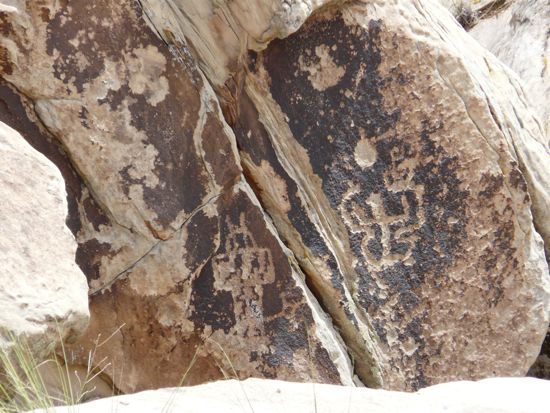

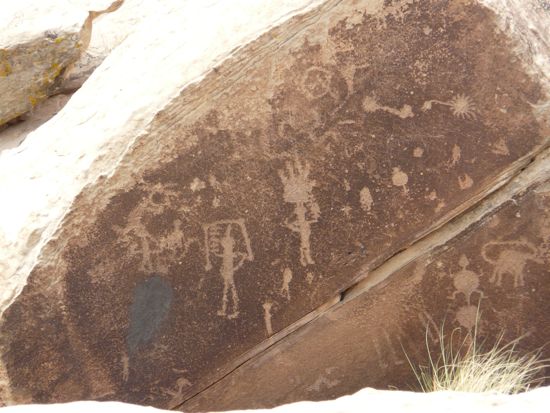
LOL, these feet are larger than life, or else they were made by giants!


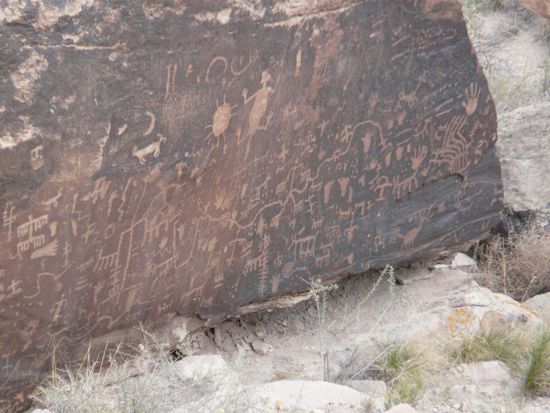
Early people in widely separated parts of the world carved and painted on rock, probably for a number of reasons, maybe keeping track of solar activity and seasons, maybe magical/religious thinking for a good hunt or nostalgia for a good hunt, maybe just someone who, like today’s blogger, just has to document in some way . . . 😉
Thank You, AdventureMan
This is a shakedown trip for the new iPad. I love the way it travels, and that it is bigger than an iPhone for picking up e-mail, and I have a keyboard, so I can write.
It is a lot harder to blog. It is harder to crop and manipulate photos, it is harder to integrate the photos into my blog entries. It was so much more difficult that I just didn’t do it. I had a lot of ideas and a lot of photos, but not enough time (you know how it is when you are traveling) to figure out how to get the job done.
AdventureMan very generously offered to let me use his computer to upload my photos and integrate them into blog entries. Thank you, AdventureMan!
Old Dog, New Tricks or I Greet New Technologies
About a year ago, I finally bought an iPhone. It could do so many things, it scared me, but when my little (then) 18 month old grandson fearlessly showed me how to play Tozzle, and Zombies in the Garden, and Angry Birds, I knew it was time for me to step up my game.
I don’t want my identity stolen, I don’t want Google tracking my searches, I don’t want targeted advertising, so I’ve been really careful about what I do. And then I though about the CIA. The CIA and NSA (aka No Such Agency) and several other highly technical services find themselves inundated with so much information these days that they have a harder time sorting it and then determining what is important and what is not. That gives me hope. I’m just not that important. Who would want to track me?
So, after a year, I finally synched my iPhone with my computer for the first time. Very scary. Then, when it didn’t work, I don’t know why, I restored the original settings, losing what little I had stored on the phone, but it wasn’t much.
Mostly, I like ringtones. I like for the people who call me regularly to have identifiable ring tones, and I have been really happy with the ones I have except for my daughter-in-law, I wanted an Edith Piaf song for her, and I never could find it.
Today, I girded my loins and bought a ring tone from a non-iTunes provider. Yes. Scary. And I thought it would magically go straight to my phone, but no, I had to download it, save it into iTunes, then synch my phone.
Earlier, I had taken another giant step and subscribed to “the Cloud” so, I thought, my computer, iPad and iPhone would all have the same music, but as it turns out, not everything goes to the cloud, like ringtones that you don’t buy from iTunes. So I had to risk everything and Synch again. It warned me that I could lose everything! I hesitated, then asked “what would I do if I were 11?” and pressed Synch. Woooo HOOOO, oh, the exhilaration!
There are some things I don’t want my devices to share, like financial information, etc. I don’t really want something like my iPhone, which gets carried everywhere and has the highest probability to get lost or stolen (although I have activated the Find My iPhone program, too). It’s a good think it’s not all-or-nothing, but it takes a longer time when you want some things but not others.
Now, I am all synched-up, and oh, I feel so dramatically technological, as I jump into last years technology. I know that my problem is over-thinking; the secret is to just jump in, just do it. I am just so thankful I have a son and a grandson to help me make the technology leaps.
Phthalates Risk Factor for Diabetes
A Swedish study, posted on AOL Everyday Health News, indicates we heighten our risk of diabetes with repeated exposures to phthalates common in items we use every day of our lives . . .
HealthDay News
Common Plastics Chemical Might Boost Diabetes Risk
Phthalates, found in soaps, lotions and food packaging, may disrupt insulin production, researchers say.
By Steven Reinberg, HealthDay News
THURSDAY, April 12, 2012 (HealthDay News) — High blood levels of chemicals called phthalates, which are found in soaps, lotions, plastics and toys, may double the risk for type 2 diabetes among older adults, Swedish researchers say.
“Our study supports the hypothesis that certain environmental chemicals can contribute to the development of diabetes,” said lead researcher Monica Lind, an associate professor of environmental medicine in the section for occupational and environmental medicine at Uppsala University.
“Most people come into daily contact with phthalates as they are used as softening agents in everyday plastics and as carriers of perfumes in cosmetics and self-care products,” she added.
The study’s implications “must be to cut down on plastics and choose self-care products without perfumes,” Lind said.
But the research does not prove cause and effect. To find out whether phthalates (pronounced THAL ates) truly are risk factors for diabetes, further studies are needed that show similar associations, she said.
“Experimental studies are also needed regarding what biological mechanisms might underlie these connections,” Lind stressed.
The report was published online April 12 and in the June print edition of Diabetes Care.
For the study, Lind’s team collected data on more than 1,000 Swedish men and women, age 70, who took part in the Prospective Investigation of the Vasculature in Uppsala Seniors Study.
The researchers measured the participants’ blood sugar, insulin levels and levels of toxins from the breakdown of phthalates.
As expected, they found diabetes was more common among those who were overweight and had high cholesterol.
And they also found an association between blood levels of some phthalates and diabetes. That association remained even after taking into account obesity, cholesterol, smoking and exercise.
For people with high phthalate levels, the risk of developing diabetes was about double compared to those with lower levels, the investigators found.
Some phthalates were also linked to disrupted insulin production, the researchers said. Insulin is a hormone that helps deliver blood sugar into the body’s cells for energy. Without insulin, or with too little of the hormone, too much sugar stays in the blood, setting the stage for diabetes.
“Even at relatively low levels of phthalate in the blood, the risk of getting diabetes begins to rise,” Lind added.
Other studies have linked these chemicals with breast growth in boys and reproductive problems in men, possibly caused by estrogen disruption.
Phthalates are used in hundreds of products, such as toys, vinyl flooring and wall coverings, detergents, lubricating oils, food packaging, pharmaceuticals, blood bags and tubing, according to information from the U.S. Food and Drug Administration. Personal care products, such as nail polish, hair sprays and shampoos, also contain phthalates.
At present, “the FDA does not have compelling evidence that phthalates, as used in cosmetics, pose a safety risk,” according to the FDA website.
In the United States, companies are not required to test the long-term health effects of chemicals before using them in consumer products. Lind said this means the dangers of hazardous chemicals aren’t known until they are already widely used.
Lind said the health effects of chemicals should be tested before they reach the consumer market similar to the way drugs get tested before being approved.
“We are looking at a tip of an iceberg,” she said in terms of a possible health crisis. “We are just scratching the very top of the iceberg.”
The way the system is designed, if phthalates were banned, they would be replaced by other chemicals about which even less is known, Lind said.
According to the Environmental Working Group, a group trying to rid hazardous chemicals from consumer products, there is no practical way to choose phthalate-free products. Sometimes the print on ingredient labels is too small to read, and different names are often used for the same plasticizing chemicals. And some products lack ingredient labels even though they’re required by federal regulations.
That said, some of the names to look for in cosmetics, self-care products, solid air fresheners, and scented candles are: mono-methyl phthalate (MMP), mono-ethyl phthalate (MEP) and mono-isobutyl phthalate (MiBP), which are types of the chemicals dimethylphthalate (DMP), diethyl phthalate (DEP) and di-isobutyl phthalate (DiBP). DMP is also used in ink and as a softening agent in plastics.
Solar Storm Hits Today – How it will effect us
From the Huffpost Science:

Solar Flare, Solar Storm, Sun Storm: Whatever It’s Called, Sun Activity May Yield Stellar Aurora Borealis
By SETH BORENSTEIN
WASHINGTON — The largest solar storm in five years was due to arrive on Earth early Thursday, promising to shake the globe’s magnetic field while expanding the Northern Lights.
The storm started with a massive solar flare earlier in the week and grew as it raced outward from the sun, expanding like a giant soap bubble, scientists said. When it strikes, the particles will be moving at 4 million mph.
“It’s hitting us right in the nose,” said Joe Kunches, a scientist for the National Oceanic and Atmospheric Administration in Boulder, Colo.
The massive cloud of charged particles could disrupt utility grids, airline flights, satellite networks and GPS services, especially in northern areas. But the same blast could also paint colorful auroras farther from the poles than normal.
Astronomers say the sun has been relatively quiet for some time. And this storm, while strong, may seem fiercer because Earth has been lulled by several years of weak solar activity.
You can read the rest of the article here (click on blue text)
Recent Comments
intlxpatr on Waiting for Snow intlxpatr on Waiting for Snow Abou Tabblouleh on t… on Waiting for Snow Abou Tabbouleh on in… on Waiting for Snow intlxpatr on Waiting for Snow Wikipedia Donate Button

Amazina


Early Voting in Florida


 Here There and Everywhere