Public Art
My home town sponsors a huge Arts fest every year, raising hundreds of thousands of dollars, which they donate to different charities. Each year, in addition, they donate a piece of art to the community. I love this place. This is what I saw on the BeachWalk, about two miles of public path along the beachfront, punctuated with public art.
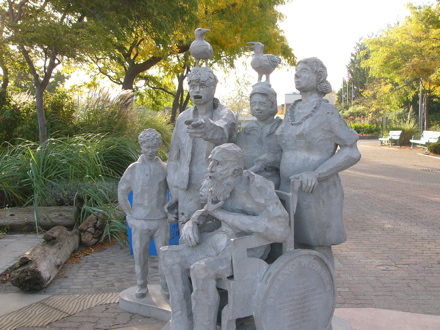
This is called the Whale Watchers

This is the breakwater wall, with shells, periwinkles, and sand patterns sculpted into it.
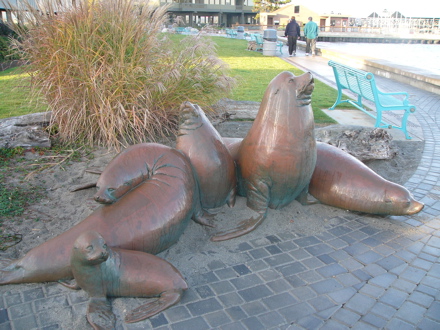

And this is my favorite:
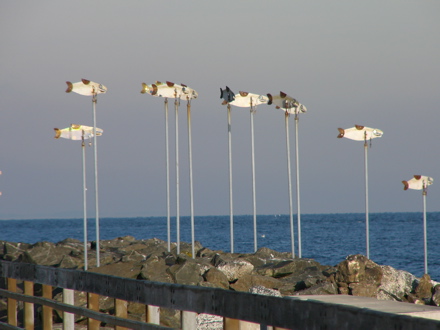
Opposite World
I need to write this post while I am freshly back home, because it wears off, you forget the sharpness of the differences . . .
You have to think about how you will manage your bags when you get here, because there will be no willing men with carts to do it for you.
Getting on the highway . . . people are so polite. People drive exactly at the speed limit, or maybe up to 4 miles over. If you put on your turn signal, they slow down and allow you to enter their lane. No one weaves back and forth, no one gets on your tail and insists you get out of their way. Traffic flows smoothly, predictably. People are wearing seat belts; their babies are in baby seats and their children are buckled in the back seat. It’s five lanes, and it’s all very tame. Our testosterone drivers in Kuwait would find it very very dull. I didn’t see a single accident, or single wrecked car all the way home, about twenty miles.
At the grocery stores, there are places for inviduals to put their grocery carts back – and they really do. There are also enough parking places. The cashiers also put the groceries in a bag for you, but there is no one who carries them out to your car.
The streets are immaculate – not because we have hoards of people to pick them up, but because people here have a horror of littering – and huge fines that discourage the rare few who would toss a kleenex out a window.
Service providers are more helpful, and less servile. There is a sense of interchangeable rolls – the guy behind the counter at Starbucks might also be a full time IT student at the local university, just piling up a few barista bucks to pay his way through school. (There is always a tip jar in every Starbucks – Have you ever noticed there are no tip jars at the Starbucks in Kuwait?) The gal behind the counter at the grocery store might live just up the street from you. The guy at the Half Price book store has kids at the same school where your child goes to school. It’s different when all the workers are part of the same community.
The health care worker living with my parents to take care of my father is treated like family. He’s from Ghana. I watch him watch us as we gather. I imagine some of it is very familiar to him – the way women communicate when family gathers, laughter, tears, family business, making plans and arrangements. And I imagine some of it is very . . . foreign. I would love to read HIS blog!
There are seasons here. You need to have socks with you to keep your feet warm, and closed-toed shoes. There are trees that were green two months ago, and are now a flaming red, or orange, or yellow. I need a sweater outside, over a shirt. It’s cool, but not yet really cold.
Part of the transportation system here is ferry boats. People take them to get to work. My home town is, like Kuwait City, on the beach, but the water is not jade green, but a deeper, colder blue.

Karma Payback
When I started this blog, one of the first posts I wrote was about getting an upgrade. This trip, it was karma payback. I booked a ticket and paid online, and later when I tried to reserve my seat online, I kept getting an error message. When I got to the airport, (confirmation in my hand, thank God) the clerk said my reservation had been cancelled. I had paid extra to have an upgradeable ticket, and to be able to change dates if I need to – it took the fixer-guy over an hour and a half to figure out how to re-instate my reservation.
And I asked for an upgrade – I have thousands and thousands of frequent flyer miles; I don’t need a free ticket but it helps on the night flights to be in business class because you can lie down and sleep! Makes a difference when you have a long way to go. But they didn’t give any upgrades – and when I got on the place, the entire business section in front of where we were sitting was . . . EMPTY. Go figure!
In Europe, I asked for an upgrade for the next leg – not free, I am willing to cash in miles, but the snotty desk clerk told me my ticket was the non-upgradable kind. It doesn’t do any good to lose it in those circumstances, but I was steamed. What did I pay extra for??? When the guy who fixed my reservation fixed it, I guess he didn’t put in the right code. I’m screwed.
After the next flight, which was very long (had a good seatmate, though, quiet, like me, but when we talked it was about books and families and comfortable stuff) I went through immigration and because this was my fifth trip back home this year, when I filled out the immigration form, I listed that I wasn’t bringing back anything. And I wasn’t. I barely have the right clothes. But that got the attention of customs, and I got the full inspection, which after you’ve been travelling for more than 28 hours is annoying. They were cordial enough, but they went through everything, suitcases, carry-ons and purse, very thoroughly. And found nothing.
Last, but not least, I went to pick up my rental car, only to discover I don’t have my stateside driver’s license with me. After half an hour of desperate searching (I am an organized person; things are where they are supposed to be! but it wasn’t!) I offered her my Kuwait license, which she couldn’t read and said she couldn’t accept, and then, miracle of miracles, I came across my old Germany driver’s license. A German license is good for life. And, thanks be to God, she accepted it. And on top of that, for some amazing reason, using a German license made the rate even better than renting in my own state with a state license. Again – go figure.
And I just figure all of that is karma payback for all the good luck I have had in previous trips. We have a saying: Every monkey gets his turn in the barrel. I guess it was just my turn.

Heritage Market

I couldn’t resist this photo. I love the art work in the Heritage Souk. Cat looks pretty content, too. I bet he gets the leftovers.
Get Out of Jail Free Card
Who could be whispering my name?
I was in the Jarir bookstore, on my way to the airport after a three week visit to Saudi Arabia. My husband wanted me to get a feel for the place before moving there to be with him. To my surprise, I really liked Saudi Arabia, what little I had seen of it. And I really wanted to be with my husband. But who could be calling my name?
“I can’t believe it! Is that you, teacher?”
I turned to see a traditionally garbed man, whom I instantly recognized as my former student in classes I had taught back in the US.
“Khalid! Khalid! I am so glad to see you!” I exclaimed, and I was. Khalid was one of my very best students, before he disappeared from classes. He was bright, he studied hard, and from time to time, he would even practice hard and tell a joke in English. He was a student any teacher would remember. He had more maturity than the other students, who treated him with respect, but he also had a delightful sense of humor.
Instantly, my husband and two other men who had come with us to the bookstore were standing between Khalid and me. I knew they were protecting me, so I quickly explained who Khalid was, and introduced him to the men with me.
“You remembered my name!” he said with an astonished look.
“Of course!” I assured him, “You were one of my best students. I missed you when you left.”
“Truly God works in mysterious ways,” Khalid looked dazed. “I never dreamed I would see you again, and here you are, in my country.”
We had to leave. Khalid gave me his card, and asked that I call so his mother could invite me for tea. I told him I wouldn’t be back for a couple months, and he said he was hoping to start legal studies in London in January.
In the car, my husband and the other two guys were cracking up, slapping their knees, almost howling with laughter. I was annoyed; what was so funny about my running into an old friend?
“He’s a muttawa!” they exclaimed, continuing their cackles, “You’re friend is a muttawa!”
The muttawa, the religious police in Saudi Arabia, are kind of the boogeyman, and we scare one another telling Muttawa stories. The problem is that you never know what new rules are going to go into effect, or what old rules they will begin enforcing. Our embassy guidance, for example, was that we were NOT to cover our hair, that it was a choice made by Moslem women, but not a requirement for non-Moslem women. We were also told to carry a scarf and not to argue if a muttawa told us to cover our hair, but to cover, and to take it off again when out of sight.
We were told that if our abaya was too short, a muttawa might hit our legs with sticks. We were told not to laugh, and to keep our eyes lowered to the ground to avoid problems. We were told that sometimes you might be arrested and not even know what you were being arrested for, and to always carry your cell phone with the embassy number on speed dial. In short, we lived in terror of arbitrary powers of the dreaded muttawa.
“Khalid is muttawa?” I couldn’t believe my ears. My husband explained how you could identify muttawa, the short robes, the lack of egal, the sandals, and that Khalid had probably broken the rules he was in Jarir to enforce by having spoken to me.
I never saw Khalid again, not in the Jarir bookstore, not anywhere. I am guessing by the time I returned to live in Riyadh, he was in London studying. But I often think of his amazement, and my own, in that one-time encounter. I often think, as he said, that “God works in mysterious ways.” I wish him well.
For me, I was never again terrified of the Muttawa. Khalid was muttawa, and he was a good man. I carried Khalid’s card with me, and figured if ever I was arrested (never even came close) that I would tell them to call Khalid, and he would help me. I thought of it as my “Get out of Jail Free” card.
Going back to the Locard Exchange Principal . . . knowing Khalid as a student and as a person made a difference to me. It colored my ideas about the muttawa, made me less afraid. If the Locard Exchange Principal works on a social and spiritual level, I wonder if knowing me has colored his perceptions?
Hemingway Safari: Leaving the Kalihari Lions (Part 11)
Our last morning hearing “Good morning” and zip zip, as our water is delivered. The big full moon is still up as we get our coffee around the campfire, hating to go. But, all too soon, it is time to load our bags into the truck and head for the airstrip. It is cold. I have my sweater on over my dress. Both Godfrey and Paul, at separate times, admire my long Saudi dress, and tell me with approval that I look like an African woman. I am just glad that there are also blankets available in the truck, as it is really, really cold in the desert.
I am even more glad for the blanket a couple hours later, when Godfrey slows the truck, and then stops. In the middle of the road, not 100 yards away, are two lions. Big young male lions. They show no fear, and, in fact, one starts walking purposefully toward the truck. He eventually turns back, but as we begin to leave, he turns back for another look. Now, there are three of them. The biggest keeps walking toward us, and walks to the side of the truck, the side where I am sitting. Godfrey tells us just to keep still, and all that he has taught us about lions goes through my mind. Sit still, look him in they eye so he will know you are dominant and not afraid.
We’ve seen lions before, in Chobe, in Moremi, and in these more heavily travelled game parks, I think the animals know you aren’t a threat. Most of the time, they just tolerate you presence, or slowly walk away. And, my friends, I am looking this lion in the eye. He is four feet from me. And I know sees me. And I don’t think he thinks I am a part of the diesel and rubber smell, he looks amused, and intrigued, and . . .hungry.
I have seen my cats look at little mice the same way. And I am aware that we have no gun, and no real weapon. There is a shovel, but it is attached to the front bumper. The jack is on the rear bumper. There are thermoses, but they are in the wicker baskets. I am sitting her with nothing but a blanket and a camera, and this big interested looking lion is within pouncing distance. And he doesn’t think I am dominant. And he is very, very close. “Godfrey, DRIVE” I say, and I can hear AH and Angela breathe again; we’ve all been holding our breaths. Godfrey drives, very slowly, and the three young males lope along behind us.
I will add, that while I was sitting motionless with terror, eye to eye with the Kalihari lion, my husband was sitting just behind me, shooting photos over my shoulder.
What if we had had the flat tire in the middle of all this, we wonder? How would we change a tire? Godfrey says, you just wait until they go away. Waiting out a lion could take a LONG time, and it would seem even longer.
Then, out in front of the truck steps a female, and she has wounds. Godfrey drives very slowly, very carefully, for a wounded lion is a far less predictable lion. We are nearly giddy with relief when we finally get free of the lions, who lope along behind us for quite a while. The road is sand, and we can’t drive very fast.
My Adored Husband is totally annoyed that he ran out of film in the middle of the episode; I had film but I didn’t want to shoot while I was busy maintaining eye contact with the lion. (As it turns out, he did get one really good shot of the lion, a very beautiful shot, the lion is light gold against the white wheat of the background, and I love the shot.) The adreneline is still pumping. We made it to the airstrip just in time, in spite of the time we spent with the Kalihari lions.
Time to say goodbye to Godfrey, climb aboard our last little Cessna and leave the bush. What a way to go! Our flight to Maun is uneventful. Maun is a funny little airport, very small. We find a couple gift shops – we haven’t been spending anything out in the bush – and we deliver a message to Afro-Ventures from Godfrey, telling them he needs more information on his next safari. He has a full contingent of seven for the safari, a reverse of ours, starting in the Kalihari, just hours after we leave. They promise they will radio him the information.
We are not the same people as before we went to Botswana. We miss our camp. We loved this trip. You have to be able to endure the bumps and lumps of the overland drive to handle this particular trip, Afro Ventures’ Botswana a la Hemingway, but there are other ways, there are trips where you fly from destination to destination, and stay mostly in lodges. You would still experience much of what we experienced, just not the camping portion.
AfroVentures and CCAfrica merged, and we don’t think you can get a better combination of knowledgeable guides and gracious accomodations. Every single day of our journey exceeded expectations. It was a grand adventure. Thanks for coming along.

This lion is actually a Grumeti lion from Tanzania, but I wasn’t digital yet when we travelled Botswana.
The Hemingway Safari: The Kalihari (Part 10)
The next morning, we take it easy, late breakfast, get all packed up and are ready for our short trip to the airstrip. Our pilot is Collin McAlister, again, which we find delightful. And this time, I don’t even feel the least bit claustrophobic. I LIKE flying this way, where you stow your own bag, you get on, fly, get off, grab your bag – it is SO efficient!
This flight is totally different from the last one, in that we go from the lushness of the Okavango Delta into the dry Kalihari. Now the Kalihari airstrip seems remote enough when we see Godfrey there to meet us, but we still have a four hour drive in front of us to the Deception Valley camp site. Godfrey has put the canvas top over the wagon which protects us from the hottest part of the sun, but still we can see out.
Godrey points out to us the tiny melons growing along the side of the road, and says that the lions eat them for water, as there is no source of water in the middle of the desert. There were some pumps, but there was an earthquake and the pipes broke. Later, on one of our game drives, we see a crew out in the middle of way-far-out-nowhere, and they are repairing the pipes so that one day the water holes will function again. We also see a tiny green desert hibiscus flower.
We have never seen such a bleak landscape. It is hard to believe that this land can support any life at all, but . . . Godfrey shows us wonders. One of the first is an entire herd of gigantic male kudus, very large deer-like animals with beautiful twisted antlers. They can bound over very high fences, and make it look easy. We saw this, on the long drive to our camp site, the fences were over 7 feet high, and these huge antelope sailed over at a gallop. It takes our breath away.
We also saw ostrich, many of them, male and female, and they always run away when we get close. When they run, they really bounce from side to side, and look very comical, like ballerinas running off-stage.
We have to stop several times to go through gates into the Kalihari game reserve. We want to see the lions, the lions of the Kalihari, the great, very wild lions we have heard about. We don’t see any on the four hour ride to our camp, but we have seen so much that it hardly matters. And we are grateful to sink into our familiar beds in our familiar tents, to have a hot shower, and a rest before the afternoon game drive.
As we come into camp, John and Richard are leaving in the big truck, to go get water. We use water very sparingly, but supporting life out on the desert means you have to bring in everything. John and Richard will drive a couple hours to the water station, will fill and drive back. The water is a little red. We don’t drink it, and we keep our mouths shut when we shower.
During our late afternoon game drive, we see a Cape Fox running through a herd of steinbok, and just as the light is failing, Godfrey spots a cheetah walking through the grass a few hundred yards away. We watch until darkness falls and we can’t see it any longer.
By this time, our ears have adjusted and we can understand Godfrey almost perfectly. When he says the steinbok dig for “tubas”, we know it is not musical instruments, but tubers. When he says “maybe he feign-ed illness, I don know”, we understand that maybe Paul was sick and maybe he wasn’t. We know that the “red boo boo shirke” is the red breasted shrike. We have come to admire and respect Godfrey immensely. He has so much knowledge of the animals and birds and trees and flowers, and also he manages the staff so well, keeps them operating smoothly under very extreme conditions AND keeps all the equipment well maintained.
We admire his driving ability. You would have to see the roads we are on to understand, the narrow, one lane, unpaved roads. Sometimes rocky, mostly sandy and always rutted and full of holes. In the Kalihari, there is the additional challenge of aardvark holes. The aardvark loves digging in the roads, as the roads are clear of brush. But aardvarks dig HUGE holes.
Back in camp, the lanterns are glowing in front of our tents, Dorcas meets us with hot washcloths, and oh, glory, there is a huge full moon rising over our camp. Here we are in the Kalihari desert, and we never want to leave.
I DO miss the sound of the elephants and hippos, and I don’t hear any lions. Even the birds are quieter here, no owls. It is very, very quiet. And then, there is that huge, full moon. We are in heaven. For dinner that night, Sky serves chicken in peanut sauce, and oh, it is delicious. The next morning when we stop for mid-morning tea and coffee, we find he has made sandwiches with the leftovers, and we are delighted. On this morning’s game run we see mongoose, an aardwolf, and a bat-eared fox. Four days in the Kalihari, and where are the lions?
We take a full day game drive to far away places. We see a solitary giraffe, and wonder how on earth he survives? He is very old, you can tell by his very dark color, Godfrey tells us. We set up for lunch under a huge tree. Godfrey looks up, and while we don’t see a leopard, we know a leopard has been there, as there is a dessicated springbok carcass high in the tree, where the leopard left it.
We get to see the springbok springing, which is a lot like the pronking of the impala, and we see a red haartebeast, and a brown hyena, all very rare, but still, no lions. We do see lion poop, Godfrey tells us we know it is lion poop because it has fur in it.
On our way back to the camp, at the end of a long day, we have the first, and only, flat tire of our trip, and the cause is a thorn. Not just any old thorn, this thorn is as thick and strong as an iron spike. It is astonishing how fast Godfrey and Paul change the tire. The tires are big, thick, sturdy tires, and we are amazed that this is the first and only one we have had. And at the same time, we haven’t seen anyone else for hours. If we didn’t have a spare, or if we lost a tire AND a second tire, we would be very very isolated out here in the middle of the desert. It is a soboring thought. The kind of thought you don’t think before you make a trip like this or you might not make the trip at all! 😉
We are back in camp this last night of our journey about 5, early for us, but we have been out all day, and we have to be packed to leave the next morning BY seven, in order to make it to the airstrip for our pickup.
Godfrey prides himself on being reliable, and says if you get a bad reputation for not being on time the bush pilots can refuse to do your pick ups. Not only does he deliver people promptly, but he always has tea/coffee/sodas and sandwiches available to offer to the pilots, and from talking with Collin, we know that this is exceptional and remarkable. But Godfrey is a very unusual person, and we have watched him now for two weeks, and learned that a lot of his success comes from taking his time with people, talking with them, building relationships and consensus. We kid him that one day he will probably be president of Botswana, but Godfrey says he will be happy to be president of the Tour Guide association.
The Hemingway Safari: Nxabexa (Part 9)
The next morning we are going on the mokoro ride. The mokoro is a very narrow little canoe, and they are going out into the swamp with men who use poles to take the canoes on a shallow water safari. You don’t want to get into too deep water, as there are hippos, who are very mean and ugly when you get into their territory. They are also very fast for creatures their size, and lethal. There are also mosquitos.
All in all, I just figure I NEED a quiet morning to myself. I love my sweet husband, and from time to time I just NEED some alone time. Coffee and tea, and small cookies are delivered in a wicker basket at 6:30, even small flasks of milk. AH pours me coffee and gets ready to leave. I am looking forward to a leisurely shower, wash my hair – I know there is a hair dryer. So I go to the shower (zip zip zip zip) and then discover there is no conditioner so I have to go back into the cabin, already dripping wet (zip zip zip zip – zip zip zip zip) and I have to laugh; it is a good thing I am not in a hurry!
I spend the morning reading magazines, updating my little notebook, and I can hear voices as they sail off in front of the cabin in their little Mokoros. There are all sorts of odd noises, including a crashing sound on my tent at odd intervals. As it warms up, I sit out on my deck and meet a young monkey friend. We play a game, he bobs his head up and down and I bob back. Who is imitating whom? He scrambles up the tree, drops onto my tent and slides down, grabs another branch and within seconds is back bobbing at me. Now I understand that crashing sound!
One of the nicest things at Nxebega is that throughout the day, you can hear singing coming from various parts of the camp. There is a safe in our cabin, but since we left Victoria Falls, there have been no locks, just tent flaps – zip zip zip zip. After a while, we no longer even thought about it. Nothing is taken. We even have gotten used to the whole tent flap thing – zip down, zip sideways, step in, zip sideways, zip up. At night, you also zip the outer flaps, so then you have four zips to get in and another four to close back up. And you just do it.
At dinner this night there are two tables, as Nxebega has it’s full capacity of guests- 20 people. AH and I and Angela sit with Ashleigh and Steve, and an Italian couple. It is a lovely evening, full of great conversation. Dinner is a roasted tomato soup, a lamb tagine with couscous (which even AH loves, and he doesn’t usually like lamb) and dessert is a brownie with caramel sauce.
We love being at Nxebaga. We love the genuine hospitality and the beauty of the place. At night, you hear a tinkling sound, it is the painted green frog. Each frog has a slightly different pitch, and when they all sing together, it sounds like wind chimes, or some very modern kind of music. I just love the sound.
In the middle of the night, we can hear elephant sounds, loud loud trumpeting, more than one elephant. The next day, Steve tells us that it sounded like a bull elephant in “must”, but that when a lion attacks an elephant baby, and all the elephants wail and wail, it is truly a horrible sound. We hope never to hear such a tragic sound.
Recent Comments
ExpatAlien on What Country am I Living … intlxpatr on Yellowstone: Old Faithful to C… Michelle on Yellowstone: Old Faithful to C… Cathy on No Grown-Ups in Charge intlxpatr on Waiting for Snow Wikipedia Donate Button

Amazina


Early Voting in Florida


 Here There and Everywhere