Even After All this Time – Latifi
A good book can make your blood race faster. A good book may even require underlines, turned page corners to mark the places you liked the best. A good book may compell you to tell others about it. Above all, a good book is a book you think about long after you have turned the last page.
Some of my best “good books” come to me through Little Diamond, my neice who lives in Beirut. We share a family culture, but even better, we share a wacky sense of humor. There are times we can’t even let our eyes meet in family gatherings, because we are thinking the same thing and can’t afford to laugh out loud.
She recommended this book to me more than three years ago, and I bought it immediately. And then it sat in my “read me soon” pile(s), languishing, unread, until early this year.
Oh, what a treat this book is! Once I picked it up, I could hardly put it down!
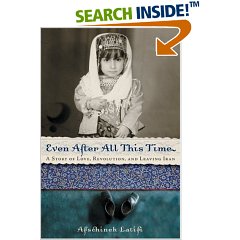
The book is autobiographical, and begins in pre-revolutionary Iran, where Afchineh Latifi’s father is a soldier. You see the early years of her life with her sweet, struggling parents, and you feel like you lived in their home with them, the images are so vivid.
As a military officer, though, her father is suspect once the revolutionaries come into power, and her family’s fortunes fail. Her father is arrested. As Latifi’s mother bravely goes from jail to jail, trying to find her husband, her daughters are often with her. Once she finds him, she brings him comfort items – shaving kit, washcloth, etc. so he can maintain a small amount of dignity while he is being beaten and imprisoned. Latifi’s mother was young when this book opens, maybe in her thirties, with two daughters and two sons, and I am totally blown away by the courage it took to persist as her husband was transferred from prison to prison, increasingly brutalized, and then, immediately after the last visit – shot. So immediately that the family heard the shots.
And then the real nightmare begine. The young mother and her family have no income, and her (now dead) husband’s mother claims her house, even though they bought her a house of her own while her husband was alive. Latifi’s Mom never gives up. She gets her daughters visitor’s visas to Austria and puts them in a convent school, and then gets them to America – again on visitor’s visas – where they are forced to camp – for years – with a relative. Literally, years. Their brave mother eventually manages to get herself and her sons out of Iran, and join them in the US.
Their mother is a pistol. She is brave in the face of obstacles that would deter most of us. She never gives up. I am in total awe of her commitment to the survival – and thriving – of her family.
I love this book for two reasons – the first being the strength and courage of this family, and the second being that they immigrated to America. You will hear a lot of Americans who say terrible things about immigrants, and how they take up scarce resources better meant for “real” Americans. Who are they kidding? We are ALL immigrants, in America, except for the Native Americans! This family, their will to succeed, is the story of us all, and what makes the country great. It is still a country where you can work hard, and succeed, and thrive. It’s an every day story in our country, but a story I never get tired of hearing.
Here are some excerpts from the book:
She looked at me as if I were an alien, which in fact I was. “Yes,” she said, “You get a library card and you can borrow as many books as you want.”
“And it doesn’t cost a thing?” I asked.
“Not a penny,” the woman said. “Unless you bring the books back late. Then we charge you a late fee.”
This was news to me. There were libraries in Tehran to be sure, but we had never frequented them. Mom would come home every two or three weeks with armsful of new books, and we would devour them hungrily. We were much too spoiled to share books with anyone.
The librarian processed my card on the spot. I couldn’t believe it. It felt like the biggest gift of my life. . . . . By the end of the summer I discovered a whole new world. Books. Words. Stories. I got in touch with my inner geek. Reading was not only exciting, it offered escape. When I was reading, my other life didn’t exist. There were days when I didn’t even think of Mom.
Her Mother was still in Iran at this time, and she and her sister are living with relatives who have loud arguments wondering how much longer they will be burdened with these girls. Finally, the two sisters find jobs, as well as going to school, and save every penny, and get an apartment where they live while putting themselves through university. And, one day, their mother and brothers arrive. Life changes. They all live together again.
“It’s almost Norouz,” she said. “Or have you forgotten?”
I had indeed forgotten. She was referring to the Persian New Year, which on the Gregorian calendar falls in late March. About two weeks before the start of Norouz, many Persians take part in something called ‘khane tekani,’ which literally means ‘shaking your house.’ You will see people painting their homes, washing their carpets, sweeping out their attics, cleaning their yards. One could say that it is a form of spring cleaning, but that is only a very small part of it. In Persian ‘no’ means new, and ‘rouz’ means day. The last Wednesday of the year is known as ‘chahar shanbeh suri.’ At dusk, with the cleaning over, people light small bonfires and sing traditional songs, and those who can manage it are urged to jump over flames. Fire, too, is seen as a cleansing, purifying agent: it burns away all the negative things in one’s life – the bad habits, the misfortune, the sorrows. It’s all about cleanliness: clean house, clean soul, new beginnings.
On the “new day” itself, people focus on family and friends, and for the next two weeks there will be much visiting back and forth. In each house, one finds a ‘sofreh eid,’ . . . Laid out on this garment, one will find the ‘Haft Seen’ (Seven S’s) comprised of seven items that begin with the letter S. These are ‘sabzeh’ or sprouts (representing rebirth); samanu, a pudding (for sweetness in life); ‘senjed,’ the sweet, dry fruit of the lotus tree (representing love); ‘serkeh’ or vinegar (for patience); ‘seer’ or garlic (for its medicinal qualities); ‘somaq’ or sumak berries (for the color of sunrise); and ‘seeb’ or red apples (symbols of health and beauty. In addition there are candles laid out on the ‘sofreh eid” one for each member of the household. The lit candles represent the goodness and warmth that enter life with the coming of spring.
(For the first time, this year we are invited to a new year’s celebration, and I thank God that I read this book just at the right time, so I will know even just a little of what this is all about. I am excited to see the ‘haft seen.’ )
Something else happened that November that I will never forget: Our family celebrated Thanksgiving for the first time. We loved the whole idea behind the celebration. It wasn’t about religion, and it wasn’t about gifts; it was about people sitting down to enjoy a meal together and acknowledging everything that they had to be thankful for. And we had a lot to be thankful for.
By the end of the book, all four children have graduated from university with professional degrees. This isn’t a spoiler. The book is about the sacrifice, the hard work and the commitment it took to get them there. Even After All This Time is an inspirational book, a book you won’t soon forget, and a book you will want to share with your friends.
Amazon offers it used from $4.67 and in hardcover around $25.
And Happy New Year to my Persian friends.
Bacteria Helpful, Not Harmful
You might think I am obsessed with bacteria, but I am not. I think we are overly fearful, and overly protective of ourselves. Washing hands frequently is proven to help prevent frequent colds, but disinfecting our work place, etc. on a daily basis is probably not so productive. This article says, essentially, that we can disinfect all we want; we carry the stuff with us.
Bacteria on our skin natural, so stop obsessing with the hygiene
March 17, 2007
FEAR of common bacteria stoked by incessant advertising of antimicrobial soaps and cleaners may be misplaced. Researchers say that while they have discovered nearly 200 different species of bacteria living on human skin, many of these have evolved along with us for so long that they should be considered part of us – and many are helpful rather than harmful.
Some of 182 species identified on the skin appeared to be permanently in residence, while others were temporary visitors, according to the researchers from New York University School of Medicine.
In research published recently in the Proceedings of the National Academy of Sciences, Dr Martin Blaser and his colleagues took swabs from the forearms of six healthy people to study the bacterial populations in human skin – our largest organ.
“We identify about 182 species,” Blaser said in an interview. “And based on those numbers, we estimate there are probably at least 250 species in the skin.
“In comparison, a good zoo might have 100 species or 200 species. So we already know that there are as many different species in our skin, just on the forearm, as there are in a good zoo.”
Bacteria are single-celled micro-organisms believed to have been the first living things on Earth.
While some cause disease, bacteria also reside normally in our bodies, for example in the digestive tract, performing useful chores.
“Without good bacteria, the body could not survive,” added Dr Zhan Gao, a scientist in Blaser’s lab involved in the study.
The researchers noted that microbes in the body actually outnumber human cells 10-to-1.
“Our microbes are actually, in essence, a part of our body,” Blaser said. “We think that many of the normal organisms are protecting the skin. So that’s why I don’t think it’s a great idea to keep washing all the time because we’re basically washing off one of our defence layers,” Blaser added.
It has long been known that bacteria reside in the skin, but Blaser and his colleagues used a sophisticated molecular technique based on DNA to conduct a rigorous census.
The inhabitants proved to be more diverse than had been thought, with about 8 per cent of the species previously unknown, the researchers found.
Some bacteria seemed to be permanent residents of the skin, with four genera – Staphylococcus, Streptococcus, Propionibacteria and Corynebacteria – accounting for a bit more than half the population. Others were more transient.
In each person, the population of bacteria changed over time although a core set existed for each.
The volunteers included three men and three women, and the findings suggested the two sexes may differ in the bacteria they tote along.
The researchers previously had studied bacteria in the stomach and esophagus. With this research, they found that the insides of the body and the skin had major differences in bacterial populations.
“Microbes have been living in animals probably for a billion years. And the microbes that we have in our body are not accidental. They have evolved with us,” Blaser said.
Reuters
This article is from The Australian: Health and I found it on Google News.
Who is St. Patrick?

Saint Patrick is believed to have been born in the late fourth century, and is often confused with Palladius, a bishop who was sent by Pope Celestine in 431 to be the first bishop to the Irish believers in Christ.
Saint Patrick was the patron saint and national apostle of Ireland who is credited with bringing christianity to Ireland. Most of what is known about him comes from his two works, the Confessio, a spiritual autobiography, and his Epistola, a denunciation of British mistreatment of Irish christians. Saint Patrick described himself as a “most humble-minded man, pouring forth a continuous paean of thanks to his Maker for having chosen him as the instrument whereby multitudes who had worshipped idols and unclean things had become the people of God.”
Saint Patrick is most known for driving the snakes from Ireland. It is true there are no snakes in Ireland, but there probably never have been – the island was separated from the rest of the continent at the end of the Ice Age. As in many old pagan religions, serpent symbols were common and often worshipped. Driving the snakes from Ireland was probably symbolic of putting an end to that pagan practice. While not the first to bring christianity to Ireland, it is Patrick who is said to have encountered the Druids at Tara and abolished their pagan rites. The story holds that he converted the warrior chiefs and princes, baptizing them and thousands of their subjects in the “Holy Wells” that still bear this name.
There are several accounts of Saint Patrick’s death. One says that Patrick died at Saul, Downpatrick, Ireland, on March 17, 460 A.D. His jawbone was preserved in a silver shrine and was often requested in times of childbirth, epileptic fits, and as a preservative against the “evil eye.” Another account says that St. Patrick ended his days at Glastonbury, England and was buried there. The Chapel of St. Patrick still exists as part of Glastonbury Abbey. Today, many Catholic places of worship all around the world are named after St. Patrick, including cathedrals in New York and Dublin city
Why Saint Patrick’s Day?
Saint Patrick’s Day has come to be associated with everything Irish: anything green and gold, shamrocks and luck. Most importantly, to those who celebrate its intended meaning, St. Patrick’s Day is a traditional day for spiritual renewal and offering prayers for missionaries worldwide.
So, why is it celebrated on March 17th? One theory is that that is the day that St. Patrick died. Since the holiday began in Ireland, it is believed that as the Irish spread out around the world, they took with them their history and celebrations. The biggest observance of all is, of course, in Ireland. With the exception of restaurants and pubs, almost all businesses close on March 17th. Being a religious holiday as well, many Irish attend mass, where March 17th is the traditional day for offering prayers for missionaries worldwide before the serious celebrating begins.
In American cities with a large Irish population, St. Patrick’s Day is a very big deal. Big cities and small towns alike celebrate with parades, “wearing of the green,” music and songs, Irish food and drink, and activities for kids such as crafts, coloring and games. Some communities even go so far as to dye rivers or streams green!
The above information came from St. Patrick’s Day: About Saint Patrick where you can also find Irish recipes, Irish sayings, more information about how St. Patrick’s Day is celebrated and also information on Irish dancing and Irish shopping.
St. Patrick’s Day, March 17
Even non-Irish around the world celebrate St. Patrick’s Day. St. Patrick was the saint who converted the majority of Irish to Christianity, and legend has it, made all the snakes leave Ireland.
People have parties, make Irish stew and soda bread, and drink beer colored green with food coloring.
And – they tell Irish jokes.
Here is one of my favorites:
Even God Enjoys A Good Laugh
There were 3 good arguments that Jesus could have been Black:
1. He called everyone “brother”
2. He liked Gospel
3. He couldn’t get a fair trial.
But then there were 3 equally good arguments that Jesus was Jewish:
1. He went into His Fathers business.
2. He lived at home until he was 33.
3. He was sure his Mother was a virgin and his mother was sure he was God.
But then there were 3 equally good arguments that Jesus could have been Italian:
1. He talked with his hands.
2. He had wine with every meal.
3. He used olive oil.
But then there were 3 equally good arguments that Jesus could have been a Californian:
1. He never cut his hair.
2. He walked around barefoot all the time.
3. He started a new religion.
But then there were 3 equally good arguments that Jesus could have been Irish:
1. He never got married.
2. He was always telling stories.
3. He loved green pastures.
But the most compelling evidence of all – 3 proofs that Jesus could have been a woman:
1. He fed a crowd at a moment’s notice when there was no food.
2. He kept trying to get a message across to a bunch of men who just didn’t get it..
3. And even when he was dead, He had to get up because there was more work to do.
You can find an entire website devoted to Irish Jokes by clicking here.
Record foreclosures hit mortgage lenders
This story is from USA Today and is related to an earlier blog entry on spiraling mortgage foreclosures. The reason it caught my eye is that no-where in the article does it mention that the top two states where foreclosures occurred are Mississippi and Louisiana, the two states most recently hit – and hit hard – by hurricanes. And the reason people are failing to continue mortgage payments are that in some cases, the houses no longer exist and either they had no insurance, or the insurance company found a way NOT to pay up.
This is a big story – the record foreclosures – and evidence how in every society, when borrowing money becomes too easy, people get hurt.
It is an equally big story when the insurance companies don’t pay up. I have been told by the company insuring my Florida house that they will probably not continue insuring me. It is hard to find a company who will insure your house against hurricane damage in Florida.
By Noelle Knox, USA TODAY
The reason many mortgage lenders are in trouble became alarmingly clear Tuesday. The Mortgage Bankers Association said more than 2.1 million Americans with a home loan missed at least one payment at the end of last year — and the rate of new foreclosures hit a record.
The problem is most severe for borrowers with scuffed credit and adjustable-rate mortgages. More than 14% of them were behind on their payments. And the worst is yet to come, the MBA said. At least $300 billion in subprime ARMs will reset this year to higher interest rates. Those borrowers face higher payments and a harder time refinancing.
Blindsided by the number of loans that have already gone bad, more than two dozen lenders have gone out of business or been purchased. New Century Financial, the nation’s second-largest subprime lender, has quit making loans and is edging toward bankruptcy protection.
“There’s been a stunning erosion of mortgage quality,” said Mark Zandi, chief economist at Moody’s Economy.com. “It’s primarily in the subprime market, but the entire market is weakening … and that adds to problems in the housing market, and by extension the broader economy.” Retailers are already feeling the effect, he said, because homeowners tend to spend less when they fear their homes are worth less.
To stem their losses, lenders are ending 100% financing plans, requiring better credit scores and demanding more proof of a borrower’s income. The stricter rules are squeezing first-time buyers, as well as homeowners who want to refinance.
To read the rest of the story, and to see a state-by-state list of mortgage foreclosures, Click USA Today, here.
Even Light Exercise Helps Smokers Quit
This is for my blogging friend Elijah, from Google Health News:
Even short bouts of light exercise such as strolling can help smokers quit by reducing cigarette cravings and withdrawal symptoms, say scientists at the University of Exeter in the UK.
The study is published in the April edition of the journal Addiction.
The scientists suggest that a short session of moderate exercise, lasting for as little as five minutes, is sufficient to reduce cravings for a cigarette.
“People who struggle to give up smoking could make things much easier for themselves by taking just moderate exercise,” said lead author Dr Adrian Taylor of the University of Exeter’s School of Sport and Health Sciences.
“Not only may it help prevent weight gain but it will also help control the cravings and withdrawal symptoms that often lead to relapse,” he added.
With today, 14th March, being National No Smoking Day in the UK, it is expected that one third of UK smokers (around 4 million people) will try to give up and 85,000 will do so for good.
Dr Taylor and his co-authors reviewed 12 studies on the effect of a single session of exercise compared to no exercise on three outcome measures: cigarette cravings, withdrawal symptoms and smoking behaviour. All reported beneficial impact on at least one of the three outcome measures.
The papers they reviewed covered between them nearly 1,400 people who rarely exercised and in all but one study stopped smoking during the period of the experiment.
The participants were assessed while they were doing the exercise using single and multi-item questions on cravings, symptoms of withdrawal and negative affect, the results of which reduced rapidly during exercise and remained reduced for up to 50 minutes afterwards.
Most of the studies on withdrawal symptoms showed a significant reduction in 2 of 6 symptoms: stress, restlessness, irritability, anxiety, tension and poor concentration.
Most of the studies showed increasing reductions in cravings and withdrawal symptoms with increasing duration and intensity of exercise, but even a short 5 minute seated exercise showed beneficial effects.
For the rest of the article, Click here.
Outside My Window
I live a busy life. To bring some order into the enormous potential for chaos, I have routines. Not inviolable routines; I can be flexible when I need to be, but routines that help me take care of the important things so that they don’t get lost in the pressure of other demands.
I start each day with coffee, and sit at my laptop and check all my e-mail. I read my daily readings in the Lectionary (see blogroll). Then I check the blog and respond to comments. Sometimes I write an entry, sometimes I don’t.
So this morning I have just sat down with my coffee, just opened my first e-mail, and suddenly, three men are outside my window, washing the windows. I am still in my nightgown, and had NO warning.

The Qatteri Cat was fascinated, and thought I had arranged this for his special entertainment. I was aghast, and rushed to the back rooms, away from the prying eyes.
I needn’t have worried. As you can see, just as I grabbed my camera, another traffic accident happened and they were very taken with the loud argument that ensued. My friends, the Kuwaiti police showed up about an hour later to sort things out.
The Wire
A couple years ago our son started talking to us about The Wire. He always puts us on to really interesting series. The Wire is an HBO series, like Rome
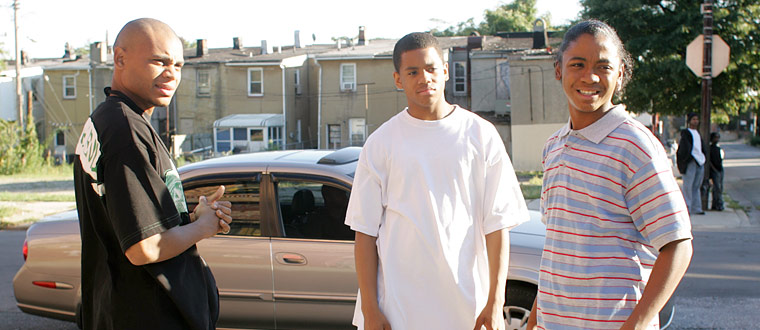
Season 1 starts with a new unit being set up to interdict the drug trade in Baltimore. Season 2 re-unites the team to combat illegal imports and illegal importation of sex slaves out of Eastern Europe and Asia. Season 3, my favorite season of all, is back to the drug trade, but with a difference.
In Season 3, one police district changes the rules. They clean up their neighborhood and send all the drug traders and sex trade workers to one area. The area doesn’t legalize crime – not exactly – but the police leave that area alone. As they explain it to the primary drug dealers, it’s a little like Amsterdam. The homies don’t understand; they call it “Hamsterdam”. I laugh everytime I hear it.
The series doesn’t focus strictly on the police – we get to go inside to watch how the drug dealers organize and divide up the city. We learn how drug lords use big business management modules to streamline their supply and demand, and to stay ahead of the police technology. And they are masters at manipulating the judicial system.
There is brutality. There is sex. There is love and there is betrayal. Sometimes, it isn’t easy to tell who the “good” guys are. There are bad guys who show decent values and there are police and politicians on the take. You get the impression it is probably pretty real stuff. In one season 3 episode, a policeman is shot in the line of duty, and they hold a wake in an Irish pub. They are all very very drunk, and vomiting out in the streets. It isn’t pretty.
And all the same, when each season ends, we can hardly wait for the next one. It is gripping drama, vintage HBO cutting edge production. It keeps you on the edge of your chair. You can read more about The Wire at it’s HBO site, where I just learned that The San Francisco Chronicle calls The Wire “the best television show of the year.”
Internet Phones Giggle
From a teeny-tiny article on page 2 of today’s Kuwait Times:
‘Phone’ Teams Honored
Kuwait: It is important to reduce charges of international calls to prevent illegal activities, Communication Minister Dr. Maasouma Al-Mubarak stressed yesterday.
In a press conference held on the occasion of honoring the team of the ministry’s telephone control department, Al-Mubarak said the department succeeded in cooperation with the Interior Ministry in locating and stopping illegal international calls dealers praising their efforts that continued despite the dangers they faced.
My comment: I’m sorry. I truly mean no disrespect. And at the same time I am having a very hard time trying to maintain a straight face. Oh, these dangerous telephone callers out there!
• Raiding brothels.
• Chasing drug dealers.
• Dealing with arrogant/immature/drunk/drugged drivers.
• Family disputes involving knives and guns.
• Protecting the borders, land and sea.
All of the above can involve serious dangers. One of the axioms in policing is that your most dangerous call is getting between a fighting husband and wife. But the bravery of raiding telephone call centers? Please. Spare me.
You can’t turn back the clock. Technology has given us a whole new way of making international calls. The MOC can spend its resources fighting a numerous enemy – people who want to make reasonably priced phone calls – or they can become a part of the solution, regulating and encouraging growths of new technologies to the greater good of all.

Fat Impairs Fertility?
Today’s (March 10) Kuwait Times
Fat lovers face slimmer chance of parenthood
PARIS: Love handles might help couples get a better grip but all that excess fat could dampen their chances of having a baby, a new study has shown. Researchers monitoring nearly 48,000 couples in Denmark between 1996 and 2002 found that when both parents were clinically obese, the risk of waiting more than a year before conceiving nearly tripled. The odds improved somewhat when the prospective parents were simply overweight, but even they had to persist in their efforts longer than their leaner counterparts. Obesity could even have a demographic impact in countries where the problem of fat has taken on epidemic proportions, said the study published this week in the British Journal of Human Reproduction
“If obesity is a cause of sub-fecundity . . . this reduced capacity to reproduce could become a serious health problem.” said lead author Cecilia Ramlau-Hansen, an epidemiologist at Aarhus University in Denmark, in an interview. “The heavier the population gets, the more problems we would see with infertility,” she said. Earlier research had already established a clear link between too much fat and levels of fertility hormones. In women, excess body fat has a negative impact on ovulation and conception; in men, it is linked with decreased semen quality and the level of reproductive hormones.
But this is the first study, which looked at the conception rate among obese couples, who are increasingly common. In the United States, 30 percent of the adults – some 60 million people – are clinically obese, according to the US National Center for Health Statistics. Within certain demographic groups, such as African-Americans, the rate is even higher. In Europe, Britain tops the list with 23%, nearly twice the rate in Germany, where 12% tip the scales into obesity, according to the Organization for Economic Cooperation and Development.
The benchmark for obesity is the body-mass index, defined as one’s weight in kilograms divided by the square of one’s height in meters. A BMI from 18.5 up to 25 is considered in the healthy range, from 25 up to 30 is overweight, and 30 or higher is obese. The authors add a word of caution, saying they did not know how often the couples in their study had sex.
“We cannot exclude that infrequent intercourse has delayed conception in overweight and obese couples,” they say, delicately. In other words, more fat may mean less sex . . . so the fertility problem could lie elsewhere.”
Recent Comments
ExpatAlien on What Country am I Living … intlxpatr on Yellowstone: Old Faithful to C… Michelle on Yellowstone: Old Faithful to C… Cathy on No Grown-Ups in Charge intlxpatr on Waiting for Snow Wikipedia Donate Button

Amazina


Early Voting in Florida


 Here There and Everywhere