Driving in Kuwait – Traffic Stop
Sitting on the side of the road waiting to catch speeding drivers, a
Kuwaiti traffic policeman sees a car puttering along at 30 km/h. He thinks to himself, “This driver is as dangerous as a speeder!”
So he turns on his lights and pulls the driver over. Approaching the car, he notices that there are women – two in the front seat and three in the back, wide-eyed and white as ghosts. The driver, obviously concerned, says to him, “Officer, I don’t understand. I was going the exact speed limit, 30 km/hr. What seems to be the problem?”
The policeman, trying to contain a chuckle, explains to her that 30 was
the road number, not the speed limit. A bit embarrassed, the woman
grins and thanks the officer for pointing out her error.
“But before you go, Ma’am, I have to ask, is everyone in this car OK?
These women seem awfully shaken.”
“Oh, they’ll be all right in a minute, officer. We just got off Road 303.”
The Power of Words
I’m slow with the whole blogging thing. It’s taken me this long to figure out “link.” But I persist. I want to share with you two particular websites that give you the power of using the exact, most descriptive word or phrase.
A Word a Day has over 600,000 subscribers in every country of the world. Originally started as a labor of love, AWAD now has books and interviews. You can subscribe to get a daily e-mail with a new word, its meaning and its origin. Every week has a theme – last week it was Talk Like a Pirate! AWAD is fun, and a great tool for learning.
The wordorigins.org site has a big list of words and phrases that aren’t what they appear to be, like “pussyfoot”. We use phrases all the time that we don’t know why we use – this site tells you where the phrases and words originated, and how they should be used.
If you have not yet downloaded Google Earth, it is free, and it is fantastic. Kuwait is now so hi res that you can see a tiny little person in a swimming pool. Take a look, and start discovering the power of Geography!
Get Out of Jail Free Card
Who could be whispering my name?
I was in the Jarir bookstore, on my way to the airport after a three week visit to Saudi Arabia. My husband wanted me to get a feel for the place before moving there to be with him. To my surprise, I really liked Saudi Arabia, what little I had seen of it. And I really wanted to be with my husband. But who could be calling my name?
“I can’t believe it! Is that you, teacher?”
I turned to see a traditionally garbed man, whom I instantly recognized as my former student in classes I had taught back in the US.
“Khalid! Khalid! I am so glad to see you!” I exclaimed, and I was. Khalid was one of my very best students, before he disappeared from classes. He was bright, he studied hard, and from time to time, he would even practice hard and tell a joke in English. He was a student any teacher would remember. He had more maturity than the other students, who treated him with respect, but he also had a delightful sense of humor.
Instantly, my husband and two other men who had come with us to the bookstore were standing between Khalid and me. I knew they were protecting me, so I quickly explained who Khalid was, and introduced him to the men with me.
“You remembered my name!” he said with an astonished look.
“Of course!” I assured him, “You were one of my best students. I missed you when you left.”
“Truly God works in mysterious ways,” Khalid looked dazed. “I never dreamed I would see you again, and here you are, in my country.”
We had to leave. Khalid gave me his card, and asked that I call so his mother could invite me for tea. I told him I wouldn’t be back for a couple months, and he said he was hoping to start legal studies in London in January.
In the car, my husband and the other two guys were cracking up, slapping their knees, almost howling with laughter. I was annoyed; what was so funny about my running into an old friend?
“He’s a muttawa!” they exclaimed, continuing their cackles, “You’re friend is a muttawa!”
The muttawa, the religious police in Saudi Arabia, are kind of the boogeyman, and we scare one another telling Muttawa stories. The problem is that you never know what new rules are going to go into effect, or what old rules they will begin enforcing. Our embassy guidance, for example, was that we were NOT to cover our hair, that it was a choice made by Moslem women, but not a requirement for non-Moslem women. We were also told to carry a scarf and not to argue if a muttawa told us to cover our hair, but to cover, and to take it off again when out of sight.
We were told that if our abaya was too short, a muttawa might hit our legs with sticks. We were told not to laugh, and to keep our eyes lowered to the ground to avoid problems. We were told that sometimes you might be arrested and not even know what you were being arrested for, and to always carry your cell phone with the embassy number on speed dial. In short, we lived in terror of arbitrary powers of the dreaded muttawa.
“Khalid is muttawa?” I couldn’t believe my ears. My husband explained how you could identify muttawa, the short robes, the lack of egal, the sandals, and that Khalid had probably broken the rules he was in Jarir to enforce by having spoken to me.
I never saw Khalid again, not in the Jarir bookstore, not anywhere. I am guessing by the time I returned to live in Riyadh, he was in London studying. But I often think of his amazement, and my own, in that one-time encounter. I often think, as he said, that “God works in mysterious ways.” I wish him well.
For me, I was never again terrified of the Muttawa. Khalid was muttawa, and he was a good man. I carried Khalid’s card with me, and figured if ever I was arrested (never even came close) that I would tell them to call Khalid, and he would help me. I thought of it as my “Get out of Jail Free” card.
Going back to the Locard Exchange Principal . . . knowing Khalid as a student and as a person made a difference to me. It colored my ideas about the muttawa, made me less afraid. If the Locard Exchange Principal works on a social and spiritual level, I wonder if knowing me has colored his perceptions?
Is This For Real?
This information is being forwarded on the Internet, and in e-mails. . . is this for real?

For Jewaira
( . . .And for all Mother’s who wonder if they are making a difference. . . )
When you thought I wasn’t looking
Author: Unknown
When you thought I wasn’t looking,
I saw you hang my first painting on the refrigerator,
and I wanted to paint another one.
When you thought I wasn’t looking,
I saw you feed a stray cat,
and I thought it was good to be kind to animals.
When you thought I wasn’t looking,
I saw you make my favorite cake for me,
and I knew that little things are special things.
When you thought I wasn’t looking,
I heard you say a prayer,
and I believed that there was a God to talk to.
When you thought I wasn’t looking,
I felt you kiss me goodnight,
and I felt loved.
When you thought I wasn’t looking,
I saw tears come from your eyes,
and I learned that sometimes things hurt,
but it’s alright to cry.
When you thought I wasn’t looking,
I saw that you cared,
and I wanted to be everything that I could be.
When you thought I wasn’t looking,
I looked….
and I wanted to say thanks for all the things I saw
when you thought I wasn’t looking.
Fasting Question
Ramadan blessings to all our Moslem friends, and a question. I read the Qur’an, also, and am amazed at how alike many passages are in both our holy books. In today’s readings for our church is a passage on fasting. Is there a comparable reading in the Qur’an? Is there a tradition one way or the other?
Matthew 6
16 ‘And whenever you fast, do not look dismal, like the hypocrites, for they disfigure their faces so as to show others that they are fasting. Truly I tell you, they have received their reward. 17 But when you fast, put oil on your head and wash your face, 18 so that your fasting may be seen not by others but by your Father who is in secret; and your Father who sees in secret will reward you.*
“I’m Not Japanese Anymore”
she said, and we dissolved into gales of giggles. We struggled to regain control over ourselves. She was the Japanese ambassador’s wife, my dear friend, and we would hide out and have coffee together whenever our busy schedules would allow. We always sought out the quietest time of day, the most remote tables, so we could have complete and utter privacy as we shared our week, our worries about our kids, our lives.

Our topic was a recurring one in our conversations – that once you have left your native country and lived elsewhere, you aren’t the same anymore. Your eyes change, and you see things differently, your taste buds change and the unfamiliar becomes familiar. Unacceptable color combinations become acceptable, the cacaphonous and discordant become music to your ears. Once you have lived in a foreign country, you can never be truly the person you were before you left.
“I’m not so patient with ceremony any more,” she continued, and we dissolved into laugher again, because her life was full of endless ceremonial events. The great blessing in all this for both of us, is that we are both married to men who are at the same time traditional and ceremonial, and secret iconoclasts. Every now and then we could even get together, all four of us, and share an evening of relaxation and laughter, mostly laughing at ourselves and the difference between how others perceived us, and how we really are.
We treasure these friends. They are the kind that could call us late in the day and say “We are unexpectedly free tonight – can you meet us?” and if there was any way we could, we would. They were our playmates; when we were together we were free to be totally ourselves.
Sometimes in life we are handed roles to play, and if we are honorable people, we play them as best we can. The secret is to keep a very clear idea of where the role ends and we begin. We show respect where respect is due, we carry out the rituals that give richness and tradition to our lives, and heritage to our children.
But glory and honors are transient. Roles and job titles come and go. Good friends and those who keep your worst secrets – they are worth more than gold and diamonds.
Where are You?
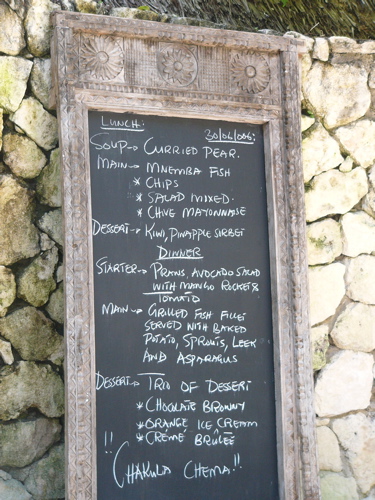
You want to get away from it all – where to go? This island paradise is THE great escape. Luxury, privacy, great food, expeditions, exotic location – everything you ever wanted. Where are you?



The No. 1 Ladies’ Detective Agency, and more
If you enjoyed the trip through Botswana and would like to read more about Botswana, if you think you might go there someday, or if you think you might never go there – you need to read a wonderful series of books by Alexander McCall Smith.
The first book is The No. 1 Ladies’ Detective Agency. You meet the main character, and heroine, Mma Precious Ramotswe, the founder and owner of the only women’s detective agency in Botswana, and her assistant, Mma Grace Makutsi (who can’t resist a handsome pair of shoes), and the love of her Mma Ramotswe’s life, Mr. J. L. B. Matekone. Mma Ramotswe describes herself as “a woman of traditional build” and drives a very old, small white truck. She has a way of looking at things differently – and she solves her mysteries in ways you or I wouldn’t think of.
The books are short, and deceptively simple. They are “feel good” books, giving you smiles and warming your heart as you read. At the same time, you find yourself thinking back to these books, some of the issues, some of the characters, some of the plots – long after you have finished the book. That’s a sign of a good read!
As different as the thinking and culture is, the books are so full of grace and good humor and tolerance and forgiveness that when the book finishes, you can hardly wait to start the next one. You feel like Precious is your sister, a very smart sister, not without her flaws, but a woman to be respected, a woman of good character and who can make tough decisions.
She also makes mistakes, and has to live with the consequences. You will find the books addictive. The entire series is:
The No. 1 Ladies Detective Agency
Tears of the Giraffe
Morality for Beautiful Girls
The Kalahari Typing School for Men
The Full Cupboard of Life
In the Company of Cheerful Ladies
Blue Shoes and Happiness
Jeffrey Deaver’s mysteries, on the other hand, are intricate and woven through with arcane information, but you always learn something. He has a series about a quadriplegic, Lincoln Rymes, a criminologist, who solves cases in a very Sherlock Holmes kind of way, by thinking about the evidence and the patterns that it presents. He has a girlfriend, Amelia, who is a policewoman, and works with him on many of the cases. The books that have these two characters are:
The Bone Collector
The Coffin Dancer
The Empty Chair
The Stone Monkey
The Vanished Man
The Twelfth Card
Last – and least, for The Devil Wears Prada crowd is Linda Fairstein, who almost always has a book on the New York Times best seller list. Her heroine is Manhattan sex-crimes prosecutor (District Attorney) Alexandra Cooper, whose dad made a fortune on an artificial heart device, allowing her to work in the public service sector and still wear fabulous clothes, have weekly manicures and hair stylings at the best salons and eat at the coolest restaurants in town, and she tells you all about them.
They make great airplane reading for the trendy. The plots are formulaic – an astounding, mysterious crime is committed, Alexandra gets involved, along with her detective side-kicks, the criminal involved somehow focuses on Alexandra and she has to spend the night at her friends’ houses. You don’t read these mysteries for the astounding plots, you read them because they are funny and superficial and a quick read that doesn’t require much thinking.
Happy reading!
Recent Comments
ExpatAlien on What Country am I Living … intlxpatr on Yellowstone: Old Faithful to C… Michelle on Yellowstone: Old Faithful to C… Cathy on No Grown-Ups in Charge intlxpatr on Waiting for Snow Wikipedia Donate Button

Amazina


Early Voting in Florida


 Here There and Everywhere