My Friend Shin Yuu . . .
LLOOOLLLL! He wants to send us money because our economy is getting better? Mr. Shin Yuu, please send your donation directly to the US Treasury! They need all the help they can get!
Attn:
My name is MR.SHIN YUU,a contractor from Japan.The statistics shows that the Economy of your country is getting better and will be more profitable in few years to come. I am interested to invest in your country through you. I am in HONG KONG NOW with the Sum of Sixteen Million,five Hundred Thousand US Dollars ($16,500.000.00) that I would like to invest in your country if possible?
I made this money through a contract awarded to me by the ministry during the relocation of OSAKA AIRPORT,and I am not safe if I go back to Japan because I did not finish the contract. I hope you can understand my situation and assist me to invest this money properly as this is my only hope.
Please kindly get back to me as soon as possible.
Best regards,
MR. SHIN YUU
Whatever Floats Your Boat
Actually, I hate that phrase, but today it fits. I looked out the window and laughed – there is a tanker, floating above the horizon. At first, I almost thought it was a balloon. Look! See for yourself:

The day is so clear, I can see the tin roofs on Failaika Island with my bare eye. It isn’t much, but it is the clearest day in a long time:

In today’s Kuwait Times, Dr. Saleh al-Ajeeri tells us that the chances of rainfall are going away because the winds are changing, and that the temperatures are going to fall again. It’s hard for me to believe, on a day like today, warm and sunny and not a cloud in the sky, it’s hard to believe it is going to be cold. Dr. Al-Ajeeri says “The winter season is still going on and the cold will return during a season locally known as the ‘Scorpion’s Cold'” and that we can’t count on higher temperatures until the end of February.
SCORPION’S COLD?? OK, my Kuwaiti friends, I have never heard of that before. Can anyone explain to me what this is? And what it it called in Arabic?
Together We Can
This one gave me shivers – the good kind. Together we can – take the pledge:
Starbucks Press Release
Thanks to a good friend who forwarded this . . . haven’t seen any slowdown in the Starbucks I visit. 🙂
January 16, 2009
Facts about Starbucks in the Middle East Arabic Language Statement
It is disheartening that calls for boycotts of Starbucks stores and products, which are based on blatant untruths, have had direct impacts on local economies and residents, and have also led to violent situations involving our stores, partners (employees) and customers.
Our more than 160,000 partners and business associates around the globe have diverse views about a wide range of topics. Regardless of that spectrum of belief, Starbucks Coffee Company remains a non-political organization. We do not support any political or religious cause. Further, allegations that Starbucks provides financial support to the Israeli government and/or the Israeli Army in any way are unequivocally false. Unfortunately, these rumors persist despite our best efforts to refute them.
What we do believe in, and remain focused on, is staying true to our company’s long-standing heritage — simply connecting with our partners and customers over a cup of high quality coffee and offering the best experience possible to them – regardless of geographical location. Though our roots are in the United States, we are a global company with stores in 49 countries, including more than 230 stores in nine Middle Eastern countries. In countries where we do business, we are proud to be a part of the fabric of the local community — working directly with local partners who operate our stores, employing thousands of local citizens, serving millions of customers and positively impacting many others through our support of neighborhoods and cities.
Myths
Is it true that Starbucks provides financial support to Israel?
No. This is absolutely untrue. Rumors that Starbucks Coffee Company provides financial support to the Israeli government and/or the Israeli Army are unequivocally false. Starbucks is a publicly held company and as such, is required to disclose any corporate giving each year through a proxy statement. In addition, articles in the London Telegraph (U.K.), New Straits Times (Malaysia), and Spiked (online) provide an outside perspective on these false rumors.
Has Starbucks ever sent any of its profits to the Israeli government and/or Israeli army?
No. This is absolutely untrue.
Is it true that Starbucks is teaming with other American corporations to send their last several weeks of profits to the Israeli government and/or the Israeli Army?
No. This is absolutely untrue.
Is it true that Starbucks closed its stores in Israel for political reasons?
No. We do not make business decisions based on political issues. We decided to dissolve our partnership in Israel in 2003 due to the on-going operational challenges that we experienced in that market. After many months of discussion with our partner we came to this amicable decision. While this was a difficult decision for both companies, we believe it remains the right decision for our businesses.
Middle East Partnership and Operations
Do you work with a Middle East partner to operate Starbucks stores?
Through a licensing agreement with trading partner and licensee MH Alshaya WLL, a private Kuwait family business, Starbucks has operated in the Middle East since 1999. Today Alshaya Group, recognized as one of the leading and most influential retailing franchisees in the region, operates more than 274 Starbucks stores in the Middle East and Levant region. In addition to its Starbucks stores, the Alshaya Group operates more than 1,700 other retail stores in the region, providing jobs for more than 15,000 employees of more than 35 nationalities.
We are extremely fortunate and proud to have forged a successful partnership for the past ten years and look forward to building on this success.
In which Middle Eastern countries do you operate?
We partner with Alshaya Group to operate Starbucks stores in Egypt, Kuwait, KSA, Bahrain, Qatar, Oman, UAE, Jordan and Lebanon in the Middle East region. We are fortunate to have the opportunity to work with so many communities, and we are committed to providing the Starbucks Experience while respecting the local customs and cultures of each country we are a part of. We are also committed to hiring locally, providing jobs to thousands of local citizens in the countries where we operate.
Are you still operating Starbucks stores in Israel? If not, do you have plans to re-open should the opportunity arise?
We decided to dissolve our partnership in Israel in 2003 due to the on-going operational challenges that we experienced in that market.
When and where the business case makes sense and we see a fit for the Starbucks brand in a market we will work closely with a local partner to assess the feasibility of offering our brand to that community. We will therefore continue to assess all opportunities on this basis. At present, we will continue to grow our business in the Middle East as we have been very gratified by the strong reception of the brand in the region. We continue to work closely with our business partner, the Alshaya Group, in developing our plans for the region.
Contact Information:
Starbucks Coffee Company
Customer Relations
(800) 235-2883
info@starbucks.com
Sweet Home Alabama – As You’ve NEVER Seen it
Courtesy of my friend, Momcat, who shares my quirky sense of humor:
ROCKING RUSSKIES
Written by To The Point News
Thursday, 06 March 2008
Prepare yourself for this one – maybe with a Stoli martini or two.
Back in the days of the Soviet Union, the Soviet Red Army had an official choir composed of male soldiers and musicians. It still exists. The Red Army Choir performs throughout Russia to this day.
Now consider the Finnish rock band called The Leningrad Cowboys. A little while ago, they held a concert in Russia, in which – to the screaming applause of Russkie teen-agers – they got the Red Army Choir to join them on stage for a performance of “Sweet Home Alabama.” In English. You couldn’t make this up.
We’re talking seriously off the wall here. Better have that Stoli ready when you watch it:
(Prepare to die, laughing!) DA! Da! Da!
The Wexford Carole (with slideshow)
An old Irish favorite:
Good Morning, Kuwait!

Good morning, Kuwait, and another gorgeous morning it is!
For a moment, I wondered why I was doing this – all my college students missing Kuwait are back home for the holidays. But – with all that partying, going to diwaniyya, etc. I am guessing most of you missed the sunrise.
It’s considerably warmer. The day is going to be perfect, warm, comfortable – not hot. Not cold, either. Have a great day, Kuwait!

Bulgur/Burgul and Garbonzo Beans/Hummos – Great Cold Weather Fare
While we were staying with our son and his wife, we had a lot of fun cooking. EnviroGirl shared a great grain recipe, with like seven different grains. It reminded me that I had wanted to find a recipe for the wonderful dish we ate at Naranj, in Damascus so I Googled, and found a recipe that sounded a lot like it – and besides that, it looks really simple.
There are a lot of ingredients I cannot find in Kuwait, but burgul is something easily found. I gave it a try, and AdventureMan and I agreed, it is a total keeper. Looks pretty good, hmmm?
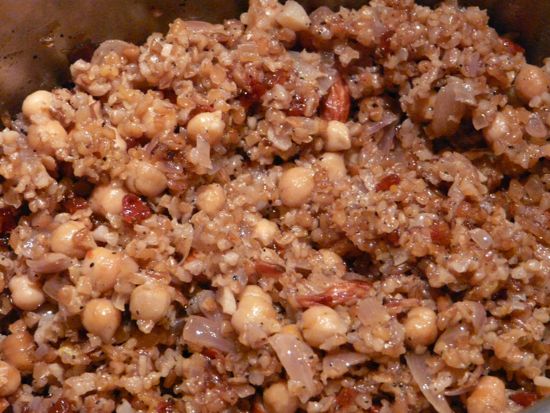
When we sat down to dinner, AdventureMan asked what it was called.
“Burgul and garbanzo beans,” I replied.
“What was it called in Damascus?” he asked.
“Burgul Wa Hummos” I replied, and we both laughed, because it is exactly the same name, except maybe it was called “Hummos wa Burgul,” I might have switched it. Same thing, same thing.
Of course, I changed the original recipe a little. The one we had in Damascus was sinfully butter-y.
Here is the original recipe:
Bulgur and Garbanzo Bean Pilaf
1 1/2 cup Chopped onion
2 tbl Butter or olive oil
1cup Bulgur or cracked wheat
1cup Canned garbanzo beans, drained and rinsed
1/4 cup Diced dried apricots or golden raisins
1 stk cinnamon
2 cup chicken broth
2 tbl Sliced natural almonds, toasted in dry skillet
Method :
• Combine onion and butter in deep wide skillet. Cook, stirring, over mediun-low heat until onion is golden, about 10 minutes. Stir in bulgur, garbanzo beans, apricots and cinnamon stick.
• Add broth and bring to boil. Stir once. Cover and cook over low heat until broth is absorbed. about 20 minutes. Let stand. covered, 10 minutes.
• Meanwhile, toast almonds in small dry skillet, stirring, over low heat, about 3 minutes. Remove cinnamon stick from pilaf. Sprinkle almonds over pilaf and serve.
• Makes 4 servings.
I doubled the butter. I added five cloves of finely chopped garlic, which I sauteed until soft. Instead of apricots or raisins, I used those dried pomegranate seeds you find in the Mubarakiyya market – can someone tell me what they are called? So tart, so beautiful, so delicious! It just made this dish.
(Wiki says: Wild pomegranate seeds are sometimes used as a spice known as anardana (which literally means pomegranate (anar) seeds (dana) in Persian)
We used about double the toasted almonds.
This was my very first time ever for toasting almonds. It took me a little longer than three minutes; maybe my low heat is too low, but it was fun, and the toasted almonds make a big difference in the final taste. I had so much fun toasting the almonds that afterwards, I also toasted sesame seeds, just to see if I could (and I could! 🙂 )
I have to tell you, this dish is delicious! We are trying to eat less meat, eat lower on the food chain, and this dish will help us to do that. We figured, we actually could add a little meat – some leftover chunks of chicken, some sausage, or even some shrimp – and it would still be really really good, and keep meat intake minimal.
Does anyone eat burgul for breakfast? It seems to me it would be good with a little brown sugar and cinnamon and pecans, or blueberries?
Butterfly Award

“I’m choosing three blogs to pass it on to and asking that they tell us why they started blogging and then pass the love on to three of their favorite blogs.”
I was nominated for the Butterfly Award by Scars and Souvenirs (I always have a problem spelling “souvenirs!”) and of course, right now while I am travelling and my posts are sporadic and erratic and varying in quality, I feel totally unworthy! Scars and Souvenirs is a very intelligent Syrian blog, written by a woman with a lot of insight and interesting thoughts who lives and works in Damascus, one of my favorite places on earth. I am totally honored she would nominate me.
I discovered blogs when I was moving to Kuwait. I was particularly fascinated by two women bloggers, Jewaira and 1001 Nights (another articulate and intelligent blog; she is, unfortunately, no longer blogging.) I started blogging when my comments began to be longer than the original blog entry and I figured it was time. It was very scary for me, and I made a lot of mistakes with the new technology, but persevered.
There are new bloggers showing up all the time. I would like to nominate three that have fresh, original voices, authentic voices, and from whom I learn more about Kuwait:
Kill the Damn Patient
Danderma’s Blog
Confessions of a Love-Struck Flana
Premarital Testing Made Compulsory in Kuwait
From today’s Al Watan
MPs make premarital tests compulsory
KUWAIT: The National Assembly passed a new law on Tuesday that makes preـmarital medical checks compulsory.
The first article of the law stipulates that wouldـbe couples have to undergo medical tests to verify they are free from contagious or hereditary diseases.
In they are free of the diseases outlined in a decree by the minister of health they will get a medical certificate that proves their marriage is safe.
The document is valid for six months only, according to the provisions of the new law.
The second article bans the endorsement of a marriage by any concerned authorities without a valid medical certificate.
If the medical report shows that the possible marriage is unsafe and the wouldـbe couple still insists on getting married, the marriage officer must get a written notice from the couple stating that they are aware of the risks and want to pursue the affair.
The third article of the law stipulates that the minister of health should issue executive statutes for the new legislation which includes the type of medical tests required and the relevant procedures within three months of the new law”s publication in the official gazette.
The fourth article pertains to the privacy of all the information contained in the medical report and stipulates a punishment of up to one year in prison and up to 1,000 Kuwaiti dinars as a fine on anyone who might violate the privacy of such information.
The fifth article stipulates either or both punishments of up to oneـyear in prison and up to KD 1,000 fine on the marriage officer should he violate the provisions of the second article. ـKUNA
Last updated on Wednesday 12/11/2008
Recent Comments
ExpatAlien on What Country am I Living … intlxpatr on Yellowstone: Old Faithful to C… Michelle on Yellowstone: Old Faithful to C… Cathy on No Grown-Ups in Charge intlxpatr on Waiting for Snow Wikipedia Donate Button

Amazina


Early Voting in Florida


 Here There and Everywhere