Jump Back In the Market?
Thank you, AbdulAziz, for this interesting article on today’s investment opportunities from Yahoo News: Finances where you can read the entire article>
Why Stocks Are Dirt Cheap
by Jeremy Siegel, Ph.D.
No one can guarantee the future of the stock market. But I believe that stock prices are now so extraordinarily cheap that I would be very surprised that if an investor who bought a diversified portfolio today did not make at least 20% or more on his investment in the next twelve months.
Valuations Low Worldwide
The case for equities at these levels is compelling. The last time we have seen prices this low was more than 30 years ago, when the US economy was in far worse shape than today.
The table below lists the price-to-earnings ratios of the world’s major stock markets as of October 29. It is taken directly from the Bloomberg World P-E Ratio (WPE) screen. These P-E ratios are calculated based on 2008 earnings, of which the first two quarters have already been reported and the 3rd and 4th quarters’ earnings are estimated. Keep in mind that the average historical P-E ratio of the US stock market has been 15 and that when P-E ratios are ten or lower, investors have reaped generous rewards from investing in stocks.
Except for the tech-laden Nasdaq, the US markets are selling at 10 to 11 times 2008 estimated earnings while European markets, save Switzerland, are selling between 7 and 9 times earnings. Asian stocks are also very cheap, as the Japanese Nikkei Index is selling at 11.4 times earnings, not much different than stocks in Hong Kong, Australia, and Singapore. The Chinese market, which had been selling at over 50 times earnings last year is now selling at a far more modest 15 times earnings.
Bears will claim that these P-E ratios are too low, since earnings will sharply deteriorate over the next twelve months. Indeed, the last 12 months of reported earnings on the S&P 500 Index have fallen to $51.37 from $84.92 a year earlier. On those numbers, the US market is selling at about an 18 multiple.
But this gives a very distorted picture of the market. Aggregate earnings over the past year are greatly depressed by huge write-offs not only in the financial sector but in other firms. For example, Ford, GM, and Sprint, whose aggregate market value is less than 0.2% of the S&P 500 Index, lowered the S&P’s reported earnings by about $12.00, more than 20% of the current aggregate earnings.
Even if these firms all go bankrupt and their stock prices go to zero, it would have a negligible impact on the market value of a well-diversified stock portfolio. The same is true of the financial sector as S&P adds the huge losses in banks that now have almost no value today to the earnings of profitable firms. This means that the P-E ratio of firms that are still profitable is far lower than the ratio calculated for the whole index.
Furthermore, it is a major mistake to use earnings in a recession when calculating the right valuation of the market going forward. That is because stock values are dependent on earnings far in the future, not just those estimated over the next 12 month.
Since stocks have historically sold at 15 times annual earnings, the earnings of the next twelve months contribute only 1/15 of the value of the firm, or less than 7%. The other 93% of the value of stock is realized beyond the next twelve months. Right now the “normal” level of earnings, based on trend analysis of past 15 years of earnings on the S&P 500 Index is $92 a share.
If the average 15 price-earnings ratio applied to these $92 per share normalized earnings, the S&P 500 Index would be selling at 1380, which is almost 50% above its current level. Even if it takes two, or even three years for earnings to return to thetrend line, the normalized valuation of the market is far above what it is today.
Read the rest of the article HERE.
Ain’t No Sunshine . . .
I was up to take the sunrise photo, but once again, no sunrise. The streets are wet, but the clouds are high and it looks like the rain may hold off long enough for go-to-work/school traffic. Be careful out there, Kuwait. During the recent rains there were many many more accidents, according to Traffic Police.

That color range is pretty much the colors houses are painted in the great Pacific Northwest. 🙂
Grab your fleece, grab your sweaters – look at the temperatures expected for today:

Have a great Thursday, Kuwait.
More Bacteria on Women’s Hands
This is from BBC Health News:
Women’s hands ‘harbour more bugs’
Human skin harbours many bacteria
Women have a greater range of different types of bacteria on the palms of their hands than men, US research suggests.
The study also found that human hands harbour far higher numbers of bacteria species than previously thought.
Using powerful gene sequencing techniques, researchers found a typical hand had roughly 150 different species of bacteria living on it.
The Proceedings of the National Academy of Sciences study found bacteria types varied greatly between individuals.
The researchers, from the University of Colorado at Boulder, hope their work will help scientists to establish a “healthy baseline” of bacteria species on the human hand.
This could potentially help them to identify which species are linked to specific diseases.
Lead researcher Dr Noah Fierer said: “The sheer number of bacteria species detected on the hands of the study participants was a big surprise, and so was the greater diversity of bacteria we found on the hands of women.”
The study detected and identified more than 4,700 different bacteria species across 102 human hands in the study.
However, only five species were shared among all 51 participants.
Even the right and left palms of the same individual shared an average of only 17% of the same bacteria types.
Acidic skin
Dr Fierer said that the higher bacterial diversity on women’s hands may be due to the fact that men tend to have more acidic skin, which provides a more harsh living environment for the microscopic bugs.
Alternatively, differences in sweat, oil gland or hormone production may be key – or the fact that women and men tend to make different use of cosmetics such as moisturisers.
Dr Fierer said the study also found hand washing had little impact on the diversity of bacteria found on an individual’s hands.
Maybe it’s because Women carry purses?


Remigius of France
When James Kiefer writes up the saints in The Lectionary he gets a little long-winded, and yet, I find myself reading every word and understanding more and more about the origins and development of the Christian faith. In this entry, we learn about Remi, Bishop of Rheims, we learn about a very transitory period in European and Christian history, and we learn about a family of women whose marriages to pagans, and conversions of them to the Christian faith, changed the flow of history.
REMIGIUS OF RHEIMS
BISHOP, APOSTLE OF THE FRANKS (1 OCTOBER 530)
St. Remi (or Remigius)
A 1987 motion picture, “The Big Easy” (a nickname for the city of New Orleans), and a current (1996) television series of the same name based on it, have as the male lead a Cajun police detective named Remy McSwaine. In the first episode of the series (I am not sure of the film) we are informed that “Remy” is short for “Remington.” I fear that this shows that the scriptwriters have not troubled to research Cajun culture. Remi is one of the three great national saints of France (the others are Denis (Dionysius) of Paris and Joan of Arc, or Joan the Maid (Jeanne la Pucelle)), and it is thoroughly natural for a Cajun to be named Remi. How is that for a topical introduction?
Remi (Latin Remigius) was born about 438 and became bishop of Rheims about 460, at the remarkably young age of 22. (Both he and the city were named for his tribe, the Remi.) In his time, the Roman Empire and the Christian church were jointly faced with a serious practical problem — the barbarian invasions. A series of droughts in central Asia had driven its inhabitants out in all directions in search of more livable territory. This brought the Goths, for example, across the Danube in the early 300’s. Now the Emperor Constantine had died in 337, and during his lifetime the Church had debated the question of whether the Logos, the Word who was made flesh for our salvation in the person of Jesus of Nazareth, was (as Arius taught) the first and greatest of the beings created by God, but nevertheless not eternal, and not God; or was (as Athanasius taught) fully God, co-eternal and co-equal with the Father.
At the Council of Nicea in 325, the Athanasian position had been endorsed by an overwhelming majority of the bishops assembled from throughout the Christian world. But the Arians refused to accept the decision, and there were attempts to re-negotiate and find a compromise that would make everyone happy. Then Constantine died, and his Empire was divided among his sons, with Constantius Emperor of the East, and eventually of the whole Empire. And Constantius was an Arian, and made a serious attempt to stamp out the Athanasian position by banishing its leaders and pressuring churches into electing or accepting Arian bishops.
During his reign, missionaries, led by one Bishop Ulfilas, were sent to convert the Goths. And naturally, Ulfilas was an Arian. He preached with great vigor and eloquence among the Goths, and translated the Bible into their language (omitting, we are told, the wars of the Hebrews, on the grounds that the Goths were quite warlike enough without further encouragement). In fact, the portions of his translation that have survived are the only material we have in the Gothic language, and as such are highly valued by students of the history of languages. So the Goths became Arian Christians, and so did the Vandals. And these two highly warlike peoples were most of the time either making war on the settled peoples of the Empire or hiring out as mercenaries to defend the borders of the Empire from the next wave of invaders.
You may remember that Ambrose, bishop of Milan (died 397, remembered 7 December), was commanded by the Empress Mother to hand over a church for the use of her soldiers, who were Goths and Arians, and that Ambrose refused, and filled the church with members of his congregation, who sang hymns composed by Ambrose for the occasion, and the soldiers did not attack. You may also remember that when Augustine lay on his deathbed in his town of Hippo in North Africa (near Carthage or modern Tunis), the city was under attack by Vandal troops, who had come into Africa out of Spain, and who captured and vandalized (that is where we get the term) the cities of North Africa, and Sicily and Sardinia and Corsica (which they made into bases for piracy) and the southern part of Italy. Long after Arianism had died out elsewhere, it was the religion of the Goths and Vandals and related peoples, and being an Arian was the mark of a good Army man.
Now a new people appeared on the scene, a pagan warrior tribe called the Franks. In the late 400’s, they were led by a chief called Clovis, a pagan but married to a Christian wife, Clotilda. His wife and Bishop Remi (remember him?) spoke to him about the Christian faith, but he showed no particular signs of interest until one day when he was fighting a battle against the Alemanni, and was badly outnumbered and apparently about to lose the battle. He took a vow that if he won, he would turn Christian. The tide of battle turned, and he won.
Two years later, he kept his vow and was baptized by Remi at Rheims on Christmas Day, 496, together with about 3000 of his followers. (Rheims became the traditional and “proper” place for a French king to be crowned, as we learn from the story of Joan of Arc. It remained so until the French Revolution.) Now Clovis was converted to the Athanasian (or orthodox, or catholic) faith rather than the Arian, and this fact changed the religious history of Europe. The clergy he brought to his court were catholic, and when the Franks as a whole became Christians, which did not happen overnight, they became catholic Christians, meaning in this context that they were Athanasian rather than Arian, and accepted the belief that it was God himself, and not a particularly prominent angel, who came down from heaven and suffered for our salvation. During the preceding century, the Arians had had a near-monopoly on military power, and now this was no longer true.
The conversion of the Franks brought about the conversion of the Visigoths, and eventually (about 300 years later) the empire of Charlemagne and the beginning of the recovery of Western Europe from the earlier collapse of government and of city life under the impact of plague, lead poisoning, currency inflation, confiscatory taxation, multiple invasions, and the assorted troubles of the Dark Ages.
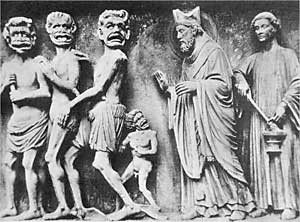
St. Remigius and the demons
Clothilda, Berta and Ethelburga
As noted above, Clot(h)ilda, a Christian princess of Burgundy, married the pagan Clovis, King of the Franks, thus preparing the way for his baptism by Remi in 496, and for the conversion of the Franks. Their great-grandaughter, Bertha, married the pagan Ethelbert, King of Kent, thus preparing the way for his baptism by Augustine of Canterbury in 601, and for the eventual conversion of southeast England. Bertha and Ethelbert’s daughter, Ethelburga, married the pagan Edwin, King of Northumbria, thereby preparing the way for his baptism by Paulinus in 627, and for the eventual conversion of many in the North of England.
End of Ramadan Sunrise
The end of Ramadan is coming with the end of the great heat of summer. I checked Weather Underground: Kuwait this morning, and by Thursday, we will have our first day under 100°F /37°C. WOOOO HOOOOO, Kuwait!
Here is what might be the last sunrise of Ramadan:

How Can I Forgive?
Today’s Gospel reading touches on a very difficult theme – how do we forgive those who sin against us? It is so much easier to cling to hatred and resentment than to let go.
Note to my Christian friends – did you know that the Gospels (Injil“) are considered one of the five Holy Books of the Qur’an? I didn’t – I learned that from Fahad, a blogger who comments here. Wikipedia says that “Muslim scholars generally dispute that Injil refers to either the entire New Testament or the four Gospels. Others believe the Injil was not a physical book, but simply a set of teachings. The word Injil is used in the Qur’an, the Hadith and early Muslim documents to refer specifically to the revelations made by God to Isa (Jesus), and is used by both Muslims and some Arabic-speaking Christians today.”
I mention this only because it is Ramadan, and a season of contemplating God’s word. My Christian friends might wonder why I quote from our books to my Kuwaiti / Gulf friends, but in truth, I find that we are all wrestling with many of the same moral questions, and we just have more tools in our spiritual tool boxes when we share ideas and approaches. I find my Moslem readers can greatly illuminate my own readings when I ask how their books approach – say the problem of Job / Ayyoub or problems of wealth and poverty, or, as today – forgiveness.
This is yesterday’s reading from Forward Day by Day.
Matthew 18:21-35. Lord, if another member of the church sins against me, how often should I forgive? As many as seven times?
Forgiveness is always a difficult matter. In the Eastern church, the season of Lent begins with “Forgiveness Vespers” in which each member of the church asks forgiveness of the priest and of every other member of the church. When the service is completed the entire church has asked forgiveness. It is a healthy way to begin a season of repentance.
To the question, “How many times?” Christ gives an answer that is the equivalent of “However many times you need to.” Forgiveness is a double-edged sword. The sins of those who need to be forgiven bind them and leave them less than free in their quest for peace. For those who must forgive, refusing to forgive can have the same binding effect. It is as though we are tied to all whom we have anything against.
Finding a way to forgive can be difficult. When someone has offended us unknowingly, going to him to confront him with his behavior can be positively damaging. Instead, I use this simple form in my prayers: “Lord, on the day of judgment, do not hold this sin against him.”
House of the Rising Sun
I was wide awake at 0430 this morning. My days are busy; I go to bed at night intending to read and find myself falling asleep too early!
Being awake that early is a good thing for me, it means I can exercise in the pool without feeling watched. There aren’t a lot of people up and around that early. This morning, there was a hot wind and the pool was just a little chilled – it was a great combination. Woooo HOOO on me, I did my exercise!
It also meant I was up to catch the sunrise (what, you thought I was going to write about a house of ill-repute in New Orleans?), but the sunrise never really happened. Around the time of the sunrise, there was just all this haze. The sun had a tough time breaking through; it was a very grey sunrise:

I have miles to go before I sleep today – although maybe I will be able to catch a short cat nap in the afternoon.
Meanwhile, I will leave you with a song I can’t get out of my head:
Chickpea Salad with Ginger
Easy to make, from today’s New York Times
Chickpea Salad With Ginger
Time: 10 minutes with precooked chickpeas
1 tablespoon cumin seeds or ground cumin
3 cups cooked or canned chickpeas (rinse canned ones)
2 bell peppers, red, yellow or orange; cored, seeded and diced
1 red onion, diced
1 1-inch piece ginger, peeled and minced, or more to taste
1 tablespoon sugar, optional
3 tablespoons fresh lemon juice, or to taste
Salt and pepper to taste
Chopped fresh cilantro leaves.
1. In a dry pan, toast cumin seeds over medium-low heat until fragrant, about 2 minutes. Grind to a powder using a spice mill, coffee grinder or mortar and pestle. If using ground cumin, lightly toast.
2. In a large bowl, toss all ingredients but cilantro. (You can prepare dish up to this point in advance; let sit for up to 2 hours.)
3. Taste and add more salt, pepper or lemon juice if you like, garnish with cilantro, and serve.
Yield: 4 servings.
Recent Comments
Cathy on No Grown-Ups in Charge intlxpatr on Waiting for Snow intlxpatr on Waiting for Snow Abou Tabblouleh on t… on Waiting for Snow Abou Tabbouleh on in… on Waiting for Snow Wikipedia Donate Button

Amazina


Early Voting in Florida


 Here There and Everywhere