It may not be dementia. It may be a reaction to a medication in the elderly that LOOKS like dementia.
My father was 87, and doing pretty well for a man 87. He still walked on his own, using a walker when he had to, and very rarely, a wheelchair if we were going a long ways. He went into the hospital for a minor surgery. The tube inserted in his hand for the anesthetic became infected. Dad was acting weird, he was having hallucinations, and my sister rightly identified that Dad had a reaction to the diuretic drug Lasix; when they switched him to an alternative, the raving and hallucinations stopped.
He was transferred to a rehabilitation unit, where for two days, they put him back on Lasix. Poor communication between hospital and the rehab facility, plus standardization of drug regimens – they switched him without telling him, or us. Once again, he went loony tunes, and at the same time, his right hand began to swell until it looked like a lobster claw. He kept saying it hurt, and it was big and red, and the rehab people kept saying it would get better.
Dad was rushed to another hospital, one the rehab clinic worked with, and the doctors told us he had a ‘cascade of problems’ and which were the primary three we wanted them to work with?
Get him off the Lasix, first thing, we all agreed, and find a way to have it annotated on any record that he is never to have Lasix. (It did no good; the next hospitalization, back at the first hospital, they gave him Lasix again, which made him crazy and masked all the other symptoms.)
Long story short, there were a cascade of hospital mistakes – not one hospital, two hospitals and the rehab clinic – where miscommunications, inattentions and shortage of trained personnel resulted in a cascade of issues that led to my father’s death later that year. The other lesson learned is that if you go into a hospital, make sure you have a good support system, someone with you who will bravely ask questions, and remind someone if an inappropriate medication is prescribed. You need a family member with you for protection against inattention, mistakes, miscommunications and personnel shortages.
It’s not like there’s anyone to bring a lawsuit against; they were all doing the best they could, but Dad was old. My bet is that he might have lived another couple years, at the very least, had he not gone in for that first non-essential minor surgery. To me, the moral of the story is if you want to live a long life, stay away from hospitals.
Anesthesia Linked to Increased Dementia Risk in Seniors
Exposure to anesthesia has been linked to a 35 percent increase of dementia in patients over age 65, according to a new study.
By Jeffrey Kopman, Everyday Health Staff Writer
FRIDAY, May 31, 2013 — Caregivers and seniors struggling with the dilemmas of elder care have another risk to weigh against potential rewards — senior patients exposed to general anesthesia face an increased risk of dementia, according to research presented at Euroanaesthesia, the annual congress of the European Society of Anaesthesiology (ESA).
Researchers reviewed the medical information of 9,294 French patients over the age of 65. The patients were interviewed several times over a ten year period to determine their cognitive status.
After two years, 33 percent of participants had been exposed to anesthesia. Most of the exposed patients (19 percent overall) were exposed to general anesthesia — a medically induced coma. The rest were exposed to local/locoregional — any technique to relieve pain in the body — anesthesia.
In total, 632 participants developed dementia eight years after the study began. A majority of these patients, 512, were diagnosed with probable or possible Alzheimer’s disease. The remainder had non-Alzheimer’s dementia.
The gap between dementia related to general anesthesia (22 percent) and non-dementia patients (19 percent) was associated with a 35 percent increased risk of developing dementia. This risk was linked to at least one general anesthesia.
“Elderly patients are at an increased risk for complications following anesthesia and surgery,” said Jeffrey H. Silverstein, MD, MS, and vice chair for research at the Department of Anesthesiology at Mount Sinai in New York City. “[They] are particularly prone to postoperative delirium, which is a loss of orientation and attention. Anesthesiologists have been evaluating higher cognitive functions (for example, memory and executive processing) and found that a substantial number have decreases in one or more of these areas after a surgical procedure.”
Researchers hope this study will lead to more awareness for surgeons.
“Recognition of postoperative cognitive dysfunction (POCD) is essential in the perioperative management of elderly patients,” said study author Dr. Francois Sztark, INSERM and University of Bordeaux, France, in a press release. “A long-term follow-up of these patients should be planned.”
Elderly Care: Risk vs. Reward
Senior citizens and their caregivers might be willing to accept an increased risk of dementia if it means getting necessary anesthesia for an important medical procedure. Dementia is a relatively common occurrence in old age: One in three seniors has Alzheimer’s disease or dementia by the time of their death.
But surgery at old age can also carry more severe, and less common, health risks. In fact, simply surviving surgery can be difficult for elderly patients, especially those over the age of 80.
While the numbers vary depending on procedure, researchers have found that mortality risk tied to elective major surgeries increases with age. The risk more than doubles for patients over 80 compared to patients ages 65 to 69.
But other surgery complications are even more common in seniors.
“The major risk for elderly patients following surgery is pneumonia,” said Dr. Silverstein. “Cardiac complications are next most common.”
However, Dr. Silverstein still feels that if surgery is deemed necessary, patients should not fear the risks.
“In theory, only necessary surgery is done,” he said. “Knowing how [patients] reacted to anesthesia and surgery in the past may give them some idea of their postoperative course.”
There is a graciousness in Pensacola that reminds me of life in the Middle East, although the local Pensacolians would be astounded to be compared with the Middle East. If you look closely, though, you can see the similarities.
There is politeness and civility toward others, even strangers. When workmen are in your home, you offer them ice water, or iced tea, and you ask about their families before they start work. It seems to us that when we call for help, we get the same service people coming to our house; I don’t think it is an accident.
People chat a little before they get down to business. I think many a Pensacolian would feel comfortable in the souks, sitting and drinking a little tea before they start to discuss the appropriate price level for the bauble they are considering. They ask about a person’s health, and they ask about your family. They take meals to those who are suffering or recovering.
People spend time with family. Families go to church together, families have meals together, families share child rearing. Multi-generations live near one another. People who went to school together more than fifty years ago form their own kind of family, sharing deeply, attending the funerals of one another’s kin. Funerals are well attended. Very Arab, if only they knew.
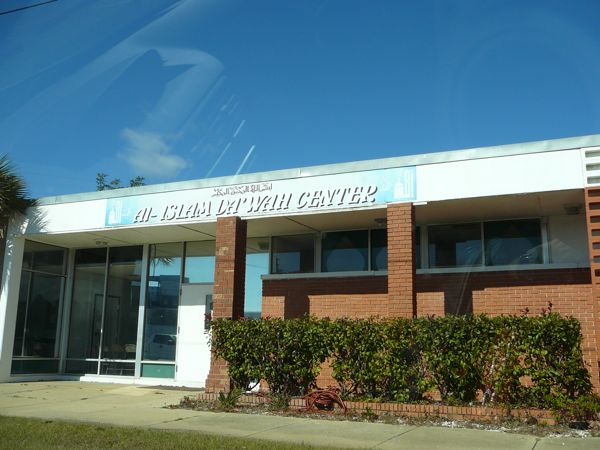
There are pockets in the United States where you find groups of Arab nationals; Pensacola has these groups, even a discreet mosque or two. There are stores selling international supplies, including zaat’r and sumak and harissa, chana dal, bulger, wuhammara . . . and restaurants billing themselves as ‘Mediterannean’ whose food would be recognizable to those in the Levant and the Gulf.
There is almost always a breeze off the Gulf to fight the heat and humidity and mosquitoes, and, by the grace of God, there is air conditioning and ice water coming out of the refrigerators. Life is sweet.
Life is all the sweeter because we can get together with our son and his family on the spur of the moment, and end up at a great family place like Taco Rock, where our little grandson can get down when he gets restless, and where there is plenty of time for us to chat, discuss Django Unchained, discuss new developments in entertainment technology, discuss upcoming vacations and arrangements – there is that great luxury of time together, and tasty food at reasonable prices. LOL, this is the Pensacola equivalent of a Michelin Red R, good local cuisine at reasonable prices. Hmmmm, Mexican is probably not qualified as good local food at reasonable prices, but close enough . . .
He is such a delight, our little grandson, who calls the coming baby “that little girl,” as in “when that little girl comes, I’m going to teach her how to float on her back!”
This week, there is another parade! Pensacola must be the parade capital of the world; so many parades! We’ll pick up our grandson, stand on the corner and wave our arms until they throw us some beads. Great fun and good exercise. 🙂
This post is really a great excuse to post some new photos of our grandson 🙂
LOL, I have flown a lot of miles, but I have never flown any of these airlines in the ‘Worst of the Worst.” We used to fly RyanAir when we lived in Germany, and if you know to expect nothing, you get what you expect :-). It’s a lot like Jazeera, only without reserved seats and without leather seats. Oh, and people shoving to get on; I guess it was pretty bad, but oh, it was so CHEAP! Awful, but the flights were short, so you just gut it out and get there.
Economy class is pretty bad, even at its best. And at it’s worst, it’s truly horrendous, a toxic mix of too-tight seats, rancid peanuts, and don’t-bother-me service.
So which airline’s coach class is the worst of the worst? Business Insider Australia set out to answer that question, using data compiled by airline reviewer Skytrax on such measures as seat comfort, inflight entertainment, meals, and inflight service.
Such perennial service underproviders as Spirit and RyanAir made the list, at 18th and 11th worst respectively, but the other contenders for the title of world’s worst airline will be mostly unfamiliar to U.S.-focused travelers.
The envelope, please …
1. Turkmenistan Airlines (rated 30.8 on a 100-points scale)
2. Sudan Airways (rated 33.3)
3. Ukraine International Airlines (rated 36.3)
4. Uzbekistan Airways (rated 37.5s)
5. Air Koryo (rated 39.2)
6. Bulgaria Air (rated 41.8)
7. Rossiya Airlines (rated 42.7)
8. Iceland Express (rated 42.8)
9. Tajik Air (rated 43.3)
10. Syrian Air (rated 44.8)
Regarding Turkmenistan, the report noted that “terrible rankings on Skytrax for in-flight entertainment, seat comfort, service efficiency, staff response to passenger requests, and staff language skills make it the worst airline you can find.”
So next time you’re tempted to dub Spirit or US Airways or Frontier the worst airline ever, find some solace in the fact that the flight could have been worse. Much worse. It could have been Turkmenistan bad.
During my years in Kuwait, I saw many sorry situations. It doesn’t matter where you are on the social scale, if you are not Kuwaiti, you are expat labor. When management, for whatever reason, wants you to go, you go. People who have lived in Kuwait 50 years, who are elderly, sent home, and sent home quickly, barely time to sell what you can’t take with you, people who have had a health setback and can’t work anymore, handed their papers and told their visas will no longer be valid in 30 days.
There is no point in romanticizing your position. You’re hired help. You think you have friends, but your friends are not going to help you live out your days and die in Kuwait. When your usefulness is over, they want you gone.
We often had to get special permission to bring in professional workers for critical jobs who were over – or even approaching – 60 years old. Long-in-the-tooth is not a highly valued characteristic for imported labor.
Have an exit strategy.
The Kuwait Times title for this photo is “Illegals”
Embassies push for deportees’ rights – KD500 minimum wage proposed for dependency visa
KUWAIT: Two Asian embassies complained to Kuwaiti officials about the “arbitrary actions” taken during the deportation of illegal residents and lawbreakers, who were arrested in a series of crackdowns over the past few weeks across the country, a local daily reported yesterday, quoting sources with knowledge of the case.
Nearly 1,260 people of Arab and Asian nationalities have been deported since Kuwait launched crackdowns on traffic violators late last month. The General Traffic Department stated that deportation was enforced in cases of repeat offenders.
Thousands of others have been detained in simultaneous crackdowns targeting people with expired visas or those working in violation of labor regulations. But according to a report published yesterday by Al-Qabas daily, the Ministry of Interior received complaints from the embassies of India and Bangladesh, regarding the swift deportation of a large number of their nationals without them getting the opportunity to receive what they were owed from their employers.
The sources, who spoke to Al-Qabas on the condition of anonymity, said many of the deportees were sent back home through the use of travel documents released by their respective embassies, instead of their original passports that, in most cases, are kept by their sponsors. “The Indian and Bangladeshi embassies are currently taking legal recourse to secure the rights of the deported nationals, including their original passports”, the sources said.
Many expatriates arrested during the recent traffic crackdowns reportedly remain in custody, as their respective embassies refuse to grant authorities travel documents on the grounds that their visas are still valid. In that regard, the sources revealed the ministry had been trying to reach the employers in order to retrieve the passports of the soon-to-be-deported expatriates.
Meanwhile, a senior Interior Ministry official defended Kuwait’s right to deport illegal residents or foreigners who break the law. “It is the right of every country to deport expatriates who violate its residency laws or its laws in general, or take legal action against them, in order to maintain safety and security, in line with human rights principles,” Assistant Director of the ministry’s General Training Department, Brigadier General Adel Al-Saadoun, was quoted by Al-Jarida yesterday. He made these comments at a workshop on Tuesday, organized by the International Organization for Migration office in Kuwait.
In other news, Undersecretary Assistant for Citizenship and Passports Affairs, Major General Sheikh Faisal Al-Nawaf Al-Sabah, during a meeting with directors of migration departments in Kuwait, called for “tougher procedures” with regard to the issuance of visitor visas, so marginal labourers would not be able to gain access into the country.
He made the demand amid a discussion on efforts to address Kuwait’s demographic imbalance, which senior ministry officials described as “a main duty” for his department. “Maj Gen Al-Sabah told the directors that labor forces in countries having internal struggles should not be able to move to Kuwait, and that Kuwait should not become a shelter for them and their problems,” said sources quoted in an Al-Rai report yesterday.
Nationals of Syria, Iraq, Iran, Pakistan, Afghanistan, and Yemen are currently banned from obtaining visas to work in or visit Kuwait. In that regard, Maj Gen Al-Sabah said the lifting of the ban on them in the future must be coupled with controls to regulate their entrance and prevent the country’s demographic imbalance from getting worse, said the sources, who spoke to Al-Rai on the condition of anonymity.
The meeting also discussed other suggestions aimed at reducing the number of expatriate workers in Kuwait, including Maj Gen Al-Sabah’s intentions to “prepare a memorandum about the benefits of raising the minimum cap for foreigners applying for dependency visas for relatives”. Currently, such visas can be obtained as long as a supporter earns a minimum of KD250 a month, but the Undersecretary Assistant reportedly suggested during the meeting that the cap be raised to KD500.
“Maj Gen Al-Sabah questioned the capability of a man who receives KD250 a month to meet the educational, health and living requirements of a family with children,” the sources explained. They added that the senior official also plans to refer a letter to the Ministry of Social Affairs and Labor, recommending that it suspend issuing work visas to holders of commercial visit visas.
Minister of Social Affairs and Labor Thekra Al-Rashidi announced two months ago a plan to deport 100,000 foreigners every year, as part of a strategy to reduce the number of expatriates in the Gulf state by one million over a period of 10 years. Criticism sparked by the lack of details about the proposed plan prompted the minister to later clarify that the plan targeted illegal residents, whose numbers have reached 93,000, as per official statistics released last year. Kuwait is home to 2.6 million expatriates who account for 68 percent of the country’s total population of 3.8 million.
Meanwhile, minister Al-Rashidi released an order – with effect from July 1, 2013 – to terminate the services of expatriate employees who have worked for at least 30 years in the Social Affairs and Labor Ministry. According to sources familiar with the issue, the ministry has already started the process to end the services of nearly 70 foreigners by the beginning of July. The decision is in accordance with a government plan that requires forcing Kuwaitis who have held government posts for 30 years, including senior officials, into retirement. According to official statistics, published by Al-Qabas yesterday, 138 senior officials, including 11 women, will be subjected to this regulation. – Al-Qabas, Al-Jarida & Al-Rai
In a related article, measures are gaining support for withdrawing Kuwait citizenship from naturalized citizens for different reasons; below another article from the 30 May 2013 Kuwait Times Foreign spouses married to Kuwaitis watch these developments with trepidation.
MPs want citizenship revoked for breaching security – Long-time employees won’t be forced out
KUWAIT: A number of MPs yesterday proposed that Kuwaiti nationality should be withdrawn from naturalized Kuwaitis who abuse the country’s internal security or insult the country’s figures. The lawmakers also proposed that all benefits given to the naturalized person proven to have breached national security should be withdrawn and this measure should include withdrawing the citizenship of other people who gained the citizenship as a result of naturalizing that person. The proposal also suggests that people who applied for Kuwaiti citizenships and carried out similar offenses should have their applications rejected even if they fulfilled all the conditions for nationality.
To become effective, the proposal must be adopted by the concerned Assembly committees, mainly the legal and legislative and the interior and defense committees and then passed by the National Assembly and eventually accepted by the government. The proposal comes amid protests by opposition activists and former MPs and a crackdown on opposition tweeters – several of whom have received jail terms on charges of insulting the Amir. Meanwhile, MP Faisal Al-Duwaisan yesterday asked Justice Minister Sharida Al-Meosharji about implementing a law passed a few months ago to establish the Anti-Corruption Authority. Besides the corruption authority, the legislation also calls for wealth disclosure of ministers, MPs and top government officials. Duwaisan asked the minister about the steps that have been taken to implement the law and the obstacles facing it.
MP Yacoub Al-Sane said yesterday that he was informed by Prime Minister Sheikh Jaber Al-Mubarak Al- Sabah that top bureaucrats who served 30 years and above will not be forced to resign as has been published. The lawmaker said he told the premier that forcing such top officials to step down is “unconstitutional” and the prime minister replied that the government will not force them to resign but will grant them incentives and benefits to encourage them to resign. In the meantime, MP Saud Al- Huraiji questioned Finance Minister Mustafa Al-Shamali about the charges collected from expatriates for the health insurance scheme and other charges since applying the law in 1999. Huraiji said that he learned that KD522 million have been collected since that year but the ministry of finance has failed to utilize the funds in proper channels. He asked the minister if the ministry has any plan to spend the funds in the right way.
By B Izzak, Staff Writer
‘Hundreds’ deported for traffic offences
KUWAIT: Kuwait has deported hundreds of expats for traffic offences in the past month, a report said yesterday, drawing condemnation from a human rights group.
The Al-Anbaa newspaper cited a senior interior ministry official as saying that as many as 1,258 foreigners have been deported for traffic violations since a crackdown began about a month ago.
Foreign residents caught driving without a licence, using their cars to carry paying passengers, jumping a red light for a second time, or breaking the speed limit by more than 40 km per hour, can be deported without a court order. The Kuwait Society for Human Rights called on the government to halt the deportations describing them as “oppressive”. “The oppressive measure against expatriates… violates the basic principles of human rights,” it said.
The group warned that the measure could tarnish the state’s image abroad at a time when its human rights record is under scrutiny. Kuwait is home to 2.6 million expatriates who form 68 percent of the country’s 3.8 million population.
Kuwaiti nationals who commit similar offences have their vehicles seized and can be sent to court. Last month, Minister of Social Affairs and Labour Thekra Al-Rasheedi said the state plans to deport around 100,000 expatriates every year for the next decade to reduce the number of foreigners living in the Gulf state by one million. She did not say what measures she would adopt to carry out the plan.
Foreigners need to hold a university degree, earn KD 400 a month and have lived in Kuwait for at least two years to be eligible to apply for a driver’s licence, under a decision issued nearly a decade ago. —AFP
When I start to fret about those in high places who oppress the poor and the workers, whose lives are so far from worrying about a roof over their head and food to eat that they will pass still laws further oppressing the poor and homeless, I take consolation in this psalm.
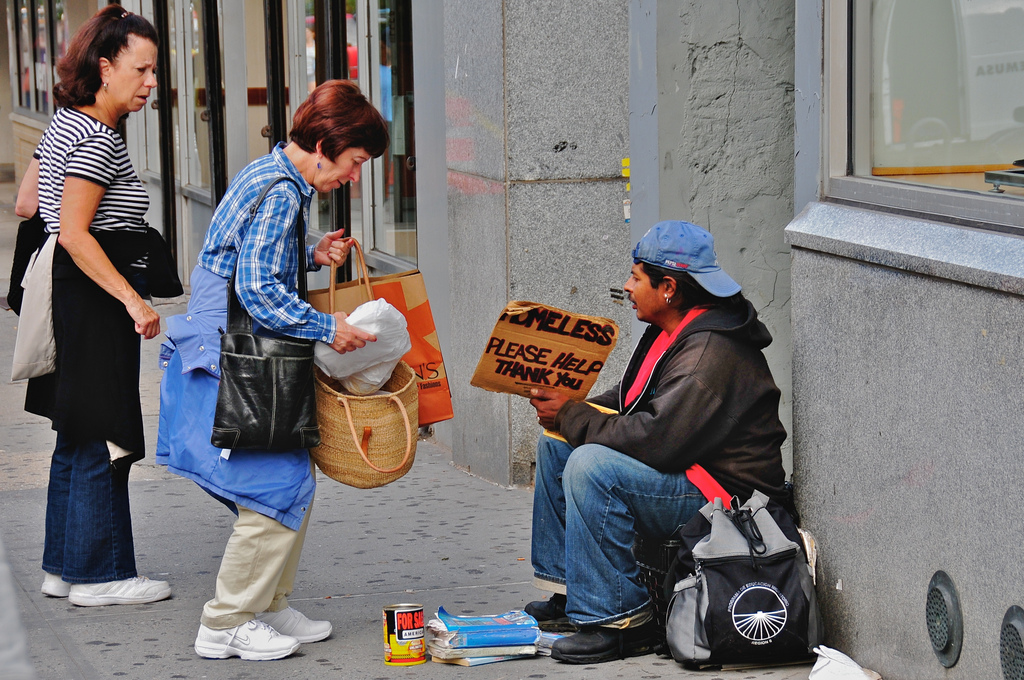
The Pensacola City Council is passing a draconian measure against the homeless. I’ve been so proud of Pensacola, and the citizen response to the homeless, the beds Pensacola provides, the meals the citizens, through a variety of church and social agencies, hand out. Their response is humane, and compassionate.
The homeless are attracted by the moderate climate; they are here in droves. They panhandle at the intersections, they approach you at downtown attractions. They often have dogs. For the most part, they greet people cheerfully or respectfully, and they aren’t aggressive.
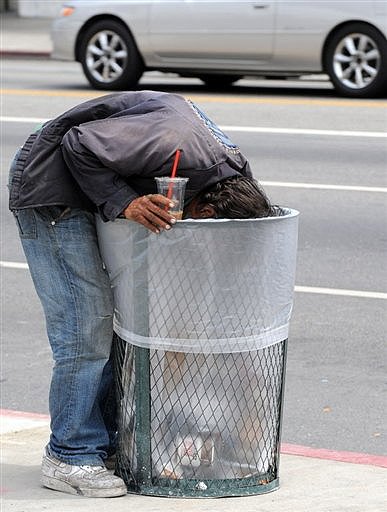
They are, in truth, a kind of plague on Pensacola, but as a traveler, I have brushed my teeth in many a restroom, changed my clothes, even had to rise out a coffee stained outfit before my next flight once – these are things for which the homeless will be charged with an offense against the law. If I were without a place for the night, I might look for a safe public restroom in which to sleep, especially if I had a child with me, as so many women did when I worked with homeless women.
I understand the problem.
But I also understand the desperation of those who have little, and that very little – a public restroom, a safe place to sleep outdoors – are being taken away from them by this statute. It’s heartless, and if there is truly an accounting at the end of our lives, and an afterlife, I fear for those who put additional burdens on the poorest of the poor.
Psalm 37
Of David.
1 Do not fret because of the wicked;
do not be envious of wrongdoers,
2 for they will soon fade like the grass,
and wither like the green herb.
3 Trust in the Lord, and do good;
so you will live in the land, and enjoy security.
4 Take delight in the Lord,
and he will give you the desires of your heart.
5 Commit your way to the Lord;
trust in him, and he will act.
6 He will make your vindication shine like the light,
and the justice of your cause like the noonday.
7 Be still before the Lord, and wait patiently for him;
do not fret over those who prosper in their way,
over those who carry out evil devices.
8 Refrain from anger, and forsake wrath.
Do not fret—it leads only to evil.
9 For the wicked shall be cut off,
but those who wait for the Lord shall inherit the land.
10 Yet a little while, and the wicked will be no more;
though you look diligently for their place, they will not be there.
11 But the meek shall inherit the land,
and delight in abundant prosperity.
12 The wicked plot against the righteous,
and gnash their teeth at them;
13 but the Lord laughs at the wicked,
for he sees that their day is coming.
14 The wicked draw the sword and bend their bows
to bring down the poor and needy,
to kill those who walk uprightly;
15 their sword shall enter their own heart,
and their bows shall be broken.
16 Better is a little that the righteous person has
than the abundance of many wicked.
17 For the arms of the wicked shall be broken,
but the Lord upholds the righteous.
18 The Lord knows the days of the blameless,
and their heritage will abide for ever;
19 they are not put to shame in evil times,
in the days of famine they have abundance.
20 But the wicked perish,
and the enemies of the Lord are like the glory of the pastures;
they vanish—like smoke they vanish away.
21 The wicked borrow, and do not pay back,
but the righteous are generous and keep giving;
22 for those blessed by the Lord shall inherit the land,
but those cursed by him shall be cut off.
23 Our steps* are made firm by the Lord,
when he delights in our* way;
24 though we stumble,* we* shall not fall headlong,
for the Lord holds us* by the hand.
25 I have been young, and now am old,
yet I have not seen the righteous forsaken
or their children begging bread.
26 They are ever giving liberally and lending,
and their children become a blessing.
27 Depart from evil, and do good;
so you shall abide for ever.
28 For the Lord loves justice;
he will not forsake his faithful ones.
The righteous shall be kept safe for ever,
but the children of the wicked shall be cut off.
29 The righteous shall inherit the land,
and live in it for ever.
30 The mouths of the righteous utter wisdom,
and their tongues speak justice.
31 The law of their God is in their hearts;
their steps do not slip.
32 The wicked watch for the righteous,
and seek to kill them.
33 The Lord will not abandon them to their power,
or let them be condemned when they are brought to trial.
34 Wait for the Lord, and keep to his way,
and he will exalt you to inherit the land;
you will look on the destruction of the wicked.
35 I have seen the wicked oppressing,
and towering like a cedar of Lebanon.*
36 Again I* passed by, and they were no more;
though I sought them, they could not be found.
37 Mark the blameless, and behold the upright,
for there is posterity for the peaceable.
38 But transgressors shall be altogether destroyed;
the posterity of the wicked shall be cut off.
39 The salvation of the righteous is from the Lord;
he is their refuge in the time of trouble.
40 The Lord helps them and rescues them;
he rescues them from the wicked, and saves them,
because they take refuge in him.
Hilarious! Thank you, John Mueller and the Guardian for this giggle.
Qatar returns statues to Greece amid nudity dispute
Culture clash erupts after Greek minister visits Doha show and spots ancient treasures covered in strategically placed cloth.
Naked ambition: cash-strapped Greece has long been wooing Qatar. The display was meant to ‘open a bridge of friendship’ between the countries. Photograph: Alamy
It was a spat that nobody wanted – neither the Greeks, the Qataris nor, say officials, the two nude statues that sparked the furore.
But in a classic clash of cultures, Greece has found itself at odds with the oil-rich state – a nation it is keen to woo financially – over the presentation of masterworks depicting athletes in an exhibition dedicated to the Olympic games.
“The statues are now back at the National Archaeological Museum in Athens,” said a culture ministry official.
The dispute, though authorities are not calling it that, broke when Greece’s culture minister, Costas Tzavaras, arrived in Doha last month to discover the “anatomically challenging” treasures cloaked in cloth for fear of offending female spectators.
“In a society where there are certain laws and traditions authorities felt women would be scandalised by seeing such things, even on statues,” added the official who was present at the time.
“The minister, of course, said while he totally respected local customs he couldn’t accept the antiquities not being exhibited in their natural state,” she told the Guardian. “They were great works of art and aesthetically it was wrong.”
The statues, an archaic-era Greek youth and a Roman-era copy of a classical athlete, were to be the centrepiece of an exhibition entitled Olympic Games: Past and Present. Bankrupt Greece was delighted to facilitate when organisers in Doha got in touch. Mired in its worst economic crisis in modern times, the debt-stricken country is eager for investment from the Gulf state, which this year promised to pour €1bn into a joint investment fund.
In another hopeful sign, the emir of Qatar, Sheik Hamad bin Khalifa Al Thani, recently bought six isles in the Ionian sea with a view to building palaces on them for his three wives and 24 children.
Visiting the Qatari capital for the opening of the show, Tzavaras seized the opportunity to describe the exhibition as “opening a bridge of friendship” between the countries. The discovery of the covered-up antiquities was a setback few had envisaged.
“We don’t want to portray it as a row, and we certainly didn’t want it to overshadow the exhibition,” explained the official. “It was all very friendly. When they turned down our request (to remove the cloth) the statues were boxed up again and sent back to Athens.”
Mystery, nonetheless, shrouds the affair. The show, which had previously been hosted in Berlin, features more than 700 artworks from around Greece, including numerous nude statues. It remains unclear why Qatari authorities had taken such umbrage over the antiquities in question, although officials in Athens described the young athletes – both from Eleusis – as being especially beautiful.
I am appalled. I have scoured the TV News, have looked through newspapers – not a word! I steam at corruption in Kuwait and Qatar and Saudi Arabia, and then a small NPR Report on yesterday’s news alerts me to a measure, passed in Congress, WITHOUT A WHISPER!
A tourist takes cover underneath an umbrella while snapping a photo of the U.S. Capitol on March 6, 2013 in Washington, DC.
Chip Somodevilla/Getty Images
Joining the Senate, the House of Representatives approved a measure today that repeals a requirement that top government officials post financial disclosures on the Internet.
The House, like the Senate, acted quietly without a vote. Instead, they sent the measure to the president’s desk by unanimous consent.
The provision was part of the Stop Trading on Congressional Knowledge Act (Stock), which became law in March of 2012. The act was intended to stop members of congress from profiting from nonpublic information.
As NPR’s Tamara Keith reported, at the time, Sen. Joe Lieberman called the law “the most significant congressional ethics reform legislation to pass Congress in at least five years.”
“That law mainly addressed conflict-of-interest policies for members of Congress and their staffs, but it also included a requirement that the financial disclosure forms filed by some 28,000 high-ranking federal employees be posted online.
“While those forms are public records, they must be requested individually from employing agencies. The Stock Act envisions online posting first on agency sites and later in a central, searchable database.
“The posting requirement was delayed three times out of concerns about the potential for identity theft and other crimes against career employees, as well as security risks to the government.”
The foundation explained that instead of addressing specific security concerns, Congress has acted broadly.
For instance, they note, the president, vice president, members of Congress, congressional candidates and individuals subject to Senate confirmation are still required to make their financial disclosures public. But the change in law now makes the posting of those disclosures on the Internet optional.
Sunlight adds:
“Not only does the change undermine the intent of the original bill to ensure government insiders are not profiting from non-public information (if anyone thinks high level congressional staffers don’t have as much or more insider information than their bosses, they should spend some time on Capitol Hill) but it sets an extraordinarily dangerous precedent suggesting that any risks stem not from information being public but from public information being online.
“Are we going to return to the days when the public can use the Internet to research everything exceptwhat their government is doing? Will Congress, in its twisted wisdom, decide that information is public if journalists, academics, advocates and citizens are forced to dig through file cabinets in basements in Washington, DC to find it? And does anyone think that makes us safer?
“As my colleague Tom Lee noted, ‘This approach is known as ‘security through obscurity.’ Essentially, the idea is that rather than fixing a system’s flaws, you can just make the system opaque or unusable or unpopular enough that those flaws never surface.'”
Update at 5:35 p.m. ET. 30 Seconds:
NPR’s Tamara Keith tells us the House procedure took exactly 30 seconds.
Correction at 5:29 p.m. ET. An earlier version of his post said the House followed the Senate. In fact, the Senate voted Thursday and the House voted today.
Most people I know these days are trying to eat less meat. In the readings for today, we start the story of Daniel, a story every Christian child learns in Sunday School, but when you read as an adult, you see different things. This morning, doing the readings from the Lectionary, I smiled to see that Daniel and his companions wanted only vegetables; they were working very hard not to violate their food laws.
I also wonder if not eating meat was helpful in the den of lions; maybe they smelled less interesting as vegetarians? Then again, lions eat impalas, wildebeest, all sorts of vegetarians, so that probably was not a factor . . . 🙂
Daniel 1:1-21
1In the third year of the reign of King Jehoiakim of Judah, King Nebuchadnezzar of Babylon came to Jerusalem and besieged it. 2The Lord let King Jehoiakim of Judah fall into his power, as well as some of the vessels of the house of God. These he brought to the land of Shinar,* and placed the vessels in the treasury of his gods.
3 Then the king commanded his palace master Ashpenaz to bring some of the Israelites of the royal family and of the nobility, 4young men without physical defect and handsome, versed in every branch of wisdom, endowed with knowledge and insight, and competent to serve in the king’s palace; they were to be taught the literature and language of the Chaldeans. 5The king assigned them a daily portion of the royal rations of food and wine. They were to be educated for three years, so that at the end of that time they could be stationed in the king’s court. 6Among them were Daniel, Hananiah, Mishael, and Azariah, from the tribe of Judah. 7The palace master gave them other names: Daniel he called Belteshazzar, Hananiah he called Shadrach, Mishael he called Meshach, and Azariah he called Abednego.
8 But Daniel resolved that he would not defile himself with the royal rations of food and wine; so he asked the palace master to allow him not to defile himself. 9Now God allowed Daniel to receive favour and compassion from the palace master. 10The palace master said to Daniel, ‘I am afraid of my lord the king; he has appointed your food and your drink. If he should see you in poorer condition than the other young men of your own age, you would endanger my head with the king.’
11Then Daniel asked the guard whom the palace master had appointed over Daniel, Hananiah, Mishael, and Azariah: 12‘Please test your servants for ten days. Let us be given vegetables to eat and water to drink. 13You can then compare our appearance with the appearance of the young men who eat the royal rations, and deal with your servants according to what you observe.’ 14So he agreed to this proposal and tested them for ten days. 15At the end of ten days it was observed that they appeared better and fatter than all the young men who had been eating the royal rations. 16So the guard continued to withdraw their royal rations and the wine they were to drink, and gave them vegetables. 17To these four young men God gave knowledge and skill in every aspect of literature and wisdom; Daniel also had insight into all visions and dreams.
18 At the end of the time that the king had set for them to be brought in, the palace master brought them into the presence of Nebuchadnezzar, 19and the king spoke with them. And among them all, no one was found to compare with Daniel, Hananiah, Mishael, and Azariah; therefore they were stationed in the king’s court. 20In every matter of wisdom and understanding concerning which the king inquired of them, he found them ten times better than all the magicians and enchanters in his whole kingdom. 21And Daniel continued there until the first year of King Cyrus.
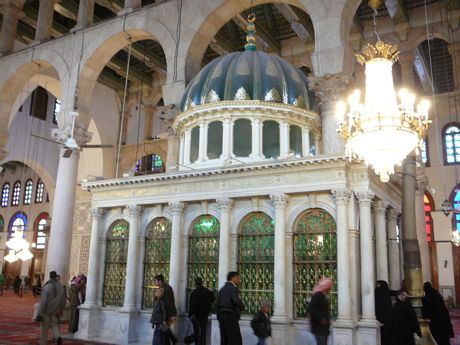
In today’s Lectionary readings, Saint John explains the coming of the light (Jesus Christ) into the world. On this day, when we celebrate that he is risen from the dead, it is a most fitting and wonderful verse to read. Below is the tomb of John-the-Baptist (Yahyah,) in the Umayyad Mosque in Damascus, one of my favorite cities on earth. On this wonderful day of new beginnings, I pray for the peace and prosperity of Syria and all mankind, that we might set aside all the pettiness and grubbing for small things, and look to the larger and harder issues of how to love one another.
John 1:1-18
1In the beginning was the Word, and the Word was with God, and the Word was God. 2He was in the beginning with God. 3All things came into being through him, and without him not one thing came into being. What has come into being 4in him was life,* and the life was the light of all people. 5The light shines in the darkness, and the darkness did not overcome it.
6 There was a man sent from God, whose name was John. 7He came as a witness to testify to the light, so that all might believe through him. 8He himself was not the light, but he came to testify to the light. 9The true light, which enlightens everyone, was coming into the world.*
10 He was in the world, and the world came into being through him; yet the world did not know him. 11He came to what was his own,* and his own people did not accept him. 12But to all who received him, who believed in his name, he gave power to become children of God, 13who were born, not of blood or of the will of the flesh or of the will of man, but of God.
14 And the Word became flesh and lived among us, and we have seen his glory, the glory as of a father’s only son,* full of grace and truth. 15(John testified to him and cried out, ‘This was he of whom I said, “He who comes after me ranks ahead of me because he was before me.” ’) 16From his fullness we have all received, grace upon grace. 17The law indeed was given through Moses; grace and truth came through Jesus Christ. 18No one has ever seen God. It is God the only Son,* who is close to the Father’s heart,* who has made him known.










 Here There and Everywhere