Donna Leon and Beastly Things Made Me Cry

I can always count on Donna Leon. She gives me a good read, a solid mystery, a social issue, the louche damp atmosphere of Venice and the Venetian aristocracy, and my good friend Guido Brunetti, police commissario, with his lovely wife and dear children and great Italian meals.
This time, she fooled me.
A barrel chested man is found floating in the canals with no identification. When identified, he is found to be a veterinarian, separated from his angry and hostile and broken-hearted wife.
Then Donna Leon pulls me way out of my comfort zone – TWICE. First, there are parts of the book I can scarcely read, as she talks about the meat industry. I’m reading this book, dealing with the meat industry, and I’ve just watched the movie GreY posted on the devastation meat eating causes in your metabolism and blood; the passages in Beastly Things sealed the deal – I don’t think I can eat red meat again. I’m not sure I can even be around red meat. Leon is fearless; she spotlights issues few dare to tackle. There are issues here that are not for the faint-hearted. Read at your own risk.
It’s a tricky mystery, and at the end, Leon catches me by surprise again, as she describes the funeral of the veterinarian, a very unusual funeral, where his patients are also in attendance. It was hard to read. My eyes were blurring. If you like mysteries, if you have pets you adore, this is the sweetest literary funeral you will ever attend.
Arian or Athanasian?
Remigius, today’s saint written up in The Lectionary, has so many interesting facets. Kiefer starts out explaining that the common Cajun name Remi is short for the French saint Remigius, who converted Clovis, one of the earliest kings of France, to Christianity. Not just to Christianity, however, but to Athanasian Christianity, the branch that believes Christ is of the same substance with God, and is one with God, as opposed to Arianism, a predominant belief at the time, which proposed Jesus was not the same as God.
REMIGIUS OF RHEIMS
BISHOP, APOSTLE OF THE FRANKS (1 OCTOBER 530)
by James Kiefer

(This photo cracks me up because one of the demons looks a lot like Ronald Reagan. I don’t know where it is, but it may be the Cathedral in Strassbourg)
St. Remi (or Remigius)
A 1987 motion picture, “The Big Easy” (a nickname for the city of New Orleans), and a current (1996) television series of the same name based on it, have as the male lead a Cajun police detective named Remy McSwaine. In the first episode of the series (I am not sure of the film) we are informed that “Remy” is short for “Remington.” I fear that this shows that the scriptwriters have not troubled to research Cajun culture. Remi is one of the three great national saints of France (the others are Denis (Dionysius) of Paris and Joan of Arc, or Joan the Maid (Jeanne la Pucelle)), and it is thoroughly natural for a Cajun to be named Remi. How is that for a topical introduction?
Remi (Latin Remigius) was born about 438 and became bishop of Rheims about 460, at the remarkably young age of 22. (Both he and the city were named for his tribe, the Remi.) In his time, the Roman Empire and the Christian church were jointly faced with a serious practical problem — the barbarian invasions. A series of droughts in central Asia had driven its inhabitants out in all directions in search of more livable territory. This brought the Goths, for example, across the Danube in the early 300’s.
Now the Emperor Constantine had died in 337, and during his lifetime the Church had debated the question of whether the Logos, the Word who was made flesh for our salvation in the person of Jesus of Nazareth, was (as Arius taught) the first and greatest of the beings created by God, but nevertheless not eternal, and not God; or was (as Athanasius taught) fully God, co-eternal and co-equal with the Father. At the Council of Nicea in 325, the Athanasian position had been endorsed by an overwhelming majority of the bishops assembled from throughout the Christian world. But the Arians refused to accept the decision, and there were attempts to re-negotiate and find a compromise that would make everyone happy.
Then Constantine died, and his Empire was divided among his sons, with Constantius Emperor of the East, and eventually of the whole Empire. And Constantius was an Arian, and made a serious attempt to stamp out the Athanasian position by banishing its leaders and pressuring churches into electing or accepting Arian bishops. During his reign, missionaries, led by one Bishop Ulfilas, were sent to convert the Goths. And naturally, Ulfilas was an Arian. He preached with great vigor and eloquence among the Goths, and translated the Bible into their language (omitting, we are told, the wars of the Hebrews, on the grounds that the Goths were quite warlike enough without further encouragement). In fact, the portions of his translation that have survived are the only material we have in the Gothic language, and as such are highly valued by students of the history of languages. So the Goths became Arian Christians, and so did the Vandals. And these two highly warlike peoples were most of the time either making war on the settled peoples of the Empire or hiring out as mercenaries to defend the borders of the Empire from the next wave of invaders.
You may remember that Ambrose, bishop of Milan (died 397, remembered 7 December), was commanded by the Empress Mother to hand over a church for the use of her soldiers, who were Goths and Arians, and that Ambrose refused, and filled the church with members of his congregation, who sang hymns composed by Ambrose for the occasion, and the soldiers did not attack. You may also remember that when Augustine lay on his deathbed in his town of Hippo in North Africa (near Carthage or modern Tunis), the city was under attack by Vandal troops, who had come into Africa out of Spain, and who captured and vandalized (that is where we get the term) the cities of North Africa, and Sicily and Sardinia and Corsica (which they made into bases for piracy) and the southern part of Italy. Long after Arianism had died out elsewhere, it was the religion of the Goths and Vandals and related peoples, and being an Arian was the mark of a good Army man.
Now a new people appeared on the scene, a pagan warrior tribe called the Franks. In the late 400’s, they were led by a chief called Clovis, a pagan but married to a Christian wife, Clotilda. His wife and Bishop Remi (remember him?) spoke to him about the Christian faith, but he showed no particular signs of interest until one day when he was fighting a battle against the Alemanni, and was badly outnumbered and apparently about to lose the battle. He took a vow that if he won, he would turn Christian. The tide of battle turned, and he won. Two years later, he kept his vow and was baptized by Remi at Rheims on Christmas Day, 496, together with about 3000 of his followers. (Rheims became the traditional and “proper” place for a French king to be crowned, as we learn from the story of Joan of Arc. It remained so until the French Revolution.)
Now Clovis was converted to the Athanasian (or orthodox, or catholic) faith rather than the Arian, and this fact changed the religious history of Europe. The clergy he brought to his court were catholic, and when the Franks as a whole became Christians, which did not happen overnight, they became catholic Christians, meaning in this context that they were Athanasian rather than Arian, and accepted the belief that it was God himself, and not a particularly prominent angel, who came down from heaven and suffered for our salvation.
During the preceding century, the Arians had had a near-monopoly on military power, and now this was no longer true. The conversion of the Franks brought about the conversion of the Visigoths, and eventually (about 300 years later) the empire of Charlemagne and the beginning of the recovery of Western Europe from the earlier collapse of government and of city life under the impact of plague, lead poisoning, currency inflation, confiscatory taxation, multiple invasions, and the assorted troubles of the Dark Ages.
As noted above, Clot(h)ilda, a Christian princess of Burgundy, married the pagan Clovis, King of the Franks, thus preparing the way for his baptism by Remi in 496, and for the conversion of the Franks. Their great-grandaughter, Bertha, married the pagan Ethelbert, King of Kent, thus preparing the way for his baptism by Augustine of Canterbury in 601, and for the eventual conversion of southeast England. Bertha and Ethelbert’s daughter, Ethelburga, married the pagan Edwin, King of Northumbria, thereby preparing the way for his baptism by Paulinus in 627, and for the eventual conversion of many in the North of England.
Male Castration Increases Life Expectancy
I’m sorry, when I read this article, I couldn’t help laughing. I don’t think I know a single man who would choose a longer life at the cost of castration.
By: Stephanie Pappas, LiveScience Senior Writer
Published: 09/24/2012 12:16 PM EDT on LiveScience
Castration & Life Expectancy: Eunuchs Live Longer Than Other Men, Study Shows
It’s a life-extending strategy most men probably won’t want to pursue, but new research suggests eunuchs live longer than non-castrated guys.
Historical Korean eunuchs — men who had their testicles removed in order to secure high positions in the palace hierarchy — outlived their non-castrated counterparts by as much as 20 years, the study finds. The results will be published tomorrow (Sept. 25) in the journal Current Biology.
In animals, castration tends to lengthen life span, likely because male sex hormones aren’t great for the health. Testosterone is an immune-system suppressor, for example, and can also increase the risk for cardiovascular disease.
But in humans, results have been mixed as to whether castration lengthens life span. One study on patients in a mental hospital found that it does, while another on castrated and non-castrated male singers found that it does not. Nevertheless, researchers have theorized that testosterone’s effects may be the reason women outlive men on average. Other research has suggested a genetic explanation for this life-span gap. [7 Ways to Live Past 100]
In the new study, Inha University researcher Kyung-Jin Min and his colleagues scoured the historical records from Korea’s Chosun (or Joseon) Dynasty, which ran from 1392 to 1910. Until 1894, castration was a way for men to gain access to political power and prestige in the dynasty. Eunuchs could achieve official ranks and marry and adopt girls and similarly castrated boys in order to maintain a family lineage. Eunuchs and male royal family members were the only men allowed to stay overnight in the royal palace.
In fact, eunuchs were used in many ancient empires to guard royal harems, given that they could not impregnate an emperor’s queen or mistress, according to “Hidden Power: The Palace Eunuchs of Imperial China” (Buffalo NY: Prometheus, 1990). Without children of their own, eunuchs were also thought to be more loyal and less likely to attempt to establish their own family dynasties.
By comparing an 1805 genealogy of eunuchs and their families with other court documents, Min and his colleagues were able to determine the life spans of 81 eunuchs. They then compared those life spans with those of non-castrated men of similar socioeconomic status living at the same time. These men were members of three prominent families, most of whom were martial officers or civil administrators.
They found that the average life span for a Korean court eunuch was about 70 years, plus or minus 1.76 years. That was 14.4 to 19.1 years longer than their average non-eunuch contemporaries, who tended to live between 50.9 and 55.6 years.
The differences couldn’t be explained by a cushy palace existence, the researchers wrote, because most eunuchs only went to the palace when on-duty and lived outside it. In fact, male members of the royal family, who spent all their time in palaces, had the shortest lives, making it to about 45 or 47 years of age on average.
Teachers’ Expectations Evoke Life-Changing Achievement
Yes, this is a long article from National Public Radio, but it’s important. I want you to read it, and if you have the time, go to the website – you can click on the blue type above – and listen to it yourself, because it is life changing for us, and for how we treat our children, too.
Do it at a time when you have time to listen. It caught me by surprise, but I was so enthralled, I stayed for the entire segment. Children with the greatest challenges can succeed, if they are nurtured and mentored. Any child can be a success; there are no losers. This is powerful stuff. 🙂
by ALIX SPIEGEL
In my Morning Edition story today, I look at expectations — specifically, how teacher expectations can affect the performance of the children they teach.
The first psychologist to systematically study this was a Harvard professor named Robert Rosenthal, who in 1964 did a wonderful experiment at an elementary school south of San Francisco.
The idea was to figure out what would happen if teachers were told that certain kids in their class were destined to succeed, so Rosenthal took a normal IQ test and dressed it up as a different test.
“It was a standardized IQ test, Flanagan’s Test of General Ability,” he says. “But the cover we put on it, we had printed on every test booklet, said ‘Harvard Test of Inflected Acquisition.’ ”
Rosenthal told the teachers that this very special test from Harvard had the very special ability to predict which kids were about to be very special — that is, which kids were about to experience a dramatic growth in their IQ.
After the kids took the test, he then chose from every class several children totally at random. There was nothing at all to distinguish these kids from the other kids, but he told their teachers that the test predicted the kids were on the verge of an intense intellectual bloom.
As he followed the children over the next two years, Rosenthal discovered that the teachers’ expectations of these kids really did affect the students. “If teachers had been led to expect greater gains in IQ, then increasingly, those kids gained more IQ,” he says.
But just how do expectations influence IQ?
As Rosenthal did more research, he found that expectations affect teachers’ moment-to-moment interactions with the children they teach in a thousand almost invisible ways. Teachers give the students that they expect to succeed more time to answer questions, more specific feedback, and more approval: They consistently touch, nod and smile at those kids more.
“It’s not magic, it’s not mental telepathy,” Rosenthal says. “It’s very likely these thousands of different ways of treating people in small ways every day.”
So since expectations can change the performance of kids, how do we get teachers to have the right expectations? Is it possible to change bad expectations? That was the question that brought me to the Curry School of Education at the University of Virginia, where I met Robert Pianta.
Pianta, dean of the Curry School, has studied teachers for years, and one of the first things he told me when we sat down together was that it is truly hard for teachers to control their expectations.
“It’s really tough for anybody to police their own beliefs,” he said. “But think about being in a classroom with 25 kids. The demands on their thinking are so great.”
Still, people have tried. The traditional way, Pianta says, has been to sit teachers down and try to change their expectations through talking to them.
“For the most part, we’ve tried to convince them that the beliefs they have are wrong,” he says. “And we’ve done most of that convincing using information.”
But Pianta has a different idea of how to go about changing teachers’ expectations. He says it’s not effective to try to change their thoughts; the key is to train teachers in an entirely new set of behaviors.
For years, Pianta and his colleagues at the Curry School have been collecting videotapes of teachers teaching. By analyzing these videos in minute ways, they’ve developed a good idea of which teaching behaviors are most effective. They can also see, Pianta tells me, how teacher expectations affect both their behaviors and classroom dynamics.
Pianta gives one very specific example: the belief that boys are disruptive and need to be managed.
“Say I’m a teacher and I ask a question in class, and a boy jumps up, sort of vociferously … ‘I know the answer! I know the answer! I know the answer!’ ” Pianta says.
“If I believe boys are disruptive and my job is control the classroom, then I’m going to respond with, ‘Johnny! You’re out of line here! We need you to sit down right now.’ ”
This, Pianta says, will likely make the boy frustrated and emotionally disengaged. He will then be likely to escalate his behavior, which will simply confirm the teacher’s beliefs about him, and the teacher and kid are stuck in an unproductive loop.
But if the teacher doesn’t carry those beliefs into the classroom, then the teacher is unlikely to see that behavior as threatening.
Instead it’s: ” ‘Johnny, tell me more about what you think is going on … But also, I want you to sit down quietly now as you tell that to me,’ ” Pianta says.
“Those two responses,” he says, “are dictated almost entirely by two different interpretations of the same behavior that are driven by two different sets of beliefs.”
To see if teachers’ beliefs would be changed by giving them a new set of teaching behaviors, Pianta and his colleagues recently did a study.
They took a group of teachers, assessed their beliefs about children, then gave a portion of them a standard pedagogy course, which included information about appropriate beliefs and expectations. Another portion got intense behavioral training, which taught them a whole new set of skills based on those appropriate beliefs and expectations.
For this training, the teachers videotaped their classes over a period of months and worked with personal coaches who watched those videos, then gave them recommendations about different behaviors to try.
After that intensive training, Pianta and his colleagues analyzed the beliefs of the teachers again. What he found was that the beliefs of the trained teachers had shifted way more than the beliefs of teachers given a standard informational course.
This is why Pianta thinks that to change beliefs, the best thing to do is change behaviors.
“It’s far more powerful to work from the outside in than the inside out if you want to change expectations,” he says.
In other words, if you want to change a mind, simply talking to it might not be enough.
7 Ways Teachers Can Change Their Expectations
Researcher Robert Pianta offered these suggestions for teachers who want to change their behavior toward problem students:
Watch how each student interacts. How do they prefer to engage? What do they seem to like to do? Observe so you can understand all they are capable of.
Listen. Try to understand what motivates them, what their goals are and how they view you, their classmates and the activities you assign them.
Engage. Talk with students about their individual interests. Don’t offer advice or opinions – just listen.
Experiment: Change how you react to challenging behaviors. Rather than responding quickly in the moment, take a breath. Realize that their behavior might just be a way of reaching out to you.
Meet: Each week, spend time with students outside of your role as “teacher.” Let the students choose a game or other nonacademic activity they’d like to do with you. Your job is to NOT teach but watch, listen and narrate what you see, focusing on students’ interests and what they do well. This type of activity is really important for students with whom you often feel in conflict or who you avoid.
Reach out: Know what your students like to do outside of school. Make it a project for them to tell you about it using some medium in which they feel comfortable: music, video, writing, etc. Find both individual and group time for them to share this with you. Watch and listen to how skilled, motivated and interested they can be. Now think about school through their eyes.
Reflect: Think back on your own best and worst teachers, bosses or supervisors. List five words for each that describe how you felt in your interactions with them. How did the best and the worst make you feel? What specifically did they do or say that made you feel that way? Now think about how your students would describe you. Jot down how they might describe you and why. How do your expectations or beliefs shape how they look at you? Are there parallels in your beliefs and their responses to you?
Libyans Say “Sorry” In Counter-Protests
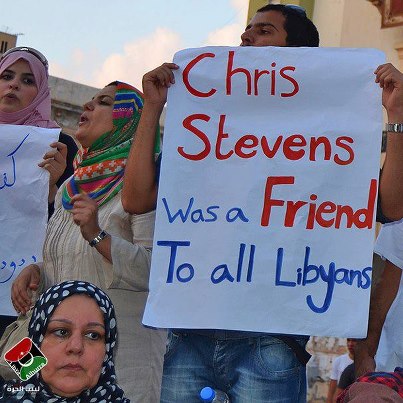
I was living in Qatar, and the Libyan ambassador’s wife had invited me, along with several other women, to morning coffee. It’s what people did. I was sitting between one of my Libyan friends and my good Iranian friend, and I started laughing. I said “Oh, what is this good little American girl doing sitting between a Libyan and an Iranian?” and then we all laughed. We weren’t Libyan, or American, or Iranian, we were just women who liked each other; we got along.
We were all religious women. Not the same religion, but all believers in the Abrahamic tradition. I felt more comfortable with them than I felt around non-religious women. We had a lot of fun together, and we liked each other.

It breaks my heart when bad things happen, and I know how good these people are, and that the people on the attack have their own agenda which has nothing to do with Islam, or Christianity, and everything to do with power. If they prevail, I fear for my good friends.

This article from USA Today made me cry this morning. Ambassador Stevens was loved, and these brave people are risking their futures to tell us so.

Libyans express sorrow over killing of Americans
by Donna Leinwand Leger, USA TODAY
Hours after learning of Ambassador Chris Stevens’ death, the Libyan Youth Movement transformed its Facebook page into a tribute to the slain diplomat. It changed its cover photo from “Free Libya” graffiti sprayed on a Tripoli wall to a somber photo of Stevens with the tag “RIP Christopher Stevens1960-2012.”
“As North America wakes up, dread washes over me. What a rough night. I’m sorry for the horrible day the world is about to face,” the administrator of the Shabab Libya page wrote. “We are sorry.”
As anti-American protests swept across North Africa and the Persian Gulf, a counter-protest of apology emerged. Photos of Libyans carrying hand-lettered signs condemning the violence and expressing contrition for their countrymen appeared on Facebook. “Sorry” became the trending mantra of Libyans on Twitter.
At one counter-protest, an unidentified man carried a crude sign phonetically written in English with blue marker on lined notebook paper, “Sorry People of America this not the Pehavior of our ISLAM and Profit.”
Another sign in red, white and blue read: “Chris Stevens wasa friend to all Libyans.”
On Facebook, one group formed The Sorry Project, designed to collect thousands of personal, written apologies from Libyans. Its profile photo is a man holding a sign, “USA. We are sorry. We are sad.”
“We Are Sorry,” the group wrote on the page created Sept.11. “We would like show that as Libyans we do not support on the actions committed by these criminals. USA, we are sorry and we will say it one thousand times over. Our apologies will never be enough, but the Libyan people will always be grateful for you since you were the first to stand by us in our fight for freedom and hopefully you will continue supporting us.”
One commenter, Hajer Sharief, vowed to avenge Stevens’ death by rebuilding a “new civilized democratic Libya.”
“We promise, we will not tire, we will not falter, and we will not fail,” Sharief wrote. “This is the way real Libyans will pay you back Mr. Ambassador Chris Stevens.”
At the ceremony Friday outside Washington to repatriate the remains of the four American victims, President Obama acknowledged Libya’s internal conflict.
“I know that this awful loss, the terrible images of recent days, the pictures we’re seeing again today, have caused some to question this work. And there is no doubt these are difficult days. In moments such as this — so much anger and violence — even the most hopeful among us must wonder,” Obama said. “But amid all of the images of this week, I also think of the Libyans who took to the streets with homemade signs expressing their gratitude to an American who believed in what we could achieve together. I think of the man in Benghazi with his sign in English, a message he wanted all of us to hear that said, ‘Chris Stevens was a friend to all Libyans.’ “
Psalm 55; Old Wisdom for Today
I’ve always liked this Psalm, from today’s readings in the Lectionary. It captures the worst betrayal, that of a friend, with whom you have shared meals and confidences. It captures the dichotomy of diplomacy, when one speaks with words ‘soft as butter’ which are, in truth, as steely as drawn swords. It captures the curse of the violent, those who cause strife and bloodshed and who die young.
Psalm 55
To the leader: with stringed instruments. A Maskil of David.
1 Give ear to my prayer, O God;
do not hide yourself from my supplication.
2 Attend to me, and answer me;
I am troubled in my complaint.
I am distraught 3by the noise of the enemy,
because of the clamour of the wicked.
For they bring* trouble upon me,
and in anger they cherish enmity against me.
4 My heart is in anguish within me,
the terrors of death have fallen upon me.
5 Fear and trembling come upon me,
and horror overwhelms me.
6 And I say, ‘O that I had wings like a dove!
I would fly away and be at rest;
7 truly, I would flee far away;
I would lodge in the wilderness;
Selah
8 I would hurry to find a shelter for myself
from the raging wind and tempest.’
9 Confuse, O Lord, confound their speech;
for I see violence and strife in the city.
10 Day and night they go around it
on its walls,
and iniquity and trouble are within it;
11 ruin is in its midst;
oppression and fraud
do not depart from its market-place.
12 It is not enemies who taunt me—
I could bear that;
it is not adversaries who deal insolently with me—
I could hide from them.
13 But it is you, my equal,
my companion, my familiar friend,
14 with whom I kept pleasant company;
we walked in the house of God with the throng.
15 Let death come upon them;
let them go down alive to Sheol;
for evil is in their homes and in their hearts.
16 But I call upon God,
and the Lord will save me.
17 Evening and morning and at noon
I utter my complaint and moan,
and he will hear my voice.
18 He will redeem me unharmed
from the battle that I wage,
for many are arrayed against me.
19 God, who is enthroned from of old,
Selah
will hear, and will humble them—
because they do not change,
and do not fear God.
20 My companion laid hands on a friend
and violated a covenant with me*
21 with speech smoother than butter,
but with a heart set on war;
with words that were softer than oil,
but in fact were drawn swords.
22 Cast your burden* on the Lord,
and he will sustain you;
he will never permit
the righteous to be moved.
23 But you, O God, will cast them down
into the lowest pit;
the bloodthirsty and treacherous
shall not live out half their days.
But I will trust in you.
How to Tell If Your Relationship is in Trouble
With all the dire international news in focus, let’s focus on our own relationships. 🙂 Found this on CNN News
By Leigh Newman, Oprah.com
updated 9:13 AM EDT, Thu September 13, 2012
(Oprah.com) — All marriages have problems: He gives you silent treatment instead of talking when he’s upset; you pay more attention to the kids’ school art projects than to the details of his day; neither of you can agree on the fate of Peggy after leaving Sterling Cooper Draper Pryce on Mad Men. This, you tell yourself, is just what happens after so many years together, right? Or…not right? Because, sure, you’re not fighting, and nobody’s having an affair. But at the same time, what if dangerous issues are brewing? How can you are you supposed to know?
William Doherty, PhD, the Director of the University of Minnesota’s Couples On the Brink project helps more than 60 exceptionally troubled couples a year. In his 35 years of doing this kind of work, he’s noticed a handful of almost imperceptible signs when two people are just beginning to splinter apart. He tells us what to look for—when it comes in your own thoughts and actions—that may signal a crisis to come.
1) You’re Doing a Lot of Cost-Benefit Analyses
Perhaps this is you. While walking home from work, you have a little conversation with yourself: “I make dinner every night, plus, I said sorry when he freaked about organic toothpaste—even though I love organic toothpaste and it’s not too expensive. In fact, now that I think about it, I’m usually the first apologize…and the first to stay home with the kids at night. I work so hard. And what am I getting in return? A hug before bed? The occasional bunch of flowers?”
What you’re doing here is a cost-benefit analysis. Corporations do this all the time. A company that makes, say, skinny jeans, compares the energy, money and time all of its departments put into producing them with the energy, money and time it gets out of selling them, to figure out if it should keep manufacturing pants—in a style that horrifies short, round women all over the world—or just stop.
People also use this technique to make decisions. “At the beginning of the relationship,” says Doherty, “this kind of accounting is natural and appropriate [for couples] deciding whether or not to commit.” But if you’ve already joined your life with someone else, you may not realize that by engaging in this kind of emotional inventory, you’re already seeing yourself as separate from your spouse. Your time, energy and resources are not his time, energy and resources. You’re one business, and he’s another, instead of the two of you being united for the profit of all.
2. You’re Conducting an Imaginary Marriage
Just to clarify, an imaginary marriage is not an imaginary affair, complete with dreams of secret rendezvous in obscure motels. It’s a more subtle and, at times, harder-to-recognize fantasy, says Doherty. What to look for? You sitting at your desk, watching Jeremy from production post yet another blissful photo of his wife and himself on Facebook—this time of their trip to Napa for her birthday. A thought crosses your mind: “Jeremy is so much more considerate than my husband.”
Pretty soon, you make the leap to thinking things like: “If I were married to Jeremy, I’d never spend another of holiday at home watching parades on TV.” In your reveries, you tell yourself you’d go to Paris with him. You’d come home at night to him in the kitchen making veal cordon bleu. The two of you would never argue about the cost of non-generic toilet paper or give each other lectures on how many squares you’re allowed to use. Because, in this relationship, you don’t have to deal with all those pesky details that challenge real-life marriage and that probably also caused you to invent Jeremy, the ideal hubby, with whom no man, not even your good, adorable, non-cordon-bleu-making husband can compare.
You’ve lost interest in you husband taking you to Paris or posting photos of you on Facebook. You’re not ready to leave him in reality, but in the vast and unchecked world of your mind, you’re looking for Mr. Anybody Else.
3. You’re building a second home
In a lot of marriages, there comes a time when you realize, “Hey, my husband isn’t meeting all my needs. And I just have accept that and start taking care of myself.” This can be a healthy decision. Let’s say you love all things literary, and he doesn’t. So you join a book group, and maybe make some friends on Good Reads or Shelfari. Metaphorically speaking, you’ve built yourself a little room in your life and filled it with not just with books but friends who love books. You have all kinds of wonderful conversations there.
Where things get dicey, says Doherty, is when you commit to more and more groups. As you get busier and busier, you build a room for each different activity, then fill that room with new intimates — now, you’ve built a gardening room and a PTA room, as well as a room for your weekly office drinks date. In fact, you have a whole house for your emotional life, and that doesn’t include a room for your spouse.
One way to tell the difference between nurturing your own interests and moving out of your marriage, says Doherty, is to examine how you talk about your activities. If you’re saying, “I’ve got to get my opera fix,” on the way to the opera guild, then you’re talking about your love of opera. But if you’re saying, “I’ve got to do what I want,” then you’re looking for something much larger and more perilous for your relationship.
4. You’re keeping coffee dates secret
After you’ve built the second home, there’s a often tendency to hide what happens there. Let’s say you and your friend—not your crush, not your secret love or your secret passion—from book club have coffee one afternoon. Over coffee, you two talk about the memoir Wild. You bring up your own mother’s death. She brings up her own experimentation with drugs. The two of you share some pretty heavy intimacies. When you come home, your spouse asks what you did today. “I worked,” you say. “And then I picked up the dry cleaning and called that guy about the car.”
The problem is not that you shared an intimacy with somebody else, says Doherty, “but that you edited the event out of the conversation.” In other words, you’re hiding a meaningful exchange from the person you supposedly most trust—and you didn’t give that person the opportunity to have that meaningful exchange with you. Another way to think about it? You took an emotional risk with someone, but you didn’t (or couldn’t or wouldn’t) take the lesser risk of telling your spouse about it.
In all these situations, says Doherty, whether you recognize it or not, you’re beginning to start a new life—as yourself, the individual, and not yourself, the part of a couple. At times, you may be convinced you’re just giving yourself some space or giving your spouse some time to himself. But all that space and time can quickly turn into emotional light years. Thankfully, this distance can also lead to some clarity on whether or not you want to return back to where the two of you started—over thousands of revolutions of the planet that mark the rest of your experiences on earth.
US Ambassador Killed by Angry Mob in Libya
Most people who die heroic deaths don’t wake up in the morning thinking “today I will do something heroic.” Most people who die heroic deaths end up dead because they make a choice to do the right thing.
Some minor film maker made a film mocking the prophet Mohammed. Under our system, it was his right; a man (or woman) can say what they think, even if another disagrees with it. It doesn’t mean the film is accurate, it doesn’t make it a good film; he had an idea and he made a film. The film – or even the idea of the film – is causing outrage, and attacks on US Embassies in Islamic countries. Ambassador Chris Stevens personally went to the consulate site to make sure his people got out safely while the consulate was under attack by an angry mob. He lost his life in the effort. May he rest in peace.
I’ve never liked crowds, and even less when a crowd is excited, or angry, and becomes a mob. There is something about doing things as a large group that anesthetizes thinking; mobs do horrendous things that any one individual acting within the mob would never do. Group-think is dangerous thinking; you need disagreement and dissent to rein in rash actions.
From today’s Huffpost:
TRIPOLI, Libya — The U.S. ambassador to Libya and three American members of his staff were killed in the attack on the U.S. consulate in the eastern city of Benghazi by protesters angry over a film that ridiculed Islam’s Prophet Muhammad, Libyan officials said Wednesday.
They said Ambassador Chris Stevens was killed Tuesday night when he and a group of embassy employees went to the consulate to try to evacuate staff as the building came under attack by a mob guns and rocket propelled grenades.
The three Libyan officials who confirmed the deaths were deputy interior minister for eastern Libya Wanis al-Sharaf; Benghazi security chief Abdel-Basit Haroun; and Benghazi city council and security official Ahmed Bousinia.
The State Department said Tuesday that one American was killed in the attack. It has not confirmed the other deaths.
The attack on the Benghazi consulate took place as hundreds of protesters in neighboring Egypt scaled the walls of the U.S. Embassy in Cairo and tore down and replaced the American flag with a black Islamic banner.
The attacks in Benghazi and Cairo were the first such assaults on U.S. diplomatic facilities in either country, at a time when both Libya and Egypt are struggling to overcome the turmoil following the ouster of their longtime authoritarian leaders, Moammar Gadhafi and Hosni Mubarak, in uprisings last year.
The protests in both countries were sparked by outrage over a film ridiculing Muhammad produced by an Israeli filmmaker living in California and being promoted by an extreme anti-Muslim Egyptian Christian campaigner in the United States. Excerpts from the film dubbed into Arabic were posted on YouTube.
Stevens, 52, was a career diplomat who spoke Arabic and French and had already served two tours in Libya, including running the office in Benghazi during the revolt against Gadhafi. He was confirmed as ambassador to Libya by the Senate earlier this year.
Before Tuesday, five U.S. ambassadors had been killed in the line of duty, the last being Adolph Dubs in Afghanistan in 1979, according to the State Department historian’s office.
___
Michael reported from Cairo. Associated Press writer Matthew Lee in Washington contributed to this report.
“I Am The Good Shepherd”

Every time I read those words from the Gospel of John, I am transported back to our first tour in Jordan, sitting outside our little villa near fourth circle, watching the shepherd and the sheep go by. Dusk is falling, you can hear multiple calls to prayer issuing from nearby mosques, and the shepherd is crossing back to their night time pastures.
But there is a ditch, a deep ditch, for new sewer and water lines, and there is only a thin board by which to cross.
One by one, he carries the sheep across. It takes a long time. The sheep are restless, but with a few words, he calms them. They don’t stray, they wait for him to lift and carry them across. Once across, they wait for the rest to follow before they all head on their way. The shepherd is grimy and dusty, covered with mud from ferrying the sheep across the ditch.
The sheep know the shepherd’s voice, and when faced with a new threat, they trust that he will deliver them safely. Sheep are pretty stupid. On their own, they can get into all kinds of trouble. If they have a good shepherd, they are safe.
This is today’s Gospel reading from John:
John 10:1-18
10‘Very truly, I tell you, anyone who does not enter the sheepfold by the gate but climbs in by another way is a thief and a bandit. 2The one who enters by the gate is the shepherd of the sheep. 3The gatekeeper opens the gate for him, and the sheep hear his voice. He calls his own sheep by name and leads them out. 4When he has brought out all his own, he goes ahead of them, and the sheep follow him because they know his voice. 5They will not follow a stranger, but they will run from him because they do not know the voice of strangers.’ 6Jesus used this figure of speech with them, but they did not understand what he was saying to them.
7 So again Jesus said to them, ‘Very truly, I tell you, I am the gate for the sheep. 8All who came before me are thieves and bandits; but the sheep did not listen to them. 9I am the gate. Whoever enters by me will be saved, and will come in and go out and find pasture. 10The thief comes only to steal and kill and destroy. I came that they may have life, and have it abundantly.
11 ‘I am the good shepherd. The good shepherd lays down his life for the sheep. 12The hired hand, who is not the shepherd and does not own the sheep, sees the wolf coming and leaves the sheep and runs away—and the wolf snatches them and scatters them. 13The hired hand runs away because a hired hand does not care for the sheep. 14I am the good shepherd. I know my own and my own know me, 15just as the Father knows me and I know the Father. And I lay down my life for the sheep. 16I have other sheep that do not belong to this fold. I must bring them also, and they will listen to my voice. So there will be one flock, one shepherd. 17For this reason the Father loves me, because I lay down my life in order to take it up again. 18No one takes* it from me, but I lay it down of my own accord. I have power to lay it down, and I have power to take it up again. I have received this command from my Father.’
Ten Shot While Kuwaiti Youngsters Are ‘Just Having Fun’
As AdventureMan and I read the Pensacola News Journal, we often wonder if we knew what we were getting into. Shootings in Pensacola are frequent. Killings, by gun, by beating, by knife – are equally frequent. Pensacola has one of the highest violent death rates per capita in the nation. Just this week a 72 year old man shot a preacher at his church because he thought the preacher was having an affair with his 69 year old wife. He then tried to enter the child care center where she was caring for small children, still with his loaded weapon. The paper quotes his wife as saying he has mental health issues.
What are people with mental health issues doing with loaded guns???
My Southern friends ask me if we more strictly regulate guns, how will they protect themselves, that the ‘bad guys’ will still have guns. Right now, they can protect themselves, they also have the right to shoot to defend their property? I can’t answer. All I know for sure is that the more people who carry guns, the more likely guns are to be used when the instinct strikes, whether it is a real threat or a perceived threat.
And then – there are these Kuwaiti teens, shooting passers-by, and when arrested, still carrying the shotgun used, say that they were ‘just having fun.’
KUWAIT: Jahra detectives, in cooperation with criminal investigation detectives, have arrested two Kuwaiti 17-year-old juveniles on charges of misuse of a hunting gun, which resulted in the shooting and wounding of 10 people in Jahra area. Police received several reports of pedestrians being wounded after they were shot by unknown assailants. Following an investigation, the juveniles were arrested with the gun still in their possession. They confessed to the shootings, claiming they were only having a good time. The teens were sent to concerned authorities. Later, Ministry of Interior officials called upon citizens and expatriates to watch their children and prevent them from behaving in ways that might cause harm to others, as the parents could be held liable for their children’s acts.
By Hanan Al-Saadoun, Staff Writer
Kuwait Times
The link refers to ‘hunting gun misuse.’ Because they are Kuwaiti, and because they are young, they are unlikely to have any severe punishment. They are likely to be released into the custody of their parents. Where were these parents when their children wounded ten innocent people? What lesson do these young men, 17 years old, learn if they can shoot ten people and be charged with ‘misuse’ of a weapon?
The only good thing I can think of in this case is that these youngsters had so little self-discipline that they never learned to shoot straight, thus no one was killed. They weren’t just lacking in any compassion for their fellow human beings, they were also bad shots. (I’m from a hunting culture. That’s an insult.)
Recent Comments
ExpatAlien on What Country am I Living … intlxpatr on Yellowstone: Old Faithful to C… Michelle on Yellowstone: Old Faithful to C… Cathy on No Grown-Ups in Charge intlxpatr on Waiting for Snow Wikipedia Donate Button

Amazina


Early Voting in Florida


 Here There and Everywhere