Josiah; Before Him There Was No King Like Him
It’s been about 11 years that I have done the daily readings in The Lectionary. What started out as a discipline, an offering, has become a blessing, and provides me with food for thought. Many times, I have to talk over the things I read with someone who knows a lot more than I do, or find a commentary (God bless the Internet for all its religious resources!) which gives insight.
As I was reading today’s old testament reading from the book of Second Kings, I came to the end, where it says never before and never after was there a human king who worshipped and followed the Lord with all his heart. If you are interested, read the whole story of Josiah, which spans a couple days. He was ignorant of the law, but a book was found while they were building, and it was a book of the law. Once he knew the law, he tore his clothing, repented profoundly, and he scoured the land of all idols, everything that related to any god but the one true God.
What if there were a Josiah now? In the United States, he would be bound by all the national laws which prohibit religious discrimination, and he wouldn’t get very far. In a country like Afghanistan, he would do what the Taliban did – eliminate all images, all modern music, make sure that women kept covered, regulate all the interactions between people, mostly eliminate anything that distracts us from our focus on God.
For me, it is a troubling thought, and it all goes back to God having given us free will, and the freedom to make bad choices, to know what is right and to choose to do other.
But how can we be moral, and make moral choices, if the morality is imposed from without?

2 Kings 23:4-25
4 The king commanded the high priest Hilkiah, the priests of the second order, and the guardians of the threshold, to bring out of the temple of the Lord all the vessels made for Baal, for Asherah, and for all the host of heaven; he burned them outside Jerusalem in the fields of the Kidron, and carried their ashes to Bethel. 5He deposed the idolatrous priests whom the kings of Judah had ordained to make offerings in the high places at the cities of Judah and around Jerusalem; those also who made offerings to Baal, to the sun, the moon, the constellations, and all the host of the heavens.
6He brought out the image of* Asherah from the house of the Lord, outside Jerusalem, to the Wadi Kidron, burned it at the Wadi Kidron, beat it to dust and threw the dust of it upon the graves of the common people. 7He broke down the houses of the male temple prostitutes that were in the house of the Lord, where the women did weaving for Asherah. 8He brought all the priests out of the towns of Judah, and defiled the high places where the priests had made offerings, from Geba to Beer-sheba; he broke down the high places of the gates that were at the entrance of the gate of Joshua the governor of the city, which were on the left at the gate of the city.
9The priests of the high places, however, did not come up to the altar of the Lord in Jerusalem, but ate unleavened bread among their kindred. 10He defiled Topheth, which is in the valley of Ben-hinnom, so that no one would make a son or a daughter pass through fire as an offering to Molech. 11He removed the horses that the kings of Judah had dedicated to the sun, at the entrance to the house of the Lord, by the chamber of the eunuch Nathan-melech, which was in the precincts;* then he burned the chariots of the sun with fire. 12The altars on the roof of the upper chamber of Ahaz, which the kings of Judah had made, and the altars that Manasseh had made in the two courts of the house of the Lord, he pulled down from there and broke in pieces, and threw the rubble into the Wadi Kidron.
13The king defiled the high places that were east of Jerusalem, to the south of the Mount of Destruction, which King Solomon of Israel had built for Astarte the abomination of the Sidonians, for Chemosh the abomination of Moab, and for Milcom the abomination of the Ammonites. 14He broke the pillars in pieces, cut down the sacred poles,* and covered the sites with human bones.
15 Moreover, the altar at Bethel, the high place erected by Jeroboam son of Nebat, who caused Israel to sin—he pulled down that altar along with the high place. He burned the high place, crushing it to dust; he also burned the sacred pole.* 16As Josiah turned, he saw the tombs there on the mount; and he sent and took the bones out of the tombs, and burned them on the altar, and defiled it, according to the word of the Lord that the man of God proclaimed,* when Jeroboam stood by the altar at the festival; he turned and looked up at the tomb of the man of God who had predicted these things.
17Then he said, ‘What is that monument that I see?’ The people of the city told him, ‘It is the tomb of the man of God who came from Judah and predicted these things that you have done against the altar at Bethel.’ 18He said, ‘Let him rest; let no one move his bones.’ So they let his bones alone, with the bones of the prophet who came out of Samaria. 19Moreover, Josiah removed all the shrines of the high places that were in the towns of Samaria, which kings of Israel had made, provoking the Lord to anger; he did to them just as he had done at Bethel. 20He slaughtered on the altars all the priests of the high places who were there, and burned human bones on them. Then he returned to Jerusalem.
21 The king commanded all the people, ‘Keep the passover to the Lord your God as prescribed in this book of the covenant.’ 22No such passover had been kept since the days of the judges who judged Israel, even during all the days of the kings of Israel and of the kings of Judah; 23but in the eighteenth year of King Josiah this passover was kept to the Lord in Jerusalem.
24 Moreover, Josiah did away with the mediums, wizards, teraphim,* idols, and all the abominations that were seen in the land of Judah and in Jerusalem, so that he established the words of the law that were written in the book that the priest Hilkiah had found in the house of the Lord. 25Before him there was no king like him, who turned to the Lord with all his heart, with all his soul, and with all his might, according to all the law of Moses; nor did any like him arise after him.
Male on Male Sexual Abuse on Law and Order
AdventureMan teases me about my loyalty to the Law and Order Series . . . “Ripped from the headlines!” he will taunt me, when I flip the channel. We often watch separate TV’s when he wants to watch one of his droning military history channels and I want to watch Law and Order re-runs. But tonight’s L&O will tackle a topic no-one talks about – male on male rape and abuse.
I was so naive. I thought it only happened in prisons. While I was living in Qatar, I started hearing horrific stories about young men abducted and taken to the desert, often gang raped. Most of them lived, but had to deal with the aftermath of the violence and humiliation. In Kuwait, it was reported almost weekly in the papers, it was so common. I had a friend whose son was abducted, and walked with her through the horrors of the aftermath. Her greatest fear was that her son would commit suicide. He overcame his abduction, and is happy now, but the path was long, and full of perils along the way.
Male on male rape, like male on female rape, or any kind of rape, is not about sex. It’s about power. It’s about humiliation. It’s bullying taken to the extreme. It’s just wrong.
From AOL TV:
The second episode of ‘Law & Order: SVU’ Season 13 is one for the TV history books. Not only does it feature guest stars Dan Lauria, Mechad Brooks, Carmelo Anthony and Chris Bosh, but it’ll also tackle the taboo issue of male-on-male sexual violence.
In ‘Personal Fouls,’ a basketball coach known as a trusted mentor and figure in the community comes under suspicion of molesting a number of his players.
“This script was very exciting and I think the cast felt honored and excited to be able to talk about this issue because obviously sexual violence is something people are scared to talk about,” series star Mariska Hargitay said at a recent press event on the ‘SVU’ set.
Hargitay’s The Joyful Heart Foundation, Wolf Films, NBC, 1in6 and A Call to Men are partnering in an effort to raise awareness about male-on-male sexual abuse.
“It takes so much courage to come forward and male-on-male sexual violence is even more swept under the carpet,” she said. “The statistics are frightening.”
According to statistics from 1in6, an organization that seeks to help male sexual abuse survivors, 19 million men in the United States are victims of sexual abuse.
“It’s exciting to do a show about it because obviously when things are on TV somehow they’re made OK to talk about and that’s been exciting.”
The partnerships between the organizations hope to spread awareness about the subject. Hargitay said one of the objectives is to “let male survivors know they’re not alone and there are so many people that want to help them.”
“It’s not a shameful secret that you should keep to yourself, that the blame belongs with the perpetrator, not the survivor,” she said.
Weekend At the Beach
We didn’t go far – just out to the beach, Pensacola Beach, for a weekend. It was so much fun. It rained our entire drive to the beach, LOL all twenty minutes it took to get there:

But it started clearing, and with all the clouds, the sunset was spectacular:
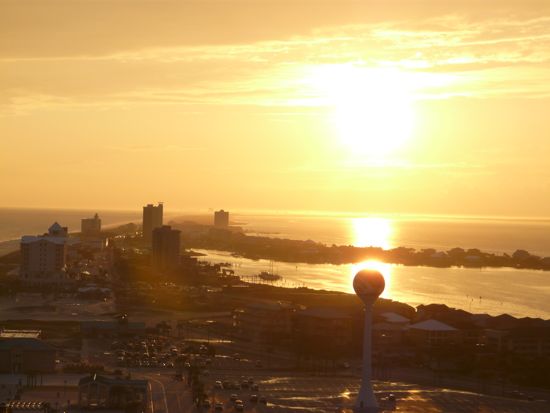

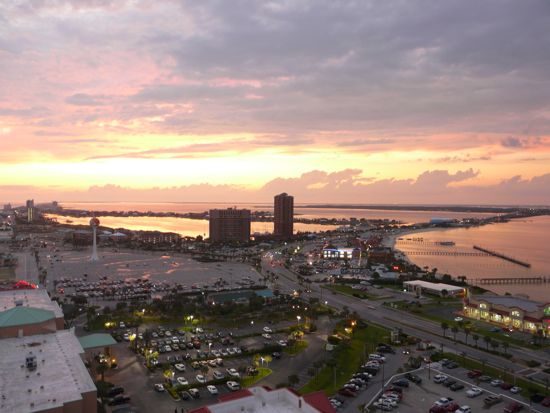
We all have such a good time together. We took a drive out to Fort Pickens and I saw so many butterflies!

We had to watch THE game later in the day, which the Happy Baby calls “buttball,” LLOOLLL!
Here he is at breakfast with his BaBa:

It was a beautiful day, with another beautiful sunset:


AdventureMan asked me if I wanted a house overlooking the Gulf. I said ‘no, it would never be so interesting as Kuwait.’ In Florida, I think I would want a house up high over a bayou, where there are birds and wildlife. High enough to not flood when there is a hurricane or a storm surge. . . It still was a thrill to spend a couple days high above the beach, and watch the sun set. 🙂
It’s funny the things that make a marriage succeed. It’s the little things. We both wanted to go to Barnes and Nobles because the 2012 calendars are out and we like to have calendars we love to look out through the year. You can take a chance on waiting until New Year’s week, and sometimes you get a cool calendar at 50% off, but mostly the one you really wanted is already gone gone gone, woe woe woe.
Besides that, we always like to get what we want, then the other one hides it until Christmas. By then, we’ve forgotten what we picked out, so it is a really good surprise. 😉
I told AM that I was going to have to have a chocolate fix and he said he would have to have a chocolate fix, too. We decided we could share an Oreo cake:

It was a fun idea, but it didn’t taste as good as it looked. We didn’t even finish it, it just wasn’t that great.
Uyen Nichole Duong: Mimi and Her Mirror

I must be on a streak. I really wanted to like this main character, Mi Chou (Mimi) but I found her obsessive, impulsive, overly emotional, self-absorbed and boastful. Her strongest relationship in the book is with her three way mirror. She specifically claims not to be narcissistic, and I think the story tells us otherwise.
The book is supposed to be fictional, and I truly hope some parts are fictional, but the strengths of the book lie in the ‘coming to America’ experience, which she captures well. She has a strong eye for ironies, hypocrisies and cultural differences. Her beginnings are vague, as is often the case when an immigrant goes through the shell-shock of being cut off from their own culture and grafted into another. I believe the author drew strongly on her own experiences to write this part of the book, and to me, it is the strongest part.
Mi Chau and her family leave Viet Nam during the great evacuation, and are given a spot on the planes that should have gone to someone else. Her entire family, mother, father, sister and brother all escape together, leaving behind a beloved grandmother who refuses to leave. Their entry into the US goes smoothly. They are the first wave of Vietnamese, the lucky ones. They have support, they have jobs. They have lost their own world, and they struggle. All this is part of the normal immigrant experience.
Neither is it abnormal that the children thrive through their struggles, and achieve excellent eduations. What is distracting to me in the book is how Mimi bases her self worth first on her academic excellence, and later in life on what she owns, and on her status. She has accomplished so much, she owns high-status symbols, but she is miserable and her life is empty.
Is it because of her experience as she evacuates out of Vietnam? Is it a character defect? There are no meaningful relationships in her life, she lives an empty and soulless existence, focusing on work and accomplishment and status symbols. Her major problem, as I see it, is an unwillingness to connect, to step out of herself and see through other’s eyes.
It’s an interesting book. There are, in my opinion, better books about the Vietnamese coming-to-America experience, and one is Anne Fadiman’s The Spirit Catches You and You Fall Down about immigrant Hmong, which is rich in cultural teachings, rich in relationships, and I still remember details more than ten years after I first read it. It is only available in Kindle format now, through Amazon, although they may have a used copy from time to time. Way better book than Mimi.

Naman: Cured or Pride?
Today’s Old Testament reading is from 2Kings. I like this story. Although it happened so long ago, it still applies to me today – do I want to be right or do I want to be cured?
2 Kings 5:1-19
5Naaman, commander of the army of the king of Aram, was a great man and in high favour with his master, because by him the Lord had given victory to Aram. The man, though a mighty warrior, suffered from leprosy.* 2Now the Arameans on one of their raids had taken a young girl captive from the land of Israel, and she served Naaman’s wife. 3She said to her mistress, ‘If only my lord were with the prophet who is in Samaria! He would cure him of his leprosy.’* 4So Naaman* went in and told his lord just what the girl from the land of Israel had said. 5And the king of Aram said, ‘Go then, and I will send along a letter to the king of Israel.’
He went, taking with him ten talents of silver, six thousand shekels of gold, and ten sets of garments. 6He brought the letter to the king of Israel, which read, ‘When this letter reaches you, know that I have sent to you my servant Naaman, that you may cure him of his leprosy.’* 7When the king of Israel read the letter, he tore his clothes and said, ‘Am I God, to give death or life, that this man sends word to me to cure a man of his leprosy?* Just look and see how he is trying to pick a quarrel with me.’
8 But when Elisha the man of God heard that the king of Israel had torn his clothes, he sent a message to the king, ‘Why have you torn your clothes? Let him come to me, that he may learn that there is a prophet in Israel.’ 9So Naaman came with his horses and chariots, and halted at the entrance of Elisha’s house. 10Elisha sent a messenger to him, saying, ‘Go, wash in the Jordan seven times, and your flesh shall be restored and you shall be clean.’
11But Naaman became angry and went away, saying, ‘I thought that for me he would surely come out, and stand and call on the name of the Lord his God, and would wave his hand over the spot, and cure the leprosy!* 12Are not Abana* and Pharpar, the rivers of Damascus, better than all the waters of Israel? Could I not wash in them, and be clean?’ He turned and went away in a rage. 13But his servants approached and said to him, ‘Father, if the prophet had commanded you to do something difficult, would you not have done it? How much more, when all he said to you was, “Wash, and be clean”?’ 14So he went down and immersed himself seven times in the Jordan, according to the word of the man of God; his flesh was restored like the flesh of a young boy, and he was clean.
15 Then he returned to the man of God, he and all his company; he came and stood before him and said, ‘Now I know that there is no God in all the earth except in Israel; please accept a present from your servant.’ 16But he said, ‘As the Lord lives, whom I serve, I will accept nothing!’ He urged him to accept, but he refused. 17Then Naaman said, ‘If not, please let two mule-loads of earth be given to your servant; for your servant will no longer offer burnt-offering or sacrifice to any god except the Lord. 18But may the Lord pardon your servant on one count: when my master goes into the house of Rimmon to worship there, leaning on my arm, and I bow down in the house of Rimmon, when I do bow down in the house of Rimmon, may the Lord pardon your servant on this one count.’ 19He said to him, ‘Go in peace.’
Sobering Reading on Wealth
It’s a long weekend, Labor Day weekend, and Pensacola awakes to rain-sodden streets and forecasts of a rain soggy three day weekend (bad for hotels and restaurants at the beach who hope for a sell-out Labor Day) and high surf from off-shore storms.
The reading for today from James is equally gloomy. I always think of “Insh’allah” when I read it, because it probably has an equivalent somewhere in the Quran, and my Muslim friends say “Insh’allah” (As God wills, or If God wills it) when they state a planned event.
While we are not rich, we have a large homeless population in Pensacola, sleeping out under the skies in hidden camps, scrounging for food, often with a dog, seeking handouts, seeking scraps. They are a constant reminder, to me, of how comfortable we are, and how comfort wars with the religious spirit. When we are too comfortable, we often fail to keep our focus on God, and are distracted by our toys and interests.
(I told you this would be gloomy.)
On the other hand, I wonder how spiritual I would be if I were hungry, worried about getting enough to eat, worried about my safety sleeping out in one of the camps. I wonder if their community looks after one another, or if it is a brutal and chaotic life. I wonder how you can keep your mind on things of the spirit when the search for basic necessities takes up a large part of your life.
James 4:13-5:6
13 Come now, you who say, ‘Today or tomorrow we will go to such and such a town and spend a year there, doing business and making money.’ 14Yet you do not even know what tomorrow will bring. What is your life? For you are a mist that appears for a little while and then vanishes. 15Instead you ought to say, ‘If the Lord wishes, we will live and do this or that.’ 16As it is, you boast in your arrogance; all such boasting is evil. 17Anyone, then, who knows the right thing to do and fails to do it, commits sin.
5Come now, you rich people, weep and wail for the miseries that are coming to you. 2Your riches have rotted, and your clothes are moth-eaten. 3Your gold and silver have rusted, and their rust will be evidence against you, and it will eat your flesh like fire. You have laid up treasure* for the last days. 4Listen! The wages of the labourers who mowed your fields, which you kept back by fraud, cry out, and the cries of the harvesters have reached the ears of the Lord of hosts.
5You have lived on the earth in luxury and in pleasure; you have fattened your hearts on a day of slaughter. 6You have condemned and murdered the righteous one, who does not resist you.
What Tiny Qatar Stands To Gain In Libya
Another fascinating discussion on National Public Radio, which covers subjects not covered by major national news sources.
Of course, anything having to do with Qatar is of interest to us, as we lived there for four years during a time of breathtaking and exhilarating change. It is astounding, and wonderful, to us, that Qatar defies the lethargy and inertia of the Gulf Countries, and has transformed itself into a major influence, in spite of its smaller size, and even smaller population of native Qataris. They have taken the huge influx of cash that came with the discovery of natural gas, and leveraged it into massive modernization, transformation, and influence on the international scene. It’s an amazing accomplishment.

ROBERT SIEGEL, host: The Libyan rebels received decisive air support from NATO. But there was another, less publicized, smaller-scale but equally remarkable foreign involvement in support of the uprising, the involvement of Qatar, Q-A-T-A-R.
Qatar is a peninsula, a little smaller than Connecticut. It juts north into the Persian Gulf. On the south, it borders Saudi Arabia. It is rich in oil and natural gas. Its population is only about 900,000. And while it is an Arab country, a monarchy ruled by the al-Thani family, the majority of its residents are non-Arabs, non-citizens from India and Pakistan. Qatar is also home to the TV channel Al Jazeera. It will host soccer’s World Cup and it was an important player in Libya.
Ibrahim Sharqieh is deputy director of the Brookings Doha Center. Doha is the capital of Qatar. And, Ibrahim, first, what did the Qataris do in support of the Libyan rebels?
Dr. IBRAHIM SHARQIEH: That Qataris’ support to the Libyan rebels has been politically, diplomatically and militarily. We had about five Qatari fighter jets. In Qatar, we had about the training of Libyan rebels. And Qatar also played an important role in developing an Arab League support through the military intervention in Libya, which this Arab League support actually has provided the umbrella for the NATO intervention and for the military intervention and provided the legitimacy that, for example, was missing in Iraq.
SIEGEL: Why? What are the motives behind Qatar’s involvement in Libya and some of its broader ambitions in the region?
SHARQIEH: Oh, there are many theories. The one that makes the most sense in my view is that Qatar is supporting the revolution for humanitarian reasons. And in addition to this, Qatar is working and supporting the revolution is they’re strictly with its vision for its role in the region and in the world.
SIEGEL: One thing we should note, though, in this year of the Arab Spring, one thing Qatar isn’t is it isn’t a democracy. It isn’t an elected parliamentary republic.
SHARQIEH: Well, there is very high level satisfaction of the people here in the country, of the political system and of its leadership. So there haven’t been – we haven’t seen any cause for change or any protests or any different types of complaints. So the system seems to work and we seem to have a stable country. That distance itself very far away from the protests that are happening in the region.
SIEGEL: How would you describe U.S.-Qatar relations?
SHARQIEH: We know it’s a strong relationship. Qatar hosts a military base, the largest in the region here, in Al Udeid. And this has been a sophisticated policy where Qatar managed to have a good relationship between the United States and other rivals in the region, like Iran. In order to protect yourself as a small, wealthy country, some sort of striking a balance is needed and Qatar has been more influential in this crisis and other regions in Benghazi.
Going back to Libya, when you go outside the offices of the National Transition Council, you see the American flag. You see the French flag. You see the British flag, and you see also the Qatari flag.
SIEGEL: Yes. Here’s a country that aspires to a very high profile in regional affairs, but it consists of fewer than a million people. And of them only about 350,000 I read are citizens. That doesn’t sound like a country that can really be a world player, you know? It just sounds too tiny.
SHARQIEH: Well, it is too tiny but, hey, we are living in an international system that you have the means to play it right and become an important player. Qatar has invested in the right political market by mediation. Qatar was successful in the mediating an agreement between the Yemeni government and the Houthi rebels. Prevented a civil war almost in Lebanon, brokered peace agreements between the Palestinians, Fatah and Hamas, and also intervened in the fall in Sudan.
So, Qatar has proved to me an important, major emerging power in the region and to play it right and position itself very well in the international scene.
SIEGEL: Well, Ibrahim Sharqieh, thank you very much for talking with us about Qatar.
SHARQIEH: My pleasure. Thank you for having me, Robert.
SIEGEL: Ibrahim Sharqieh is deputy director of the Brookings Doha Center. Doha is the capital city of Qatar.

Neighbors Key to Survival
“Americans don’t know their neighbors” my dinner guest said, in response to my asking him what surprises him most in his visit to this country. “In my country, we all know our neighbors. It’s important to know your neighbors.”
I agreed, and quoted him this article supporting his view that I heard on National Public Radio, one of those ideas I hear so often on NPR because they cover news other news sources ignore.
Below is just a portion of the story, which you can read in whole by clicking on this blue type. Even better, if you want, you can listed to the story yourself by clicking on the “Listen to the Story: All things Considered” button on this same page.

When Hurricane Katrina struck in 2005, one victim was political scientist Daniel Aldrich. He had just moved to New Orleans. Late one August night, there was a knock on the door.
“It was a neighbor who knew that we had no idea of the realities of the Gulf Coast life,” said Aldrich, who is now a political scientist at Purdue University in Indiana. He “knocked on our door very late at night, around midnight on Saturday night, and said, ‘Look, you’ve got small kids — you should really leave.’ ”
The knock on the door was to prove prophetic. It changed the course of Aldrich’s research and, in turn, is changing the way many experts now think about disaster preparedness.
Officials in New Orleans that Saturday night had not yet ordered an evacuation, but Aldrich trusted the neighbor who knocked on his door. He bundled his family into a car and drove to Houston.
“Without that information we never would’ve left,” Aldrich said. I think we would’ve been trapped.”
In fact, by the time people were told to leave, it was too late and thousands of people got stuck.
Because of his own experience in Katrina, Aldrich started thinking about how neighbors help one another during disasters. He decided to visit disaster sites around the world, looking for data.
Aldrich’s findings show that ambulances and firetrucks and government aid are not the principal ways most people survive during — and recover after — a disaster. His data suggest that while official help is useful — in clearing the water and getting the power back on in a place such as New Orleans after Katrina, for example — government interventions cannot bring neighborhoods back, and most emergency responders take far too long to get to the scene of a disaster to save many lives. Rather, it is the personal ties among members of a community that determine survival during a disaster, and recovery in its aftermath.
When Aldrich visited villages in India hit by the giant 2004 tsunami, he found that villagers who fared best after the disaster weren’t those with the most money, or the most power. They were people who knew lots of other people — the most socially connected individuals. In other words, if you want to predict who will do well after a disaster, you look for faces that keep showing up at all the weddings and funerals.
“Those individuals who had been more involved in local festivals, funerals and weddings, those were individuals who were tied into the community, they knew who to go to, they knew how to find someone who could help them get aid,” Aldrich says.
My visiting guest was from Lebanon, where neighbors have relied on one another for years as civil unrest rocks the country.
“I am guessing we move more often than your family and friends,” I ventured. “You are right, it is harder to establish long-lasting neighborly relations here where people come and go more often.”
Actually, we have settled in a fairly established neighborhood, where many people around us have lived for years and years, some all their lives. But we have only been here a year, and it takes time to build strong neighborly relations. But we are aware that connecting with our neighbors and staying connected is important in a part of the country vulnerable to life-threatening hurricanes and other natural emergencies.
You can listen to the entire report in 6 minutes and 3 seconds here.
HIV Epidemic Emerging in Middle East and North Africa
Recently published on National Public Radio is a study showing that governments are quietly gathering statistics on the rising tide of HIV infections in the Middle East and North Africa, but they don’t want those statistics published:
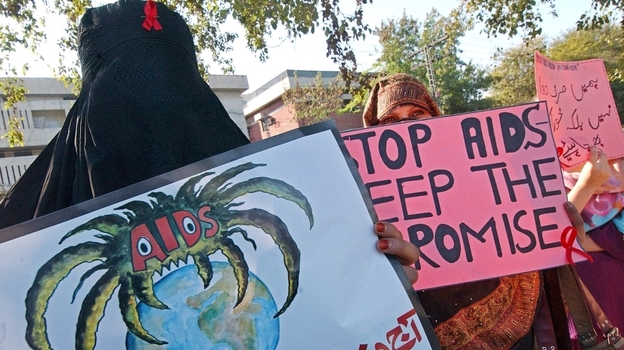
HIV epidemics are emerging among men who have sex with men in the Middle East and North Africa, researchers say. It’s a region where HIV/AIDS isn’t well understood, or studied.
More than 5 percent of men who have sex with men are infected by HIV in countries including Egypt, Iran, Lebanon, Morocco, Sudan and Tunisia, according to a recent study in PLoS Medicine. In one group of men in Pakistan, the rate of infection was about 28 percent. (For reference, in 2008, rates of HIV infection among men who have sex with men in the U.S. ranged from 16 percent among white men up to 28 percent of black men, according to the CDC.)
Risky behavior, low condom use, injectable drug use and male sex workers are some of the factors that could cause HIV rates to rise in the region, the researchers say. On average, the men who have sex with men group had between four and 14 sexual partners within the past six months, with consistent condom use falling below 25 percent.
Lack of HIV surveillance and low access to treatment and prevention are a concern for researchers, who believe the window of opportunity to prevent the epidemic from spreading across the region is growing smaller.
Shots had a chance to speak with one of the study’s authors, Dr. Laith Abu-Raddad, assistant professor of public health at the Weill Cornell Medical College in Qatar, to discuss the challenges of researching such a taboo topic.
What made you decide to pursue this study?
There are some political and community leaders who believe that our region is not affected by the epidemic. While others, such as HIV activists, believe that men having sex with men behavior is hidden, so HIV data must be hidden. They have called it the “HIV epidemic behind the veil.” It occurred to me that these are very contrasting views, and the truth must be out there somewhere.
I started this work eight years ago, to get every piece of evidence that we have on HIV. Turns out that there are more data than we think. The regions are not hiding the data, it’s just a sensitive issue. These issues aren’t discussed like in the western media. But it doesn’t mean that the government isn’t dealing with it. Governments do have programs such as active non-government organizations, NGOs, working with groups that are infected.
What surprised you about the findings?
Certain countries did surprise us with the work they’ve done. In Iran, they target the population of drug users. When Iran discovered HIV among drug users, they created programs that offered drug users access to treatment, and gave them free clean needles and syringes.
Many governments don’t want to provide HIV treatment or counseling directly. They support NGOs financially and logistically to help treat communities affected. It’s a way for them to protect people without raising sensitive issues of sexual and drug use behaviors that are often controversial.
What challenges did you face while gathering evidence?
There were some governments that gave us their data on the condition that we didn’t publish it. They want to deal with this issue, but they see no reason to raise it to the public. There were governments who did not want to release data. I can’t tell you which countries, since we have long-standing relationships with them. But we managed to convince some of them that the data would be used purely for scientific research and not used against them by the media.
What do you hope to accomplish from this study?
To raise awareness among policy makers. Hopefully, governments will make changes to policy. Surprisingly, the No. 1 barrier is poor research capacity in this region. If we don’t have the scientific data, we can’t have effective policy. We need to have an effective surveillance program, so we can help prevent further HIV transmission.
This part of the world is seen as not addressing the epidemic. Countries like Iran, Morocco and Egypt are developing programs and working with NGOs. But other countries haven’t yet improved their services to the public. But we hope they will.
Major Pettigrew’s Last Stand
 Major Pettigrew’s Last Stand by Helen Simonson
My rating: 5 of 5 stars
I loved this book. It follows all the themes I love – how convention blinds us, how our cultural assumptions make us unconsciously snobbish and leads us to hideous behavior, it is very cultural and also very cross-cultural. Major Pettrigrew is widowed, and his grief has made him old. At the beginning of the book, his life seems very dull and grey. It lightens as his friendship sparks with Mrs. Ali, a widow who runs a small convenience market in his small English village. They both love reading (of course I love that part!) and they talk books, and sparks of warmth kindle.
This book is also very uncomfortable for me, as Roger has a grown son who bullies his father. The book isn’t just cross-cultural, it’s cross-generational, and I see glimpses of myself in the boorish behavior of his son toward his father.
There are some amusing scenes, some wickedly insightful village-interaction scenes, some painfully introspective moments, and some truly grand moments when everything becomes clear and a person acts. For me, there was an added bonus in that as I read Mrs. Ali’s words, I could hear them so clearly, and she spoke in the voice of a dear friend. I could picture her, because I could see the sweet smiling face of a dear friend. It was like having a great visit.
<a href=
Recent Comments
ExpatAlien on What Country am I Living … intlxpatr on Yellowstone: Old Faithful to C… Michelle on Yellowstone: Old Faithful to C… Cathy on No Grown-Ups in Charge intlxpatr on Waiting for Snow Wikipedia Donate Button

Amazina


Early Voting in Florida


 Here There and Everywhere