Naman: Cured or Pride?
Today’s Old Testament reading is from 2Kings. I like this story. Although it happened so long ago, it still applies to me today – do I want to be right or do I want to be cured?
2 Kings 5:1-19
5Naaman, commander of the army of the king of Aram, was a great man and in high favour with his master, because by him the Lord had given victory to Aram. The man, though a mighty warrior, suffered from leprosy.* 2Now the Arameans on one of their raids had taken a young girl captive from the land of Israel, and she served Naaman’s wife. 3She said to her mistress, ‘If only my lord were with the prophet who is in Samaria! He would cure him of his leprosy.’* 4So Naaman* went in and told his lord just what the girl from the land of Israel had said. 5And the king of Aram said, ‘Go then, and I will send along a letter to the king of Israel.’
He went, taking with him ten talents of silver, six thousand shekels of gold, and ten sets of garments. 6He brought the letter to the king of Israel, which read, ‘When this letter reaches you, know that I have sent to you my servant Naaman, that you may cure him of his leprosy.’* 7When the king of Israel read the letter, he tore his clothes and said, ‘Am I God, to give death or life, that this man sends word to me to cure a man of his leprosy?* Just look and see how he is trying to pick a quarrel with me.’
8 But when Elisha the man of God heard that the king of Israel had torn his clothes, he sent a message to the king, ‘Why have you torn your clothes? Let him come to me, that he may learn that there is a prophet in Israel.’ 9So Naaman came with his horses and chariots, and halted at the entrance of Elisha’s house. 10Elisha sent a messenger to him, saying, ‘Go, wash in the Jordan seven times, and your flesh shall be restored and you shall be clean.’
11But Naaman became angry and went away, saying, ‘I thought that for me he would surely come out, and stand and call on the name of the Lord his God, and would wave his hand over the spot, and cure the leprosy!* 12Are not Abana* and Pharpar, the rivers of Damascus, better than all the waters of Israel? Could I not wash in them, and be clean?’ He turned and went away in a rage. 13But his servants approached and said to him, ‘Father, if the prophet had commanded you to do something difficult, would you not have done it? How much more, when all he said to you was, “Wash, and be clean”?’ 14So he went down and immersed himself seven times in the Jordan, according to the word of the man of God; his flesh was restored like the flesh of a young boy, and he was clean.
15 Then he returned to the man of God, he and all his company; he came and stood before him and said, ‘Now I know that there is no God in all the earth except in Israel; please accept a present from your servant.’ 16But he said, ‘As the Lord lives, whom I serve, I will accept nothing!’ He urged him to accept, but he refused. 17Then Naaman said, ‘If not, please let two mule-loads of earth be given to your servant; for your servant will no longer offer burnt-offering or sacrifice to any god except the Lord. 18But may the Lord pardon your servant on one count: when my master goes into the house of Rimmon to worship there, leaning on my arm, and I bow down in the house of Rimmon, when I do bow down in the house of Rimmon, may the Lord pardon your servant on this one count.’ 19He said to him, ‘Go in peace.’
Sobering Reading on Wealth
It’s a long weekend, Labor Day weekend, and Pensacola awakes to rain-sodden streets and forecasts of a rain soggy three day weekend (bad for hotels and restaurants at the beach who hope for a sell-out Labor Day) and high surf from off-shore storms.
The reading for today from James is equally gloomy. I always think of “Insh’allah” when I read it, because it probably has an equivalent somewhere in the Quran, and my Muslim friends say “Insh’allah” (As God wills, or If God wills it) when they state a planned event.
While we are not rich, we have a large homeless population in Pensacola, sleeping out under the skies in hidden camps, scrounging for food, often with a dog, seeking handouts, seeking scraps. They are a constant reminder, to me, of how comfortable we are, and how comfort wars with the religious spirit. When we are too comfortable, we often fail to keep our focus on God, and are distracted by our toys and interests.
(I told you this would be gloomy.)
On the other hand, I wonder how spiritual I would be if I were hungry, worried about getting enough to eat, worried about my safety sleeping out in one of the camps. I wonder if their community looks after one another, or if it is a brutal and chaotic life. I wonder how you can keep your mind on things of the spirit when the search for basic necessities takes up a large part of your life.
James 4:13-5:6
13 Come now, you who say, ‘Today or tomorrow we will go to such and such a town and spend a year there, doing business and making money.’ 14Yet you do not even know what tomorrow will bring. What is your life? For you are a mist that appears for a little while and then vanishes. 15Instead you ought to say, ‘If the Lord wishes, we will live and do this or that.’ 16As it is, you boast in your arrogance; all such boasting is evil. 17Anyone, then, who knows the right thing to do and fails to do it, commits sin.
5Come now, you rich people, weep and wail for the miseries that are coming to you. 2Your riches have rotted, and your clothes are moth-eaten. 3Your gold and silver have rusted, and their rust will be evidence against you, and it will eat your flesh like fire. You have laid up treasure* for the last days. 4Listen! The wages of the labourers who mowed your fields, which you kept back by fraud, cry out, and the cries of the harvesters have reached the ears of the Lord of hosts.
5You have lived on the earth in luxury and in pleasure; you have fattened your hearts on a day of slaughter. 6You have condemned and murdered the righteous one, who does not resist you.
What Tiny Qatar Stands To Gain In Libya
Another fascinating discussion on National Public Radio, which covers subjects not covered by major national news sources.
Of course, anything having to do with Qatar is of interest to us, as we lived there for four years during a time of breathtaking and exhilarating change. It is astounding, and wonderful, to us, that Qatar defies the lethargy and inertia of the Gulf Countries, and has transformed itself into a major influence, in spite of its smaller size, and even smaller population of native Qataris. They have taken the huge influx of cash that came with the discovery of natural gas, and leveraged it into massive modernization, transformation, and influence on the international scene. It’s an amazing accomplishment.

ROBERT SIEGEL, host: The Libyan rebels received decisive air support from NATO. But there was another, less publicized, smaller-scale but equally remarkable foreign involvement in support of the uprising, the involvement of Qatar, Q-A-T-A-R.
Qatar is a peninsula, a little smaller than Connecticut. It juts north into the Persian Gulf. On the south, it borders Saudi Arabia. It is rich in oil and natural gas. Its population is only about 900,000. And while it is an Arab country, a monarchy ruled by the al-Thani family, the majority of its residents are non-Arabs, non-citizens from India and Pakistan. Qatar is also home to the TV channel Al Jazeera. It will host soccer’s World Cup and it was an important player in Libya.
Ibrahim Sharqieh is deputy director of the Brookings Doha Center. Doha is the capital of Qatar. And, Ibrahim, first, what did the Qataris do in support of the Libyan rebels?
Dr. IBRAHIM SHARQIEH: That Qataris’ support to the Libyan rebels has been politically, diplomatically and militarily. We had about five Qatari fighter jets. In Qatar, we had about the training of Libyan rebels. And Qatar also played an important role in developing an Arab League support through the military intervention in Libya, which this Arab League support actually has provided the umbrella for the NATO intervention and for the military intervention and provided the legitimacy that, for example, was missing in Iraq.
SIEGEL: Why? What are the motives behind Qatar’s involvement in Libya and some of its broader ambitions in the region?
SHARQIEH: Oh, there are many theories. The one that makes the most sense in my view is that Qatar is supporting the revolution for humanitarian reasons. And in addition to this, Qatar is working and supporting the revolution is they’re strictly with its vision for its role in the region and in the world.
SIEGEL: One thing we should note, though, in this year of the Arab Spring, one thing Qatar isn’t is it isn’t a democracy. It isn’t an elected parliamentary republic.
SHARQIEH: Well, there is very high level satisfaction of the people here in the country, of the political system and of its leadership. So there haven’t been – we haven’t seen any cause for change or any protests or any different types of complaints. So the system seems to work and we seem to have a stable country. That distance itself very far away from the protests that are happening in the region.
SIEGEL: How would you describe U.S.-Qatar relations?
SHARQIEH: We know it’s a strong relationship. Qatar hosts a military base, the largest in the region here, in Al Udeid. And this has been a sophisticated policy where Qatar managed to have a good relationship between the United States and other rivals in the region, like Iran. In order to protect yourself as a small, wealthy country, some sort of striking a balance is needed and Qatar has been more influential in this crisis and other regions in Benghazi.
Going back to Libya, when you go outside the offices of the National Transition Council, you see the American flag. You see the French flag. You see the British flag, and you see also the Qatari flag.
SIEGEL: Yes. Here’s a country that aspires to a very high profile in regional affairs, but it consists of fewer than a million people. And of them only about 350,000 I read are citizens. That doesn’t sound like a country that can really be a world player, you know? It just sounds too tiny.
SHARQIEH: Well, it is too tiny but, hey, we are living in an international system that you have the means to play it right and become an important player. Qatar has invested in the right political market by mediation. Qatar was successful in the mediating an agreement between the Yemeni government and the Houthi rebels. Prevented a civil war almost in Lebanon, brokered peace agreements between the Palestinians, Fatah and Hamas, and also intervened in the fall in Sudan.
So, Qatar has proved to me an important, major emerging power in the region and to play it right and position itself very well in the international scene.
SIEGEL: Well, Ibrahim Sharqieh, thank you very much for talking with us about Qatar.
SHARQIEH: My pleasure. Thank you for having me, Robert.
SIEGEL: Ibrahim Sharqieh is deputy director of the Brookings Doha Center. Doha is the capital city of Qatar.

Neighbors Key to Survival
“Americans don’t know their neighbors” my dinner guest said, in response to my asking him what surprises him most in his visit to this country. “In my country, we all know our neighbors. It’s important to know your neighbors.”
I agreed, and quoted him this article supporting his view that I heard on National Public Radio, one of those ideas I hear so often on NPR because they cover news other news sources ignore.
Below is just a portion of the story, which you can read in whole by clicking on this blue type. Even better, if you want, you can listed to the story yourself by clicking on the “Listen to the Story: All things Considered” button on this same page.

When Hurricane Katrina struck in 2005, one victim was political scientist Daniel Aldrich. He had just moved to New Orleans. Late one August night, there was a knock on the door.
“It was a neighbor who knew that we had no idea of the realities of the Gulf Coast life,” said Aldrich, who is now a political scientist at Purdue University in Indiana. He “knocked on our door very late at night, around midnight on Saturday night, and said, ‘Look, you’ve got small kids — you should really leave.’ ”
The knock on the door was to prove prophetic. It changed the course of Aldrich’s research and, in turn, is changing the way many experts now think about disaster preparedness.
Officials in New Orleans that Saturday night had not yet ordered an evacuation, but Aldrich trusted the neighbor who knocked on his door. He bundled his family into a car and drove to Houston.
“Without that information we never would’ve left,” Aldrich said. I think we would’ve been trapped.”
In fact, by the time people were told to leave, it was too late and thousands of people got stuck.
Because of his own experience in Katrina, Aldrich started thinking about how neighbors help one another during disasters. He decided to visit disaster sites around the world, looking for data.
Aldrich’s findings show that ambulances and firetrucks and government aid are not the principal ways most people survive during — and recover after — a disaster. His data suggest that while official help is useful — in clearing the water and getting the power back on in a place such as New Orleans after Katrina, for example — government interventions cannot bring neighborhoods back, and most emergency responders take far too long to get to the scene of a disaster to save many lives. Rather, it is the personal ties among members of a community that determine survival during a disaster, and recovery in its aftermath.
When Aldrich visited villages in India hit by the giant 2004 tsunami, he found that villagers who fared best after the disaster weren’t those with the most money, or the most power. They were people who knew lots of other people — the most socially connected individuals. In other words, if you want to predict who will do well after a disaster, you look for faces that keep showing up at all the weddings and funerals.
“Those individuals who had been more involved in local festivals, funerals and weddings, those were individuals who were tied into the community, they knew who to go to, they knew how to find someone who could help them get aid,” Aldrich says.
My visiting guest was from Lebanon, where neighbors have relied on one another for years as civil unrest rocks the country.
“I am guessing we move more often than your family and friends,” I ventured. “You are right, it is harder to establish long-lasting neighborly relations here where people come and go more often.”
Actually, we have settled in a fairly established neighborhood, where many people around us have lived for years and years, some all their lives. But we have only been here a year, and it takes time to build strong neighborly relations. But we are aware that connecting with our neighbors and staying connected is important in a part of the country vulnerable to life-threatening hurricanes and other natural emergencies.
You can listen to the entire report in 6 minutes and 3 seconds here.
HIV Epidemic Emerging in Middle East and North Africa
Recently published on National Public Radio is a study showing that governments are quietly gathering statistics on the rising tide of HIV infections in the Middle East and North Africa, but they don’t want those statistics published:
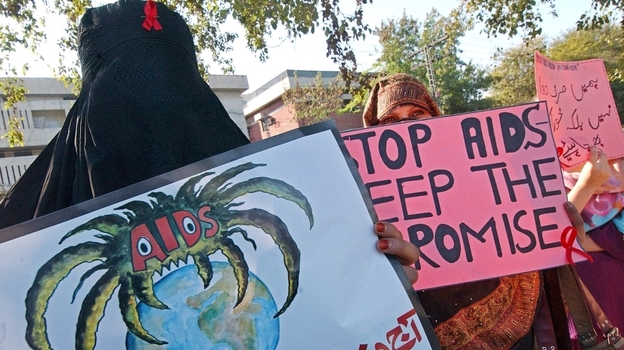
HIV epidemics are emerging among men who have sex with men in the Middle East and North Africa, researchers say. It’s a region where HIV/AIDS isn’t well understood, or studied.
More than 5 percent of men who have sex with men are infected by HIV in countries including Egypt, Iran, Lebanon, Morocco, Sudan and Tunisia, according to a recent study in PLoS Medicine. In one group of men in Pakistan, the rate of infection was about 28 percent. (For reference, in 2008, rates of HIV infection among men who have sex with men in the U.S. ranged from 16 percent among white men up to 28 percent of black men, according to the CDC.)
Risky behavior, low condom use, injectable drug use and male sex workers are some of the factors that could cause HIV rates to rise in the region, the researchers say. On average, the men who have sex with men group had between four and 14 sexual partners within the past six months, with consistent condom use falling below 25 percent.
Lack of HIV surveillance and low access to treatment and prevention are a concern for researchers, who believe the window of opportunity to prevent the epidemic from spreading across the region is growing smaller.
Shots had a chance to speak with one of the study’s authors, Dr. Laith Abu-Raddad, assistant professor of public health at the Weill Cornell Medical College in Qatar, to discuss the challenges of researching such a taboo topic.
What made you decide to pursue this study?
There are some political and community leaders who believe that our region is not affected by the epidemic. While others, such as HIV activists, believe that men having sex with men behavior is hidden, so HIV data must be hidden. They have called it the “HIV epidemic behind the veil.” It occurred to me that these are very contrasting views, and the truth must be out there somewhere.
I started this work eight years ago, to get every piece of evidence that we have on HIV. Turns out that there are more data than we think. The regions are not hiding the data, it’s just a sensitive issue. These issues aren’t discussed like in the western media. But it doesn’t mean that the government isn’t dealing with it. Governments do have programs such as active non-government organizations, NGOs, working with groups that are infected.
What surprised you about the findings?
Certain countries did surprise us with the work they’ve done. In Iran, they target the population of drug users. When Iran discovered HIV among drug users, they created programs that offered drug users access to treatment, and gave them free clean needles and syringes.
Many governments don’t want to provide HIV treatment or counseling directly. They support NGOs financially and logistically to help treat communities affected. It’s a way for them to protect people without raising sensitive issues of sexual and drug use behaviors that are often controversial.
What challenges did you face while gathering evidence?
There were some governments that gave us their data on the condition that we didn’t publish it. They want to deal with this issue, but they see no reason to raise it to the public. There were governments who did not want to release data. I can’t tell you which countries, since we have long-standing relationships with them. But we managed to convince some of them that the data would be used purely for scientific research and not used against them by the media.
What do you hope to accomplish from this study?
To raise awareness among policy makers. Hopefully, governments will make changes to policy. Surprisingly, the No. 1 barrier is poor research capacity in this region. If we don’t have the scientific data, we can’t have effective policy. We need to have an effective surveillance program, so we can help prevent further HIV transmission.
This part of the world is seen as not addressing the epidemic. Countries like Iran, Morocco and Egypt are developing programs and working with NGOs. But other countries haven’t yet improved their services to the public. But we hope they will.
Major Pettigrew’s Last Stand
 Major Pettigrew’s Last Stand by Helen Simonson
My rating: 5 of 5 stars
I loved this book. It follows all the themes I love – how convention blinds us, how our cultural assumptions make us unconsciously snobbish and leads us to hideous behavior, it is very cultural and also very cross-cultural. Major Pettrigrew is widowed, and his grief has made him old. At the beginning of the book, his life seems very dull and grey. It lightens as his friendship sparks with Mrs. Ali, a widow who runs a small convenience market in his small English village. They both love reading (of course I love that part!) and they talk books, and sparks of warmth kindle.
This book is also very uncomfortable for me, as Roger has a grown son who bullies his father. The book isn’t just cross-cultural, it’s cross-generational, and I see glimpses of myself in the boorish behavior of his son toward his father.
There are some amusing scenes, some wickedly insightful village-interaction scenes, some painfully introspective moments, and some truly grand moments when everything becomes clear and a person acts. For me, there was an added bonus in that as I read Mrs. Ali’s words, I could hear them so clearly, and she spoke in the voice of a dear friend. I could picture her, because I could see the sweet smiling face of a dear friend. It was like having a great visit.
<a href=
Surprising Secrets to Happiness
Received this in an e-mail this morning from Bottom Line, a service we have subscribed to for many years because they report some of the newest findings in concise and readable articles:
Surprising Secrets from the World’s Happiest People
Dan Buettner
We’ve all heard that “wealth doesn’t buy happiness.” Neither, it turns out, does social status, youth or beauty.
Social scientists have collected tens of millions of data points that help identify what truly makes people happy. Genetics and life circumstances can influence happiness, but personal choices account for about 55% of it. That means we all have more control over our happiness than we may realize.
National Geographic author and explorer Dan Buettner spent five years talking to people in areas identified by researchers as the world leaders in happiness—Denmark’s Jutland Peninsula… Singapore…Nuevo León, Mexico … and the town of San Luis Obispo in California.
In his new book, Thrive, he identified the main characteristics of what he calls thrivers, people who consistently report the highest levels of well-being. Here, secrets from the world’s happiest people…
Own one TV, no more. Americans spend more than four hours a day, on average, in front of the television. This is time that they’re not spending with other people, including their families. (Family time in front of the television is not the same as real interaction.)
In the places where happiness is highest, people spend the least time watching television. It’s not that they never watch—they just watch less than most people.
I advise people to own no more than one television—and to keep it in an out-of-the-way place, such as the basement. You still can watch your favorite programs, but watching will become a deliberate activity, not something you just do automatically.
Create a “flow room.” In Danish society, most families have an area in the house where everyone naturally congregates. I call these rooms “flow rooms” because they’re places where time seems to flow away when people are engaged and enjoying one another’s company. Flow rooms have no screens (TVs or computers) and no clocks. They are quiet environments where it’s easy to engage in meaningful activities with family.
In our house, I chose a room with good lighting and the best views—it’s comfortable, and everyone in the family wants to be there. I keep it stocked with good books, musical instruments and the best family games.
There’s nothing formal about our gatherings. People wander in and out. Because it’s so pleasant, we spend a lot more time there than in front of the TV or separated in different parts of the house.
Experience the “sun bonus.” By most standard measures, people in Mexico should be less happy than those in other countries. About 60% of the population is poor. Education and health care are less than optimal. Yet on the happiness scale, Mexico ranks high.
This is partly due to the “sun bonus.” People in sunnier climates are consistently happier than those who live in northern countries.
Those of us who live in colder, less sunny climates still can take advantage of the sunny days we do have by getting out and enjoying the sun. The vitamin D that is produced in the body from sun exposure is sometimes called the “happiness vitamin” because it increases brain levels of serotonin, the same neurotransmitter that is increased by some anti-depressant medications.
Stop shopping. The satisfaction that we get from buying things—an expensive watch, a new suit, a fancy car—wears off within 14 months. Yet in the US, we’re pressured by the media and social expectations to always want more. In order to get it, we have to work longer hours and take fewer vacations, which generally reduces happiness.
In Denmark, regulations limit the number of hours that shops can be open. In Mexico, most of the inhabitants are not running a status race with their neighbors.
For more happiness, take the money that you could spend on nonessential items and spend it on something that lasts. For example, take a vacation with your family or sign up for a painting class. The experiences and good memories will continue to give satisfaction for the rest of your life.
Employ yourself. Self-employed workers and business owners report some of the highest levels of well-being. It may be because they are more likely to pursue work that they love or simply because they feel more in control.
The happiness zone of San Luis Obispo, California, has far more self-employed people per capita than the average community in the US. These self-employed workers are shop owners, graphic designers, artists, wine-makers and the like. The more autonomy and control you have over your job, the more likely you will be satisfied with your work.
Make new friends. People around the world report higher levels of satisfaction when they spend time with family and friends. Every additional friend that you make (assuming that these friends are upbeat) increases your chances of being happy by 9%.
People who get together with others for at least seven hours a day have the highest levels of happiness. That sounds like a lot, but the time quickly adds up.
For example, everyone eats lunch. Ask a coworker to join you, or sit with a group in a cafeteria. Talk with friends during coffee breaks. After work, encourage the family to eat and socialize together, rather than dispersing to separate rooms. Take classes or join a club.
The Danes don’t identify themselves as being particularly outgoing, yet 19 out of 20 Danish adults belong to clubs dedicated to arts, exercise and hobbies.
Get addicted to this. The happiest people almost always volunteer in some fashion—at their church, with environmental groups, for social-service organizations and the like. Volunteering means spending time with others, and it also takes your mind off your own problems and increases self-worth and pride in your community.
Studies have shown that altruism has an effect on the brain that is similar to that of sugar and cocaine. It creates feelings of well-being, along with an addictive feedback loop that encourages people to keep doing it.
Also, volunteers are healthier. They tend to weigh less than those who don’t volunteer, and they’re even less likely to suffer a heart attack.
Commit to volunteering for a set period of time—say, once a week for four weeks. People are more likely to keep doing it when they make this initial commitment—and then get “hooked” on the rewards.
Keep the faith. Religious people tend to be happier than those without faith. It’s not clear whether religion makes people happy or if happy people tend to be drawn to religious practices. Either way, those who are religious have less disease, live longer and are less likely to engage in dangerous behavior (such as smoking and heavy drinking).
In Mexico, for example, more than 80% of people who were asked, “How important is God in your life?” responded with a 10 on a scale of one to 10, compared with only 58% in the US. This helps explain why people in some parts of Mexico, despite the hardships of daily life, tend to thrive emotionally.
Even if you’re not religious, you can achieve similar benefits by cultivating a sense of spirituality—and a belief in giving back to your community and making the world a better place.
Bottom Line/Personal interviewed Dan Buettner, founder of Blue Zones, an organization that studies the regions of the world where people commonly live active lives past the age of 100. Based in Minneapolis, he is a writer for National Geographic and author of Thrive: Finding Happiness the Blue Zones Way (National Geographic). http://www.BlueZones.com
Episcopal Reading for the Fourth of July
For those in a hurry, in addition to the daily readings in The Lectionary, there is a small booklet, Forward Day by Day, which prints a short reading for each day.
I love the reading for today:
Today’s Meditation
monday, july 4 independence day
Deuteronomy 10:17-21. For the Lord your God is…the great God, mighty and awesome, who is not partial and takes no bribe…and who loves the strangers.
In the reading from Deuteronomy, Moses charges Israel to love the stranger, because the people of Israel were once strangers in Egypt. In Mark, Jesus entreats us to love our enemies and to pray for those who persecute us because God is not partial. The sun rises on the just and the unjust.
It is easy for us to love friends and people like ourselves. Christians are called to greater challenge: to create a community in which we love the stranger and pray for the one who wants to do us harm.
I remember standing on the Lake Erie shore and reading that during the War of 1812 soldiers died there so that the lake would not belong to the British. The British were the bad guys. A little over a hundred years later, the United States fought two World Wars on the side of Great Britain. The British were good guys. In the intervening years, each country learned to see the other not as evil strangers, but as allies with common interests.
As we give thanks for our country, let us accept the challenge to create a community that includes those who might be our enemies, the people who today don’t seem to be one with us. Our perspective can change.
PRAY for the Diocese of Ottawa (Ontario, Canada)
Ps 145 * 145:1-9; Hebrews 11:8-16; Matthew 5:43-48
Cultural Issues as Qatar races Towards 2022 World Cup
In the same issue of The Peninsula (Qatar), this author addresses cultural sensitivity when it comes to dress, but includes some intriguing mistakes. He (or she) states that all women are required to ‘veil their faces’ in Saudi Arabia, which is untrue. There is no law requiring women to cover their faces. Custom drives many – but not all – Saudi women to cover their faces. Western women are asked to cover their hair and to wear an abaya, and must do so when going off compounds or out of their hotels, but no one is required to cover their face.
The Issue: Is Qatar ready for 2022? Well, the country is all set to launch mega infrastructure projects worth billions of dollars in order to have facilities in place to host the coveted event.

But the key question being asked by many is whether the conservative Qatari society is ready to take in its stride the cultural shock that the preparations for the event and it being actually held here would trigger.
With no less than half-a-million international soccer fans expected to descend on the Qatari soil in 2022, Qatar must build the requisite mindset — and not just physical infrastructure — to be able to absorb the social and cultural tremors such an avalanche of people from different ethnicities and cultures would cause.
Or, will the Qatari society rise in rebellion against the onslaught, especially as Western values and traditions are seen gradually overshadowing local customs and the way people dress up and behave in public?
Already, there is widespread fear in the Qatari community about their identity being diluted due to the sheer size of the expatriate population. Official estimates suggest that out of a total of 1.7 million people living in Qatar, an incredible 1.5 million are foreigners. This means that some 90 percent people in the country are non-Qatari.
Since expatriates come from all over the world (unconfirmed reports suggest there might be people from more than 80 nationalities living here) the threat to Qatari identity and culture is real, say social analysts.
Some, though, argue that since Qatar is a small country with a tiny population, its people must pay the social price for development and prosperity. “Given the situation, you can’t have both—prosperity and identity. You must compromise and choose between the two,” says another social analyst not wanting his name in print.
Concerns in the Qatari community about its age-old culture and identity being compromised due to the ever-rising numerical preponderance of foreigners, are growing.
Rising indebtedness in the community due to limited income and growing consumerism has been relegated to the background as fears deepen over the local customs and folklore falling prey to what seems to be unstoppable intrusion of foreign cultures.
There is immense hostility in the Qatari community towards the way foreigners, especially young women, dress up. Foreign cultures have already reached Qatari homes with children being largely raised by foreign maids.
“Things are still under control since we can influence our children, but we are helpless when it comes to stopping outside influences that are causing damage to our society,” says a Qatari requesting anonymity. “The most harmful outside influences are TV and foreigners living in our midst.”
Objections are raised to young non-Qatari women, particularly Westerners, wearing skirts and sleeveless tops.
A number of Qatari mothers have expressed ire and want the state to intervene and ‘discipline’ young non-Qatari women who dress up ‘indecently’ in public. The mothers say they fear that their daughters might ape such negative behaviour.
There are some Qatari women, though, who see the media (read: foreign TV stations) posing a bigger threat than foreign women wearing skirts and sleeveless tops here in public.
Says Wisam Al Othamn, a lecturer at Qatar University: “It’s necessary to monitor the media, not foreign women.”
There are others, though, who feel that dressing up in public is one’s freedom and choice, so no one should impose restrictions.
Qatari social websites are filled with comments from people talking about threats to their identity. Some have called for setting up a ‘religious police’ to especially monitor young foreign women dressing up ‘indecently’ in public.
The commentators argue that Saudi Arabia has such a police and it is compulsory for every woman, whether local or foreigner, Muslim or non-Muslim, to veil her face in public.
But there are others who laud Qatar for the freedom people have in personal matters such as dressing up in public, and claim that foreigners here dress up decently if comparisons are made with neighbouring countries like Bahrain and Dubai.
There are still others who favour Qatar forcing foreign women to veil their faces while in public. They argue that since countries like France and Belgium have banned Muslim women from using face veils in public, Qatar and other Muslim countries should take counter measures and force all women, whether Muslim or non-Muslim, to cover their faces while moving in public.
An interesting comment on the way Qatari women dress is from a man writing on a local social website. He suggests that there is nothing like Qatari attire for women. Abaya is used by women in Yemen, Iraq and Syria, so it has come here from these countries.
As for naqab or full face and body veil, it did not exist in Qatar until 20 years ago, suggests the man. “So there is nothing called Qatari dress for women,” he says.
There are some who find fault with some schools having co-education and say Qatari girls tend to ape their foreign peers from these schools.
There is ire in sections of the Qatari community over the schools’ regulator, the Supreme Education Council (SEC), giving the freedom to schools on imparting lessons in Qatari history, language (Arabic) and religion.
Writing on social websites, some commentators are critical of the SEC and say that since land, history, language and religion are the four pillars of a society’s cultural identity, the schools must impart lessons in these subjects.
“It’s surprising why the SEC has not made the teaching of these subjects compulsory in schools. It’s a step that would destroy the Qatari identity,” wrote an angered commentator.
About language, the commentator quoted a famous Qatari writer, Dr Mohamed Al Kubaisi, as saying that it is only through their version of English language (different from the British English) that the Americans have built their identity and are dominating the world by popularising it (American English).
Another commentator said he saw the SEC move as a step aimed at diluting the Qatari identity. He even suggests that some teachers are opposing the SEC’s decision individually.
“Go to Germany and France and if you don’t speak the local language you wouldn’t get a response,” the commentator said, hinting that everyone in Qatar must speak the local language, Arabic.
Social analysts believe that Qatar faces a huge challenge over the coming 11 years (during the run-up to the 2022 event) in its struggle to maintain its cultural identity, and much of the onus will be on the Ministry of Awqaf and Islamic Affairs and the Ministry of Interior.
Talk of a dress code being imposed by the Interior Ministry is going on for a while with analysts wondering if at all it would see the light of day. Despite opposition to foreign women dressing up ‘indecently’ in public, there are some in the Qatari community who say they believe a dress code is unwanted and how people dress up in public should better be left to them, respecting their freedom.
There are some in the community, though, who want the government to act and impose a dress code, particularly as the number of foreigners in the country is quite high. Moreover, the fact that the foreigners come from so many nationalities makes it necessary to have some code in place to help protect Islamic values, they argue.
“If not a dress code, it should be accepted in principle by everyone living in the country that one must dress up decently to respect local customs and values,” says a community source.
“It’s normal for a country to have some say in matters like how people, especially women, dress up in public. This will in no way tantamount to curbing individual freedom,” he insists.
Analysts say that the Ministry of Interior introduced the concept of community policing sometime ago with this vision in mind. The entire concept of community policing where the law-enforcement agencies actively coordinate with different expatriate communities as well as civil societies and the locals is based on the idea of how to help protect and preserve Qatari identity and culture in the midst of threats being posed by the swelling population of foreigners in the country.
The focus of the effort (community policing) is on helping preserve basic social and religious values, knowledgeable sources say. Critics, however, maintain that the effort having been launched quite a while ago, is yet to yield results.
Qatar Women Want Dress Code to Maintain Cultural Norms
Every year around this time The Peninsula (Qatar) runs an article reminding other nationalities to respect Qattari values on modesty, and asking women to wear loose clothing, cover arms and shoulders and wear skirts at least to the knees. This year, there are comments about women wearing ‘indecent’ clothing around the hotel swimming pools, and calling for a national dress code with enforcement.

Qatari women lament disregard for norms
By Huda NV
DOHA: Dress code in any country is a very sensitive topic, for, while it protects the rights of many, it may hinder the rights of many others. When France issued ban on Hijab in public places, many Muslims who used the attire had to let it go. Same is the case in Saudi Arabia where all, including non-Muslims have to wear the abaya.
As of now, there is no strict ruling on dress code in Qatar except that it asks for modest dressing in public. The rules are with loose ends, according to some. With the on going development much have changed in dressing over the last 10 years.
Some Qatari women who spoke to The Peninsula said that due to the lack of awareness or mainly due to disregard for local norms, many people flout with the Qatari Penal Code that “prohibits wearing revealing indecent clothing”. Since no action is taken against the violators, rules or laws are being flouted with.
“The law asks one dress decent lyto protect oneself and the society as a whole. We are functioning in a society in various roles and at various levels. We go out, do what we need to do and go home, as other women do. But it pains to see many women bring with them negative influences into the community and dress in a way which is against the discipline of the community,” said Sheikha Al Naimi, a Qatari woman.
“We are not asking them to use hijab or abaya. We just want them to be modest, by which we mean covering the arms and shoulders, wearing skirts at least up to knee length, and wearing loose clothes. We are asking for respect not hindering their personal choices,” said Asma Abdullah.
RIGHTS?
So would not any law or dress code be against personal rights? Then, is not smoking or drinking a personal choice and a law banning these are against the so called rights, ask some.
“There are laws banning smoking and penalties for violating traffic rules, which are issued in public interest and these are strictly followed, for fear of heavy fines on violations. So a dress code is also needed for public security. We all have our own freedom, but in public we need to check the rights of public too. One’s freedom should not hinder other person’s rights and people should realise that rights come along with duties,” said Mariam Al Ali.
However some argued dressing in skimpy clothes is not freedom, but rather lack of self respect. “We would say the western idea of freedom and right is twisted and is not based on truth. For example, when it comes to dressing, the so called right is more or less like what men want to see,” said Tammy, a US expatriate.
“Our policy is you see what we want you to see rather than you decide what you need to see. We choose to whom we show our beauty. It is not for public attention,” one of the Qatari women said
THE WORRIES
One of the key problems, most of the Qatari women who spoke to The Peninsula, was on encroachment on their identity. “We are a minority in our own land; this does not mean we leave our identity. We are trying to pass it over to next generation and all these influences is a threat to our identity as Muslims, Arabs and Qataris,” Al Naimi said.
“All the expats come here for a reason, mainly financial, and hence they need to respect the culture here but now its more on destroying the society,” she laments. “Even in some schools and colleges, teachers dress badly. Even if it’s a girls-only school, it does not mean teachers show their body parts which we ourselves do not show to our children. Wearing translucent dress, shirts which are waist length and short skirts are in no way modest for a teacher,” said Al Ali
PROTECTING IDENTITY
Some Qatari women revealed the measures they take to ensure their children are not influenced by the changes. “My children have gone to the malls or shopping centers only few times. I want them to know what the Qatari identity is. They are not usually taken for shopping here. For their amusement and entertainment, I built a house away from Doha with all the amenities.
“So the question would be how will they learn to live in the society if they are kept isolated? Its just that we do not want these influences at very young age. After they get to know their roots, children will go out and understand the world,” said Asma.
“Earlier, when I was young, we used to go out to the beaches and enjoy as a family. But now we cannot take our children to the beaches as people wear indecent clothing even in public beaches,” said Sara Yousuf.
“Even some of the Qatari media post almost nude pictures, especially when it comes to movies. So we do censoring at home so that our children at young age do not have to distinguish between the right and wrong,” Sara said. “I would love to take my children to hotels here and enjoy time with them in the pool. But how can we do it when many are indecently dressed,” said a Qatari woman.
DRESSING WHEN ABROAD
Even when dress code is debated here, Qataris are much criticised for not abiding to the Qatari customs while abroad. “These are mainly people who are ashamed of their identity. Abaya or hijab is part of culture and our culture is based on Islam, which is same throughout the world. Hence, indecent dressing while abroad tarnishes the whole Qatari community. I have gone abroad, and even recently when I visited Thailand, I was wearing the exact costume – abaya — which I wear here. They should respect laws of other countries when abroad but at the same time try to protect their identity,” said Sara.
“I was educated in the US. I did face few problems but I knew the influences were coming from all directions and made sure I held on to my traditions,” said Asma.
THE CULPRITS
Majority of the Qatari women say that some of the Arab communities themselves are responsible for violating the dress code. “We feel that majority of the westerners and Asians know and understand us and respect the culture. People from sub-continent culturally they have their own modesty which is almost similar to ours. If these people are dressing badly it is because they think ‘if Arabs can do, why not we’,” says Al Ali.
“The sad part is that there are some Arab communities who mock themselves and us wearing skimpy dresses. Also some are so talented that they know how to dress exactly as Qataris and impersonate — they actually tarnish our image. They also talk indecently when faults are pointed out,” said Hessa Al Kuwari.
“Worse is when many dress indecent inside the abaya and pose as Qataris. The very purpose of abaya is to cover, but now it is turning into something that is used for showcasing the body,” Sara said.
SUGGESTIONS
1. Set up a new committee to establish and implement specific regulation with regard to dress code
2. Define exactly what modest dressing means
3. Malls should have individuals to warn people as they have people to keep out bachelors on family days.
4. While issuing visas, embassies should inform people about the dressing. They should also make strict rulings.
5. The existing laws on dresses should be activated by the authorities.
URGENT ACTION
Few of the women say there is an urgent need for a law or enforcement of existent regulations, as the situation is getting worse. “Over last three to four years, we are seeing women wearing very-short shorts in public places. I would ask what next? Will we have to see ladies in bikinis in malls in the next few years? It can happen if there is no enforcement,” said Sara.
“The identity change that we talked is not going to happen today or tomorrow. We will see the effect in some 10 to 20 years — majority of our people will not know what being an Arab or Qatari means. The values what we have will be lost,” Asma said. “We need development, but it should be framed in our identity. It’s not fair to cut our roots and establish on top of us,” she said.
The Peninsula
Recent Comments
intlxpatr on Shampoo Ginger tigerbutterya0c5ff1d… on Shampoo Ginger intlxpatr on British Soldier Kidnapped, Esc… John on British Soldier Kidnapped, Esc… intlxpatr on British Soldier Kidnapped, Esc… Wikipedia Donate Button

Amazina


Early Voting in Florida


