Air France: The Journey Begins
AdventureMan and I have developed a philosophy – how we get there matters. Truly, it didn’t matter so much when we were a lot younger. The government sent us where it wanted us to be; Germany, Tunisia, Jordan, Germany . . . well, you get the idea. You didn’t even get to make your own reservations and choose your own seats, it was all done for you. It could have been awful, but most of the flights were not so full then, seats were wider, aisles were wider, and . . . we were younger. We never really minded, not even the long long flights with a 2 year old active child. On our way to Tunis we were on the same flight with friends who had twin 1 year old babies and a 5 year old. We all survived.
Now, we have a six hour limit to what we will fly in economy. I had thought we could be comfortable enough in economy going to Hawaii, and I was very very wrong. Never again. So now we cough up a little extra and go business class, and, when we can, we go Air France.
Air France is a partner with Delta and with KLM, but Air France is nicer. The planes feel cleaner, and the flight crews are, well, French. Charming and attentive. The food is pretty good. We get on in Atlanta, eat a nice meal and sleep our way to Paris. And that’s how this trip started. Easy. Happy.
When we got to Paris, and were about to board our flight, the gate attendant frowned. “This part of your trip has been cancelled,” she informed us. “Your bags have been taken off the flight.”
This is not a happy surprise.
But this is also not our first rodeo.
“Nothing has changed,” we explain calmly, “We are booked all the way to Venice.”
“I see that,” she responded, “and I don’t know what happened, but I can fix it for you. Just give me a few minutes.”
A few minutes turned into a lot of minutes, as the plane was boarded, all the passengers but us, and we stood calmly waiting for her to fix it. She handed us tickets, same seats we had originally been assigned.
“Are our bags on board?” I asked.
“Not yet,” she replied, “but they are tracking them down and will get them on the plane.”
A half an hour later, when they closed the door to the flight, I asked the attendant to check to make sure our bags had made it. She came back and affirmed “all bags are now on board.”
The really good news: when we got to Venice, people were waiting to greet us and take us to the hotel. The bad news: our bags were not on board, and it took AdventureMan about an hour of getting a number here, waiting there, going over to talk to this person, and then than person, just to fill out the paperwork.
More good news – because we have had this happen a time or two in all our travels, we have all our electronics, toiletries, medications and two days of clothing with us, including our walking shoes. We are not happy, but we can survive. The water taxi takes us to the Molino Stuckey Hotel, where as he registers, AdventureMan upgrades quietly to a room on the executive floor with a view of Venice. As we walk in our room, we could be griping, but the room is beautiful, and this is our view:

What’s a little missing baggage with a view like that?
We fall into bed and sleep for about an hour, then we get up to take a walk and have some dinner. There is a church I want to visit, within walking distance. It is chilly, and by the grace of God, I have a pair of jeans and a sweater with me, and my walking shoes. We head down to Redentore, The Church of the Redeemer, built to thank God for sparing Venice from the plague. It is simply beautiful, and we sit inside and let the peace soak into our bodies and spirits.
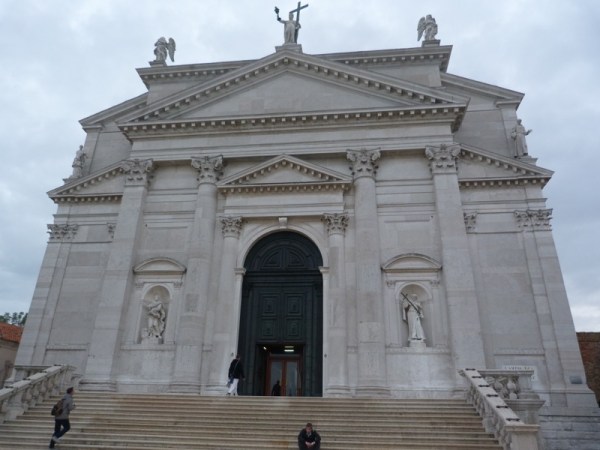

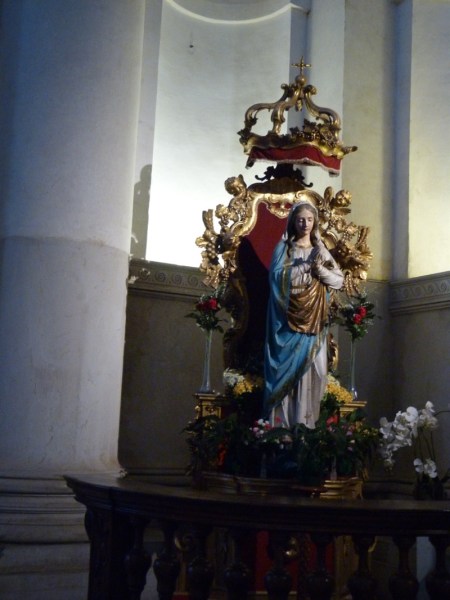
The hotel is on Giudecca, a large island across the laguna from St. Mark’s. We love this location, and the residential nature of the island. As we explore, there is beauty everywhere.


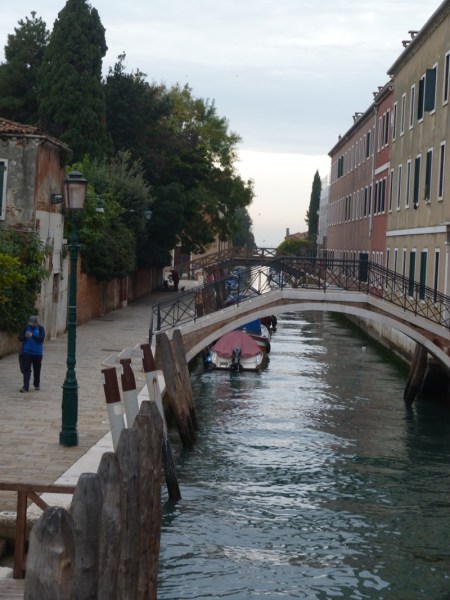
Along a side canal, we find a boat building shop, with workers putting together new gondolas:


We are exhilarated. We had thought we would be exhausted, but we have done 10,000 steps and way more than 10 sets of stairs. We are in Venice, where the light and the water work together to thrill our heart in a new way every time we look. Here is something special for you; the sun going down in Venice:
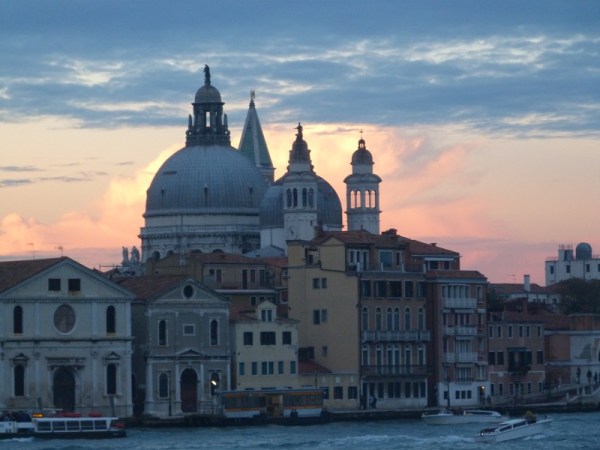
It was supposed to be raining. This is late October, and there are signs of rain, but there is no rain.
Dinner is at a small local restaurant, and it is divine. Is it divine, or does it just taste divine because it is our first night in Venice and we are a little jet lagged and maybe a little delirious? At Duo Mori we can eat overlooking the water, watch the vaporettos come and go, and dive into some Venetian specialties, a mixed appetizer plate with all kinds of fish and fish pates, followed by plates of spaghetti with clams and mussels, washed down by a carafe of wine. Service is slow. It’s fine with us. We are happy just to be here.
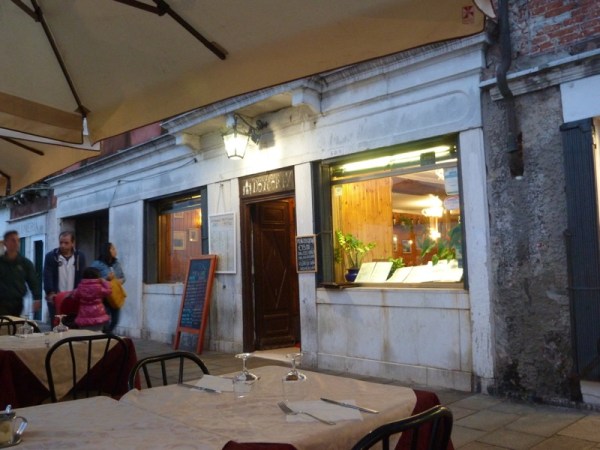

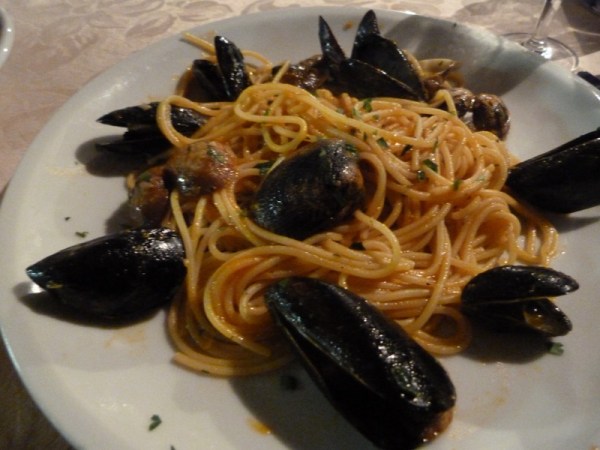
The meal is delicious, and on top of that, we have been watching how the vaporetto passengers use their magnetized tickets to open the gate to get to the vaporetto they want. Tomorrow will be a new day, and we have all-day vaporetto tickets which will take us all the places we want to go.

We walk happily back to the hotel, fall into bed. About half an hour later, dumb with sleepiness, there is a knock at the door, and our bags have arrived in Venice to meet up with us. All is well.
“Do All Americans Worship Idols?”
We have guests in town from another country who are living with Americans and visiting many others.
One of them asked her host “Do all Americans worship idols?” and the host was flummoxed.
We have been in private houses of the most religious Muslims, and their houses look very different from ours. They have nothing on the walls, except perhaps a picture of the Kaaba in Mecca, or a beautiful calligraphy in Arabic with one of the Surahs. To us, the houses look very plain, but they are being careful to observe carefully the word of the Lord.
We don’t consider the objects in our homes idols because we don’t worship them. When I read today’s Lectionary reading from Deuteronomy, I have to rethink what God might thing idols are.
Deuteronomy 4:15-24
15 Since you saw no form when the Lord spoke to you at Horeb out of the fire, take care and watch yourselves closely, 16 so that you do not act corruptly by making an idol for yourselves, in the form of any figure—the likeness of male or female, 17 the likeness of any animal that is on the earth, the likeness of any winged bird that flies in the air, 18 the likeness of anything that creeps on the ground, the likeness of any fish that is in the water under the earth. 19 And when you look up to the heavens and see the sun, the moon, and the stars, all the host of heaven, do not be led astray and bow down to them and serve them, things that the Lord your God has allotted to all the peoples everywhere under heaven. 20 But the Lord has taken you and brought you out of the iron-smelter, out of Egypt, to become a people of his very own possession, as you are now.
21 The Lord was angry with me because of you, and he vowed that I should not cross the Jordan and that I should not enter the good land that the Lord your God is giving for your possession. 22 For I am going to die in this land without crossing over the Jordan, but you are going to cross over to take possession of that good land. 23 So be careful not to forget the covenant that the Lord your God made with you, and not to make for yourselves an idol in the form of anything that the Lord your God has forbidden you. 24 For the Lord your God is a devouring fire, a jealous God.
Donna Leon and The Golden Egg
“What are manners?”
“What is ‘nice’, what does it mean?”
“What is ‘kind’?” the most adorable little boy in Pensacola asked me. It was bath time, a time when we have some of our best conversations, and you never know where the conversation will go.
I love these conversations because I have to think, too, but most of all, because I love to watch this little boy’s mind grow in grasping concepts and perceptions. He is four; his class in school is on the letter “U” this coming week, and already he can sound out words in the books we read together. He knows what a globe is, and how it differs from a map. He knows his address, and he can point to Pensacola on the globe.
He knows things because we talk to him, and because he goes to school and his teachers talk to him. His mind is wide open and he is eager to learn, and he asks the most wonderful questions.
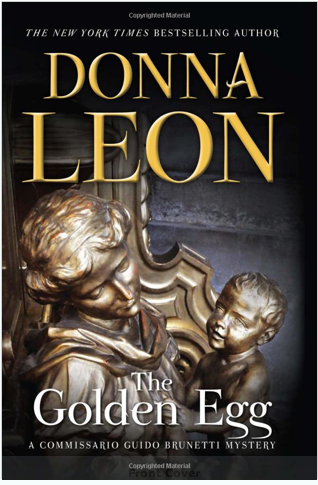
Donna Leon’s Commissario Guido Brunetti has a new case that troubles him. He knows the dead man, not well, but he would see him in his quarter, and he often saw him helping out at the local laundry. He assumed the man was deaf and retarded, everyone knew that. When the dead man has no papers, in bureaucratic Italy, no birth certificate, no medical records, no finance records, no record of social aid (he is poor as well as disabled) Brunetti is troubled. How could such a familiar figure be so undocumented?
His mother is no help; her stories are transparent lies about travel to France and her son having grown up in the country with people whose name she cannot remember.
It is a troubling book. If you read Donna Leon, you will understand how close and wonderful and articulate Brunetti’s family is, how loved and cherished their children. We eat meals with them, we understand how the Venetian vernacular distinguishes those to whom one speaks more frankly and those to whom one lies. Brunetti’s a detective; the things he sees often trouble him, but this case troubles him more than most.
I can’t tell you more without spoiling the ending. All I can tell you is that it will encourage you to love your children, hold them closely, and give them all the benefits in their life-toolbox of attention, instruction and loving discipline that a parent (and grandparent!) can give.
Some Peeks in Edmonds, Washington
You would love Edmonds, Washington.
It is a picturesque village. Along Main Street, and Fifth Avenue there are corner gardens, maintained by the city. This year, they are planted primarily with white flowers, big, fluffy flowers which make all the other flowers POP! with color. Overhead, from the lamp posts, are huge hanging baskets, full of a variety of plants, mostly purples, blues and fuchsias. The overall effect is stunning.
On our way to her manicure-pedicure, I drove Mom around looking at the sights. Down at the Edmonds Beach, I was shocked to see an eagle, perched on a piling. The shot isn’t very good, I jumped out of the car in a hurry and snapped, not taking enough time, but I was so surprised – I had never seen an eagle there before.

After lunch, as we headed out, we saw people touching up one of the murals Edmonds has painted on the sides of buildings there:

Here is another one, nearby:

I love it that this sweet little town, with its ferry coming faithfully in and out, preserves its identity and character in the face of changing times.
Shadrach, Meshach and Abednigo Survive the Test of Fire
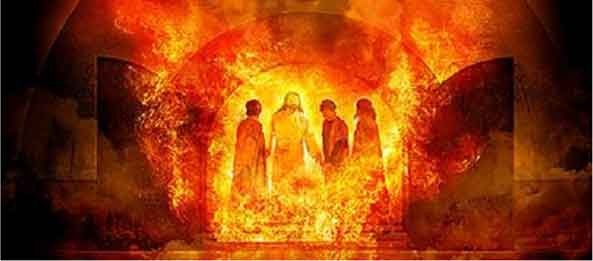
Some of the stories you come across in the Bible are so horrifying – and so human – that they still have a compelling immediacy. People do the most horrible things to one another, it mystifies me. This King, Nebuchadnezzar, is so incensed that his Jewish bureaucrats won’t bow down and worship his statue that he orders them cast into a furnace, which he heats seven times hotter than normal. That’s pretty angry!
Daniel 3:19-30
19 Then Nebuchadnezzar was so filled with rage against Shadrach, Meshach, and Abednego that his face was distorted. He ordered the furnace to be heated up seven times more than was customary, 20and ordered some of the strongest guards in his army to bind Shadrach, Meshach, and Abednego and to throw them into the furnace of blazing fire. 21So the men were bound, still wearing their tunics,* their trousers,* their hats, and their other garments, and they were thrown into the furnace of blazing fire.
22Because the king’s command was urgent and the furnace was so overheated, the raging flames killed the men who lifted Shadrach, Meshach, and Abednego. 23But the three men, Shadrach, Meshach, and Abednego, fell down, bound, into the furnace of blazing fire.
24 Then King Nebuchadnezzar was astonished and rose up quickly. He said to his counsellors, ‘Was it not three men that we threw bound into the fire?’ They answered the king, ‘True, O king.’
25He replied, ‘But I see four men unbound, walking in the middle of the fire, and they are not hurt; and the fourth has the appearance of a god.’* 26Nebuchadnezzar then approached the door of the furnace of blazing fire and said, ‘Shadrach, Meshach, and Abednego, servants of the Most High God, come out! Come here!’
So Shadrach, Meshach, and Abednego came out from the fire. 27And the satraps, the prefects, the governors, and the king’s counsellors gathered together and saw that the fire had not had any power over the bodies of those men; the hair of their heads was not singed, their tunics* were not harmed, and not even the smell of fire came from them.
28Nebuchadnezzar said, ‘Blessed be the God of Shadrach, Meshach, and Abednego, who has sent his angel and delivered his servants who trusted in him. They disobeyed the king’s command and yielded up their bodies rather than serve and worship any god except their own God. 29Therefore I make a decree: Any people, nation, or language that utters blasphemy against the God of Shadrach, Meshach, and Abednego shall be torn limb from limb, and their houses laid in ruins; for there is no other god who is able to deliver in this way.’ 30Then the king promoted Shadrach, Meshach, and Abednego in the province of Babylon.
When I read this, I think of the recent legislation proposed in Kuwait against insulting God or his prophets. Let men insult. Let them build their gods, their statures, let them pursue their little gods of vanity, power and wealth. The one true God laughs. He holds all the true power. He doesn’t need our protection; he is in charge.
In Florida, some friends complain about “the law that says our kids can’t pray in school.” There is no law that says kids can’t pray in school. Kids pray in school all the time! I did, specially when I had a really hard test I hadn’t prepared adequately for 🙂 What the law says is that no one can make all pray together, using the same words, as we did at one time. It’s not such a bad thing; even as Christians, we don’t all share the same beliefs. You might not want your children praying a prayer I might compose 🙂 because I might have a dogmatic belief a little different from your own. Our job is to teach our children to pray; the Holy Spirit will be with them, and put the words in their hearts.
February Barnacles

I rarely miss a water aerobics class. The Y makes it easy, even if I oversleep, there is also a 0930 class, or if I’m feeling bad, there are also classes on Tuesday and Thursday. Since I’m going to have to make it up anyway, I just go. I rarely feel bad enough to stay home, and most things I can schedule for after my class.
Any kind of aerobics class is funny. I try to be friendly to everyone, because these classes can be a real pain in the patootie if there are cliques or snobs, it starts to feel like junior high all over again, and God knows, that was bad enough the first time. Life is too short.
But there is one spot I really like. I like to be in the back of the class, so I can exercise harder or differently and not confuse anyone else. I’ve been doing water aerobics for a while and sometimes while the rest of the class is doing cross-country, for example, I will do it off the floor of the pool, or do an extra kick on the jacks, things like that, so it just works better for me to be at the back of the class. I also like to be at a certain depth, not too deep and not too shallow. So . . . regrettably . . . I am one of those people who have a spot.
Sometimes if I am a little late someone else stands in “my” spot and I have to stand somewhere else. I don’t worry about it, people in these classes come and go, and I usually get to stand there. If I don’t, I am still OK.
There are two other women on the back wall with me, who are pretty much always in their same places, and we really do have a good time. I joke that we are the barnacles, stuck to the back wall. This morning, I complimented one of them on her earrings, and she said they were amethysts for February, and as it turns out, we all have birthdays within one week of one another in February – all three of us, within one week. What an amazing coincidence.
She worked us hard this morning, and it is a good thing, as I fly this afternoon for Seattle. Keep me in your prayers for safe travels, and travel mercies, please!
Music Banned in Somalia
We are in our own world these days, boxes needing unpacking, deliveries interrupting tasks, and no connection – no TV, no internet, no land line phone. We do have a cell phone, and Friday night our son called to ask us if we have heard about the weather.
Nope.
Heavy rains, strong winds, possibility of tornados. It was lively!
I hadn’t heard about Somalia, either.
This is really scary to me. This is the kind of thing I worry about in my own country – who makes the rules? Who gets to say what music I listen to, what movies I watch? Who gets to restrict my access to information?
Who gets to tell me that as a woman, I can’t have a checking account in my name? Or that I have to wear a burqa? Or that I am not allowed to wear a niqab (if that’s what I want?)
Somalia Radicals Declare Music ‘Un-Islamic,’ and Radio Goes Tuneless
POSTED: 04/25/10
If, as my colleague Sarah Wildman reports, the Francophonic world is intent on curbing expressions of fundamentalist Islam belief, then the radical Muslim world is taking no prisoners with the West, either. Last week, the Somalian fundamentalist Islamic group Hizbul Islam announced that music of any kind is “un-Islamic,” warning of “serious consequences” for those who dare to violate their decree. In response, radio stations all over the country, including those run by the moderate Muslim transitional government, cut all music from their broadcasts. Even intro music for news reports was scrapped. In its place? “We are using sounds such as gunfire, the noise of vehicles and the sound of birds to link up our programmes and news,” said one Somalian head of radio programming.
Get the new
PD toolbar!
Somalia has been wracked with inter-tribal violence for nearly two decades. In the last few years, increasingly radical Muslim militants, including the dominant Shabab group, have taken over large parts of the country and become closely affiliated with al-Qaeda. A moderate Muslim transitional government, helmed by a former teacher named Sheik Sharif Sheik Ahmed, controls a small part of the country. His government is largely propped up by African Union peacekeepers, with United Nations’ and U.S. support.
In the meantime, Islamic radicals like Shabab have gone on a campaign the New York Times described as “a quest to turn Somalia into a seventh century style Islamic state.”
The music decree follows a string of fundamentalist decrees, including prohibitions on wearing bras (also “un-Islamic”), the banning of modern movies and news channels, including the BBC and Voice of America.
As evidence of a power struggle between the moderate Muslim government and the hard-line radicals who control many parts of the country, Sheik Ahmed’s government responded last Sunday by saying any radio stations that stopped playing music would face closure. In the government’s eyes, those radio stations that complied with the ban were colluding with the radicals.
In the meantime, the radio stations have been caught between a rock and a hard place. “The order and counter-order are very destructive,” radio director Abukar Hassan Kadaf said in the Times article. “Each group are issuing orders against us and we are the victims.”
In the escalating tug-of-war between Western and Islamic powers over freedom of expression, what remains to be seen is how much of a causal relationship exists between the two. Is a proposed burqa ban in Quebec a result of the shuttering of a radio station in Somalia? Does a call for prohibition of headscarves in Paris force a bra-burning in Mogadishu?
If Islamic decrees do, in fact, fuel the fire for legal actions in the West (and vice versa), then continued and increased prohibition seems inevitable. But if radical Islam and a skeptical West are destined to one-up each other in a battle of bans, the powers that be might remember the men and women caught in the crossfire. That is, the women in the West who wear niqabs by choice, or the men and women in Somalia who just want to listen to music. What is perhaps most strikingly absent in all the brouhaha surrounding sharia vs. Western law are the voices of the moderate Muslims themselves. In the end, perhaps the gulf between the two sides will prove too great to be bridged, but for the immediate future, we would do well to remember the ground we share in common. Before there’s nothing left to ban.
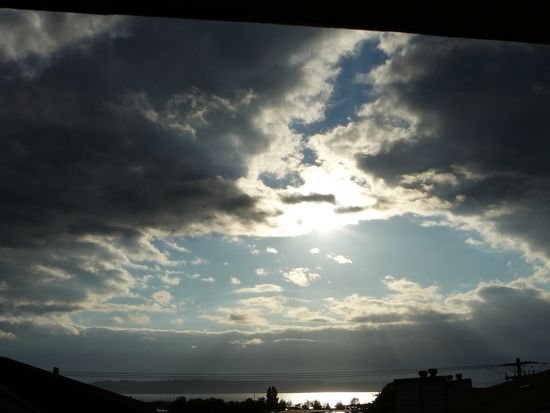
Heavenly Sunset
This sunset sort of made me think about the heavens opening and the hand of God coming out – yep, sunsets in the Pacific Northwest are like that. 🙂
Donna Leon: Suffer the Little Children
After reading Zanzibar Chest I decided it was time to give myself a break, and I allowed myself another Donna Leon book, this one Suffer the Little Children. I am currently reading another detective series, recommended by my sister, set in China. What they all seem to have in common is a very tired, sad, jaded view of corruption in society, and particularly among the poorly paid police. Sigh.

In this book, a Doctor and his wife are invaded in the middle of the night by the carabinieri, a kind of police in Venice. I am not sure how the two agencies differ, maybe it is like the difference between state police and local police in the US, but when the paper was faxed over coordinating with Brunetti’s office, it got lost somewhere, and the action was never coordinated, and Brunetti gets a call in the middle of the night.
The doctor and his wife have adopted a child illegally. They bought an unwanted child from an Albanian woman, paid for her pregnancy expenses, paid a huge fee to her, and then had the child taken from them. Here is the saddest part of the story – the child’s mother doesn’t want the child, the illegally adopting parents want him back desperately, but the child is sent to a state orphanage, because of the illegal adoption.
It is a very sad book.
Here is why I read Donna Leon – some of her paragraphs are just brilliant. Memorable. Unforgettable.
“Brunetti’s profession had made him a master of pauses: he could distinguish them in the way a concert-master could distinguish the tones of the various strings. There was the absolute, almost belligerent pause, after which nothing would come unless in response to questions or threats. There was the attentive pause, after which the speaker measured the effect on the listener of what had just been said. And there was the exhausted pause, after which the speaker needed to be left undistrubed until emotional control returned.
Judging that he was listening to the third, Brunetti remained silent, certain that she would eventually continue. A sound came down the corridor: a moan or the cry of a sleeping person. When it stoped, the silence seemed to expand to fill the place.”
When you read Donna Leon, you forget you live anywhere else. For one brief moment, you become Venetian, you live in Guido Brunetti’s shoes. The speak the Venetian dialect, you think like a Venetian. What an escape!
The paperback edition will be out in April for $7.99 at Amazon.com for $7.99 plus shipping.
Leon: Friends in High Places

After reading two stinkers, I needed a read I could rely on for a good fix. I needed escape, mixed with good food, good clothes and some social awareness. I needed Guido Brunetti, Donna Leon’s Venetian detective, and his smart, savvy wife Paula, and his family meals of pasta with soft shell crabs and risi e bisi, his children, his disgust for the politics that impinge on his doing his job.
If you think Kuwait has “wasta” (doing business by connections, influence, calling in favors), you aint’ seen nuthin’ till you’ve seen how Byzantine Venetians operate.
Friends in High Places opens with Commissario Brunetti lying on his couch re-reading Anabasis when he receives a visit from a building inspector, who determines that the apartment he owns, on the very top of a building in Venice, was probably built illegally – there are no plans or restoration approvals on file at the bureaucracy regulating residential buildings in Venice – and may have to be torn down.
Wouldn’t that be a shock? It’s a shock to Brunetti and to his family, just as it would be to us. We learn all the ins and outs of housing codes, the impact of becoming part of the EEC, and how the clever Venetians devise ways around the codes, all while Brunetti is investigating one murder – and then three other murders.
It is a VERY satisfying book. I will share with you a lengthy quote from Friends in High Places as Guido and Paola discuss how to deal with the problem:
At no time did it occur to him, as it did not occur to Paola, to approach the matter legally, to find out the names of the proper offices and officials and the proper steps to follow. Nor did it occur to either of them that there might be a clearly defined bureaucratic procedure by which they could resolve this problem. If such things did exist or could be discovered, Venetians ignored them, knowing that the only way to deal with problems like this was by means of conoscienze: acquaintances, friendships, contacts and debts built up over a lifetime of dealing with a system generally agreed, even by those in its employ, perhaps especially by those in it’s employ, prone to the abuses resultant from centuries of bribery, and encumbered by a Byzantine instinct for secrecy and lethargy.
I am sorry to tell you that the only copy of this I could find on Amazon.com cost $99.98. I must have bought this one in England, where, I promise you, it was the normal cost of a paperback book.
I will warn you in addition, I was looking forward to reading a second Leon novel, Quietly in their Sleep, only to discover when I started that I had already read it, as The Death of Faith. The books published by Leon in England are often retitled for the American market. Leon fans, beware!
Recent Comments
ExpatAlien on What Country am I Living … intlxpatr on Yellowstone: Old Faithful to C… Michelle on Yellowstone: Old Faithful to C… Cathy on No Grown-Ups in Charge intlxpatr on Waiting for Snow Wikipedia Donate Button

Amazina


Early Voting in Florida


 Here There and Everywhere