Donna Leon: Wilful Behavior
You think Donna Leon is writing about one thing, and then you discover it is about something else entirely. It seems to happen often in that line of work – you see the same thing on Law and Order, and Cold Case, and The Wire – what initially seems like a straightforward crime had depths and switch-backs unfathomable from the initial crime scene.
In Wilful Behavior, Paula, Brunetti’s wife, has just about had it with her university level students. They have no yearning for knowledge and insight, they are rife with materialism, she is feeling burned out and cynical. One student, who bucks the trend, comes to talk with her, and then Brunetti about the possibility of a post-mortem clearing of a person’s name, but she won’t give the name of the person or the crime that person committed. Before Commissario Brunetti has begun to plumb these depths – the student is murdered.
It’s always depressing when a young person dies. You can’t help but think of how treasured they were, how full of potential, and all that is gone now, wasted. A light in the world has gone out, and you grieve for how brightly that light might have shown. Brunetti and his wife only knew the murdered girl briefly, but her murder strikes them deeply.
Here is an excerpt from Brunetti’s discussion with the student before she was killed:
“I didn’t know young people even knew who Il Duce was.” Brunetti said, exaggerating, but not by much, and mindful of the almost total amnesia he had discovered in the minds of anyone, of whatever age, with whom he had attempted to discuss the war or its causes. Or worse, the sort of cock-eyed, retouched history that protrayed the friendly, generously disposed Italians led astray by their wicked Teutonic neighbors to the north.
The girl’s voice drew him back from these reflections. “Most of them don’t. This is old people I’m talking about. You’d think they’d know or remember what things were like then, what he was like.” She shook her head in another sign of exasperation. “But no, all I hear is that nonsense about the trains being on time and no trouble from the Mafia and how happy the Ethiopians were to see our brave soldiers.” She paused as if assessing just how far to go with this conservatively dressed man with the kind eyes; whatever she saw seemed to reassure her, for she continued. “Our brave soldiers come with their poison gas and machine guns to show them the wonders of Fascism.”
So young and yet so cynical, he thought, and how tired she must be already of having people point this out to her. “I’m surprised you aren’t enrolled in the history faculty,” he said.
“Oh, I was, for a year. But I couldn’t stand it, all the lies and dishonest books and the refusal to take a stand about anything that’s happened in the last hundred years.”
“And so?”
“I changed to English Literature. The worst they can do is make us listen to all their idiotic theories about the meaning of literature or whether the text exists or not.” Hearing her, Brunetti had the strange sensation of listening to Paula in one of her wilder moments. “But they can’t change the texts themselves. It’s not like what the people in power do when they remove embarassing documents from the State Archives. They can’t do that to Dante or Manzoni, can they?” she asked speculatively, a question that really asked for an answer.
“No,” Brunetti agreed. “But is suspect that’s only because there are standard editions of the basic texts. Otherwise, I’m sure they’d try, if they thought they could get away with it.” He saw that he had her interest, so he added, “I’ve always been afraid of people in possession of what they believe is the truth. They’ll do anything to see that the facts are changed and whipped into shape to agree with it.”
And, as it turns out, in the persistent corruption of Venetian bureaucracy, that is exactly what this murder is all about – the theft and possession of art during WWII, and how the ramifications are still trickling down today. How people are willing to kill to keep the past safely in the past, and to hang on to their treasured and priceless possessions.
Donna Leon continues to be one of my favorites because she is never formulaic – she has ISSUES, and she uses her Brunetti novels to educate her readers. As we become educated, we continue to experience Venice through all the senses, the smell of the veal cooking for dinner, the taste of the tiny espressos in the corner cafe meeting places, the gruesome murder sites, the sound of the waves in the canals, whipped up by the prevailing winds . . .you read Donna Leon, you become Venetian.
Donna Leon Crossing Cultures
I’m in the middle of a Donna Leon read-fest. When I wrote the reviews the last time, I saw three books by her I had never seen – and I comb the aisles of Barnes and Noble when I am in the US, and Half Price Books, looking for titles by her. I am guessing some of her books haven’t been printed in the US, but I was able to find them from the UK Amazon.com.
The two latest books I have read by Donna Leon are timely. The first, Fatal Remedies, starts out being about Commissario Guido Brunetti’s wife, Paola’s crusade against the sex tours to undeveloped countries, her outrage against trips that allow grown men to exploit the poverty and need that the poorest of families will sell their own daughters and even young children to satisfy these men’s uncontrolled lusts. Her outrage leads her to a jail cell in her own husband’s precinct.
But just when you think you know where this story is going, it turns, as many of Leon’s books do, and tackles another subject, one very much in the eye of the news – falsified medications. There is a huge profit to be made, and huge wrongdoings in the medical supplies field, as expired medications are shipped to the most needy countries, and prescription and over-the-counter medications contain ingredients that are at best, harmless, and at worst – poisonous!
Guido Brunetti follows the money, and exposes the cheats.
In the second book, The Death of Faith, the issue – corruption in the church – comes close to home, as Brunetti’s daughter gets a low grade from her religious education instructor for asking questions, logical questions, about the dogma of the Catholic faith. Leon also tackles the issue of the order of Opus Dei, the same mysterious order featured in The DaVinci Code, an order that does exist, but about which solid knowledge is murky. What is known is that the order, in jihadist fashion, seeks to establish the Catholic church as the supreme guide to behavior on earth, it’s own version of sharia law to be the ruling principle in every country.
This is an anethema to Commissario Brunetti, and to all thinking Italians who savor the separation of church and state. He asks the eternal question – who decides? Who decides what behavior is acceptable, what questions are allowable? Religious belief, or the lack of it, is so very personal – this is a very timely issue that all nations are struggling with. Religious rule? Secular rule?
Underlying all the Donna Leon books is the sweetness of daily life with Brunetti’s family, his beautiful and principled wife, his teenaged children, the food they eat, the family discussions they have, the flowers he brings home and the strength of the connection they have with one another. The Venetian setting weaves its own magical thread through every novel, as we ride with Brunetti in the vaporetto on the canals, as we sit with him in a local bar for a quick coffee – or something stronger – and as he walks the streets from home to office, or to talk with a witness.
And last, but not least, the utter corruption in the Venetian system reminds us that veniality is not restricted to the United States, or to Kuwait, or to Nigeria, or Italy, or to any one country, but wherever man seeks to impose order, the chaos of corruption must be slowly and surely overcome by the building of an honest bureaucracy, people like you and me, serving in seemingly hopeless situations, but doing our best, day by day, like Guido Brunetti, to build a better world for our children.
Strolling Through Villagio
As I sat in the Kuwait airport, waiting, waiting, waiting . . . .I ran into a friend also heading to Doha, and we spent some time together. For one thing, she told me about Villagio, which didn’t exist when I lived in Doha.
If I lived in Doha, this is where I would spend my summer, walking along the avenues and gondola filled lagoons of Villagio. After a good stroll, I could sit down at one of the many restaurants and cafes and wipe out all the good work I had done strolling!
How cool is this?
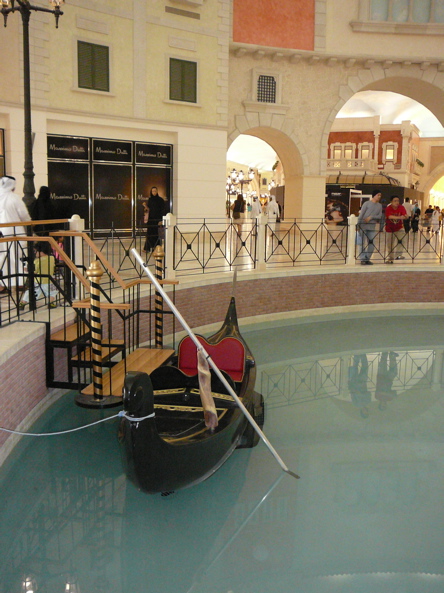
The lagoon winds through the Mall, and you can take a boat ride when you are tired of shopping:

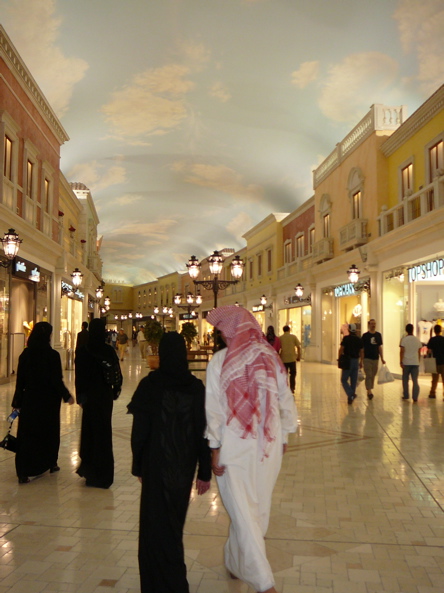
I love all the attention to detail, especially the streetlights, which are lit day and night, and provide a delightful romantic atmosphere:

The perfect place for a stroll – or a 10K hike!
Recent Comments
ExpatAlien on What Country am I Living … intlxpatr on Yellowstone: Old Faithful to C… Michelle on Yellowstone: Old Faithful to C… Cathy on No Grown-Ups in Charge intlxpatr on Waiting for Snow Wikipedia Donate Button

Amazina


Early Voting in Florida


 Here There and Everywhere