Mobile Botanical Garden Plant Sale: Plantasia
AdventureMan and I had one of the sweetest days of the year – nice cool sunny morning, heading into a warm afternoon as we got up early to head over to the Mobile Botanical Gardens Annual Plant Sale.
They do a GREAT job. Starting with publicity, ads in the Pensacola News Journal and information sent out to all the regional gardening clubs and extension centers raising the level of awareness and creating a buzz. Everyone wants to go.
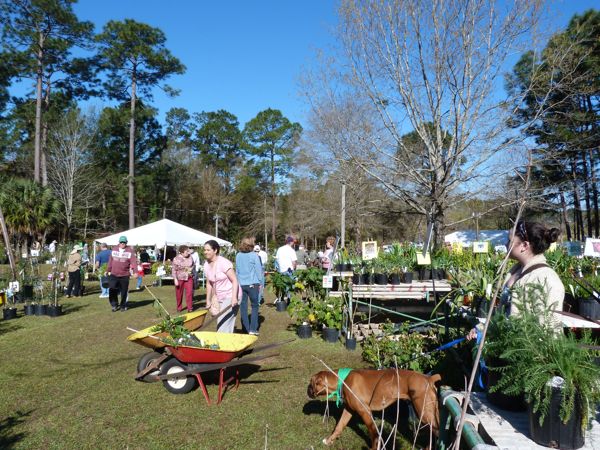
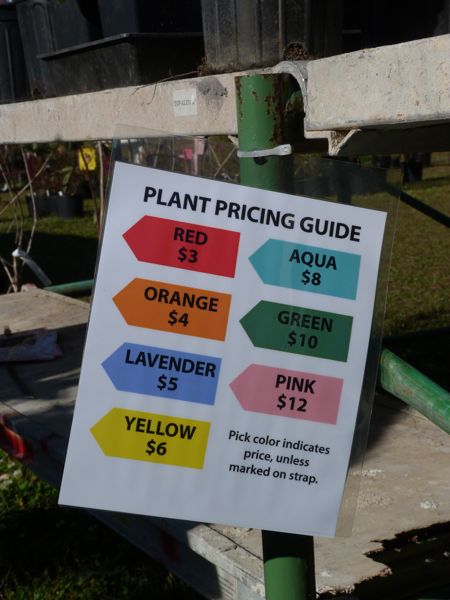
You get there, and parking is well organized and handy to the sales area. Signage is great – ENTER HERE! EXIT ONLY! PERRENIALS! ROSES! SHADE PLANTS! TREES! And great signs telling you how each plant is color coded and you know immediately what the price is:
Lots and lots of healthy looking plants. We knew what we wanted and found it quickly, except for the ones that were already sold out. Check-out was friendly – and fast. There was an exit strategy; people with large purchases could leave plants, drive into a pick up zone and have them loaded up. It was an amazingly efficient and well-run operation. Perfect weather, great selection of healthy plants, well-organized and efficient – it doesn’t get much better.
Well done, Mobile.
Spring Break Hits the Gulf Coast
This last week has to have been the sweetest week of the year; running into all my friends at Home Depot, the cool mornings and the warm afternoons, it all makes you feel energetic, and you tackle all those projects you’ve been mentally lining up.
For me, it was painting the front door. I think it used to be red. It faces west, and the strength of the setting sun over the years faded it to a rosy rose. It needed to go back to shimmering red, but that takes patience, and more than one coat, and it takes a special day, cool enough, warm enough, and entirely without humidity. To paint a door, you have to have it open, and then it has to dry open, and when you are painting a door red red, you have to paint it more than once, even painting over rosy red.
Done. And time for a field trip to the Botanical Gardens Sales in Mobile, with AdventureMan, now in another career as Master GardenerMan.
It’s all good this weather, this time of year – until you get on any road leading to the beach, especially on a Friday, Saturday or Sunday.
Saturday, coming back from Mobile, there was a sudden jamming up as the cars went down into the tunnel running under the tip of the bay. As we are waiting to get through, we hear these banshee screams and yells, and my first thought, after years of living in the Middle East is “oh! it’s a wedding!”
No. No, I was wrong. It is no one’s wedding, but it does seem to be a major mating ritual, as colleges close for a week or so for Spring break and the students head for the beaches. These students were hanging out the windows of their cars – sitting on the window sills – waving bottles and screeching.

Animal spirits. I hope they packed their sun protection, and all kinds of other protections.
Another Thorny Issue
It is one of those glorious days in Pensacola. I love winter here anyway, I love the cold temperatures and a chance to wear some of my old German sweaters and coats, but today, the threat of deep freeze seems past, it is just warm enough to prune the roses and the bougainvilleas.
I used to garden, I gardened well. I gardened in Seattle, and in Germany, mostly, although I also had gardens in Jordan, and in Qatar. In Qatar, I will admit, my function was mostly to buy the plants and buy the pots and tell the gardener where to place them. He came to my door when I tried to do it myself, and he said “Madam, this is MY job. Please don’t take my work away from me.”
Now that AdventureMan is also a Master Gardener, my gardening responsibilities – and my gardening prerogotives – have declined substantially. I tried gardening when we got here; I can garden just fine in November – April, but the summer heat and humidity and mosquitos defeat me. Oh? Yes? You’ve heard this before? I am so sorry!
I still retain personal interest in the bougainvillea and the roses. I love the bougainvillea, and it is now three years old. I am trying to grow it tall, so it will cascade over the end of my porch area, as it does in the more tropical countries. Yes, it is a challenge.
I also love trimming, rooting, and creating new rose bushes from the beautiful old white rose bush we have, with it’s delicate coloring and scent.
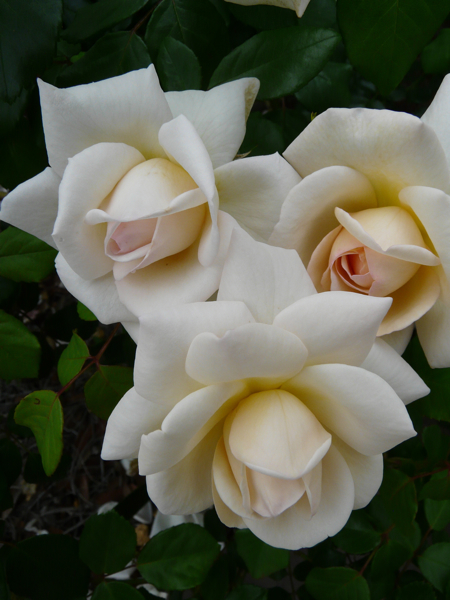
Old White Roses
I was careful. I wore leather globes. But when you are working with bougainvillea (great big huge thorns!) and with roses (smaller, but equally lethal thorns) you can get very scratched up. I did, indeed, get very scratched up, but I succeeded in getting the bougainvillea gathered and trimmed, some new bougainvillea starts made, and several new rose bushes started. I think next time I will at least wear long sleeves; my Master Gardener suggested long leather gauntlets!
The Master Gardener pruned the roses. 🙂 He had a class in pruning roses a couple weeks ago, and wanted to tackle the roses, but he wanted our marriage to survive. Today was the perfect day; a day we could both be outside. We discovered we have very similar styles in pruning roses, and our marriage is better than intact 🙂
A Night of Booming Thunder
As I opened my Lectionary this morning, the first Psalm is Psalm 57 which begins:
Be merciful to me, O God, be merciful to me,
for in you my soul takes refuge;
in the shadow of your wings I will take refuge,
until the destroying storms pass by.
I just had to laugh.
The lightning and thundering started last night around 10:00. Electrical storms are nothing new to the Pensacola area, but this one went on ALL NIGHT. It was like a front rolled in and got stuck over Pensacola. I woke up later this morning, having been awake around four for a couple hours, just listening. These were close, “BOOM – boom – booom – BOOM!” and loud. Even with the window coverings, you could see flashes of light in the bedroom.
As I lay awake, I thought about how the voice of God must have that deep, resonant, authoritative BOOM of thunder and I wondered what that voice might be trying to say to Pensacola or – oops! – to me.
This morning, that voice is still rumbling off in the distance, with no guarantee it won’t be back to scold us thunderously.
Endless Rain in Pensacola

“I am so thankful we had such good weather when our house guests were here,” I said to AdventureMan. Not only was it raining steadily as we headed home from the commissary, but we had thunder and lightning early in the morning, and it meant no water-aerobics class – pools are not a safe place to be when there is a thunderstorm outside.
“And I am thankful to have a garage.” he added, and I totally agree. When you have a big load of groceries is not a great time for a rain storm if you are toting them inside, pelted by a pouring rain.
We thought of all the places we have lived. I thought of all the groceries we have toted. Probably, for me, the worst was in Kuwait, where we had underground parking (very nice protection from the heat and merciless sun) and you had to take groceries and other shopping up in an elevator. We’ve lived in many countries, however, with no garage at all, and carried groceries inside through all kinds of weather.
And the rain keeps coming down . . . .
Catastrophic Vanishing Water in Middle East
I found this article in the Weather Underground News this morning:
DOHA, Qatar — An amount of freshwater almost the size of the Dead Sea has been lost in parts of the Middle East due to poor management, increased demands for groundwater and the effects of a 2007 drought, according to a NASA study.
The study, to be published Friday in Water Resources Research, a journal of the American Geophysical Union, examined data over seven years from 2003 from a pair of gravity-measuring satellites which is part of NASA’s Gravity Recovery and Climate Experiment or GRACE. Researchers found freshwater reserves in parts of Turkey, Syria, Iraq and Iran along the Tigris and Euphrates river basins had lost 117 million acre feet (144 cubic kilometers) of its total stored freshwater, the second fastest loss of groundwater storage loss after India.
About 60 percent of the loss resulted from pumping underground reservoirs for ground water, including 1,000 wells in Iraq, and another fifth was due to impacts of the drought including declining snow packs and soil drying up. Loss of surface water from lakes and reservoirs accounted for about another fifth of the decline, the study found.
“This rate of water loss is among the largest liquid freshwater losses on the continents,” the authors wrote in the study, noting the declines were most obvious after a drought.
The study is the latest evidence of a worsening water crisis in the Middle East, where demands from growing populations, war and the worsening effects of climate change are raising the prospect that some countries could face sever water shortages in the decades to come. Some like impoverished Yemen blame their water woes on the semi-arid conditions and the grinding poverty while the oil-rich Gulf faces water shortages mostly due to the economic boom that has created glistening cities out of the desert.
In a report released during the U.N. climate talks in Qatar, the World Bank concluded among the most critical problems in the Middle East and North Africa will be worsening water shortages. The region already has the lowest amount of freshwater in the world. With climate change, droughts in the region are expected to turn more extreme, water runoff is expected to decline 10 percent by 2050 while demand for water is expected to increase 60 percent by 2045.
One of the biggest challenges to improving water conservation is often competing demands which has worsened the problem in the Tigris and Euphrates river basins.
Turkey controls the Tigris and Euphrates headwaters, as well as the reservoirs and infrastructure of Turkey’s Greater Anatolia Project, which dictates how much water flows downstream into Syria and Iraq, the researchers said. With no coordinated water management between the three countries, tensions have intensified since the 2007 drought because Turkey continues to divert water to irrigate farmland.
“That decline in stream flow put a lot of pressure on northern Iraq,” Kate Voss, lead author of the study and a water policy fellow with the University of California’s Center for Hydrological Modeling in Irvine, said. “Both the UN and anecdotal reports from area residents note that once stream flow declined, this northern region of Iraq had to switch to groundwater. In an already fragile social, economic and political environment, this did not help the situation.”
Jay Famiglietti, principle investigator of the new study and a hydrologist and UC Irvine professor of Earth System Science, plans to visit the region later this month, along with Voss and two other UC Irvine colleagues, to discuss their findings and raise awareness of the problem and the need for a regional approach to solve the problem.
“They just do not have that much water to begin with, and they’re in a part of the world that will be experiencing less rainfall with climate change,” Famiglietti said. “Those dry areas are getting dryer. They and everyone else in the world’s arid regions need to manage their available water resources as best they can.”
Karen Thompson Walker and The Age of Miracles
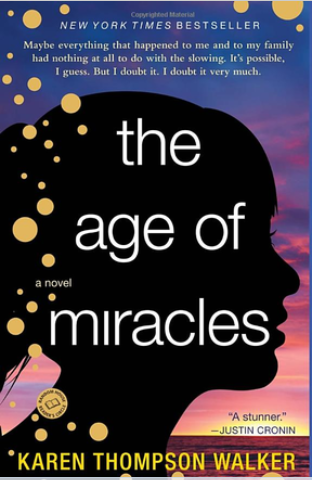
The Age of Miracles is a very odd name for this book, which starts off in a beautiful little coastal town in California, a very normal, modern town, and then everything changes. Suddenly, the earth’s rotation is slowing, incrementally, but resulting in longer and longer days and longer and longer nights. The difference is small at first, but grows.
Julia is in sixth grade, a painful time anyway in most lives where your body suddenly changes and all your relationships with all your friends change, and boys become a major factor. Imagine. All this AND the earth’s rotation is slowing.
No one knows what to expect. No one knows why or how the rotational slowing is happening, and no one has a clue how to fix it. Do you stay on a 24 hour clock, as the days grow to 30 hours? Forty hours? Can you even function in a forty hour day, or sleep a 40 hour night? How do you stay on a 24 hour clock and force yourself to sleep when the sun is shining brightly overhead? How do you have a school day entirely in the middle of the darkest part of the night? How does food continue to grow? What impact does this have on birds? Migrations? How does kicking a soccer ball feel when earth’s gravitational field starts to lessen?
The author does a brilliant job in a what-if situation, and manages to make it quite real. Don’t read this book if you are the suggestible type – it’s just one more thing you’ll start worrying about when you don’t need to. If you can read speculative fiction without letting it influence you, then by all means read this book, it is a good read.
Payback is a Bummer
People all around Pensacola are dropping like flies; the weather fluctuates between hot and humid and cold and dry, with thunderstorms marking the boundaries, and there are colds and flu popping up everywhere. I’ve flown serenely through the season without much problem, just a little four day cold around Christmas, feeling thankful for my strong immune system. I may have been a little smug.
And then, WHAM, it hit. One minute I was in a meeting, and the next, as I headed home, I was sniffing and reaching for a tissue. It quickly got worse. It was one of those nights where you can’t sleep because you are drowning in your own mucus. I know, I know, too much information, too graphic. Trust me, the reality has been worse. I stayed in bed most of Friday, and Saturday, when I was feeling better, we discovered our water heater has sprung a leak. All that mopping up was probably good exercise; once we got all the water up we were OK. Yesterday, my sniffles had turned into aching, irritated sinuses, so I spent the day putting warmth on my face.
This morning, we have the plumbers coming in with a new water heater, I feel marginally better, and I know I will feel a LOT better once I can get a hot shower 🙂
There was a huge blessing in all this. Our calendars for January and February are full, winter is the active season in Pensacola. We have events, we have commitments, and we have house guests coming. In the entire period, I only had five dates with no obligations, and that was this weekend. It’s a strange thing to be thankful for, but I thank God to be sick during a time when I can stay home and take care of myself, and I don’t have to call anyone and renege on an obligation.
It’s also wonderful that if the water heater was going to go (and it is ten years old) it burst while we were here, and we were able to stop the flow and mop up the water before it caused a lot of damage. We had a water heater go out several homes ago, while we were out of town, and oh, what a mess we came back to, and it took forever to get all the carpeting dried out and replaced. It’s wonderful that we could take care of this BEFORE our house guests start arriving.

We’ve been exploring tankless heaters; our heater is smack in the center of the house, a terrible location, where, if it goes, it can cause a lot of damage. We’ll go ahead with a regular old-fashioned heater this time, but suddenly, we have some urgency to trying to install tankless – maybe in the next couple of years. We had tankless heaters in Germany, and in the Middle East; we are used to them and comfortable with the idea. I like the idea of not keeping water warm when we are not using it, and heating it only when we do. I also like the idea of not having gallons and gallons of water spilling into my kitchen, dining room, living room and family room when the tank goes 😦
I miss my energy . . . I no longer feel smug, no longer assured of my good health. I’d forgotten how wonderful it is to be normal, without sinus pain, without this thick-headed draggy feeling. I think I’m on the mend; the last three days I couldn’t even begin to think about writing a blog entry . . .
It’s Just Not Right

How can this be? Pensacola is hotter, at seven in the morning, than Kuwait or Doha at mid-afternoon? It is almost 70° at seven in the morning, in JANUARY??? This isn’t right.
I get my daily weather information from Weather Underground. They have a page that allows me to keep track of several cities at one time; they appear at the top of the page of my Pensacola report. 🙂
Freakish Winter Weather Strikes Syrian Refugees in Jordan
As if they haven’t suffered enough, Syrian refugees from the civil war in the refugee camp in Zataari, Jordan, have been hit with unusually cold conditions, rain, wind and snow.

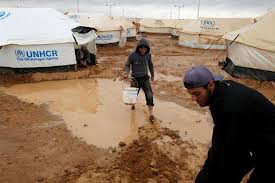
You’d think all the countries in the Middle East are warm, but there is nothing miserably colder than a desert country in the throws of winter . . .
Recent Comments
ExpatAlien on What Country am I Living … intlxpatr on Yellowstone: Old Faithful to C… Michelle on Yellowstone: Old Faithful to C… Cathy on No Grown-Ups in Charge intlxpatr on Waiting for Snow Wikipedia Donate Button

Amazina


Early Voting in Florida


 Here There and Everywhere