Storm Rolling In
This is what a storm looks like rolling into Kuwait. The normal day is on the right, the storm rolling in is on the left. Nothing has been enhanced; this is the way it really looks:

You really can’t imagine what an orange sky looks like:

Retro Metro
Getting ready to open at Villagio is one of my favorite places – Paul’s. When you can’t get to France, you can at least get to Paul’s. No, no little pichet of good wine with your salad, but truly great croissants, tartes and salads, and I am a great fan of their salmon fettucine.
And look what they are doing at Villagio! Look at the Art Nouveau wrought-iron trim on the shade! It looks like the Sacre Coeur metro stop! When it opens, it will be out in the open, a la Marina Mall, very French sidewalk cafe/restaurant. Unlike Al Kout Mall, this one has no outside area, tant pis!
When the weather outside is blistering hot, these malls are the only comfortable place to be. Thank God they are done with so much imagination.

Fish on Friday
Early on Friday morning in Kuwait, the water is still and flat as glass. The only people awake, it seems to me, are me and the fisherman.

Even at 7 in the morning, the temperatures are hot, although the air is dry.
Tornado Before and After
Imagery provided in Ogle Earth of the recent tornado damage in Greensburg, Kansas on May 4th.
If you go to Ogle Earth, you can see the before and after shots. The destruction is unbelievable. The immediacy with which the damage could be assessed with the help of these shots helps emergency workers and insurance assessors do their job more quickly.

Twitchy Water
Here is what the Gulf looks like this afternoon:
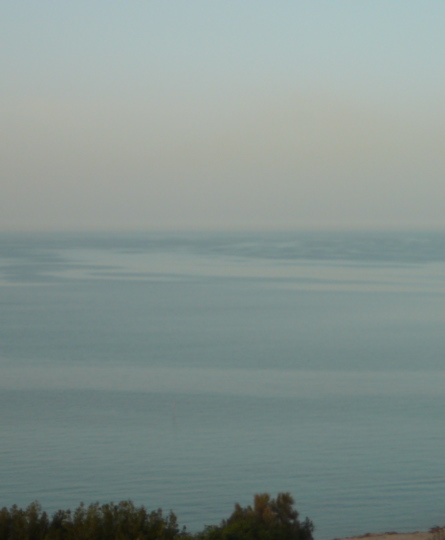
It is one of those amazing afternoons, where the water is nearly as flat and reflective as glass.
With one anomaly:
In the midst of the glass like waters of the Gulf, there are patches of twitchy water. I can’t help it. I lost two hours of my life today watching the twitchy water. It was the wierdest thing I have seen; it looked like waves with fleas, except that the fleas would sparkle silver now and then. While all the regular waves would be going one way, this “wave” would flutter and go in one direction, then flutter, and turn in another direction.
It has to be fish. From time to time a bird would pass over and the twitchy water would disappear. Sometimes, it didn’t disappear fast enough, and the bird would dive down and grab a snack and fly away. The fish must be tiny – maybe like anchovies or herring or minnows – and their activity gives the water an entirely different character.
I never thought of fish swarming before, but it looked like hive behavior. I wonder if it is because the weather is so suddenly and consistently warm (between 100 – 110F for my non-Kuwaiti readers) or if they are always there and the surf is too active for me to see them?
Twitchy water.
Kuwaiti End of Days

When I took this photo, it was a beautiful evening, all the more treasured because we know we will not be able to eat our dinners outside that much longer. The haze made the photo look like some foreign planet, and it reminded me of the coming “end of days,” and that is what I called it.
Dire Predictions on Earth Day
This is from AOL Top News compiled for Earth Day 2007.
Scientists Offer Frightening Forecast
By Ker Than and Andrea Thompson
LiveScience.com
(April 22) — Our planet’s prospects for environmental stability are bleaker than ever as the world celebrates Earth Day on Sunday. Global warming is widely accepted as a reality by scientists and even by previously doubtful government and industrial leaders. And according to a recent report by the Intergovernmental Panel on Climate Change (IPCC), there is a 90 percent likelihood that humans are contributing to the change.
The international panel of scientists predicts the global average temperature could increase by 2 to 11 degrees Fahrenheit by 2100 and that sea levels could rise by up to 2 feet.
Scientists have even speculated that a slight increase in Earth’s rotation rate could result, along with other changes. Glaciers, already receding, will disappear. Epic floods will hit some areas while intense drought will strike others. Humans will face widespread water shortages. Famine and disease will increase. Earth’s landscape will transform radically, with a quarter of plants and animals at risk of extinction.
While putting specific dates on these traumatic potential events is challenging, this timeline paints the big picture and details Earth’s future based on several recent studies and the longer scientific version of the IPCC report, which was made available to LiveScience.
2007
More of the world’s population now lives in cities than in rural areas, changing patterns of land use. The world population surpasses 6.6 billion. (Peter Crane, Royal Botanic Gardens, UK, Science; UN World Urbanization Prospectus: The 2003 Revision; U.S. Census Bureau)
2008
Global oil production peaks sometime between 2008 and 2018, according to a model by one Swedish physicist. Others say this turning point, known as “Hubbert’s Peak,” won’t occur until after 2020. Once Hubbert’s Peak is reached, global oil production will begin an irreversible decline, possibly triggering a global recession, food shortages and conflict between nations over dwindling oil supplies. (doctoral dissertation of Frederik Robelius, University of Uppsala, Sweden; report by Robert Hirsch of the Science Applications International Corporation)
2020
Flash floods will very likely increase across all parts of Europe. (IPCC)
Less rainfall could reduce agriculture yields by up to 50 percent in some parts of the world. (IPCC)
World population will reach 7.6 billion people. (U.S. Census Bureau)
2030
Diarrhea-related diseases will likely increase by up to 5 percent in low-income parts of the world. (IPCC)
Up to 18 percent of the world’s coral reefs will likely be lost as a result of climate change and other environmental stresses. In Asian coastal waters, the coral loss could reach 30 percent. (IPCC)
World population will reach 8.3 billion people. (U.S. Census Bureau)
Warming temperatures will cause temperate glaciers on equatorial mountains in Africa to disappear. (Richard Taylor, University College London, Geophysical Research Letters:)
In developing countries, the urban population will more than double to about 4 billion people, packing more people onto a given city’s land area. The urban populations of developed countries may also increase by as much as 20 percent. (World Bank: The Dynamics of Global Urban Expansion)
2040
The Arctic Sea could be ice-free in the summer, and winter ice depth may shrink drastically. Other scientists say the region will still have summer ice up to 2060 and 2105. (Marika Holland, NCAR, Geophysical Research Letters)
2050
Small alpine glaciers will very likely disappear completely, and large glaciers will shrink by 30 to 70 percent. Austrian scientist Roland Psenner of the University of Innsbruck says this is a conservative estimate, and the small alpine glaciers could be gone as soon as 2037. (IPCC)
In Australia, there will likely be an additional 3,200 to 5,200 heat-related deaths per year. The hardest hit will be people over the age of 65. An extra 500 to 1,000 people will die of heat-related deaths in New York City per year. In the United Kingdom, the opposite will occur, and cold-related deaths will outpace heat-related ones. (IPCC)
World population reaches 9.4 billion people. (U.S. Census Bureau)
Crop yields could increase by up to 20 percent in East and Southeast Asia, while decreasing by up to 30 percent in Central and South Asia. Similar shifts in crop yields could occur on other continents. (IPCC)
As biodiversity hotspots are more threatened, a quarter of the world’s plant and vertebrate animal species could face extinction. (Jay Malcolm, University of Toronto, Conservation Biology)
2070
As glaciers disappear and areas affected by drought increase, electricity production for the world’s existing hydropower stations will decrease. Hardest hit will be Europe, where hydropower potential is expected to decline on average by 6 percent; around the Mediterranean, the decrease could be up to 50 percent. (IPCC)
Warmer, drier conditions will lead to more frequent and longer droughts, as well as longer fire-seasons, increased fire risks, and more frequent heat waves, especially in Mediterranean regions. (IPCC)
2080
While some parts of the world dry out, others will be inundated. Scientists predict up to 20 percent of the world’s populations live in river basins likely to be affected by increased flood hazards. Up to 100 million people could experience coastal flooding each year. Most at risk are densely populated and low-lying areas that are less able to adapt to rising sea levels and areas which already face other challenges such as tropical storms. (IPCC)
Coastal population could balloon to 5 billion people, up from 1.2 billion in 1990. (IPCC)
Between 1.1 and 3.2 billion people will experience water shortages and up to 600 million will go hungry. (IPCC)
Sea levels could rise around New York City by more than three feet, potentially flooding the Rockaways, Coney Island, much of southern Brooklyn and Queens, portions of Long Island City, Astoria, Flushing Meadows-Corona Park, Queens, lower Manhattan and eastern Staten Island from Great Kills Harbor north to the Verrazano-Narrows Bridge. (NASA GISS)
2085
The risk of dengue fever from climate change is estimated to increase to 3.5 billion people. (IPCC)
2100
A combination of global warming and other factors will push many ecosystems to the limit, forcing them to exceed their natural ability to adapt to climate change. (IPCC)
Atmospheric carbon dioxide levels will be much higher than anytime during the past 650,000 years. (IPCC)
Ocean pH levels will very likely decrease by as much as 0.5 pH units, the lowest it’s been in the last 20 million years. The ability of marine organisms such as corals, crabs and oysters to form shells or exoskeletons could be impaired. (IPCC)
Thawing permafrost and other factors will make Earth’s land a net source of carbon emissions, meaning it will emit more carbon dioxide into the atmosphere than it absorbs. (IPCC)
Roughly 20 to 30 percent of species assessed as of 2007 could be extinct by 2100 if global mean temperatures exceed 2 to 3 degrees of pre-industrial levels. (IPCC)
New climate zones appear on up to 39 percent of the world’s land surface, radically transforming the planet. (Jack Williams, University of Wisconsin-Madison, Proceedings of the National Academy of Sciences)
A quarter of all species of plants and land animals—more than a million total—could be driven to extinction. The IPCC reports warn that current “conservation practices are generally ill-prepared for climate change and effective adaptation responses are likely to be costly to implement.” (IPCC)
Increased droughts could significantly reduce moisture levels in the American Southwest, northern Mexico and possibly parts of Europe, Africa and the Middle East, effectively recreating the “Dust Bowl” environments of the 1930s in the United States. (Richard Seager, Lamont Doherty Earth Observatory, Science)
2200
An Earth day will be 0.12 milliseconds shorter, as rising temperatures cause oceans to expand away from the equator and toward the poles, one model predicts. One reason water will be shifted toward the poles is most of the expansion will take place in the North Atlantic Ocean, near the North Pole. The poles are closer to the Earth’s axis of rotation, so having more mass there should speed up the planet’s rotation. (Felix Landerer, Max Planck Institute for Meteorology, Geophysical Research Letters)
Florida Panhandle Weather
We used to live in Tampa, a long time ago. From Tampa, it took nearly a day to drive to the southern tip of Florida. It took a whole day – a very long day – to drive north and then west toward Alabama. Florida is a long state. And it can have a lot of different weather.
When we arrived most recently in Florida, it was hot, as hot as Kuwait is right now, but with more humidity. We had all the right clothes, thank goodness.
Until the Thursday before Easter, when we stepped outside and suddenly it was 40 degrees (F) and a stiff sea-breeze made it feel even colder. We had to run to the store and buy little sweatshirts with hoods to keep warm!
Now it is back up, even hitting 80 or so in the “heat” to the afternoon. We are reveling in the coolness, knowing what we face upon our return back to Kuwait. Last night we had thunderstorms and much needed heavy rainfall, greening up the grass. Today we went out and played with the in-ground watering system, so we could see which zones were which – 12 different settings!
My husband, Adventure Man, is waiting for me. He wants to go have some breakfast, with real bacon. down at the local diner. Then we will hit the hardware stores again, run a few more errands, mail off some items, do some work around the house and just goof around. Aren’t vacations fun?
TanUrEen in Fehaheel
A friend asked me if I had ever been to TanUrEen, in Fehaheel. Not only had I never been there – I had never even heard of it! When she took me there, I was astounded. I had driven by it a million times, and never even knew it was there.
TanUrEen is at its best at this time of the year, when you can sit outside in the gardens. The night we were there was very comfortable, not too cool nor too hot. This is the perfect time of year for a visit.
There are tables all through the gardens as you enter, in the “see and be seen” section, and then, off to the right, there are private cabins and to the upper right, larger family cabins, near the children’s play ground. Although any given evening there are a LOT of children, they are all behaving themselves (at least they have been when I am there) and there isn’t a lot of noise. For being near a major road, and in the middle of a city, it is a very quiet restaurant, even with lots of people, and if you get there early enough to choose a cabin, quiet AND private.
The food is Lebanese, with a concentration on mezzes and grills, but being Kuwait, they also have a good selection of fish and shrimp. I can promise you that both the grilled shrimp and the hamour are excellent. The mezzes are all freshly made, and, of course, they have their own baker, and the thin, hot, puffy bread is delivered to your table fresh from the oven. It doesn’t get any yummier.
The service is excellent, very personal, and the waiters are all in suits and ties. We find this a great place to go with friends, where we can enjoy one another’s good company and excellent conversation.

Above are the tables in the open garden area, where there is also a waterfall.
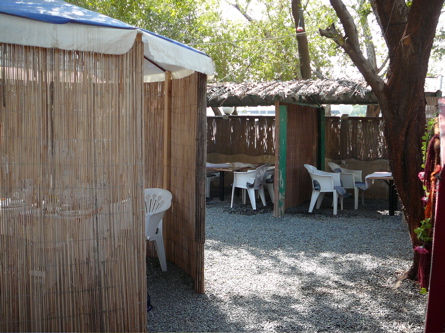
These are the cabins in the family section, open so you can keep an eye on the kids. There is another section of cabins that are more circular, more private, if you don’t have children with you.
Stormy Weather
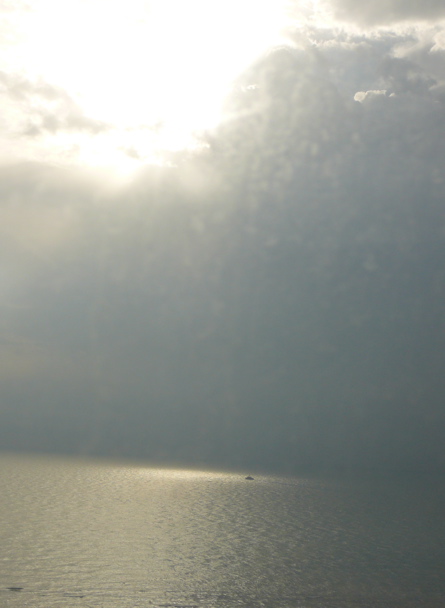
This was taken minutes ago, through my dust encrusted window. For my non-Kuwait readers, although we have rain throughout the winter (and winter does get cold here, down to almost freezing at night) the “rainy season” is late March – April. We have had truly spectacular thunder storms, amazing lightning, and rainy days.
Even on the rainiest day, the sun breaks through at some point in the day. We are already beginning to feel hints of the heat to come. The rain, combined with the heat, makes it increasingly muggy. Most of the year, it is dry, not terribly humid, even living at the coast.
But my windows! You would think that the rain would wash them clean, but no! The rain carries dust, and my windows are streaked and caked! You can see it if you look at the darker part of the clouds – but you grab the shot you can when you can, and although this one is flawed by the dust, I love the contrast of lights and darks.
Recent Comments
ExpatAlien on What Country am I Living … intlxpatr on Yellowstone: Old Faithful to C… Michelle on Yellowstone: Old Faithful to C… Cathy on No Grown-Ups in Charge intlxpatr on Waiting for Snow Wikipedia Donate Button

Amazina


Early Voting in Florida


 Here There and Everywhere