Some Peeks in Edmonds, Washington
You would love Edmonds, Washington.
It is a picturesque village. Along Main Street, and Fifth Avenue there are corner gardens, maintained by the city. This year, they are planted primarily with white flowers, big, fluffy flowers which make all the other flowers POP! with color. Overhead, from the lamp posts, are huge hanging baskets, full of a variety of plants, mostly purples, blues and fuchsias. The overall effect is stunning.
On our way to her manicure-pedicure, I drove Mom around looking at the sights. Down at the Edmonds Beach, I was shocked to see an eagle, perched on a piling. The shot isn’t very good, I jumped out of the car in a hurry and snapped, not taking enough time, but I was so surprised – I had never seen an eagle there before.

After lunch, as we headed out, we saw people touching up one of the murals Edmonds has painted on the sides of buildings there:

Here is another one, nearby:

I love it that this sweet little town, with its ferry coming faithfully in and out, preserves its identity and character in the face of changing times.
Round-Up Herbicide Tied to Serious Health Deterioration
Shocking news for everyone with grounds and gardens – we’ve all been using this, not knowing its long term impact on our environment – and on us.

Roundup, An Herbicide, Could Be Linked To Parkinson’s, Cancer And Other Health Issues, Study Shows

The peer-reviewed report, published last week in the scientific journal Entropy, said evidence indicates that residues of “glyphosate,” the chief ingredient in Roundup weed killer, which is sprayed over millions of acres of crops, has been found in food.
Those residues enhance the damaging effects of other food-borne chemical residues and toxins in the environment to disrupt normal body functions and induce disease, according to the report, authored by Stephanie Seneff, a research scientist at the Massachusetts Institute of Technology, and Anthony Samsel, a retired science consultant from Arthur D. Little, Inc. Samsel is a former private environmental government contractor as well as a member of the Union of Concerned Scientists.
“Negative impact on the body is insidious and manifests slowly over time as inflammation damages cellular systems throughout the body,” the study says.
We “have hit upon something very important that needs to be taken seriously and further investigated,” Seneff said.
Environmentalists, consumer groups and plant scientists from several countries have warned that heavy use of glyphosate is causing problems for plants, people and animals.
The EPA is conducting a standard registration review of glyphosate and has set a deadline of 2015 for determining if glyphosate use should be limited. The study is among many comments submitted to the agency.
Monsanto is the developer of both Roundup herbicide and a suite of crops that are genetically altered to withstand being sprayed with the Roundup weed killer.
These biotech crops, including corn, soybeans, canola and sugarbeets, are planted on millions of acres in the United States annually. Farmers like them because they can spray Roundup weed killer directly on the crops to kill weeds in the fields without harming the crops.
Roundup is also popularly used on lawns, gardens and golf courses.
Monsanto and other leading industry experts have said for years that glyphosate is proven safe, and has a less damaging impact on the environment than other commonly used chemicals.
Jerry Steiner, Monsanto’s executive vice president of sustainability, reiterated that in a recent interview when questioned about the study.
“We are very confident in the long track record that glyphosate has. It has been very, very extensively studied,” he said.
Of the more than two dozen top herbicides on the market, glyphosate is the most popular. In 2007, as much as 185 million pounds of glyphosate was used by U.S. farmers, double the amount used six years ago, according to Environmental Protection Agency (EPA) data.
AdventureMan and the Box Turtle
“There’s a box turtle in our backyard!” AdventureMan exclaimed, coming in after making his early morning rounds to make sure all was well in the garden, and to bring us up to date on any new developments. I was eating breakfast with our house guests, getting ready to leave for water aerobics class. (If you come to visit, you get to come to water aerobics 🙂 too!)
The two guys went back out to consider the box turtle, but the box turtle had disappeared. Of course we kidded AdventureMan.
“Are you SURE you saw a turtle? How would it get in to the backyard?”
He was mystified, but certain he had seen a box turtle. They searched all the spots they could think of, but could not find any turtle.
This morning, I was up early feeding the Qatari Cat when I saw a movement in the yard, and there he was, the box turtle.
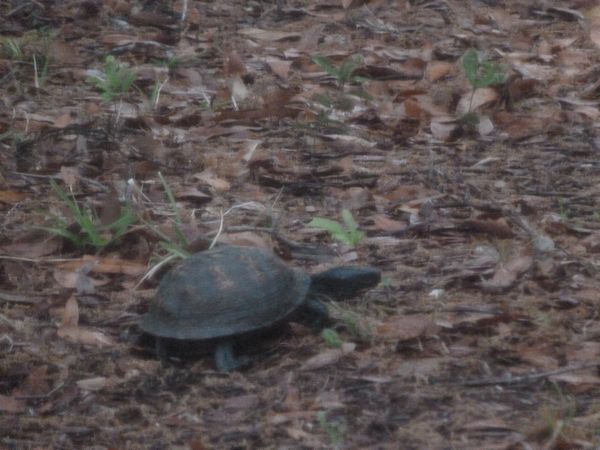

AdventureMan was still sleeping; so I ran and got my camera and took some photos. I think he was aware of me, but couldn’t figure out where I was (I was inside, he was outside). When he got up, AdventureMan was delighted to have his observation verified, and hurried outside to see if he could spot him. Nope! Turtle back in hiding.
The Baboon Coughed
We’ve had three sets of houseguests in a very short time span, and today is our first day of ‘normal.’ We saw our friends off at 0430 (we used to call it oh-dark-hundred) and I couldn’t get back to sleep, so by the grace of God (and I mean that literally) I got up and walked.
I know I need to walk. I’ve always walked. I used to run, but I suffered for it – the knees – and decided I didn’t want to pay that price. But when my sister was here, we decided to take a walk and I said “don’t worry, I walk fast” and she said “I don’t, I am so slow now, my body has to warm up.” Confidently I started – and starting is uphill from my house. Very shortly, I discovered my fast was her slow, and I was HUFFING and puffing, and so embarrassed because I guess it’s been a while since I did this walk . . . but we did it. It felt good. And I was happy for a nice cool morning so I could do it again.
I ran into a neighbor, ignored that she was in her nightgown, we both pretended she was as fully dressed as I, had a brief conversation and she went inside with her newspaper and I carried on. About halfway through my walk, as I puffed along, I heard it.
The baboon coughed.
I could even smell a faint drift of wood burning fire. I could hear the doves. But it was only very briefly, very intangential, and I quickly realized it must have been a dog barking distantly; I could still hear him. For one brief moment I was back in Zambia, and while I love the magic of Zambia, I would not be out for a mile long hike early in the morning while the lions prowl for a last meal before they settle down for their day-long snooze.
We are off this morning to a grand plant sale across the bay in Milton. Symphony tonight. Back to “normal” for Pensacola.
When Camels Roamed the Arctic
So cool! I found this article this morning on Weather Underground. I’m shocked – camels originated in North America?

Giant Camels Once Roamed the Arctic
By: Tanya Lewis
Published: March 5, 2013
Camels are the poster animals for the desert, but researchers now have evidence that these shaggy beasts once lived in the Canadian High Arctic.
The fossil remains of a 3.5-million-year-old camel were found on Ellesmere Island in Canada’s northernmost territory, Nunavut. The camel was about 30 percent bigger than modern camels and was identified using a technique called collagen fingerprinting. The finding, detailed today (March 5) in the journal Nature Communications, suggests that modern camels stemmed from giant relatives that lived in a forested Arctic that was somewhat warmer than today.
“It’s the first evidence that camels were ever there,” lead study author and paleobiologist Natalia Rybczynski of the Canadian Museum of Nature in Ottawa told LiveScience.”It is surprising because usually we associate camels with arid and semi-arid habitats.”
Camels, which belong to the Camelus genus, originated in North America during the Eocene period about 45 million years ago, and later crossed to Eurasia over the Bering Isthmus, a landbridge between Alaska and Russia. Their closest relatives are llamas, alpacas, vicunas and guanacos.
The researchers found about 30 pieces of bone that were part of a camel’s tibia, or shinbone. The fossil’s location moves the known range of North American camels northward by about 745 miles.
The camel’s identity and age were determined via collagen fingerprinting, a technique that measures the amount of a bone protein called Type I collagen. Different mammals have characteristic amounts of this protein, which survives longer than many other biological molecules in the body.
The team dated the fossil to roughly 3.5 million years ago, a period known as the mid-Pliocene warm period. The global temperature was about 3.5 to 6 degrees Fahrenheit warmer than today, Rybczynski said, and about 33 degrees F warmer where the camel was found, with temperatures averaging around 30 degrees F. The Canadian High Arctic was forested then.
The fossil specimen closely resembles modern dromedary camels, based on the fingerprinting, but was about a third larger in size. It also bears similarity to the giant Yukon camels that lived about 1,240 miles away from the site where the ancient camel bones were discovered.
The researchers plan to continue searching for camel remains in the High Arctic. “We hope to find more,” Rybczynski said.
First Gator on Dauphin Island
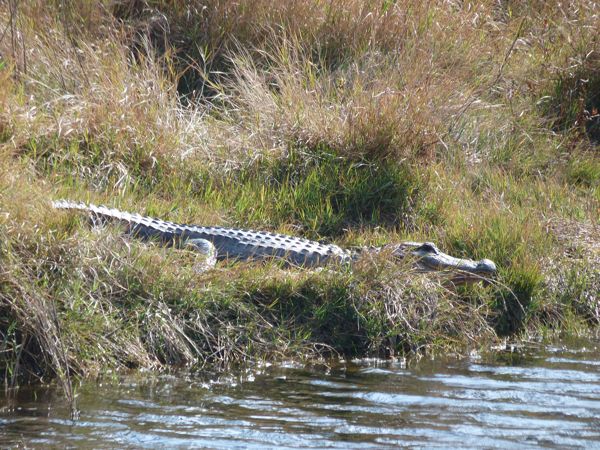
“That’s my very first gator!” our friend said, watching the reptile sun himself on the side of the big pond in the Audubon Bird Sanctuary. We had taken the very short hike out to see the gators and the turtles, and any birds who might be migrating through this gorgeous February day between storms.
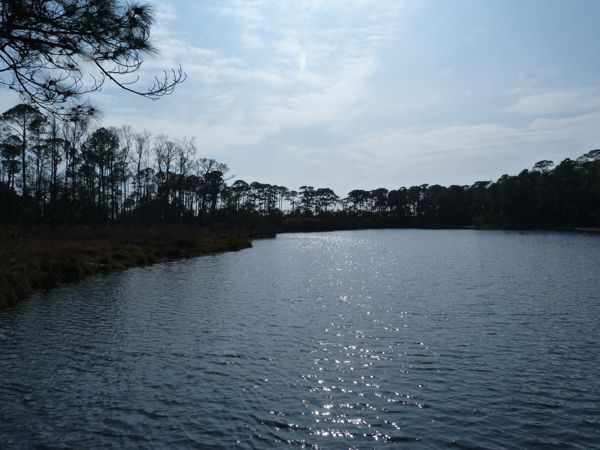
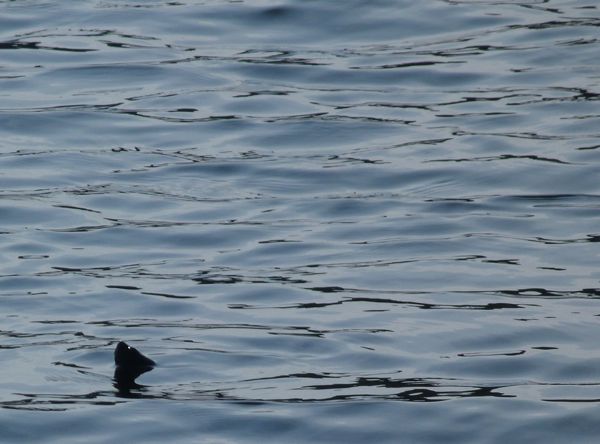
(That’s not a stick; it’s a turtle head sticking out of the water 🙂 )
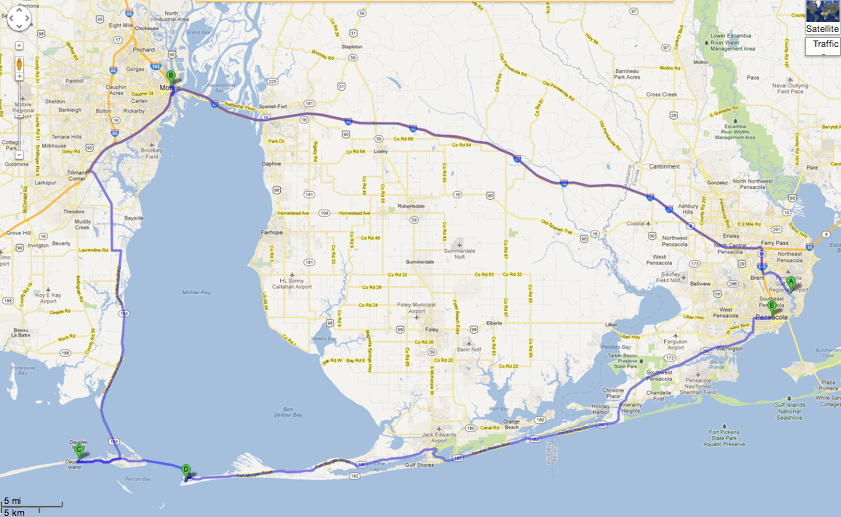
We had a great day for a drive and a ferry boat ride. The car ferry only handles maybe thirty cars max on the trip across Pelican Bay from Dauphin Island to Gulf Shores. It cuts off a long long trip back into Mobile and around the huge Mobile Bay, and takes us along the beach back into Pensacola.
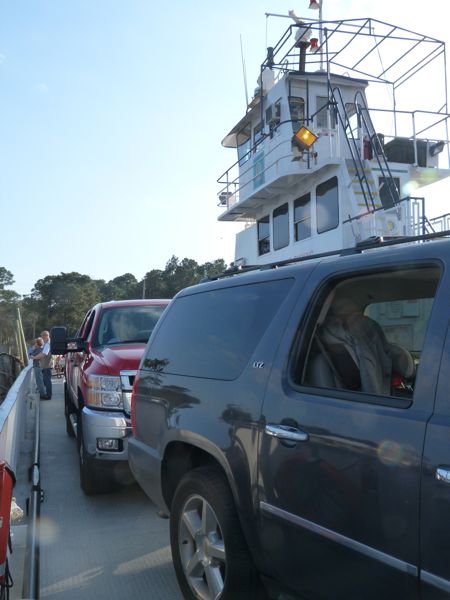

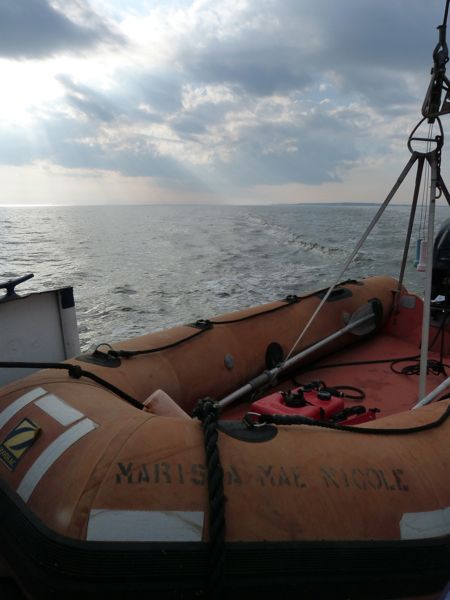

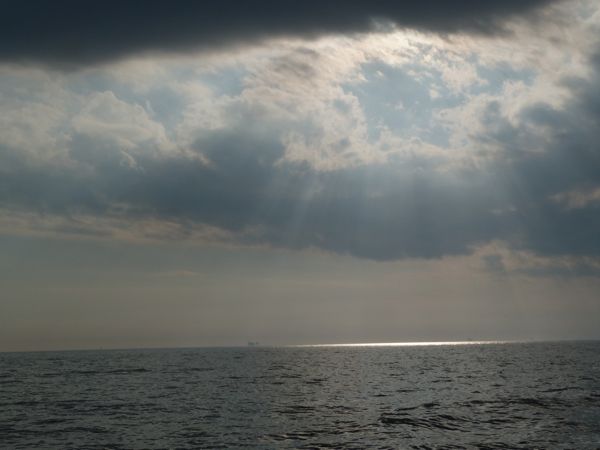

February is a great time of the year to walk these areas and to take a day trip. We had a wonderful day, mild temperatures and calm waters – altogether a great adventure, counting in our unforgettable stop at Smokey Dembo’s Smokehouse en route along Douphin Island Parkway.
Birding at St. Mark’s National Wildlife Refuge

Some mornings, I am astonished at how wonderful it is to live in a place where we have the luxury to set aside wide tracts of lands to preserve our natural heritage. St. Mark’s National Wildlife Refuge evokes that response in me. It’s even more astonishing that because a couple years ago I bought a lifetime Senior Pass, getting into the national parks is free – for the rest of my life. What a great country we live in. 🙂
It is a cold and frosty morning as we load up to head out to St. Marks for some serious bird watching and photographing. Serious, that is, for AdventureMan, who actually does birding trips with other serious birders. I am a bird-appreciator, as in I know what a cardinal is, and a blue jay. I can pretty well recognize a buzzard. Hey, show me a painting and I can probably tell you who painted it, but birds . . . not so much.

I love being outdoors in Florida on a wonderful clear cool day with fabulous conditions for taking photos. I love just wandering along some of the birding trails and seeing what we can see. It’s an amazing place; in some of the areas where we stopped to wander, it reminded me of places we like to go in Africa, of Zambia, of Namibia, of Botswana . . . some of the habitat is so alike, I can almost hear those tectonic plates creaking apart, drifting, and wonder how much of the flora is directly related to African flora.
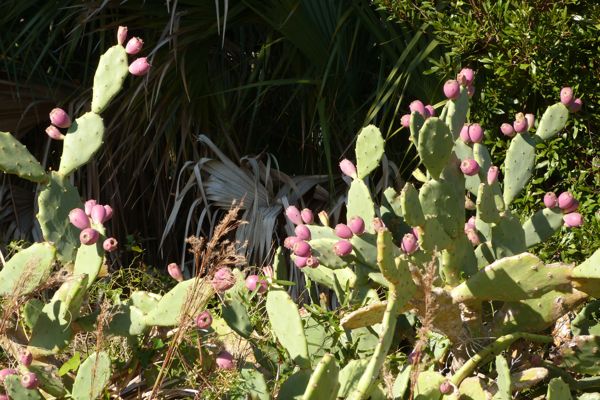
We had these in Tunisia; we called them Prickly Pear, and the Tunisians used them for borders to separate their lands. They also made jam with the prickly pears, and they skinned the leaves and fried up the meat from inside the thick prickly pear leaves. I think what a great border they would make in Pensacola, but a very unfriendly border. Good for keeping away thieves and burglers, but not very attractive, and not very welcoming . . . but very very African:
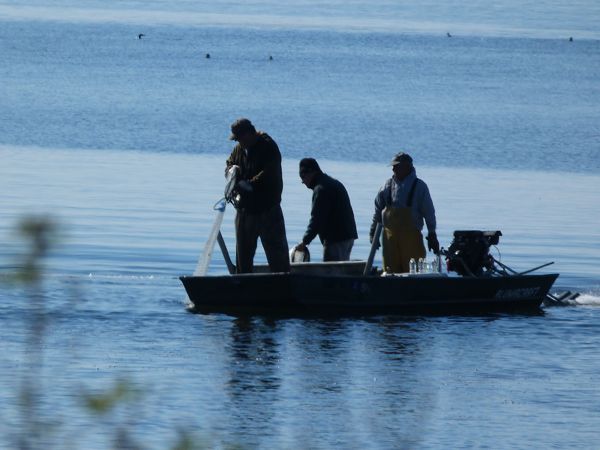
Some fishermen, probably setting some crab traps near the shore:

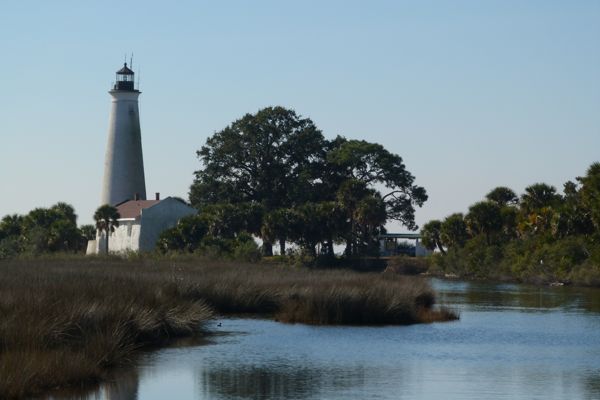
The St. Mark’s lighthouse:


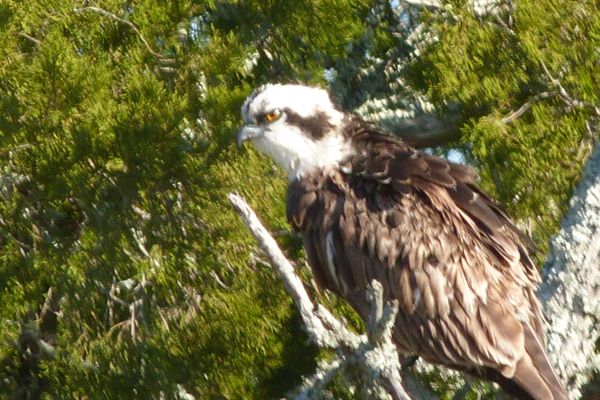

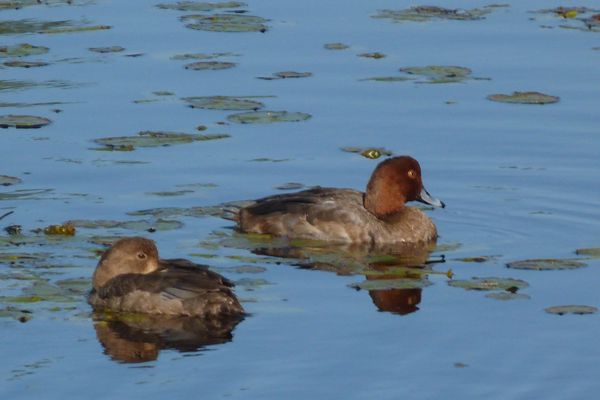
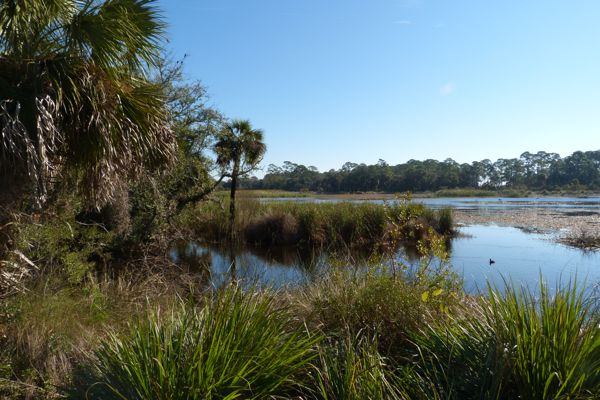


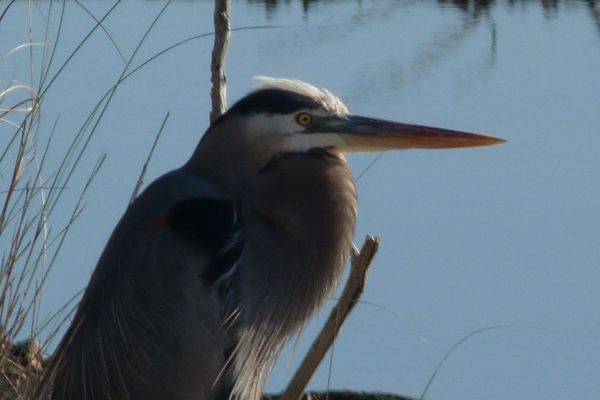
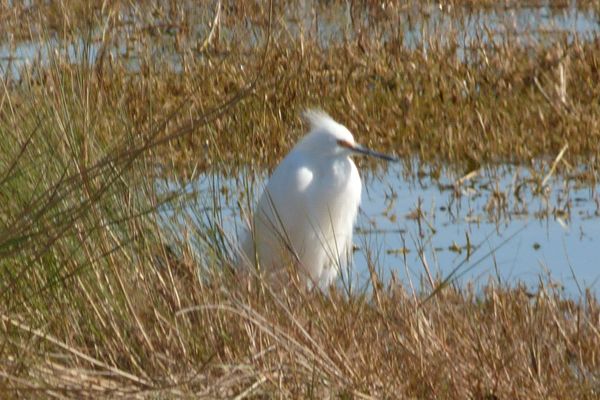
Every now and then you have a lucky moment, and I happened to shoot this heron just as he had a wiggling sparkly fish in his beak, just before he swallowed it. I admit it, I wasn’t trying. If I had been trying, I could never have gotten it just at the right moment:


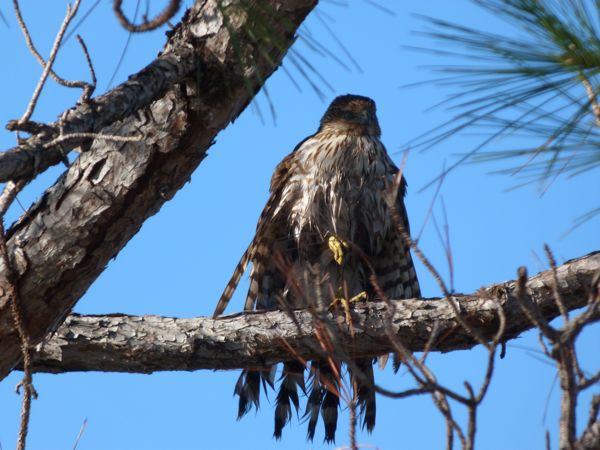
Some very clever park person went around and made all the deer crossing signs into Rudolph signs, LOL!

The park is full of very serious-faced people carrying HUGE lenses on cameras attached to seriously sturdy tripods, lenses meant to capture the details of the pinfeathers, cameras to document a rare sighting. These people don’t talk about ducks, they talk about Merganzers and Koots, and the rarely seen such-and-such, and I just listen and keep my mouth shut while my head spins.
For me, it’s enough to see these wonderful creatures, free of fear, safe in their migrations. It’s enough to have a cool day, a great day for walking, and NO mosquitos. It’s a great day for my kind of birding, which is very non-serious to be sure.
Wakulla Springs Boat Trip
At Wakulla Springs, everything is separate. Like the entrance fee goes to the State. The Wakulla Lodge is run by some corporation with a state contract, I am guessing, and the Wakulla Boat Rides are another separately run concession. If you are staying at the Lodge, or booked for the lunch buffet at the Lodge, you get into the Edward Ball Wakulla Springs State Park for free, instead of paying the $6/vehicle entrance fee.
The boat trip is half the fun. On hot days in the park, you can swim right in the same spring as the manatees, but on chilly winter days – take the boat trip. We took the boat trip twice, it is so much fun, and because we love the late afternoon light. I will share my photos of some of what we saw on the hour long trip below; warning you that trying to get a shot of an underwater manatee is not such an easy thing to do. You may have to use a little imagination to see the manatee 🙂 but I swear, it is there.
These are leathery buzzards, wintering in Wakulla Springs:

Great Blue Heron:
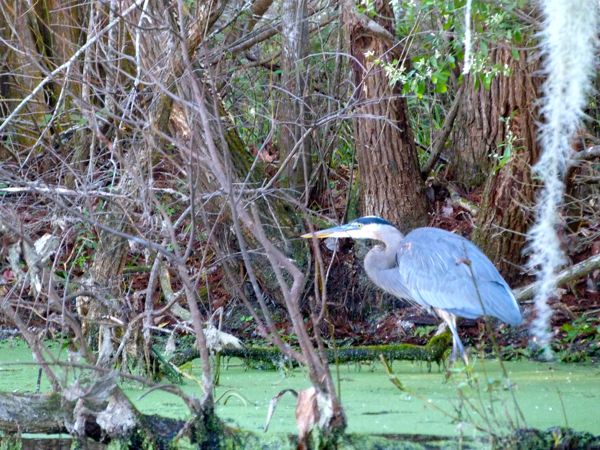
Little ducks called Koots:

Sunning Gator:

Close up of Gator skin:

Close up Gator head – he was so cold he didn’t even care about the boat being near, he just wanted to soak up as much sun as he could before it set:
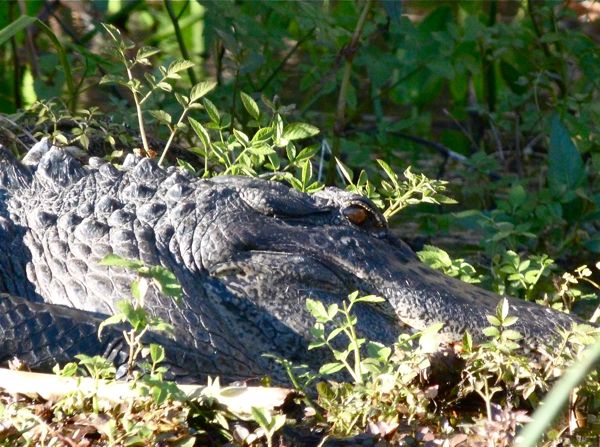
Wakulla Springs Cypress:

The Wakulla Springs Lodge from the Springs:
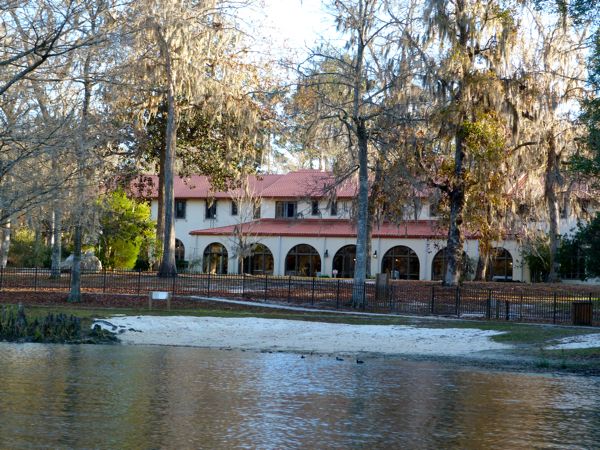
Old fashioned swimming platform:

Buzzards roosting:

Turtle soaking up some sun:

Anhinga drying out his wings:

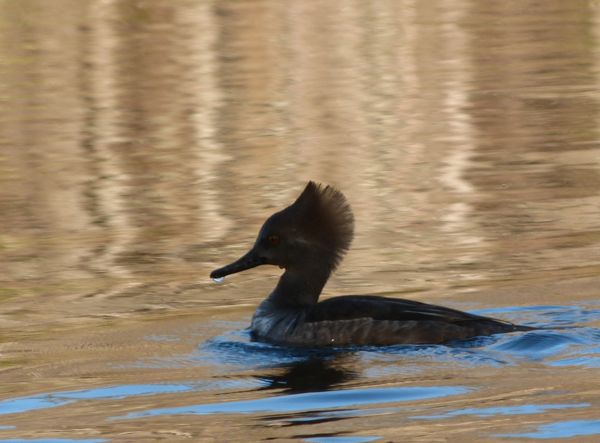
Merganzer Duck – don’t you love his helmeted head?
OK, there it is, the Manatee, otherwise known as a sea cow, a siren, and a sea slug – about the size of a small whale or a very large shark:

Recent Comments
Kitchen on Isiais: Winding Down intlxpatr on Shampoo Ginger tigerbutterya0c5ff1d… on Shampoo Ginger intlxpatr on British Soldier Kidnapped, Esc… John on British Soldier Kidnapped, Esc… Wikipedia Donate Button

Amazina


Early Voting in Florida


