Attempt to Kidnap Kuwaiti Girl: Print Their Names
From the Arab Times
Here is what scares me about this story – the language. It says “the side glass of the car broke.” That is very neutral language. I am pretty sure that the girl who was the intended victim would not break the glass; it was part of the barrier protecting her from the would-be kidnappers. It bothers me that it doesn’t state that the man broke the car glass attempting to kidnap the girl.
It also bothers me that the language says that they have been “detained for interrogation.” These men are a danger to society. They need to be locked up, for their own good and for the sake of the innocent young women who are their potential victims. There are witnesses, including the police. Enough! Try them, convict them and put them away!
It is also time to start publishing the names of the men who commit these acts. Would you want your daughter to marry such a man? Your cousin? Your sister? Doesn’t a woman have a right to know what sort of man she is marrying? Yes, it would shame the families from which the kidnappers have come. It seems that maybe shame is the only effective tool for deterring this kind of shameful behavior. If the families forbade this kind of behavior, you would see a drastic drop in the crime of kidnapping. Print their names.
Women are not the only victims. These same entitlement-loaded kidnappers seize boys and young me off the streets, sometimes lure their own friends, take them to the desert and rape them. What are they thinking? What makes them think they have that right? What makes them think there will be no consequences for bestial behavior?
Police save Kuwaiti girl from kidnappers’ clutches in Shaab Entertainment Park
KUWAIT CITY, Oct 2: The Hawalli police recently foiled at attempt by two Kuwaitis to kidnap a female compatriot from the parking lot of the Shaab Entertainment Park, reports Al-Shahid daily.
It has been reported as the victim was about to pull out of the parking lot, the youths blocked her way with their car and one of them got down from his vehicle and tried to drag the girl into his vehicle.
At this point the victim strongly resisted and in the confusion the side glass of the car broke. The victim then cried for help and a passing police patrol went to her rescue.
Seeing police the suspects grabbed the victim’s handbag containing her personal documents, cell phone and money and tried to escape but police chased and arrested them.
They have been detained at the Hawally Police Station for interrogation.
Predators prey on those they perceive to be weak and without protection. We, society, are supposed to be protecting the weak. When this man is refused sex, he and his friends try to rape the man, and trash the entire massage parlor?
Kuwaiti Man attempts to rape Jordanian massageur
KUWAIT CITY, Oct 2: An 18-year old Jordanian teenager reported at Jahra Police Station that a Kuwaiti man attempted to rape him while he was massaging the suspect inside a men’s salon — where the complainant works, in the Industrial Area on Thursday.
He narrated the man offered to pay him certain amount of money if he acceded to his demand for immoral act, which the complainant turned down and immediately asked the suspect to leave the salon.
He stressed the suspect later tried to kidnap him, which he resisted, so the suspect fled with his friends, but they destroyed some contents of the salon before fleeing the scene. However, he managed to record the number plate of the suspect’s car, which the detectives found out it belonged to a Kuwaiti man. A case has been registered against the suspect.
New Regulations Enforced for Drinking in Qatar Bars
New bar rules evoke complaints
By Peter Townson/Staff Reporter
From The Gulf Times
A number of residents in Doha have complained about recently introduced regulations requiring them to apply for membership to certain bars and clubs as well as providing ID upon entering such establishments in Qatar.
Due to new national regulations, hotels are enforcing membership rules, ensuring that all visitors have either a valid Qatari ID, their passport, or in many cases a membership card to enter the premises.
The bars now have a published set of rules outside the premises to indicate the necessary entry requirements, and although certain rules change from place to place, the general guidelines are the same throughout.
All applicants for membership must be over 21 years of age and possess a valid Qatari ID card, and the printing of membership cards usually costs a small fee, ranging from around QR30 to QR50 (and QR100 for replacements in some cases).
However, the new rules have meant that many places have substantial queues outside their establishments, and during special events guests can often have to wait for over half-an-hour to have their membership cards of ID scanned by hotel staff.
A representative of one hotel bar in Doha claimed that another major issue with the new membership rules had been the problem of informing their guests of the regulations.
“It seems it has been the hotels who have had to tell people about these new rules, not the people who have instigated them,” he said, arguing that it would have been beneficial to have some information regarding the reasons for the new rules and their specific details.
“I think they brought in the rules to prevent people who are living here illegally from drinking in the bars, and also to stop Qatari ladies from entering any drinking establishments,” he added.
Another hotel representative explained that the introduction of the new membership system had cost the hotel a significant amount.
“It was a big cost to the hotel to get all the necessary software and hardware to create the membership cards and register everyone’s details,” he said, adding: “However, we are trying to keep the cost of membership as low as possible for our guests.”
He pointed out that the new regulations do make it somewhat easier to “control the clientele,” and said that the rules have made life easier for the busier bars in Qatar.
However, a number of Western expatriates who have lived here for many years have become disgruntled at the new rules, claiming that it makes it more difficult for them to enter bars – especially if they have guests visiting from aboard.
Many have reported that visitors have travelled to hotels, only to be informed that they cannot enter without their passport – a document most travellers like to keep safe in their hotel room when abroad.
And other visitors to the bars – especially those who are quite obviously over 21 – resent the need to screen their ID before entering establishments they have been frequenting for years.
Government regulations defining what is appropriate dress and behaviour have also been highlighted by the hotels.
But these have also been bemoaned by customers who have in fact been turned away from places because of the clothes they are wearing.
Government officials were unable to comment, except to confirm that new rules had recently been introduced to all establishments serving alcohol in the country.
Girls of Riyadh by Rajaa AlSanea
“Have you read Girls of Riyadh?” my friend asked me on the phone, and when I said I had not, she said she would bring it to me.
“It’s an easy read” she said, “it will take you an afternoon.”
Sometimes life intruded. It took me a little longer. I had expected this to be lightweight, along the lines of the shopaholic books, read ’em and forget ’em. Airport reading, stuff you save to read when you know you will have time to kill.
I was surprised. I guess I had gotten the impression it was lightweight because I had seen it discussed on some of the blogs, and there are some light-hearted moments in the book. The four young women are well drawn, and their experiences are handled with sensitivity. She never reveals which character from the book she is, but I have my suspicions. 🙂
Each girl has her own unique experiences as she reaches young womanhood, and mating. Although the experiences are treated deftly, there is a serious undercurrent that belies the light tone. The underlying circumstances surrounding the mating rituals in a country so tradition-bound as Saudi Arabia turn mating into a dark ritual, full of unseen pits and minefields.
The very worst fear during these years is the wagging tongues of others. I have heard this theme over and over in my own dealings with young women in this part of the world.
“You know, khalto, a woman’s reputation is like glass, it is easily shattered,” explained my young-woman Qatteri friend, solemnly.
(for my Western readers, Khalto means ‘aunt’ literally, and is a term used respectfully for family friends, meaning ‘sister of my mother’)
“I don’t want to get married,” she continued, “They come for you as a bride and they are so nice and they make you feel so in love with them, but then, when you are married, they change. Men are . . . men are . . ”
“Dogs?” I asked.
“Yes! Yes!,” she exclaimed, “Dogs!” (pause)
“How did you know, Khalto?”
LLLLOOOOLLLLLLLLLL! It’s one of those moments when you know we are all more alike than we are different.
Girls of Riyadh is a worthy read. It is thought-provoking, and compassion-provoking. You grow to love these girls, and you hope a happy ending for them.
Holiday Inn Express, Seattle-Tacoma Airport
AdventureMan and I are what we call “Michelin Red R” people. When we were younger, living in Europe courtesy of Uncle Sam, every now and then – not often enough – AdventureMan would take some leave and we would go off adventuring, all over, but our greatest love was traveling in France.
We always had the latest Michelin, but through the years, we discovered that the fanciest places were not the places we liked the best. We would save up and go to a multiple-starred restaurant, order their speciality, and discover that the food was so rich, even with the small portions, even a three course meal would have us awake in the middle of the night, busy digesting the richness of the food.
We discovered, by trial and error, the Michelin red R, which stands for good local food at reasonable prices. Most of these places, you could order a la carte, and while the food remained rich, we found we could enjoy it more eating less of it.
There was also a red R equivalent in the hotels and inns section, but I think maybe it was a red rocking chair. It’s been a while since we’ve made a big trip into France . . .
The Holiday Inn Express at the Seattle Tacoma Airport is a red R in my book. I actually have free nights available at a higher priced chain, but we stayed there on our last long trip, and while the surroundings were luxurious, we found we felt crowded, we like more space and we like NOT to have features we really don’t care about. The rooms were actually about the same size as the one I am staying in, but over-furnished, over-stuffed, crowded.
For being by the airport, it was very very quiet. The shuttle picked me up at the airport almost immediately, they had my room and keys all prepared and waiting for me, it was about the fastest I have ever been checked in.
They are refurbishing the hotel and I like it. I got a new room, with serene furnishings, and all the furnishings I need without too many furnishings. I even had my choice of soft or firm pillows – right in the room. The bathroom was about 6 feet by 10 feet, and had a BIG feel, with terrazzo floors and one of those outward swooping shower curtains.

This is VERY handy, especially if you are tired and don’t want to go out looking for a place to eat, and especially if you are a female traveling alone. I ordered miso soup and salmon teriyaki and had it in under an hour, delivered to my door. There were a huge variety of restaurants to choose from. Wooo HOOO.

I like a room to have a clock I can see in the middle of the night, with an alarm:

I would prefer wi-fi, which is available in the lobby, but they provide a cable in the room, so I have no complaints:

My own little coffee maker, my own little refrigerator, and a little sink and microwave. In the closet is also an ironing board and iron. Yes, it matters to me.

Nice:

And didn’t we just read that metal showerheads gather less bacteria than plastic ones?

Just the right toiletries, not too much, not too little, and a hairdryer. I know it is becoming standard, but even in the nicest hotels sometimes you can get a surprise, and – sometimes they don’t work!

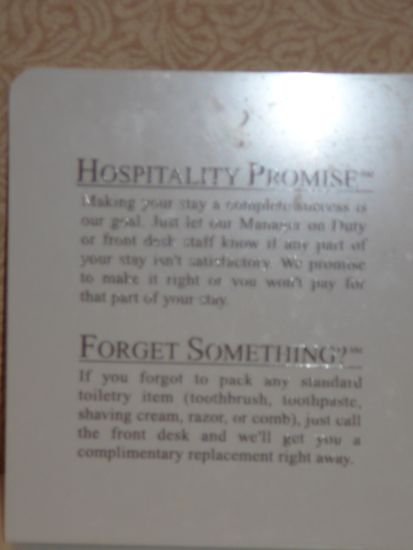
And, just in case there is something missing, they provide it – complimentary – at the desk. I like the graciousness of that.
Sudan Journalist Escapes Flogging, Chooses Jail
This spunky journalist has chosen to go to jail in the Sudan instead of paying the fine. Her lawyer is aghast, but Lubna Hussein says it will give her material to do a series on Sudanese jails, LOL! The judge had the option of sentencing her to flogging, but, wisely, abstained. You can read the entire story on AOL News
This is a follow up to an earlier story Whip Me if you Dare
Journalist Escapes Flogging in Sudan
By MOHAMED OSMAN and SARAH EL DEEB, AP
KHARTOUM, Sudan (Sept. 7) – A Sudanese judge convicted a woman journalist on Monday for violating the public indecency law by wearing trousers outdoors and fined her $200, but did not impose a feared flogging penalty.
Lubna Hussein was among 13 women arrested July 3 in a raid by the public order police in Khartoum. Ten of the women were fined and flogged two days later. But Hussein and two others decided to go to trial.
The female journalist on trial in Sudan for wearing trousers in public was convicted Monday for violating the country’s indecency law. A judge ruled that Lubna Hussein, seen above outside the courthouse after the verdict in Khartoum, will not be flogged, but must pay a $200 fine. The case has made headlines around the world.
“I will not pay a penny,” she told the Associated Press while still in court custody, wearing the same trousers that had sparked her arrest.
Hussein said Friday she would rather go to jail than pay any fine, out of protest of the nation’s strict laws on women’s dress.
“I won’t pay, as a matter of principle,” she said. “I would spend a month in jail. It is a chance to explore the conditions in jail.”
The case has made headlines in Sudan and around the world and Hussein used it to rally world opinion against the country’s morality laws based on a strict interpretation of Islam.
Galal al-Sayed, Hussein’s lawyer, said he advised her to pay the fine before appealing the decision. She refused, he said, “She insisted.”
The lawyer said the judge ignored his request to present defense witnesses.
“The ruling is incorrect,” he said, adding that the prosecution witnesses gave contradictory statements.
Al-Sayed said the judge had the option of choosing flogging, but apparently opted for fine to avoid international criticism. “There is a general sentiment in the world that flogging is humiliating.”
Ahead of the trial, police rounded up dozens of female demonstrators, many of them wearing trousers, outside the courtroom.
The London-based Amnesty International on Friday called on the Sudanese government to withdraw the charges against Hussein and repeal the law which justifies “abhorrent” penalties.
Human rights and political groups in Sudan say the law is in violation of the 2005 constitution drafted after a peace deal ended two decades of war between the predominantly Muslim north and the Christian and animist south Sudan.
The Amnesty statement said Sudan had been urged to amend the law which permits flogging, on the grounds that it is state-sanctioned torture, after eight women were flogged in public in 2003 with plastic and metal whips leaving permanent scars on the women. The women had been picnicking with male friends.
Myths about Contraception
Sometimes news articles are unintentionally humorous. I couldn’t help it – this statement:
Dr Annie Evans, Women’s Health Specialist at the Bristol Sexual Health Centre, said: “It is not surprising, given that Britain continues to have the highest unintended pregnancy rate in Europe.”
had me totally giggling. If you thought chicken skin would prevent contraception, you might have an unintended pregnancy, too! Hilarious. I thought as time passed, people would know more and more about these things. How can so many people NOT know?
Contraception myths ‘widespread’
By Sudeep Chand
Health reporter, BBC News
A UK survey has revealed that myths about contraception may be widespread.
One in five women said they had heard of kitchen items, including bread, cling film and even chicken skin, being used as alternative barrier methods.
Others had heard food items such as kebabs, Coca-cola or crisps could be used as oral contraceptives.
The survey questioned 1,000 women aged 18 to 50 and was carried out by market research company Opinion Health, sponsored by Bayer Schering Pharma.
Contraceptive myths have been around for thousands of years.
Ancient methods have varied from crocodile dung and honey before sex, to sea sponges and beeswax after.
Perhaps the most intoxicating was alcohol made from stewed beaver’s testicles.
However, it seems that a variety of unsafe and unproven methods might still exist in modern Britain.
Dr Annie Evans, Women’s Health Specialist at the Bristol Sexual Health Centre, said: “It is not surprising, given that Britain continues to have the highest unintended pregnancy rate in Europe.”
Other myths surround the use of oral contraceptive pills. One in 10 of the women questioned believed that it always takes a number of years to regain fertility after discontinuation of the pill. Others believed that the pill could protect them against HIV.
Professor Steve Field, Chairman of the Royal College of General Practitioners, commented: “This is alarming but not surprising.
“I’ve had complications with patients over the years that have concerned me.
“The more we can put appropriate information to the public about the availability of different methods of contraception, about their advantages and disadvantages, the better.
“It is important that access to advice is made as easily as possible for all ages.”
Joke for Women
A sixteen year-old boy came home with a new Chevrolet Avalanche and his
parents began to yell and scream, ‘Where did you get that truck???!!!’
He calmly told them, ‘I bought it today.’
‘With what money?’ demanded his parents. They knew what a Chevrolet
Avalanche cost.
‘Well,’ said the boy, ‘this one cost me just fifteen dollars.’ So the
parents began to yell even louder. ‘Who would sell a truck like that for
fifteen dollars?’ they said.
‘It was the lady up the street,’ said the boy. I don’t know her name –
they just moved in. She saw me ride past on my bike and asked me if I
wanted to buy a Chevrolet Avalanche for fifteen dollars.’
‘Oh my Goodness!,’ moaned the mother, ‘she must be a child abuser. Who knows
what she will do next? John, you go right up there and see what’s going
on.’ So the boy’s father walked up the street to the house where the lady
lived and found her out in the yard calmly planting petunias!
He introduced himself as the father of the boy to whom she had sold a new
Chevrolet Avalanche for fifteen dollars and demanded to know why she did it.
‘Well,’ she said, ‘this morning I got a phone call from my husband.. (I
thought he was on a business trip, but learned from a friend he had run off
to Hawaii with his mistress and really doesn’t intend to come back)
He claimed he was stranded and needed cash, and asked me to sell his new
Chevrolet Avalanche and send him the money.
So I did.’
(Are women good or what?)
Casper’s A Taste of the South
We had decided on one restaurant, an Italian restaurant we both like, and were on our way, when Mom thought of another restaurant we might like to try, but it was on the way, so we could look at it and decide whether we wanted to eat there or go on to the Italian one.
This is very normal for our family. Our son used to call it “bait and switch” because we would say “Hey! Do you want to go to Tortilla Gonzales?” and he would say “Yeah!” and we would all jump in the car and then on the causeway, AdventureMan would say “You know I really have a taste for Chinese . . . would anyone prefer Chinese?” and I would jump in and say “We’re really close to that sushi place we all love!” and then our son would have to rein us in “NO! You said we were going to Tortilla Gonzales!”
Once he went away to college, we switched all the time. Later, we learned that now he and his wife do the old switch-a-roo, too – family culture is a hard thing to shake.
So we are en route and Mom suddenly shouts “RIBS!” and I say “What??” and she said “We just passed a rib place!” We were at a stop light. “Mom,” I asked, “Do you want to go to that rib place?”
Silence.
Silence.
I pull into the U-turn lane and complain “You’ve got to start dealing with me directly; if you want to go to the rib place, you have to say so!” The complete irony being that I was already making the U-turn, which is what she wanted me to do. . . . Family culture being a hard thing to shake . . .
But as we pulled into the already crowded parking lot, the smell was absolutely divine. There was already a line. Good thing, too, it gave us time to read the menu and decide what we wanted.

We both ordered ribs. We are both forbidden to eat ribs. I eat ribs maybe one time each year, like once, at a buffet, I ate one small rib. It is so rare that I allow myself to eat a rib that I can remember even that one tiny rib. But this time, I ordered ribs, because my Mom did. She ordered Sweet Potato Fries and Cole Slaw and I ordered Hush Puppies and Cole Slaw.
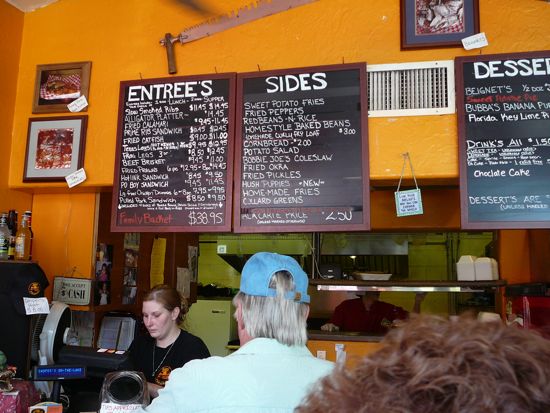
You are going to be so so proud of me. I took pictures before we ate the food this time, well, except for one tiny bite I took out of the hushpuppies, but that was to show you what they look like on the inside. (My Mom has NEVER had a hushpuppy in her life before having one of mine.)
We sat down in the large outside sitting place – I can’t help but wonder what they do in the winter time, because it can get really really cold and damp in Seattle, but I am guessing that they do a huge take-out business.

They have a map that they want people to put push-pins in to say where they are from:
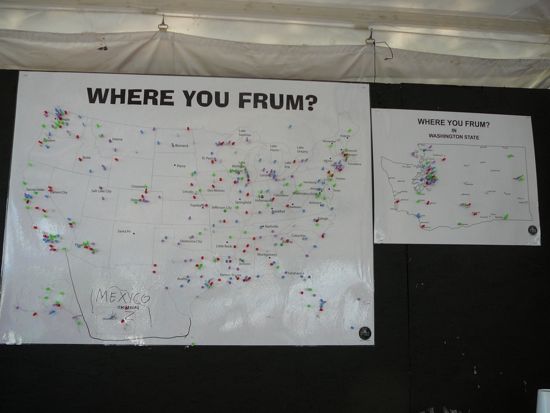
I made a little addition:

And, as I promised, here is the food. Actually, they gave Mom this HUGE portion, about double my portion, but since I got four ribs and only ate two, Mom took home a huge box of leftover ribs to package up and freeze and have a little at a time.

Did you know sweet potatoes are really really healthy for you?

(I think sweet potatoes are healthier for you when they have a lower surface/interior ratio and have absorbed less fat, but these are totally, incredibly delicious. That’s sugar on the sweet potato fries, not salt.) Mom took leftover sweet potato fries home, too.

I can’t even pretend that there is anything healthy about deep fried cornbread. I ate them all, except the one Mom ate. They . . . they were really really good. Yes, I am so ashamed, but I would do it again.
And no, I didn’t take a photo of the sweet potato pie, generously seasoned with fresh nutmeg, it was divine, or the key lime pie we couldn’t eat and Mom took that home, too.
Oh, this food was good. As we left, the line stretched way out to door and into the parking lot.
Casper’s Taste of the South
15030 Bothell Way
Lake Forest Park, WA
(206)268-0202
Their slogan is:
Put a Little South in Your Mouth. LLLOOOLLLL!
A New Approach – The John School
From CNN World News
NASHVILLE, Tennessee (CNN) — The accused came from all walks of life: Retirees, dads and twentysomethings. An engineer, a business owner and an auto worker. A man in a wheelchair. Men in need of Spanish or Farsi translators.
Brett Beasley, with Nashville’s Health Department, educates men arrested for trying to buy sex about STDs.
About 40 men somberly entered a classroom on a recent Saturday morning. About half of them wore shiny wedding bands.
All had tried to buy a prostitute’s services and were caught by police. It was their first offense, and a county court referred them to a one-day program called the John School. It’s a program run by volunteers and city officials in conjunction with Magdalene House, a nonprofit that works to get prostitutes off the streets.
“Prostitution doesn’t discriminate,” said Kenny Baker, a cognitive behavioral therapist who is the program’s director. “Most of these men don’t have a prior criminal history, so our goal is to help these folks understand why they put themselves in a bad position, to prevent it from happening again.”
Set in a church in Nashville, Tennessee, the John School is led by former prostitutes, health experts, psychologists and law enforcement officers who talk to — and at times berate — the men about the risks of hiring a prostitute.
Prostitution is based on the law of supply and demand. The thinking is: Women won’t stop selling sex until men stop buying.
So Nashville and a growing number of cities are shifting their focus from locking up suppliers to educating buyers. Across the country, about 50 communities are using John Schools. Atlanta, Georgia, and Baltimore, Maryland, are among dozens more cities that plan to launch similar programs by the end of the year. See where the John Schools are »
“It will make them [offenders] see that this is not a victimless crime, and they are contributing to the exploitation of women,” said Stephanie Davis, policy adviser on women’s issues at the mayor’s office in Atlanta. “It’s hurting them, the man, and it’s hurting their families and its hurting the community.”
No comprehensive effort has been made to track the numbers, but experts estimate 1 million to 2 million prostitutes work in the United States. The FBI’s 2007 Uniform Crime Report lists about 78,000 arrests for prostitution and commercialized vice, but experts say those numbers are extremely conservative because many sex workers and johns aren’t caught.
Experts add that easy accessibility to prostitutes and pornography on the Internet are feeding the problem.
In most communities, prostitution has been a one-sided battle focused on the women who offer sex. Their customers, when they are arrested, are usually cited for a misdemeanor and fined.
By comparison, prostitutes are often charged with more severe sentences and jailed for months, depending on the offense.
But in Nashville, the johns’ faces are shown on a police Web site.
For decades, Nashville battled prostitution by arresting women on the streets and through stings. Still, the problem persisted, irritating business owners and residents.
In the early 1990s, Nashville’s mayor helped launch the John School with the help of the Magdalene House, public defenders, prosecutors and police officers. Nashville became one of the first major cities in the U.S. to focus on the customers, predominantly men.
Only first-time offenders who solicit an adult are eligible for John School. Johns who pick up minors are not eligible and face much tougher sentences.
“If you get caught again and you get me, I will guarantee to put you in jail,” warned Antoinette Welch, a local prosecutor, in speaking to the men in the class. “I’ve had men cry to me that they will lose their jobs or their wives, but you’re all grown up and you make your own decisions.”
The men listened carefully as Welch talked about their records; many had not yet told their wives or significant others about their arrest.
If the john pleads guilty, pays a $250 fee and completes the course without re-offending, the charge can be dismissed after a year. The money paid by the john goes to Magdalene House; the program doesn’t cost taxpayers any money. John School models in other communities may differ.
A woman who called herself Alexis, a 35-year-old former prostitute with dark hair and bright blue eyes, spoke to the men as the class came to an end. Four years ago, she left the streets and now works at a factory.
By the age of 10, Alexis had learned to barter with sex with her stepfather. In her 20s, she found herself hooked on drugs and selling her body. She was arrested more than 80 times. She was hospitalized after someone shot her on the job.
As she told her story, the men were silent. A few blushed, while others stared at the floor.
“These gentlemen are no different than I was on the streets,” she said. “I think everyone has to look at the void they are trying to fill.”
One john, a father of two with salt-and-pepper hair, found himself near tears after Alexis spoke. In July, he tried to pick up a prostitute through Craigslist. He said he was depressed and having problems with his wife.
“I’m so embarrassed,” he said. “These girls are somebody’s daughters. I have a daughter.”
Some evidence suggests that John Schools are working. A 2008 government study looked at the John School program in San Francisco, California. It’s one of the largest programs in the country; more than 7,000 johns have attended since 1995.
According to the study, the re-arrest rate fell sharply after the school was launched, and stayed more than 30 percent lower for 10 years afterward.
But critics call John School a slap on the wrist. On Saturday, one john abandoned the classroom.
Carol Leigh, who founded the Sex Workers Outreach Project, a group that promotes legalizing prostitution in California, said she doesn’t believe the program is an effective deterrent. Last year, she helped advocate on behalf of a law known as Proposition K that would legalize prostitution in San Fransisco. The proposal was rejected by the city.
“John School doesn’t do that much,” said Leigh, who has worked as a prostitute. “The reality is they aren’t spending that much time on the johns and they will just go and re-offend at other venues. This also doesn’t target the violent offenders who are the real problem.”
Melissa Farley, head of the nonprofit group Prostitution Research and Education in San Fransisco, believes johns deserve stronger punishment like longer prison sentences.
A recent study she conducted among johns in Chicago, Illinois, found that 41 percent of them said John School would deter them from buying sex, compared with 92 percent who said being placed on a sex offender registry would scare them from re-offending.
Nashville officials said they haven’t tracked recidivism rates in their city, but the school’s program director said it’s probably deterring a third of the offenders in each class.
At least one college educated, 47-year-old john’s attitude appeared to change on a recent Saturday.
After class he wrote, “There is no good part. I would rather be with my wife. This was quick but it wasn’t worth it.”
Recent Comments
Kitchen on Isiais: Winding Down intlxpatr on Shampoo Ginger tigerbutterya0c5ff1d… on Shampoo Ginger intlxpatr on British Soldier Kidnapped, Esc… John on British Soldier Kidnapped, Esc… Wikipedia Donate Button

Amazina


Early Voting in Florida


