Teacher Orders Students to Strip
From Al Watan. Wonder how much longer this teacher will have a job? What was she thinking???
KUWAIT: Enraged parents of young female students at one of the intermediate schools in Hawally have filed a complaint against an Egyptian teacher, who ordered all the girls in the classroom to strip. A reliable source said: “The Egyptian teacher entered the classroom and asked the students about the source of some foul odor emanating from the classroom. The students however refused to admit or identify the girl who broke a chemical ampoule, so she allegedly ordered all the students to take off their clothes. The students in turn informed their parents about the incident, after which a group of parents filed a complaint against the teacher at the AlـNugra Police Station.”
Kuwait Times on Morality Police
Wooo HOOOO on you, Jamie Etheridge; you bring grammar, tone and content to the Kuwait Times
Kuwait’s illegal morality police
Published Date: January 02, 2009
By Jamie Etheridge
Two female students were attacked by two youths this past week in Hawally, reportedly for not wearing the hijab. The girls were standing outside their school when two bearded young men jumped from an SUV, whacked them with a stick and then jumped back into their truck and took off. The incident sparked outrage and triggered discussions across Kuwait about the self-proclaimed morality police encouraged by a radical Islamist cleric Mubarak Al-Bathali.
In late December, Al-Bathali announced that he had established a voluntary committee for the “Promotion of Virtue and the Prevention of Vice” along the lines of the dreaded Saudi mutaween. The mutaween are a sort of religious police that patrol the streets in the villages and cities of Saudi Arabia, ensuring that women are covered from head to toe, that men go to the mosque to pray and that unmarried men and women do not mix in public. They also enforce other important moral strictures, like no mixed dancing or playing rock and roll music.
Al-Bathali said that his ‘vice’ squad will patrol the Sulaibikhat area first and then slowly spread out to other areas. It’s not clear who was behind the attacks in Hawally. Some have argued that it might have been just a couple of youths having fun and playing a trick on the girls by whacking them like the mutaween in Saudi do.
Let’s hope it was a bad joke by bored teens. God help us if random groups of men suddenly start forming ‘morality’ patrols and beating women on the streets of Kuwait. A Kuwaiti mutaween would create a host of problems.
First, the morality police would be trying to enforce a brand of radical Islam and ideology many in Kuwait – both citizens and expats – do not follow. Many Muslim women in this country do not wear hijab and there are no laws that require them to do so – despite the best efforts of the fundamentalists in parliament.
Second, Kuwaitis are highly protective of their female family members and few are likely to accept strange men whacking their mothers, sisters, daughters, wives and aunts in public areas. Following the 1990-1991 Iraqi invasion and occupation, some radical Islamists tried to establish a religious police and had begun even stationing ‘officers’ outside the Co-ops in Jabriya, Surra and elsewhere.
These mullahs carried short sticks and would strike women coming out of the Co-ops who they deemed to be dressed inappropriately. The women, of course, immediately called their male relatives who then rushed to the Co-ops and attacked the mullahs for attacking the women. The resulting chaos led to the banning of the self proclaimed morality cops.
Third, an ad hoc security force running loose around the country poses a real and present danger to the forces of the Interior Minister and by extension, the stability and security of Kuwait as a whole.
Nearly 20 years later, the radicals have reemerged and wider popularity – as evidenced by the fundamentalists victory in parliamentary polls – has encouraged them to reassert their plans for greater social control.
Success for the mullahs will mean failure for Kuwait’s experiment with democracy. Unlike the rest of the Gulf Arab states, Kuwait isn’t just beginning this experiment. For nearly half a century, this diminutive Muslim country has balanced tribal mores and religious identity with the Islamic and democratic ideals of freedom, dignity and self respect. Allowing roving bands of self appointed religious police to patrol the streets of Kuwait will undermine all of the country’s efforts toward balancing tradition
and modernity.
Family Crisis
The Gospel reading for today details a family crisis. We grow up with these words, we know them by heart, but it is only living in the countries near where Jesus was actually born that I have come to ponder these words in my heart, and try to imagine what it meant in Mary’s time.
Matthew 1:18-25
18 Now the birth of Jesus the Messiah* took place in this way. When his mother Mary had been engaged to Joseph, but before they lived together, she was found to be with child from the Holy Spirit. 19 Her husband Joseph, being a righteous man and unwilling to expose her to public disgrace, planned to dismiss her quietly. 20 But just when he had resolved to do this, an angel of the Lord appeared to him in a dream and said, ‘Joseph, son of David, do not be afraid to take Mary as your wife, for the child conceived in her is from the Holy Spirit. 21 She will bear a son, and you are to name him Jesus, for he will save his people from their sins.’ 22 All this took place to fulfil what had been spoken by the Lord through the prophet:
23 ‘Look, the virgin shall conceive and bear a son,
and they shall name him Emmanuel’,
which means, ‘God is with us.’ 24 When Joseph awoke from sleep, he did as the angel of the Lord commanded him; he took her as his wife, 25 but had no marital relations with her until she had borne a son;* and he named him Jesus.
Living in Jordan, living in the Gulf has helped me so much to understand the context in which this birth took place. In America today, it is still hoped for that women will be married when they have children, but it is not taken for granted. No one goes out and kills a daughter or sister who has had sexual relations with a man before she is married. Parents don’t disown daughters who conceive before the vows are publicly exchanged.
Even now, in the Middle East, most expect women to be virgin at marriage, and to conceive only after the formalities of marriage. There are steep penalties to be paid for varying from that route. Banishment. Death. Dishonor. A bastard child, if she lives that long. These are all things Mary was facing as she entered her earliest months of pregnancy. Joseph had decided to set her aside – not to marry her. He was a decent man, but a man of the times, he didn’t want a pregnant bride. The angel comes – he tells Joseph that this baby is special, conceived of the Holy Spirit, that Mary remains virgin. And miracle of miracles . . . Joseph listens.
What a courageous woman. What a courageous man.

Vigilante Volunteers
“Helping out the Ministry of Interior”
From today’s Kuwait Times
Kuwaiti activist establishes voluntary religious police
Published Date: December 27, 2008
KUWAIT: Islamist activist Mubarak Al-Bathali announced that he has established a voluntary Kuwaiti Committee for the Promotion of Virtue and the Prevention of Vice, like the Saudi Mutaween or religious police.
Al-Bathali said the Kuwait committee would begin its religious tasks in the Sulaibikhat area before spreading to other areas of the country. He explained that he was inspired to adopt the idea after a number of devout young people complained to him about seeing inappropriate and immoral behavior in Kuwait’s streets.
He emphasized that the committee members would focus only on advising people to avoid irreligious and immoral behavior and would never implement harsh or violent treatment on anyone.
Among the types of treatment which Al-Bathali protested against was the alleged drinking of alcohol, banned in Kuwait, at Christmas parties in the country. He reiterated that those who wished to drink alcohol should go outside Kuwait to do so.
Al-Bathali emphasized that the committee’s work would not conflict with the Ministry of Interior’s, saying that on the contrary it would help the MoI to uphold public morality and values.
From today’s Arab Times:
WE DON’T WANT YOUR HELP GUARDING PUBLIC MORALITY! responds MOI
Interior Ministry hits out at new ‘guardians of freedom’
KUWAIT, Dec 26, (KUNA): “Kuwait is an institutional state governed by law”, a statement by the Ministry of Interior said on Friday. The statement came in response to a press statement published on the front page of a local daily earlier today. The press statement talked about a group that allocated itself as “guardian” of people’s personal freedoms guaranteed by law, the ministry statement noted. The statement stressed that the ministry was the only directorate tasked with implementing and preserving the law in the country through imposing security and order, as well as safeguarding public morals. “The Kuwaiti society is a conservative, Arab and Muslim one that maintains refined morals and abides by its customs and traditions,” it pointed out.
“The ministry will counter such ‘radical’ calls with firmness,” the statement said, adding that the ministry would not allow anyone, whether individuals or groups, to interfere in the public’s personal freedoms, describing the calls as a “loud” infringement of the law as it also defied the state’s constitutional institutions. The statement concluded by saying that the ministry would take needed legal and security procedures to counter these calls and maintain the nation’s safety under the leadership of His Highness the Amir Sheikh Sabah Al-Ahmad Al-Jaber Al-Sabah.
Meanwhile, the Citizenship and Passport Affairs Department at the Ministry of Interior has announced that citizenship will not be granted to Kuwaiti children born abroad, if they hold any other nationality, reports Al-Rai daily. The department said since Kuwait doesn’t accept dual citizenship, children born abroad, especially in western countries where citizenship is given on birth, will not be granted Kuwaiti citizenship if they accept another country’s citizenship. It applies even on children of diplomats and “the department will not grant citizenship to such children unless they give up their previous citizenship.”
It is easy to discover nationality from birth certificates, say sources. In another development, Iraqi authorities have extended invitation to Kuwait officials to visit Baghdad to locate the whereabouts of their compatriots captured during the August 1990 Iraqi invasion, reports Arrouaih daily quoting reliable Kuwaiti Foreign Ministry sources as saying. Sources added the step demonstrates the serious determination of Iraqis to see to an amicable resolution of the issues and to put to end the lingering suffering of many families who lost their loved ones during the war.
PS. I don’t want your help, either, morality volunteers, guarding my morality. My morality is between me and God. I obey the laws of the country I live in – the laws of the country, not your idea of what the laws should be. “Volunteers” guarding morality are vigilantes, pure and simple.
Jailed for Headscarf?
It’s a good think I read this article all the way through before I published it. I thought it was about a woman getting arrested for wearing hijab. She was not arrested for wearing hijab. Read the last sentence in the article. She was turned away from the courtroom for wearing hijab – that’s bad enough. She was arrested when she swore at the bailiff (an officer of the court who preserves a dignified atmosphere in the courtroom, or tries to.)
I suspect this policy is more a gang thing – prohibiting headgear that would cause an outbreak of violence in the court – but that it was enforced in ignorance and protest against this Muslim-American woman. They released her quickly once threatened with investigation.
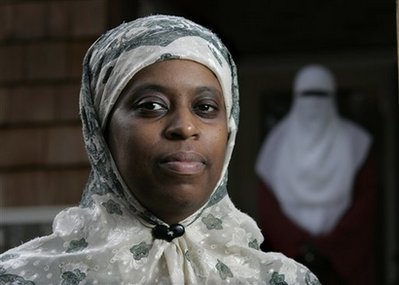
Sikhs won the right to wear their headgear while serving in the US military, as a religious right. I am betting Muslim women can win the right to wear hijab – it just needs to be tested in the courts. I do not think they can win the right to wear niqab, or other face coverings into the court – it isn’t a religious requirement, and the safety of the court can’t be protected if you don’t know who you are letting into the courtroom.
ATLANTA (Dec. 17) – A Muslim woman arrested for refusing to take off her head scarf at a courthouse security checkpoint said Wednesday that she felt her human and civil rights were violated.
‘Stripped of My … Human Rights’
A Georgia judge ordered Lisa Valentine, above at her home in Douglasville, to serve 10 days in jail for refusing to take her head scarf off in court Tuesday. The Muslim, who had violated a policy that prohibits any headgear, was released Wednesday after an advocacy group called for a federal probe into the matter.
A judge ordered Lisa Valentine, 40, to serve 10 days in jail for contempt of court, said police in Douglasville, a city of about 20,000 people on Atlanta’s west suburban outskirts.
Valentine violated a court policy that prohibits people from wearing any headgear in court, police said after they arrested her Tuesday.
Kelley Jackson, a spokeswoman for Georgia Attorney General Thurbert Baker, said state law doesn’t permit or prohibit head scarfs.
“It’s at the discretion of the judge and the sheriffs and is up to the security officers in the court house to enforce their decision,” she said.
Valentine, who recently moved to Georgia from New Haven, Conn., said the incident reminded her of stories she’d heard of the civil rights-era South.
“I just felt stripped of my civil, my human rights,” she said Wednesday from her home. She said she was unexpectedly released after the Washington-based Council on American-Islamic Relations urged federal authorities to investigate the incident as well as others in Georgia.
The group cited a report that the same judge removed a woman and her 14-year-old daughter from the courtroom last week because they were wearing Muslim head scarves.
Jail officials declined to say why she was freed and municipal Court Judge Keith Rollins said that “it would not be appropriate” for him to comment on the case.
Last year, a judge in Valdosta in southern Georgia barred a Muslim woman from entering a courtroom because she would not remove her head scarf. There have been similar cases in other states, including Michigan, where a Muslim woman in Detroit filed a federal lawsuit in February 2007 after a judge dismissed her small-claims court case when she refused to remove a head and face veil.
Valentine’s husband, Omar Hall, said his wife was accompanying her nephew to a traffic citation hearing when officials stopped her at the metal detector and told her she would not be allowed in the courtroom with the head scarf, known as a hijab.
Hall said Valentine, an insurance underwriter, told the bailiff that she had been in courtrooms before with the scarf on and that removing it would be a religious violation. When she turned to leave and uttered an expletive, Hall said a bailiff handcuffed her and took her before the judge.
Associated Press writer Kate Brumback in Atlanta contributed to this report.
An Eye for an Eye in Iran – Penalty for Acid Disfigurement?
I found this today in the Washington Post
Woman Blinded by Spurned Man Invokes Islamic Retribution
By Thomas Erdbrink
Washington Post Foreign Service
Sunday, December 14, 2008; Page A01
TEHRAN — Ameneh Bahrami once enjoyed photography and mountain vistas. Her work for a medical equipment company gave her financial independence. Several men had asked for her hand in marriage, but the hazel-eyed electrical technician had refused them all. “I wanted to get married, but only to the man I really loved,” she said.
Four years ago, a spurned suitor poured a bucket of sulfuric acid over her head, leaving her blind and disfigured.
Late last month, an Iranian court ordered that five drops of the same chemical be placed in each of her attacker’s eyes, acceding to Bahrami’s demand that he be punished according to a principle in Islamic jurisprudence that allows a victim to seek retribution for a crime. The sentence has not yet been carried out.
You can read the rest of the article Here.

You may think you know how I feel about this. The man stole from this woman. He violated her very life. He stole her ability to see, her ability to support herself, he disfigured her for life and stole the likelihood of the love match she was holding out for. He treated her like property – if he can’t have her, then he will have revenge.
She fought – and won – for him to be blinded with the same acid she has been blinded with. She doesn’t ask that he be disfigured, only blinded. The court in Iran agreed. The sentence has not yet been carried out.
I’m interested in what YOU think. I feel sympathy for the woman, Ahmena Bahrami. I love the way she went after her attacker in the courts. I love it that she didn’t just collapse and be a victim.
On the other hand, I wish she had gone after something different. The thought of purposely blinding someone is SO repugnant to me, I can’t support it. I wish she had gone after his money, forcing him to support her at the level she was earning, for the rest of her life – and his. I find myself thinking – what good does it do to blind him?
He committed a heinous act. Hideous, unthinkable. And yet I find the punishment equally hideous, and unthinkable. I worry that in the future, she will regret having enforced this upon her assailant. I think that revenge, getting revenge, can extract it’s own price from our character. Do you think she will feel better? Do you think she will be happier knowing he was blinded in retrubution? I kinda sorta doubt it.
What do you think?
First Female Police Class Graduates
Congratulations to the first class of female police academy graduates! I remember when women were first integrated into the US Military, my husband was assigned one of the first female lieutenants in Europe. I remember him saying, a year or two later that many of his best soldiers were women. I expect that that it will take some getting used to in Kuwait – just as it does in any country – and that the country will be the better for it in the long run.
These brave women have had the courage to break a barrier. God bless their work!

Al Watan staff
KUWAIT: The Support Authority at the Ministry of Interior held an open day on Wednesday for the parents of the first group of female cadets who joined the police academy this year. The event was held under the patronage of Undersecretary for Training and Education Brigadier Sheikh Ahmad AlـNawaf AlـSabah.
Brigadier Yusuf AlـMudhika welcomed the parents and sponsors of the event and said that Kuwait is grateful to the Kingdom of Bahrain for “making this dream a reality.” Bahrain has provided Kuwait with muchـneeded expertise in this field as it has already established a police academy for female cadets.
AlـMudhika explained that the new training for women has been designed to conform with Islamic teachings, customs and traditions and that the female cadets have proved to be as efficient and punctual as their male counterparts. He also referred to the curriculum and their daily timetable and said that their uniform has also been carefully selected to suit the cadets and that military accessories are being used to give a professional and disciplinary appearance.
He also mentioned the CCTV cameras within the academy and said that the parents had toured the cadets” dorms and shown satisfaction with their daughters” daily activities and their living quarters.
Last updated on Friday 14/11/2008
Fighting for Muslim Women’s Rights
BBC News reports on a fascinating conference taking place right now in Barcelona regarding Women’s Rights in Islam:
Fighting for Muslim women’s rights
Some of the world’s leading Islamic feminists have been gathered in Barcelona for the third International Congress on Islamic Feminism, to discuss the issues women face in the Muslim world.
Some of the women taking part in the conference explained the problems in their home countries, and where they hoped to make progress.
ASMA BARLAS, Author, Pakistan
Religions always come into cultures, they don’t come into abstract and pure spaces. Islam came into a very patriarchal, tribal and misogynistic culture. One of the deepest damages to Islam has been its reduction to “Arabisation”.
I’m not going to say that the Arabs are particularly misogynistic in a way that nobody else is, but I do think there are very particular traits and attitudes towards women that have crept into Islam.
I have a friend who has been studying the interface between what he calls the Persian models and the Arabist models of Islam in the subcontinent and surprise, surprise: the Arabist models are misogynistic, authoritarian, unitarian and the Persian models are much more plural and tolerant.
This is a fight on two fronts – on the one hand we are struggling against the kinds of oppression dominant in Muslim patriarch societies and, on the other, Western perceptions of Islam as necessarily monolithic, and confusing the ideals of Islam with the reality of Muslim lives.
If we read the Koran as a totality rather than pulling out random verses or half a line, that opens all kinds of possibilities for sexual equality.
RAFIAH AL-TALEI, journalist, Oman
Oman is relatively liberal, women are free to choose what to wear, and can choose their jobs and education. And the law does not require us to wear any particular form of clothing. But there are strong social and cultural factors – coming from the fact that we are in Arabia – that limit women.
As a journalist, it has not been hard for me to work among men, but it has been hard for some of my colleagues whose families told them this was not “appropriate” work for them.
The biggest difficulties are the social and cultural factors, and some aspects of law. For example, women who marry a foreigner cannot pass on their nationality to their children, whereas men in that situation can.
Religion is not an issue in our struggle, although there are problems with family law about divorce and marriage status. Omani laws are based on sharia law. Sharia is fair, but it is the wrong interpretations that are the problem. Male judges often don’t understand the principal goals of sharia.
We feel the law is fair, but ends up being unfair for women because of how judges interpret it.
Cultural and social factors often get mixed up with religion. Educated women can be more empowered and separate the two, but many don’t dare challenge the conventions.
NORANI OTHMAN, Scholar-activist, Malaysia
I don’t think it is any more difficult to be an Islamic feminist than a non-Muslim, or secular feminist.
Asian Muslim states have very different traditions to Middle Eastern countries
Feminists in general have to face up to political and cultural obstacles, to achieve our objectives of women’s rights. Even Western feminists have had a similar history – having to engage with certain religious beliefs not conducive to gender equality.
Perhaps the only distinctive difference peculiar to Muslim feminists is that we are caught in the cross-currents of modernisation and a changing society, due to a modern economy on the one hand and the global resurgence of political Islam on the other.
Political Islam wants to impose a world view about the gender order that is not consistent with the realities and the lived experiences of Muslim men and women in contemporary society.
Our detractors would hurl empty accusations at us – calling us Western, secular or anti-Islamic
There is a difference between South East Asian Muslim countries and the ones in the Middle East – culturally we are less patriarchal, we can always respond to our detractors by pointing out we don’t have the cultural practices that they do.
Our detractors would hurl empty accusations at us – calling us Western, secular or anti-Islamic.
Our arguments are rooted within Islam – we want renewal and transformation within the Islamic framework. They don’t like that.
We have a holistic approach, seeking gender equality within the Islamic framework, supported by constitutional guarantees. We see that these are not inconsistent with the message of the Koran, particularly during its formative stages. We have to understand the history and cultural context and extract the principle that will be applicable in modern times.
SITI MUSDAH MULIA, Academic, Indonesia
In my experience, I find that it is very difficult to make Indonesian Muslim women aware that politics is their right.
In Indonesian society, politics is always conceived as cruel and dirty, so not many women want to get involved, they think it is just for men.
According to the [radicalist] Islamic understanding, women should be confined to the home, and the domestic sphere alone
We try to make women understand that politics is one of our duties and rights and they can become involved without losing their femininity.
Personally, I’m non-partisan, I’m not linked to one political party because, in Indonesia, the political parties often discriminate against women.
I struggle from outside the political sphere to make it women-friendly, to reform political parties and the political system.
One day, I hope to be involved more directly, if the system becomes more women-friendly. We have passed a law about affirmative action and achieving 30% female representation, but we won’t see if it is implemented until after 2009 elections. We are waiting.
In Indonesia, some groups support us, but some radical groups oppose what we are trying to achieve. They accuse me, accuse feminist Muslims, of being infidels, of wanting to damage Islamic affairs.
According to their Islamic understanding, women should be confined to the home, and the domestic sphere alone.
AMINA WADUD, Academic, United States
There are many more conversations going on today between different interpretations of Islam. Some interpretations are very narrow, some are more broad, principled, ethically-based.
Unless we have sufficient knowledge about Islam, we cannot bring about reform of Islam. I am not talking about re-interpretation, I am talking more about gender-inclusive interpretation.
Islam and feminism are not mutually exclusive
We have a lot of information about men’s interpretations of Islam, and of what it means to be a woman in Islam. We don’t have equal amounts of information about what women say it means to be a good woman in Islam.
Now it’s time for men to be active listeners, and after listening, to be active participants in bringing about reform.
There is a tendency to say that it is Islam that prohibits women from driving a car, for example, when women drive cars all over the world except in one country. So then you know it is not Islam. Islam has much more flexibility, but patriarchy tends to have the same objective, and that is to limit our ability to understand ourselves as Muslims.
I have always defined myself as pro-faith and pro-feminism.
I do not wish to sacrifice my faith for anybody’s conception of feminism, nor do I sacrifice the struggle and actions for full equality of women, Muslim and non-Muslim women, for any religion. Islamic feminism is not an either/or, you can be Muslim and feminist and strive for women’s rights and not call yourself a feminist.
FATIMA KHAFAJI, Consultant, Egypt
In Egypt, Islamic feminism is a way for women activists to reach a large number of ordinary women in the villages and in urban low-income areas, using a framework of Islam. So there would be a reference to Islam when talking about women’s rights. Experience has shown that that is an easy way to get women to accept what you’re saying.
Not many women get information about women’s rights easily, so you have to counter what has been fed to them, to both men and women, from the strict, conventional, religious people who have more access to women.
They have their own idea of women’s rights in Islam – that is, patriarchal, still limiting opportunities for women. But women have been receiving this concept for ages, through the radio, TV, mosques, so the challenge is how to give them another view, of enlightened Islam, that talks about changing gender roles. It’s not an easy job.
Historically, in Egypt in the feminist movement, there have been both Muslim and Christian women. It has never been a problem. Unfortunately nowadays, it has become a problem. Religious discrimination has been dividing people very much. We have to think carefully about how to supersede the differences.
With family law, we’re aiming to change the philosophy of the law itself. Traditional family law puts women down. I can see this whole notion of “women do not have control over their bodies” in so many laws, in the penal code and family law. For example, sexual harassment is happening because men think the control of women’s bodies is a matter for them. Even the decision whether to have children is the decision of men. This whole notion has to be changed in a dramatic way if we are really going to talk about women’s rights in Egypt.
Interesting Twist on Hijab
From today’s Al Watan:
”Policewomen must comply with Islamic attire”
Al Watan staff
KUWAIT: In reaction to a statement by the Director General of Sheikh Saad AlـAbdullah Academy on policewomen”s uniforms, MP Mohammed Hayef noted that the current uniform requirements for female police contravene with the spirit of Islamic law as well as the Constitution, which guarantees personal freedom.
According to him, the announced uniform will ban policewomen for wearing a veil, even if they chose to do so.
The lawmaker reiterated his resolve to stand against the uniform to ensure that Islamic law is observed.
He also criticized the period during which policewomen will undergo training, arguing that 12 hours is too long for the female conscripts, considering their physical abilities.
Describing the training period as similar to hard labor, he called on the relevant authorities to reconsider their decision on this particular matter.
Last updated on Tuesday 28/10/2008
What do you think? I think that there are ways of covering your hair that are not inconsistent with being a policewoman. If the uniform forbids hijab, in my mind, that is as bad as the parliament requiring hijab, for the same reason – wearing hijab or not wearing hijab is a personal decision between a woman and her God. It is not to be mandated by state or mankind. Instead of getting into a big fracas about it, why not have a fashion-design contest to design a professional headgear that a covered woman could CHOOSE to wear as part of her uniform?
As to the 12 hours – well LLLLOOOLLLL! How many hours of hard labor per day do women put in with taking care of children, cleaning, shopping and meal preparation, not to mention family obligations? Working a 12 hour day training to be a policewoman? Piece of cake!
Women in all parts of the world are working as soldiers, police, fire protection, etc. They train as hard as the men, and they get the job done. Think of the female doctors in Kuwait, and the hours they work! Think of their sacrifice! Our estrogen issues are no more diverting and/or debilitating than male testosterone issues!
(thank you, thank you, I’ll get off my soapbox now)
Aware Center: November Schedule
If you are feeling a little clueless in Kuwait, the Aware Center is a great place to get started. They offer classes in Arabic, in addition to multiple opportunities to understand the culture and all that Kuwait has to offer.
AWARE Center November Calendar
“Advocates for Western-Arab Relations”
The AWARE Center is a non-profit and non-governmental organization that was established in 2003 by a group of Arabs and Westerners whose aim was to promote positive relations between Westerners and Arabs through dialogue and friendship. Since our opening in 2003, individuals from more than 50 countries have visited AWARE to take part in our cross-cultural activities.
We hope you will join us as we share the culture of the Arabs and Muslims through a variety of programs scheduled during the month of November.
For further details on any of our programs, you may contact our staff by telephone at
2 5335280 or by email at info@www.aware.com.kw or delores.aware@gmail.com or view our webpage atwww.aware.com.kw
November at AWARE:
Nov. 2-8
Tues. 4th Nov. Diwaniya: “The Status of Women in the World and Islam’s Response”, by Dr Teresa, 7:00pm
Wed. 5th Nov. Cultural Orientation Course: “Cultural Clothing of Kuwait” by Iman Martin, 7:00pm
Thurs. 6th Nov. Arabic Winter Courses Begin (Please refer to the attachment for a full schedule of class offerings)
Nov. 9-15
Mon. 10th Nov. Tour: Tareq Rajab Museum Please note: This tour meets directly at the Museum at 5pm. For directions and further details, contact amina@aware.com.kw
Tues. 11th Nov. Diwaniya: “What is the Real Jihad?” by Shayma Mahmoud, 7:00pm
Wed. 12th Nov. Cultural Orientation Course: “Etiquette when visiting Kuwaiti Homes” by Wadha, 7:00pm
Thurs. 13th Nov. International Friends Film and Coffee Social: “Inside Mecca“, A National Geographicdocumentary film, 7:00pm
Sat. 15th Nov. Tour: Grand Mosque 9.30am Please note: This tour meets directly at the Grand Mosque at 9:15am. For directions and further details, contact amina@aware.com.kw
Nov. 16-22
Tues. 18th Nov. Diwaniya: “Globalization Vs Universalism“ by Kevin Stoda, 7:00pm
Wed. 19th Nov. Cultural Orientation Course: “Kuwaiti Weddings & Islamic Married Life” by Iman Martin, 7:00pm
Nov. 23-30
Tues. 25th Nov. Diwaniya: “Why are human beings different?”, by Hassan Taha, 7:00pm
Thurs. 27th Nov. Carpet Exhibition & Lecture, “The Art of Persians Carpets”, by Nazi Riasati Al-Dashti, 7:00pm
Recent Comments
Kitchen on Isiais: Winding Down intlxpatr on Shampoo Ginger tigerbutterya0c5ff1d… on Shampoo Ginger intlxpatr on British Soldier Kidnapped, Esc… John on British Soldier Kidnapped, Esc… Wikipedia Donate Button

Amazina


Early Voting in Florida


