Risk Taking Men Found Less Attractive
Risk-taking men ‘not attractive’ from BBC Health News.
Women are not attracted to dare-devil men, US researchers believe.
Men thought the opposite sex would be attracted by risky stunts such as bungee jumping and fast driving, a study of 48 men and 52 women found.
But in contrast, women said it was a turn-off, claiming they preferred more cautious people for partners.
However, the team from the University of Maine in Orono said those who took risks for the thrill were likely to be respected by fellow men.
Lead researcher Dr William Farthing said: “Men thought women would be impressed by pointless gambles, but women in fact preferred cautious men.”
However, Dr Farthing said women were attracted to men with a high-status, so if the risk-taking meant a man was respected by his friends they could then become attractive.
During the research, reported in New Scientist magazine, the young people were all given a series of scenarios to choose from, including saving someone’s life and fast driving.
The participants were asked to decide which they found more attractive.
The majority of women choose an altruistic action, rather than a thrill-seeking scenario.
Dr David Lewis, a member of the British Psychological Society, said in many ways the findings were not surprising.
“Previous studies have show that women are attracted to someone who acts in an altruistic way. Saving someone’s life shows a degree of empathy and sensitivity, and this is an attractive trait in men.
“On the other hand men see risk-taking as a particularly macho characteristic.
“Social norms are important and our society attaches weight to men expressing their macho qualities.
“But I think what you would find is that as men get older, they become less prepared to take risks.
“When you decide to do something you attach a cost-benefit to it, and when men are older the priorities they place on things change.”
Something in the Way She Moves . . .
From BBC Health News.
Attraction ‘determined by walk’
There really is something in the way she moves, according to researchers.
An hourglass figure has long been perceived to be the ideal figure for a woman to have.
But New York University researchers have found that to be found attractive, a woman had to move in a feminine way – swaying her hips.
Men, the Proceedings of the National Academy of Sciences paper found, were more attractive if they moved with a “shoulder swagger”.
The waist-hip ratio has long been thought to be key to Western perceptions of attractiveness, with a small waist and bigger hips the ideal combination.
Marilyn Monroe, and now Beyonce and Jennifer Lopez are famous examples of women with that figure.
Its popularity may be down to media images, or because Western women do not need to have strong and muscular bodies in order to carry out manual labour, unlike women in developing countries.
But the US research suggests they would never have achieved their sex symbol status if they did not move in the right way.
Not just measurements
The team carried out a series of studies involving over 700 participants who were shown a variety of animations and videos of people moving.
Some showed shadow figures, where it was not possible to see if it was a man or a woman, while others obviously showed a man or a woman.
No matter which format was being used, the participants rated women or “female” figures as more attractive if their hips swayed as they walked, while men were more attractive if they had the characteristic shoulder movement.
The research also confirmed the waist-hip ratio assumption, with women’s attractiveness being rated higher if their waist-hip ratio was small and men’s being higher if their’s was large.
But Kerri Johnson and Louis Tassinary who led the research, say their work shows attractiveness is not as simple as the difference between two measurements.
Writing in PNAS, the researchers said: “The body’s shape and motion provoke basic social perceptions, biological sex and gender – ie masculinity or femininity respectively.
“The compatibility of these basic precepts predicts perceived attractiveness.”
The team say their findings only apply to Western cultures, and other societies will judge attractiveness depending on their most prized feminine and masculine traits.
Dr George Fieldman, principal lecturer in psychology at Buckinghamshire Chilterns University College said: “This is quite plausible.
“It’s the movement which attracts, and not just the waist-hip ratio per se.”
He added: “It would be interesting to see what the ideal combination of measurements and wiggle is.”
Fat Impairs Fertility?
Today’s (March 10) Kuwait Times
Fat lovers face slimmer chance of parenthood
PARIS: Love handles might help couples get a better grip but all that excess fat could dampen their chances of having a baby, a new study has shown. Researchers monitoring nearly 48,000 couples in Denmark between 1996 and 2002 found that when both parents were clinically obese, the risk of waiting more than a year before conceiving nearly tripled. The odds improved somewhat when the prospective parents were simply overweight, but even they had to persist in their efforts longer than their leaner counterparts. Obesity could even have a demographic impact in countries where the problem of fat has taken on epidemic proportions, said the study published this week in the British Journal of Human Reproduction
“If obesity is a cause of sub-fecundity . . . this reduced capacity to reproduce could become a serious health problem.” said lead author Cecilia Ramlau-Hansen, an epidemiologist at Aarhus University in Denmark, in an interview. “The heavier the population gets, the more problems we would see with infertility,” she said. Earlier research had already established a clear link between too much fat and levels of fertility hormones. In women, excess body fat has a negative impact on ovulation and conception; in men, it is linked with decreased semen quality and the level of reproductive hormones.
But this is the first study, which looked at the conception rate among obese couples, who are increasingly common. In the United States, 30 percent of the adults – some 60 million people – are clinically obese, according to the US National Center for Health Statistics. Within certain demographic groups, such as African-Americans, the rate is even higher. In Europe, Britain tops the list with 23%, nearly twice the rate in Germany, where 12% tip the scales into obesity, according to the Organization for Economic Cooperation and Development.
The benchmark for obesity is the body-mass index, defined as one’s weight in kilograms divided by the square of one’s height in meters. A BMI from 18.5 up to 25 is considered in the healthy range, from 25 up to 30 is overweight, and 30 or higher is obese. The authors add a word of caution, saying they did not know how often the couples in their study had sex.
“We cannot exclude that infrequent intercourse has delayed conception in overweight and obese couples,” they say, delicately. In other words, more fat may mean less sex . . . so the fertility problem could lie elsewhere.”
Offices Full of Germs: Women the Worst
From – I am not kidding – The Nigerian Tribune.
(A recent) study pointed out that for a woman, her office desk may harbour far more bacteria than the workplace restroom and the office desk of men. In fact, women have three to four times the number of bacteria in, on and around their desks, phones, computers, keyboards, drawers and personal items than men do, the study by University of Arizona Professor Charles Gerba found. Gerba, a Professor of Soil, Water and Environmental sciences, tested more than 100 offices on the UA campus and in New York, Los Angeles, San Francisco, Oregon and Washington, D.C. in a study commissioned by the Clorox Co.
The researchers swabbed the offices of 59 women and 54 men in New York City, Los Angeles, San Francisco, Oregon, and Washington, D.C. They sampled eight sites in each office: the phone, desktop, computer mouse, computer keyboard, exclamation key on the computer keyboard, pen, bottom of desk drawer, and handle of desk drawer. The researchers also swabbed workers’ personal items at the office, including personal digital assistants (PDAs), women’s purses and makeup cases, and men’s wallets and found women have more germs on their office desks than men.
“I thought for sure men would be germier,” Gerba said. “But women have more interactions with small children and keep food in their desks. The other problem is makeup.” The tendency is high to doubt this statement. But much as a woman’s desks may typically look cleaner, the germs are likely to be more abundant. Cosmetics and hand lotions make prime germ-transfer agents, Gerba said. Makeup cases also make fine germ homes, along with phones, purses and desk drawers. Food in desk drawers also harbour lots of microorganisms, and it is more abundant among female office workers to have food in their desks and munch while on an assignment, on the computer or even picking a call.
Then, they tend to be around children more often than men, and we all know how easily kids transmit germs. And finally, they use makeup, which tends to absorb germs. Then it rubs off the face or gets scattered by brushes and sponges. The news was not all negative for females though. Gerba in the study found the worst office germ offender is men’s wallets. The back pocket is nice and warm; it’s a great incubator for bacteria. Another hot spot for bacteria in men’s offices: the personal digital assistant.” Men tend to play with their palm pilots more, thinking they’re playing video games or something,” Gerba said.
The top three bacteria hot spots in women’s offices, in order of germs amount : Makeup case, phone, and purse and in men’s offices starting from the highest to the least: Wallet, personal digital assistant and phone. Though a similar study by the Clorox Company, a manufacturer of disinfectant in February 2006, reported that in a study of nine office-based jobs, teachers had the work space with the highest amount of germs and lawyers had the least, Gerba said everyone should arm their office with a germ arsenal that includes: disinfectant wipes, disinfectant spray, paper towels and fruit (for drawer).
According to Gerba, people should clean cell phones and desk phones to get rid of bacteria. “You need to use a disinfectant wipe, or spray disinfectant on a paper towel, and clean the phone off. Never directly spray disinfectant cleaner on phone,” he said. “Do not use soap and water — that just pushes the germs around.” “We recommend that you use a wallet or purse that can be easily wiped off — like leather. A fabric bag is harder to clean and just holds more germs.”
Finally, Gerba said office knickknacks and accessories should be given the same thorough cleaning as everything else , explaining that “people tend to touch and pick up the germs on their desks. It’s a vicious cycle of germs transferring from hands to objects to desks. Hand sanitizers are great in eliminating the transfer of germs from your hands.” The level of germs on office desktops and telephones came in gender neutral; women had three to four times more germs on their keyboards and computer mice than their male counterparts. Desk drawers at women’s desks contained seven times more germs than men’s. Surprisingly, the research showed that the average office desktop has 400 times more bacteria than the average office toilet seat.
What Gerba found among the bacteria was coliform — intestinal bacteria generally found in human waste — on the restroom handles and faucets, in the kitchen sink and sponge, and even in candy basket. That “indicates to me somebody’s not washing his or her hands after coming back from the bathroom,” Gerba said.
That’s why Gerba found hundreds of thousands of bacteria on hot spots like a printer button and the button for the first floor in the elevator, touched by hundreds of fingers each day. Even though none of the bacteria Gerba found was life-threatening, they could lead to more colds and flu.
Prof Oluwole Adebo, a cardiothoracic surgeon commenting said this is a study Clorox, maker of a disinfectant commissioned and is motivated at helping them sell more of their products.” Without being in an office, the surface of our hand picks up germs throughout the day, but you don’t get infected by them because the skin is a barrier against germs. Some of the germs are not in a state to infect, especially in places that are dry and hot, but where humid, it can incubate bacteria. So when you are to eat, wash your hands because there are bacteria on your hands. These bacteria are not in a position to harm us and therefore these is no reason to clean with disinfectants.
“America is full of studies like that. They study everything and make money out of it. The fact is this, in the air you breathe in, there are bacteria in it. Do you sterilize it? No, the body is sufficient to keep the germs at bay. It is all out to pursue people to buy their product”, he concluded.
My Comment: Remember Lies, Damn Lies and Statistics where we talked about who structures the survey? It works the same for studies. The sponsor of this study is Clorox, who make Clorox bleach and multiple cleaning disinfectants. It is in their interest for Professor Gerba to find a very germy environment. The more disinfectants we buy, the higher their profits soar. Prof Oluwole Adebo is right! Germs are everywhere, and we survive, and even develop immunities to them. This study is purely to sell more Clorox products by convincing us we have an epidemic of uncleanliness.
On the other hand . . . it may be time to clean out the make up case and throw away that candy bar . . . 🙂
Hawally Monster in Custody?
Today’s Kuwait Times, page 2, under National News/Crime:
Children Report Kidnapper
Children on spotting a police patrol asked for help after informing them that two Arabs tried to kidnap them. Police chased the expats and arrested them, and referred them to the relevant authorities. After conducting initial investigations and taking their blood samples, the blood group of one of the men matched that of the Hawally monster.
That’s not exactly a DNA match, but it does help narrow the field. Does the man look like the Hawally victim’s descriptions of their attacker?
Three other things – one, police were patrolling a neighborhood. That’s very cool. Second, the children trust the policement enough to ask for their help. That is also very cool. Third, BIG Hoorah for the parents of the children who reported these two losers and got them off the streets, for teaching their children well.
And meanwhile, even if the Hawally monster is caught, there seem to be a lot of other creeps out there who feel entitled to force sex upon the weak, the small, and the unwilling. Keep your eyes open out there.
Who Knew? Skimmed Milk Affects Fertility
Today’s Kuwait Times 1 March 2007 has a front page on women who drink skimmed milk having reduced fertility, inspiring a whole new category for my blog entries: Who Knew?
Skim milk as been a mainstay for women trying to maintain desired weight, along with non-fat yoghurt, low fat cheeses, and tofu – all which help women maintain bone density by providing calcium in our diets. The study, done in the United States between 1991 and 1999 concluded that non-fat dairy products may well be contra-indicated for women desiring to become pregnant.
When I was pregnant, I got nervous. I’m normally NOT nervous, but the new hormones bombarding my system made me really nervous and a little anxious, and it had a spiral effect. When I talked to the doctor – in Germany, where I was living – she just laughed and patted me and said “drink a little wine, my dear, and you will feel better! Have a glass at lunch and a glass at dinner.”
I followed her instructions. I felt better. I had my glasses of wine religiously. Thank God, my son turned out just fine, because now people react with horror to the very idea of a woman having anything to drink during pregnancy. But then – Who Knew???
The truth about the world as we know it changes daily. Our assumptions are challenged, and we have to be flexible, and move with the times and with the newest information. But I’m happy not to have to give up skimmed milk.
I have an apology to the Kuwait Times, too. I thought they had misused “affect” and should have used “effect”. I was wrong. They were right. I looked it up, and here is the information:
* Note on affect and effect from answers.com: USAGE NOTE Affect and effect have no senses in common. As a verb affect is most commonly used in the sense of “to influence” (how smoking affects health). Effect means “to bring about or execute”: layoffs designed to effect savings. Thus the sentence These measures may affect savings could imply that the measures may reduce savings that have already been realized, whereas These measures may effect savings implies that the measures will cause new savings to come about.
Women in Pakistan
Last but not least from today’s Kuwait Times are two articles from recent news in Pakistan, both involving women and the men who (seem to) own them:
Police Seek Pakistanis Pressing Woman to Hand Over Her Daughter
Karachi: Police are seeking ten men, including several tribal elders, accused of pressuring a Pakistani woman to hand over her teenage daughter as payment for a 16 year old poker debt, officials said yesterday.
In the latest case highlighting how conservative customs threaten women’s rights in Pakistan, Nooran Umrani alleges that despite paying off her late husband’s debt of 10,000 Pakistani rupees, she was threatened with harm if she failed to hand over her daughter, Rasheeda. The 17 year old was to be surrendered as a bride for the son of Lal Haider, the man who won the card game years before, Umrani told reporters . . . Police said yesterday that the mother and daughter were in their protection and that an investigation was opened against Haider, his son, and eight others. . .
Nooran said her husband was a gambler who ran up the debt at a poker game when Rasheeda was 1 year old. He promised Haider that he would get Rasheeda in lieu of payment when she grew up, Nooran said. . . .
President General Pervez Musharraf has vowed to give women more rights in line with his policy to project Pakistan as a moderate, progressive Islamic nation. In December, Musharraf signed into law a bill that makes it easier to prosecute rape cases in the courts, and the country’s ruling party recently introduced a bill to outlaw forced marriages, including under tribal custom in which woman are married off in order to settle disputes.
My comment: The debt was paid. And what was the father thinking?? giving away his daughter to cover his debts? I can’t wrap my mind around it.
Pakistani Sells Wife’s Kidney to Buy Tractor
Karachi: Pakistani police have arrested two men after a village woman complained that her husband and relatives had sold one of her kidneys in order to buy a tractor, police said yesterday. Although her kidney had been removed 18 months earlier, the woman named Safia only learnt it was missing after seeking treatment for a urinary tract problem in January. “She had said she was three months pregnant when her husband, Shakeel Ahmed beat her and then took her to the hospital for treatment,” said Mohammad Akram, duty officer at Noushera Jadeed police station in Punjab province. “But at the hospital, her husband, in connivance with three other people, sold her kidney to buy the tractor,” he said. Unlike many other parts of the world, including neighboring India, there is no law in Pakistan banning the trade in organs. Poverty-ridden Pakistanis living in rural areas sell their kidneys to pay off debts or raise money for their families. Sick but wealthy Pakistanis, and foreigners from the Gulf, Britain and Canada flock to private hospitals in Pakistan for kidney transplants, made possible by these donors.
My comment: Seems his wife is just another revenue-raising resource to Shakeel Ahmed. If asked, she might have even agreed, but it would be nice to be asked, not to discover it 18 months later. The news article says he was arrested. I wonder if he committed a crime under Pakistani law?
Indian Maid “Falls” from House Roof
This is from yesterday’s Kuwait Times (27 February 2007) and by the way, the Kuwait Times has a new, more attractive and easier to use web-page.
Hanan Al Saadoun, the reporter for this column, does a great job with crime reporting. Even when forced to be oblique, he gets the gist across.
Kuwait: Sabah Hospital investigators recently referred to the police the medical report of a woman who was admitted to the hospital with several injuries on her chin, jaw, lower lip, broken teeth and pelvic bone fractures. The lady was in a coma and was admitted to the intensive care unit of the hospital. They said after a while, the brother of her sponsor (who had reportedly been out of the country) brought in her passport, and informed the hospital that she was an Indian maid and had fallen from the roof of her sponsor’s house. Further investigations have been stalled until after her recovery from the coma.
My comment: Injuries on her chin, jaw, lower lip, broken teeth . . . . and a “fall” from the roof? Too outrageous for words.
Facets of Oman 3
Nizwa mosque shot from Nizwa fortress – even more gorgeous in person. This isn’t the best photo, but I like the bird in it:

The desert weaver had cuffs she had embroidered herself. Cuffs everywhere were a work of art:
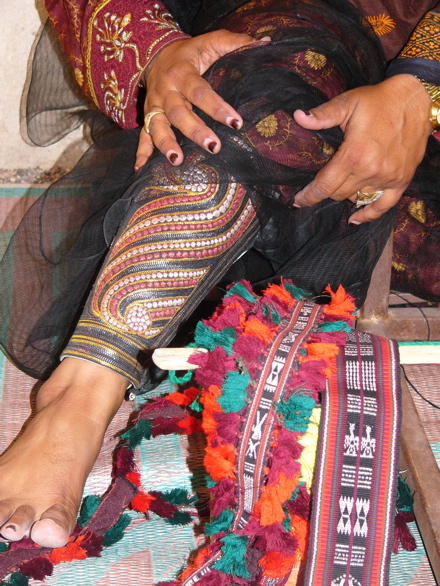
The women welcomed photos – this desert woman was the mother-in-law of the weaver. She was delightful.

I Never Knew There Was a Word for it
From this weeks A-Word-a-Day (see Blogroll)
This week’s theme: porcine words to mark the Chinese new year.
epigamic (ep-i-GAM-ik) adjective
Of or relating to a trait or behavior that attracts a mate.
Examples: In an animal, bright feathers or big antlers.
In a human, a sports car or a big bust.
[From Greek epigamos (marriageable), from epi- (upon) + gamos (marriage).]
-Anu Garg (garg wordsmith.org)
“The change from the young, intellectual, epigamic Jays, to the more
diplomatically sophisticated Hendersons also reflected a sharp change
in Washington lifestyle.”
Peter D. Carr; It Occurred to Me; Trafford Publishing; 2006.
Recent Comments
ExpatAlien on What Country am I Living … intlxpatr on Yellowstone: Old Faithful to C… Michelle on Yellowstone: Old Faithful to C… Cathy on No Grown-Ups in Charge intlxpatr on Waiting for Snow Wikipedia Donate Button

Amazina


Early Voting in Florida


 Here There and Everywhere