Is He a Keeper?
I found this today in the AOL Life coaching section. It is worth a read if you are experiencing any doubts whether to remain in a relationship or to leave.
1. Is he interested? When you first meet him, you should feel that he wants you. It may be conveyed by a look, a touch, a compliment or attention to detail. It should be backed up by his willingness to make a plan and move the relationship forward. Constant calling, e-mailing and text-messaging is not true contact since he cannot touch you, see you, adore you or get to know you.
2. Is he accomplished? Soon after meeting him, you will discover that he has appropriately achieved in at least one area of his life. If he went to college he now has a good job. If he inherited his parents’ business, he has learned how to successfully manage it. His efforts continue to generate new opportunities, new skills, new challenges or new possessions.
3. Is he a Stand-Up Guy? He says what he means and means what he says. And the words that he speaks are backed up by action that coincides. Even if he cannot give a guarantee, the relationship is always moving forward. Thus, you will never find yourself drunk-dialing at 2AM because you fear he is out with another girl.
4. Is he Into YOU? It will feel reciprocal and mutual. Do you feel that what he gives is as valuable and meaningful as what you offer? Is he as devoted to you as you are to him? Healthy relationships are based upon mutual give and take. If the only thing that you are getting out of this relationship is text messages, e-mails or occasional plans, you are not getting what you need.
5. Is He Consistent? He will have good friends and you will like who he is when he’s with them. You are confident that he is the man you know and love whether he’s with you or apart from you. When he’s out of sight, he does not turn into somebody else. Conversely, when you include him with your friends, you know who he will be — charming and engaging, enhancing instead of detracting.
6. Is He Understanding? He will like you for who you are. Even if you have a bad day or say something that he does not like, his adoration will remain steady and his view of you will remain the same. Beware of the guy whose perception changes whenever you deviate from his expectations. You should not feel that you must suppress your personality in order to hold onto his approval.
7. Is he Judgemental? He will never view you as unconditionally bad or make you feel terrible about yourself. Even in the midst of an argument, he will be able to see both the good and the bad in you. He will not stay mad at you once the argument is over. And he will move on instead of clinging to bad feelings or suspicions. He loves you and sees you as a good person, no matter what.
8. Is he Trusting? If he is right for you, he will tolerate the unexpected and the unknown because he trusts you. He will not pin you down or put a leash on you every moment of the day in order to feel secure. Instead, he will respect your boundaries and give you the privacy and independence you deserve. Conversely, he will not block you out or use distance to keep the upper hand.
9. Is He Willing to Talk? He has a learning curve. He is willing to learn from his mistakes and to modify his actions. For instance, if he begins a friendship with a flirtatious girl and you let him know that this is creating a problem, he will be concerned about your feelings and come up with a solution. When you discuss relationship obstacles, he works on them.
10. Is he Proactive? He will seek his own solutions. If he has a problem he will reach out to others for help, find resources, have a conversation, go to therapy, attend a 12-step program — anything that will move him closer to making the changes that he needs to make. Pride, laziness or stubbornness will not keep him from taking the steps that he needs to have a relationship with you.
11. Is He Controlling? He will not try to have power over you. He won’t leave you wondering where he is and what he is doing. Or leave you hanging just to prove a point. Even if he has more money, status and power, he will not make you feel that you would be nothing without him. He is willing to listen, meet your needs and include you in mutual decision making.
My comment: I agree with all of the above, especially Is he Controlling? Some women see a man who wants to know where she is at every moment and who she is with as charmingly caring . . .but these men can be monsters in a relationship, and the caring turns to suspicions and isolating the loved one.
Number nine is kind of funny – most men need some time to think about things before they are ready to talk, and as hard as it is, we need to give them some space before trying to have one of those “we need to talk” conversations! 😉
If you have brothers, they are good people to ask about Is He a StandUp Guy? A brother can often sense things about another guy that they can warn you about – and may hear things about him in the male grapevine that you will never hear. If your brother, or good male friend warn you off, LISTEN!
These guidelines are excerpted by AOL from ‘Deal Breakers: When to Work on a Relationship and When to Walk Away’ by Dr. Bethany Marshall. Copyright © 2007 by Dr. Bethany Marshall.
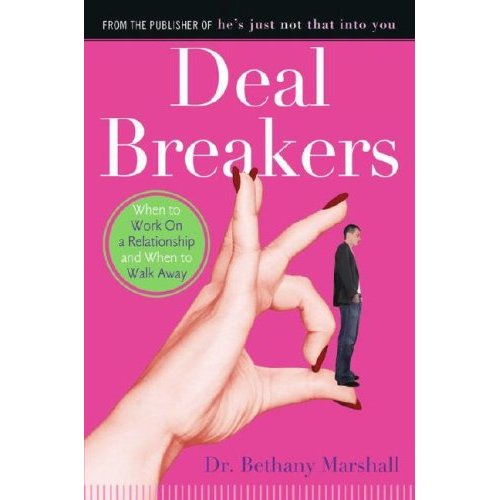
Available for $15.61 + shipping from Amazon.com.
U.S. Continues Proud Tradition Of Diversity On Front Lines
Funny in a very sad way . . .from The Onion. Note the Kuwait dateline – folks, this is satire, one of the bleakest forms of humor.
CAMP COYOTE, KUWAIT—With blacks and Hispanics comprising more than 60 percent of the Army’s ground forces in Iraq, the U.S. military is continuing its long, proud tradition of multiculturalism on the front lines of war. “Though racism and discrimination remain problems in society at large, in the military—especially in the lower ranks where you find the cannon fodder—a spirit of inclusiveness has prevailed for decades,” Gen. Jim White said Monday. “When it comes to having your head blown off by enemy fire, America is truly colorblind.”
A Male Theory
I read this op-ed piece yesterday in the Kuwait Times, and found it heartbreaking. And yet . . . I read hints of these stories in your blogs, too. I am printing this with the author’s permission. Tell me what you think – and make a copy and send it on to Fouad Al-Obaid, whose e-mail address is at the end of the article.
A Male Theory
By: Fouad Al-Obaid
In recent talks with many friends, I heard rather spine chilling revelations on how my fellow males (Kuwaiti that is) perceive their fellow Kuwaiti girl counterparts! Today I will try to rationally touch upon a matter that is highly irrational in nature. I will discuss the Kuwaiti male theory on women, dating and relating.
The average Abdallah I have noticed is a person filled with great ego, an individual who has a desire to control and manipulate others. In his desire to manipulate, often encourage by both elder relatives and society at large, seemingly has developed a tendency to project power over his friends, enemies, and concubines alike.
The desire of power is inherently something that most men aspire to. However if everyone in society was a leader then it would be hard to govern. Hence men in local custom, and to an extent projected in religion are deemed to be sovereigns of their possessions, which could be understood as leaders of their family and of the people that directly report to them. In this social order, a concubine is yet another person the average Abdallah can project his power upon.
A dilemma however constantly surrounds the average Abdallah for despite his desire to grow his “harem” he is conscious that perhaps other ill-natured people: people at the end of the day similar to him, are likewise on the look for yet another conquest.
Abdallah aware of the situation realizes that people out there could try to make any-given number of his female relatives likewise concubines in their respective “harems”. At this point if one question’s Abdallah’s rational of wanting other female yet at the same time if one transgressed his “sovereign kingdom” he would not hesitate to decapitate the fool who would have dared come close to any of his female relatives. Yet he like a lion in a jungle after a long day preying on Gulf Street and Marina, nevertheless is proud to share details of his hunt with fellow kings at their weekly roundtable or more correctly speaking “diwaniya”.
Moving to the next illogical notion that many have in recent times developed, if a girl accepts to even talk “innocently” on the phone it is seen as a big problem by many, yet most if not all people I have come to known do it on a rather consistent basis. Following the initial contact, a relationship develops usually, and more often than not, it would be an open one, unless off course prince-charming is eloquent in speech and threatening in nature. If the later is the case, then another highly illogical matter arises. Brining back the concept of power and control, guys I have noticed have this inherent nature to have the final word on most of everything. This is applied to “dating” for I have witnessed many irrational actions based on the later notion.
I recall once being with a friend cruising around when he called his “girlfriend” and asked here where she was. Upon knowing that she was out with her mother, he started to literally scream and shout at her, telling her how she disobeyed his command to not go out, and ordered her to return home immediately, he further instructed her to make an excuse in order for her mother not to doubt anything was wrong with her! I for one was shocked by the conversation and so I intriguingly asked the given friend about the rational of his action.
In all calm and serenity he replied that he had to teach her how to respect him. Furthermore he went on how it made him feel good, and that it was her fault not to ask permission from him to go out! What made the situation that much more unusual was the fact that they were “phone-dating”, needless to mention the irony of the situation!
On the one hand you have the guy ordering a girl he physically isn’t close to. On the other hand you have a girl who naively believed that the guy was overprotective and saw it as a gesture of love, or simply plainly put happened to be stupid, foolish enough to abide by the rules of a guy she barely knew; certainly a guy she will not end up having any meaningful relationship with.
For thoughts and comments fouad@kuwaittimes.net
So here is my question – would a man marry a woman who had a phone relationship with him? Is a phone relationship enough to ruin a woman’s reputation?
The Many Uses of Vinegar
When I wrote yesterday about being a mosquito magnet, Walzing Australiaquoted a recommendation about drinking vinegar every day to keep the mossies away. It tickled a brain cell, and I googled Vinegar and Health this morning and found pages and pages of information. Vinegar is amazing, even if it is HALF as good as all these articles claim.
From How Stuff Works: The Healing Power of Vinegar
Health Benefits of Vinegar Overview
Vinegar has been valued for its healing properties for thousands of years, and during that time, it has found its way from the apothecary’s shelf to the cook’s pot. Today, it can continue to play that dual role, taking the place of less healthful dietary ingredients and helping to regulate blood sugar levels while entertaining our taste buds with its tart flavor.
There seems hardly an ailment that vinegar has not been touted to cure at some point in history. And while science has yet to prove the effectiveness of many of these folk cures, scores of people still praise and value vinegar as a healthful and healing food. So let’s take a look at the history of vinegar, the healing claims made for it, and what science does and doesn’t have to say about those claims. Along the way, we’ll discover why vinegar deserves a place in every healthy kitchen.
The Healing History of Vinegar
For centuries, people from Asia and Europe have used different types of vinegar to add flavor and zest to their food. Read about how this tangy condiment was first discovered and then developed into a must-have for kitchens around the world. Learn the key ingredient that gives vingear its special sour taste and the basic chemical process used to create it.
Misconceptions About Vinegar’s Health Benefits
Although some people believe vinegar is a miracle cure, it can’t fix everything. Marketers have asserted that vinegar cures diseases such as diabetes, osteoperosis, cancer, and many other disorders. Some even claim that it halts the aging process. Obviously, these claims are exaggerated. Find out what’s being said, and learn the truth about the real nutritional value of vinegar.
How Vinegar Affects Digestion
Although vinegar can’t cure cancer, it can help improve your general health in many ways. Vinegar benefits the digestive system, improving the absorbtion and utilization of several essential nutrients. Learn about the different organ systems that are affected by simply adding vinegar to your diet, and find out how you can improve your health and the taste of your vegetables at the same time.
If you go to the above website, there are additional articles that elaborate on the uses of vinegar. There are so many websites about the positive powers of vinegar!
There are hundreds of articles about the health benefits of vinegar. One of the most comprehensive was at Vinegarbook: Vinegar tips for health where there are topics you can click on to get to the full article, such as Treat Dandruff with Vinegar, Itchy Skin Soothed with Vinegar, Urinary Tract Infections and Vinegar, Soothing Aching Feet with Vinegar and several articles about fighting off colds and sore throats with vinegar. Vinegar has some known anti-fungal properties, and also anti-microbial and antiseptic properties. Fascinating, all from a cheap little bottle of vinegar found on any grocery shelf.
Oops – Hershey Sponsored the Study?
If you will remember, one of my key themes is “Who sponsors the study?” I love studies, and I also love going behind the scenes to find out where the funding is coming from (ok, ok, grammar-nazis, from where the funding is coming.)
So, checking around for the credentials on my previous story about chocolate being good for your heart, I found the below, which I excerpted from The International Herald Tribune. Let the chocolate buyer beware!
During a talk with analysts in October, the Hershey chief executive, Richard Lenny, called the dark-chocolate category a “major growth platform.” He told of a new Yale study sponsored by Hershey’s, and yet to be put through peer reviews, that found that eating Hershey’s Extra Dark chocolate improved blood pressure and blood flow because of the candy’s level of natural flavanol antioxidants.
In the study, 45 people were fed 2.6 ounces, or two servings, of Extra Dark, which also contained 26 grams of fat.
“These results enable us to better communicate with consumers the positive aspects of antioxidants and dark chocolate,” Lenny said.
Such claims are troubling to Mars’s chief scientist, Harold Schmitz, a driving force behind the development of CocoaVia. He said competitors were potentially misleading consumers by talking about antioxidants in chocolate when it was the level of flavanols that really made a difference.
Bonnie Liebman, nutrition director at the Center for Science in the Public Interest, said that when it came to flavanols, “the marketing is getting ahead of the science.” She noted that two recent studies, including one from Harvard, had found no link between flavanols and any reduced risk of breast cancer or heart disease.
A spokeswoman for Hershey, Stephanie Moritz, denied that the company was exploiting the excitement over flavanols and said that a range of studies had linked dark chocolate to health benefits for the heart.
Bottom line: Sponsored by Hershey’s.
Chocolate: The Newest Truth
I heard this tidbit on today’s Good Morning America – Good news for chocolate lovers!
And Now Some Good News from the AAAS: Chocolate in Medicine, Tractors in Space
By John Tierney From the New York Times blogs.
I just spent five days at the Woodstock of science, the annual meeting of the American Association for the Advancement of Science. The theme at this year’s meeting, in San Francisco, was “sustainability” — not the most sprightly topic. But in between the lectures on environmental degradation, there were some cheerier discussions. A couple of my favorites:
The healing power of chocolate. The researchers weren’t quite ready to call chocolate a health food — they cruelly reminded the audience of its fatty content — but they did have good news about the flavanols found in cocoa (particularly some dark chocolates).
Norman Hollenberg of Harvard Medical School has documented that central American Indians who consume large quantities of cocoa have low rates of hypertension and of vascular dementia (caused by restriction of blood flow in the brain). At the AAAS meeting, he reported on a experiment showing people given flavanol-rich cocoa enjoyed a “a significant increase” in cerebral blood flow. “We hope,” he noted, “to explore the potential of flavanol-rich cocoa in preventing or ameliorating the vascular dementias.”
Another researcher, Ian Macdonald of the University of Nottingham, scanned the brains of women who’d been given flavanol-rich cocoa. He found it increased “cerebral blood flow to gray matter.” He and Dr. Hollenberg didn’t urge listeners to go out and gorge on chocolate, but they did raise the possibility of flavanols being used to help aging brains, perhaps being administered in the form of vitamins. Let’s hope these vitamins are the chewable variety.
Heart Attacks in Women
I got this in an e-mail this morning. It was particularly interesting to me that we should not be drinking cold water during or after a meal (we drink iced tea) because it solidifies fats and makes them more harmful. I remember there used to be a syndrome called Fondue Belly in Switzerland, because people would eat cheese fondue (lots of fat there) and drink chilled white wine, and then get terrible stomach aches. As it turns out, a stomach ache is the least of the problems . . .
Here is an article on Heart Attacks “for women”; written by one who had one.
I’ve meant to send this to my women friends to warn them that it’s true that women rarely have the same dramatic symptoms that men have when experiencing a heart attack…you know, the sudden stabbing pain in the chest, the cold sweat, grabbing the chest & dropping to the floor [that we see in the movies]’
Having had a completely unexpected heart attack about 10:30 p.m. with NO prior exertion, NO prior emotional trauma which one would suspect might’ve brought it on, it was this past April,’06, about 1-1/2 hours after I’d spent a pleasant 2 hrs. rehearsing with the Note-a-Belles.
I was sitting all snuggly & warm on a cold evening, with my purring cat in my lap, reading an interesting story my friend had sent me, and actually thinking, “Ah-Ah-Ah; this is the life …. all cozy and warm in my soft, cushy Lazy Boy with my feet propped up.” [Now pay attention to these symptoms]: A moment later, I felt that awful sensation of indigestion, like when you’ve been in a hurry and grabbed a bite of sandwich and washed it down with a dash of water; that hurried bite seems to feel like you’ve swallowed a golf ball going down the esophagus in slow motion, and it is really awful and so most uncomfortable. You realize you shouldn’t have gulped it down so fast; needed to chew it more thoroughly, and this time drink a glass of water to hasten its progress down to the stomach ….. which doesn’t do much good because your esophagus and throat muscles are in spasms, and it hurts like h _ _ _ to swallow.
This was my initial sensation — the only trouble was that I hadn’t taken a bite of anything since about 5:00 p.m. After that, it had seemed to subside, and the next sensation was like little squeezing motions that seemed to be racing up my SPINE(hind-sight: it was probably my aorta spasming), and gaining speed as they continued racing up and under my sternum (breast bone, where one presses rhythmically when administering CPR). This fascinating process continued on into my throat and branched out into both jaws!
* * * * * * * * * * * * * * * * * * * * * * *
AHA!! NOW I stopped feeling being puzzled about what was happening. We all have read and/or heard about**pain in the jaws being “one of the signals” of a heart attack happening, haven’t we??
I said aloud to myself and the cat, “Dear God, I think I’m having a heart attack!” I lowered the footrest, dumping the cat from my lap, and started to take a step but fell on the floor instead. I thought to myself, “If this is a heart attack, I shouldn’t be walking ……… into the next room where the phone is, or anywhere else ……. but, on the other hand, if I don’t, nobody will know that I need help. And if I wait any longer, I may not be able to get up in moment, or at all.”
I pulled myself up with the arms of the chair, walked slowly into the next room, and dialed the paramedics. [ I guess when one reaches them, your address automatically flashes on a screen], and the operator verified my address immediately and asked my symptoms.
I told her I thought I was having a heart attack due to the **pressure building under the sternum and radiating into my jaws. I didn’t feel hysterical or afraid; just stating the facts, She said she was sending the paramedics over immediately; asked if the front door was near to me, and if so, to unbolt the door and then lie down on the floor where they could see me when they came in. No, I didn’t take an aspirin, as I’m allergic to it, but I did take a [important] 100 mg “magnesium oxide” capsule … which bottle I keep handily in reach on the kitchen counter … which is a small detour on my way to the front door…with about a 3/4 glass of water to get it dissolving ASAP into my bloodstream.
[Important info] ~”Magnesium” relaxes blood vessels, and it dissolves to get them expanded to let blood get through the constriction of the vessels~. I then laid down on the floor as instructed and lost consciousness. I don’t remember the medics coming in…their examination…lifting me onto a gurney or getting me into their ambulance…or hearing the call they made to St. Jude ER on the way. But I did briefly awaken when we arrived, and saw that the Cardiologist was already there in his surgical blues and cap, helping the medics pull my stretcher out of the ambulance.
He was bending over me asking questions (probably something like “Have you taken any medications?”) but I couldn’t make my mind interpret what he was saying, or form an answer, and just nodded off again…not waking up until the Cardiologist and partner had already threaded the teeny angiogram balloon up my femoral artery into the aorta and into my heart where they installed two side-by-side stints to hold open my right coronary artery; and now was being taken into the CCU, and looking up at the three anxious faces of my children, Karen, Mark, and Wendy. Since I’d been a patient at St. Jude in 2002 for my TIA treatment, they had my emergency info in their system and had called my kids. I spent two days in CCU, and two in General Ward, and then was discharged.
I know it sounds like all my thinking and actions at home must have taken at least 20-30 minutes before calling the paramedics, but actually it took perhaps 4-5 minutes before the call, and both the fire station and St. Jude are only minutes away from my home, and my Cardiologist was all ready to go to the OR in his scrubs and was getting going on restarting my heart (which had stopped somewhere between my arrival and the procedure) and was installing the stints
Why have I written all of this to you with so much detail? Because I want all of you who are so important in my life to know what I learned firsthand, as a Certified Medical Back-Office Assistant in Internal Medicine Clinics, and as one who has lived through a heart attack due to:
*1. Being aware that something very different was happening in my body …not the usual men’s symptoms,… but inexplicable things happening (until my sternum and jaws got into the act ). It is said that many more women than men die of their first (and last!) MI because they “didn’t know they were having one, and commonly mistaking it as indigestion”… take some Maalox or other anti-“heartburn” preparation…and go to bed…hoping they’ll feel better in the morning when they wake up….which doesn’t happen.
My female friends, your symptoms might not be exactly like mine, so I advise you to: *call the paramedics if ANYTHING is unpleasantly happening that you’ve not felt before. It is better to have a “false-alarm” visitation than to risk your life guessing what it might be!
*2. Note that I said **”Call the Paramedics,” Ladies. *TIME IS OF THE ESSENCE! **Do NOT try to drive yourself to the ER. You’re a hazard to others on the road, and so is your panicked husband/friend who will be speeding and looking anxiously at what’s happening with you instead of the road, and so are your kids or friends a hazard as well. As sure as I sit here, they will get the attention of a cop who will pull you over for speeding — more wasted time.
*Do NOT call your doctor — he doesn’t know where you live and if it’s at night you won’t reach him anyway, and if it’s daytime, his assistants (or answering service) will tell you to call the Paramedics. [He doesn’t carry the equipment that you need to be saved in his car! ] The Paramedics have what you NEED — principally “OXYGEN” …… that you need ASAP. Your Dr. will be notified later.
*3. Don’t assume that it couldn’t be a heart attack because you have a normal cholesterol count — I did, and do, too. Research has discovered that a cholesterol elevated reading is rarely the cause of an MI (unless it’s unbelievably high, and/or accompanied by high blood pressure.) MI’s are usually caused by long-term stress and inflammation in the body, which dumps all sorts of deadly hormones into your system to sludge things up in there (and, of course, family genetics can be a factor). I qualify for the latter, and the years 2005 and 2006 have been the most stressful of my life since Jack died in 1981.
4. Read on for the e-mail I received today that prompted my above lecture to you:
SUBJECT: Drinking ice water at mealtime (which I’ve always done until now.)
Noting that neither Urban Legends nor Snopes has anything to say about this one, it could be true.
For those who like to drink cold water, this article is applicable to you. It is nice to have a cup of cold drink after a meal. However, the cold water will solidify the oily stuff that you have just consumed. It will slow down the digestion. Once this “sludge” reacts with the stomach’s hydrochloric acid, it will break down and be absorbed by the intestine faster than the solid food. It will line the intestine. Very soon, this will turn into fats and lead to cancer. It is best to drink hot soup or warm water after a meal. (Make it green tea–a great antioxidant!)
A serious note about heart attacks: Women should know that “not every” heart attack symptom is going to be the left arm hurting.
*Be aware of intense pain in the “jaw line”, or even pressure there …… and under the sternum, or “indigestion” symptoms, especially if you haven’t eaten in several hours.
**You may never have the first chest pain during the course of a heart attack, but heaviness /pressure under the sternum is common.
*Nausea and intense sweating are also common symptoms, but not necessarily in the women. 60% of people who have heart attacks while they are asleep do not wake up.
*Pain in the jaw can wake you from a sound sleep. Let’s be careful and be aware. The more we know, the better chance we could survive.
Djinns and Jewish Grandmothers
Two small nuggets from today’s Kuwait Times.
Black ‘Jinn’ Terrorizes Bayan Neighborhood
Kuwait: Terrified Bayan residents were unable to sleep last night from fears of being victims of an unknown creature, which attacked many of them.
Police said that they received several reports from residents of the creature, which they dubbed as ‘jinn.’ One complaintant said that the ‘jinn’ attacked his wife while she was praying; another said that his daughter had been attacked and strangled, while a third said that someone kept consistently knocking on his bedroom window but none claimed to have actually seen the ‘jinn.’
(Police captured a “ferocious black ape”.)
I love this second article:
Jewish Grandmothers Patrol Checkpoints in West Bank
Jerusalem: Hanna Barag remembers the day an Israeli soldier called her a Palestinian whore. She was 67 and she had just joined Machsomwatch, an all-women group set up to curb human rights abuses at military checkpoints in the West Bank. “It was at the Qalandia checkpoint between Jerusalem and Ramallah,” Barag said, “and the remark at first struck me speechless. But then I asked him two questions: ‘Do you really think a woman my age has a chance at that profession? And would you say what you said to me to YOUR grandmother?'”
The soldier said nothing, but was embarrassed, and when Barag, who was born in Israel and describes herself as a Zionist, returned for another “shift” of watchdog duty a week later, the soldier was there – and apologized.
That was in the early days of Machsomwatch, set up in 2001 by three Israeli women who were alarmed by a spate of reports of beatings and abuse of Palestinians at the hands of Israeli soldiers manning checkpoints. . .
You can read the rest of the story here.

Little old ladies in tennis shoes, volunteering to guard the guards one night a week. . . changing their world.
Peeking Inside
You are a blessing in my life.
You think you are just blogging, but for me, you allow me to get a little bit beneath the surface of what your lives are like here in Kuwait.
I have to assume that most of you, like me, protect a lot of realities in your life, and that I am just getting the surface, just getting what you feel comfortable sharing with me.
And yet . . .no matter how superficial the “peek,” it is better than nothing.
Over time, we build a body of work. No matter how discreet we are ( Little Diamond I almost wrote “discrete,” and thinking of your pet peeve, checked it, thank God!) we reveal how we think, and what is important to us.
I love having some Kuwaiti friends. You teach me things I could never learn in a million years, just looking from the outside.
True story: I am having breakfast with my Kuwait friend at the Al-Kout Mall and she shivers. This friend is very special to me; it’s as if a flame burns inside her, keeping her pure and true from the inside out.
“I feel so out of place here!” she says.
I am truly bewildered.
“You are Kuwaiti! This is a Kuwaiti Mall!” I cry. “What is it that makes you so uncomfortable?”
“It’s like another world,” she says. “I’m not dressed conservatively enough.”
She is dressed in jeans – not tight. A t-shirt – not tight. And has a long sleeved shirt to go over it tied around her shoulders. She is entirely modest.
“I don’t see it,” I say. “Please, let me see through your eyes. What are you seeing, how is it different, why are you uncomfortable?”
“You’ve been to Marina Mall,” she responded. “You can see the difference?”
Of course. But Marina Mall . . . it is kind of a la la land to me, sort of bizarre. It almost looks Western, but there are things that are just not quite right . . .
“Yes,” she said. “You’ve got it.”
I still don’t know what I’ve got. So she starts explaining . . .”Look, you can see how the thobes are cut differently down here, tighter around the chest.”
(Uh . . . no, I can’t see!)
“. . . and the cuffs, the way they button. And the shoes are different, less . . . . ”
all of a sudden, I am thinking of my friend who taught Arabic, and the hours she labored, trying to get me to hear the difference between the light “t” and the hard “t”, I am trying and trying, but I don’t get it and then one day – I do!
I thank God for you, my friends, letting me see through your eyes, helping me understand, giving me new ways of seeing the world.
Risk Taking Men Found Less Attractive
Risk-taking men ‘not attractive’ from BBC Health News.
Women are not attracted to dare-devil men, US researchers believe.
Men thought the opposite sex would be attracted by risky stunts such as bungee jumping and fast driving, a study of 48 men and 52 women found.
But in contrast, women said it was a turn-off, claiming they preferred more cautious people for partners.
However, the team from the University of Maine in Orono said those who took risks for the thrill were likely to be respected by fellow men.
Lead researcher Dr William Farthing said: “Men thought women would be impressed by pointless gambles, but women in fact preferred cautious men.”
However, Dr Farthing said women were attracted to men with a high-status, so if the risk-taking meant a man was respected by his friends they could then become attractive.
During the research, reported in New Scientist magazine, the young people were all given a series of scenarios to choose from, including saving someone’s life and fast driving.
The participants were asked to decide which they found more attractive.
The majority of women choose an altruistic action, rather than a thrill-seeking scenario.
Dr David Lewis, a member of the British Psychological Society, said in many ways the findings were not surprising.
“Previous studies have show that women are attracted to someone who acts in an altruistic way. Saving someone’s life shows a degree of empathy and sensitivity, and this is an attractive trait in men.
“On the other hand men see risk-taking as a particularly macho characteristic.
“Social norms are important and our society attaches weight to men expressing their macho qualities.
“But I think what you would find is that as men get older, they become less prepared to take risks.
“When you decide to do something you attach a cost-benefit to it, and when men are older the priorities they place on things change.”
Recent Comments
Kitchen on Isiais: Winding Down intlxpatr on Shampoo Ginger tigerbutterya0c5ff1d… on Shampoo Ginger intlxpatr on British Soldier Kidnapped, Esc… John on British Soldier Kidnapped, Esc… Wikipedia Donate Button

Amazina


Early Voting in Florida


