I am not Catholic, but what I love about this humble Pope shines through in these photos – the Pope, the revered leader of the Christian world, is standing, while the family sits in his presence. His loving actions speak loudly. You can see all the photos on AOL News by clicking here.
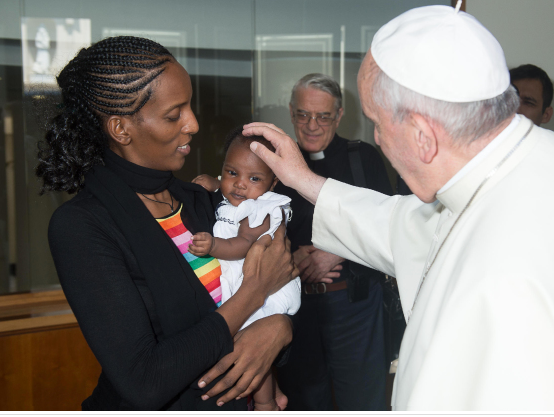
ROME (AP) – Pope Francis met privately Thursday with a Sudanese woman who refused to recant her Christian faith in the face of a death sentence, blessing the woman as she cradled her infant born just weeks ago in prison.
The Vatican characterized the visit with Meriam Ibrahim, 27, her husband and their two small children as “very affectionate.”
The 30-minute encounter took place just hours after the family landed at Rome’s Ciampino airport, accompanied by an Italian diplomat who helped negotiate her release, and welcomed by Italy’s premier, who hailed it as a “day of celebration.”
Vatican spokesman the Rev. Federico Lombardi said the pope “thanked her for her faith and courage, and she thanked him for his prayer and solidarity” during the half-hour meeting Thursday. Francis frequently calls attention to the suffering of those persecuted for their religious beliefs.
Lombardi said the presence of “their wonderful small children” added to the affectionate tone of the meeting. Ibrahim was presented with a rosary, a gift from the pope.
Ibrahim held her sleeping infant as she stepped off the plane from Sudan, which had blocked her from leaving the country even after the country’s highest court overturned her death sentence in June. An Italian diplomat carried her 18-month-old son and they were followed by her husband, Daniel Wani, who is a citizen of the United States and South Sudan.
Ibrahim and her family are expected to spend a few days in Rome before heading to the United States.
Ibrahim, whose father was Muslim but whose mother was an Orthodox Christian from Ethiopia, was sentenced to death over charges of apostasy. She married her husband, a Christian, in a church ceremony in 2011. As in many Muslim nations, Muslim women in Sudan are prohibited from marrying non-Muslims, though Muslim men can marry outside their faith.
The sentence was condemned by the United States, the United Nations and Amnesty International, among others, and both the United States and Italy – a strong death penalty opponent with long ties to the Horn of Africa region – worked to win her release.
Sudan’s high court threw out her death sentence in June, but she was then blocked from leaving the country by authorities who questioned the validity of her travel documents.
Lapo Pistelli, an Italian diplomat who accompanied the family from Sudan, said Italy was able to leverage its ties within the region. “We had the patience to speak to everyone in a friendly way. This paid off in the end,” he said.
I love this story. When you start reading the bible, you come across the most human of our race, you have the dramas of sibling rivalry, disobedience, and murder, the heartbreak of childlessness, slavery, and terrible loss, you have marriages and wars . . . the full spectrum of human behavior is there. And you have Rehab, a prostitute, who has heard of this God, but is not a Hebrew. She will help them in return for safety for her family. All who shelter in her small apartment, protected by a red ribbon (or rope), live.
In a later chapter of the bible, we learn how Rehab figures in the family line of Jesus.
Joshua 2:1-14
2Then Joshua son of Nun sent two men secretly from Shittim as spies, saying, ‘Go, view the land, especially Jericho.’ So they went, and entered the house of a prostitute whose name was Rahab, and spent the night there. 2The king of Jericho was told, ‘Some Israelites have come here tonight to search out the land.’ 3Then the king of Jericho sent orders to Rahab, ‘Bring out the men who have come to you, who entered your house, for they have come only to search out the whole land.’
4But the woman took the two men and hid them. Then she said, ‘True, the men came to me, but I did not know where they came from. 5And when it was time to close the gate at dark, the men went out. Where the men went I do not know. Pursue them quickly, for you can overtake them.’ 6She had, however, brought them up to the roof and hidden them with the stalks of flax that she had laid out on the roof. 7So the men pursued them on the way to the Jordan as far as the fords. As soon as the pursuers had gone out, the gate was shut.
8 Before they went to sleep, she came up to them on the roof 9and said to the men: ‘I know that the Lord has given you the land, and that dread of you has fallen on us, and that all the inhabitants of the land melt in fear before you. 10For we have heard how the Lord dried up the water of the Red Sea* before you when you came out of Egypt, and what you did to the two kings of the Amorites that were beyond the Jordan, to Sihon and Og, whom you utterly destroyed. 11As soon as we heard it, our hearts failed, and there was no courage left in any of us because of you. The Lord your God is indeed God in heaven above and on earth below. 12Now then, since I have dealt kindly with you, swear to me by the Lord that you in turn will deal kindly with my family. Give me a sign of good faith 13that you will spare my father and mother, my brothers and sisters, and all who belong to them, and deliver our lives from death.’ 14The men said to her, ‘Our life for yours! If you do not tell this business of ours, then we will deal kindly and faithfully with you when the Lord gives us the land.’
No matter who we are, no matter what we have done, the love of God follows us everywhere, with the free gift of salvation, if only we see it, as Rehab did, and ask for it. God is great!
Myself Majed M Garoup, senior legal Executive. We need to bring a serious concern infront of you regarding an article which you have posted on your blog https://intlxpatr.wordpress.com/. The article which you have posted contains defamatory content about our country. It has some news which is not relevant and also having some wrong statements about the country which is purely illegal. Publishing this kind of half true matters through online is a punishable offense. Before posting any article about a particular country you need to verify those things to us. You need to ask the story from both the parties while publishing such kind of articles. But we haven’t recieved any such calls or mails from your side. Posting such news without proper confirmation from the relevant party is a serious crime.And you are a blogger and don’t have any rights to publish this kind of news on your blog. So this page should get remove imediately from your blog otherwise legal action will be taken against your wordpress blog for posting defamatory content and half true matters on your blog which is spoiling the reputation of our country.
The post is a reprint of an article on labor abuse in Qatar from a Lebanese paper. I guess he’s feeling a little touchy; Qatar is getting a lot of unwelcome publicity lately for labor abuses. How is that for a country whose labor laws give everyone except household help a day off?
Today the church celebrates the Birth of John the Baptist, whom the Moslems call Yahyah, and who has a much-visited tomb in the Ummayyad Mosque in Damascus, Syria. The church also prays today for the diocese of Lokoja, Nigeria, which is just south of Abuja, from where 300 girls were kidnapped by Boko Haram, people who believe girls should not be educated. Most of those girls are still missing. Three hundred girls . . . Lokoja . . . John the Baptist . . . Syria . . . so much need for prayer. . . The reading is from Forward Day by Day.
TUESDAY, June 24 The Nativity of Saint John the Baptist
Isaiah 40:11. He will feed his flock like a shepherd; he will gather the lambs in his arms, and carry them in his bosom, and gently lead the mother sheep.
So much of our scripture is violent and distressing, yet there are many passages like this, full of comfort and assurance that the trouble is over. Others might look at it and say, “Your God is violent and terrible, and the reassurances are flat and silly.”
Maybe that’s true. I tend to look at them more as descriptions of how we experience our lives rather than declarations of God’s nature. Our lives are difficult and often catastrophic—earthquakes, malaria, civil wars, and dangerous militias, to name only a few issues—and our lack of control means we blame God for it. But I don’t think God acts that way. And in the face of catastrophe, we say meaningless things: “Everything happens for a reason.” That’s no comfort at all.
Isaiah speaks peace to his people, trying his hardest to take their pain seriously and to offer the truth that everything will be okay in the end. When it’s not okay, it’s not yet the end. That “okayness” might be justice here or it might be eternal life, but this present trouble is not the end of the story.
PRAY for the Diocese of Doko (Lokoja, Nigeria)
Today the Church remembers The Nativity of Saint John the Baptist.
Ps 85 or 85:7-13; Isaiah 40:1-11; Acts 13:14b-26; Luke 1:57-80
This was fascinating to me because most of the research on aging has been done on males. Most medicinal dosages are based on male tests, and males respond differently to medications than females. Here are some results from a study done on only females. From AOL EveryDay Health:
For most of medical history, scientific research had largely been conducted on white men, which makes it pretty difficult to know how to treat conditions that affect other populations, particularly women. Take menopause: For years, doctors prescribed long-term use of hormones estrogen and progestin to help women manage symptoms during and after menopause because it helped women feel better. But in 1991, researchers wanted a definitive answer as to whether hormones used to ease menopause’s symptoms were helping women more than they were hurting them. So, the National Institutes of Health launched the largest study ever focused exclusively on women to answer that question.
Dubbed the Women’s Health Initiative (WHI), the research project recruited 68,132 postmenopausal women to participate. They were divided into groups, some taking just estrogen, some taking estrogen and progestin, and some taking placebos. After over a decade of observation, the researchers stopped the trials early, in 2002 and 2004, because it was so clear that hormones posed serious health risks to the women. However, researchers have continued to follow up with these women in the years since, and have also tested other health interventions on the group, including low-fat diets and taking vitamin D and calcium. In 1998, an observational component of the WHI launched, with another 93,676 participants, to study even more aspects of women’s health. Much of the data collected over the years is now accessible to other researchers, too.
This has created a glut of women-specific health information that has paid off in big ways. In fact, the findings from the WHI have prompted a net economic return of $37.1 billion dollars, or $140 for each dollar that was spent on the trial itself, according to a new paper published in the Annals of Internal Medicine. That’s because the results have led to better treatment and care for millions of women, decreasing healthcare spending and increasing quality of life.
Here are some of the most important WHI findings:
1. You probably shouldn’t take hormones for longer than you have to. Long-term use of estrogen and progestin increases the risk of breast cancer, heart attack, stroke, and blood clots, though it decreased the risk of hip fractures and colon cancer in the main WHI trial. While these results have caused doctors to largely stop prescribing long-term hormone replacement, individuals are encouraged to make a personal decision based on their own risk factors. For example, if a woman has a very low family history of breast cancer and cardiovascular disease, but a high risk of colon cancer and osteoporosis, she may choose to take the hormones, which are thought to be safe when prescribed for just a short time around menopause, to manage symptoms. They may also extend the life expectancy for women who have had hysterectomies, the data revealed, so be sure to talk to your doctor about your specific needs.
2. Low-fat diets are good, but not enough to reduce your risk of some cancers or cardiovascular disease. The researchers asked some of the participants to eat a low-fat diet, and then compared how this affected their risk of various diseases. They found that a low-fat diet alone was not enough to significantly impact women’s risk of cardiovascular disease, breast cancer, orcolorectal cancer, according to the results published in JAMA. The researchers concluded that more dramatic lifestyle changes, including increased exercise, might be necessary to affect risk of developing these diseases.
3. Taking vitamin D and calcium may not be worth it. Some of the women in the study were given calcium and vitamin D supplements, while others were not. The results showed that the supplements did increase the bone density in the hip, but they didn’t significantly decrease the number of hip fractures the women experienced. Nor did taking the supplements lower the risk of colorectal cancer, according to the paper published in the New England Journal of Medicine. They did, however, increase the risk of kidney stones.
5. If you’re at high risk for melanoma, aspirin might help. Researchers analyzed the data from the WHI observational study, and found that women who took aspirin regularly had a 20 percent lower risk of melanoma than women who did not. The correlation was strong — the longer the women took the drug, the lower their risk. Aspirin comes with its own benefits (preventing subsequent heart problems) and harms (increased risk of bleeding), so talk to your doctor before adding it to your routine.
TEHRAN: The arrest of six Iranian youths for dancing to US singer Pharrell Williams’ hit “Happy” in a video that went viral highlights the rift between conservatives and youths fascinated by the West. Recorded on a smartphone and uploaded multiple times on YouTube, the clip shows three girls dancing and singing along to the song in a room, on rooftops and in secluded alleys with three young men. For the youths, the homemade video now watched one million times was merely an “excuse to be happy”, but for the Iranian authorities it was “vulgar” breach of the Islamic republic’s values. Originally posted online in April, the clip gradually spread online before it led to the arrest of the dancers and their director on Tuesday for having “hurt” the country’s strict moral codes, according to Tehran police chief Hossein Sajedinia.
The youths appeared on state television repenting for appearing in the clip, after the girls failed to properly observe hijab, a series of rules that oblige women in Iran to cover their hair and much of their body when outside.
Their arrest sparked international fury and criticism in the media and online, with many Iranians expressing shock and some observers questioning whether it was a “crime to be happy in Iran”. Supporting the young Iranians, Williams himself chimed in and hit out at their treatment, saying on Twitter and Facebook: “It’s beyond sad these kids were arrested for trying to spread happiness.” Reports emerged Wednesday night that the dancers were released on bail, with one of the arrested girls, Tehranbased fashion photographer Reihane Taravati, saying on Instagram: “Hi I’m back.” The arrests came after President Hassan Rouhani-a selfdeclared moderate who claims to be for more social freedomsreiterated in a weekend speech his calls for a relaxation of Internet censorship. Rouhani’s statements have irked the conservatives, who have long imposed limitations on the Internet, blocking millions of websites particularly social media platforms, including Facebook and Twitter, as well as YouTube. — AFP
She is also charged with adultery, for marrying a Christian man and (gasp) having sex with him. Now pregnant with her second child, Mariam claims she has never been a Muslim, was raised Christian, but the judge is applying new and strict Sharia laws.
International outrage grows for Sudanese woman sentenced to death for apostasy
Published May 16, 2014FoxNews.com
Meriam Ibrahim and Daniel Wani married in a formal church ceremony in 2011. The couple has an 18-month-old son, Martin, who is with Meriam in jail.
International outrage is mounting over the death sentence a Sudanese judge ordered for the pregnant wife of an American citizen — all because she refuses to renounce her Christian faith.
Meriam Ibrahim, 26, was sentenced Thursday after being convicted of apostasy. The court in Khartoum ruled that Ibrahim must give birth and nurse her baby before being executed, but must receive 100 lashes immediately after having her baby for adultery — for having relations with her Christian husband. Ibrahim, a physician and the daughter of a Christian mother and a Muslim father who abandoned the family as a child, could have spared herself death by hanging simply by renouncing her faith.
“We gave you three days to recant but you insist on not returning to Islam,” Judge Abbas Khalifa told Ibrahim, according to AFP. “I sentence you to be hanged to death.”
But Ibrahim held firm to her beliefs.
“I was never a Muslim,” she answered. “I was raised a Christian from the start.”
Ibrahim was raised in the Christian faith by her mother, an Orthodox Christian from Ethiopia. She is married to Daniel Wani, a Christian from southern Sudan who has U.S. citizenship, according to sources who spoke on condition of anonymity.
“I was never a Muslim. I was raised a Christian from the start.”
– Meriam Ibrahim
The cruel sentence drew condemnation from Amnesty International, the U.S. State Department and U.S. lawmakers.
“The refusal of the government of Sudan to allow religious freedom was one of the reasons for Sudan’s long civil war,” Rep. Chris Smith, R-N.J., chairman of the House congressional panel that oversees U.S. policy in Africa, said in a statement. “The U.S. and the rest of the international community must demand Sudan reverse this sentence immediately.”
Amnesty International called the sentence a “flagrant breach” of international human rights law and the U.S. State Department said it was “deeply disturbed” by the ruling, which will be appealed.
Khalifa refused to hear key testimony and ignored Sudan’s constitutional provisions on freedom of worship and equality among citizens, according to Ibrahim’s attorney Al-Shareef Ali al-Shareef Mohammed.
“The judge has exceeded his mandate when he ruled that Meriam’s marriage was void because her husband was out of her faith,” Mohammed told The Associated Press. “He was thinking more of Islamic Shariah laws than of the country’s laws and its constitution.”
Ibrahim and Wani married in a formal ceremony in 2011 and have an 18-month-old son, Martin, who is with her in jail. The couple operate several businesses, including a farm, south of Khartoum, the country’s capital. Wani fled to the United States as a child to escape the civil war in southern Sudan, but later returned. He is not permitted to have custody of the little boy, because the boy is considered Muslim and cannot be raised by a Christian man.
Sudan’s penal code criminalizes the conversion of Muslims into other religions, which is punishable by death. Muslim women in Sudan are further prohibited from marrying non-Muslims, although Muslim men are permitted to marry outside their faith. Children, by law, must follow their father’s religion.
Islamic Shariah laws were introduced in Sudan in the early 1980s under the rule of autocrat Jaafar Nimeiri, whose decision led to the resumption of an insurgency in the mostly animist and Christian south of Sudan. An earlier round of civil war lasted 17 years, ending in 1972. In 2011, the south seceded to become the world’s newest nation, South Sudan.
Sudanese President Omar Bashir, an Islamist who seized power during a 1989 military coup, said his county will implement Islam more strictly now that the non-Muslim south is gone. A number of Sudanese have been convicted of apostasy in recent years, but they have all escaped execution by recanting their faith. Religious thinker and politican Mahmoud Mohammed Taha — a vocal critic of Nimeiri — was sentenced to death after his conviction of apostasy and was executed at the age of 76 in 1985.
Ibrahim’s case first came to the attention of authorities in August, when members of her father’s family complained that she was born a Muslim but married a Christian man. They claimed her birth name was “Afdal” before she changed it to Meriam. The document produced by relatives to indicate she was given a Muslim name at birth was a fake, Mohammed said.
Ibrahim refused to answer the judge when he referred to her as “Afdal” during Thursday’s hearing.
Ibrahim was initially charged with having illegitimate sex last year, but she remained free pending trial. She was later charged with apostasy and jailed in February after she declared in court that Christianity was the only religion she knew.
The US-based Center for Inquiry is demanding that all charges against Ibrahim be dropped, saying the death sentence is a clear violation of the International Covenant on Civil and Political Rights, which forbids persecution or coercion of religious beliefs and the right to marry.
“Religious belief must never be coerced and free expression must never be punished, through threat of imprisonment, violence, or any other means,” the group wrote in a letter to Sudan’s UN ambassador, H.E. Hassan Hamid Hassan. “This cannot go unanswered, and the world will not stand for it.”
Fox News’ Joshua Rhett Miller and The Associated Press contributed to this report.
Sudanese woman may face death for choosing Christianity over Islam
KHARTOUM: A Sudanese court gave a 27- year-old woman until today to abandon her newly adopted Christian faith and return to Islam or face a death sentence, judicial sources said on Monday. Mariam Yahya Ibrahim was charged with apostasy as well as adultery for marrying a Christian man, something prohibited for Muslim women to do and which makes the marriage void. The final ruling will be announced today.
Ibrahim’s case was the first of its kind to be heard in Sudan. Young Sudanese university students have mounted a series of protests near Khartoum University in recent weeks asking for an end to human rights abuses, more freedoms and better social and economic conditions.
The authorities decided on Sunday to close the university indefinitely. Western embassies and Sudanese activists sharply condemned the accusations and called on the Sudanese Islamist-led government to respect freedom of faith. “The details of this case expose the regime’s blatant interference in the personal life of Sudanese citizens,” Sudan Change Now Movement, a youth group, said in a statement.
President Omar Hassan Al-Bashir’s government is facing a huge economic and political challenge after the 2011 secession of South Sudan, which was Sudan’s main source of oil. A decision by Bashir last year to cut subsidies and impose austerity measures prompted violent protests in which dozens were killed and hundreds were injured. — Reuters
This is what I love about New Yorker magazine: they print stories no one prints, they follow stories that need following. They lead, and they do their job, alerting us to issues that matter. My heart goes out to the families, Christian and Muslim, of these girls who were abducted because they were being educated. Boko Haram believes educating women goes against Islam. Someone should read them a Quran.
“I thought it was the end of my life,” Deborah Sanya told me by phone on Monday from Chibok, a tiny town of farmers in northeastern Nigeria. “There were many, many of them.” Boko Haram, an Islamist terrorist group, kidnapped Sanya and at least two hundred of her classmates from a girls’ secondary school in Chibok more than two weeks ago. Sanya, along with two friends, escaped. So did forty others. The rest have vanished, and their families have not heard any word of them since.
Sanya is eighteen years old and was taking her final exams before graduation. Many of the schools in towns around Chibok, in the state of Borno, had been shuttered. Boko Haram attacks at other schools—like a recent massacre of fifty-nine schoolboys in neighboring Yobe state—had prompted the mass closure. But local education officials decided to briefly reopen the Chibok school for exams. On the night of the abduction, militants showed up at the boarding school dressed in Nigerian military uniforms. They told the girls that they were there to take them to safety. “They said, ‘Don’t worry. Nothing will happen to you,’ ” Sanya told me. The men took food and other supplies from the school and then set the building on fire. They herded the girls into trucks and onto motorcycles. At first, the girls, while alarmed and nervous, believed that they were in safe hands. When the men started shooting their guns into the air and shouting “Allahu Akbar,” Sanya told me, she realized that the men were not who they said they were. She started begging God for help; she watched several girls jump out of the truck that they were in.
It was noon when her group reached the terrorists’ camp. She had been taken not far from Chibok, a couple of remote villages away in the bush. The militants forced her classmates to cook; Sanya couldn’t eat. Two hours later, she pulled two friends close and told them that they should run. One of them hesitated, and said that they should wait to escape at night. Sanya insisted, and they fled behind some trees. The guards spotted them and called out for them to return, but the girls kept running. They reached a village late at night, slept at a friendly stranger’s home, and, the next day, called their families.
Sanya could not tell me more after that. She is not well. Her cousins and her close friends are still missing, and she is trying to understand how she is alive and back home. All she can do now, she said, is pray and fast, then pray and fast again.
The day after the abduction, the Nigerian military claimed that it had rescued nearly all of the girls. A day later, the military retracted its claim; it had not actually rescued any of the girls. And the number that the government said was missing, just over a hundred, was less than half the number that parents and school officials counted: according to their tally, two hundred and thirty-four girls were taken.
In the wake of the military’s failure, parents banded together and raised money to send several of their number into the forest to search for the girls. The group came across villagers who persuaded the parents to turn back. They told the parents that they had seen the girls nearby, but the insurgents were too well armed. Many of the parents had just bows and arrows.
***
The circumstances of the kidnapping, and the military’s deception, especially, have exposed a deeply troubling aspect of Nigeria’s leadership: when it comes to Boko Haram, the government cannot be trusted. Children have been killed, along with their families, in numerous Boko Haram bombings and massacres over the past five years. (More than fifteen hundred people have been killed so far this year.) State schools and remote villages in the north have borne the brunt of Boko Haram’s violence this year. The group is believed to be at least partly waging a campaign against secular values. The kidnapped girls were both Christian and Muslim; their only offense, it seems, was attending school.
Last June, I visited Maiduguri, the capital of Borno state and the birthplace of Boko Haram, to report on the insurgency and the Nigerian government’s counteroffensive, a security operation that placed three northeastern states, including Borno and Yobe, under a state of emergency as troops launched attacks on terrorist hideouts and camps. The military cut phone lines and Internet access, and, while residents were glad for the intervention, there was a sense of living in the dark. Gunshots, a bomb blast: was it Boko Haram or a military attack? Were the hundreds of men disappeared by the military actually terrorists—even the young boys? And was the government, as it claimed, really winning the war?
The military has restored phone lines in Borno. But the sole airline that flew to Maiduguri cancelled the route at the end of last year. The road to Chibok is so hazardous that Borno’s governor visited the town with a heavy military escort. Much of the northeast is now physically isolated. What is happening there that we cannot see?
Nigerians in the rest of the country had, until recently, been able to ignore the deaths. The general mood has been one of weary apathy—from a government waging a heavy-handed crackdown on northerners to civilians far removed from the chaos. That mood may finally change.
***
Sanya’s father, a primary-school teacher named Ishaya Sanya, is struggling with conflicting emotions: gratitude that his daughter has returned to him; guilt that the daughters of his siblings, friends, and neighbors are still somewhere in the bush; and an angry frustration that there seemed to be no effort to rescue the girls.
“We don’t know where they are up until now, and we have not heard anything from the government,” he told me. “Every house in Chibok has been affected by the kidnapping.” The only information that the families had been able to gather about the kidnapped girls, he went on, was from the girls who had escaped.
He remembers the exact time that Deborah appeared in front of him after her escape—4:30P.M.—and how he felt: “very happy.” But his despair soon returned. “Our area has been affected very seriously,” he told me. Parents had fallen physically ill, and some were “going mad.”
The military’s current plans are unclear; the Chibok parents hope that it is acting swiftly and cautiously. There is worry, too, that a rescue operation could result in the deaths of many of the girls; this happened during a previous attempted rescue, of two Western engineers kidnapped by Boko Haram. Last week, a military spokesman, Brigadier-General Chris Olukolade, said only that the search for the girls had “intensified.”
In the meantime, as in so many other ways in Nigeria, each community has to fend for itself. For a while after the abduction, girls trickled back into town—some rolled off trucks, some snuck away while fetching water. That trickle has stopped. “Nobody rescued them,” a government official in Chibok said of the girls who made it back. “I want you to stress this point. Nobody rescued them. They escaped on their accord. This is painful.”
A pastor in Chibok whose daughter is missing told me that he set out with friends on the morning after the abduction to find the girls. “I was forced to come home empty-handed,” he told me by phone. “I just don’t know what the federal government is doing about it. And there is no security here that will defend us. You have to do what you can do to escape for your life.”
I asked the pastor about rumors that Boko Haram has taken the girls outside of Nigeria’s borders, into Cameroon and Chad, and forcibly married them. He paused, and then said, “How will I be happy? How will I be happy?”
Four students walk in Chibok following their escape from Boko Haram. Photograph by Haruna Umar/AP.



 “I thought it was the end of my life,” Deborah Sanya told me by phone on Monday from Chibok, a tiny town of farmers in northeastern Nigeria. “There were many, many of them.” Boko Haram, an Islamist terrorist group, kidnapped Sanya and at least two hundred of her classmates from a girls’ secondary school in Chibok more than two weeks ago. Sanya, along with two friends, escaped. So did forty others. The rest have vanished, and their families have not heard any word of them since.


 Here There and Everywhere