Saudi Women Working in Shops
This weeks New Yorker, with a delightful cartoon of Pope Francis on the cover, making snow angels (Isn’t it great to see a powerful man having so much fun doing his job?)

. . . there is also a truly wonderful article, sympathetic and well written, about Saudi women being allowed to work in select shops. New Yorker only allows me to print an few lines from the article, but I loved how it captured the delight these women take in having a little bit of life outside the home to call their own. It also covers the dilemma of dealing with the religious police, the Muttawa, who are in a fit because now women will be in contact with MEN and who knows what might happen?
I had not read anything in the papers – our papers rarely cover smaller details of life in the Middle East. We were there when men were in every shop, selling underwear, selling abayas, and not a woman to be seen. This is a major change, done so so quietly, and women who need more space to breathe are finding a little bit of that space.
Not every woman wants to work outside the home, but many are bored and restless. When they talk about working, they talk about the friendships they form with other women, the pride they take in having a purpose to their daily life, and the increased respect with which they are treated by family members – all good things. The article is sensitively and sympathetically written.
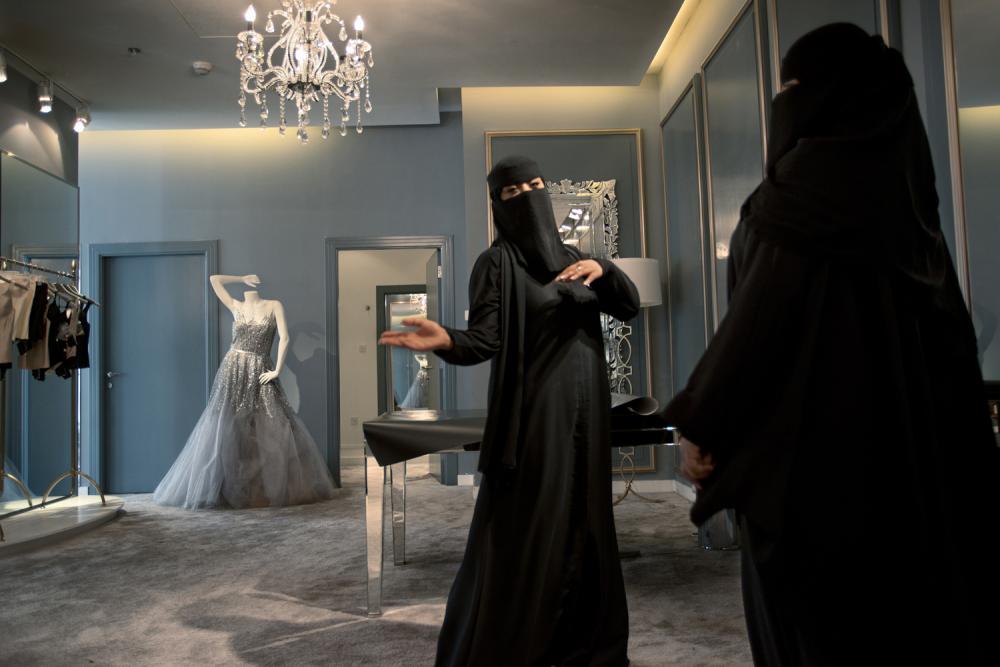
LETTER FROM RIYADH SHOPGIRLS: The art of selling lingerie.
BY KATHERINE ZOEPF
DECEMBER 23, 2013
A women’s revolution has begun in Saudi Arabia, although it may not be immediately evident. This fall, only a few dozen women got behind the wheel to demand the right to drive. Every female Saudi still has a male guardian—usually a father or husband—and few openly question the need for one. Adult women must have their guardians’ permission to study, to travel, and to marry, which effectively renders them legal minors. It took a decree from King Abdullah to put tens of thousands of them into the workforce. For the first time, they are interacting daily with men who are not family members, as cashiers in supermarkets and as salesclerks selling abayas and cosmetics and underwear.
One afternoon in late October, at the Sahara Mall, in central Riyadh, the Asr prayer was just ending. The lights were still dimmed in the mall’s marble corridor, but the Nayomi lingerie store had been unlocked. The rattle of steel and aluminum could be heard as security grilles were raised over nearby storefronts. Twenty-seven-year-old Nermin adjusted a box of perfume on a tiered display near the entrance, then turned to greet six saleswomen as they filed out of a storeroom, preparing to resume their shift. Nermin started working at Nayomi eighteen months ago, as a salesclerk herself. She was warm and engaging with customers, and was recently promoted to a position in which she oversees hiring and staff training for Nayomi stores across four Saudi provinces. All the employees wore long black abayas and niqabs, which revealed nothing but their eyes. They positioned themselves among the racks of bras, underpants, nightgowns, and foundation garments—black-cloaked figures moving against a backdrop of purples, reds, and innumerable shades of pink.
Nermin is one of the Nayomi chain’s longest-serving female employees. She was hired nearly a year after King Abdullah issued a decree, in June of 2011, that women were to replace all men working in lingerie shops. Early in 2012, on a visit to the Nayomi store in a mall near her house with her younger sister, Ruby, Nermin noticed a poster advertising positions for saleswomen. The sisters had never considered working, since there were virtually no jobs for women without a college degree or special skills. Nermin and Ruby mostly spent their days watching television, exercising, and surfing the Internet. In a blisteringly hot city with few parks, the mall was one of the only places to go for a walk. They filled out applications on the spot, and their family encouraged the idea. “I was surprised to find that I like to work,” Nermin said. Ruby, who got a job at the same store, is now the manager there. She wore its key on a yellow lanyard around her neck; pink-trimmed platform sneakers were visible beneath the hem of her abaya. After graduating from high school, she had spent four years feeling increasingly trapped at home, she said. “Nayomi gave me the chance to go on with life.” . . .
Rape Victim Should Have Just Closed Her Legs: Defense Attorney
Ignorance and outrageous statements on rape are rampant world-wide. Today, this story from New Zealand, via AOL HuffPost World:
This week’s example of how not to handle a rape trialhave comes to you from New Zealand, where a defense attorney is being criticized for saying a sexually assaulted woman should have kept her legs shut.
Speaking to a Wellington District Court jury on Wednesday, defense lawyer Keith Jefferies claimed that his client, George Jason Pule, a bouncer at a local club, had merely engaged in consensual sex with the victim, as quoted by local paper The Dominion Post.
Jefferies’ “proof”? The drunk 20-year-old woman did not attempt to stop Pule’s advances after he convinced her to follow him down an alley.
“All she would have had to do was to close her legs,” Jefferies told the jury in his closing argument, per the Post. “[I]t’s as simple as that.”
Pule had attempted to claim that the victim had filed a false rape charge because she regretted having sex with him, reports the Post.
Despite his best efforts, Jefferies’ client was ultimately convicted on the rape charge and is currently awaiting sentencing.
It’s been a difficult month so far for victims advocates in New Zealand, with the Wellington trial following news of an alleged “teen rape club, ” known as the “Roast Busters,” operating in New Zealand. Members of the group, which is currently being investigated by police, are said to have boasted about getting underage girls drunk and sexually assaulting them.
“This whole situation is horrific,” Wellington Rape Crisis Center’s Natalie Gousmett said in a press release. “First we have the abhorrent behaviour of the members of the rape group, causing serious harm to the victims they have targeted. Then we have appalling coverage by media, including extreme victim-blaming. … All of this demonstrates the rape culture in [New Zealand], which is extremely harmful to survivors.”
Gousemett went on to note that victims who “are told they are at fault for being raped” are far less likely to come forward and receive the support they need.
In an effort to counteract the problem, advocacy groups have launched a new public service campaign called “Who Are You,” urging New Zealanders to keep “an eye on your mates when you’re out –- You look after them, they look after you. It’s all about having fun and making it home safely.”
Wooo HOOO the New Q8 Books!
Brava! Brava, Fajer! What a great gift to the children and the community, to make Q8Books more accessible and family friendly. Woooo HOOOOO!
Reading and literacy are key to civilization. Brava!
From the Kuwait Times:
Kuwait’s community bookshop gets new life

Finding quality English books in Kuwait is a challenge as any book lover here knows. Local lawyer Fajer Ahmed, 26, recently took up the challenge when she acquired the small but well-loved bookshop, Q8 Books. She moved Q8 Books from downtown Kuwait City into a renovated space in Bayt Lothan, the non-profit arts and culture center located next to Marina Mall in Salmiya. Home to more than 15,000 titles of all genres including literature, general fiction, history, romance, thrillers and mysteries, westerns, classics, cook books, true crime, self help and motivation, family and lifestyle, business and philosophy and arts and crafts, Q8 Books has something to suit every reader’s taste.
By adding sofas, tables, chairs and beanbags, Q8 Books created a cozy, relaxed atmosphere along with free WiFi that invites customers to come and hang out. “We want to encourage reading, writing and communication in Kuwait, “Fajer explained. “As one example, we provide local writers with a place to display and sell their books free of charge, we also do all the administrative work for them.”
A community bookshop
Q8 Books also holds a free weekly story time for children, offers 50% store credit for trade ins, encourages book clubs and other responsible community groups free space to hold meetings and has an outreach project to support a library in Gambia. “We thank Bayt Lothan for giving Q8 Books a home,” Fajer said. “Without them none of this would have been possible.” Q8 Books’ erudite former owner, Jacob, started the bookshop almost a decade ago with only a handful of books. During his travels, he would browse used bookstores and markets to find quality titles that would be appreciated by the book-loving community in Kuwait. Jacob continues to help out at Q8 Books along with a group of dedicated volunteers and support from the Kuwait Writing Club.
Fajer also organizes regular events in order to build Q8 Books as a community space. On the first of November, Q8 Books hosted a Spooky Book night for kids, which included a story telling by local street artist Monstariam dressed in a bunny costume, a crafts and arts table, coloring and glitter, a costume contest and a chance for parents to browse and chat.
Kid and family friendly
“We really enjoyed Spooky Books night,” said Umm Sara, a mother of three children who attended the event all wearing ‘scary’ costumes. “The kids loved the story telling and we got several books. Much better than going to a mall and they got to draw and color and dress up.” The Kuwait Writing Club also took part, judging over 80 submissions for the writing competition. The winning submission will be published in Kuwait Times. “We also had a cover design competition for children to draw covers for the age appropriate horror story, Goosebumps, and every kid that took park received a free book of their choice,” Fajer explained.
Q8 Books will offer monthly events for children and parents with the goal of encouraging reading. “When kids come in playing games on electronic devices, we try to find books with the same characters and get them interested in reading,” Fajer noted. “Welovekuwait.com Children’s Bookshop has also donated coloring and reading books to give for free for every child that walks in.” Q8 Books encourages Kuwait’s community of readers to share their love of reading. They accept donations and offer store credit for traded in books. They also invite anyone to email ask@q8bookstore.com if they are interested in volunteering, donating or just want to talk to someone about suggestions for what to read.
Q8 Books is located in Bayt Lothan, next to Marina Mall. Store Hours: Weekdays 9am- 1pm and 5pm-9pm. Weekends 11am-9pm. Follow them on Instagram @q8bookstore
By Jamie Etheridge
Saudi Women Drive, No Problem
For your delight of the day, please go to YouTube and watch this hilarious Saudi video, No Woman, No Drive! Click on the blue type above 🙂

From The Guardian:
Dozens of Saudi Arabian women drive cars on day
of protest against ban
-
Staff and agencies
- theguardian.com, Saturday 26 October 2013 12.03 EDT
Activists say at least 60 joined call to allow female drivers – making it country’s biggest ever demonstration against the ban
More than 60 Saudi women got behind the wheels of their cars as part of a protest against a ban on women driving in the kingdom, activists have claimed.
A Saudi professor and campaigner, Aziza Youssef, said the activists have received 13 videos and another 50 phone messages from women showing or claiming they had driven, the Associated Press reported.
She said it had not been not possible to verify all of the messages. But, if the numbers are accurate, they would make Saturday’s demonstration the biggest the country has ever seen against the ban.
Despite warnings by police and ultraconservatives in Saudi Arabia, there have been no reports from those who claimed to have driven of being arrested or ticketed by police.
A video clip of a protest by May al-Sawyan, a 32-year-old economics researcher and mother of two, was uploaded on the YouTube channel of the October 26 driving for women group, along with several other videos of women purportedly driving in defiance of the ban in Riyadh, al-Ahsa and Jeddah. It was not possible to verify when they were filmed. Another video to feature on YouTube was the spoof No Woman, No Drive.
“I am very happy and proud that there was no reaction against me,” she told AP. “There were some cars that drove by. They were surprised, but it was just a glance. It is fine. They are not used to seeing women driving here.”
Sawyan said she had obtained a driver’s licence from abroad. She said she was prepared for the risk of detention if caught but added that she was far enough from a police car that she was not spotted.
“I just took a small loop. I didn’t drive for a long way, but it was fine. I went to the grocery store,” she said.
Her husband and family waited at home and called her when she arrived at the shop to check on her, she said. She drove with a local female television reporter in the car. They were both without male relatives in the vehicle.
“I know of several women who drove earlier today. We will post videos later,” one of the campaign organisers told Reuters.
The Associated Press reported that a security official said authorities did not arrest or fine any female drivers on Saturday.
Youssef said she and four other prominent women activists received phone calls this week from a top official with close links to Interior Minister Prince Mohammed bin Nayef, warning them not to drive on Saturday, the day the campaign set for women’s driving.
She also said that “two suspicious cars” have been following her everywhere all day. “I don’t know from which party they are from. They are not in a government car,” she said.
Activists said they have 16,600 signatures on an online petition calling for change. Efforts to publicise the issue have been described as the best-organised social campaign ever seen in Saudi Arabia, where Twitter has millions of users and is used to circulate information about the monarchy and official corruption.
Previous attempts to promote change fizzled out in arrests for public order offences and demoralisation. In 2011, the activist Manal al-Sharif made a YouTube video urging women to drive their own cars, and was imprisoned for more than a week. But the signs are far more positive now.
Three female members of the shura (advisory) council – among 30 appointed by the 90-year-old King Abdullah – recommended this month that the ban be rescinded, though no debate has yet taken place.
Latifa al-Shaalan, Haya al-Mani and Muna al-Mashit urged the council to “recognise the rights of women to drive a car in accordance with the principles of sharia and traffic laws”.
The three – praised by supporters for “stirring the stagnant water” – framed their argument with careful references to religious edicts banning women from being in the company of an unrelated male driver. Other ideas designed to reassure critics are appointing female traffic police and driving instructors. Cost is another big factor, with families having to employ chauffeurs, as is convenience.
Though no specific Saudi law bans women from driving, women are not issued licenses. They mostly rely on drivers or male relatives to move around.
Powerful clerics who hold far-reaching influence over the monarchy enforce the driving ban, warning that breaking it will spread “licentiousness.” A prominent cleric caused a stir when he said last month that medical studies show that driving a car harms a woman’s ovaries.
Saudi Arabia Inching Toward Allowing Women to Drive

Saudi Arabia is the only country in the world where women are not allowed to drive. There is an irony – there is no law banning women from driving. They do not issue driver’s licenses to women, they arrest women seen driving, and they do not – officially – teach women to drive. Thank God for good fathers and brothers and husbands, who take their daughters, sisters and wives to isolated places and teach them, often for the good of the family in case of an emergency.
Saudi women drive in Europe, in the USA – they drive everywhere except in their own country. The government shows signs of wanting to allow women to drive (officially) but they seem hesitate to stir the wrath of the religious police who believe – based on nothing – that God forbids women to drive. Recently, the head of the Saudi religious police said there is nothing in Islam that forbids a woman to drive. What’s the hold-up guys?
This article is from AOL Auto News, where you can also see a video of a woman driving in Saudi Arabia with cars passing her and waving encouragement:
Saudi Arabian Women To Protest Driving Ban On Oct. 26
Saudi society is slowly inching toward more equality, but driving is still disallowed for women

When Farha was a young girl, about seven years old, her mother told her something that rocked her world: She said women could drive.
For Farha, a 24-year-old writer who has spent her entire life in Saudi Arabia, this was akin to a Western child learning the truth about Santa Claus. She’d only ever seen men behind the wheel in her country, where women are not permitted to drive. The revelation was slightly scandalous, a little bit funny, and totally paradigm-shifting.
It took another two years for Farha (who didn’t want to be identified with her last name due to the sensitivity of the issue in her home country) to decide she would, one day, learn how to drive a car. And, for good measure, she’d learn how to ride a bike. Two modes of transportation that have been banned to women and girls for most of Farha’s lifetime.
On Oct. 26, women in Saudi Arabia will engage in the third protest against the female driving ban by getting behind the wheel anyway. The protest won’t be widely attended, because the vast majority of women in Saudi Arabia don’t know how to drive. There are no driving schools in the Kingdom that cater to females, and state agencies will not issue a driver’s license to a woman.
“Since there is no justification for the Saudi government to prohibit adult women citizens who are capable of driving cars from doing so, we urge the state to provide appropriate means for women seeking insurance of permits and licenses to apply and obtain them,” a petition at the protestor’s web site reads. The web site has been blocked within Saudi Arabia, yet there are still a thousand or so names on the petition. The few women who are adept behind the wheel learned while living overseas, often in the U.S., Canada, or nearby Bahrain or Dubai.
In urban areas, women are chauffeured around by male relatives or paid drivers, or they pay for taxis. In rural areas, the driving ban generally isn’t enforced, and more women drive out of necessity. One woman who was recently videotaped disobeying the ban got support from her fellow (male) drivers, who passed by and gave her the thumbs up, a sign that society may be more willing to accept an eventual change.
Learning to drive
Farha tackled the task of learning to drive first by reading about the process. She edited a story on how to drive for her high school newspaper, and from that she felt she learned quite a bit. Then her father spent some time talking to her about how cars work, and the theoretical aspects of driving. He took her out for a few hours over the course of a few days, letting her drive around their neighborhood in the coastal city of Jeddah. But she never ventured onto the main roads.
She also learned the basics of riding a bicycle, but doesn’t consider herself adept at either skill. When the ban is lifted, she said she’ll sign up for classes at a real driving school.
“I always thought this ban would go away when I was 18,” she told AOL Autos. We connected with her through a publication where Farha wrote, under a pseudonym, about the driving ban. “And I’m still hoping it will be lifted when I am 26.”
“I always thought this ban would go away when I was 18,” Farha said. “And I’m still hoping it will be lifted when I am 26.”
Not driving makes life’s everyday movements difficult. Sidewalks aren’t available, so walking isn’t realistic. Farha’s father has mostly been responsible for driving her and her mother around, but five months ago he got into a car accident and broke his leg. He is currently unable to drive. Farha feels the burden of her father’s injury. If she could drive, she said, she could bring him to doctor’s appointments and help him get out of the house. Instead, the family is home-bound unless they pay someone to bring them places.
Farha has hired a part-time driver to take her to and from work. It costs about 2,000 to 3,000 Saudi riyals (or around $530 to $800) a month for a driver. That’s about the same amount that women make earning minimum wage in Saudi Arabia, prompting many women to just stay home.
“A lot of women don’t feel the incentive to work and hire a driver,” she said. “It doesn’t make any economic sense.”
Some women opt for the public bus system, but that makes women from conservative families feel nervous because it exposes them to strange men – the exact problem the country is trying to avoid by banning women drivers. Taxis run the same problem, putting females into cars with strange men. “It doesn’t make sense,” Farha said.
Farha is considering signing up for a karate class, but she’ll have to pay her driver for more hours or take a taxi to the classes. On top of the class fees, the price of getting to and from karate starts to seem like a silly amount of money, she said.
And she worries she’s spending too much money on herself. She could spend 30 riyals on a taxi each way, or she could donate that money to a family in need. Or spend that money sending school supplies to girls in other countries.
“It’s a difficult decision to make every time,” she said.
One unintended consequence of the rule strikes Farha as incredibly unsafe: Women often let their 13-year-old sons drive them around when they are out of other options. Farha’s observation was backed up by a U.S. intelligence research note made public by Wikileaks, which noted that these young drivers sometimes get into very serious accidents.
Weird, long history
Oddly enough, there isn’t any actual law in Saudi Arabia banning women from driving. In 1991, the late Grand Mufti of Saudi Arabia, Sheik Abdulaziz bin Baz issued a fatwa prohibiting women from driving. A fatwa is different from a government law, in that only followers of the religious leader who issues the fatwa are obliged to follow that law. But given the intertwined nature of Saudi Arabia’s government and its religious leaders, the fatwa took hold. The government agency in charge of issuing driver’s licenses will not issue one to a woman. Saudi Arabia’s court system relies heavily on fatwas from the Grand Mufti.
So, in essence, the religious order became a rule that everyone follows, even though it’s not enforced by the Saudi government. The government just makes it impossible for women to get drivers licenses, and if they catch women driving, they make them sign a pledge promising they won’t do it again.
Abdulaziz bin Baz said at the time that the ban would protect women, because allowing women to drive would put them out in society alone, leaving them to mix with men. If women were stranded by the side of the road due to a flat tire or car problem, they could end up being assaulted or raped by a man who came to help them, argue critics who still uphold the ban.
A reporter for the Christian Science Monitor recalled a 2012 conversation with a man in Saudi Arabia about what would happen if the ban was lifted. “What would happen if a woman got in a car accident, he asked? Then she would be forced to deal with the male driver of the other car, a stranger, with no oversight – a problematic situation in a country where male guardianship of women is deeply entrenched.”
Just last week, a Saudi cleric came under fire for claiming women were damaging their pelvises and causing birth defects by driving. Sheikh Saleh bin Saad al-Lohaidan argued women should put reason ahead of their hearts, because it “could have negative physiological impacts as functional and physiological medical studies show that it automatically affects the ovaries and pushes the pelvis upward.”
Saudi society is slowly inching toward more equality for women. Just this week, four women became attorneys. Earlier this year, women were allowed to work in retail establishments that sell underwear and bras, taking away the embarrassment for women who’d previously had to purchase these items from male salespeople.
Since around 2006, the Saudi government has been indicating it would consider lifting the driving ban if society deems it acceptable for women to drive. Diplomatic cables released by Wikileaks showed the U.S. government has been paying attention to this issue, and putting some pressure on the Saudis to change their ways.
Will of the people?
But it’s clear the Saudi government won’t make any controversial moves: “This has to do with the will of Saudi society,” said Saudi Justice Minister Muhammad Al-Issa in a TV interview in April, according to a translation by the non-profit group MEMRI. “If Saudi society, given its culture, wants women to drive, it’s fine. But if society has any reservation for whatever reason, that’s fine too.”
Farha said she’s holding out hope that the rules will change, as soon as possible. But the change will depend greatly on men’s attitudes.
“More men certainly support it now, but … they have their concerns,” she said. And “some are outright hostile to the idea.”
When she does get her license, Farha said she’d like to try driving a sports car. It doesn’t matter what kind, she just would like to try driving something fun. But she’d rather be able to walk or bike to work, even if she could drive.
“Cars feel suffocating inside,” she said. “But the whole idea is to lift this difficulty for women. I hope it happens soon.”
In sharing this story, and others, with our readers we hope you are inspired to Raise Your Hand for girls’ education, helping us spread the word on this crucial effort.
Kuwait Divorce Rate “50% and Rising”
How did I miss this truly excellent article in the Arab Times?
Divorce Rate In Kuwait 50pc … And Rising
Huge Increase Seen In ‘Cheating’
A good, productive and stable marriage is built on one’s ability to love someone else and make sacrifices for that person. We in this region as a whole are sometimes very materialistic and usually wealthy. Many a time couples get married for the wrong reasons. Sometimes because marriage is the new “thing to do”, it’s merely the new toy. Maybe the honeymoon period is the only highlight of the whole affair.
Lawyer Waleed Khaled Al-Dousari was talking to the Arab Times on marriages in Kuwait, exploring the causes behind the increasing rate of divorces in the society. “The rate of divorce in Kuwait has reached more than 50 per cent, and the number is still on the rise,” he adds.
Q: How would you describe marriage in Kuwait, and have the trends changed?
A: Traditionally, the ideal marriage was tribal, related families encouraging their offspring to marry cousins or other relatives in order to increase and strengthen the tribe, or occasionally to marry into another tribe in order to heal rifts between families. Another reason for such marriages was that families knew the background of the partner.
As is the case in some Latin countries, young couples in the region are allowed to meet under the watchful eyes of a chaperon. In Kuwait, however, the marriage is arranged without any part of the girl’s body (including her face) being seen by the prospective groom, who must rely on the reports of his female relatives as to his wife’s appearance.
There are three main elements in an Arab marriage. First, the groom must discuss and agree the dowry with the bride’s father. This might include gold, jewelry and clothing and is usually of considerable valuable. After the dowry settlement, comes the actual marriage contract, which is conducted by a legal or religious representative.
The bride is asked in the absence of the prospective groom if she agrees to the marriage and this question is then put to the groom. After the agreement, the groom joins hands with his future father-in-law and, with two witnesses present, the marriage becomes official.
However, there’s another stage before the couple actually meet as man and wife: the wedding party. Celebrations are segregated, with the women in one section of the house or private ballroom and the men in another. Finally, on the last night of celebrations, the couple meets, accompanied by all their friends, and eventually leaves for their honeymoon. On their return, they either live with the groom’s parents and become members of the extended family or – as is increasingly the case – set up a separate home by themselves.
According to Sharia, a Muslim man may have four wives, provided that he can look after them materially and treats them equally. This practice is now dying out, however, not only because only a few can afford it, but also because women are becoming more independent and assertive and many refuse to accept it.
In fact, a Muslim woman can insert a clause in the marriage contract that restricts her husband from marrying another woman for as long as the contract is valid. The wife also retains her own name after the marriage.
Although gender roles have always been clearly defined in the Islamic world, with the man as ‘provider’ and the woman as ‘nurturer’, both the man and the woman are increasingly going out to work, although this is much less common in Saudi Arabia, where there are restrictions on women working, except in culturally ‘acceptable’ occupations such as medicine and teaching. However, many Saudi men are reluctant to marry doctors and nurses, who have physical contact with male patients.
A man can divorce his wife simply by saying ‘I divorce you’ three times. He can rescind the divorce if this was done in the heat of the moment, but only if the wife agrees (and only on three occasions though). On the other hand, even if a wife has a good reason to seek a divorce (e.g. if her husband has been unfaithful, abused or deserted her, or engaged in criminal activity), she must go to a court for the case to be heard.
The husband must maintain a divorced wife and any children from the marriage if the wife is unable to support herself. He can claim custody of any sons when they reach a certain age; however, the priority is given to the mother, but this still depends on the sect of the couple. A female divorcee usually returns to her family, and few remarry.
Although a Muslim woman may not marry a non-Muslim man unless he converts to Islam, the reverse isn’t the case. Non-Muslim women are often pressurized into converting, and there have been many cases of foreign women marrying Arabs and then discovering that the local culture and lifestyle are unacceptably restrictive. It should also be noted that, in the event of the breakdown of such a union, the children are usually kept by the husband in his home country.
Expatriate workers can usually be married in the Gulf, provided that they meet the civil and religious requirements of their home country. Embassy and consulate staff sometimes performs civil marriage ceremonies, again provided that certain requirements are met. Religious ceremonies can be arranged, but only in countries that allow churches or similar non-Muslim places of worship.
Although many young citizens in Kuwait are still seeking the blessing and help of their parents for choosing life partners, some youngsters in Kuwait prefer finding their partners without parental guidance and mediation. This approach is the result of cultural interactions. This changing trend has become quite noticeable in the countries of the region.
Q: Why are we currently encountering an increasing rate of divorce in the country?
A: A good, productive and stable marriage is built on one’s ability to “love” someone else and make sacrifices for them. We in this region as a whole are sometimes very materialistic and usually wealthy. Many a time couples get married for the wrong reasons. Sometimes because marriage is the new “thing to do”, it’s merely the new toy. Maybe the honeymoon period is the only highlight of the whole affair.
In some cases, both partners may be in need of intimacy and so they get married to have that kind of intimacy. There’s nothing wrong with that. In fact in this arrangement, there is one good thing in that youngsters feel that they should “get married first” before “becoming intimate with anyone”. That’s a noble and encouraging thought.
But after the first few months or the first couple of years, we start noticing the first signs of trouble, and you see both sides contemplating the “D” word. They think “I don’t need this.” And rightly so, they really don’t need it. Both are wealthy, both have high paying jobs, their rooms in their parents’ houses are still empty and perhaps are still untouched with their original furniture in place and in tact.
Other reasons, however, come along due to the change in the definition of marriage as a whole from the perspective of both men and women. Even families in Kuwait today no longer feel shameful that their daughter or son is divorced. Some families are actually encouraging their daughters to divorce, because sometimes that divorce gives her more financial gains than she already has.
In Kuwait, it is a huge problem when a man cannot provide a luxurious life to his wife. It is his duty to provide her with the maid, driver, shopping every now and then, and the ability to travel at least on a yearly basis.
However, not all Kuwaitis are able to provide this kind of lifestyle for their wives and children.
Another issue is that of cheating. There is a huge increase in the percentage of cheating wives and husbands. It has become so easy for a husband or wife to cheat on each other, especially because marriages are neither based on love nor respect.
The high divorce rate in Kuwait insinuates that we are too spoiled to remain stuck to our marriages.
So what will happen to us in say 50 years? The world will be less dependent on our oil, and the oil will become less abundant anyway. We will become poorer in general. Isn’t that right?
We will have less materialistic “toys” to play with. And therefore we will be less spoiled. And I think we will tend to stay committed to our marriages more.
Our men will start actually doing some “work” to earn a living. And less of these jobs will be suited to women, and women will have less incentive to leave the umbrella of her husband’s (modest) financial security. Just like the times of our grandfathers and grandmothers.
Now, this might be a bleak picture, but maybe with less material distractions, and with healthier marriages, I only see us becoming happier people.
Q: So what happens, when a couple comes asking for a divorce?
A: From my experience as a lawyer, the usual scene when two couples ask for a divorce is that they come to my office in the image of two enemies who completely hate each other, and cannot even stand being in the same room with each other.
The women usually tries to file as much cases against her husband to get all the rights that she wants, and the man tries to do the same thing.
Q: What is the role of Shari’a law in divorce cases? Is there a difference between the rights that a woman may take if she was Sunni or Shi’ite?
A: In Kuwait we abide by the Islamic Sharia law when it comes to marriage or divorce. Therefore, when a couple asks for a divorce, usually there are certain proceedings that should take place.
To apply for divorce, you should be of sound mind and be able to make your own choices.
The first step the couple should do is to register the case at the Moral and Family Guidance Section at the court.
Shortly afterwards, a counselor will meet the couple and discuss their problems. They are then given a three-month time to try and solve the problems, before beginning the divorce process.
If the couple, or either of them, still insists on divorce, the papers will be forwarded to the court for the judge to study the case. The judge will discuss it with the couple and listen to the witnesses. It could take a couple of sessions before the judge makes his decision. The couple needs to attend all the proceedings.
A woman may be granted a divorce if she can prove that her husband has physically hurt her or mentally tortured her. A woman also may sue for divorce if her husband abandons her for a period of three months, or if he has not taken care of her needs or that of their children.
The law allows women to obtain a khula – a separation, when she returns the dowry to the husband.
The Sharia Court will accept a divorce lawsuit from Muslim men or Christian or Jewish women married to a Muslim and apply the Islamic laws.
If the divorce applicants are both Muslims, but from different countries and are residents in Kuwait, they will be divorced according to the administrative laws in their country, or the Kuwaiti law, whichever they wish. While Sharia is same in all Muslim countries, there are a few administrative differences between the various schools of thought.
If the couple is from the same country, the law of their country, will be applied or the Kuwaiti law may be applied, if they so wish.
If the husband is a Muslim and the woman is not a Muslim, the Kuwaiti laws will be applied, or the law of the country where they had got married will be applied.
If the couple is non-Muslim, they can seek divorce according to the law of their country, at the embassy or consulate.
There is not much difference between the two sects when it comes to divorce; there is only one main difference, and that is a Sunni women can take the custody of her children without ever having to return them to their father. However, the father can be with his children on previously arranged days.
According to the Shi’ite sect, the father can take his children when the children reach the age of seven or above, by which time the children too have a say in that kind of decision.
However, even the issue of custody is abused by some women, who place a huge financial burden on the man under the pretext of asking for the children’s upkeep. Some women do so despite being financially well off themselves.
Q: Can you give us examples of some divorce cases in Kuwait?
A: One intriguing divorce case involved a woman who divorced her husband on their wedding day because she found out at the wedding ballroom that groom had not made the costly arrangements that she had asked for, and instead chose a reception that cost much.
Some women get divorced because they see divorce as a financial gain for them. Men are sometimes forced to provide his divorcee with a house, a maid, a driver, and a monthly alimony for her and her children.
In many cases the reasons are very silly, which makes it very difficult for us lawyers to take any stand on the issue. For example one woman filed for a divorce because she didn’t like the way her husband made sounds while eating.
Q: What do you think is the role of society to tackle the problem of increasing divorce rates? How can education help reduce the rate of divorce, or help couple’s understand and appreciate the true value of marriage?
A: In light of high rates of divorce cases, social authorities should play a role in educating youth about the basic criteria for sound marriages. Grassroots associations and the media in the Gulf have to educate families about potential negative aspects of coercing young males and females to marry relatives, in the first place, and also how arranged marriages can have very harmful results on both couples, especially as they might not be suitable for each other.
Most of the persons I have met expressed desire to marry non-relatives, thus affirming the idea that parents must refrain from coercion. Moreover, to by taking away the right of youngsters to choose their life partners is against religious values and common sense.
Some official reports estimate that divorce cases in Kuwait are at 50 percent, and the phenomenon has been linked to diverse factors related to modern-day developments in the country, and western concepts and values and post-oil-boom social transformations.
Most males in Kuwait tend to get acquainted with the would-be “soul mate” personally while the majority of the females favor the parents’ role in this regard.
In Kuwait, we are starting to have many welfare societies that are helping couples to refrain from divorce as much as possible. However, the problem is that we do not have the right education concerning marriage in the country.
Neither families nor schools educate children on marriage or even give them the chance to fall in love and make their own choices of who they want to get married to.
We need to set a proper age limit for marriage for both males and females, because some are getting married at a very young age, such as 17 and 18. This is also leading to the great increase in divorce rates. The proper age for males to get married should be between 26 and 30, and that for the females should be above 20. However, that is only my opinion.
As to the qualifications of the would-be partner, the couples should believe in commitment. They should be educated. There is the need to be attracted to the physical appearance of each other and not be forced to get married to people they don’t know. Then of course financial capacities and employment are important factors. These are not the most important issues though.
biography
Born in 1983
Khaled Al-Dousari: currently a divorce lawyer at the Mohamad Saleh Al-Sabti, Lawyer Office. Started at the office in January 2007.
Graduated from the Academic Law Institute in Jordan in 2006.
Until today he has taken up to 300 cases of divorce.
By: Rena Sadeghi
Uwem Akpan and Say You’re One of Them

This is a very troubling book, and, for me, a difficult book to read. It has taken me weeks, and I will admit I have often interrupted the reading of it to read other, easier books. This book makes me very uncomfortable. The stories and images trouble my sleep.
Uwem Akpan is of the tribe of Annang, from Nigeria, and has committed to an even larger tribe, the Catholic Church, of which he is a priest, and this gives him a unique perspective. The stories in this book often focus on tribal differences, including religious differences, and although they are set in different African states, have parallels in lives lived elsewhere. Those tribal differences are between Moslem and Christian, but also between Pentecostal and Catholic, Tutsi and Hutu, and, most significantly, the differences between to tribe of the very poor and the very rich.
Each story is told through the eyes of a child living in a different African state – Kenya, Benin, Ethiopia, Nigeria, Rwanda.
In one of my favorite segments of the book, strife has broken out in Nigeria, strife between the Moslems and the Christians, but also throw in the Pentecostals and the Pagans and really mix it up. A bus is waiting in the bus station to take people back to the southern part of Nigeria, and on this bus is a young man, half Moslem, half Christian. The bus stands idle for hours, while the bus driver seeks fuel to make the trip. During this time on the bus, many conversations take place, and what I loved was how alliances shifted with each conversation. The people on the bus were from different traditions, but came together as a community. No community is without arguments and dissensions, however, and consensus builds, diminishes, shifts – it is a microcosm of the tensions and stressors pulling apart the Nigerian nation state.
Uwem Akpan treats the children in each story lovingly, treasuring their innocent perspective and the sweetness of their hearts and vision. The adults don’t come off so well, passing their days in drug-induced stupors, drunk, selling children into slavery and prostitution, chopping off their limbs with machetes, and closing themselves off into groups which protect themselves and exploit others.
It would be an easier book to read if it were about aliens, or if these stories were confined to Africa, but the stories of these abused, neglected and exploited children echo in every continent, country and city in the world.
Uwem Akpan writes prose that is poetry; the surroundings are described with such detail that you feel in the moment, you see through the eyes of each child, and you see things that are beautiful as well as scenes you did not want to see. As you can see, I have a lot of ambiguous feelings about this book. At the same time I can admire the writing, the stories have left images in my mind that cannot be erased. Dark images. There is hope in the persistence and resilience of many of the children, but concern about their long term survival. It leaves a heavy weight on my heart.

Recent Comments
Cathy on No Grown-Ups in Charge intlxpatr on Waiting for Snow intlxpatr on Waiting for Snow Abou Tabblouleh on t… on Waiting for Snow Abou Tabbouleh on in… on Waiting for Snow Wikipedia Donate Button

Amazina


Early Voting in Florida


 Here There and Everywhere