Insh’allah
When a western-world thinker first goes to live in an Islamic country, the words we love to hate are “bukra” (tomorrow) “badeen” (later) and “insh’allah (God willing), because in the world we are coming from, when you say “tomorrow,” it means that the plumber will be coming tomorrow. In Islamic countries, “tomorrow” or “later” might mean that they don’t want to upset you by telling you that it is unlikely that the plumber will be able to come within the next two weeks.
“Will you have this dress back to me by November 10th?” you ask, because you intend to wear it to the Marine Ball.
“Insh’allah,” they might answer, God willing. They have never seen a dress come back that fast, but God is mighty, and in his power anything is possible.
In today’s Lectionary, James reminds us that “insh’allah” should be our own response to every commitment, and I always find it humbling. We in the West are always so sure, so confident, and as we plan, God just laughs. Or weeps.
James 4:13-5:6
13 Come now, you who say, ‘Today or tomorrow we will go to such and such a town and spend a year there, doing business and making money.’ 14 Yet you do not even know what tomorrow will bring. What is your life? For you are a mist that appears for a little while and then vanishes. 15 Instead you ought to say, ‘If the Lord wishes, we will live and do this or that.’ 16 As it is, you boast in your arrogance; all such boasting is evil. 17 Anyone, then, who knows the right thing to do and fails to do it, commits sin.
5 Come now, you rich people, weep and wail for the miseries that are coming to you. 2 Your riches have rotted, and your clothes are moth-eaten. 3 Your gold and silver have rusted, and their rust will be evidence against you, and it will eat your flesh like fire. You have laid up treasure* for the last days. 4 Listen! The wages of the labourers who mowed your fields, which you kept back by fraud, cry out, and the cries of the harvesters have reached the ears of the Lord of hosts. 5 You have lived on the earth in luxury and in pleasure; you have fattened your hearts on a day of slaughter. 6 You have condemned and murdered the righteous one, who does not resist you.
Wooded Boise
I am driving and AdventureMan is reading from the AAA Tour book.

“Basque explorers and hunters found the area and it was full of green trees so they called it Boisee´” he said.
Boise´ would be bwa-say, but Americans call it Boy’-see, LLOOLLL, and actually, most call it Boy’zee.
We also went through Yakima (first a as in “Al” or “advice) Ya’-kih-mah, and Umatilla, and all kinds of places with great names . . . Cle Elem, Snoqualamie, etc. but we did not go through Walla Walla. All these wonderful, colorful names, many from First Nation peoples, some from the earliest explorers, some names of early settlers. We crossed the 45th latitude in Oregon, and traces of the Oregon Trail.
Why We say . . . .
I can’t vouch for the verity of these, but I sure had a lot of fun reading them. Thank you, my Kuwait friend. 🙂
1. Q: Why are many coin banks shaped like pigs?
A: Long ago dishes and cookware in Europe were made of a dense orange clay called pygg. When people saved coins in jars made of this clay, these became known as pygg banks. An English potter misunderstood the word and made a bank resembling a pig…and it caught on.
2. Q: Why do dimes, quarters and half dollars have notches, while pennies and nickels do not?
A: The US Mint began putting notches on the edges of coins containing gold and silver to discourage holders from shaving off small quantities of the precious metals. Dimes, quarters and half dollars are notched because they used to contain silver. Pennies and nickels aren’t notched because the metals they contain weren’t considered valuable enough to shave.
3. Q: Why do men’s clothes have buttons on the right while women’s clothes have buttons on the left?
A: When buttons were invented, they were very expensive and worn primarily by the rich. Because wealthy women were dressed by maids, dressmakers put the buttons on the maid’s right. Since most people are right-handed, it is easier to push buttons on the right through holes on the left. And that’s where women’s buttons have remained since.
4. Q. Why do X’s at the end of a letter signify kisses?
A: In the Middle Ages, when many people were unable to read or write, documents were often signed using an X. Kissing the X represented an oath to fulfill obligations specified in the document. The X and the kiss eventually became synonymous.
5. Q: Why is shifting responsibility to someone else called passing the buck?
A: In card games, it was once customary to pass an item, called a buck, from player to player to indicate whose turn it was to deal. If a player didn’t wish to assume the responsibility, he’d pass the buck to the next player.
6. Q: Why do people clink their glasses before drinking a toast?
A: It was once common to try to kill an enemy by offering him a poisoned drink. To prove to a guest that a drink was safe, it became customary for the host to pour a small amount of the guest’s drink into his own glass. They’d then drink simultaneously. When a guest trusted his host, he’d merely touch or clink the host’s glass with his own.
7. Q: Why are people in the public eye said to be in the limelight?
A: Invented in 1825, limelight was used in lighthouses and stage lighting by burning a cylinder of lime, thus producing a brilliant light. In the theatre performers in the limelight were seen by the audience to be the center of attention.
8. Q: Why do ships and aircraft in trouble use mayday as their call for help?
A: This comes from the French word m’aidez (meaning help me) and is pronounced mayday.
9. Q: Why is someone who is feeling great on cloud nine?
A: Types of clouds are numbered according to the altitudes they attain, with nine being the highest. If someone is said to be on cloud nine, that person is floating well above worldly cares.
10. Q: Why are zero scores in tennis called love?
A: In France, where tennis first attained popularity, a big, round zero on the scoreboard looked like an egg and was called l’oeuf– which is French for egg. When tennis was introduced into the US, Americans pronounced it love.
11. Q: In golf, where did the term caddie come from?
A. When Mary, later Queen of Scots, went to France as a young girl (for education & survival), King Louis learned that she loved the Scottish game golf. So he had the first golf course outside of Scotland built for her enjoyment. To make sure she was properly chaperoned (and guarded) while she played, Louis hired cadets from a military school to accompany her. Mary liked this and, when she returned to Scotland (not a very good idea in the long run), she brought the practice with her. In French the word cadet is pronounced ca DAY, which the Scots changed to caddie.
Prince Attab of Baghdad
I love A-Word-A-Day. This morning, I read it aloud to AdventureMan – who knew? Who knew that tabby cats got their name from a cloth which was named for a district in Baghdad named after Prince Attab? You can subscribe to this daily e-mail by clicking on the blue type above. It’s free. Amazing, huh?
A.Word.A.Day
with Anu Garg
tabby
PRONUNCIATION:
(TAB-ee)
MEANING:
noun:
1. A domestic cat with a striped or brindled coat.
2. A domestic cat, especially a female one.
3. A spinster.
4. A spiteful or gossipy woman.
5. A fabric of plain weave.
6. A watered silk fabric.
7. A building material made of lime, oyster shells, and gravel.
ETYMOLOGY:
For 1-6: From French tabis, from Medieval Latin attabi, from Arabic attabi, from al-Attabiya, a suburb of Baghdad, Iraq, where silk was made, from the name of Prince Attab. Cats got the name tabby after similarity of their coats to the cloth; the derivations of words for females are probably from shortening of the name Tabitha.
For 7: From Gullah tabi, ultimately from Spanish tapia (wall).
USAGE:
“I was playing whist with the tabbies when it occurred, and saw nothing of the whole matter.”
Charles James Lever; Jack Hinton, the Guardsman; 1857.
“Kay Sekimachi uses tabby and twill weaving to contrast black and beige linens.”
Stunning 30-year Retrospective at San Jose Museum of Quilts Textiles; Independent Coast Observer (California); Jan 4, 2008.
“Mayor Carl Smith suggested that tabby fence posts be used around the cemetery’s perimeter because the oyster-based concrete would better fit the island’s character.”
Jessica Johnson; Group Restoring Cemetery; The Post and Courier (South Carolina); Jan 21, 2010.
Arab Gulf? Persian Gulf? Games Cancelled
Islamic Solidarity Games cancelled over Gulf dispute
From BBC News
The first Islamic Solidarity Games were held in Jeddah in 2005
The Islamic Solidarity Games, due to be held in Iran in April, have been called off because of a dispute with Arab countries over what to call the Gulf.
The games federation in Saudi Arabia said the Iranian organisers had failed to address its concerns, particularly about the planned logo and medals.
These bear the words “Persian Gulf”, but Arab countries, who call it the Arabian Gulf, reject the term.
The games had been postponed in October in the hope of striking a deal.
The Islamic Solidarity Sports Federation (ISSF) in Riyadh said, after an emergency board meeting, Iran’s local organising committee “unilaterally took some decisions without asking the federation by writing some slogans on the medals and pamphlets of the games”.
Iran “did not abide by the rules of the Islamic Solidarity Sports Federation” and “did not follow the decisions taken by the general assembly of the federation at a previous meeting in Riyadh”, it said in a statement.
But Iran’s committee for the games disputed the decision.
“In spite of convincing arguments made to the ISSF executive committee, regrettably and without presenting any logical reasons, the ISSF committee decided not to hold the games with Iran as the host,” it said.
The games – which are meant to strengthen ties among Islamic countries – were first held in the Saudi city of Jeddah in 2005.
Iran has campaigned to ensure the body of water between Iran and the Arabian peninsula is known as the Persian, not the Arabian, Gulf.
Qatar: “We Are a Nation That Does Not Read”
This is one of the saddest articles I could read, a Nation that Does Not Read.
There is a secret to teaching your child to read. The secret is: be readers.
When a child grows up surrounded by books and magazines, when she grows up seeing her parents with books, magazines and newspapers in their hands, guess what happens? The child also grows up to be a reader.
YOU are the key to your child’s reading. Do you read to your children before bed every night? Do they already have their favorite books? Do you use books to reward good behavior?
There is a world of wonderful children’s books out there for children of every age. I commend Qatar for taking these first steps to create a nation of readers, and I urge that this be a long term project, with continuing support.
There are several bookstores in Qatar – the Jarir has a large number of children’s books. Virgin has books. The Dar ath Thaqafa stores have children’s books. There is a store in City Center called Eye Spy which has all kinds of children’s educational resources, it is up on the third floor, I believe. Buy books when you are travelling abroad and give them out during the year as special treats. You CAN create a nation of readers. 🙂
From the Gulf Times
Club will nurture rare ‘book worms’
By Ourouba Hussein
The Childhood Cultural Centre is to launch an ambitious project that aims to inculcate the reading habit among children in Qatar.
Called the “Book Club”, the project was conceived after a study found that children in Qatar read only a quarter of a page per year.
Book Club project manager Abdullah Hamid al-Mulla said that children in Qatar read almost nothing outside their syllabus while children in the US read 11 books a year and their counterparts in the UK 8 books.
“We are a nation that does not read,” he stated.
According to the study, the number of books published in the Arab world is eight for every 12,000 children, al-Mullah said, adding “we know why Arabs are lagging in many fields”.
He said the project, under the slogan “a trip into the minds of people”, targeted children in the age group of 6-18 years and aimed at expanding their perceptions, as well as creating a reading culture.
He noted that since statistics showed that Arabs did not read more than six minutes per year and experience proved that children did not go to libraries or book clubs, the centre decided to reach out to them, in schools and “wherever they are”.
“We will work out agreements with schools and provide the books in schools also.”
Al-Mullah said incentives associated with the project that will be launched in conjunction with the Doha Book Fair 2009, featured excursions inside and outside Qatar, awards and cultural publications. The book fair opens at the Doha International Exhibition Centre today.
He explained that once a child is registered with the club, he will earn points according to participation in activities organised by the forum.
“Points are earned according to the level of the child’s usage of the free library, reciting stories for reading groups or attempts to write on his own, as well as participation in workshops,” he said.
According to the number of points earned, the child will be rewarded.
Al-Mulla also pointed out that experts would be available to help children select the most appropriate books.
He noted that the club’s pavilion at the Doha Book Fair will introduce many interactive educational projects for children.
Ya Gotta Love the Qatar Press

OK, bear with me. I am picky about language. I dance with joy to see that the Qatar press no longer uses “flay” on a daily basis; it is a strong word, a word that literally means ‘to skin’, and it was often used when one team triumphed over another, like Arsenal Flays Manchester, or some such, even if the victory was just points.
“No! No!” I would shake my head in horror, “please stop! Use some restraint! Choose the right word!”
But when it comes to rain, the press vocabulary seems stunted, and once again, predictably, we were treated to a ‘lashing’.
Think about it. It’s a strong word. What does lashing rain look like?
A lashing rain is blowing in bursts, coming at you sometimes at almost a 90° angle, an umbrella is useless. A lashing rain can hurt your face, it hits so hard, a lashing rain is heavily wind blown. A lashing rain has FORCE behind it.
What we had in Doha was a steady, drenching rain. At no time did it exceed an angle of maybe 15%; almost 100% of the time the rain came steadily down. Maybe it streamed. Maybe it soaked. Maybe it even flooded. But lashing? No. No. It was never lashing. There was no great wind behind it, no great force. It gently, steadily dripped. It accumulated. It never never lashed.
Good Looking
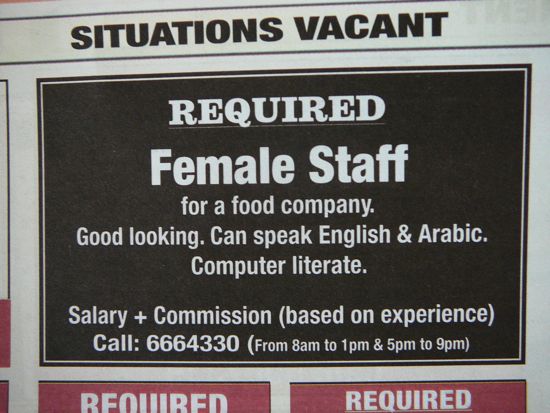
Seeing ads like this one always cracks me up. I don’t see so many specifying “must be under 30 years old” any more, but evidently, it is not politically incorrect here to specify that they must look good. 😉 It also cracks me up that companies are allowed to specify nationalities – like wouldn’t you think we could all work together? But it isn’t so – companies tend to have a Philipino staff OR an Indian staff, and rarely both.
Expecting Too Much?
The newspapers in Kuwait have gotten better. Really. They are using fewer hackneyed cliches, their spelling is better, their use of photos is getting better – mostly the captions match the photo.
This, however, is inexcusable.
A headline featuring the Emir of Kuwait – a big story.
Sew, my newspaper friends, is what you do with a needle.
Sow is what you do with seeds, or grains, as in “as you sow, so shall you reap.”
Oh, Arab Times, the shame!
AMIR WARNS IN RUN-UP TO POLL CAMPAIGN; ‘Prosecute bids to sew disunity’
KUWAIT CITY, April 12, (KUNA): His High-ness the Amir Sheikh Sabah Al-Ahmad Al-Jaber Al-Sabah on Sunday called on the relevant national authorities to take legal action against persons or establishments that target national unity in the run-up to the electoral campaigns. The Amir made the call during an extraordinary session of the Cabinet that he chaired. The meeting was attended by HH the Crown Prince Sheikh Nawaf Al-Ahmad Al-Jaber Al-Sabah and Minister of Amiri Diwan Affairs Sheikh Nasser Sabah Al-Ahmad Al-Sabah. Following the session, Deputy Prime Minister and Minister of State for Cabinet Affairs Faisal Mohammad Al-Hajji Bou-Khaddour stated that HH the Amir, during the meeting, expressed his dismay and regret at those who are fomenting discords and hateful factional disputes, as part of their campaigns for the upcoming elections for the ninth legislative term of the National Assembly.
Today’s Jargon Watch
Jargon Watch: Satellite Sheik, Spitterati, Locasexual
Jonathon Keats
Today, 07:00 AM
(From Wired News Feed
Satellite Sheik n. A televangelist for Islam. These media-savvy religious leaders broadcast moderate Muslim beliefs on satellite TV and social networks, appealing to Arabs alienated by traditional imams.
Spitterati n. Celebrities who attend posh soirees organized to collect saliva for genetic sequencing. Power players like Rupert Murdoch and Harvey Weinstein have hosted spit parties to provide convenient venues for dispensing the requisite half teaspoon of drool.
Sea Grape n. Pet name for the newly discovered Gromia sphaerica. This grape-sized relative of the giant amoeba leaves an animal-like trail as it rolls itself along the seabed. It may be responsible for tracks in Precambrian fossils that were previously attributed to more complex organisms.
Locasexual n. An environmentalist who applies locavore logic to affection and, on principle, will date only locally. Refusing long-distance attachments and coolly calculating “sex miles,” this carbon-conscious canoodler makes love as romantic as a spreadsheet.
Recent Comments
ExpatAlien on What Country am I Living … intlxpatr on Yellowstone: Old Faithful to C… Michelle on Yellowstone: Old Faithful to C… Cathy on No Grown-Ups in Charge intlxpatr on Waiting for Snow Wikipedia Donate Button

Amazina


Early Voting in Florida


 Here There and Everywhere