
Seeing ads like this one always cracks me up. I don’t see so many specifying “must be under 30 years old” any more, but evidently, it is not politically incorrect here to specify that they must look good. 😉 It also cracks me up that companies are allowed to specify nationalities – like wouldn’t you think we could all work together? But it isn’t so – companies tend to have a Philipino staff OR an Indian staff, and rarely both.
December 1, 2009
Posted by intlxpatr |
Beauty, Doha, ExPat Life, Living Conditions, Qatar, Women's Issues, Words, Work Related Issues |
4 Comments
What excites me about this project is that the train which will begin construction soon, also ties in with a beautifully laid out public train system to link major hubs in Qatar. I wish I had taken a photo of the map in the paper – it looks like the London tube system, different lines – different colors, circles where you can switch lines . . . Qatar is definitely going to do this, and to me, it is very exciting.
What public transportation means to me – instead of driving, which I don’t mind all that much, I can sit and read a book!
Qatar-Bahrain causeway work to start in early 2010
Web posted at: 11/23/2009 6:49:46
Source ::: Reuters
ABU DHABI: Construction of a 40km causeway that would connect gas exporter Qatar to the Gulf island state of Bahrain will start in the first quarter of 2010, an official said yesterday.
“We are evaluating the final design and cost of the project and expect construction to start early next year,” Jaber Al Mohannadi, general manager of the Qatar-Bahrain Causeway Foundation, told a conference in Abu Dhabi.
Construction was initially scheduled to start in 2009, but the addition of rail lines delayed the project.
“Project completion will be in 2015,” he said, but declined to give the estimated cost of the project because the figure was yet to be finalized.
Contractors selected to carry out the project include France’s Vinci and Germany’s Hochtief AG, Mohannadi said.
The latest official cost estimate of the causeway, one of the longest in the world, stands at $3bn to be shared between Bahrain and Qatar. Users of the bridge will have to pay a toll, Mohannadi said.
Jassim Ali, a member of the financial and economic affairs committee of Bahrain’s parliament, estimated the project to cost $4-$5bn.
“Qatar will probably be providing some soft financing to Bahrain” to help cover its share of the cost of the project, Ali said.
Qatar, the world’s largest exporter of liquefied natural gas, has one of the world’s highest per capita gross domestic product, while Bahrain is a small oil producer with limited public finances.
The rail tracks on the causeway would be part of a planned train network that will connect the members of the Gulf Cooperation Council (GCC), which also include Saudi Arabia, Kuwait, Oman and the United Arab Emirates (UAE). The UAE is an important business hub of the region.
The 1,940km GCC rail network will cost $20-$25bn as Gulf Arab states plan to spend more than $100bn on various rail projects to improve public transportation.
Qatar and German rail and logistics group Deutsche Bahn [DBN.UL] signed a $23bn deal that provides for building a passenger and freight railway.
Bahrain in April launched a new port that it hopes would help it become a shipping hub for the northern part of the Gulf.
November 23, 2009
Posted by intlxpatr |
Building, Bureaucracy, Community, Doha, ExPat Life, Interconnected, Leadership, Living Conditions, News, Social Issues, Work Related Issues | public transportation |
5 Comments
This has provided us with an ongoing burble of amusement, every time we drive into our compound.
Someone wants the name of the compound in the garden. It seemed a simple enough request, doesn’t it?
The first try I saw, was a perfect ‘A’ followed by a second ‘A’. I started laughing. It was being put in by laborers who are probably illiterate in their own language, much less have any idea about western letters. To them, these are just meaningless shapes, not symbols for sounds. The second ‘A’ was gone the next day, torn out, and replaced with the appropriate letter.
But concrete blocks are big and unwieldy. When the name was finished, it was big, with no spaces between words, and no ‘s’ on the end.
They tore it out, too.
Now, working with smaller bricks, working with templates, working with a diagram, the name is finally being completed accurately. It is actually lovely, so we can’t laugh anymore.
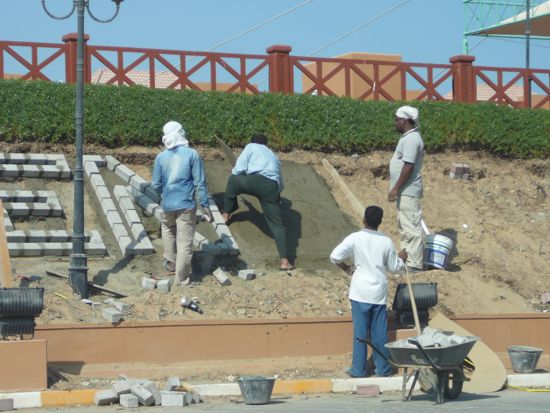
I wonder how we would do, trying to lay out the same in Arabic . . .
November 2, 2009
Posted by intlxpatr |
Arts & Handicrafts, Building, Cultural, Doha, Entertainment, ExPat Life, Language, Living Conditions, Work Related Issues |
Leave a comment
So today I became, once again, a legal driver in Qatar, five months to the day from my arrival. Yep, for those of you who never have the joy of trying to maneuver through the complexity of getting a license in a foreign country – you have NO idea. NO idea. There are people who try and try to get a license and never do.
We are really lucky. We have some very good people who help us get things done. Somehow, it’s my turn to be lucky today.
When I showed up at the office, however, one of the HR girls told me “Oh! Flana is not here today! You will have to come back.”
You all know how nice I am. I smiled at her and said “my husband told me to be here today to get my driver’s license. Someone is going to help me.” Smile again, big smile.
Sure enough, someone is going to help me, and it is someone who I like, someone who has helped me before and who is always calm and patient and knows how to persist pleasantly until he gets what he wants from the bureaucrats. In fact, I admire him, because people end up liking to help him. He is low key. He takes me to the driver’s station, where, because of my advanced age (DO NOT ASK) I have to have an eye test. This leads me to wonder. Doesn’t everyone have to have an eye test?
Then I wait, in the special ladies’ majlis:

I had to wait quite a long time, but I was comfortable, and while I was waiting, I read all the driving safety signs they had up along the ceiling. They were all in English and Arabic, and they were great thoughts, but too many words. Like if you are reading that many words: If you are driving too fast you may not get home alive (that is not a real one, but that was the gist of most of them) so I was creating a new driving safety campaign called the equal campaign:
Speed + Texting = (shows a vehicle turned on its side and all smashed
Speed + Weaving = Two or three crunched vehicles
Texting + Driving = QR (enormous fine)
Something simple to read, graphically simple, something you can glance at and get the meaning.
When I got my driver’s license, I was really happy, except for one tiny little thing – it’s kind of my name but not exactly my name. It’s an easy mistake to make, names can be complicated, but . . . it isn’t my name on my license. It’s my face, it’s my information – it isn’t my name. For half a heartbeat, I consider saying something and then Wisdom kicks in and I zip my lip.
So then, driving home in traffic, I got to thinking about names and how we file things, alphabetically, and even Europeans sometimes file us wrong, which has led us to first class seats because airlines can’t find us, etc. It isn’t always such a bad thing.
Then I started wondering about how Arab speaking people file. Like do you have half the files in the “A” drawer, like Al So-and-So and Al Somebody Else, and how do the sun and moon words affect the filing, like Ar Rayyan, or Ath Thalaka, or As Shams, etc. Once you have filed someone, the goal is to be able to retrieve that information? How does alphabetization work in Arabic? How are things filed?
So being stuck in traffic might not be so bad if someone answers my question and I learn something. 🙂
November 1, 2009
Posted by intlxpatr |
Adventure, Bureaucracy, Community, Cross Cultural, Cultural, Customer Service, Doha, Education, ExPat Life, Family Issues, Living Conditions, Social Issues, Work Related Issues |
7 Comments
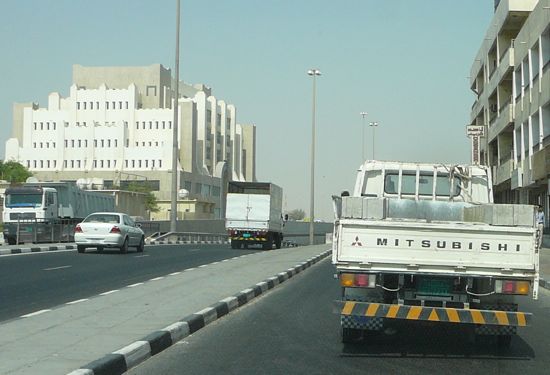
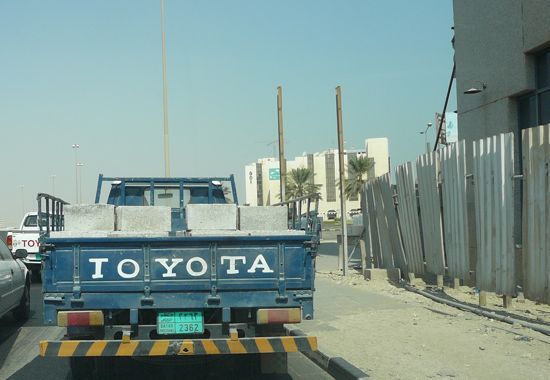
“. . . When we first came to Doha,” I laughed to my friend, “the first thing my husband warned me was never never to get behind a truck carrying concrete blocks. They weren’t tied down, and now and then a bump or a lumpy corner would send concrete blocks all over the roads. They don’t do that any more. They have rules now.”
Spoken too soon.
The very next week, I saw three trucks in a row, laden with concrete bricks, moving slowly down B-ring; one red, one white, one blue. I got stuck, first behind one, then behind the second.
No one was endangered as I took these photos. Traffic was at a standstill.
October 30, 2009
Posted by intlxpatr |
Adventure, Building, Doha, ExPat Life, Law and Order, Living Conditions, Qatar, Safety, Work Related Issues |
2 Comments
I got an e-mail from Amber Johnson today, part of online college, and she asked if I would refer my readers to this article, 100 Ways You Should Be Using FaceBook in your Classroom. I always check these things out, and I was really impressed with the creative ways they have come up with making the classwork exciting, fresh and expedient.
(I love it when someone else writes my blog!) Because I use StatCounter, I know a lot of my readers come from schools and universities around the world, and I am happy to share a part of this article and to ask you to click on the blue type above to read the rest of it. It is full of great information.
100 Ways You Should Be Using Facebook in Your Classroom
October 20th, 2009
Facebook isn’t just a great way for you to find old friends or learn about what’s happening this weekend, it is also an incredible learning tool. Teachers can utilize Facebook for class projects, for enhancing communication, and for engaging students in a manner that might not be entirely possible in traditional classroom settings. Read on to learn how you can be using Facebook in your classroom, no matter if you are a professor, student, working online, or showing up in person for class.
Class Projects
The following ideas are just a starting point for class projects that can be used with Facebook in the classroom.
1. Follow news feeds. Have students follow news feeds relevant to the course material in order to keep current information flowing through the class.
2. Share book reviews. Students can post their book reviews for the instructor to grade and other students to read. If it’s a peer-reviewed project, then students can more easily access each other’s papers online.
3. Knighthood. Playing this game promotes strong reading skills. This teacher explains how he used it with his ESL class.
4. Poll your class. Use polls as an interactive teaching tool in class or just to help facilitate getting to know one another with the Poll app for Facebook.
5. Practice a foreign language. Students learning a foreign language can connect with native speakers through groups or fan opportunities such as this one.
6. Create your own news source. A great way for journalism students to practice their craft, use the Facebook status update feed as a breaking news source for sports results, academic competition results, and other campus news.
7. Follow news stories. Keep up with news through Facebook on groups like World News Webcast that provides video clips of world news.
8. Keep up with politicians. Political science students can become fans of politicians in order to learn about their platforms and hear what they have to say first hand.
9. Create apps for Facebook. A class at Stanford started doing this in 2007 and still has a Facebook group profiling their work. A class at Berkeley also did the same.
10. Participate in a challenge. Look for challenges like the one held by Microsoft and Direct Marketing Educational Foundation that challenges undergrads and grad students to create usable products for Microsoft in return for experience and, in some cases, certification.
11. Bring literature to life. Create a Facebook representation of a work of literature like this class did.
Facilitate Communication
An excellent way to ensure students are more engaged in the learning experience is by strengthening the communication between students and student-to-teacher. These are just a few ideas to do just that.
12. Create groups. You can create groups for entire classes or for study groups with smaller subsets of students that allow for easy sharing of information and communication, without students even having to friend each other.
13. Schedule events. From beginning of semester mixers to after-finals celebrations, easily schedule events for the entire class using Facebook.
14. Send messages. From unexpected absences to rescheduling exams, it’s easy to send messages through Facebook.
15. Share multimedia. With the ability to post videos, photos, and more, you can share multimedia content easily with the entire class.
16. Post class notes. Post notes after each class period for students to have access for review or in case they were absent.
17. Provide direct communication with instructors. Instructors and students can contact each other through Facebook, providing an opportunity for better sharing of information and promoting better working relationships.
18. Allows shy students a way to communicate. Shy students who may not want to approach their teacher after class or during office hours can use Facebook to communicate.
Read the rest of the article here, by clicking on the blue type.
October 22, 2009
Posted by intlxpatr |
Blogging, Community, Education, Interconnected, Technical Issue, Tools, Work Related Issues |
1 Comment
Today, on my way home from a marathon-fun day, even though it was full of errands, I got to thinking great thoughts – in my car. Some of my best ideas come when I am sitting in traffic, something about the enforced nothing-to-do frees up my unconscious to tackle things I don’t otherwise think about.
One of the things I was thinking about was what, when I studied it, was called The Decision Making Process. It’s something you study in Political Science, and, although I can’t say this for sure because I haven’t specialized in these other areas, I am betting you would also study the process in Business, in Economics, in Engineering . . . when you know the process by which decisions are made, so the theory goes, you can get better at predicting how the decision making will go, what people will decide.
Or so the theory goes. . .
My personal observation is that human beings are highly unpredictable, and sometimes will make an opposite decision, even an irrational decision, in order not to be so predictable. I hate to be so cynical, but I think we are not so rational as we like to think we are.
In my Kuwait life, I remember being at a not-so-important meeting, more just a gathering, but at one point, I saw four people – influential people – meeting off in a corner, very casually, probably no one else even noticed, but they were deciding an outcome of an election, I realized later that day. OOps – not THE Kuwait election, my friends, no no no, a much lesser election. But that was where the decision was really made. These four quiet people were people who had the respect of others, and once they decided, they quietly shared their opinion with others, who shared their opinion with others and on it went, until the deed was done.

I have seen decisions made in a swimming pool. I know decisions are made on golf courses. I was hired for one job once after attending a concert, and for another because I had a responsible position in my church (it had nothing to do with the job I was hired for, but the skills were transferable.) I was hired once because my hair and eyes matched another woman working in the front office, and the boss wanted a “matched pair.” (I didn’t know that until later.)
I know that at one time AdventureMan helped lay out a military base. He said they were in a truck, and as they drove along someone dropped big stones out the back to mark the boundaries. Don’t you love it?
Gulf women tell me that weddings are important; young women are often spotted by future mother-in-laws, so moms try to make sure that their daughters are well appointed for major weddings, major events where they may be on display . . . and then they ask around checking on character and personality and suitability. But I wonder on what basis those decisions are really made, deep down? Family alliances? Securing a future? Business connections? I know there are rare alliances based on true and lasting love; I wonder how often that happens?
I know there are matrixes, and even simple two-column + – lists by which people can rationally work out what to decide. What I am cynical about – after all the matrixes are filled out, after all the plusses and minuses are totaled – I think that the decision can go counter to rationality, because we are – if not irrational – then intuitive, we are people who make decisions with other than our conscious minds. I think our hearts get involved, and you KNOW that feelings/emotions get involved. Sometimes we have “a gut feeling”; sometimes we know something on an unconscious level that we don’t know on a conscious level. If we all acted in our own rational self interest, there would not be young drivers dying on our roads, people would not be irrationally exuberant about investments, young people would not fall in love with the wrong people and life would sure a lot more dull, wouldn’t it?

I am cynical even about decisions made at the highest levels, because even decisions made by boards and after studies – even these decisions are ultimately based by human beings, and sometimes on “hunches.”
So I am wondering if YOU have had similar experiences? Have you seen major decisions made irrationally?
All this because I was stuck in traffic . . . .
October 20, 2009
Posted by intlxpatr |
Character, Community, Cultural, ExPat Life, Financial Issues, Friends & Friendship, Kuwait, Leadership, Living Conditions, Marketing, Mating Behavior, Technical Issue, Work Related Issues |
4 Comments
I love my family. There is Earthling, and his darling wife, who keep me up to date on trends and the newest coolest things in GoogleEarth, there is Sporty Diamond and her family who are my go-to people for the newest in child raising and urban trends, Law and Order Man and EnviroGirl, who keep us up to date on media – books, music and television they think we need to know about, as well as keeping the smallest possible footprint as we exercise our stewardship of the planet Earth, and then adorable Little Diamond, who speaks fluent Arabic in about 20 dialects, who lives comfortably in Damascus, or Beirut, or Rabat, and who sends me these articles, this one from the Oxford Business Group, that tell me more about the countries I live in.
Thank you, little Diamond, especially since public transportation is one of my pet projects. 🙂
Kuwait: Working on the Railway
8 October 2009
Kuwait was one of the first countries in the region to float the idea of a metropolitan rapid transit network, and attention is once again returning to public transport projects in the country.
While there has long been talk of developing a rapid transit system in Kuwait, the proposal has been taken further by the private Kuwait Overland Transport Union through a detailed feasibility study completed last year that included setting out routes and estimating the cost of the project.
The plan called for a four-line metro grid to be built, with some two-thirds of the network to be elevated and the remainder below ground. According to government projections, when the 165-km network is fully operational, it will carry 69m passengers a year.
However, the scheme was soon sidetracked, even though there had been an announcement that tenders would be called for the project before the end of 2008. In January, the government said it would conduct a comprehensive study of Kuwait’s land transport needs, with the metro project to be incorporated into a wider national transport strategy.
Enthusiasm for the rail network may have got a timely boost from the opening of the initial stage of Dubai’s metro network on September 9, the much-touted answer to the emirate’s traffic congestion and pollution problems.
In its first two weeks of operations, more than 1m passengers rode the Dubai metro. Although it will be some time before a full assessment of the Dubai metro can be made,. the launch and apparent popularity of the line could encourage Kuwait to push ahead with its own project.
Supporters of the Kuwaiti scheme say the transit system will reduce pollution and traffic congestion in Kuwait City, encourage more decentralised residential development, and promote economic growth in outlying areas that will be opened up by quick rail access.
Though all this will likely be true, as is the case with most such major public transport schemes, there are almost as many cons as there are pros. In particular, the cost of constructing and operating the metro could weigh against the project.
While the development should ease Kuwait’s traffic congestion and could prove popular with commuters, it is unlikely to turn a profit. In its current form, the metro grid is expected to cost around $7bn. While this may change following the broad review of the country’s transport needs and the type of rail system needed – underground, raised or ground level – the outlay will be high.
Added to this is the fact that there is little chance this initial outlay will be recovered though earnings once the network is up and running. Even with the projected 69m passengers a year, in order to make a return on investments and then turn a profit, ticket prices will have to be high, defeating the objective of a low-cost transport system.
Most of the proposals put forward for the metro scheme involve a mix of public and private capital to fund the project. One version of the partnership arrangement put forward by the Ministry of Communications would see the state providing 24% of the project funding, contractors putting in 26% and the remaining 50% coming via an initial public offering (IPO).
Another suggested funding breakdown has the state contributing 50% of the capital required and the other half coming from the private sector, with several companies to be set up to undertake different parts of the projects, each being subject to an IPO.
Though these formulas would restrict the state’s exposure to the project and serve to encourage greater private participation in the economy, the question remains as to whether either the lead contractor or other investors would commit to a scheme that is a potential loss-maker.
However, at least some of the running costs of the metro could be offset by the lower use of subsidised petrol by commuters. With Kuwait having some of the cheapest fuel in the world, there is less inducement for locals to find an alternative to the automobile to get around. Raising the price of petrol at the pump could induce some motorists to abandon their cars and adopt the metro as their transport of choice, with the higher cost of fuel and more revenue from ticket sales combining to reduce any potential losses.
While the slow pace of the metro project may be frustrating for some, there could be advantages to adopting a methodical approach. By not being the first train out of the station, Kuwait’s planners will be able to learn from the experiences of Dubai and other cities, taking the best and avoiding the worst in the planning and construction process and also developing a sound funding model acceptable to all.
By all accounts, it is not a case of if but when for Kuwait’s urban rail transit network. The extended planning and development process may well result in a project that can combine versatility and popularity with profitability, a rare combination in public transport.
October 9, 2009
Posted by intlxpatr |
Bureaucracy, Community, ExPat Life, Interconnected, Kuwait, Living Conditions, News, Technical Issue, Travel, Work Related Issues | public transportation |
9 Comments
School is just starting up today in Qatar. Many parents are sending their children only reluctantly; they are afraid of the H1N1 flu. School was already delayed long past its normal opening by Ramadan and the Eid al Adha, but now there are no more excuses.
AdventureMan has called twice, stuck in traffic. What is normally a 45 minute commute to work has gone well over an hour, stuck in the gridlock of bumper to bumper traffic, parents taking children to schools. Although some of the schools have buses, many parents still have to take their children to school, or they have their drivers take the kids to school, or they pay a taxi to take them every day.
This town needs a monorail, a good, well maintained public transportation system that can whiz us all over town and is air-conditioned. It is going to have to be fast and attractive to entice people out of their cars.
Update from today’s Peninsula:
Call for delaying school reopening
Web posted at: 10/4/2009 0:52:57
Source ::: The Peninsula
DOHA: A vast majority (78 percent) of respondents to a survey conducted by Al Sharq on the schools reopening today say they favour the move to be further put off for a week. Only 20 percent of the interviewees said they saw no need for any further delay in re-opening the schools, while two percent said they were undecided.
The daily referred the findings to educationists and some of them also agreed the schools should have been given more time to prepare themselves to deal effectively with a possible spread of swine flu.
A delay in school reopening by another week would have given some time to parents too, many of whom have returned from long overseas vacations. Said Dr Khalid Al Hindawi, an educationist: “I was in favour of delaying the school reopening by another week as that would have given the schools more time to take effective measures to prevent a possible spread of the H1N1 virus”.
But Amina Al Jaber, a Qatar University professor, said she did not agree with this view since any further delay in reopening the schools would curtail the academic year and hamper studies.
The schools had already taken effective measures to deal with the situation, so there was no need for keeping them closed to students. Khalifa Al Kuwari said he preferred a further delay as school buildings needed some modifications, especially the doors of the classrooms are too narrow so they should have been widened.
There really is little protection against any flu. The flu shots may help some, Tamiflu may help with the symptoms, but viruses mutate. Anyone who has ever worked in a school knows that colds and flu are just a part of life, and it may be a good thing to help us all gain immunity against more bugs.
What I really don’t understand is the low value placed on education by so many parents in this area. For example, many parents place little value on getting kids into their classes on time. Teachers complain that the kids don’t do their homework, and get little personal attention and encouragement from their parents to complete it, and then the parents come in and yell at the teachers for not teaching when the child gets a low grade because the homework has not been completed.
Children are kept out of school for any excuse, like “I needed her at home to watch the smaller children” or “he didn’t want to come to school.” Few children get enough sleep at night, and are consequently drowsy in the classroom. Last and not least, few of the children are instructed on classroom behavior, and when the teacher tries to instruct – and enforce – mutual respect and polite conduct, once again an angry parent shows up on the doorstep asking how he/she dare to discipline this child?
The teachers here are truly heroes.
October 4, 2009
Posted by intlxpatr |
Community, Doha, ExPat Life, Family Issues, Living Conditions, Work Related Issues |
4 Comments
GREAT article from today’s Arab Times
Kuwaiti women played key role in liberating nation: Maasouma
GENEVA, Sept 29, (KUNA): Member of National Assembly of Kuwait Dr. Masouma AI-Mubarak said that during Iraqi Invasion of Kuwait in 1990, and the Liberation War in 1991 the Kuwaiti women played a major role in liberating their country. Addressing the International Parliamentary Union (IPU) conference in Geneva, she stressed that the Kuwaiti women put up a remarkable resistance against occupation and struggled in every front for the safety of their country.
“It is a fact that no society can prosper when women do not contribute to its progress. It is a fact also, that we hold only a very small percentage of public offices, very few women are involved in politics and even fewer run for elected offices,” Dr. Al-Mubarak said. In her speech, “The Role of Women: Expectations and Challenges,”
Al-Mubarak said that the Kuwait Constitution does not discriminate between women and men with respect to their citizenship rights, but social customs. “Women make up more than 50 percent of the Kuwaiti population. They compose 24.5 percent of the country’s total workforce, and more than 40 percent of the Kuwaiti workforce, and about 70 percent of students at university level. More than 85 percent of the honor graduates are women,” she said. And added that Kuwaiti women hold prominent positions. However, Dr. Al-Mubarak said that one of the first obstacles faced as the first female MP was in running for in-house elections. “Another experience was in the election of the Parliamentarian committee for Women’s Affairs; all four female MPs won, in addition to three male MPs,” she said.
She explained that historically, this committee was not on the radar screen of Parliament “it only succeeeded in becoming so after the granting of women’s political rights in May 2005 where female voters became an attractive asset to those running for elections.
“One of our first decisions upon being elected into the committee was to suggest an amendment to the bylaws of the Parliament to include this committee among the roster of permanent parliamentarian committees thus cementing its importance to the nation,” said Al-Mubarak. Al-Mubarak explained that the committee is currently studying two proposals for social and civil women’s rights, and several proposals to amend discriminatory articles in several laws as: the Public Housing Law, the Civil Service Law, the Passport Law, the Labor Law, the Social Security Law, and the Immigration Law which affects the stability of families comprised of Kuwaiti wives married to non-Kuwaiti husbands.
She added that the committee also succeeded in putting women’s issues on the priority list of the Parliament which is comprised of 23 priorities for the upcoming session starting on October 27, 2009.
“The Five-Year Development Plan of Kuwait has allocated an entire program to support and develop the role of women in society and to incorporate them in the workforce, by training 19,416 women during the current Plan,” said Dr. Al-Mubarak. She stressed that until women are fully represented in local, national and international decision making bodies, their issues will not be priorities and the necessary resources will not be allocated.
September 30, 2009
Posted by intlxpatr |
Character, Community, Cultural, Family Issues, Kuwait, Leadership, News, Political Issues, Social Issues, Women's Issues, Work Related Issues |
1 Comment


 Here There and Everywhere