Wayfaring Stranger and James Lee Burke in the Heat of August
Just in time to save August from being my most hated month EVER, a new James Lee Burke novel, Wayfaring Stranger.

LOL, escaping from the relentless heat and humidity of Pensacola, I enter the heat and humidity of Burke country, ranging from the oil fields in Louisiana to the desolate social scene of Houston in the 1950’s.
I got hooked on James Lee Burke in a very cold winter February in Wiesbaden, Germany, when I came across a book called A Morning for Flamingos. I like mysteries, but this was a mystery by a poet! When I read about the what an approaching thunderstorm looks like when you live in a little cabin in New Iberia on Bayou Teche, I was lost. I-don’t-know-how-many books later, I’ve been to New Iberia, had lunch by the Bayou Teche and explored Burke country.
Louisiana is soulful, all those little roads, and sugar cane factories (think True Detective, here) but, (sigh) no matter how colorful, no matter how beautiful, the Louisiana in James Lee Burke’s books is better. He’s been there longer, he has the eye to see that heron, that shiver of wind over the water, that glint of pure evil in a bad guy’s eye. I know you think I am blathering on, but kinda-sorta the Dave Robicheaux detective series are all pretty similar, what changes is the particular social injustice. So this is what hooks me – Burke’s relentless battle against injustice, by writing powerful books that get read by a lot of people, and the elegant prose and philosophy he inserts to lift it way beyond the run of the mill mystery book.
The Wayfaring Stranger is the best yet. It’s not one of the Robicheaux series, it’s part of a Holland series, lawmen whose Texas lives and challenges we’ve read about in previous books. Wayfaring Stranger is the story of Weldon Holland (Burke tells us in an after word that Hollan – no D – is an old Texas family name in his line) who lives with his grandfather and runs into the real Bonnie and Clyde. Fast forward and he is fighting in the Ardennes, and the only reason you have faith he will survive is that there are so many pages ahead of you . . . he and one of his men trek, hop a train, and end up in a deserted death camp, where they find one survivor – a woman. The three of them are surrounded by fighting armies and find safety in a local farm’s cellar.
Oops. I’ve already given away that Weldon survives the battle. It’s hard to write much more without giving too much away. It’s a powerful story, powerfully written. It’s about good men and women and weak men and women and how sometimes an evil person can surprise you with a goodness.
Warning. Once you pick up Wayfaring Stranger, you’ll need a block of time so you can just go ahead and finish it. You won’t be putting it down.
Rehab, An Unlikely Hero
I love this story. When you start reading the bible, you come across the most human of our race, you have the dramas of sibling rivalry, disobedience, and murder, the heartbreak of childlessness, slavery, and terrible loss, you have marriages and wars . . . the full spectrum of human behavior is there. And you have Rehab, a prostitute, who has heard of this God, but is not a Hebrew. She will help them in return for safety for her family. All who shelter in her small apartment, protected by a red ribbon (or rope), live.

In a later chapter of the bible, we learn how Rehab figures in the family line of Jesus.
Joshua 2:1-14
2Then Joshua son of Nun sent two men secretly from Shittim as spies, saying, ‘Go, view the land, especially Jericho.’ So they went, and entered the house of a prostitute whose name was Rahab, and spent the night there. 2The king of Jericho was told, ‘Some Israelites have come here tonight to search out the land.’ 3Then the king of Jericho sent orders to Rahab, ‘Bring out the men who have come to you, who entered your house, for they have come only to search out the whole land.’
4But the woman took the two men and hid them. Then she said, ‘True, the men came to me, but I did not know where they came from. 5And when it was time to close the gate at dark, the men went out. Where the men went I do not know. Pursue them quickly, for you can overtake them.’ 6She had, however, brought them up to the roof and hidden them with the stalks of flax that she had laid out on the roof. 7So the men pursued them on the way to the Jordan as far as the fords. As soon as the pursuers had gone out, the gate was shut.
8 Before they went to sleep, she came up to them on the roof 9and said to the men: ‘I know that the Lord has given you the land, and that dread of you has fallen on us, and that all the inhabitants of the land melt in fear before you. 10For we have heard how the Lord dried up the water of the Red Sea* before you when you came out of Egypt, and what you did to the two kings of the Amorites that were beyond the Jordan, to Sihon and Og, whom you utterly destroyed. 11As soon as we heard it, our hearts failed, and there was no courage left in any of us because of you. The Lord your God is indeed God in heaven above and on earth below. 12Now then, since I have dealt kindly with you, swear to me by the Lord that you in turn will deal kindly with my family. Give me a sign of good faith 13that you will spare my father and mother, my brothers and sisters, and all who belong to them, and deliver our lives from death.’ 14The men said to her, ‘Our life for yours! If you do not tell this business of ours, then we will deal kindly and faithfully with you when the Lord gives us the land.’
No matter who we are, no matter what we have done, the love of God follows us everywhere, with the free gift of salvation, if only we see it, as Rehab did, and ask for it. God is great!
Worst Places in the World to Work
From AOL Huffpost Business:
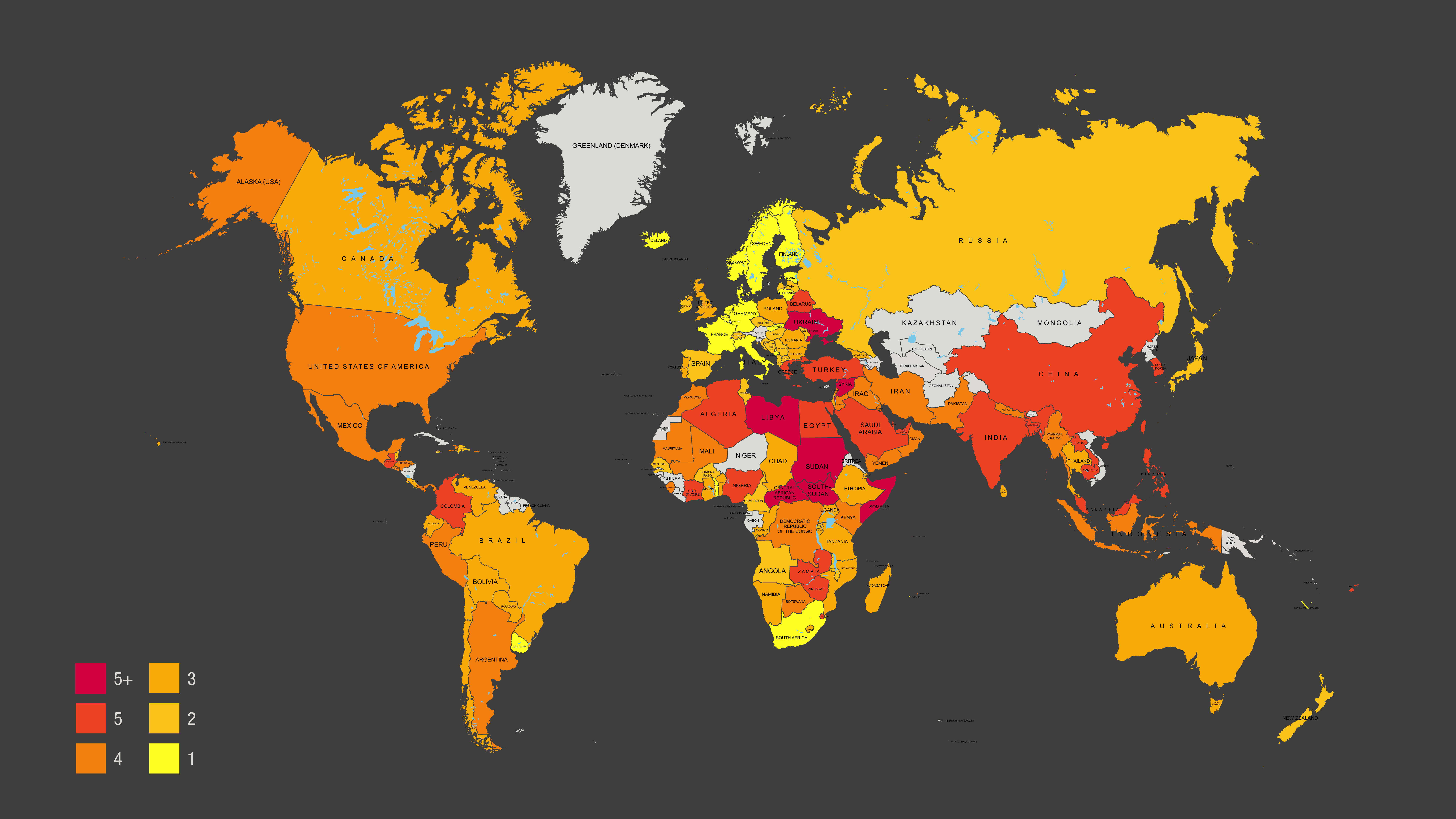
Where are the worst places on the planet to be a worker?
A new report by the International Trade Union Confederation, an umbrella organization of unions around the world, sheds light on the state of workers’ rights across 139 countries. For its 2014 Global Rights Index, the ITUC evaluated 97 different workers’ rights metrics like the ability to join unions, access to legal protections and due process, and freedom from violent conditions. The group ranks each country on a scale of 1 (the best protections) to 5 (the worst protections).
The study found that in at least 35 countries, workers have been arrested or imprisoned “as a tactic to resist demands for democratic rights, decent wages, safer working conditions and secure jobs.” In a minimum of nine countries, murder and disappearance are regularly used to intimidate workers.
Denmark was the only country in the world to achieve a perfect score, meaning that the nation abides by all 97 indicators of workers’ rights.
The U.S., embarrassingly, scored a 4, indicating “systematic violations” and “serious efforts to crush the collective voice of workers.”
“Countries such as Denmark and Uruguay led the way through their strong labour laws, but perhaps surprisingly, the likes of Greece, the United States and Hong Kong, lagged behind,” wrote ITUC general secretary Sharan Burrow in a statement about the report. “A country’s level of development proved to be a poor indicator of whether it respected basic rights to bargain collectively, strike for decent conditions, or simply join a union at all.”
Here’s a look at the world rankings. Darker shades represent worse protects for workers. A score of 5+ means that active conflicts, like those in Syria or Sudan, block any legal protections for workers.
Pensacola Flood Recovery Instructions
Here are our recovery instructions quoting from the Pensacola News Journal:
“Caution. Stay off roads. Stay off bridges. Stay out of the water. Stay home, unless home is gone.” And in my wrecked neighborhood, boil all water for at least a minute until further notice.

More rain expected. People are not staying home. People are out and about, going to their jobs, keeping on keeping on. People are out helping one another clean out, carrying out soggy furniture and putting it by the curb. People are helping clean the trash. People are closing roads to make sure the underpinnings haven’t washed away. All our fire and police people are out doing extra duty, trying to keep us all safe and prevent chaos.
I saw a woman today with a T-shirt that said “medical examiner.” These days, you don’t know, there are shirts that say FBI and they aren’t FBI at all, or Alice in Chains, and it isn’t Alice in Chains. But as she turned around, the badge on her belt glinted in the light. She and her assistant were taking out; between the flood and the prison explosion, I doubt she has gotten a lot of sleep.
Heroes At The Dinner Table
“That’s Jollaf rice!” the Nigerian journalist said, a note of delight in her voice. She is famous for her passion and persistence drawing attention to the environmental issues in the Niger delta related to oil extraction and production. I told her that here in the Gulf, it’s called Jambalaya, but we all agreed that it very likely had African roots. She delighted my heart; she had three helpings.
When we have visitors from foreign countries, I try to serve foods they can identify – grilled vegetables, a chicken dish, several salads, a dessert. This time, because we had no Moslems, we used a real Cajun sausage in the jambalaya (pork), and jumbo shrimp.
The award-winning Finnish environmentalist has his own online website and a goal of planting 100 million trees by 1017. He is well on his way, visiting and planting trees in new countries every week. He also has his own band and has a CD out with Finnish music.

Our South African guest manages a large rhino reserve, protecting the rhinos from those who would kill them for their horns, thinking it renews sexual energy. Poor rhinos! He was quiet, but an acute observer, and the highlight of the evening was as he sang the haunting South African national anthem, Nkosi Sikelel’, with the Finnish guest. They did not sing all 11 verses (!) in all the different languages; just one verse, it was very moving:
Our own sweet environmentalist was with us. We think our son and his wife are super heroes; they fight for justice and a clean environment. This evening, our son stayed at home with the grandchildren and his wife, who works with clean water, was able to join and talk shop over dinner with her counterparts from other parts of the world.
It isn’t so easy anymore to get these dinners on the table, off the table, dessert served, etc. I used to be able to do these easily, for more than 20 people, but I also had help, LOL! But these dinners give us so much joy that I can’t imagine giving them up any time soon.
Please: ‘Condescend’ to Me With Equal Pay
It happened to me. I was working in the best job I ever had, working harder than I had ever worked and loving the work I was doing. Then raise time came, and I got a raise, but I knew it was not as much as the young guy who had started after I started. I liked the young guy; we worked together a lot and we worked together well. Sometimes he disappeared, sometimes for a long time. As it turned out, he suffered from depression, and I ended up doing a lot of his work.
So I confronted my boss, and said it was unfair that he had gotten the larger raise and I the smaller. My boss said “Intlxpatr, you have a husband who makes a lot of money and this young man is just getting started.” It had nothing to do with merit, quality of work, productiveness – it had to do with me being a woman who had a husband who provides for me. I know that to some of you reading this, that makes sense, but to me, even from the time I was a young girl, it makes no sense at all. You pay what the work is worth, regardless of sex. Regardless of nationality. Regardless of marital status. That’s FAIR.
I didn’t quit. The boss moved on and the next boss gave me a giant raise to stay. I loved that job 🙂

WASHINGTON — Democrats’ push for pay equity between men and women is “condescending,” one of the top women in the House Republican leadership argued Tuesday, suggesting that the campaign for equal pay for equal work reflects a lack of understanding of women’s contributions to the workforce.
Rep. Lynn Jenkins (R-Kan.), the GOP conference’s vice chair, made her comments flanked by her fellow leaders in the House at their weekly news conference, and suggested that the campaign for equal pay for equal work reflects a lack of understanding of women’s contributions to the workforce.
“Please allow me to set the record straight. We strongly support equal pay for equal work, and I’m proud that I live in a country where it’s illegal to discriminate in the workplace thanks to the Equal Pay Act of 1963 and the Civil Rights Act of 1964,” said Jenkins. “Some folks don’t understand that women have become an extremely valuable part of the workforce today on their own merit, not because the government mandated it.”
Jenkins went on to belittle Democratic efforts on the issue.
“Many ladies I know feel like they are being used as pawns, and find it condescending [that] Democrats are trying to use this issue as a political distraction from the failures of their economic policy,” Jenkins said.
Senate Minority Leader Mitch McConnell (R-Ky.), speaking on the Senate floor Tuesday morning, appeared to slam the Democrats’ push as cheap political showmanship and accuse Senate Majority Leader Harry Reid (D-Nev.), who had just addressed the issue, of playing games.
“Yesterday, here in the Senate, Republicans were hoping the Democrat Majority Leader would finally work with us to pass a job creation package that contains ideas from many of our members — legislation with provisions several key Democrats support too,” McConnell said. “But that’s not what the Majority Leader chose to do. Instead of focusing on jobs, he launched into another confusing attack on the Left’s latest bizarre obsession. Democrats chose to ignore serious job-creation ideas so they could blow a few kisses to their powerful pals on the left.”
However, shortly after this story was posted, McConnell’s office said his remarks were being misconstrued. Spokesmen pointed to his use of the word “yesterday,” and said that he had been referencing Reid’s Monday speech targeting the billionaire Koch brothers, rather than his procedural motion, also on Monday, to begin work on the Democrats’ Fair Pay Act.
According to many independent assessments, women who do the same job as a man are often paid significantly less, on average earning just 77 cents to a man’s dollar. Even when many of the factors that lead women to make different job choices are controlled for, significant gaps remain.
Jenkins did not address the issue of women getting paid less for the same job, but suggested that women simply tend to choose different jobs.
“When it comes to employment, the fact is many women seek jobs that provide more flexibility for their family over more money, which is the choice that I made as a young working mom,” Jenkins said.
Jenkins’ and McConnell’s opinions notwithstanding, women overwhelmingly backed the Democratic ticket in the last election, running up the largest gender gap in the history of Gallup polling. Women supported President Barack Obama over GOP nominee Mitt Romney by a 12-point margin.
House Majority Leader Eric Cantor (R-Va.) chose his words more carefully than his colleagues at the press event when asked whether there was anything in terms of legislation that Republicans would consider doing to address the gap.
Though Cantor demurred from offering new ideas, he did tweak the White House, noting reports that women working there get paid about 88 cents on the dollar, compared to men.
He said a better idea than passing new laws was trying to enforce the old ones.
“I point to the White House, and say what it is that they’re doing? They’ve got a problem in the White House,” said Cantor. “Let’s put the politics aside.”
He suggested that repealing part of Obamacare would help, and pointed to a bill the House GOP passed last week that would change the definition of full-time work in the law from 30 hours a week to 40.
“If you look to see those most impacted, it’s women. Sixty-three percent of those impacted by the 30-hour workweek rule are women,” Cantor said. “If the Senate Democrats would pick [the bill] up, we could help women right now.”
Under the Affordable Care Act, employers must provide health insurance for full-time workers, currently defined as people employed more than 30 hours per week. Republicans argue that because of that, employers are pushing people — in this case, mostly women — into part-time work, although independent fact-checkers havefound that claim to be false.
This article was updated after a spokesman for McConnell clarified the intended meaning of his remarks.
Michael McAuliff covers Congress and politics for The Huffington Post.
The Clothes Dryer

I was talking to my Mom last night, asking her how her mother coped with having twins. She was trying to remember if her mother even had a washing machine, and thought not. She was only four, but she remembers a woman who came in and did ironing every day, and she thought maybe she also did all the laundry.
Imagine. Imagine doing diapers for twins by hand, in a wash tub with a wash board. It gives me shudders, but women worked harder in those days, life was physical. They also died a lot younger. Hmmm . . . having said that, my grandmother lived to 105.
Clothes dryers came much later. Even today, most women in the world hang their clothes to dry, some even lucky enough to have special racks or lines for that purpose, others hang them over shrubs and bushes and fences surrounding their homes.
Today’s meditation from Forward Day by Day caught my attention; in Germany the last time I lived there, I did without a dryer, hanging my clothes on racks, and I did just fine. I had the time, I had the space and it was just a different pace of life.
Mark 8:34. If any want to become my followers, let them deny themselves and take up their cross and follow me.
A few years ago, a young husband and wife started an intentional community in rural Ohio. They share the house with others committed to simple living, to daily prayer and worship, and to issues of justice, especially around hunger and care of the earth. The farm not only yields enough to feed the members of the house and volunteers, but also supplies thousands of pounds of food each year to the local pantries.
I was struck by one story about their common life. They decided to get rid of the clothes dryer. After all, it’s not a vital machine, they determined. They could use a clothesline and conserve energy and money. Hanging clothes to dry would be an exercise in patience, in slowing down, as well as in planning and coordinating the wash with others in the house.
This small sacrifice provides powerful insight into the faithful witness of this group of people. I don’t know if God wants me to give up my clothes dryer (please, God, I hope not). But I do believe God calls us to sacrifice, to make hard decisions, to give up important things, so that we can take up the cross and follow Jesus.
Recent Comments
ExpatAlien on What Country am I Living … intlxpatr on Yellowstone: Old Faithful to C… Michelle on Yellowstone: Old Faithful to C… Cathy on No Grown-Ups in Charge intlxpatr on Waiting for Snow Wikipedia Donate Button

Amazina


Early Voting in Florida


 Here There and Everywhere