“if You Can’t Prevent Rape, You Enjoy It”: Ranjit Sinha
The Chief of India’s Central Bureau of Investigation said this! Was he snorting cocaine in a drunken stupor? Of course he is apologizing, but his careless remark demonstrates the sentiments buried deep in his culture’s heart – it’s only women. Not worth much, not like us men. Outrageous.

NEW DELHI (AP) — India’s top police official apologized Wednesday for saying, “If you can’t prevent rape, you enjoy it,” a remark that has outraged women across the country.
Central Bureau of Investigation chief Ranjit Sinha made the remark Tuesday during a conference about illegal sports betting and the need to legalize gambling. The CBI, the country’s premier investigative agency, is India’s equivalent of the FBI.
Sinha said at the conference that if the state could not stop gambling, it could at least make some revenue by legalizing it.
“If you cannot enforce the ban on betting, it is like saying, ‘If you can’t prevent rape, you enjoy it,'” he said.
The remarks have caused outrage across India, which in the past year has been roiled by widespread protests following the fatal gang rape of a 23-year-old woman on a bus in New Delhi.
On Wednesday, Sinha said that his comments had been taken out of context and misinterpreted, and that he was sorry if he had caused hurt.
Angry activists, however, called for his resignation.
Communist Party of India (Marxist) leader Brinda Karat said Sinha’s comments were offensive to women everywhere.
“It is sickening that a man who is in charge of several rape investigations should use such an analogy,” Karat told reporters. “He should be prosecuted for degrading and insulting women.”
The New Delhi attack on the young woman last December caused nationwide outrage and forced the government to change rape laws and create fast-track courts for rape cases. New laws introduced after the attack make stalking, voyeurism and sexual harassment a crime. They also provide for the death penalty for repeat offenders or for rape attacks that lead to the victim’s death.
Saudi Women Drive, No Problem
For your delight of the day, please go to YouTube and watch this hilarious Saudi video, No Woman, No Drive! Click on the blue type above 🙂

From The Guardian:
Dozens of Saudi Arabian women drive cars on day
of protest against ban
-
Staff and agencies
- theguardian.com, Saturday 26 October 2013 12.03 EDT
Activists say at least 60 joined call to allow female drivers – making it country’s biggest ever demonstration against the ban
More than 60 Saudi women got behind the wheels of their cars as part of a protest against a ban on women driving in the kingdom, activists have claimed.
A Saudi professor and campaigner, Aziza Youssef, said the activists have received 13 videos and another 50 phone messages from women showing or claiming they had driven, the Associated Press reported.
She said it had not been not possible to verify all of the messages. But, if the numbers are accurate, they would make Saturday’s demonstration the biggest the country has ever seen against the ban.
Despite warnings by police and ultraconservatives in Saudi Arabia, there have been no reports from those who claimed to have driven of being arrested or ticketed by police.
A video clip of a protest by May al-Sawyan, a 32-year-old economics researcher and mother of two, was uploaded on the YouTube channel of the October 26 driving for women group, along with several other videos of women purportedly driving in defiance of the ban in Riyadh, al-Ahsa and Jeddah. It was not possible to verify when they were filmed. Another video to feature on YouTube was the spoof No Woman, No Drive.
“I am very happy and proud that there was no reaction against me,” she told AP. “There were some cars that drove by. They were surprised, but it was just a glance. It is fine. They are not used to seeing women driving here.”
Sawyan said she had obtained a driver’s licence from abroad. She said she was prepared for the risk of detention if caught but added that she was far enough from a police car that she was not spotted.
“I just took a small loop. I didn’t drive for a long way, but it was fine. I went to the grocery store,” she said.
Her husband and family waited at home and called her when she arrived at the shop to check on her, she said. She drove with a local female television reporter in the car. They were both without male relatives in the vehicle.
“I know of several women who drove earlier today. We will post videos later,” one of the campaign organisers told Reuters.
The Associated Press reported that a security official said authorities did not arrest or fine any female drivers on Saturday.
Youssef said she and four other prominent women activists received phone calls this week from a top official with close links to Interior Minister Prince Mohammed bin Nayef, warning them not to drive on Saturday, the day the campaign set for women’s driving.
She also said that “two suspicious cars” have been following her everywhere all day. “I don’t know from which party they are from. They are not in a government car,” she said.
Activists said they have 16,600 signatures on an online petition calling for change. Efforts to publicise the issue have been described as the best-organised social campaign ever seen in Saudi Arabia, where Twitter has millions of users and is used to circulate information about the monarchy and official corruption.
Previous attempts to promote change fizzled out in arrests for public order offences and demoralisation. In 2011, the activist Manal al-Sharif made a YouTube video urging women to drive their own cars, and was imprisoned for more than a week. But the signs are far more positive now.
Three female members of the shura (advisory) council – among 30 appointed by the 90-year-old King Abdullah – recommended this month that the ban be rescinded, though no debate has yet taken place.
Latifa al-Shaalan, Haya al-Mani and Muna al-Mashit urged the council to “recognise the rights of women to drive a car in accordance with the principles of sharia and traffic laws”.
The three – praised by supporters for “stirring the stagnant water” – framed their argument with careful references to religious edicts banning women from being in the company of an unrelated male driver. Other ideas designed to reassure critics are appointing female traffic police and driving instructors. Cost is another big factor, with families having to employ chauffeurs, as is convenience.
Though no specific Saudi law bans women from driving, women are not issued licenses. They mostly rely on drivers or male relatives to move around.
Powerful clerics who hold far-reaching influence over the monarchy enforce the driving ban, warning that breaking it will spread “licentiousness.” A prominent cleric caused a stir when he said last month that medical studies show that driving a car harms a woman’s ovaries.
MRSA Link to Pigs

From Nature.com News:
People living near pig farms or agricultural fields fertilized with pig manure are more likely to become infected with methicillin-resistant Staphylococcus aureus (MRSA) bacteria, according to a paper published today in JAMA Internal Medicine1.
Previous research has found that livestock workers are at high risk of carrying MRSA, compared to the general population2. But it has been unclear whether the spreading of MRSA through livestock puts the public at risk of infection.
The study examined the incidence of infections in Pennsylvania, where manure from pig farms is often spread on crop fields to comply with state regulations for manure disposal. Researchers reviewed electronic health-care records from patients who sought care from the Pennsylvania-based Geisinger Health System (which helped to fund the study) in 2005–10.
The team analysed cases of two different types of MRSA — community-associated MRSA (CA-MRSA), which affected 1,539 patients, and health-care-associated MRSA (HA-MRSA), which affected 1,335 patients. (The two categories refer to where patients acquire the infection as well as the bacteria’s genetic lineages, but the distinction has grown fuzzier as more patients bring MRSA in and out of the hospital.)
Then the researchers examined whether infected people lived near pig farms or agricultural land where pig manure was spread. They found that people who had the highest exposure to manure — calculated on the basis of how close they lived to farms, how large the farms were and how much manure was used — were 38% more likely to get CA-MRSA and 30% more likely to get HA-MRSA.
The researchers also analysed 200 skin, blood, and sputum samples isolated from patients in the same health-care system in 2012. The MRSA strains found in those samples are commonly found in humans. Researchers did not find any evidence of bacteria belonging to clonal complex 398 (CC398), a MRSA strain classically associated with livestock and found in farms and farmworkers in many previous studies.
However, there is little information about which MRSA strains are most common on US farms, so the absence of CC398 is not a sign that MRSA is not being transmitted from livestock to humans. “We’ve done studies in Iowa, we haven’t always found CC398. That’s not too shocking,” says Tara Smith, a microbiologist at Kent State University in Ohio, who was not involved in the study.
Many researchers think that widespread use of antibiotics to encourage growth in farm animals fuels the proliferation of MRSA and other drug-resistant bacteria. The latest findings suggest that manure is helping antibiotic resistance to spread, says Joan Casey, an environmental-health scientist at the Johns Hopkins Bloomberg School of Public Health in Baltimore, Maryland, and a co-author of the study.
“We’ve certainly described a connection we think is plausible,” she says. “We haven’t described every step in the path.”
“It’s a pretty interesting and provocative observation,” says Robert Daum, a paediatrician and the principal investigator of the MRSA Research Center at the University of Chicago in Illinois. He adds that he would like to see similar studies done in different geographic regions, and research to find out whether the MRSA strains carried in pig manure are the same as the MRSA strains found in nearby human infections.
Casey is at work on a follow-up genetics study to identify the most common MRSA strains in the region.
Nature doi:10.1038/nature.2013.13752
References
Casey, J. A., Curriero, F. C., Cosgrove S. E., Nachman, K. E. & Schwartz, B. S. JAMA Intern. Med. http://dx.doi.org/10.1001/jamainternmed/2013.10408 (2013).
Show context
Smith, T. C. et al. PLoS ONE 8, e63704 (2013).
Adventures in Chenega Bay
By the time we reach Chenega Bay, we are READY! The departure board tells us we only have a half an hour, but a half an hour is enough to hike to the top of the hill, see the church, take some photos and return. Actually, it took us more than half an hour. It didn’t matter. The ship needed to offload and onload, and the Chenega Bay residents needed their fix of hamburgers and ice cream.
As it turns out – and we should have known this by now – we really had a lot longer. It took a while to load the snow plow and all of its accessories 🙂
Chenega Bay was totally wiped out in a tsunami following an earthquake. Here is what their official site tells us:

Chenega IRA Council
PO Box 8079 * Chenega Bay, AK 99574 * 907-573-5132
The Chenega IRA Council is a federally recognized Indian Tribe that serves the Alutiiq people of Chenega Bay, Alaska. The Chenega IRA Council operates a variety of social, cultural and economic development programs designed to enhance the quality of life within Chenega Bay.
Chenega Bay – Description & Location
The village of Chenega Bay is located on Evans Island in Crab Bay, (42) miles Southwest of Whittier in the Prince William Sound. It is one hundred and four (104) air miles southeast of Anchorage. Until the March 27,1964 earthquake, Chenega was an Alutiiq Native tranquil fishing village located on the southern end of Chenega Island in western Prince William Sound. Founded before the Russian arrival in the late 1700s, Chenega was the longest occupied village in Prince William Sound at the time of the earthquake. Moments after the earthquake, a tsunami destroyed all of the buildings in Chenega village with the sole exception of a single home and the village school. Over a third of the village residents were killed and the survivors were taken initially to Cordova and then were later resettled in the village of Tatitlek by the Bureau of Indian Affairs.
With the passage of the Alaska Native Claims Settlement Act, the former residents of Chenega formed the Chenega Corporation that acquired the right to select 76,093 acres around the old Chenega Village Township. The Alutiiq Natives enrolled in the Chenega Corporation selected their new village site at Crab Bay on Evans Island in the Prince William Sound in March of 1977. This site was carefully chosen following extensive research as the site best able to meet the needs of the residents’ subsistence lifestyle. The Chenega Corporation and the Chenega IRA Council worked together to obtain funding for roads, a water and sewer system, electric generators, a boat and floatplane dock and a school. The new village named Chenega Bay was finally occupied in 1984 following the construction of 21 Housing and Urban Development homes.
Chenega Bay is an isolated community accessible only by air or water. Charter airlines provide the majority of the transportation and the Alaska Marine Highway Ferry System provides weekly ferry service year round.
Commercial fishing and subsistence activities are an important part of the lifestyle of the people of Chenega Bay. Commercial employment is primarily with the local school, the Tribal council, health clinic, and commercial fishing.
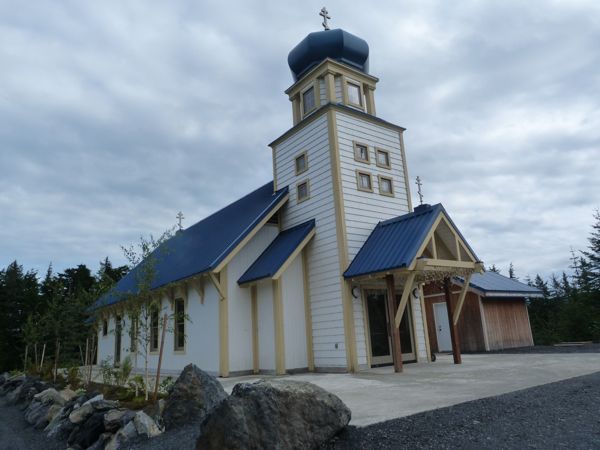
The primary business area of the village includes village council offices, a community center, the Russian Orthodox church, small boat harbor, the Alaska marine highway ferry terminal, and a future local display facility.
It felt so good to be able to get off and do some hiking. It was also a little overwhelming trying to imagine living in a village this small. Almost all the houses I saw looked exactly alike; maybe the tribe built them all. It is very very small and very isolated, the boat comes in once every week. There are no scheduled airlines, only charters.




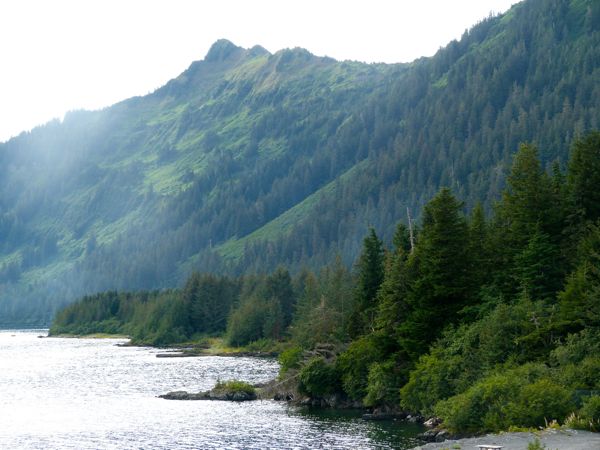
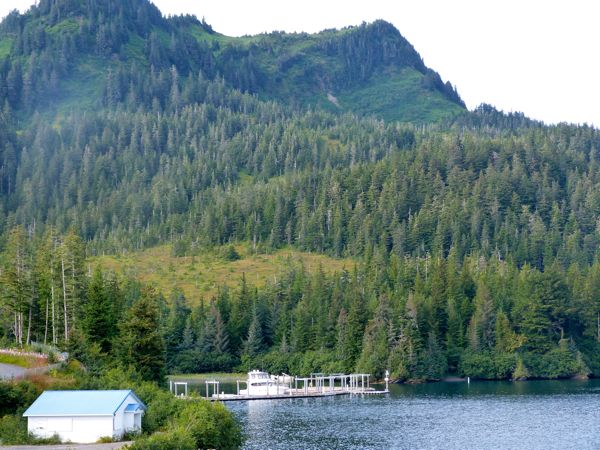
The Russian Orthodox Church, The Nativity of Theodokos, is very new, and very beautiful. We wondered where people sit? Or maybe there are chairs hidded away that are brought out for services, or brought from across the street at the Indian Affairs office? I always check, I love it that so many of the ikons look native. 🙂
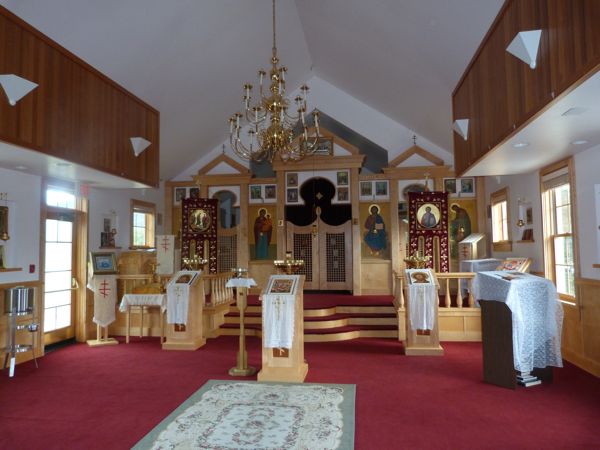


This last photo from the church is St. Herman of Alaska. Here is what Wikipedia says:
Saint Herman of Alaska (Russian: Преподобный Герман Аляскинский, c. 1750s – November 15, 1836) was a Russian Orthodox monk and missionary to Alaska, which was then part of Russian America. His gentle approach and ascetic life earned him the love and respect of both the native Alaskans and the Russian colonists. He is considered by many Orthodox Christians as the patron saint of North America.[1]
The patron saint of North America?! Who knew?!
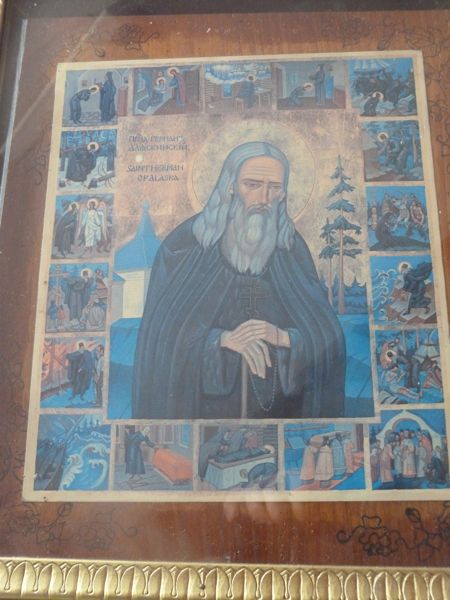
The Johnny Totemoff Museum is sometimes open – not today – and also sells homemade jams made from salmonberry and high mountain cranberries. I would have loved to have some of that! Johnny Totemoff was a local fisherman who always knew where the fish were, and was always coming to the rescue of other in troubled times. I love it that they named the museum after him. (Don’t you wonder how I knew that? On board the ship, they have a notebook at the Purser’s office they put out before you reach each stop. I read about the Totmnoff Museum in the Purser’s book.:-) Now you know.)
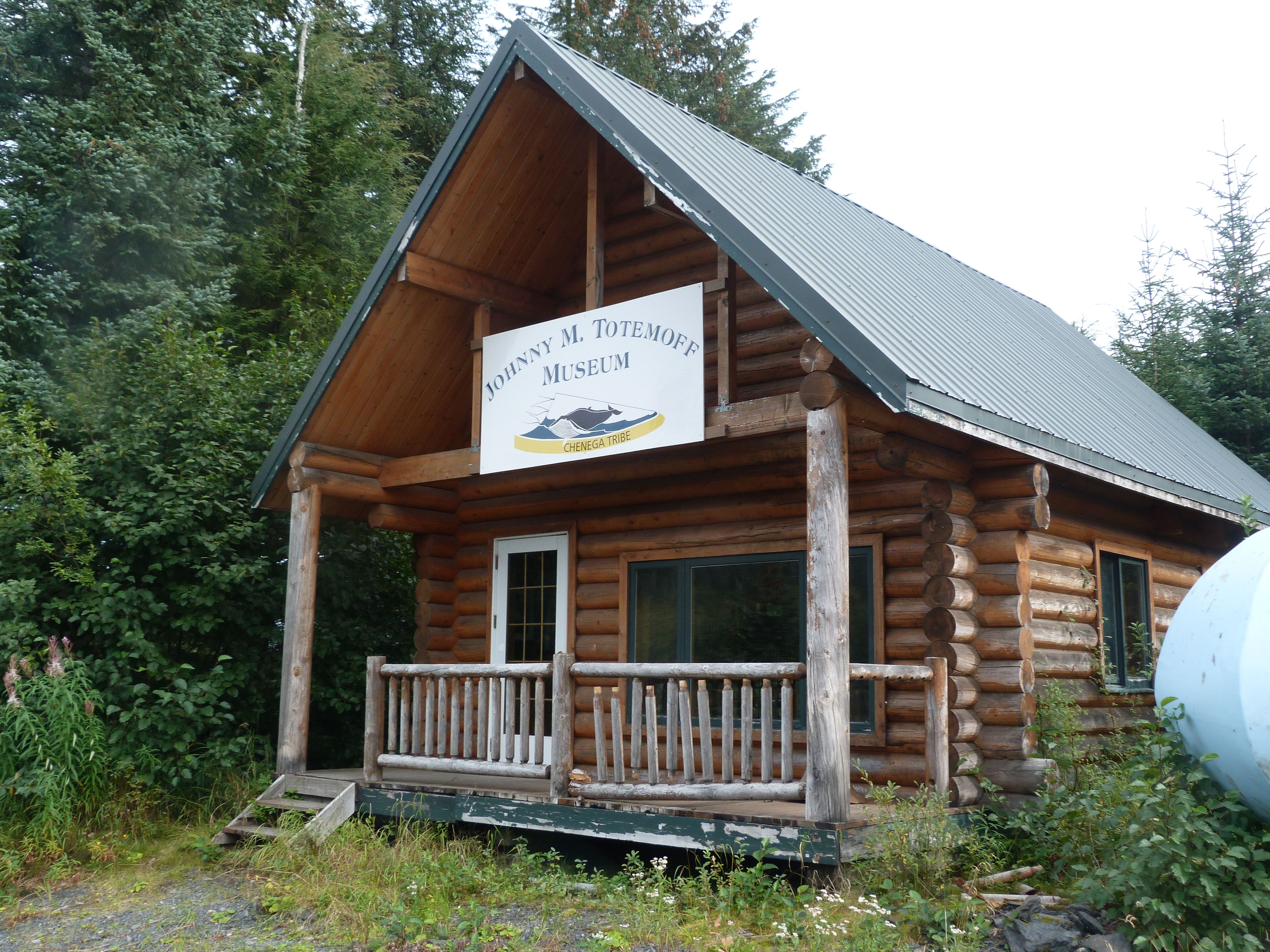
We loved watching the kids play – two of them were waiting for their father to come off the ship with their ice cream. They reminded me of my mom telling me of all the times she wanted to kill me because I did unsafe things, but oh, what fun!

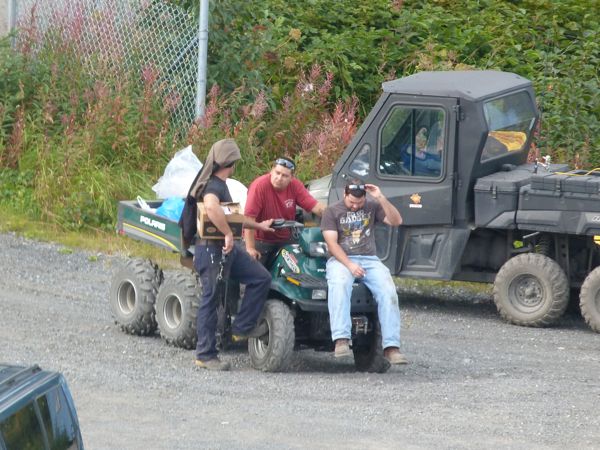
Local transportation:
This is not the Homer otter, this is the Chenega Bay otter, and totally by chance and not by talent, I caught him catching a fish!


Too soon, it is time to depart.

To Yakutat on the M/V Kennicott
Groan, docked at Yakutat early. Although we slept well, we are not eager to
debark at 0600, so we stay on the boat, which is a really fun decision.
AdventureMan discovers the upper aft viewing deck, inside and outside, and we
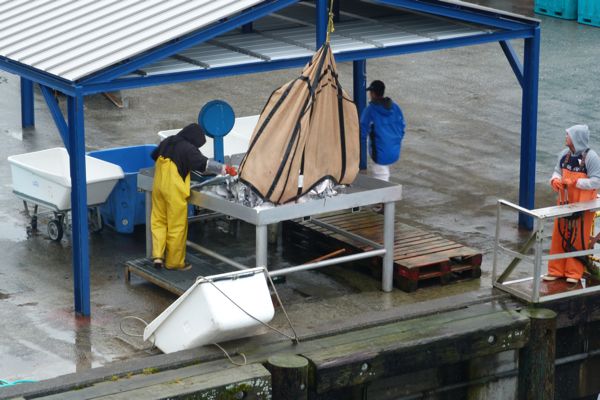
watch a fishing boat come in, the fisherman scurry up the slippery ladder, the
small tractors set up a weighing station and watch the fisherman upload his
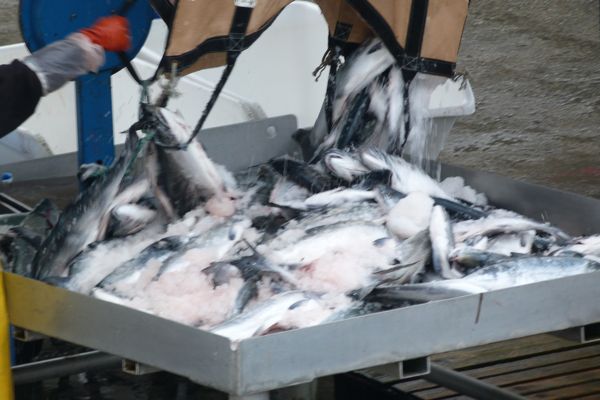
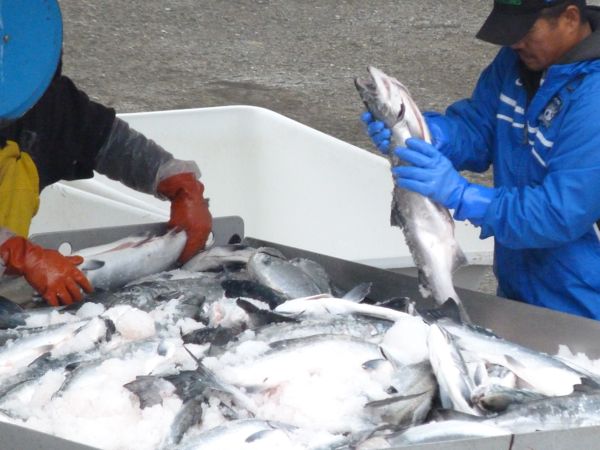
morning’s catch, and see it graded, weighed and sorted all in a matter of
minutes. Three huge loads! It’s a hard life, being a fisherman, a lot of heavy
lifting and working in the rain and stormy weather. 


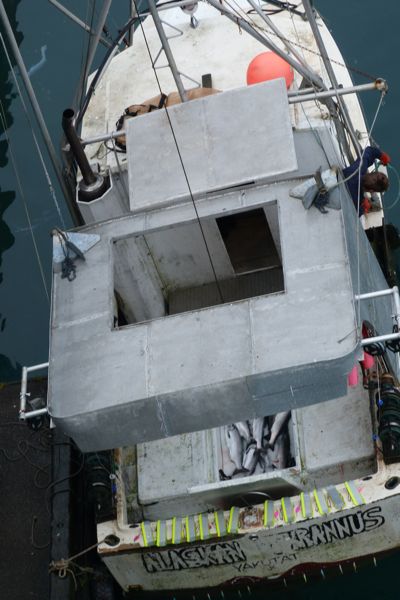




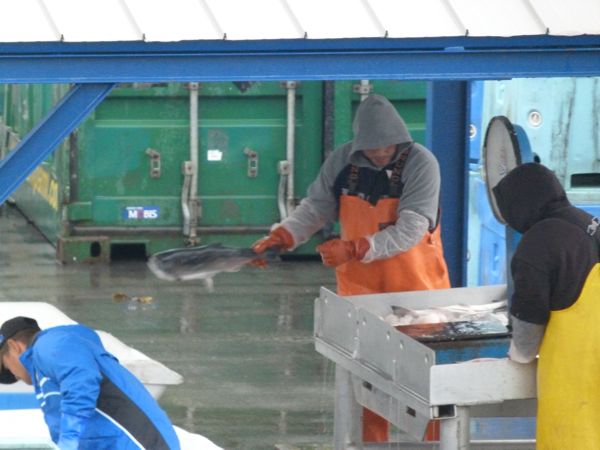
Yakutat is a small town, a fisherman’s town. Departing Yakutat:
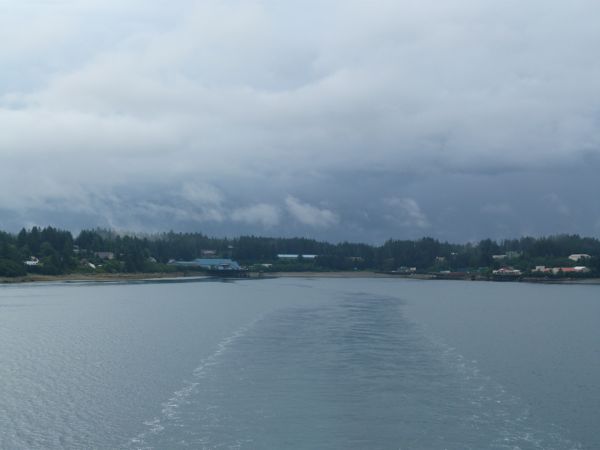
The rest of the day we are out in open water, and it is grey, grey, grey. I have to give the birders a lot of creds; they are manning the observation post in the bow and there are never fewer than three, with their bird spotting scopes.

We spend the afternoon alternately reading and walking all the decks to see if
we are missing anything. We are not. It is a dull day, not unlike many travel
days, the difference being that we have a nice private cabin where we can hang
out, re-charge our camera batteries, our phones, our iPad. It’s a good thing we
have the iPad, I can read, I can play Sudoku. I iPad allows me to
take notes (this was actually a note) because THERE IS NO WI-FI onboard. I am so shocked, I pretend to be cool about it but inside I am sort of freaking out. I just assumed there would be wi-fi everywhere. I was wrong.
AdventureMan, ever the gentleman, volunteered to take the upper bunk, but I
insisted. I am nimble on ladders, and I like being able to perch up here in my
lair and look out our window. I saw more Orcas playing the first day, and can
keep an eye out for when the sky lightens and the sun makes an appearance. Local weather people actually call these “sunbreaks.”

The cabin also has a generous supply of outlets – each bunk lamp in the cabin has an outlet plug, and then there are two other convenient double sockets.
We reserved a 4-bed with bath because we wanted an outside room – and because we like the convenience of having our own bathrooms. The two unused bunks are
stowed, and we have a large lounge chair, a table, and another chair. The toilet and shower are in a cabinet – lots of nice, hot water – and there is a sink outside the cabinet, with a mirror and another outlet, and separate overhead light. Very convenient, and it feels very roomy.
Years ago when I was off to college, the airlines were on strike and I had to
take the military ship Rose from Bremerhaven to the US and then fly Air Canada
to my university town. Just imagine – a military transport ship full of college
students. It was truly a wonderful time. I told AdventureMan this morning that I remember keeping my suitcase up in my bunk, and dressing up there as we only had like 14 inches between left side bunks and right side bunks, and with four
college girls, that wasn’t much. I can’t remember, but I don’t think we had our own toilet and shower, I think we had to use group ones. This cabin is about 8 feet across and 12 feet long, with the shower and toilet cabinet about 2.5 by 6 feet. It is tiny, but it works. We have a rack of hanging 32 hanging hooks, which might sound like a lot, but you use a lot of different outdoor clothing, layers of clothing; long sleeved shirts, hoodies, rain-gear, fleece, sweatshirts – the weather changes, you can be warm – but soaked.
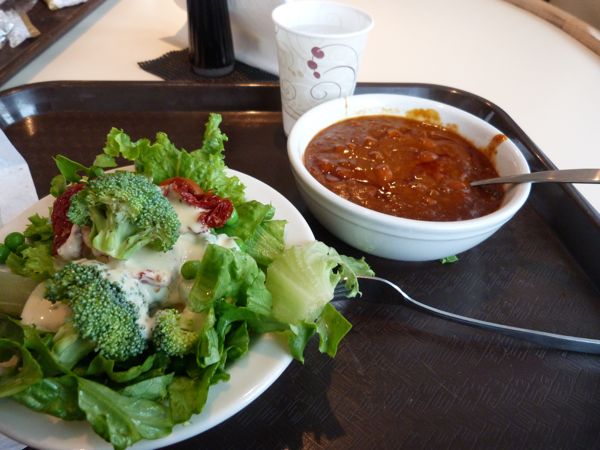
Lunch is warming and healthy:
Camels Source of MERS?

From today’s BBC News:
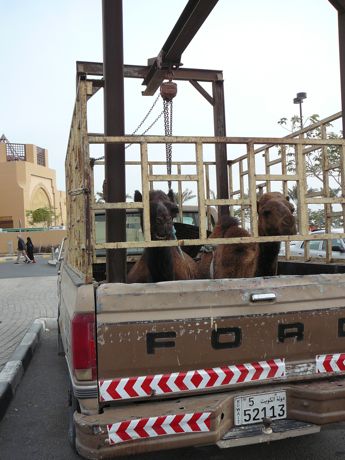
Mers coronavirus: Dromedary camels could be source
By Rebecca Morelle
Science reporter, BBC World Service
Dromedary camels could be responsible for passing to humans the deadly Mers coronavirus that emerged last year, research suggests.
Tests have shown the Mers (Middle East Respiratory Syndrome) virus, or one that is very closely related, has been circulating in the animals, offering a potential route for the spread.
The study is published in the journal Lancet Infectious Diseases.
But the scientists say more research is needed to confirm the findings.
The Mers coronavirus first emerged in the Middle East last year. So far, there have been 94 confirmed cases and 46 deaths.
While there has been evidence of the virus spreading between humans, most case are thought to have been caused by contact with an animal. But until now, scientists have struggled to work out which one.
‘Smoking gun’
To investigate, an international team looked at blood samples taken from livestock animals, including camels, sheep, goats and cows, from a number of different countries.
They tested them for antibodies – the proteins produced to fight infections – which can remain in the blood long after a virus has gone.
Professor Marion Koopmans, from the National Institute of Public Health and the Environment and Erasmus University in The Netherlands, said: “We did find antibodies that we think are specific for the Mers coronavirus or a virus that looks very similar to the Mers coronavirus in dromedary camels.”
The team found low levels of antibodies in 15 out of 105 camels from the Canary Islands and high levels in each of the 50 camels tested in Oman, suggesting the virus was circulating more recently.
“Antibodies point to exposure at some time in the life of those animals,” Prof Koopmans explained.
No human cases of the Mers virus have been reported in Oman or the Canary Islands, and the researchers say they now need to test more widely to see if the infection is present elsewhere.
This would include taking samples from camels in Saudi Arabia, the country where the virus is the most prevalent.
‘Priority search’
Prof Koopmans said: “It is a smoking gun, but it is not definitive proof.”
Commenting on the research, Professor Paul Kellam from the Wellcome Trust Sanger Institute in Cambridge and University College London, said the research was helping to narrow down the hunt for the source of the virus.
But he told BBC News: “The definitive proof would be to isolate the virus from an infected animal or to be able to sequence and characterise the genome from an infected animal.”
Health officials say confirming where the virus comes from is important, but then understanding how humans get infected is a priority.
Gregory Hartl, from the World Health Organization, said: “Only if we know what actions and interactions by humans lead to infection, can we work to prevent these infections.”
Data suggests that it is not yet infectious enough to pose a global threat and is still at a stage were its spread could be halted.
Uwem Akpan and Say You’re One of Them

This is a very troubling book, and, for me, a difficult book to read. It has taken me weeks, and I will admit I have often interrupted the reading of it to read other, easier books. This book makes me very uncomfortable. The stories and images trouble my sleep.
Uwem Akpan is of the tribe of Annang, from Nigeria, and has committed to an even larger tribe, the Catholic Church, of which he is a priest, and this gives him a unique perspective. The stories in this book often focus on tribal differences, including religious differences, and although they are set in different African states, have parallels in lives lived elsewhere. Those tribal differences are between Moslem and Christian, but also between Pentecostal and Catholic, Tutsi and Hutu, and, most significantly, the differences between to tribe of the very poor and the very rich.
Each story is told through the eyes of a child living in a different African state – Kenya, Benin, Ethiopia, Nigeria, Rwanda.
In one of my favorite segments of the book, strife has broken out in Nigeria, strife between the Moslems and the Christians, but also throw in the Pentecostals and the Pagans and really mix it up. A bus is waiting in the bus station to take people back to the southern part of Nigeria, and on this bus is a young man, half Moslem, half Christian. The bus stands idle for hours, while the bus driver seeks fuel to make the trip. During this time on the bus, many conversations take place, and what I loved was how alliances shifted with each conversation. The people on the bus were from different traditions, but came together as a community. No community is without arguments and dissensions, however, and consensus builds, diminishes, shifts – it is a microcosm of the tensions and stressors pulling apart the Nigerian nation state.
Uwem Akpan treats the children in each story lovingly, treasuring their innocent perspective and the sweetness of their hearts and vision. The adults don’t come off so well, passing their days in drug-induced stupors, drunk, selling children into slavery and prostitution, chopping off their limbs with machetes, and closing themselves off into groups which protect themselves and exploit others.
It would be an easier book to read if it were about aliens, or if these stories were confined to Africa, but the stories of these abused, neglected and exploited children echo in every continent, country and city in the world.
Uwem Akpan writes prose that is poetry; the surroundings are described with such detail that you feel in the moment, you see through the eyes of each child, and you see things that are beautiful as well as scenes you did not want to see. As you can see, I have a lot of ambiguous feelings about this book. At the same time I can admire the writing, the stories have left images in my mind that cannot be erased. Dark images. There is hope in the persistence and resilience of many of the children, but concern about their long term survival. It leaves a heavy weight on my heart.
Recent Comments
ExpatAlien on What Country am I Living … intlxpatr on Yellowstone: Old Faithful to C… Michelle on Yellowstone: Old Faithful to C… Cathy on No Grown-Ups in Charge intlxpatr on Waiting for Snow Wikipedia Donate Button

Amazina


Early Voting in Florida


 Here There and Everywhere