LLOOLLLL, oh please, please do NOT vote for this man!

July 27, 2013
Posted by intlxpatr |
Communication, Humor, iPhone, Mating Behavior, Photos, Political Issues, Values, Women's Issues, Work Related Issues | Anthony Weiner, selfies, sexting |
Leave a comment
What do you think? While ministers in Saudi Arabia seem unconcerned, this virus, which appears to have originated among an as yet unidentified animal in Saudi Arabia, kills about half the people infected with it. And soon, with the Hajj, the Moslem pilgrimage to Mecca, thousands will travel to Saudi Arabia, testing the theory that this virus does not spread easily. . .
Mers: New virus ‘not following Sars’ path’
By James Gallagher
Health and science reporter, BBC News
The new Mers virus, which has killed half of those infected, is “unlikely” to reach the same scale as Sars, ministers in Saudi Arabia say.
Most of the 90 Mers cases reported so far have been in Saudi Arabia.
Mers is from the same group of viruses as the common cold and Sars, which killed 774 people.
However, a detailed analysis of the Saudi cases, published in Lancet Infectious Diseases, did warn of “major gaps” in understanding of the virus.
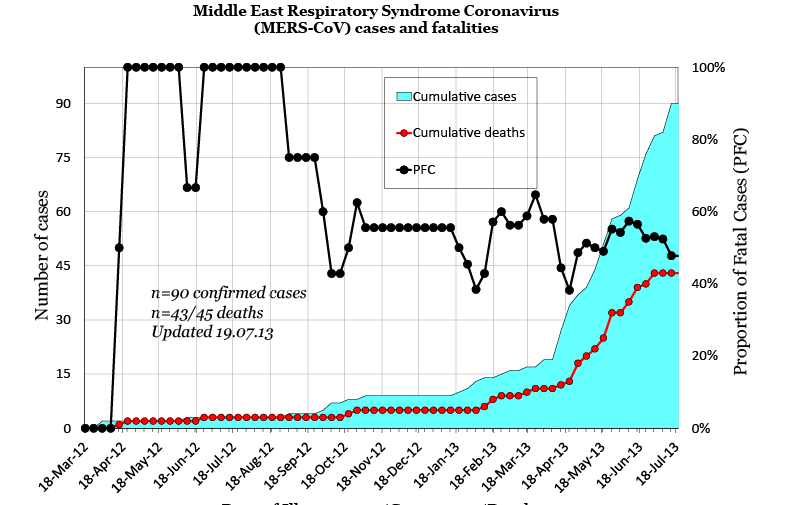
The Middle East respiratory-syndrome coronavirus (Mers) emerged in 2012 and has infected 90 people worldwide, 45 of them have died.
The global concern is that cases could spread much further, echoing the Sars outbreak.
Cases have been centred on the Middle East – with patients in Jordan, Qatar, Saudi Arabia and the United Arab Emirates. Additional cases in France, Germany, Italy, Tunisia and the UK have all been linked to travel to the Middle East.
Researchers in Saudi Arabia have published details of the 47 cases reported in the country.
They suggest a pattern of mostly older men being infected. Most cases were also in people with other medical problems, more than two-thirds of the reported cases also had diabetes.
Low threat
The lead researcher and Deputy Minister for Public Health, Prof Ziad Memish, said: “Despite sharing some clinical similarities with Sars, there are also some important differences.
“In contrast to Sars, which was much more infectious especially in healthcare settings and affected the healthier and the younger age group, Mers appears to be more deadly, with 60% of patients with co-existing chronic illnesses dying, compared with the 1% toll of Sars.
“Although this high mortality rate with Mers is probably spurious due to the fact that we are only picking up severe cases and missing a significant number of milder or asymptomatic cases.
“So far there is little to indicate that Mers will follow a similar path to Sars.”
A report earlier this month showed that the virus struggled to spread in people.
However, it and the latest Saudi investigation both highlighted the need to find where the virus was coming from.
Prof Memish’s report said: “Reducing the rate of introduction of Mers coronavirus into human beings is unpredictable because the source of the virus is not yet known.
“We are searching vigorously for the source.”
Here is a graph from a private report called Virology Down Under, a fascinating read on the identification and development of the MERS Virus by Middle East Respiratory Syndrome Coronavirus (MERS-CoV)..
Last Updated 19-Jul-2013
Written by Ian M. Mackay, PhD on his personal time.
All opinions are his own and do not represent medical advice or the views of any institution.:

July 26, 2013
Posted by intlxpatr |
Health Issues, Living Conditions, Saudi Arabia, Spiritual, Travel, Work Related Issues | MERS virus |
Leave a comment
From AOLs Daily Finance Page:
By Mark Johanson
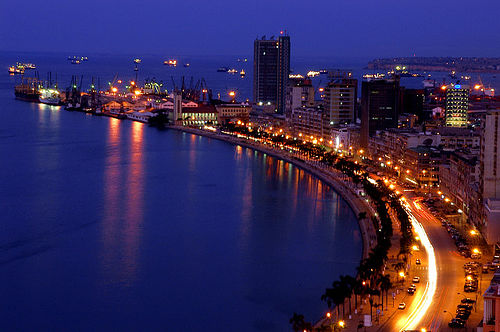
Where is the world’s most-expensive city for expatriates? It’s not notoriously pricey Tokyo. It’s not wallet-shrinking Sydney, Moscow or Oslo. And it’s definitely not surprisingly cheap New York City. Rather, it’s an African seaport you’ve probably never heard of: Luanda, Angola.
This finding from U.S. consulting firm Mercer underscores its annual survey’s purpose: to assess the cost of living around the world so that multinational companies and governments can determine appropriate compensation allowances for their expatriate employees. After all, more than half of oil-rich Luanda’s 5 million residents live below the poverty line.
“Despite being one of Africa’s major oil producers, Angola is a relatively poor country, yet expensive for expatriates since imported goods can be costly,” Barb Marder, senior partner and Mercer’s global mobility practice leader, said. “In addition, finding secure living accommodations that meet the standards of expatriates can be challenging and quite costly.”
Mercer noted in the survey that the difference in cost of various everyday items could be dramatic from country to country. The average cup of coffee, for example, costs about $1.54 in Managua, Nicaragua, while it costs $8.29 in Moscow. A fast-food hamburger meal in Kolkata, India, costs $3.62, compared to $13.49 in Caracas, Venezuela. A ticket to the cinema, meanwhile, can run between $5.91 in Johannesburg and up to $20.10 in London.
Cost of accommodation was another major factor Mercer looked at, and a one-month unfurnished luxury rental in Hong Kong topped the world at about $7,092 — more than 20 times as much as in Karachi, Pakistan. Yet, it was Moscow that crept in just below Luanda as the second-most expensive city for expats, followed by Tokyo, Chad’s capital city of N’djamena, and Singapore.
“Recent world events, including economic and political upheavals, which resulted in currency fluctuations, cost inflation for goods and services, and volatility in accommodation prices have impacted these cities making them expensive,” Marder explained.
Mercer assessed a total of 214 cities across five continents for its 2013 survey, analyzing data from March 2012 to March 2013. Cities were then ranked by the price of housing, transport, food, entertainment and clothing, and ordered on the joint cost of 200 items compared to the benchmark, New York City.
“Given the increasing numbers of business travelers, global ‘commuters’ and longer-term expatriates, companies are keeping a close eye on the cost of living for international assignees in different cities around the world,” Marder said, explaining the purpose of the study. “Organizations need to evaluate the impact of currency fluctuations, inflation, and political instability when sending employees on overseas assignments while ensuring they can facilitate the moves they need to drive the business results by offering fair and competitive compensation packages.”
Nathalie Constantin-Métral, principal at Mercer with responsibility for compiling the survey ranking, said that, overall, cost of living went up across parts of Europe, while it went down in much of Asia. Japan dropped significantly from last year due to a weakening of the yen against the U.S. dollar.
In the Americas, meanwhile, South American cities were the most expensive for expatriates, while Canadian cities moved down in rankings due to a slight decrease of the Canadian dollar against the U.S. dollar. New York remained the most-expensive urban center in the U.S.
“Overall, U.S. cities either remained stable in the ranking or have slightly decreased due to the movement of the U.S. dollar against the majority of currencies worldwide,” Constantin-Métral said. “Yet several cities, including New York, moved up in the ranking due to a rise in the rental accommodation market.”
July 26, 2013
Posted by intlxpatr |
Eating Out, Entertainment, ExPat Life, Family Issues, Financial Issues, Food, Shopping, Statistics, Work Related Issues | Cost of Living, Luanda |
Leave a comment
From today’s AOL/Huffpost:
DUBAI, United Arab Emirates — A Norwegian woman sentenced to 16 months in jail in Dubai for having sex outside marriage after she reported an alleged rape said Friday she decided to speak out in hopes of drawing attention to the risks of outsiders misunderstanding the Islamic-influenced legal codes in this cosmopolitan city.
The case has drawn outrage from rights groups and others in the West since the 24-year-old interior designer was sentenced Wednesday. It also highlights the increasingly frequent tensions between the United Arab Emirates’ international atmosphere and its legal system, which is strongly influenced by Islamic traditions in a nation where foreign workers and visitors greatly outnumber locals.
“I have to spread the word. … After my sentence we thought, `How can it get worse?'” Marte Deborah Dalelv told The Associated Press in an interview at a Norwegian aid compound in Dubai where she is preparing her appeal scheduled for early September.
Dalelv, who worked for an interior design firm in Qatar since 2011, claims she was sexually assaulted by a co-worker in March while she was attending a business meeting in Dubai.
She said she fled to the hotel lobby and asked for the police to be called. The hotel staff asked if she was sure she wanted to involve the police, Dalelv said.
“Of course I want to call the police,” she said. “That is the natural reaction where I am from.”
Dalelv said she was given a medical examination seeking evidence of the alleged rape and underwent a blood test for alcohol. Such tests are commonly given in the UAE for alleged assaults and in other cases. Alcohol is sold widely across Dubai, but public intoxication can bring charges.
The AP does not identity the names of alleged sexual assault victims, but Dalelv went public voluntarily to talk to media.
Dalelv was detained for four days after being accused of having sex outside marriage, which is outlawed in the UAE although the law is not actively enforced for tourists as well as hundreds of thousands of Westerners and others on resident visas.
She managed to reach her stepfather in Norway after being loaned a phone card by another woman in custody.
“My stepdad, he answered the phone, so I said, that I had been raped, I am in prison … please call the embassy,” she recounted.
“And then I went back and I … just had a breakdown,” she continued. “It was very emotional, to call my dad and tell him what happened.”
Norwegian diplomats later secured her release and she has been allowed to remain at the Norwegian Seamen’s Center in central Dubai. She said her alleged attacker received a 13-month sentence for out-of-wedlock sex and alcohol consumption.
Dubai authorities did not respond to calls for comment, but the case has brought strong criticism from Norwegian officials and activists.
“This verdict flies in the face of our notion of justice,” Norway’s foreign minister, Espen Barth Eide, told the NTB news agency, calling it “highly problematic from a human rights perspective.”
Previous cases in the UAE have raised similar questions, with alleged sexual assault victims facing charges for sex-related offenses. Other legal codes also have been criticized for being at odds with the Western-style openness promoted by Dubai.
On Thursday, Dubai police said they arrested a man who posted an Internet video of an Emirati beating a South Asian van driver after an apparent traffic altercation. Police said they took the action because images of a potential crime were “shared.”
In London, a spokesman for the Emirates Center for Human Rights, a group monitoring UAE affairs, said the Dalelv case points out the need for the UAE to expand its legal protections for alleged rape victims.
“We urge authorities to reform the laws governing incidents of rape in the country,” said Rori Donaghy, “to ensure women are protected against sexual violence and do not become the targets of prosecution when reporting crimes.”
July 20, 2013
Posted by intlxpatr |
Bureaucracy, Crime, Cross Cultural, Cultural, Detective/Mystery, ExPat Life, Living Conditions, Social Issues, Women's Issues, Work Related Issues | Dubai |
2 Comments
In today’s A Word a Day, Anu Garg quotes that great science fiction writer, Robert Heinlein. If you don’t know him, get a copy of his Stranger in a Strange Land, and move on from there. He makes you laugh, and cry, and THINK. I am in the middle of reading World War Z, very different from the movie, very thought provoking, and this quote fits beautifully the mid-crisis work of survival after society has collapsed. People need to be able to do things with their hands, things that help with the very real business of survival:
Science-fiction author Robert Heinlein once said, “A human being should be able to change a diaper, plan an invasion, butcher a hog, conn a ship, design a building, write a sonnet, balance accounts, build a wall, set a bone, comfort the dying, take orders, give orders, cooperate, act alone, solve equations, analyze a new problem, pitch manure, program a computer, cook a tasty meal, fight efficiently, die gallantly. Specialization is for insects.”
(How can you not love a man who believes that everyone should be able to change a diaper?)
I’ve always wanted to spin wool. I think I need to learn. I’ve often thought about how we would manage the basic necessities in a post-unthinkable-collapse society, you know, the basics like food, shelter, clothing, medications . . . Maybe, living in the South, I should learn how to work with cotton . . . or linen. Now I have to find out if flax will grow in Florida . . .
July 15, 2013
Posted by intlxpatr |
Arts & Handicrafts, Civility, Community, Experiment, Family Issues, Financial Issues, Health Issues, Living Conditions, Political Issues, Survival, Technical Issue, Work Related Issues |
5 Comments
Updated 5:42 p.m. | The Queens private detective who raped his ex-girlfriend and then framed her for a series of fictional crimeswas sentenced to the maximum of 32 years in prison on Wednesday, bringing to a close one of the most bizarre cases to grace a courtroom.
Using knowledge he acquired partly from watching crime dramas like “C.S.I.,” the private detective, Jerry Ramrattan, 39, orchestrated what prosecutors in Queens called one of the most elaborate frame-ups in recent history.
Mr. Ramrattan’s ex-girlfriend, Seemona Sumasar, 36, had accused him of raping her. After she refused to drop the rape charges, he concocted a schemethat landed her in jail for seven months, making it seem as though Ms. Sumasar was the likely perpetrator of a series of brazen armed robberies, for which she was accused of impersonating a police officer.
At his trial in State Supreme Court in Queens, prosecutors produced evidence that Mr. Ramrattan cajoled and extorted witnesses to falsely testify that she had robbed them. He even staged fake crime scenes, prosecutors said, in which he planted evidence, handcuffing one of Ms. Sumasar’s supposed victims to a pole and planting several bullets at the scene of one of the imaginary crimes.
Before Mr. Ramrattan was sentenced on Wednesday, Ms. Sumasar delivered a stinging victim impact statement, noting that he showed no remorse and was so intent on revenge that he would have stopped at nothing to destroy her. “I don’t have words for you,” she said as as he stared ahead, stone-faced, while she spoke. “You are pure evil. You are a sociopath. You need help.”
“Someone needs to put a stop to your madness,” she added.
During her seven months in jail, awaiting a robbery trial, Ms. Sumasar, a former Morgan Stanley analyst, was separated from her young daughter. She lost her business, and her house went into foreclosure. Her bail was set at $1 million, which she could not afford. Mr. Ramrattan, meanwhile, was free until an informant came forward in late 2010 and exposed his plot.
Mr. Ramrattan was convicted in November of a series of charges, including rape, conspiracy and perjury. The nearly monthlong trial offered two opposing plot lines that were seemingly irreconcilable. Prosecutors portrayed Ms. Sumasar as a single mother duped by a wily confidence man intent on malicious vengeance. But the defense characterized her as a dejected lover who had turned on Mr. Ramrattan after he said he was leaving her to return to his wife and family.
Members of the jury said the guilty verdict was predicated on their acceptance of Ms. Sumasar’s account of being bound with duct tape and viciously raped by Mr. Ramrattan, which apparently gave him a motive to create his ruse.
In his plea for leniency, Mr. Ramrattan insisted that he was innocent, saying that he had spent years helping the police solve cases as an informant. “I stand before you with no choice but to accept what is going to happen,” he said. “Think about all the cases I made over the years, the rape victims I assisted. I maintain my innocence.”
Before he was escorted away by police, he added: “There is more to come.” As he spoke, his mother, Shirley Ramrattan, began wailing and was escorted from the courtroom.
His lawyer, Frank Kelly, told the judge that Mr. Ramrattan was not the “monster” he had been made out to be.
But Justice Richard Buchter said Mr. Ramrattan deserved no mercy, calling him a “diabolical conniver and sinister manipulator” who had “shamelessly exploited the criminal justice system.”
The Queens district attorney’s office and the Nassau County district attorney’s office had insisted on Ms. Sumasar’s guilt up until she was freed just weeks before her own robbery trial was set to begin. Ms. Sumasar filed a civil suit in December against the New York City Police Department and the Nassau County Police Department for negligence leading to her wrongful imprisonment..
Justice Buchter railed against the Nassau County police, who had wrongly imprisoned Ms. Sumasar, saying that it did not take “a Sherlock Holmes” to deduce that a 5-foot-2 former Wall Street analyst with no criminal record would not have held people up at gunpoint.
He chastised the police for their egregious handling of the case, saying detectives had “turned a blind eye” to Ms. Sumasar’s protestations that she was innocent and had too easily been taken in by Mr. Ramrattan.
“The police were duped by liars by whom they had a right to be suspicious, and as a result a rape victim was framed by her rapist,” the judge said. “She was victimized by the rapist and then again by the criminal justice system.”
He added: “The defendant is the architect of his own ruin. He deserves no mercy from me, and he won’t get any.”
July 14, 2013
Posted by intlxpatr |
Community, Crime, Family Issues, Financial Issues, Law and Order, Lies, Mating Behavior, Relationships, Scams, Women's Issues, Work Related Issues |
Leave a comment
It doesn’t matter how enlightened the legislation – if the law is not enforced, the rules on the book are laughable. It gives the illusion of a lawful society, but if citizens know that they will not be penalized for breaking the law, they will scoff at the law and do as they please. People who came to the country expecting to make a fair wage and be treated decently and with dignity find themselves without proper paperwork due to the corruption of their employer or recruiter.
If the MOI in Qatar enforces this law, a terrible situation will be slightly better. This, from The Qatar Gulf Times:
By Ramesh Mathew/Staff Reporter
| With the Ministry of Interior (MoI) taking a firm stand on ID cards, residents believe that this will safeguard the interests of workers as their employers will now be forced to abide by the rules. |
A report in the Tuesday edition of Gulf Times had quoted a senior official as saying that residents should always carry their residence permit ID cards and produce the same whenever asked by the authorities concerned. Those failing to do so would be fined up to QR10,000, the report had said, adding that the MoI could also transfer the sponsorship of expatriates if they proved that they were abused by sponsors under Law No 4/2009.
Welcoming the MoI’s decision, legal expert and rights activist Nizar Kochery said this would make employers more accountable as any long delay or failure on their part to stamp the visas of their staff would invite a hefty fine.
“There have been cases of companies refusing to stamp visas for long periods and workers being picked up by the law-enforcing agencies for failing to produce valid residence proof,” said Kochery, adding that the ministerial reaffirmation would force employers to stamp visas promptly.
Reacting to the report, an Asian diplomat said his country’s mission frequently received complaints from people alleging that their employers had not stamped their visas even months after their arrival in Qatar.
“The embassy receives such complaints from expatriates every week though there has been a drastic fall in their numbers in recent times due to strict enforcement of the rules by the local authorities,” he added.
Kochery said there should also be stringent implementation of the rules pertaining to expatriates’ passports. “Though the ministry issued guidelines more than three years ago on the issue of custody of passports, complaints of violation of this norm continue,” the legal expert said.
The ministry had instructed employers to hand over the passports of employees after the completion of formalities. However, there have been cases of some employers retaining the passports in violation of the local rules.
“A similar fine (like the one for not carrying IDs) should be imposed on erring employers for illegally keeping their workers’ passports,” he said.
A few years ago, this newspaper had reported about a theft in a manpower company’s office in Musheireb. More than 150 passports of workers, which the firm had kept in its custody in violation of rules, went missing in the incident. Meanwhile, residents have also said similar penalties were required to curb violations regarding exit permits as well. A social activist in the Indian community said there have been complaints of employers failing to arrange exit permits for their workers on time even during emergencies.
There have also been reports of residents, mainly drivers, lodging complaints with embassies, alleging that their sponsors take away their licences when they go on vacation.
“The MoI should consider imposing hefty fines on such employers as well. Like a passport, a driving licence is not only the property of an individual, but is also a proof of identification under the local rules,” said Kochery.
July 11, 2013
Posted by intlxpatr |
Bureaucracy, ExPat Life, Interconnected, Kuwait, Law and Order, Leadership, Lies, Living Conditions, Pet Peeves, Qatar, Relationships, Scams, Social Issues, Transparency, Work Related Issues | exit permits, Ministry of Interior, passports, resident IDs |
Leave a comment
It looks like rather than investing in better highways, Qatar will follow in Kuwait’s footsteps to restrict driver’s licenses. This is another example of a law that invites unequal enforcement. “Ambiguous” implies that the rule will not be applied to everyone, but will be subject to bribery and connections to the right people.
Why do I even care, you might ask. As a white Western woman, this rule won’t apply. I won’t be stopped in traffic stops; if I am, and can’t show a valid license, I will politely be told I need to get one. But I publish this because it isn’t fair. It applies to my fellow expat wives, as well as to the hairdresser who would come to my home to cut my hair, or the carpenter with his own little business who wants to deliver the new couch he made for me. And, if the traffic doesn’t get better by eliminating catagories of employment, the next step considered is often eliminating licenses for WOMEN.
If the taxi situation in Doha were not so abysmal, it could be bearable not to have a license, but once the state took over the taxi business and ruthlessly clamped down on independently owned and operated taxis, taxi transportation was no longer the blessing it once was. Even at the most posh hotels in town, you might wait an hour for a taxi to show up. Or maybe things have radically improved in the time since I have been gone, but I somehow doubt it.
From the Qatar Gulf Times:
Driving schools in Qatar have started “implementing” the Traffic Department’s decision to make certain categories of expatriate workers ineligible for driving licences but there was some ambiguity in the whole exercise as the plan is in its initial phase, sources yesterday said.
According to an unofficial list those who are eligible include sales representatives, accountants, administrators, representatives, sales supervisors, receptionists, clearance agents and fitness trainers. Also, professionals like doctors, engineers, pilots, architects and lawyers will find no problem in getting a licence.
However, people who work as clerks, stewards, cashiers, salesmen, foremen, tailors, blacksmiths, masons, cooks, carpenters, plumbers, painters, electricians, mechanics, computer technicians, waiters, barbers, beauty saloon workers, store keepers, photographers and secretaries will not be issued driving licences.
People who are brought to the country on driver visas, whether they are sponsored by companies or individuals, will not find it difficult to get a licence, the source said.
An employee of a driving school said the Traffic Department had yet to issue an official and final roster of categories that will be allowed to apply for a licence.
“Right now, they are in the process of implementing the new rule and so there is some ambiguity,” he said.
The licensing section of the Traffic Department had earlier issued a circular limiting the issuance of driving licences to certain categories of expatriate workers. The move is aimed at easing traffic congestion on Qatar roads.
The source also referred to another change in policy where students who failed the road test four times might not be given a fifth chance anymore.
He disclosed that there was a plan to ban old cars on Qatar’s roads. “The new rules will be implemented very strictly.”
Earlier reports said that the Central Municipal Council (CMC) members had welcomed the move, saying it would significantly contribute to reducing the growing number of new vehicles on roads, which was cited as one of the major causes of traffic jams.
The source said the Traffic Department will also study the impact of the new rule in the coming months.
July 11, 2013
Posted by intlxpatr |
Bureaucracy, ExPat Life, Living Conditions, Political Issues, Qatar, Social Issues, Survival, Technical Issue, Transparency, Values, Women's Issues, Work Related Issues |
Leave a comment
When you read this article from the Kuwait Times, you will see that the requirements for obtaining a Kuwait driver’s license are not new, but enforcing the requirements – if it happens – will be new. It will make Kuwait more like Saudi Arabia for expat wives, where women cannot drive their own car to pick up the laundry or drop the kids off at school or go grocery shopping – unless, in the case of Kuwait, she has a university degree AND has lived in Kuwait for two years AND is employed earning 400KD. No mere expat wife will have a driver’s license under these guidelines.
But these are the same guidelines that were in effect when I arrived in Kuwait. When I was in Kuwait on a house hunting trip before moving there, I asked how this would work, with me not being able to have a license, according to the rules. I was asking Kuwaiti officials. They said that the rules did not apply to me. (This answer still stuns me.) So where is it written to whom the law applies? The office of the Interior Ministry for Traffic Affairs will have a great deal of leeway making their approvals – will they apply this law equally to all peoples of all nationalities?
No licenses without traffic chief’s nod
KUWAIT: The Interior Ministry’s Assistant Undersecretary for Traffic Affairs Maj Gen Abdulfattah Al-Ali issued a decision yesterday to stop the acceptance of applications for driving licenses from non-Kuwaitis (expatriates and bedoons) unless they are approved by his office. The decision number 61/2013 went into effect from July 1, 2013, and allows the undersecretary’s office to inspect every application forwarded by foreigners and stateless residents in order to verify whether they meet the conditions to apply for a driving license. Ali reportedly threatened traffic department officials with retribution if they fail to abide by the new instructions.
According to security sources who spoke to a local daily, the decision came after cases were discovered in which manipulations were found in some departments where licenses were issued to expatriates who do not meet the requirements. A foreign resident in Kuwait must have a university degree, a minimum monthly salary of KD 400 and have been residing in Kuwait for at least two years among other conditions to apply for a driving license.
The sources also argued that the new decision does not take away the authority of traffic departments around Kuwait. “The departments’ main role is to issue licenses to Kuwaitis, while issuing licenses to expatriates is the exception,” they said, adding the decision means transferring the exception to the assistant undersecretary’s office so that traffic department officials can focus on their jobs of serving citizens and putting more traffic police officers on the streets.
“Any decision – even if it’s for the safety and organization of traffic regulations in the country – issued suddenly without informing the public in advance will surely create hostility,” said attorney Labeed Abdal, a Kuwaiti columnist. “I advise the good undersecretary to hold a press conference to explain to the people why such a regulation is needed. In this way you send the message correctly to people who will not be angry or surprised,” he added. Abdal agreed that the decision is directed to ease traffic jams in the country blamed on reckless drivers. “I think the decision is good. Be informed that he (Ali) did not stop it completely – he said he will give a chance, under his ultimate mercy. He did this to avoid license forgery and wasta (influence),” he stressed.
Another Kuwaiti was not very happy about the new decision. “(A driving license) is the right of every human being…why can’t they understand this. This decision is short of saying ‘just terminate all the services of expatriates in Kuwait’. Why are expats here if you cannot provide the facilities they need. I ask the official (Ali) to try at least once to ride in a bus or even wait for a taxi. If he can stay for one minute under the scorching heat of the sun, then OK, cancel the licenses of expats. If not, forget about your decision – it’s inhuman and cannot be accepted,” he fumed.
I do not agree that a driving license is a right of every human being. I do believe that those under 18 should not be driving on the roads of Kuwait – I don’t mind them learning how to drive out in the desert, but save the testosterone driving for way out there where you can’t endanger the rest of us. I don’t believe people who don’t know the laws should have a license. I think there should be a test that every person can study for and must pass to have a driver’s license, otherwise you are simply saying that every human being has a right to a license to kill! I believe that every driver must be adequately insured to be licensed, and that the police must be impartial when determining fault in an accident. These are the rules that hold those responsible enough to drive the wild roads of Kuwait to be held accountable for their driving.
I applaud the sincerity with which Maj Gen Abdulfattah Al-Ali is striving to make the roads in Kuwait safer for all, and enforcing the law equally against all nationalities, even Kuwaitis. I hope he will remember transparency and accountability as he builds a truly modern and enforceable traffic system in Kuwait.
July 6, 2013
Posted by intlxpatr |
Cross Cultural, Cultural, Customer Service, ExPat Life, Family Issues, Financial Issues, Kuwait, Law and Order, Satire, Saudi Arabia, Social Issues, Transparency, Women's Issues, Work Related Issues | Driving in Kuwait, Maj Gen Abdulfattah Al-Ali |
Leave a comment
. . . Only 5 deportees allowed per Kuwait Air flight, deportees only allowed on Kuwait Air, so it takes 1200 flights just to export the deportees they have already lined up crowding the jails? Or is this 6000 already deported?
Is it orderly? Do people know why they are being deported? Do they have time to make arrangements for family and/or pets? Is there an appeal process? Are the courts also clogged? Are only illegals being deported?
Has anyone seen a breakdown of deportees by nationality?
From the Kuwait Times
6,000 illegal residents deported in 6 months – Jails getting overcrowded
KUWAIT: Nearly 6,000 people were deported over the past six months of crackdowns on illegal residents in Kuwait, a local daily reported yesterday, quoting Interior Ministry statistics as of June 23. According to a source, who agreed to provide the statistics to Al-Qabas on the condition of not being named in the report, as many as 25,000 expatriates were arrested during security campaigns carried out since the beginning of the year across Kuwait.
The source said around 15,000 people were later released after their employers submitted documents to prove that the workers were living legally in Kuwait. In other cases, workers whose visas had recently expired were released after their employers gave assurances to renew their visas immediately.
The source also revealed that some employers were required to sign undertakings that they would not to allow their employees to work in other firms before the workers were officially released.
In addition to people with expired visas, the continuing crackdowns are targeting expatriate laborers reported missing by their employers, as well as people holding Article 20 visas (for domestic helpers) but working in private firms, for which visas are issued under Article 18 of the labor law. However, the source stated, such security campaigns could be put on hold until further notice, with jails getting “overcrowded with detainees.”
The source indicated that nearly a thousand employers were blacklisted for allowing domestic workers to work for others. Furthermore, he said cooperation with the Ministry of Social Affairs resulted in the blacklisting of nearly 500 companies found guilty of visa trafficking.
The source also indicated that Kuwait Airways is currently the only airline used to transport deportees. A maximum of five deportees per flight are allowed, he added, in order to avoid trouble inside the airplane.
Minister of Social Affairs and Labor Thekra Al- Rashidi had announced in March the government’s intention to deport 100,000 foreigners this year, as part of a plan to reduce the expatriate population in Kuwait by one million within a decade.
The Interior Ministry never confirmed that the ongoing crackdowns on illegal residents were part of the deportation plan. In response to criticism from rights groups inside and outside Kuwait, Al-Rashidi later identified “marginal labor forces” as the target of the plan.
Kuwait is home to 2.6 million expatriates, who make up 68 percent of the country’s 3.8 million population.
Nearly 90,000 of them live illegally in the country, according to official numbers.
June 26, 2013
Posted by intlxpatr |
Bureaucracy, Community, Cultural, ExPat Life, Kuwait, Law and Order, Leadership, Social Issues, Work Related Issues |
5 Comments



 Here There and Everywhere