More Deaths than Birth for White Americans, a Minority in Three Decades
Don’t you love demographics? Demographics are a great forecasting tool, if you have the courage to use them. Demographics forced change on the United States military, forcing them to include women in more roles, recently increasing their job opportunities as the demographic pool dwindles. The same demographics are hurting the military budget now, as the huge bulge of baby-boomers retires, takes pensions and guaranteed free medical care, living a LONG time with more serious age-related illnesses, while the military struggles to allocate scarce resources.
Here is a fascinating factoid from The New York Times, a journal which notices small – but significant – changes, and gives us a little idea what the impact may be.
Census Benchmark for White Americans: More Deaths Than Births
By SAM ROBERTS
Published: June 13, 2013 232 Comments
Deaths exceeded births among non-Hispanic white Americans for the first time in at least a century, according to new census data, a benchmark that heralds profound demographic change.
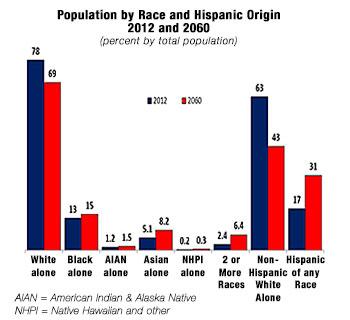
The disparity was tiny — only about 12,000 — and was more than made up by a gain of 188,000 as a result of immigration from abroad. But the decrease for the year ending July 1, 2012, coupled with the fact that a majority of births in the United States are now to Hispanic, black and Asian mothers, is further evidence that white Americans will become a minority nationwide within about three decades.
Over all, the number of non-Hispanic white Americans is expected to begin declining by the end of this decade.
“These new census estimates are an early signal alerting us to the impending decline in the white population that will characterize most of the 21st century,” said William H. Frey, a demographer with the Brookings Institution.
The transition will mean that “today’s racial and ethnic minorities will no longer be dependent on older whites for their economic well-being,” Dr. Frey said. In fact, the situation may be reversed. “It makes more vivid than ever the fact that we will be reliant on younger minorities and immigrants for our future demographic and economic growth,” he said.
The viability of programs like Social Security and Medicare, Dr. Frey said, “will be reliant on the success of waves of young Hispanics, Asians and blacks who will become the bulwark of our labor force.” The issues of minorities, he added, “will hold greater sway than ever before.”
In 2010, according to the National Center for Health Statistics, more non-Hispanic whites died than were born in 11 states, including California, Florida and Pennsylvania. White deaths exceeded births in a majority of counties, including Los Angeles, the most populous.
The disparity between deaths and births in the year that ended last July surprised experts. They expected that the aging white population would eventually shrink, as it has done in many European countries, but not for another decade or so.
Nationally, said Kenneth M. Johnson, the senior demographer at the Carsey Institute, a research center based at the University of New Hampshire, “the onset of natural decrease between 2011 and 2012 was not anticipated.” He attributed the precipitous shift in part to the recession, adding that “the growing number of older non-Hispanic whites, which will accelerate rapidly as the baby boom ages, guarantees that non-Hispanic white natural decrease will be a significant part of the nation’s demographic future.”
Professor Johnson said there were 320,000 more births than deaths among non-Hispanic whites in the year beginning July 2006, just before the recession. From 2010 to 2011, the natural increase among non-Hispanic whites had shrunk to 29,000.
Census Bureau estimates indicate that there were 1.9 million non-Hispanic white births in the year ending July 1, 2012, compared with 2.3 million from July 2006 to 2007 during the economic boom, a 13.3 percent decline. Non-Hispanic white deaths increased only modestly during the same period, by 1.6 percent.
The census population estimates released Thursday also affirmed that Asians were the fastest-growing major ethnic or racial group. Their ranks grew by 2.9 percent, or 530,000, with immigration from overseas accounting for 60 percent of that growth.
The Hispanic population grew by 2.2 percent, or more than 1.1 million, the most of any group, with 76 percent resulting from natural increase.
The non-Hispanic white population expanded by only 175,000, or 0.09 percent, and blacks by 559,000, or 1.3 percent.
The median age rose to 37.5 from 37.3, but the median declined in Alaska, Hawaii, Kansas, North Dakota and Oklahoma. It ranged from 64.8 in Sumter, Fla., to 23 in Madison, Idaho.
The number of centenarians nationally neared 62,000.
Continued Efforts to Deal with Expats in Kuwait
93,000 illegals in Kuwait?
Minimum wage KD500 for Dependency Visa?
Forced retirements?
During my years in Kuwait, I saw many sorry situations. It doesn’t matter where you are on the social scale, if you are not Kuwaiti, you are expat labor. When management, for whatever reason, wants you to go, you go. People who have lived in Kuwait 50 years, who are elderly, sent home, and sent home quickly, barely time to sell what you can’t take with you, people who have had a health setback and can’t work anymore, handed their papers and told their visas will no longer be valid in 30 days.
There is no point in romanticizing your position. You’re hired help. You think you have friends, but your friends are not going to help you live out your days and die in Kuwait. When your usefulness is over, they want you gone.
We often had to get special permission to bring in professional workers for critical jobs who were over – or even approaching – 60 years old. Long-in-the-tooth is not a highly valued characteristic for imported labor.
Have an exit strategy.

The Kuwait Times title for this photo is “Illegals”
Embassies push for deportees’ rights – KD500 minimum wage proposed for dependency visa
From 30 May 2013 Kuwait Times:
KUWAIT: Two Asian embassies complained to Kuwaiti officials about the “arbitrary actions” taken during the deportation of illegal residents and lawbreakers, who were arrested in a series of crackdowns over the past few weeks across the country, a local daily reported yesterday, quoting sources with knowledge of the case.
Nearly 1,260 people of Arab and Asian nationalities have been deported since Kuwait launched crackdowns on traffic violators late last month. The General Traffic Department stated that deportation was enforced in cases of repeat offenders.
Thousands of others have been detained in simultaneous crackdowns targeting people with expired visas or those working in violation of labor regulations. But according to a report published yesterday by Al-Qabas daily, the Ministry of Interior received complaints from the embassies of India and Bangladesh, regarding the swift deportation of a large number of their nationals without them getting the opportunity to receive what they were owed from their employers.
The sources, who spoke to Al-Qabas on the condition of anonymity, said many of the deportees were sent back home through the use of travel documents released by their respective embassies, instead of their original passports that, in most cases, are kept by their sponsors. “The Indian and Bangladeshi embassies are currently taking legal recourse to secure the rights of the deported nationals, including their original passports”, the sources said.
Many expatriates arrested during the recent traffic crackdowns reportedly remain in custody, as their respective embassies refuse to grant authorities travel documents on the grounds that their visas are still valid. In that regard, the sources revealed the ministry had been trying to reach the employers in order to retrieve the passports of the soon-to-be-deported expatriates.
Meanwhile, a senior Interior Ministry official defended Kuwait’s right to deport illegal residents or foreigners who break the law. “It is the right of every country to deport expatriates who violate its residency laws or its laws in general, or take legal action against them, in order to maintain safety and security, in line with human rights principles,” Assistant Director of the ministry’s General Training Department, Brigadier General Adel Al-Saadoun, was quoted by Al-Jarida yesterday. He made these comments at a workshop on Tuesday, organized by the International Organization for Migration office in Kuwait.
In other news, Undersecretary Assistant for Citizenship and Passports Affairs, Major General Sheikh Faisal Al-Nawaf Al-Sabah, during a meeting with directors of migration departments in Kuwait, called for “tougher procedures” with regard to the issuance of visitor visas, so marginal labourers would not be able to gain access into the country.
He made the demand amid a discussion on efforts to address Kuwait’s demographic imbalance, which senior ministry officials described as “a main duty” for his department. “Maj Gen Al-Sabah told the directors that labor forces in countries having internal struggles should not be able to move to Kuwait, and that Kuwait should not become a shelter for them and their problems,” said sources quoted in an Al-Rai report yesterday.
Nationals of Syria, Iraq, Iran, Pakistan, Afghanistan, and Yemen are currently banned from obtaining visas to work in or visit Kuwait. In that regard, Maj Gen Al-Sabah said the lifting of the ban on them in the future must be coupled with controls to regulate their entrance and prevent the country’s demographic imbalance from getting worse, said the sources, who spoke to Al-Rai on the condition of anonymity.
The meeting also discussed other suggestions aimed at reducing the number of expatriate workers in Kuwait, including Maj Gen Al-Sabah’s intentions to “prepare a memorandum about the benefits of raising the minimum cap for foreigners applying for dependency visas for relatives”. Currently, such visas can be obtained as long as a supporter earns a minimum of KD250 a month, but the Undersecretary Assistant reportedly suggested during the meeting that the cap be raised to KD500.
“Maj Gen Al-Sabah questioned the capability of a man who receives KD250 a month to meet the educational, health and living requirements of a family with children,” the sources explained. They added that the senior official also plans to refer a letter to the Ministry of Social Affairs and Labor, recommending that it suspend issuing work visas to holders of commercial visit visas.
Minister of Social Affairs and Labor Thekra Al-Rashidi announced two months ago a plan to deport 100,000 foreigners every year, as part of a strategy to reduce the number of expatriates in the Gulf state by one million over a period of 10 years. Criticism sparked by the lack of details about the proposed plan prompted the minister to later clarify that the plan targeted illegal residents, whose numbers have reached 93,000, as per official statistics released last year. Kuwait is home to 2.6 million expatriates who account for 68 percent of the country’s total population of 3.8 million.
Meanwhile, minister Al-Rashidi released an order – with effect from July 1, 2013 – to terminate the services of expatriate employees who have worked for at least 30 years in the Social Affairs and Labor Ministry. According to sources familiar with the issue, the ministry has already started the process to end the services of nearly 70 foreigners by the beginning of July. The decision is in accordance with a government plan that requires forcing Kuwaitis who have held government posts for 30 years, including senior officials, into retirement. According to official statistics, published by Al-Qabas yesterday, 138 senior officials, including 11 women, will be subjected to this regulation. – Al-Qabas, Al-Jarida & Al-Rai
In a related article, measures are gaining support for withdrawing Kuwait citizenship from naturalized citizens for different reasons; below another article from the 30 May 2013 Kuwait Times Foreign spouses married to Kuwaitis watch these developments with trepidation.
MPs want citizenship revoked for breaching security – Long-time employees won’t be forced out
KUWAIT: A number of MPs yesterday proposed that Kuwaiti nationality should be withdrawn from naturalized Kuwaitis who abuse the country’s internal security or insult the country’s figures. The lawmakers also proposed that all benefits given to the naturalized person proven to have breached national security should be withdrawn and this measure should include withdrawing the citizenship of other people who gained the citizenship as a result of naturalizing that person. The proposal also suggests that people who applied for Kuwaiti citizenships and carried out similar offenses should have their applications rejected even if they fulfilled all the conditions for nationality.
To become effective, the proposal must be adopted by the concerned Assembly committees, mainly the legal and legislative and the interior and defense committees and then passed by the National Assembly and eventually accepted by the government. The proposal comes amid protests by opposition activists and former MPs and a crackdown on opposition tweeters – several of whom have received jail terms on charges of insulting the Amir. Meanwhile, MP Faisal Al-Duwaisan yesterday asked Justice Minister Sharida Al-Meosharji about implementing a law passed a few months ago to establish the Anti-Corruption Authority. Besides the corruption authority, the legislation also calls for wealth disclosure of ministers, MPs and top government officials. Duwaisan asked the minister about the steps that have been taken to implement the law and the obstacles facing it.
MP Yacoub Al-Sane said yesterday that he was informed by Prime Minister Sheikh Jaber Al-Mubarak Al- Sabah that top bureaucrats who served 30 years and above will not be forced to resign as has been published. The lawmaker said he told the premier that forcing such top officials to step down is “unconstitutional” and the prime minister replied that the government will not force them to resign but will grant them incentives and benefits to encourage them to resign. In the meantime, MP Saud Al- Huraiji questioned Finance Minister Mustafa Al-Shamali about the charges collected from expatriates for the health insurance scheme and other charges since applying the law in 1999. Huraiji said that he learned that KD522 million have been collected since that year but the ministry of finance has failed to utilize the funds in proper channels. He asked the minister if the ministry has any plan to spend the funds in the right way.
By B Izzak, Staff Writer
‘Hundreds’ deported for traffic offences
KUWAIT: Kuwait has deported hundreds of expats for traffic offences in the past month, a report said yesterday, drawing condemnation from a human rights group.
The Al-Anbaa newspaper cited a senior interior ministry official as saying that as many as 1,258 foreigners have been deported for traffic violations since a crackdown began about a month ago.
Foreign residents caught driving without a licence, using their cars to carry paying passengers, jumping a red light for a second time, or breaking the speed limit by more than 40 km per hour, can be deported without a court order. The Kuwait Society for Human Rights called on the government to halt the deportations describing them as “oppressive”. “The oppressive measure against expatriates… violates the basic principles of human rights,” it said.
The group warned that the measure could tarnish the state’s image abroad at a time when its human rights record is under scrutiny. Kuwait is home to 2.6 million expatriates who form 68 percent of the country’s 3.8 million population.
Kuwaiti nationals who commit similar offences have their vehicles seized and can be sent to court. Last month, Minister of Social Affairs and Labour Thekra Al-Rasheedi said the state plans to deport around 100,000 expatriates every year for the next decade to reduce the number of foreigners living in the Gulf state by one million. She did not say what measures she would adopt to carry out the plan.
Foreigners need to hold a university degree, earn KD 400 a month and have lived in Kuwait for at least two years to be eligible to apply for a driver’s licence, under a decision issued nearly a decade ago. —AFP
Expats in Kuwait: A Burden on the State?
From today’s Kuwait Times . . . .

KUWAIT: The government has sent a draft law to the parliament stipulating an increase in fees collected from expatriate residents for using public services in Kuwait, a senior state official said in statements reported yesterday by the local press.
Minister of Cabinet Affairs Sheikh Mohammad Al-Abdullah Al-Sabah further indicated that the proposal is currently under review primarily to ensure it was in keeping with the constitution. “The state pays KD6 billion to subsidize public services, including electricity and water, while only KD2 billion of it is the average share of Kuwaitis,” he told a gathering of third constituency women voters at MP Ahmad Al-Mulaifi’s dewaniya on Monday night.
He also termed the remaining KD4 billion, a cost which supposedly the government bears for services used by expatriates, “a burden on the state.” Al-Sabah, who is also the State Minister for Municipality Affairs, added that similar steps have been adopted in the rest of the Gulf Cooperation Council states to increase the state revenue from expatriates. “Unfortunately, Kuwait’s law prohibits the government from increasing the fees unilaterally,” he said, referring to regulations which stipulate that such decisions must be passed by the parliament before becoming effective.
The minister’s statement is the latest turn in the government’s efforts seen targeted at the country’s expatriate community which comprises two thirds of the population, including a Ministry of Social Affairs and Labor announcement to deport 100,000 foreigners annually as part of a ‘demographic balance restoration plan’; the details of which are yet to be announced.
Meanwhile, Undersecretary Assistant for Traffic Affairs in the Interior Ministry, Major General Abdulfattah Al-Ali, announced that 213 expats were deported in the past few days for committing ‘grave’ traffic violations. In this regard, Al-Ali told Al-Rai on Tuesday that deportations only happen in cases where people have a record of repeated violations. “An expatriate who commits the same violation over and over again must be deported in the public interest,” he said, calling a person in this case as “abnormal” and “untreatable.” According to the ministry, the violations warranting deportation include driving without a driver’s license, jumping the red traffic light for a second time, using private vehicles to carry passengers and exceeding speed limits by 40 km. Al-Ali refuted the notion that the recent deportations were connected to the MSAL’s plan mentioned above.
Minister of Social Affairs and Labor Thekra Al-Rashidi had indicated that the annual deportation plan, through which the government hopes to deport a million foreigners in ten years, is chiefly going to target ‘marginal labor forces’ or workers who usually accept menial jobs and often live without valid visas.
Such workers are often the victim of visa traffickers who exploit loopholes in the ministry’s system to release work permits in the name of fake companies or nonexistent job openings, and then sell them to unskilled labor forces looking for a chance to work in the oil-rich Gulf region. The system is based on the kafala (sponsorship of foreign workers) program which is often criticized by international organizations for human right violations recorded in Kuwait and the entire region.
On a related note, Al-Rai reported yesterday that the social affairs and interior ministries are studying the possibility of creating an ‘amnesty period’ during the summer to allow illegal residents to leave Kuwait or obtain a new visa without paying the cumulative fines.
Anonymous sources were quoted in the report as saying that the project depends on the two ministries’ ability to “plug some loopholes” which could make violators irresponsive to it. “For example, we cannot expect Bangladeshi nationals staying illegally in Kuwait to leave when they know that they will be banned by law in this case from ever returning to Kuwait,” one source explained. “There are violators who become stuck in Kuwait due to circumstances in their home countries combined with regulations that prevent them from issuing a residency in Kuwait.
Legal obstacles in similar cases need to be removed before an amnesty period is announced,” the source added.
Pope Francis Defines Slave Labor
I have had wonderful women who have worked for me; they were from the Philippines, from Sri Lanka, from India. They worked hard and they didn’t spend their money. They sent their money home to help support mothers, fathers, siblings, children. They had some real horror stories to tell about how they had been treated in prior employment – employers with jealous wives, touchy-feelie employers and their sons, people who seemed to assume that because they were working under their sponsorship, they owned their lives. In Qatar and in Kuwait, Labor law provides for a mandatory day off – except for house-workers. Some work from crack of dawn getting the children ready for school until the last thobe is ironed, late late in the night.

I did a little research. Here is what 38 Euros per month – slave wages – is worth:
$50.13 US Dollars (Minimum wage $7.25/hour + social security)
Qatari Rial 182.52 (Qatar has not set a minimum wage)
Kuwaiti Dinar 14.24 (Minimum wage = 60 KD per month)
From Agence France Presse via AOL News:
Pope Francis on Wednesday condemned as “slave labour” the work conditions of victims of a factory collapse in Bangladesh in which more than 400 people have been found dead, Vatican radio reported.
“A headline that really struck me on the day of the tragedy in Bangladesh was ‘Living on 38 euros a month’. That is what the people who died were being paid. This is called slave labour,” the pope was quoted as saying at a private mass.
“Today in the world this slavery is being committed against something beautiful that God has given us — the capacity to create, to work, to have dignity. How many brothers and sisters find themselves in this situation!” he said.
“Not paying fairly, not giving a job because you are only looking at balance sheets, only looking at how to make a profit. That goes against God!” he was quoted as saying.
“There are many people who want to work but cannot. When a society is organised in a way that not everyone is given the chance to work, that society is not just,” he said.
Copyright (2013) AFP. All rights reserved.
If you have the time for some fascinating reading, it’s all available on the internet at the US State Departments Human Rights website; you can access by clicking here. Read – or skip – the overview, then go to the second column where you can see what is happening in every individual country. I’ve printed out labor excerpts below, but there are also fascinating observations on leadership, government, human rights and human trafficking.
QATAR: Labor Conditions according to
Country Reports on Human Rights Practices for 2012
a. Freedom of Association and the Right to Collective Bargaining
The law does not adequately protect the right of workers to form and join independent unions, conduct legal strikes, and bargain collectively, a situation that made the exercise of these rights difficult. The law provides workers in private sector enterprises that have 100 citizen workers who are18 and older a limited right to organize, strike, and bargain collectively. For those few workers covered by the law protecting the right to collective bargaining, the government circumscribed the right to bargain collectively through its control over the rules and procedures of the bargaining and agreement processes. The labor code allows for only one trade union, the General Union of Workers of Qatar (General Union), which was composed of general committees for workers in various trades or industries. Trade or industry committees were composed of worker committees at the individual firm level.
Noncitizens are not eligible to join worker committees or the national union, effectively banning foreign workers from organizing, striking, or bargaining collectively. The law explicitly prohibits public sector workers or the military from organizing.
Civil servants and domestic workers do not have the right to strike; the law also prohibits strikes at public utilities and health or security service facilities, which include the gas, petroleum, and transportation sectors. Although the law recognizes the right to strike for some workers, restrictive conditions made the likelihood of a legal strike extremely remote. The law requires approval for a strike by three-fourths of a company’s workers committee. The Complaint Department of the Ministry of Labor in coordination with the Ministry of Interior must rule on all industrial disputes before workers can call a strike.
In organizations with more than 30 workers, the law permits the establishment of “joint committees” with an equal number of worker and management representatives to deal with a limited number of workplace issues. Foreign workers may be members of joint labor-management committees. The law offers a means to file collective disputes. If not settled internally between the employees and employer, the Ministry of Labor can be brought in to mediate a solution to such disputes.
The law requires Ministry of Labor approval for worker organizations to affiliate with groups outside the country. The law does not prohibit antiunion discrimination or provide for reinstatement of workers fired for union activity.
Freedom of association and the right to collective bargaining were not respected in practice. The General Union was not a functioning entity. Employees could not freely practice collective bargaining, and there were no workers under collective bargaining contracts. While rare, when labor unrest occurred, mostly involving the country’s overwhelmingly foreign workforce, the government responded by dispatching large numbers of police to the work sites or labor camps involved; the strikes generally ended peacefully after these shows of force. In most cases the government summarily deported the workers’ leaders and organizers. For example, on January 24, 127 Nepali workers were detained after they went on strike to protest low pay; some were later deported.
b. Prohibition of Forced or Compulsory Labor
The law prohibits all forms of forced or compulsory labor, and the government generally enforced the law.
The government made efforts to prevent and eliminate forced labor during the year. The government arrested and prosecuted individuals for labor law violations; two cases each of forced labor and bonded labor were before courts at year’s end. In addition the government closed 15 recruitment firms during the year. The QFCHT and the NHRC conducted several training sessions during the year for migrant laborers to educate them on their rights in the country. The NHRC printed and distributed pamphlets that included pertinent articles of the labor and sponsorship laws in multiple languages to better educate migrant workers on their rights. In addition the Ministry of Labor opened a free legal clinic for low-income migrant workers in March.
There were continuing indications of forced labor, especially in the construction and domestic labor sectors, which disproportionately affected migrant workers. Exorbitant recruitment fees incurred abroad entrapped many workers in long-term debt, making them more vulnerable to being exploited for forced labor. Some foreign workers who voluntarily entered the country to work had their passports and pay withheld, were refused exit permits, and worked under conditions to which they had not agreed. In a critical June report, Human Rights Watch highlighted a number of these problems, including poor living conditions, employers who routinely confiscated worker passports, and a sponsorship system that gave employers inordinate control of workers.
Also see the Department of State’s Trafficking in Persons Report at www.state.gov/j/tip.
c. Prohibition of Child Labor and Minimum Age for Employment
The law sets the minimum age for employment at 16 and stipulates that minors between the ages of 16 and 18 can work with parental or guardian permission. Minors may not work more than six hours a day or more than 36 hours a week. Employers must provide the Labor Department with the names and occupations of their minor employees and obtain permission from the Ministry of Education to hire a minor. The Labor Department may prohibit the employment of minors in jobs judged dangerous to their health, safety, or morals. The government generally enforced relevant laws effectively, and child labor rarely occurred in practice.
d. Acceptable Conditions of Work
There is no minimum wage. The law requires equal pay for equal work in the private sector. The labor law prescribes a 48-hour workweek with a 24-hour rest period and paid annual leave days. Employees who work more than 48 hours per week or 36 hours per week during the holy month of Ramadan are entitled to an overtime pay supplement of at least a 25 percent. The law requires premium pay for overtime and prohibits excessive compulsory overtime. The government set occupational health and safety standards. The labor law and provisions for acceptable conditions of work do not apply to workers in the public sector, agriculture, or to domestic servants.
Responsibility for laws related to acceptable conditions of work fell primarily to the Ministry of Labor as well as the Ministry of Energy and Industry and the Ministry of Health. The government did not effectively enforce standards in all sectors; working conditions for citizens were generally adequate, as government agencies and the major private sector companies employing them generally followed relevant laws. Enforcement problems were in part due to insufficient training and lack of personnel. There were approximately 150 inspectors in the Ministry of Labor. Fear of penalties such as blacklisting, which allows the Ministry of Labor to suspend specific operations, appeared to have had some effect as a deterrent to some labor law violations.
The government took action to prevent violations and improve working conditions during the year. According to foreign diplomats and some individual migrant workers, the Ministry of Labor’s Department of Labor Affairs was perceived to be objective within its mandate when dealing with the nonpayment of wages, health and safety violations, and other labor law violations. The department claimed it resolved 80 percent of the 6,000 complaints filed by workers during the year. The ministry referred 292 cases to the labor courts for judgment. During the first half of the year, the labor courts heard 8,101 cases, of which 813 received final verdicts, 920 received preliminary verdicts, 5,236 were still under review, 1,111 were cancelled, and 21 were linked to existing cases. The courts ordered that companies provide both financial compensation and airline tickets to their country of origin for plaintiffs in 49 cases, financial compensation only in six cases, and airline tickets only in five cases. A limited number of labor complaints were referred to the criminal courts, but statistics were not publicly available.
The Labor Inspection Department conducted monthly and random inspections of labor camps; when it found them below minimum standards, the operators received a warning, and authorities ordered them to remedy the violations within one month. If they did not remedy the violations, the Ministry of Labor blacklisted the company and on occasion referred the matter to the public prosecutor for action. Some cases went to trial. During the year inspectors conducted 46,624 observations of work and labor housing sites. Inspectors found 90 percent of companies were compliant with the administrative aspects of the law, such as timely payment of salaries and work regulations, while 70 percent were found to be compliant with safety standards. The Ministry of Labor issued 7,337 warning notices, 5,245 for health and safety reasons and 2,092 for administrative reasons. There were 377 companies that were issued reports of violations, 231for health and safety reasons and 146 for administrative reasons. Violators faced penalties of up to 6,000 riyal ($1,648) and 30 days’ imprisonment in the most serious cases, but labor observers reported that most safety and health violations were handled through administrative fines or blacklisting. The Ministry of Labor maintained an office in Doha’s industrial area, where most unskilled laborers resided, to receive complaints about worker safety or nonpayment of wages.
Violations of wage, overtime, and safety and health standards were relatively common, especially in sectors employing foreign workers, in which working conditions were often poor. Employers often ignored working hour restrictions and other laws with respect to domestic workers and unskilled laborers, the majority of whom were foreigners. A November survey by Qatar University’s Social and Economic Survey Research Institute found that 90 percent of unskilled laborers worked on average six days per week and 9.3 hours per day. Many unskilled foreign laborers were housed in cramped, dirty, and hazardous conditions, often without running water, electricity, or adequate food. The International Trade Union Confederation (ITUC) has repeatedly reported abusive conditions, including unexplained and work-related deaths, for migrant workers, especially in the construction sector. After an ITUC investigation of working conditions for Nepali workers, the organization alleged that work-related deaths due to problems such as heat exhaustion were wrongly attributed to heart attacks or natural causes.
Domestic workers, who are not protected by the labor law, often faced unacceptable working conditions. Many such workers frequently worked seven days a week and more than 12 hours a day with few or no holidays, no overtime pay, and no effective means to redress grievances.
According to the ITUC and other organizations, foreign workers faced legal obstacles and lengthy legal processes that prevented them from seeking redress for violations and exploitative conditions. The sponsorship law was widely considered the root of these violations. Under the country’s sponsorship system, most employees cannot leave the country without permission and are prevented from switching jobs without a “no objection letter” from their employer. Employees leaving the country without a no objection letter are barred from reemployment in the country for two years.
Kuwait Labor Practices According to
Country Reports on Human Rights Practices for 2012
a. Freedom of Association and the Right to Collective Bargaining
The law protects the right of workers to form and join trade unions, conduct legal strikes, and bargain collectively, with significant restrictions. The law does not apply to public-sector employees, domestic workers, or maritime employees. Discrete labor laws set work conditions in the public and private sectors, with the oil industry treated separately. The law permits limited trade union pluralism at the local level, but there was only one government-authorized federation, the Kuwait Trade Union Federation (KTUF). The law also stipulates any new union must include at least 100 workers, and that at least 15 of the total must be Kuwaiti citizens.
The law provides workers a limited right to collective bargaining, excepting domestic servants, maritime workers, and civil servants. There is no minimum number of workers needed to conclude such agreements.
Public-sector workers do not have the right to strike. Private-sector workers have the right to strike, although cumbersome provisions calling for compulsory negotiation and arbitration in the case of disputes limit that right. Legal strikes require permission from the Ministry of Interior, which was rarely granted. The law does not prohibit retaliation against striking workers or prevent the government from interfering in union activities, including the right to strike.
The law prohibits antiunion discrimination and employer interference with union functions, and provides for reinstatement of workers fired for union activity.
However, the law empowers the courts to dissolve any union for violating labor laws or for threatening “public order and morals,” although a union can appeal such a court decision. The Ministry of Social Affairs and Labor can request the Court of First Instance to dissolve a union. Additionally, the emir may dissolve a union by decree.
Foreign workers, who constitute approximately 85 percent of the workforce, may join unions only as nonvoting members after five years of work in the particular sector the union represents, provided they obtain a certificate of good conduct and moral standing from the government. They cannot run for seats or vote in board elections. Both the International Labor Organization and the International Trade Union Confederation criticized the citizenship requirement for discouraging unions in sectors that employ few citizens, including much of private-sector employment, such as construction.
The government enforced applicable laws, and procedures were generally not subject to lengthy delay or appeals.
Although the law restricts freedom of association and collective bargaining rights, the government did not always enforce these limits. For example, according to KTUF, the government did not consistently enforce the requirement that foreign workers have at least five years working in Kuwait in a specific sector prior to joining a union.
The government also treated worker actions by citizens and noncitizens differently. While citizens and public-sector union leaders and workers faced no government repercussions for their roles in union or strike activities, companies directly threatened noncitizen workers calling for strikes with termination and deportation.
The government did not respect freedom of association and the right to collective bargaining. Worker organizations were generally not independent of the government, and the government interfered in union activities. The government essentially treated licensed unions as parastatal organizations, providing as much as 90 percent of their budgets and inspecting financial records; if a union ceases to exist, the government confiscates its assets.
While the National Trade Union Federation petitioned the government for official recognition during the year, it did not receive a license by year’s end.
b. Prohibition of Forced or Compulsory Labor
The law prohibits forced or compulsory labor “except in cases specified by law for national emergency and with just remuneration,” but the government did not effectively enforce the law.
Forced labor and conditions indicative of forced labor occurred in practice, especially among migrant workers. Such practices were usually a result of employer abuse of the sponsorship system for noncitizen workers. Employers frequently and illegally withheld salaries from domestic workers and minimum-wage laborers.
Domestic servitude was the most common type of forced labor, principally involving foreign domestic workers employed under the sponsorship system, but forced labor in the construction and sanitation sectors also existed. Forced labor conditions for migrant workers included nonpayment of wages, long working hours, deprivation of food, threats, physical and sexual abuse, and restrictions on movement, such as withholding passports or confinement to the workplace. There were numerous media reports throughout the year of domestic workers being abused by their sponsors or sustaining significant injuries while trying to escape from their sponsors; some reports alleged abuse resulted in workers’ deaths. Female domestic workers were particularly vulnerable to sexual abuse. Police and courts were reluctant to prosecute citizens for abuse in private residences.
See also the Department of State’s Trafficking in Persons Report at www.state.gov/j/tip.
c. Prohibition of Child Labor and Minimum Age for Employment
The law prohibits child labor. The legal minimum age for employment is 18 years; however, employers may obtain permits from the Ministry of Social Affairs and Labor to employ juveniles between 15 and 18 years old in some nonhazardous trades. Juveniles may work a maximum of six hours a day with no more than four consecutive hours followed by a one-hour rest period. Juveniles cannot work overtime nor between 7:00 p.m. and 6:00 a.m.
Although it was not extensive, there were credible reports of child labor by domestic servants of South Asian origin and Bidoon children. Some underage workers entered the country on travel documents with falsified birth dates.
Bidoon children as young as seven worked long hours as street vendors, sometimes under dangerous conditions, according to reports by human rights NGOs. Their need to provide for their families often led to poor educational performance or abandoning school.
The government made efforts to enforce the law effectively. Approximately 300 Ministry of Social Affairs and Labor inspectors routinely monitored private firms for labor law compliance, including laws against child labor. Noncompliant employers faced fines or a forced suspension of their company operations. However, the government did not enforce child labor laws in informal sector occupations, such as street vending.
d. Acceptable Conditions of Work
The law sets the national minimum private-sector wage at 60 dinars ($216) per month.
The law limits the standard workweek to 48 hours (40 hours for the petroleum industry), and gives private-sector workers 30 days of annual leave. The law also forbids requiring employees to work more than 60 hours per week or 10 hours per day. The law provides for 13 designated national holidays annually. Workers are entitled to 125 percent of base pay for working overtime and 150 percent of base pay for working on their designated weekly day off.
The government issued occupational health and safety standards. For example, the law provides that all outdoor work stop between 11 a.m. and 4 p.m. during June, July, and August or times when the temperature rises to more than 120 degrees Fahrenheit in the shade.
The law and regulations governing acceptable conditions of work do not apply to domestic workers. The Ministry of Interior has jurisdiction over domestic worker matters.
The Ministry of Social Affairs and Labor was responsible for enforcement of wage and hour, overtime, and occupational safety and health regulations. However, enforcement by the ministry was poor, especially with respect to unskilled foreign laborers.
Approximately 500 labor inspectors monitored private firms. The government periodically inspected enterprises to raise awareness among workers and employers and to ensure they abided by existing safety rules, controlled pollution in certain industries, trained workers to use machines, and reported violations.
The Ministry of Social Affairs and Labor monitored work sites to ensure compliance with rules banning summer work and recorded hundreds of violations during the year. Workers could also report these violations to their embassies, the KTUF, or the Labor Disputes Department. Noncompliant employers faced warnings, fines, or forced suspensions of company operations, but these were often not substantial enough to deter violators.
Workers submitted complaints to the Ministry of Social Affairs and Labor’s Labor Disputes Department; however, the government did not enforce the standards uniformly.
At times the Ministry of Social Affairs and Labor intervened to resolve labor disputes between foreign workers and their employers. The Ministry of Social Affairs and Labor’s labor arbitration panel sometimes ruled in favor of foreign laborers who claimed violations of work contracts by their employers. The government was more effective in resolving unpaid salary disputes involving private-sector laborers than those involving domestic workers. However, during the year the Ministry of Interior’s Department of Domestic Labor Office collected 8,340 dinars ($30,000) owed to 71 domestic workers by their employers.
Foreign workers were vulnerable to unacceptable conditions of work. Domestic servants and other unskilled foreign workers in the private sector frequently worked substantially in excess of 48 hours a week, often with no day of rest.
Since labor standards did not apply to domestic workers, such workers had little recourse when employers violated their rights. There were no inspections of private residences, the workplace of the majority of the country’s domestic workers, nor did the government make significant efforts to address working conditions for these workers. Reports commonly indicated employers forced domestic workers to work overtime without additional compensation. There were frequent reports of domestic workers committing or attempting suicide due to desperation over abuse or poor working conditions.
“I Joined the Navy Because of the Blue Angels”

One of our recent house guests was here visiting when it was announced that the 2013 Blue Angel season was cancelled. It was a stunning blow to the Pensacola community – we ALL love the booming roar of those jets screeching over our houses when they practice. All heads look up. It might sound annoying, all that noise, but it isn’t – it’s exciting! We’re proud to be home to the Blue Angels.
“You know, I joined the navy because of the Blue Angels,” he said.
No. I didn’t know that.
He saw them when he was a boy, living in Idaho (yearning to escape Idaho) and they ignited his imagination. He didn’t need to BE a Blue Angel, but he wanted to be a part of what they were a part of.
When cutting budgets, we all gotta do what we gotta do. Budget cuts suck, no matter what level you are on. But losing a Blue Angel season – ouch! That really hurts!
Women’s Rights a Threat to Society?
Society changes. Cable television has had a huge influence, travel to other countries changes perceptions, education gives a wider perspective, The genie is out of the bottle; women are equal people. No woman should need someone else’s permission to travel, work, or to use contraception.
Egypt’s Muslim Brotherhood: Women’s Rights Could Destroy Society, Countries Should ‘Reject And Condemn’ UN Declaration
Reuters | Posted: 03/14/2013 5:40 pm EDT


By Michelle Nichols
UNITED NATIONS, March 14 (Reuters) – Egypt’s ruling Muslim Brotherhood warns that a U.N. declaration on women’s rights could destroy society by allowing a woman to travel, work and use contraception without her husband’s approval and letting her control family spending.
The Islamist party of President Mohamed Mursi outlined 10 reasons why Muslim countries should “reject and condemn” the declaration, which the U.N. Commission on the Status of Women is racing to negotiate a consensus deal on by Friday.
The Brotherhood, which was elected to power in June, posted the statement on its website, http://www.ikhwanweb.com, on Thursday.
Egypt has joined Iran, Russia and the Vatican – dubbed an “unholy alliance” by some diplomats – in threatening to derail the women’s rights declaration by objecting to language on sexual, reproductive and gay rights.
The Muslim Brotherhood said the declaration would give “wives full rights to file legal complaints against husbands accusing them of rape or sexual harassment, obliging competent authorities to deal husbands punishments similar to those prescribed for raping or sexually harassing a stranger.”
U.S. Ambassador Susan Rice last week touted at the commission – a global policy-making body created in 1946 for the advancement of women – progress made by the United States in reducing the rate of violence against women by their partners.
“All 50 states in our union now have laws that treat date rape or spousal rape as just as much of a crime as rape by a stranger,” Rice said. “We cannot live in truly free societies, if women and girls are not free to reach their full potential.”
The contrasting views show the gap that needs to be breached in negotiations on the declaration, which this year is focused on urging an end to violence against women and girls. The commission failed to agree a declaration last year on a theme of empowering rural women due to similar disagreements.
WORLD IS WATCHING
Egypt has proposed an amendment, diplomats say, that would allow countries to avoid implementing the declaration if it clashed with national laws, religious or cultural values. But some diplomats say this would undermine the entire declaration.
The Muslim Brotherhood warned the declaration would give girls sexual freedom, legalize abortion, provide teenagers with contraceptives, give equality to women in marriage and require men and women to share duties such as child care and chores.
It said the declaration would allow “equal rights to homosexuals, and provide protection and respect for prostitutes” and “equal rights to adulterous wives and illegitimate sons resulting from adulterous relationships.”
A coalition of Arab human rights groups – from Egypt, Lebanon, the Palestinian Territories, Jordan and Tunisia – called on countries at the Commission on the Status of Women on Thursday to stop using religion, culture, and tradition to justify abuse of women.
“The current positions taken by some Arab governments at this meeting is clearly not representative of civil society views, aspirations or best practices regarding the elimination and prevention of violence against women and girls within our countries,” said the statement issued by the Coalition for Sexual and Bodily Rights in Muslim Societies.
Michelle Bachelet, a former president of Chile and head of U.N. Women, which supports the commission, said the commission was unable to reach a deal a decade ago when it last focused on the theme of women’s rights and ending violence against women.
“Ten years later, we simply cannot allow disagreement or indecision to block progress for the world’s women,” Bachelet told the opening session of the commission last week. “The world is watching … the violence needs to stop.” (Editing by Mohammad Zargham)
Recent Comments
ExpatAlien on What Country am I Living … intlxpatr on Yellowstone: Old Faithful to C… Michelle on Yellowstone: Old Faithful to C… Cathy on No Grown-Ups in Charge intlxpatr on Waiting for Snow Wikipedia Donate Button

Amazina


Early Voting in Florida


 Here There and Everywhere