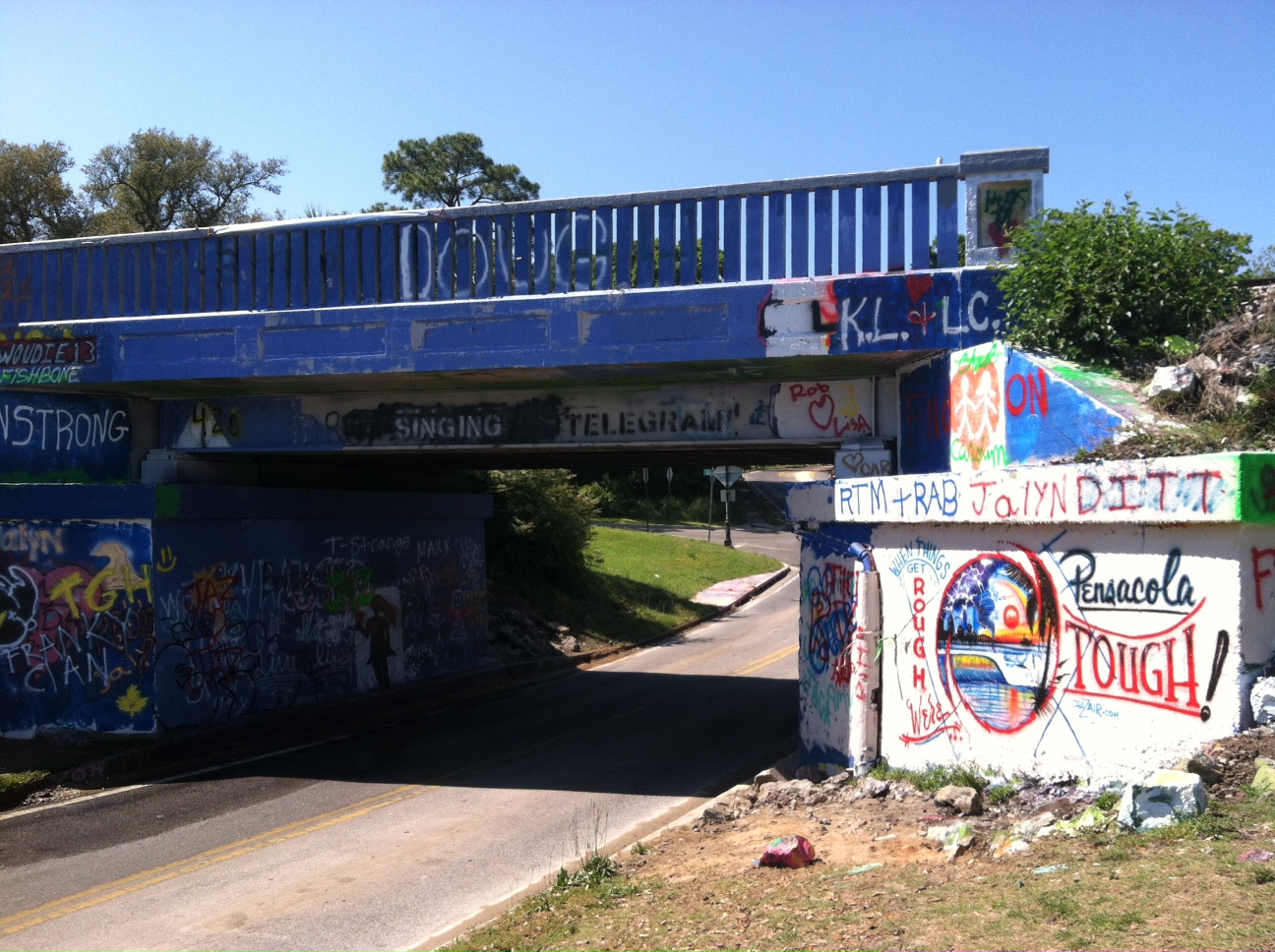
On my way home from a great Algerian pastry treat at SoGourmet, I passed Grafitti Bridge. Grafitti Bridge is one of Pensacola’s quirks. Every month – sometimes every week, even sometimes daily – the bridge is repainted. Sometimes it is that BubbleGum pink of Breast Cancer Awareness, with names of the fallen and names of survivors, sometimes it is Gay Pride, sometimes it is who loves who, or who is a first class jerk, sometimes it is Class of TwoThousandWhatever – it can be whatever someone feels passionate enough about to buy the paint and make it happen. No one gets too bent out of shape about it. Occasionally profanity will show up, but very shortly someone else will spray paint out the offensive word, or, which I love, alter it to have an entirely new meaning.
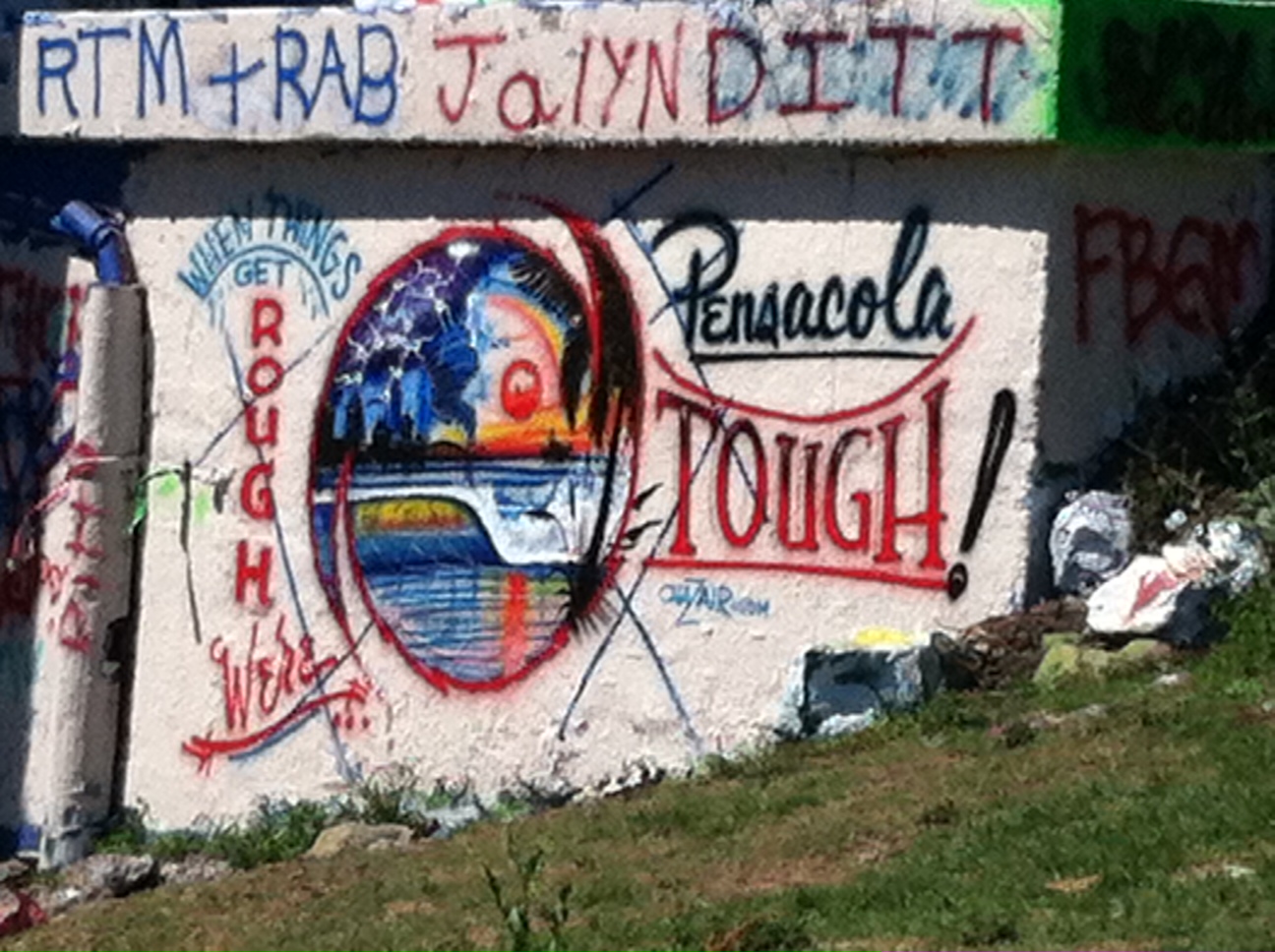
As I drove past today, I saw a lightning storm, well done, I couldn’t imagine how they had captured what it was like seeing so many strikes at once, and then I saw “Pensacola Tough.” By that time, I was through the bridge, so I had to circle and go back. I had to park, and take a closer look. And then I had to photograph it, and post it here.
Pensacola Tough. Pensacola got an award as the Toughest City in the USA, based on a criteria that measured percentage of felons in the population (it’s OK, it keeps us humble), sports heros, the number of military personnel, violent crime statistics, etc. It isn’t an award cities run for.
And yet, as the raging water abates, tales of heroism and helpfulness abound. While there have been bands of looters at an apartment complex housing the low-income workers in Pensacola, there have also been bands of volunteers scouring the county, helping clean out houses, pull out sodden carpeting, moving soaked furniture to the curbs for pickup, pulling out drywall and ceilings to prevent black mold. In today’s Pensacola News Journal, there is a story of a man who worked just above where the Escambia County Jail exploded and fell through the floor, breaking legs, ribs and assorted bones. He was paralyzed. His co-worker, also hurt, saw him with his head under water and pulled his head out, and held his head out for over an hour while waiting for help to arrive. She got tired, but the alternative was letting him die. She didn’t let go.
Pensacola Tough.
“When Things Get Rough . . . We’re Pensacola Tough.
Today’s meditation from Forward Day by Day deals with precious water. I think about how innocent we were, all of us in Pensacola, going about our daily lives as if every tomorrow would be so lovely, buying and planting new plants in our gardens, sweeping, cleaning, painting, all the things we do in Spring. And then – the deluge. And after the deluge, the “Boil water” warning (now lifted) because the water sources had been contaminated.
We have two cases of water set aside in case of hurricane. Two cases . . . really isn’t very much. We also have large containers which we fill – for hurricanes – so we can flush toilets (assuming the water mains have not broken) and keep a little clean. Those containers have not yet been filled for the upcoming season . . . Too much water – and then, too little.
After hearing the haunting strains of Nkosi Sekelel iAfrica just last weekend, I hear it again as I read the meditation:
SATURDAY, May 3
Exodus 17:1. But there was no water for the people to drink.
“Water is life—SAVE it!”
It was just a small sign on the wall next to the lavatory in a bed and breakfast, but it made a big impact. The word “SAVE” was written boldly in red block letters. Each time I approached the lavatory, my eye was drawn toward that sign. Each time, before I turned on the water, I asked myself, “Is this really necessary?”
South Africa is a water-challenged nation, and it shows. From small signs in bathrooms to national conservation campaigns to the removal of nonindigenous plants that use too much water, the country is trying to meet the challenge.
The South African Constitution’s Bill of Rights guarantees access to clean water for every citizen. After apartheid, the government extended water lines to all townships so residents without running water could at least get clean water from communal taps.
Our faith calls us to be good stewards of God’s creation. That includes the water we drink. Help us, Lord, to live out our faith by conserving, protecting, and sharing this life-giving resource that you have given us. Because water is life. Amen.
This file photo provided by the National Institute for Allergy and Infectious Diseases shows a colorized transmission of the MERS coronavirus that emerged in 2012. Health officials on Friday, May 2, 2014 said the deadly virus from the Middle East has turned up for the first time in the U.S. (AP Photo/National Institute for Allergy and Infectious Diseases via The Canadian Press, File)
By MIKE STOBBENEW YORK (AP) — Health officials on Friday confirmed the first case of an American infected with a mysterious Middle East virus. The man fell ill after arriving in the U.S. about a week ago from Saudi Arabia where he is a health care worker.
The man is hospitalized in Indiana with Middle East respiratory syndrome, or MERS, according to the Centers for Disease Control and Prevention, which is investigating the case along with Indiana health officials.
Saudi Arabia has been the center of an outbreak of MERS that began about two years ago. At least 400 people have had the respiratory illness, and more than 100 people have died. All had ties to the Middle East or to people who traveled there. Infections have been previously reported among health care workers.
MERS belongs to the coronavirus family that includes the common cold and SARS, or severe acute respiratory syndrome, which caused some 800 deaths globally in 2003.
The MERS virus has been found in camels, but officials don’t know how it is spreading to humans. It can spread from person to person, but officials believe that happens only after close contact. Not all those exposed to the virus become ill.
But it appears to be unusually lethal – by some estimates, it has killed nearly a third of the people it sickened. That’s a far higher percentage than seasonal flu or other routine infections. But it is not as contagious as flu, measles or other diseases. There is no vaccine or cure for MERS.
The CDC on Friday released only limited information about the U.S. case: The man flew to the United States about a week ago, with a stop in London. He landed in Chicago and took a bus to the neighboring state of Indiana. He didn’t become sick until arriving in Indiana, the CDC said. Symptoms include fever, cough, breathing problems, which can lead to pneumonia and kidney failure.
CDC officials say they are sending a team to investigate the man’s illness, his travel history and to track down people he may have been in close contact with.
Saudi Arabia health officials have recently reported a surge in MERS illnesses; cases have tended to increase in the spring. Experts think the uptick may party be due to more and better surveillance. Researchers at Columbia University have an additional theory – there may be more virus circulating in the spring, when camels are born.
U.S. health officials have been bracing for the arrival of one or more cases, likely among travelers. Isolated cases of MERS have been carried outside the Middle East. Previously, 163 suspected cases were tested in the U.S. but none confirmed.
Here are our recovery instructions quoting from the Pensacola News Journal:
“Caution. Stay off roads. Stay off bridges. Stay out of the water. Stay home, unless home is gone.” And in my wrecked neighborhood, boil all water for at least a minute until further notice.
More rain expected. People are not staying home. People are out and about, going to their jobs, keeping on keeping on. People are out helping one another clean out, carrying out soggy furniture and putting it by the curb. People are helping clean the trash. People are closing roads to make sure the underpinnings haven’t washed away. All our fire and police people are out doing extra duty, trying to keep us all safe and prevent chaos.
I saw a woman today with a T-shirt that said “medical examiner.” These days, you don’t know, there are shirts that say FBI and they aren’t FBI at all, or Alice in Chains, and it isn’t Alice in Chains. But as she turned around, the badge on her belt glinted in the light. She and her assistant were taking out; between the flood and the prison explosion, I doubt she has gotten a lot of sleep.
This is what I love about New Yorker magazine: they print stories no one prints, they follow stories that need following. They lead, and they do their job, alerting us to issues that matter. My heart goes out to the families, Christian and Muslim, of these girls who were abducted because they were being educated. Boko Haram believes educating women goes against Islam. Someone should read them a Quran.
“I thought it was the end of my life,” Deborah Sanya told me by phone on Monday from Chibok, a tiny town of farmers in northeastern Nigeria. “There were many, many of them.” Boko Haram, an Islamist terrorist group, kidnapped Sanya and at least two hundred of her classmates from a girls’ secondary school in Chibok more than two weeks ago. Sanya, along with two friends, escaped. So did forty others. The rest have vanished, and their families have not heard any word of them since.
Sanya is eighteen years old and was taking her final exams before graduation. Many of the schools in towns around Chibok, in the state of Borno, had been shuttered. Boko Haram attacks at other schools—like a recent massacre of fifty-nine schoolboys in neighboring Yobe state—had prompted the mass closure. But local education officials decided to briefly reopen the Chibok school for exams. On the night of the abduction, militants showed up at the boarding school dressed in Nigerian military uniforms. They told the girls that they were there to take them to safety. “They said, ‘Don’t worry. Nothing will happen to you,’ ” Sanya told me. The men took food and other supplies from the school and then set the building on fire. They herded the girls into trucks and onto motorcycles. At first, the girls, while alarmed and nervous, believed that they were in safe hands. When the men started shooting their guns into the air and shouting “Allahu Akbar,” Sanya told me, she realized that the men were not who they said they were. She started begging God for help; she watched several girls jump out of the truck that they were in.
It was noon when her group reached the terrorists’ camp. She had been taken not far from Chibok, a couple of remote villages away in the bush. The militants forced her classmates to cook; Sanya couldn’t eat. Two hours later, she pulled two friends close and told them that they should run. One of them hesitated, and said that they should wait to escape at night. Sanya insisted, and they fled behind some trees. The guards spotted them and called out for them to return, but the girls kept running. They reached a village late at night, slept at a friendly stranger’s home, and, the next day, called their families.
Sanya could not tell me more after that. She is not well. Her cousins and her close friends are still missing, and she is trying to understand how she is alive and back home. All she can do now, she said, is pray and fast, then pray and fast again.
The day after the abduction, the Nigerian military claimed that it had rescued nearly all of the girls. A day later, the military retracted its claim; it had not actually rescued any of the girls. And the number that the government said was missing, just over a hundred, was less than half the number that parents and school officials counted: according to their tally, two hundred and thirty-four girls were taken.
In the wake of the military’s failure, parents banded together and raised money to send several of their number into the forest to search for the girls. The group came across villagers who persuaded the parents to turn back. They told the parents that they had seen the girls nearby, but the insurgents were too well armed. Many of the parents had just bows and arrows.
***
The circumstances of the kidnapping, and the military’s deception, especially, have exposed a deeply troubling aspect of Nigeria’s leadership: when it comes to Boko Haram, the government cannot be trusted. Children have been killed, along with their families, in numerous Boko Haram bombings and massacres over the past five years. (More than fifteen hundred people have been killed so far this year.) State schools and remote villages in the north have borne the brunt of Boko Haram’s violence this year. The group is believed to be at least partly waging a campaign against secular values. The kidnapped girls were both Christian and Muslim; their only offense, it seems, was attending school.
Last June, I visited Maiduguri, the capital of Borno state and the birthplace of Boko Haram, to report on the insurgency and the Nigerian government’s counteroffensive, a security operation that placed three northeastern states, including Borno and Yobe, under a state of emergency as troops launched attacks on terrorist hideouts and camps. The military cut phone lines and Internet access, and, while residents were glad for the intervention, there was a sense of living in the dark. Gunshots, a bomb blast: was it Boko Haram or a military attack? Were the hundreds of men disappeared by the military actually terrorists—even the young boys? And was the government, as it claimed, really winning the war?
The military has restored phone lines in Borno. But the sole airline that flew to Maiduguri cancelled the route at the end of last year. The road to Chibok is so hazardous that Borno’s governor visited the town with a heavy military escort. Much of the northeast is now physically isolated. What is happening there that we cannot see?
Nigerians in the rest of the country had, until recently, been able to ignore the deaths. The general mood has been one of weary apathy—from a government waging a heavy-handed crackdown on northerners to civilians far removed from the chaos. That mood may finally change.
***
Sanya’s father, a primary-school teacher named Ishaya Sanya, is struggling with conflicting emotions: gratitude that his daughter has returned to him; guilt that the daughters of his siblings, friends, and neighbors are still somewhere in the bush; and an angry frustration that there seemed to be no effort to rescue the girls.
“We don’t know where they are up until now, and we have not heard anything from the government,” he told me. “Every house in Chibok has been affected by the kidnapping.” The only information that the families had been able to gather about the kidnapped girls, he went on, was from the girls who had escaped.
He remembers the exact time that Deborah appeared in front of him after her escape—4:30P.M.—and how he felt: “very happy.” But his despair soon returned. “Our area has been affected very seriously,” he told me. Parents had fallen physically ill, and some were “going mad.”
The military’s current plans are unclear; the Chibok parents hope that it is acting swiftly and cautiously. There is worry, too, that a rescue operation could result in the deaths of many of the girls; this happened during a previous attempted rescue, of two Western engineers kidnapped by Boko Haram. Last week, a military spokesman, Brigadier-General Chris Olukolade, said only that the search for the girls had “intensified.”
In the meantime, as in so many other ways in Nigeria, each community has to fend for itself. For a while after the abduction, girls trickled back into town—some rolled off trucks, some snuck away while fetching water. That trickle has stopped. “Nobody rescued them,” a government official in Chibok said of the girls who made it back. “I want you to stress this point. Nobody rescued them. They escaped on their accord. This is painful.”
A pastor in Chibok whose daughter is missing told me that he set out with friends on the morning after the abduction to find the girls. “I was forced to come home empty-handed,” he told me by phone. “I just don’t know what the federal government is doing about it. And there is no security here that will defend us. You have to do what you can do to escape for your life.”
I asked the pastor about rumors that Boko Haram has taken the girls outside of Nigeria’s borders, into Cameroon and Chad, and forcibly married them. He paused, and then said, “How will I be happy? How will I be happy?”
Four students walk in Chibok following their escape from Boko Haram. Photograph by Haruna Umar/AP.
All the years we lived in the Middle East with prohibitions against alcohol, it never occurred to me that there may be a connection between alcohol and skin cancer. This is from a Bottom Line newsletter.
Alcohol: The Drink That’s Linked to Deadly Melanoma Skin Cancer
You know that cavorting in the sun without adequate protection from clothing and sunscreen is a big mistake when it comes to preventing melanoma…and you know that this kind of skin cancer can kill. But did you know that what you drinkaffects your melanoma risk, too? When it comes to alcohol, it’s true—in fact, your skin cancer risk rises with as little as one serving of alcohol a day, according to new research. Here’s the startling connection…
IMBIBERS BEWARE
It’s well-established that the leading cause of melanoma is intermittent, intense, sunburn-causing exposure to the sun’s ultraviolet rays. Even sunburns from childhood can come back to haunt you decades later, increasing your skin cancer risk. But other factors (a fair complexion, the presence of moles, advancing age, etc.) enter into the risk equation, too…and researchers decided to see whether alcohol also played a role. To that end, they conducted a meta-analysis, pulling together 16 previous studies that investigated a possible relationship between alcohol consumption and melanoma. The data they examined represented a total of 6,251 cases of this type of skin cancer.
Because the various studies used different measures to describe levels of alcohol consumption, the researchers looked at the grams of ethanol consumed each day, designating one drink as 12.5 grams of ethanol. (For comparison’s sake, in the US, one drink is generally defined as 14 grams of ethanol—the equivalent of a 12-ounce beer, a five-ounce glass of wine or a 1.5-ounce shot of 80-proof liquor.) For the new study, light drinking was defined as no more than 12.5 grams of ethanol per day…moderate-to-heavy consumption was defined as anything in excess of 12.5 grams per day. Although there was limited data on heavy drinking, this level of consumption was defined as more than 50 grams of ethanol (four drinks) per day.
What the researchers discovered: Compared with people who never or seldom drank, people who did drink were 20% more likely to get melanoma. As alcohol intake went up, so did the danger—light drinking was associated with a 10% increase in melanoma risk…moderate-to-heavy drinking was associated with an 18% increase in risk…and heavy drinking was associated with a 55% increase in risk.
What explains the link? You may assume that people who are imbibing at the beach, barbecue or ballgame don’t want to interrupt their fun, so they don’t bother to refresh their sunscreen…or else they’re so buzzed that they’re oblivious to how sunburned they’re getting. And no doubt that plays a part—in fact, other research suggests that nearly one-fifth of sunburns in American adults are attributable to alcohol consumption.
But drunk-induced sunburns don’t tell the whole story, the new study’s authors suggested. Their theory: Alcohol intake may reduce the strength of the immune system, allowing the sun’s UV rays to do greater harm to cells. That’s because soon after ethanol is consumed, it’s converted to a substance that makes skin even more sun-sensitive and vulnerable to oxidative stress, which in turn damages DNA and increases cancer risk.
Self-defense for your skin: If you plan to drink alcohol when you’re outdoors, you’d be wise to slather on the sunscreen beforehand and wear plenty of protective clothing…set a timer on your watch or phone to remind you to refresh your sunscreen every few hours…and limit alcohol consumption to no more than one drink per day. Need even more motivation? Remember that alcohol is linked to numerous other malignancies, including cancers of the mouth, esophagus, stomach, colon, liver, breast and prostate—so in that regard, what’s good for your skin is good for the rest of your body, too.
Source: Study titled “Alcohol drinking and cutaneous melanoma risk—A systematic review and dose-risk meta-analysis,” to be published in British Journal of Dermatology.
The 7 Kingdoms in ‘Game of Thrones’ are actually these 5 real-world places
It turns out it takes less post-production tinkering than you’d expect to turn our world into the lands of Ice and Fire.
Facebook
16K
36
16K
Not much in “Game of Thrones” could be described as “true to life.” King Joffrey, for instance? IRL, actually a pretty sweet guy. And the Khaleesi definitely ain’t a natural blonde. (Oh yeah, and to the best of our knowledge she hasn’t fire-hatched any dragons, either.)
Say what you will about the vaguely insane plot and ever more inventive ways of killing off characters, though, there’s one element of the show that’s surprisingly real: the locations. It turns out it takes less post-production tinkering than you’d expect to turn our world into the lands of Ice and Fire.
Whether it’s the steep crags of Winterfell or the stone palaces of King’s Landing, the scorched slave port of Astapor or the frozen whiteness beyond the Wall, the show’s most dramatic landscapes really do exist — in five countries and on two continents.
Hold on to your dragons, it’s time for a tour.
Malta: King’s Landing (season 1), Pentos
Mdina city gate (Alex Murphy/Flickr Commons).
Malta’s stone city of Mdina, with its aptly lion-topped gate, was the original King’s Landing. San Anton Palace, the Maltese president’s residence, stood in for the Red Keep, where kings are murdered and brothers and sisters get way, way too close. Other island fortresses, notably Fort St. Angelo, Fort Ricasoli and Fort Manoel, provided the backdrop for other scenes in and around Westeros’ ruling city.
The Azure Window (Robert Pittman/Flickr Commons).
Daenerys Targaryen and her ill-fated brother Viserys, meanwhile, were supposed to be across the Narrow Sea in Pentos but in fact filmed their early scenes on another corner of the island. One of Malta’s most spectacular natural monuments, the limestone archway known as the Azure Window, loomed over Daenerys’ wedding to beefy horseman Khal Drogo. Maltese officials would later complain that the shoot damaged the protected habitat, which may have been one of the reasons why the GoT crew packed up and found a different location for the following seasons.
Croatia: King’s Landing (season 2 onward), Qarth
Dubrovnik (ELVIS BARUKCIC/AFP/Getty Images).
If King’s Landing suddenly acquired a lot more red tile roofs between seasons 1 and 2, it’s because it moved to Croatia’s walled city of Dubrovnik. Unlike Mdina, which is inland, Dubrovnik perches right on the coast — fairly important if your boy king’s deranged uncle is going to attack there by sea.
Minceta Tower (Romanceor/Wikimedia Commons).
Daenerys, by now widowed and mother to three dragons, hopped over to the idyllic island of Lokrum, opposite Dubrovnik, where the crew created much of the creepy city of Qarth. The House of The Undying, the site of the season finale, was the mainland’s real-life Minceta Tower. The palace gardens where Sansa has taken to moping in season 4, meanwhile, are the lush grounds of the Trsteno Arboretum, just up the coast from Dubrovnik.
Morocco: Yunkai, Astapor
Ait Benhaddou (Stefan de Vries/Flickr Commons).
The third season ventured to North Africa as the Khaleesi went on her travels in search of an army and those ever elusive ships. Producers selected two of Morocco’s most unique landscapes, Ait Benhaddou and Essaouira, to represent the fictional cities of Yunkai and Astapor respectively. Both are UNESCO World Heritage Sites, Ait Benhaddou for its red citadel on the foothills of the Atlas mountains, and Essaouira for its stone sea walls topped by bronze cannon. Ait Benhaddou has the added bonus of a nearby studio in the city of Ouarzazate, so popular is the area with directors (Laurence of Arabia, The Last Temptation of Christ, Alexander and Gladiator are among the many movies filmed there).
Essaouira (Mark Fischer/Flickr Commons).
It’s Essaouira’s turn as slave-trading Astapor, however, that remains most memorable to me at least, for reasons that anyone who’s seen the season 3 finale will immediately understand.
Iceland: Beyond the Wall
On the shores of Lake Mývatn (Juergen Adolph/Flickr Commons).
If Morocco’s red plains bring the fire to ‘Game of Thrones,’ Iceland brings, er, the ice. The show’s makers quite logically headed north to shoot the part of the story that unfolds at the northernmost tip of Westeros, preferring Iceland’s otherworldly landscapes to anything CGI could produce. Vatnajökull National Park and the Svínafellsjökull glacier, both in the southwest, were picked for season 2, while most of season 3’s ultra-Wall action was filmed on and around frozen Lake Mývatn further north, littered with clumps of black lava from the active volcanos that dot the region.
Thingvellir (Andreas Tille/Wikimedia Commons).
Season 4 moved on to Thingvellir National Park, a protected area of exceptional natural beauty and another UNESCO World Heritage site. Aptly enough for the Wildlings and their proto-democracy (sort of), Thingvellir’s plains are where Iceland’s parliament was first founded and continued to assemble, under the open sky, for almost nine centuries.
Northern Ireland, UK: Winterfell, Vaes Dothrak, Kings Road, Storm’s End, Castle Black, the Iron Islands…
The Dark Hedges of Armoy (horslips5/Flickr Commons).
Northern Ireland is to ‘Game of Thrones’ what New Zealand was to ‘Lord of the Rings.’ No other country has provided so many locations for the show, from the towers of Winterfell (Castle Ward) to the shore of the Iron Islands (Ballintoy Harbour), the rocky beach where the sorceress Melisandre gives birth (Cushendun Caves) to the interlacing beech trees of Kings Road (the Dark Hedges of Armoy). If you’re watching a scene set anywhere near woods, chances are it was filmed in Tollymore Forest. Entering or exiting Castle Black? That’ll be the vast outdoor set constructed in the disused limestone quarry of Magheramorne. And the number of interiors shot at the Paint Hall studio in Belfast — where the shipyard that built the Titanic has been turned into one of the biggest studio complexes in Europe — are too many to mention.
County Antrim coastline (Paolo Trabattoni/Flickr Commons).
So keen are the regional authorities to keep the crew filming there, in fact, that Northern Ireland’s national screen agency, economic development body and the European Regional Development Fund have between them stumped up the equivalent of $15.5 million in grantsto the show’s makers. In return, the Northern Irish government estimates that the productions has boosted the region’s struggling economy by some $109 million — not least by attracting globetrotting GoT fans to themed tours of filming locations and nerd-fest exhibitions of official memorabilia. Don’t tell anyone, but we sort of want to go.
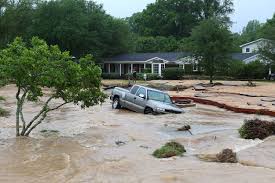
I don’t think I have ever seen a storm like we saw last night. This was not a hurricane type storm, this was a thunderstorm that had Pensacola grey and dark and gloomy all day Tuesday, and then around 7 pm, all hell broke loose. Thunder. Lots of thunder. Not just a tornado watch, but a tornado warning for our area, one of those “get away from all the outside walls of your house to a protected inner area NOW” kind of warning.
The tornado warning passed. The tornado watch passed. We found a leaking door frame, and brought buckets. The thunder and lightning continued. We found a leaking ceiling light fixture, and put another bucket under it. The thunder and lightning and high wind continued. We found water coming down through a bathroom vent – thank God we have a lot of buckets. The thunder and lightning continued.
We found a leaking closed door frame in another part of the house – four mixing bowls, surrounded by towels. The thunder and lightning continued.
The thunder and lightning continued all through the night. We slept fitfully, AdventureMan getting up three or four times to check the buckets.
I know, it sounds like we live in a terrible house, but we have never had things leak like this before. I think it has to do with rain blowing up under the roof vent, that’s all I can think of. AdventureMan has already called the roofer, and the insurance office, who is not answering, due to the number of callers they are dealing with.
Our son and his wife, down the street, have no electricity, and will come here later for some coffee and to charge their electrical devices. A road near us has collapsed, and in the collapse, contaminated two wells, so we are on a “boil water” notice until further notifications.
Today, indeed, is a very good day to pray for the Central Gulf Coast. Most schools are closed, many offices are closed.
We sit high, but many are struggling with high water and flooded roads. Many have worse leaks than we have. Many are lacking power, and how can you boil the water without power? This storm dumped inches and inches of rain on us, so much rain that they don’t have an exact calculation yet. Our front yard is eroding in front of our eyes. And we are the lucky ones.
At AOL, we care deeply about the safety and security of your online experience. We are writing to notify you that AOL is investigating a security incident that involved unauthorized access to AOL’s network and systems. Recently, our systems alerted us to an increased incidence of email users receiving spam emails from “spoofed” AOL email addresses. AOL’s security team immediately began investigating the cause of the spoofed emails. Spoofing is a tactic used by spammers to make it appear that the message is from you in order to trick the recipient into opening it. These emails do not originate from the AOL Mail system – the addresses are just edited to make them appear that way. AOL is working with other email providers like Gmail, Yahoo! Mail and Outlook·com to stamp out spoofing across the industry, and we have implemented measures that will significantly limit its future occurrence.
Although our investigation is still underway, we have determined that there was unauthorized access to AOL users’ email addresses, postal addresses, contact information (as stored in the AOL Mail “Address Book”), encrypted account passwords, and encrypted answers to security questions that we ask when a user resets his or her password. We believe spammers have used this contact information to send spoofed emails that appeared to come from roughly 2% of our email accounts.
Importantly, at this point, we have no indication that the encryption on the passwords or the answers to security questions was broken. Likewise, there is no indication that this incident resulted in disclosure of users’ financial information, including debit and credit cards, which is also fully encrypted.
Nevertheless, as a precautionary measure, we strongly encourage you to reset your password used for any AOL service and, when you do so, you should take the time to change your account security question and answer. You may reset your password and account security question at account.aol.com.
In addition, there are steps you can take to protect yourself from cyber risks. They include:
If you receive a suspicious email, do not respond or click on any links or attachments in the email.
When in doubt about the authenticity of an email you have received, contact the sender to confirm that he or she actually sent it.
Never provide personal or financial information in an email to someone you do not know. AOL will never ask you for your password or any other sensitive personal information over email.
If you believe you are a victim of spoofing, consider letting your friends know that your emails may have been spoofed and to avoid clicking the links in suspicious emails.
We place a premium on the security of our systems and our users’ information. We are implementing additional measures to address this incident, and we are working with law enforcement to pursue the matter.
If you have any further questions, additional information and an extensive Q&A can be found at faq.aol.com. We apologize for any inconvenience, and we are addressing the situation as quickly and forcefully as we can.
“That’s Jollaf rice!” the Nigerian journalist said, a note of delight in her voice. She is famous for her passion and persistence drawing attention to the environmental issues in the Niger delta related to oil extraction and production. I told her that here in the Gulf, it’s called Jambalaya, but we all agreed that it very likely had African roots. She delighted my heart; she had three helpings.
When we have visitors from foreign countries, I try to serve foods they can identify – grilled vegetables, a chicken dish, several salads, a dessert. This time, because we had no Moslems, we used a real Cajun sausage in the jambalaya (pork), and jumbo shrimp.
The award-winning Finnish environmentalist has his own online website and a goal of planting 100 million trees by 1017. He is well on his way, visiting and planting trees in new countries every week. He also has his own band and has a CD out with Finnish music.
Our South African guest manages a large rhino reserve, protecting the rhinos from those who would kill them for their horns, thinking it renews sexual energy. Poor rhinos! He was quiet, but an acute observer, and the highlight of the evening was as he sang the haunting South African national anthem, Nkosi Sikelel’, with the Finnish guest. They did not sing all 11 verses (!) in all the different languages; just one verse, it was very moving:
Our own sweet environmentalist was with us. We think our son and his wife are super heroes; they fight for justice and a clean environment. This evening, our son stayed at home with the grandchildren and his wife, who works with clean water, was able to join and talk shop over dinner with her counterparts from other parts of the world.
It isn’t so easy anymore to get these dinners on the table, off the table, dessert served, etc. I used to be able to do these easily, for more than 20 people, but I also had help, LOL! But these dinners give us so much joy that I can’t imagine giving them up any time soon.

 “I thought it was the end of my life,” Deborah Sanya told me by phone on Monday from Chibok, a tiny town of farmers in northeastern Nigeria. “There were many, many of them.” Boko Haram, an Islamist terrorist group, kidnapped Sanya and at least two hundred of her classmates from a girls’ secondary school in Chibok more than two weeks ago. Sanya, along with two friends, escaped. So did forty others. The rest have vanished, and their families have not heard any word of them since.


 Here There and Everywhere