Chilly Pensacola Sunrise
Today is the annual homeless services day, and homeless count day when hundreds of Pensacolians leave their beds at o-dark-thirty to serve our brothers and sisters who don’t have beds to sleep in, don’t have a roof over their head, don’t always have something to eat.
The homeless love Pensacola because it in so temperate, but even the temperate climate of Pensacola can be occasionally brutal, as it is right now. The Waterfront Mission has said it will take in anyone who comes, to shelter them from the harsh mid-freezing temperatures.
It’s not like Pensacola loves the homeless. The city has passed ordinances preventing them from begging, and from soliciting at the traffic stops. On the other hand, it’s not like they are going away, so charitable organizations in Pensacola do their best to care for the homeless population, providing cold weather shelter, meals, toiletries, places to collect mail and to bathe. There is a free health clinic. There is occasional dental screening. There are veteran services, who try to house and take care of our walking wounded. There is even a service for the pets of the homeless, in case of hurricane or similar emergency.These things make me very proud of Pensacola.
This morning dawned very cold:


AdventureMan crawled out of bed into the cold and chill, donned several layers of clothing and headed out to help with the count, and with serving around 500 people a hot meal. He does it because he loves doing it and I smile thinking how “The Lord loves a cheerful giver.”
Vincent of Saragossa, by the Grace of God, Invincible
Not to make light of the suffering of the Saints, but while other kids grew up on tales of the bogeyman, the man with a hook on his hand, babayaga, etc., the kids at my bus-stop told stories of the saint and their tortures. There is enough in all these stories to thoroughly terrify the heart of a young child. Today the church remembers Vincent of Sargossa (Zaragosa) who survived and prevailed some of the very worst treatement available in those times, by the Grace of God.
The Liturgical Calendar: The Church Remembers
Today the church remembers Vincent, Deacon of Saragossa, and Martyr, 304.
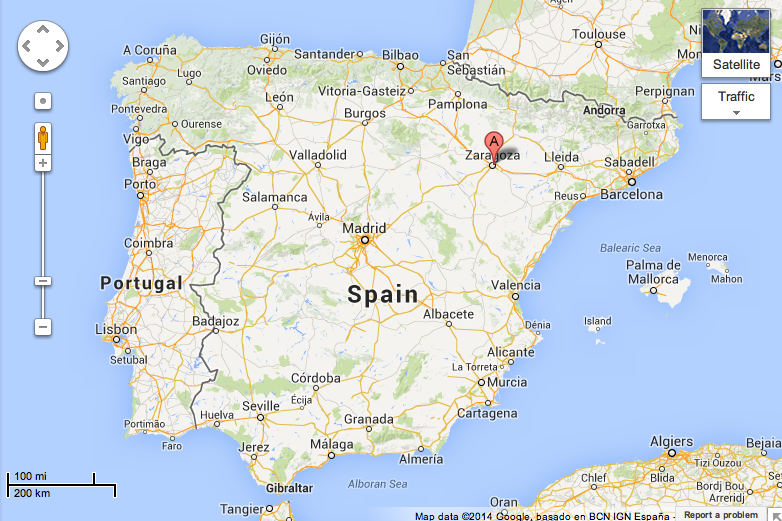
Vincent was a deacon in an early Christian church in Saragossa, Spain. He was a trusted friend and assistant of the bishop, Valerius. He was a very effective leader and therefore a prize catch for the Spanish governor, Dacian, who was implementing the Emperor Diocletian’s policy of persecution. Dacian’s agents used every means known to them to brainwash Vincent, since, if he gave up Christianity, it would surely result in the defection of others.
Vincent was submitted to intensive argumentation, interrupted by excruciating tortures. He was beaten, chained, stretched on the rack, cooked on a gridiron, and the floor of his bare cell was covered with broken glass on which he had to walk and recline. Vincent did not renounce Christ or acknowledge the Roman deities.
Finally the exhausted and mutilated saint was released, perhaps as an example to other Christians of what they might have to suffer. He died shortly after his release. But his steadfastness, far from discouraging other Christians, strengthened them in their determination to remain faithful to the Lord.
Even as your holy Deacon and Martyr Vincent triumphed over suffering and despised death: Grant that we may endure hardness and wax valiant in the fight. Amen.
Almighty God, your deacon Vincent, upheld by you, was not terrified by threats nor overcome by torments: Strengthen us to endure all adversity with invincible and steadfast faith; through Jesus Christ our Lord, who lives and reigns with you and the Holy Spirit, one God, for ever and ever. Amen.
Secret Addiction: Alaska The Last Frontier
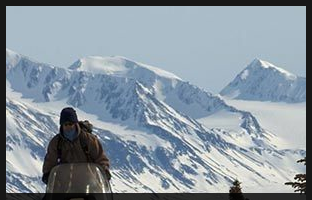
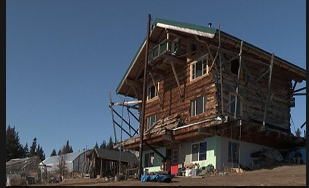
Every Sunday and Monday I get a bunch of hits on an entry I did back in August about where the Kilcher family “really” lives. The Kilcher family is featured on a Discovery Channel show called Alaska The Last Frontier. It was a joke because I had no idea where they lived; we just wanted to explore the roads around Homer and that was a house I saw – and there were a lot of really nice homes in Homer, homes that looked like they had a lot of self-sustaining features – barns, corrals, heavy farm machinery, solar panels, chicken coops, etc.
As it turns out, by accident, we were pretty close when I took that photo. When you look on Google maps, you will see, off East End Road, a road called Kilcher road. Makes sense to me that would be where at least some of the Kilcher clan live.
Do you watch Alaska The Last Frontier? It is a reality show, and kind of hokey. Like I grew up in Alaska, I’ve been in Homer, it’s not like they are Little Town on the Prairie. They are just miles away from a wonderful grocery and department store, hardware stores, some very nice restaurants, sweet summer market – they have doctors and veterinarians, they are not out in the wilderness where their only access is the weekly bush pilot – if he can get in through the wildly blowing snow-storm, if you catch my drift.
And yet . . . Sunday evening comes around and I have to get my fix. I am addicted. Yes, they are hokey, but I guess it is a kind of quixotic hokeyness I like. They hunt, and they eat the meat they hunt. I grew up that way, and what I just hate are hunters who hunt because they think it makes them big men, especially if they hunt farmed animals. The Kilchers shoot animals they can eat. They even eat bear, which, if you’ve ever eaten bear (shudder) takes a lot of something – red wine, spices, barbecue sauce – to cover up that gamey taste.
They hunt to fill the freezers to have meat through the winter, but they also build things, and have all kinds of guy-toys – bulldozers, cranes, snowmobiles, tractors, ATV’s. They build bridges, a huge garage – you know, manly Alaska sorts of things 🙂
The women garden, keep cattle, milk cows, knit, raise chickens for eggs, do a lot of the fishing – I admire that. I think it is a good thing to stay close to the earth, even having to figure out how to get water from the spring into your cabin (pretty nice cabin, spectacular view.)
They camera work and editing are amazing. Mostly they edit out the most modern conveniences – we can tell they are ‘on the grid’, i.e. they have electricity, because the lighting is electric, but they pretty much crop out any appliances, and any other nearby homes, the Homer spit – LOL – the Homer Spit is about the most prominent natural feature in Kachemak Bay, and you never even see it on Alaska The Last Frontier.
So it’s a little deceptive. I can live with that. I admire the Kilcher family for their commitment to doing their best to be self-sustaining, good neighbors, while bowing to the inevitable convenience of buying Levis and flannel shirts at the Safeway down the road. No, they don’t show us those things; it probably wouldn’t have so many followers if they did. It’s still a lot of fun following the series, and I am guessing – hoping – that the season finale will feature a new birth, and a new member of the Kilcher family.
I have one suspicion, based on having lived in Alaska for many years when I was a kid. Alaskans love Hawaii. Every year, the Discovery Channel films the Kilchers from spring thaw to hard freeze of winter . . . I am betting your find the Kilcher family on the beaches in Hawaii during at least a part of those long hard winters 😉
Alabama
Today the church prays for the Episcopal diocese of Alabama. When my far-away friends ask me where Pensacola is, I tell them we are so far west in Florida that we are next door to Alabama. It’s the truth. I can drive ten minutes and be in Alabama.

Stellenbosch on A-Word-A-Day
A-Word-A-Day was the very first website I ever bookmarked. I was getting my certification to teach English as a Foreign Language and my students loved words. I’m pretty good with words, even so A-Word-a-Day teaches me a new one, or a new meaning for an old one, more often than not. You can subscribe and receive a new word five days a week and a discussion at the end of the week.
This is a great word, and one I had never heard used before:
stellenbosch
PRONUNCIATION:
(STE-len-bosh)
MEANING:
verb tr.: To relegate someone incompetent to a position of minimal responsibility.
ETYMOLOGY:
After Stellenbosch, a town in South Africa. Earliest documented use: 1900.
NOTES:
Stellenbosch, near Cape Town, was a British military base during the Second Boer War. Officers who had not proven themselves were sent to Stellenbosch, to take care of something relatively insignificant, such as to look after horses. Even if they kept their rank, this assignment was considered a demotion. Eventually the term came to be applied when someone was reassigned to a position where he could do little harm.
A similar term is coventry.
The Invention of Wings by Sue Monk Kidd
This is one terrific book.

Amazon recommended this book to me, and as a person who loves just about everything Sue Monk Kidd writes, I bought it immediately. AdventureMan had also read a review and said it might be a good book for our book club, so he gets it next. Most of my friends have it on Kindle to read soon.
The book is written in two voices, that of Sarah Gremke’, white, and Charlestonian, of Charleston society families, and the other voice of Hetty/Handful, the slave given to Sarah for her 11th birthday. First Sarah tries to refuse the ‘gift,’ then, using her father’s law books, she writes a letter of emancipation for Hetty, and neither effort works. Sarah and Hetty are stuck with each other, stuck with the times, stuck with their situation, and stuck with the institutions that determine and limit what they will accomplish.
Or are they?
There were times, as I read the book, that I felt like I was going to suffocate. First, the heat and humidity of Charleston, South Carolina, are bad enough without the kinds of close-fitting clothing women were required to wear in that day; the thought of wearing those clothes makes me choke.
The limited expectations for women would stunt and damage the strongest female character in that society where those who thrived were those who were pretty, good at getting married, and good at bearing children, dressing appropriately and socializing endlessly at the same stale events.
Slavery damages everyone. No one should have that kind of power over another human being; studies show that when human beings are given power over another their very worst instincts come to the forefront. Why do we need studies? We have the real world to show us what that kind of power does, how it corrupts the one who holds the power so thoroughly that they don’t even know they are corrupted.
These are stories from my time living in countries where people from poorer countries came to work:
My maid had worked for a family where the men pestered her because she was full time and live-in. They assumed she was sexually available to them and made life very difficult for her. Her mistress saw a beautiful silk blouse she wore, a blouse she had saved for and only wore on her day off, and her mistress borrowed it, stained it, returned it and didn’t take any responsibility for ruining her one really nice blouse. It was never mentioned again. Only when the men complained about this woman was she allowed to leave; her mistress didn’t want the men tempted, she got her passport back and come to work for me. Her previous mistress wanted an ugly maid, and the men were hoping for someone more compliant.
The woman who bought my car had saved and saved, and was working under deplorable conditions in a day care. I told her that she had skills, get another job, and she told me that she hadn’t been paid for three months, and if she left she would never get that pay, and also her employer would never give her her passport or allow her to leave. She was, in effect, a slave.
Most of my friends are very good employers, taking good care of the people who come to work for them, but I have seen those (not my friends) who are violent and abusive. Being a slave is being trapped in an existence with no control over your own life.
Monk makes an interesting comparison of white women’s lives with their limitations being not unlike a variant of slavery. Maybe the conditions were a little better, but the un-free-ness was similar.
Sarah Grimke’ and her sister Angelina, against all odds, break free of family expectations and societal constraints. They forge their own way, with Angelina’s gift for rhetoric and Sarah’s keep legal writing. I had never heard of these women before, and I am so glad Sue Monk Kidd wrote this book to raise their visibility both as abolitionists and as some of the very first proponents for women’s rights to full equality.
As a quilter, I also loved in this book that Handfull’s mother is a quilter, and while she can neither read nor write, she puts down her history in an applique quilt which clearly spells out significant events in her life, and is a tool for passing family history from one generation to another.
All the Light There Was by Nancy Kricorian
AdventureMan came into the room where I was reading and handed me this book. “Will you read this?” he asked, and there was a note in his voice that sounded a little aggrieved.

“What’s up?” I asked. “You sound a little peeved.”
“I read this,” he said. “I thought it was pretty good, but when I read the reviews on Amazon, some people called it ‘trivial’,” and I could see he was embarrassed that something he thought was pretty good others believed was of little importance.
Big mistake, Adventureman.
I might read a little of the reviews when deciding whether to buy a book or not, because I won’t remember it when it comes time to actually read the book or review the book, but I never, NEVER read the reviews as I am reading or before I review a book. And, truthfully, I don’t really care what this reviewer says or that reviewer says. Sometimes I read a New Yorker review of a book and I think “that reviewer has her own filter and can’t see beyond her framework” or “Wow! That reviewer saw some things I’d like to see!” Sometimes I will read a review and then read the book and think that the reviewer really missed the mark, positively or negatively, it could be either way.
Reviews are opinions. We all have them. Some you might agree with, some you might not, but don’t let them touch you, or your experience with the book. We are each unique, and see through a unique lens!
First, it delighted me that I read this just after I read Babayaga, because I ejnoy Paris, and delight in walking Paris, and in Babayaga and in All the Light There Was, people do a lot of walking in Paris. So much so in All the Light There Was that I ran down to my little map collection for the Paris maps and would track the heroine through Paris. It was fun.
Although All the Light There Was is called a novel, I don’t think it is. As I read it, I thought it was highly biographical or autobiographical, based on a diary or diaries. The significant details – how the mama stockpiled food just as war was announced and all the places she stored it, including under the bed, the clothing they wore, the sweaters they knit, the indignities they endured, and the risks they bravely took against the occupying Germans – it doesn’t sound made up to me, it sounds like a story someone has told from that time.
The details are so strong – the bicycle tires that are treasured because if they go flat, that is the end of the last transport they have, the dresses that have become too big because people have eaten too little – these details sound like voices to me.
So I would not call this book trivial. This book captures a moment in time, it’s a snapshot. The characters don’t have a lot of depth, the events don’t have a lot of texture, but I do know what occupied Paris ate during the last years of the occupation (turnips) and the ambivalence with which Paris viewed their Jewish citizens. In this war-time Paris, Kricorian captures well Pastor Martin Niemoeller’s poem about When They Came for Me:
In Germany, they came first for the Communists, And I didn’t speak up because I wasn’t a Communist;
And then they came for the trade unionists, And I didn’t speak up because I wasn’t a trade unionist;
And then they came for the Jews, And I didn’t speak up because I wasn’t a Jew;
And then . . . they came for me . . . And by that time there was no one left to speak up.”
Many in Paris were happy to see the Jews go, happy it wasn’t them. Kricorian tackles this issue indirectly, with a light but inescapable hand.
One of the things that was shocking to both of us what that when Maral’s ancient Auntie Shakeh died, and we see the tombstone – she is 35 years old. We knew she and Maral’s parents had escaped the Turkish efforts to eradicate the Armenians in Turkey, but because we are seeing the story through Maral’s eyes, her parents and aunt seem ancient, whereas in today’s terms, they are very young adults.
Don’t read the reviews, AdventureMan! Read the book, take from the book what you will, enjoy your own experience. Write your own reviews!
Babayaga by Toby Barlow

You know how books come your way in coincidental ways? Amazon.com had told me I needed to read Babayaga, so I ordered it. I’ve always loved mythologies, I devoured them like candy when I was young, always looking for more. Babayagas are very old, and exist under many names in most cultures – elderly women who usually deal with concoctions, often medicinal, who live alone. In the west, they were often called witches, in the Slavic countries, babayaga, and it seems to me there is an old woman used to scare children in the Gulf, too. It seems to be a cross-cultural phenomenon.
Here is what Wikipedia has to say about Babayaga:
Baba Yaga is a witch (or one of a trio of sisters of the same name) in Slavic folklore, who appears as a deformed and/or ferocious-looking elderly woman. She flies around in a mortar and wields a pestle. She dwells deep in the forest, in a hut usually described as standing on chicken legs, with a fence decorated with human skulls. Baba Yaga may help or hinder those that encounter or seek her out, and may play a maternal role. She has associations with forest wildlife. Sometimes she frightens a hero (e.g. by promising to eat him), but helps him if he is courageous. According to Vladimir Propp’s folktale morphology, Baba Yaga commonly appears as a donor, a villain, or something altogether ambiguous. In many fairy tales she kidnaps and eats children, usually after roasting them in her oven).
Andreas Johns identifies Baba Yaga as “one of the most memorable and distinctive figures in eastern European folklore,” and observes that she is “enigmatic” and often exhibits “striking ambiguity.”[1] Johns summarizes her as “a many-faceted figure, capable of inspiring researchers to see her as a cloud, moon, Death, Winter, snake, bird, pelican or earth goddess, totemic matriarchal ancestress, female initiator, phallic mother, or archetypal image”.[2]

Barlow’s BabaYaga includes all the backstory, inserted here and there, the Russian purges, revolts, revolutions, the wars, the mud, the snows, following the troops, and several different Babayaga, while focusing one one, the beautiful and mesmerizing Zoya, who lives in a magical post World War II Paris. She in unforgettable – unless, of course, she has woven a spell to muddy your mind and make you forget.
What I love about this book is that if it were true, you would still think it is fiction. If every single thing happened just as Barlow wrote it, you would never believe it. LOL! A wicked sour old babayaga turns a police detective investigating a murder into a flea; he finds it a novel experience and manages to make things come right even as a flea.
A young American man, Will, loving living in Paris, works for an ad agency and also for THE Agency in the heady days of post war Paris, where the rules are not yet in place and lines are fuzzy. Falls for a witch with a long history of loving and killing men, but that’s life. Is it better to love and lose than never to have loved? What if your love is a gorgeous babayaga who helps you live life with a vibrance and intensity you have never experienced?
There is a long, intricate, time-appropriate adventure/spy/industrial-scientific plot which I am not sure I entirely followed, with murders and shootouts and the Paris jazz and club scene, and it didn’t matter one whit whether I could follow the plot line or not, it was a wild ride of a novel and a lot of fun. 🙂
Target Hack Letter – I Believe it is Real
Yes, I shopped at Target during the worst time, the time when all customers using a credit card had their information taken by system hackers.
Yes. I used a credit card. I’ve been monitoring my account closely since, and am considering going ahead and changing out this card for another. It is annoying and inconvenient, but less inconvenient having my account compromised.
Today I received this letter from Target – the reason I think it is really from Target is because it doesn’t ask me to click anything and enter my important information:
|


Manyang: Our Friend in South Sudan
God willing, in life, people cross paths and share their stories. I told you about Manyang, how he visited us near Christmas in 2012 and how his story changed our lives. Now, when we hear stories of the South Sudan, it is immediate, it is real, because we know the story of a young boy grown to be a very fine man, who survived the chaos and horrors of the janjaweed invasions and tribal conflicts before his country attained nationhood.
I recently wrote to Manyang, hoping he is still alive. It was that basic. I asked him, if he could, just to let us know he was alive, and that whether he could respond or not, our prayers were with him, for him, his family and his country.
This morning, by the grace of God, I received this wonderful response. Please, join your prayers with ours for Manyang/David, and his country, South Sudan, for peace, safety and prosperity, for justice and equitable distribution of resources.
I am glad to hear from you again. I have been talking of the nice people I was able to meet in Pensacola. Whenever, I talk about these people you are the first people I talk about. I still remember the nice dinner we had in your house.
I think God touched you to worry about my safety. You might have heard from news report the critical condition my country – South Sudan is going through. It is just like the story of my childhood to many other children now.
A political row in the ruling party here, turned violent in Juba, the capital of this country on December 15, 2013. Heavy artillary were fired and sporadic gunfire broke out in most part of the city. it was a genesis of another war which is now going on. Thousands of people were killed only in Juba.
I was in Bor, the captal of Jonglei State, about 125 miles north of Juba. The violent in Juba quickly spread to us in Bor and I was forced to flee to the bush with my family and the rest of the civil population as the town was quickly seized by anti-government forces. I carried my back on my head, walk long distant and drink dirty water again and eat grains when I was in the bush for seven days.
(This is a screenshot from Google Maps; Bor is the “A” north of Juba)

(These are photos from Manyang’s BBC blog, referenced below. Please go there to read more in his own words about the terrors of the South Sudan chaos.)

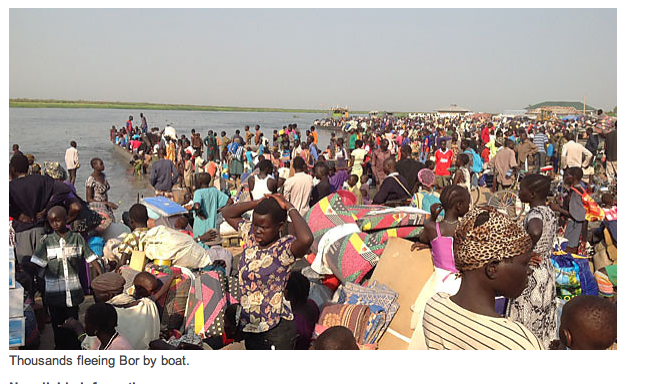
The government forces recaptured the town and we returned to the town. Many more people were killed and bodies were lying everywhere and there was a terrible smell. The rebels killed everyone they found in the town including old women, lame, deaf and all vulnerable people. And I was wounded in the upper left arm by a stray bullet of soldiers celebrating. The wound has healed and I am fine now.
It did not take long for the rebel to recaptured the town of goverment forces for a second time. And I was force to flee, this time cross the River Nile by boat to a makeshift camp across the river. This was where I got an access to go to Juba which was abit calm at the time. I am now in Juba staying in fear, not knowing where else to go.
God was speaking to you those conditions I was in in December and part of January. We spent Christmas and New Year Day on the run. I am glad for your prayers were able to lead me out of that mess. I still have hope that your prayers will continue to press political leaders to reach a peaceful solution to this crisis.
I have a live blog where I am sharing my bush experiences. You may have a look.
http://www.bbc.co.uk/blogs/bbcmediaaction/posts/Pens-down-in-South-Sudan
Share my message with the rest of the great people of Pensacola. My heart is always there with you.
Blessings
Manyang
Recent Comments
ExpatAlien on What Country am I Living … intlxpatr on Yellowstone: Old Faithful to C… Michelle on Yellowstone: Old Faithful to C… Cathy on No Grown-Ups in Charge intlxpatr on Waiting for Snow Wikipedia Donate Button

Amazina


Early Voting in Florida


 Here There and Everywhere