“Open His Eyes That He May See”
Some of the historical books of the bible have the most amazing stories. What I love about this one is that when the servant’s eyes are opened, he sees the unseen heavenly beings which surround us. Imagine, too, the King of Israel preparing a feast for the warrior force sent against him, and sending them peacefully on their way back after eating and drinking. This is the old testament reading from today’s Lectionary:
2 Kings 6:1-23
6Now the company of prophets* said to Elisha, ‘As you see, the place where we live under your charge is too small for us. 2Let us go to the Jordan, and let us collect logs there, one for each of us, and build a place there for us to live.’ He answered, ‘Do so.’ 3Then one of them said, ‘Please come with your servants.’ And he answered, ‘I will.’ 4So he went with them. When they came to the Jordan, they cut down trees. 5But as one was felling a log, his axehead fell into the water; he cried out, ‘Alas, master! It was borrowed.’ 6Then the man of God said, ‘Where did it fall?’ When he showed him the place, he cut off a stick, and threw it in there, and made the iron float. 7He said, ‘Pick it up.’ So he reached out his hand and took it.
8 Once when the king of Aram was at war with Israel, he took counsel with his officers. He said, ‘At such and such a place shall be my camp.’ 9But the man of God sent word to the king of Israel, ‘Take care not to pass this place, because the Arameans are going down there.’ 10The king of Israel sent word to the place of which the man of God spoke. More than once or twice he warned such a place* so that it was on the alert.
11 The mind of the king of Aram was greatly perturbed because of this; he called his officers and said to them, ‘Now tell me who among us sides with the king of Israel?’ 12Then one of his officers said, ‘No one, my lord king. It is Elisha, the prophet in Israel, who tells the king of Israel the words that you speak in your bedchamber.’ 13He said, ‘Go and find where he is; I will send and seize him.’ He was told, ‘He is in Dothan.’ 14So he sent horses and chariots there and a great army; they came by night, and surrounded the city.
15 When an attendant of the man of God rose early in the morning and went out, an army with horses and chariots was all around the city. His servant said, ‘Alas, master! What shall we do?’ 16He replied, ‘Do not be afraid, for there are more with us than there are with them.’ 17Then Elisha prayed: ‘O Lord, please open his eyes that he may see.’ So the Lord opened the eyes of the servant, and he saw; the mountain was full of horses and chariots of fire all around Elisha. 18When the Arameans* came down against him, Elisha prayed to the Lord, and said, ‘Strike this people, please, with blindness.’ So he struck them with blindness as Elisha had asked. 19Elisha said to them, ‘This is not the way, and this is not the city; follow me, and I will bring you to the man whom you seek.’ And he led them to Samaria.
20 As soon as they entered Samaria, Elisha said, ‘O Lord, open the eyes of these men so that they may see.’ The Lord opened their eyes, and they saw that they were inside Samaria. 21When the king of Israel saw them he said to Elisha, ‘Father, shall I kill them? Shall I kill them?’ 22He answered, ‘No! Did you capture with your sword and your bow those whom you want to kill? Set food and water before them so that they may eat and drink; and let them go to their master.’ 23So he prepared for them a great feast; after they ate and drank, he sent them on their way, and they went to their master. And the Arameans no longer came raiding into the land of Israel.
“Is Your Cat Always Fractious?”

“Fractious” isn’t a word you often hear. Clearly the veterinary tech had just read the word off the record, perhaps there is some warning in there about the Qatari Cat.
The Qatari Cat was born on the streets of Qatar, and had a bumpy start with another owner. While the man and his daughter liked him just fine, the wife and her mother did not. When the Qatari cat came to live with us, he was very wary of me. It took a couple years for him to fully trust me. He watched my feet all the time. He quailed in fear, ears back, if I used a loud voice. He was terrified of the sound of plastic bags.
Slowly, slowly, we built a relationship. Today, ten years later, he is a sweet cat.
He is a sweet cat every single day of the year, but he still has his street instincts. AdventureMan has learned that you can’t play rough with the Qatari Cat; you play rough, you lose. I never speak loudly to him; it just won’t work, it just gets his back up. Because he knows I am the boss, I speak sternly, but softly to him and he will do just what I ask him to do.
Our first visit to the vet went badly. You can read about it here. He was fine until the buzzing razor hit his bottom and then all his survival instincts kicked in. He’s been back twice, and he has been as good as gold, but somehow . . . that notation has stuck.
“No!” I replied, maybe a little bit too loudly.”No! He is a sweet kitty! He is snuggly and loving and quiet and good! But if he is scared, he wants to defend himself.” I told the tech about the Italian vet the Qatari Cat fell in love with in Kuwait, she snuggled him and told him how beautiful he was and how much she loved him and he was putty in her hands. I was almost jealous. I thought maybe she distilled some catnip and mixed it with her perfume or something, Qatari Cat’s eyes glazed a little in sheer adoration when he was around her, and he even drooled a little. She could take his temperature, give him a shot and check his innards and he never complained, just looked at her adoringly.
The tech shot a skeptical look at me and exited the room. I could hear her repeat this to the vet, and muffled laughter before she entered the room again.
So the vet came in and snuggled Qatari Cat, and told him he was pretty, and while she did not say it with an Italian accent, Qatari Cat was clearly intrigued – and on his best behavior. It doesn’t take much . . . he’s a male. Snuggle him a little, rub his fur the right way, chat him up . . . it doesn’t have to be rational, it’s all in the tone of voice and the flirtation. He totally digs it, he eats it up. A little grope here, a quick look at the teeth, a quick injection and he’s finished, not a fractious moment in the entire visit.
On the way home, we laughed thinking of our sensitivity at having our cat called “fractious.” We remember the indignant response of friends whose cat was annotated as “vicious” by a German vet. The cat was diabetic and objected to the roughness with which the vet wanted to take his blood. I think if you are a veterinarian, you might have an understanding that a sick animal, or a scared animal, might act unpredictably or defensively, there are big thick gloves you can wear if an animal seems wired up.
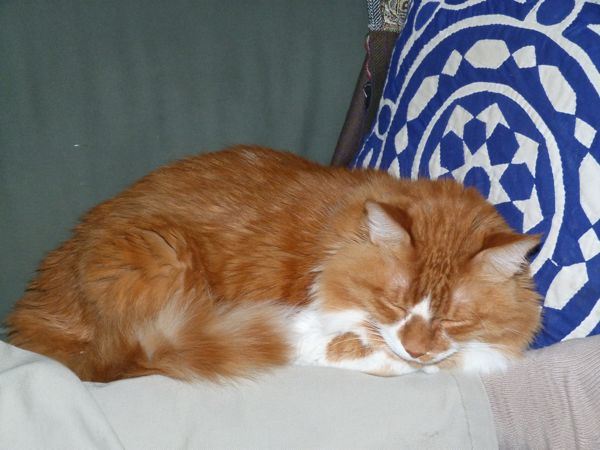
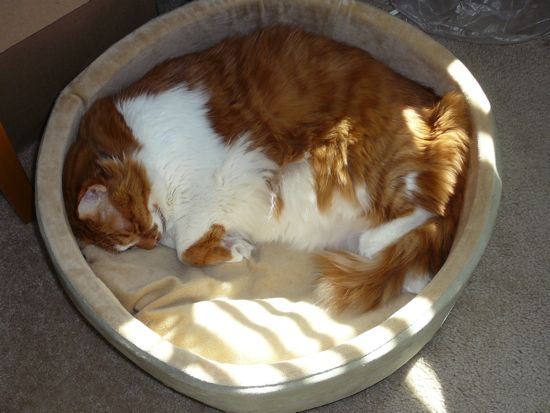
Does this look like a fractious cat to you?
Every Day Sadists Walk Among Us

“Trust your feelings,” my friend told me when I was telling her about a person who seemed so nice, but made me uncomfortable. This article says the same thing; if you feel like a person takes pleasure from humiliating or hurting others, stay far far away. It’s only a matter of time before they turn on you.
Everyday Sadists Walk Among Us, Study Says
(From AOL News/Every Day Health)
Although we may think of sadism in a sexual or criminal context, sadistic tendencies are common in everyday life.
By Laurie Sue Brockway, Everyday Health Staff Writer
Whether it’s the Marquis de Sade, the evil stepmother from Snow White, or Nurse Ratched from One Flew Over The Cuckoo’s Nest, all sadists take great pleasure in inflicting pain on others. Fortunately, you are unlikely to meet those particular three anytime soon, but according to an unusual duo of studies conducted in Vancouver, British Columbia, and published in Psychological Science this week, it is very possible you will bump into a boss, a colleague, or even a family member who may be considered an “everyday sadist.”
While most people try to avoid hurting others — and will feel guilty, remorseful, and distressed if they do hurt someone intentionally or unintentionally — an everyday sadist enjoys being cruel and may find it exciting.
“We have probably all encountered people in our daily lives who — at least seem to — enjoy hurting others,” said lead researcher Erin Buckels, MA, who conducted this work as part of her master’s thesis in Social-Personality Psychology at the University of British Columbia. She is now a doctoral student at the University of Manitoba in Winnipeg.
“Everyday sadists lack empathy, and they possess an internal motivation to hurt others. However, they are unlikely to act in a way that would be criminal or dangerous — at least in most contexts, where such behavior is met with social disapproval or punishment,” Buckels said.
Everyday sadists may be cousins to classic sociopaths in their lack of empathy, but they are not considered a danger to society in the same way. “It is only in situations where cruelty is encouraged or socially acceptable that dangerous behavior might enter the equation,” said Buckels. “Both sadistic personality and situational pressures are necessary for sadism to manifest with everyday people. War is one example of this confluence — we have all seen the images of the Abu Ghraib prisoner abuse. All forms of cruel behavior have the potential to be motivated by sadistic pleasure, including bullying and abuse by others. If it were done purely for pleasure, then it would be sadism.”
If You Like to Hurt Bugs, You May Be a Sadist
It’s one thing to take an empty mayonnaise jar to catch fireflies when you are a kid and accidentally forget to poke holes in it, causing the fireflies to die. It’s another thing to enjoy harming bugs (or animals). Buckels used a bug-crushing exercise to draw the everyday sadists out in a controlled laboratory environment. For the experiment, she defined sadists in two ways: Their cruel behavior and felt pleasure in the lab, and personality characteristics consistent with sadism. A group of 71 participants were asked to fill out a sadism personality questionnaire and also given a list of four tasks they could choose from:
Killing bugs
Helping the experimenter kill bugs
Cleaning dirty toilets
Enduring pain from ice water
A bug-crunching machine fashioned out of a coffee grinder made distinct crunching sounds. Placed close to this machine were cups containing live pill bugs that were labeled with names like Muffin, Ike, and Tootsie. Those who selected bug-crushing were told to put the bugs into the machine and grind them up. Unbeknownst to them, there was a barrier that prevented the bugs from being dropped into the grinder. No bugs were killed for this experiment, but it brought the sadists out of the closet. Of 71 participants, nearly 28 percent chose to kill bugs.
What Exactly Is a Sadist?
Sadistic personality disorder was once defined as a mental illness, but over time sadism has been considered more of a lifestyle choice or a personality quirk or trait. The new Diagnostic and Statistical Manual of Mental Disorders (DSM-5), does include sexual sadism disorder. “This is marked by recurrent and intense sexual arousal from the suffering of others as manifested by fantasies, urges, and behaviors,” said Wilfried Busse, PhD, a psychotherapist based in Bethesda, Md. “To meet full criteria for the disorder, an individual also has to act on such urges by inflicting harm on a non-consenting individual, or must experience such uncontrollable urges to cause significant social and occupational impairment.”
“The central feature of sadism is deriving pleasure from watching or inflicting physical or psychological harm on others,” added Dr. Busse. “In the extreme form a sadist will seek to inflict suffering on another for the psychological gratification derived from such an action.”
Buckel’s study did not use classic criteria to define sadism – most widely known as sexual or criminal behavior – and instead explored sadism as it exists in the “subclinical” range of personality, an aspect of sadism not considered a mental illness.
“There is clearly a difference between a person who gets pleasure from killing bugs and a person who kills other humans for pleasure,” said Buckels. “That being said, the core experience of sadism is probably pretty similar for both of them. Our research has also revealed both similarities and differences between people who enjoy acting cruelly, or direct sadists, and those who simply enjoy watching cruelty, or vicarious sadists.Regardless of whom the victim is, direct aggression requires a certain amount of callousness and a lack of distress towards the suffering of another living creature.”
How to Spot a Sadist
There is a big difference between the kind of evil sadists we know from history and movies and people with sadistic impulses, who fall into a category of sadism that is considered a personality trait rather than a personality disorder.
“It is very important to differentiate between an antisocial, or sadistic, personality disorder and sadistic impulses,” said psychologist Fran Walfish, Psy.D., a family therapist and author in Beverly Hills, Calif.
“Antisocial personality disorder is very rare,” Walfish said, offering examples such as Hitler, murderers who enjoy torturing their victims and watching them suffer, and, possibly, Syrian President Bashar Assad. “But the rest of us have unconscious sadistic impulses. Even the kindest, most loving person, when terribly mistreated, can feel an impulse of hate very strong,” she added.
Walfish explained that there are several sub-types of sadists:
Explosive sadist. When disappointed and/or frustrated with their lives, humiliated or hopeless, they lose control and seek revenge for the mistreatment to which they feel subjected. They are known for being unpredictably violent. This manifests through tantrums, fearsome attacks on others, especially family members, and uncontrollable rage.
Tyrannical sadist. They are frightening and cruel because they appear to relish the act of menacing and brutalizing others; forcing their victims to cower and submit gives them satisfaction.
Enforcing sadist. They tend to be military sergeants, deans of universities, prison overseers, police officers or people with other authoritative functions who feel they should be the ones controlling and punishing people who have broken rules, regulations or laws.
Spineless sadist. They are typically deeply insecure and act like cowards. In anticipation of real danger, they project their hostile fantasies and strike first, hoping thereby to forestall their antagonist and ask questions later. They use aggressive hostility to send the message to others that they aren’t intimidated or fearful, so that they can control their inner feelings and display the exact opposite of how they actually feel. They seek out scapegoats to gang up on, which allows them to assault the exact things that exist within themselves that they want to deny.
Everyday sadist. There is a renewed interest in studying subclinical sadism as a personality trait, said Walfish. Subclinical psychopathy, narcissism, Machiavellianism, and everyday sadism form the so-called “Dark Tetrad” of personality.
“These people aren’t necessarily serial killers or sexual deviants but they gain some emotional benefit in causing or simply observing others’ suffering,” said Walfish. “The type of person the study is referring to are, for instance, the co-worker who repeatedly humiliates you and smiles or appears to reap pleasure from hurting you. If you self-advocate and say something that inflames your co-worker, she retaliates with evil revenge, further humiliating you.”
Exercise Caution Around Everyday Sadists
The British Columbia researchers surmised that everyday sadists are not the most popular people.“A person who has a high score on a sadism personality questionnaire is unlikely to be regarded as a nice and loving person,” said Buckels. “That is not to say that they are always nasty or that they can’t love others; but in general, high scorers tend to be less nice than average.”
How does someone become an everyday sadist? “In general, the cause or reason someone wants to go the extra effort to hurt another is because someone terribly mistreated them,” said Walfish. “That someone is usually their mother, father, or an older sibling. The sadist was a receptacle, or container, for hostility and evil meanness. These toxic feelings become too much for one to bear. They have no choice but to find a weaker victim and spew their venom onto the other.”
“Within their own families and in the workplace these people cannot be trusted,” Walfish observed. “No one can ever feel safe with them. Therefore, they do not have real relationships. They engage by exploiting, manipulating, and using other people as a means to their own end. The best thing to do is keep reasonable distance from these people. Always be pleasant so you don’t become their target. This does not mean to kiss up. It just means you present yourself as a benign nice guy. Never do business or get close to one of these people. They will always take you down.”
Buckels said she was surprised to find such a low baseline of positive emotions reported by sadists. “They are not just acting out to compensate for deep-rooted insecurity or low self-esteem,” she said. “Interestingly, after an act of cruelty, their moods seemed to lighten, suggesting instead that the sadist’s appetite for cruelty derives from some diabolical need. Although speculative, our hypothesis is that sadists have an underlying deficit that is sated through cruelty’s rewards.”
Kuwait Marriage and Divorce 2013
The presentation is a little confusing, but I have to guess that if 19% of the divorces are “non-Kuwaiti” by which they mean that one member of the marriage is not Kuwaiti. So what they are not saying is that 80% of the divorces are Kuwaitis married to Kuwaitis.
They also did not say how long marriages lasted – how many of those marriages were divorced in the first year, how many after many years? If the statistics are accurate, Kuwait is doing OK – more than half the marriages are succeeding.
OOps – found second report in the same Kuwait Times! See below
9,404 Kuwaiti marriages, 4,067 divorces in 2012
KUWAIT: More than 9,000 Kuwaiti couples married last year and more than 4,000 marriages ended in divorce the same year, a local daily reported yesterday quoting official statistics.
The statistics released by the Ministry of Justice and published by Al-Qabas daily indicate that 9,404 marriages between Kuwaitis took place last year compared to 4,067 divorces, or 43.3 percent.
The same statistics also indicated that 4,910 marriages took place between a Kuwaiti and non-Kuwaiti spouse in 2012, compared to 2,605 divorces in the same category. In detail, the statistics show that 814 Kuwaiti men married non-Kuwaiti women in 2012, while 648 Kuwaiti women married non-Kuwaiti men the same year.
The percentage of Kuwait couples in the total number of marriages last year reached 65 percent, according to the statistics, while 19 percent took place between non-Kuwaiti couples. 10 percent of marriages took place between a Kuwaiti man and a non-Kuwaiti woman, while marriages between a non-Kuwaiti man and a Kuwaiti woman also reach 10 percent.
Regarding divorce percentages, the statistics show that 19 percent of divorce cases happened between non-Kuwaiti couples; 12 percent between couples in which the husband is Kuwaiti and the wife is non-Kuwaiti, and 7 percent between couples in which the husband is non-Kuwaiti and the wife is Kuwaiti.
Regarding academic qualifications, the statistics show that 35 percent of women married last year have university degrees, 30 percent have high school degrees, and 19 percent have diplomas, whereas 29 percent of men have university degrees, 24 percent have high school degrees, 21 percent have middle school qualifications and 20 percent have diplomas. On the other hand, the statistics show that the majority of women divorced last year have university degrees (29 percent), while the majority percentage of divorced men have middle school qualifications (29 percent).
55% couples married in last 4 years seek divorce
KUWAIT: Almost 55 percent of couples filing for divorce in Kuwait have been married for four years only, including 25 percent who are yet to celebrate the first anniversary of their wedding, a local daily reported yesterday quoting official statistics. The statistical report released by the Research and Statistics Department in the Ministry of Justice and obtained by Al- Qabas daily further indicates that out of 5,662 couples who sought marriage counseling, only 20 percent had their issue successfully resolved.
Lack of willingness to coexist was identified as the primary cause for divorce requests, with 32 percent of the requests made by husbands and 23 percent by wives.
The statistics further indicate that 77 percent of couples who attended marriage counseling were Kuwaitis compared to 22 percent non-Kuwaitis.
Meanwhile, 62 percent of those couples do not have children, 34 percent have one to three children, and 2.7 percent have between four and six children.
Regarding age groups, the statistics show that 42 percent of couples seeking marriage counseling are aged between 25 and 34, 22 percent aged between 35 and 44, and 20 percent aged between 15 and 25. And according to the couples’ academic levels, the statistics indicate that 28 percent of husbands have middle school degrees, 22 percent have high school degrees and 21 percent have university degrees, whereas 27 percent of wives have high school degrees, 23 percent have university degree, 22 percent have diploma and 20 percent have middle school
My Visitors from Ulaanbaatar, Mongolia
Every now and then I check statistics, see who’d dropping by, see what they are looking at. My Mongolian friends always give me a grin; I get about four a day, they are all looking at the same post:

Be careful what you blog, LOL, sometimes it assumes a life of it’s own.
MRSA Link to Pigs

From Nature.com News:
People living near pig farms or agricultural fields fertilized with pig manure are more likely to become infected with methicillin-resistant Staphylococcus aureus (MRSA) bacteria, according to a paper published today in JAMA Internal Medicine1.
Previous research has found that livestock workers are at high risk of carrying MRSA, compared to the general population2. But it has been unclear whether the spreading of MRSA through livestock puts the public at risk of infection.
The study examined the incidence of infections in Pennsylvania, where manure from pig farms is often spread on crop fields to comply with state regulations for manure disposal. Researchers reviewed electronic health-care records from patients who sought care from the Pennsylvania-based Geisinger Health System (which helped to fund the study) in 2005–10.
The team analysed cases of two different types of MRSA — community-associated MRSA (CA-MRSA), which affected 1,539 patients, and health-care-associated MRSA (HA-MRSA), which affected 1,335 patients. (The two categories refer to where patients acquire the infection as well as the bacteria’s genetic lineages, but the distinction has grown fuzzier as more patients bring MRSA in and out of the hospital.)
Then the researchers examined whether infected people lived near pig farms or agricultural land where pig manure was spread. They found that people who had the highest exposure to manure — calculated on the basis of how close they lived to farms, how large the farms were and how much manure was used — were 38% more likely to get CA-MRSA and 30% more likely to get HA-MRSA.
The researchers also analysed 200 skin, blood, and sputum samples isolated from patients in the same health-care system in 2012. The MRSA strains found in those samples are commonly found in humans. Researchers did not find any evidence of bacteria belonging to clonal complex 398 (CC398), a MRSA strain classically associated with livestock and found in farms and farmworkers in many previous studies.
However, there is little information about which MRSA strains are most common on US farms, so the absence of CC398 is not a sign that MRSA is not being transmitted from livestock to humans. “We’ve done studies in Iowa, we haven’t always found CC398. That’s not too shocking,” says Tara Smith, a microbiologist at Kent State University in Ohio, who was not involved in the study.
Many researchers think that widespread use of antibiotics to encourage growth in farm animals fuels the proliferation of MRSA and other drug-resistant bacteria. The latest findings suggest that manure is helping antibiotic resistance to spread, says Joan Casey, an environmental-health scientist at the Johns Hopkins Bloomberg School of Public Health in Baltimore, Maryland, and a co-author of the study.
“We’ve certainly described a connection we think is plausible,” she says. “We haven’t described every step in the path.”
“It’s a pretty interesting and provocative observation,” says Robert Daum, a paediatrician and the principal investigator of the MRSA Research Center at the University of Chicago in Illinois. He adds that he would like to see similar studies done in different geographic regions, and research to find out whether the MRSA strains carried in pig manure are the same as the MRSA strains found in nearby human infections.
Casey is at work on a follow-up genetics study to identify the most common MRSA strains in the region.
Nature doi:10.1038/nature.2013.13752
References
Casey, J. A., Curriero, F. C., Cosgrove S. E., Nachman, K. E. & Schwartz, B. S. JAMA Intern. Med. http://dx.doi.org/10.1001/jamainternmed/2013.10408 (2013).
Show context
Smith, T. C. et al. PLoS ONE 8, e63704 (2013).
My Travel Must-Have
I don’t like large handbags. I am small; a large bag is disproportionate. At the same time, I wanted a bag big enough to stick my computer in without looking like a briefcase. I wanted to be able to take my computer to Alaska with me.
I looked and looked, searching for the right bag. I looked in Pensacola, I looked online, I looked in Seattle. It had to be the right size, a nice heavy leather, a sturdy leather carry strap, and a neutral color as I was only taking one bag. Finally, at the very last minute I found this wonderful bag, and the computer fit beautifully, leaving room for my camera and wallet – what more do I need, right?

Then, me being me, the night before leaving for Alaska I decided I really did not need to carry a full sized computer, that the iPad had enough capacity and besides, it had books and Sudoku on it. But I still liked the purse; I stuck a nightshirt inside in case my luggage got lost, it has a side zip pocket for tickets, car rental brochures and car keys, and with everything inside, it was still roomy and not too heavy. It is wonderful boarding airplanes with just a purse!
By the end of the trip, I was in love. It is a great bag, goes everywhere, can be filled or used with little, it is versatile. I love this bag!
Get Ready For the Harvest Moon

From Weather Underground News where you can read the entire article by clicking on the blue type:
Get ready for the Harvest Moon. Depending on where you live on the planet, it’s either Wednesday or Thursday of this week.
“In traditional skylore, the Harvest Moon is the full moon closest to the autumnal equinox,” EarthSky reports, “and depending on the year, [it] can come anywhere from two weeks before to two weeks after the autumnal equinox.” For 2013, that changing of the seasons happens on September 22 — just a few days from now.
Unlike the Blue Moon we covered back in August, the Harvest Moon behaves differently than a typical full moon. “Throughout the year, the moon rises, on average, about 50 minutes later each day,” according to NASA Science News. “But near the autumnal equinox … the day-to-day difference in the local time of moonrise is only 30 minutes.” Why does that matter? Simply put, agriculture.
“In the days before electric lights, farmers depended on bright moonlight to extend the workday beyond sunset,” wrote NASA’s Dr. Tony Phillips. “It was the only way they could gather their ripening crops in time for market. The full moon closest to the autumnal equinox became the Harvest Moon, and it was always a welcome sight.”
So my question is this – the Harvest Moon is what we call it, because it gave farmers extra time to bring in the harvest. What do other cultures call it?
One Thing Leads to Another
“I’m afraid to go home,” AdventureMan told our son. “She’s moving the furniture.”
“She can do that without consulting?” our son asked.
“Yeh, she can,” AdventureMan responded, “And I count myself lucky that she hasn’t bought another house and said we’re moving.”

Moving furniture is one of those things I do. I get tired of everything the same-old same-old. If I’m not moving, it gives me a chance to re-think things, and try something else to see if that works better.
We have a dining room we hardly ever use. We have never eaten a meal in there. We had too much furniture, and besides, in the family room we have a huge circular teak table that seats eight. It’s less formal and a lot more fun. The dining room is in a very quiet part of the house, so we talked about turning it into a library (see! we talked!) and that is what I did. But when you move a piece of furniture, or get rid of another, or both, you end up also having to evaluate all the things inside that piece of furniture, and having to think through where things need to go.
Life is so different. As an Army wife, we entertained all the time. I hit the sales in Czechoslovakia and have bar ware and wine glasses for our 48 closest friends, and we just don’t entertain like that any more. We don’t even drink like that!
We do entertain; we host the monthly book club some months, I have my quilting group in frequently, and we have dinners for family and dinners for visiting IVLP delegates. We entertain people we like. It’s a whole different world when it’s a choice. I’m getting rid of a lot of pieces I’ll never use again and I’ll never miss once they’re gone.
I’m getting rid a lot of irrelevant things, including an old TV cabinet, you remember them? They enclosed an old fashioned TV, had shelves for videos (remember them?) and little drawers for CDs? I’ve been using it as storage for art work and a thing that plays music from an iPod or two. I’ll hang some of the art work, get rid of some, and find another place for the MP3 player.
Yesterday was the big work, the figuring out how to change furniture and carpets into new positions. Of course, once you move something, you have to clean the places no one ever sees, so it takes more time, but you’ve got to do it right.

Today was the small but time-consuming work of getting things put away in a kind of order so that they can be found again. When I put books on the shelves three years ago, it was like fiction here and non-fiction there, and I never went back. Now, I have them sorted into subjects and country, art related, or religious. Got rid of about half my CD’s but still have too many.
It’s a messy process; you take something fixed, turn it into chaos and slowly, slowly, bring a new pattern into being. Tomorrow I need to hang some more art work. It’s been three years.
Then we live with the changes and see if they work for us. If not . . . the process starts over, but in the meanwhile, got rid of some stuff! One of these days, need to tackle the closets . . . Have an entire closed full of evening clothes I never wear, and can’t bear to part with . . . yet.
One Night in Hawali; Cops Book 995 “To Fight Chaos On the Roads”
KUWAIT: Traffic police in the area of Hawalli have set a record by booking 995 drivers and motorcycle riders in a one-day campaign to fight chaos on the roads. “A large team of traffic policemen was deployed in the area to check the extent of discipline and compliance with the law on the roads,” security sources told local daily Al-Rai. “The policemen detained 20 people and impounded their cars. Among them, there were five people who did not have a driving licence, seven who were utterly reckless in their driving, three who staged a race and five who did not have licences to ride their motorcycles,” the sources said. According to the figures he revealed, 23 cars and five motorbikes were impounded in the crackdown conducted on Friday.
Lesser violations included uninsured vehicles, tinted windows, not wearing seat belts and parking in areas for people with special needs, the sources said. Traffic officers in Kuwait have been actively engaged in relentless campaigns to restore order in a sector plagued by a high toll of accident fatalities, reckless driving and non-compliance with administrative procedures. Foreigners who repeatedly broke the law have been deported for endangering lives while citizens have been deprived of their vehicles or licences.
Abdul Fattah Al Ali, assistant undersecretary for traffic and the force behind the campaigns, who had come under attack, mainly from the opposition, for his strong approach towards foreign drivers who commit several traffic offences, said that the trend to end the chaos and impose road discipline would continue.
“I am not an abusive person, but I do apply the law and assume my responsibilities to save lives and protect people from reckless drivers,” he said. “The expatriates who do not respect the law should be sent home. We will deport the irresponsible expatriates who do not respect the laws of the country,” he said. “We have also extended the vehicle impounding period from two to four months and drivers can now be held for 48 hours for the sake of the investigation and the normal procedures.”
The crackdown led the authorities to discover that 20,000 forged driving licences had been issued since 2010. “We have withdrawn 7,000 forged licences, and we are working on tracking down and cancelling all the others,” Al-Ali has said.
He added that expatriates summoned to the traffic directorate should come forth and hand their licences, assuring them that there would be “no questions asked”. However, those who fail to show up to hand back the licences will face forgery charges and will be deported, he said.
Comment: 20,000 forged licenses??? 20,000???
Recent Comments
ExpatAlien on What Country am I Living … intlxpatr on Yellowstone: Old Faithful to C… Michelle on Yellowstone: Old Faithful to C… Cathy on No Grown-Ups in Charge intlxpatr on Waiting for Snow Wikipedia Donate Button

Amazina


Early Voting in Florida


 Here There and Everywhere