Korean Air Pilots Mistakenly Identified in TV News Prank: Sum Ting Wong
Someone will lose their job, if it is ever discovered who pranked this totally politically incorrect news broadcast. This from Reuters via Huffington Post on AOL:
NTSB Intern Mistakenly Confirmed To KTVU Wrong Asiana Names, Statement Says
(Please note offensive language in paragraph 6)
July 12 (Reuters) – The National Transportation Safety Board apologized on Friday after an intern mistakenly confirmed to a local television station racially offensive fake names for the pilots of an Asiana flight that crashed in San Francisco.
“The National Transportation Safety Board apologizes for inaccurate and offensive names that were mistakenly confirmed as those of the pilots of Asiana flight 214, which crashed at San Francisco International Airport on July 6,” the NTSB said in a statement.
“Earlier today, in response to an inquiry from a media outlet, a summer intern acted outside the scope of his authority when he erroneously confirmed the names of the flight crew on the aircraft,” the NTSB said.
The crash of the Boeing 777 plane resulted in the deaths of three teenage girls in a group of students from eastern China who were visiting the United States for a summer camp, one of whom died on Friday in the hospital. Over 180 passengers and crew members were injured.
On Friday, an anchor for Oakland, California, station KTVU read a list of the supposed names of the pilots of the South Korean carrier on its noon broadcast after an employee apparently called the NTSB seeking to verify them.
The names appear to mock the events of the crash. The prank names were: Captain Sum Ting Wong, Wi Tu Lo, Ho Lee Fuk and Bang Ding Ow.
Justin Cronin: The Twelve
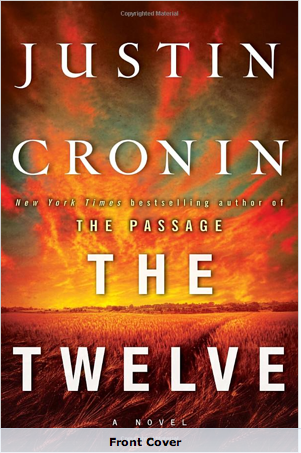
I had downloaded The Twelve to my iPad for a trip, but didn’t get to it, and sort of forgot it was there until my son mentioned he was listening to it on audio-books, and it was good, maybe even better than the first book in the trilogy, The Passage. He had loaned me The Passage several years ago when it came out, and as soon as I finished, I got on the list to download as soon as the next book came out – it was that good.
Cronin’s gift is an ability to create a future world entirely different from our own, with a devastating enemy – the virals – who, literally, are us, transformed. Cronin can make the enemy terrifying, destructive, truly horrifying – and can make them also captive to their repugnant nature and even pitiable. I think that is an amazing dance for an author to accomplish.
The setting is post-apocalyptic USA; the government had a sector working on a secret weapon which – of course – was not able to be contained, creating 12 super vampire-like creatures called Virals, who in turn create hordes of minions. This volume, The Twelve, is set more than 100 years later, but shifts back to earlier times to help us understand how this disaster occurred, and how characters relate back to the earliest times of the disaster. The populations live in fear of sudden attacks; one family, out on a picnic, are almost totally wiped out by an eclipse for which the Virals were prepared – and the families were not.
As I read his books, I find them very cinematic, but, as my son and I discussed, too complex for a movie; it would need a gritty HBO series like The Wire, or OZ, or Deadwood to capture the subtleties, the nuances that make this a best-selling series. The heroes and heroines are all make for the screen, their relationships – and inter-relationships – make them interesting, and then, as we learn more, interesting again. We never know enough to make a final judgement on any character; the characters are complex and the relationships obscure until the author chooses to reveal. It makes it fun to try to spot them before he tells us. I missed a couple!
Although it can be read as a great-adventure stand-alone, you’ll be happier if you read The Passage before you read The Twelve. If you have a problem with postponing gratification, you might want to wait until the third and conclusive volume of the trilogy is published – and that may be a year or so.
The Shrink-Wrapped Pensacola Specialty Pawn Shop Car

How cool is this? We saw this car at Taco Rock and loved the optical illusion. We also loved it that the car makes a memorable impression; you’ll think of it and you will think Pensacola Specialty Pawn. It’s an effective ad if you remember who the ad is for 🙂
When we walked inside, AdventureMan asked “Whose car is that with the mobster paint job?” and a guy picking up a take-out order grinned and said it was his. He told us it was a shrink-wrap technique – it’s temporary! When you get tired of it and want to try something else, it just peels off and you put something else on. I think that is so totally cool.
Once-A-Year Burger at Red Robin’s
AdventureMan and I are not vegetarian; we eat a lot of fish and we try not to eat a lot of beef, pork or lamb. Lamb isn’t so much of a problem here in Pensacola – you don’t even see it on the menu that often. But pork – and beef – are everywhere.
Once a year I have a burger. Really. AdventureMan will order a burger more often, and I might take one bite here and there, but once a year, usually around the 4th of July, I will have my onec-a-year burger.
(Do you have any idea how many calories one burger has in a resturant? It’s all the extras, the bacons, the sauces, the fried onions, it can be two days worth of calories in ONE burger. It can seriously clog your veins in as little as two hours after you eat one. )
Because I only have one, it has to be a really really good one. I got hooked on Red Robin burgers back in university; then, Red Robin was really a college beer joint that served really good burgers. I ordered the A-1 Peppercorn Burger, but when it came, it came on some kind of a roll 😦 not the real hamburger bun.

It was everything I had hoped for – and more. The meat was cooked perfectly, not overdone; juicy and not greasy. The bacon (yes, yes, I did. It’s just once a year) was crisp. The sauce was peppery, just the way I like it. And yes, I ate the onion rings, too.
Now I’m good for another year 🙂
“Heavyweight Saudi Arabia” Influence Counters “Over-Stepping” Qatar?
From the Kuwait Times, a fascinating comparative analysis of the influence of Saudi Arabia and Qatar on Islamic countries in transitions:
Qatar losing ground to Saudi diplomacy

DUBAI: Qatar, a key supporter of Islamists who rose to power in Arab Spring countries, is losing ground in regional politics to Saudi Arabia which appears to have seized the reins on key issues, notably Egypt and Syria. The decline in Qatar’s regional diplomacy comes as its powerful emir Sheikh Hamad bin Khalifa Al-Thani unexpectedly abdicated in favor of his son Tamim last month.
The wealthy Gulf state had transformed itself into a key regional player but began to retreat as heavyweight Saudi Arabia re-entered the political arena after lagging behind in the immediate period following the eruption of the Arab Spring uprisings in December 2010. The ouster of Egypt’s Islamist president Mohamed Morsi last week by the army and the election by the Syrian opposition of Saudi-linked Ahmad Assi Jarba as new leader stripped Qatar of strong influence in both countries.
“Qatar had tried to take a leading role in the region but overstepped its limits by openly backing the Muslim Brotherhood in Egypt, Syria, and other Arab Spring states,” said Kuwaiti political analyst Ayed Al-Manna. Jonathan Eyal, head of international relations at Britain’s Royal United Services Institute, argued that Qatar’s regional politics have failed.
“Qatar’s Middle Eastern diplomacy now lies in ruins: it failed to produce dividends in Libya, backfired in Syria and has now collapsed in Egypt,” local Emirati daily The National quoted him on Tuesday as saying. Realizing the damaging effects of their policies, Manna noted, “the Qataris sought to cut down on their commitments” which were already affected by the emir’s abdication and the sidelining of the influential prime minister Sheikh Hamad Bin Jabr Al-Thani.
As a result, “Saudi Arabia, a historical regional US ally, regained its role” in coordination with other oil-rich Gulf monarchies, said Manna. Saudi Arabia’s King Abdullah was the first foreign head of state to congratulate Egypt’s interim president Adly Mansour, hours after he was named to replace Morsi. And on Tuesday, the kingdom pledged $5 billion in assistance to Egypt. The United Arab Emirates, which has cracked down on the Muslim Brotherhood in the past few months, offered Egypt an aid package of $3 billion.
“Saudi Arabia wants to ensure stability in Arab Spring countries, regardless of its ideological interests,” said analyst Abdel Aziz Al-Sagr, head of the Gulf Research Centre. “It had supported the Muslim Brotherhood in Egypt but reconsidered this support after the Brotherhood failed to run the country wisely,” he argued. But the Saudi researcher downplayed the rivalry between Saudi Arabia and Qatar, both of which have been looking to expand their influence during the Arab Spring uprisings and prevent any potential revolt against their own autocratic regimes.
“The Saudi-Qatari harmony still exists and there is no battle for influence between the two countries,” said Sager. And as proof, “Riyadh was the first to be informed of the political change in Qatar, six months before it took place. And it welcomed it.” But the two countries, whose relations have been historically tense or at least marked by mistrust, support two different approaches of political Islam that emerged strongly in the wake of the Arab Spring.
Qatar sides with political parties linked to the Muslim Brotherhood, whose experience was cut short despite the strong media support they enjoyed from the influential Doha-based Al-Jazeera news channel. Meanwhile, Saudi Arabia promotes Salafist groups that focus less on politics and more on implementing Shariah Islamic law on daily life matters such as forcing women to wear a veil and prohibiting the mixing between sexes. Saudi King Abdullah has reiterated his country’s stance against using Islam for political purposes.
“Islam rejects divisions in the name of one party or another,” he said in a statement marking the start Wednesday of the Muslim holy month of Ramadan. The kingdom will never accept” the presence of political parties, that “only lead to conflict and failure.” But regardless of the political agendas of Saudi Arabia or Qatar, the people who rose up during the Arab Spring revolts will have the final word on their own political futures, argued former Bahraini cabinet minister Ali Fakhro. “It is the Arab people, not Qatar nor Saudi Arabia, who will determine the political future of the region.” – AFP
Pacific Northwest Natives Have DNA Link 5,000 years
Don’t you love technology? It’s like working on a complex puzzle, and all of a sudden seeing how disparate pieces relate 🙂 This is a fascinating discovery from AOL/Huffpost:
Ancient DNA Linked To Living Descendants In Genetic Study
The Huffington Post | By Macrina Cooper-White Posted: 07/09/2013 2:24 pm EDT | Updated: 07/09/2013 9:12 pm EDT
What if you could trace your ancestry back to around 5,000 years ago? Researchers were able to do just that in a fascinating new DNA study, which found adirect genetic link between the ancient remains of Native Americans and their living relatives.
“It’s very exciting to be able to have scientific proof that corroborates what our ancestors have been telling us for generations,” study co-author and participant Joycelynn Mitchell said in a written statement. “It’s very amazing how fast technology is moving to be able to prove this kind of link with our past.”
In the study, U.S. and Canadian researchers used mitochondrial genome (mitogenome) sequencing to analyze DNA inherited exclusively through mothers. Looking at the mitogenome is cheap, easier to sequence than nuclear DNA, and skirts around the problem that European men mixed with Native American women.
The researchers collected DNA from 60 living indigenous people belonging to the Tsimshian, Haida and Nisga’a tribes in the northern coast of British Columbia. The tribes’ oral histories and archaeological sites indicate they have lived in the region for generations, which made them good candidates for tracing their lineage back so many years.
Complete mitogenomes were extracted from the remains of four Mid-Holocene individuals found in British Columbia’s Lucy Islands and Dodge Island, and then that information was compared to the DNA of the study participants.
What was found? The research team discovered one of the living individuals carried this same “mitogenomic signature” as a young adult female who lived on Dodge Island 2,500 years ago — which also matched the mitogenome of the remains of a woman who lived in the Lucy Islands 5,500 years ago. Wow.
Three other living participants had mitogenomes that linked back to the remains of another individual found on Dodge Island, who may have lived around 5,000 years ago.
“This is the beginning of the golden era for ancient DNA research because we can do so much now that we couldn’t do a few years ago because of advances in sequencing technologies,” study co-author Dr. Ripan Malhi, an anthropology professor at the University of Illinois and Institute for Genomic Biology professor, said in a written statement. “We’re just starting to get an idea of the mitogenomic diversity in the Americas, in the living individuals as well as the ancient individuals.”
The new study was published online on June 3, 2013 in the journal PLoSONE.
Kuwait has Highest BMI in the World
The countries which contain the heaviest and lightest citizens can be revealed today.
This extraordinary graphic shows the average body mass index values for adults around the globe – with some surprising results.
With its wealthy society and love of fast food outlets, many would place the U.S. at the top of the list.
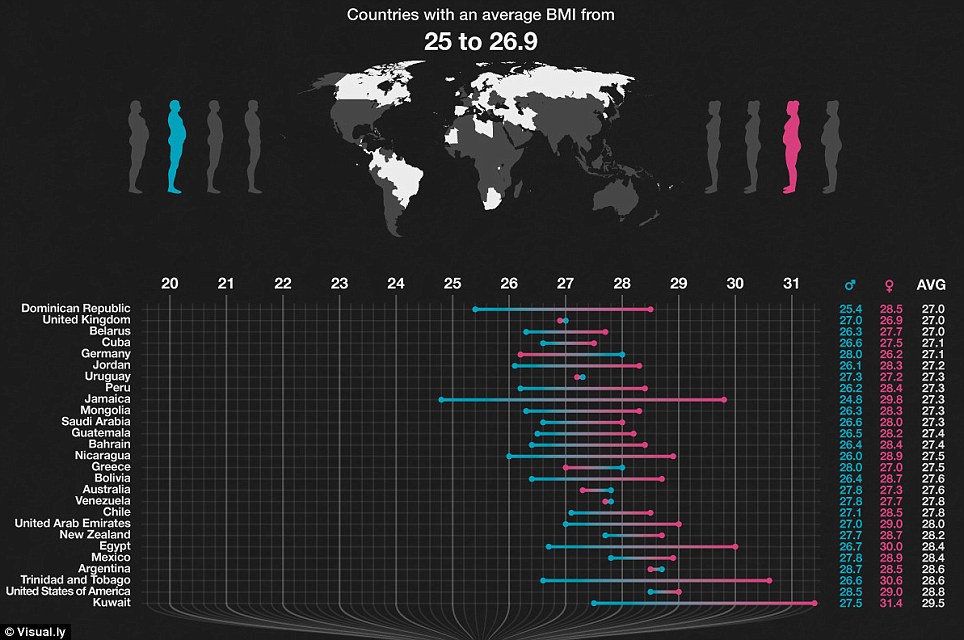
But it is pipped to first place in the body mass index chart by Kuwait. The Arab state has an average body mass index of 27.5 for men and 31.4 for women.
This beats America in second place which averages 26.5 for men and 29 for women.
From UPI:
Mexico is world fattest nation, United States No. 2
UNITED NATIONS, July 10 (UPI) — Officials at the U.N. Food and Agricultural Organization say Mexico with a 32.8 percent adult obesity rate is the most overweight of the industrialized nations.
Previously, the United States with an adult obesity rate of 31.8 percent was the world’s fattest nation. Last year, the percentage of U.S. adults overweight went down slightly.
A report by the FAO said Mexico’s widely available inexpensive junk food and penetration of U.S. fast-food chains combined with a more sedentary lifestyle all contributed to Mexico’s bulging waistline.
About 70 percent of Mexican adults are overweight, while childhood obesity tripled in a decade and about a third of teenagers are overweight as well, the Global Post said.
Weight-related diabetes claims 1-of-6 one of Mexican adults — or 70,000 people a year — suffering from the disease each year, the report said.
Ramadan: Tuesday? Wednesday? Thursday? Depends on where you live
This is from the Huffington Post via AOL. Ramadan has started in the USA, but the rest of the world . . . not so clear.

Is Ramadan Tuesday or Wednesday? How about Thursday?
Because of disagreements over when the lunar-based Islamic fasting month begins, Muslims will start their fasting on different days this year.
In the United States, the Fiqh Council of North America, a prominent group of Islamic scholars affiliated with the Islamic Society of North America, has declared the first fasting day of Ramadan to be Tuesday. It used astronomical calculations and a sighting of the new moon in California. Many mosques, such as the Islamic Society of Boston Cultural Center, have also encouraged their congregants to use Tuesday as the first fasting day.
But with the vast majority of the world’s Muslims living outside the U.S., and many of America’s Muslims having immigrated from or having family in other countries, the Ramadan calendars used in places such as the Middle East and South Asia have swayed some Americans to change their observation dates.
In several Middle Eastern countries, including Saudi Arabia and United Arab Emirates, Islamic leaders said Monday that the new moon had not been sighted, meaning that Ramadan fasting could not begin until Wednesday. Ramadan technically begins at nighttime, when the crescent moon is sighted, and the first day of fasting begins at dawn the following morning. Islamic leaders in Malaysia have also said the fast won’t start until Wednesday. To blame in some areas for the lack of a visible moon: cloudy skies and bad weather.
In Pakistan, news sources are reporting that the fast could begin either Wednesday or Thursday. The story is similar in India, which is home to 177 million Muslims. TheWall Street Journal reported Tuesday that monsoons had prevented moon-sighting committees from declaring the beginning of Ramadan.
Syed Tariq Bukhari, a member of the moon sighting committee at Old Delhi’s Jama Masjid, one of India’s largest mosques, said India lags behind the Middle East because of its geographical position and, this year, because of the monsoon.According to his committee, if the new moon is spotted either by a moon sighting committee, a reliable Islamic witnesses — a Muslim man with a beard — or a large number of people Tuesday evening, then Ramadan will begin in India on Wednesday.
If not, then Thursday will mark the start of the fast.
Regardless of differing dates abroad, American Islamic scholars are keeping with using Tuesday as the first fast, Fiqh Council of North America officials say in a statement on their website.
“There is a big chance of divergence. The Fiqh Council will stick to its criteria and decision no matter what reports come from abroad. Ramadan in North America will definitely begin on Tuesday, July 9, 2013.”
Recent Comments
ExpatAlien on What Country am I Living … intlxpatr on Yellowstone: Old Faithful to C… Michelle on Yellowstone: Old Faithful to C… Cathy on No Grown-Ups in Charge intlxpatr on Waiting for Snow Wikipedia Donate Button

Amazina


Early Voting in Florida


 Here There and Everywhere