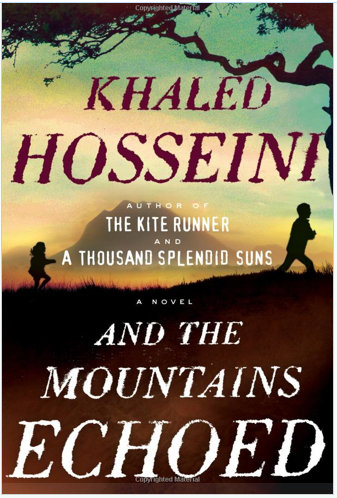
I danced when I saw the Amazon box; rarely do I buy hardcover (hurts too much when they fall over if I fall asleep reading, too bulky to carry on planes) but this one I was on the waiting list for, mail it as soon as it is published! Khaled Housseini, author of Kite Runner and A Thousand Splendid Suns has a new runaway best-seller; thanks to him I’ve just spent three days in Afghanistan, Paris and Los Angeles.
As the book opens, I am big brother to a baby sister whose Mom died in childbirth, living in a remote village in Afghanistan. Life is tough, but through the eyes of these children, life is idyllic, even though food is scarce and winters are cold. We have a huge oak tree with a swing, we play with the other children, and we have each other. Our father’s new wife is kind enough, but is busy with her own children, and the drudgery of cooking, cleaning and making do in a very small, poor Afghan village.
Later, I am Pari, living in Paris with an alcoholic, self-absorbed mother, making a life for myself, but always with a nagging feeling of something just outside my peripheral vision, another life . . .
The tale is told through the eyes of many, and on the way to the end of the tale we meet a wide spectrum of humanity, suffer the ills of war, callousness and unintended cruelties. We find that the man with superficial charm also saves and changes the lives of many, we find a doctor who finds fulfillment serving in the poorly resourced hospitals of Afghanistan, and we feel the agonies of a dutiful daughter watching her father fade into the world of Alzheimer’s.
It’s a wonderful, wild ride, richly textured, and when it finishes, you are not ready for it to end.
This is a very strange story, from the Pensacola News Journal. Continuing investigation makes it even stranger. It sounds like a lot of people on the beach for 3:00 a.m. The victim and some friends had argued, driven off, come back . . . and he is shot by another group of people who wander by, shoot him – several times – and then run off in three different cars. They claim not to know one another. There has to be more to this story. Bizarre.
A Pensacola man accused of shooting a man to death early Tuesday at Casino Beach may face a first-degree murder charge in a case that is raising more questions as new details emerge.
Damarcus Rayon Jenkins, 20, made a video appearance before Escambia County Judge Thomas Johnson on Wednesday afternoon in the shooting death of Michael Harris, 34, of Milton.
Jenkins is accused of shooting Harris multiple times after approaching Harris and his girlfriend, who had been arguing on the beach.
He was arrested on a second-degree murder charge and is being held without bond. But prosecutors will ask a grand jury to upgrade the charge to first-degree murder in the next few weeks, Assistant State Attorney John Molchan said.
Questions linger about what triggered the deadly encounter.
There is no indication that Harris and Jenkins knew each other, investigators said.
“That makes us very concerned and that’s what we are continuing to investigate,” Molchan said. “The nature of the shooting still presents a lot of questions.”
Escambia County sheriff’s deputies arrived at Casino Beach at about 3:45 a.m. Tuesday in response to a call of shots fired and found Harris lying in the sand with several gunshot wounds, including one to his sternum, according to a Sheriff’s Office report.
He was pronounced dead at the scene by emergency responders just after 4 a.m.
According to several witnesses, Harris had been out on the beach with a group of friends that night to celebrate a friend’s 30th birthday.
The group separated after Harris, his girlfriend and two other friends got into an argument, according to the report.
After the argument, Harris and another female friend became angry and walked away from the group.
The remaining two friends — a male friend and Harris’ girlfriend — got into a van and drove over the Bob Sikes Bridge before receiving a call from Harris to be picked up, according to the report.
After arriving back at the beach, Harris’ girlfriend got out of the van to meet Harris while Harris’ male friend drove to a different location to pick up his girlfriend, according to the report.
As Harris sat with his girlfriend on the beach, several witnesses said a group of males and females — who appeared in their teens and early 20s — approached the two and multiple gunshots were fired.
The suspected shooter was later identified by several witnesses as Jenkins, Molchan said.
Following the gunshots, the group ran from the beach and into the parking lot where they sped off in black Nissan Altima, a white vehicle and an orange vehicle, according to the report.
Later, officers arrived at a residence in the 4500 block of Landes Drive seeking Jenkins for questioning.
As they talked with a person who answered the door, they noticed Jenkins attempting to flee the home through a side door, the report states.
A deputy caught Jenkins, searched him and found a set of keys to an orange Kia Rio parked in the front yard, which matched one of the vehicles at the scene of the homicide.
Deputies also obtained a search warrant for the residence but found no evidence.
Jenkins was taken into custody and his vehicle was brought to the Sheriff’s Office for processing.
Molchan said there are still others being sought for questioning, but additional charges are not likely.
Jenkins’ next court appearance is scheduled for July 10.
A new report from the World Health Organisation has drawn together data from dozens of studies and found that worldwide, 35% of women have experienced violence – and that the consequences for their and that the consequences for their health can be devastating.
Indian women attend a prayer ceremony for a rape victim. Though rape has become a prominent issue in India, it’s certainly not the only country where violence against women is an issue Photograph: Adnan Abidis/Reuters
Most women know their attackers. 35% of women worldwide have experienced violence and, according to a new report from the World Health Organisation (WHO), that figure only falls to 30% when they studied violence against women that was by intimate partners.
This is the first time that WHO have gathered this worldwide data by pulling together dozens of national and regional studies. Here, we look at which women are most likely to be experience violence and how their health is affected as a result.
Regional differences
Though violence against women is undoubtedly a universal problem, the WHO research suggests that there are regional patterns in its prevalence. It finds that women in Africa are almost twice as likely to experience violence than women in Europe – a particularly striking finding given that ‘women’ are defined in the study as females aged 15 and over.
However, the term ‘Europe’ may be slightly misleading here. Only Europe’s low and middle-income countries are included (from Albania to Ukraine) while countries like the UK and France are grouped together with those from other regions in the ‘High Income’ category.
Types of violence
Violence by an intimate partner and violence by someone other than a woman’s partner are both considered in this report – although the two differ hugely in their prevalence.
The fact that 38% of all murders of women worldwide are committed by intimate partners stands out as one of the most startling figures in the entire report..
Most violence against women worldwide, whether sexual or not, is committed by their intimate partners. In South-East Asia for example, women are almost eight times more likely to experience violence by a current or former partner than someone else. Looking at the ratio between partner and non-partner violence makes these trends more explicit.
Health consequences
The report catalogues the disastrous consequences that violence has on women’s physical, mental and sexual and reproductive health. Many of these are complex and not immediately evident, but their impact is often enormous.
Non-fatal injuries are one of the most direct effects of violence. The report uses the USA as an example where half of women in abusive relationships are physically injured by their partners and that most of them sustain multiple types of injuries – the head, neck and face being the most common, followed by muscular, skeletal and genital injuries.
Several studies identified that women with a history of intimate partner violence are 16% more likely to have a low-birth-weight baby and twice as likely to report having had an induced abortion – nearly half of which globally take place in unsafe conditions. What’s more, when compared with women who have not experienced partner violence, those that have are 1.5 times more likely to acquire HIV.
Every study that looked at the relationship between intimate partner violence and harmful alcohol use found a positive correlation between the two – although substance abuse may also be linked mental health disorders which also increase a woman’s vulnerability to violence.
Depression and suicide was also consistently cited as a severe health consequence of violence against women. Traumatic stress is the mechanism most likely to explain the fact that depression rates are double for women who have experienced violence.
Conflict and violence against women
Several studies have explored how violence against women rises in times of conflict. In March this year Maplecroft, a risk analytics company, analysed the risk of sexual violence in conflict across 15 years using indicators such as the “systematic use of sexual violence as a weapon of war”.
Click to view full map. Source: Maplecroft 2013
Their findings may shed light on some of the regional trends in violence against women. Of the ten countries where the risk of sexual violence in conflict was highest, seven were in Africa.
The problem has also been recognised by the UN who have a specificcampaign called Stop Rape Now aimed at ending sexual violence in conflict.
Today’s report sheds light on not only how widespread violence against women is – but also the deep effect it has on their health. By highlighting the connection between violence and health, WHO has marked the first step in a public health response.
Today’s meditation is on the Gospel reading from the Lectionary found in Forward Day by Day. I’ve always loved this image, this humble, poor woman who gives what little she has.
THURSDAY, June 20
Luke 20:41—21:4. Jesus looked up and saw rich people putting their gifts into the treasury; he also saw a poor widow put in two small copper coins. He said, “Truly I tell you, this poor widow has put in more than all of them; for all of them have contributed out of their abundance, but she out of her poverty has put in all she had to live on.”
There is something about generosity that is compelling. Jesus says that the poor widow has given out of her poverty, but in reality it is only she who has given out of her abundance—an inner abundance of the heart that allows her to behave almost recklessly, as if she had more than enough.
I was taught to save those pennies, to save them for a rainy day, and it can still keep me looking to the horizon for any sign of clouds. My spouse, admittedly, has a much better relationship to money: it’s not about having or not having, but about knowing the relative value of wealth; it is energy to be moved around, rather than bankable power or security. Above all, it is a potent way to extend and manifest generosity.
As we see in the widow’s mite, it’s not the amount, but the heart’s intention behind it that matters. That is where the real power lies.
Night before last, night a man was shot at the beach at 3:45 in the morning. According to the (very sketchy) details in the Pensacola News Journal, he had been having a fight with his girlfriend, had finished his fight and was then shot three times by a man he doesn’t know and who has no relationship to him. (This is what I understand from reading the paper; it doesn’t make sense to me, but it also says alcohol was involved.)
I only knew about the shooting because I saw a tiny little article about it on the AOL Local news section. When I went to look at it, it was gone.
In this morning’s paper, there is this sketchy description, and then – in several different sections – local are people quoted as saying “we’re moving on.”
OK I get it. We’re a beach community, and this is peak tourist season as folks pour in here from all the Southern states and other countries to enjoy our fabulous sugar-white sand beaches.
Before the tourists had hit the beach, the crime scene tape was down and a beach excavator had carted off the bloody sand.
I do get it. I really do. The season is short and we don’t want to be known as a beautiful beach where people can get shot. It’s a marketing problem.
There is something, however, that sticks in my craw about the swiftness of the moving on, and the barely there press coverage. A man was killed. Maybe he had been drinking. Maybe he had a fight with his girlfriend. Maybe he was at the beach very late (or very early) in the morning. None of these things seem to have anything to do with him having been shot, other than maybe being in the wrong place at the wrong time and the wrong person had a gun and shot him. It seems a little disrespectful, to me, to move on quite so swiftly. A man lost his life. We don’t know why. Maybe we could just take a little time to figure out what happened and to acknowledge his loss?
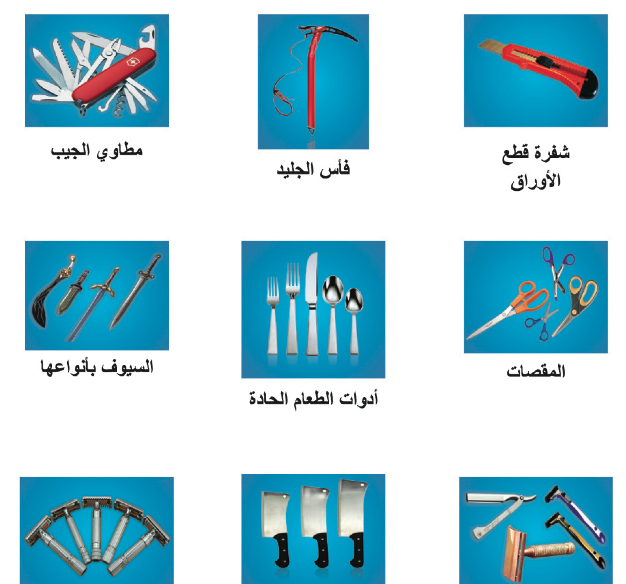
My last move to Kuwait, I was allowed several hundred pounds to take on the airplane. I packed an entire set of flatware, and all my good kitchen knives, and lots of scissors. . . like, who can live without scissors???
Honest Judge, so sorry, I had NO idea! No one asked me if I was carrying dangerous flatware in my baggage!
You all know me – I am a law and order kind of gal. I like order, I like laws, especially those voted on by the people. I like laws which can be enforced, and are enforced, equally, for all people equally in the country. Oh? I did? I said EQUALLY twice?
We are all equal before the law.
Now here is the tricky part. Have you ever seen a listing of traffic laws in Kuwait? Can you find a listing of laws, violations, and their charges? When we apply for driver’s licenses in almost any country, we get a little booklet to memorize, with the laws written inside it. The laws are clear. Clear laws are enforceable.
I’ve looked at the MOI website. I see something that looks like it might be a traffic code in Arabic. I have looked everywhere; I cannot find one in English. I find no reference to any handbooks for people applying for their driver’s license.
How can you enforce a law if the law is not published? Is there a code somewhere listing violations and fines? I published one many years ago, something that all the expats were sending around as ‘the new Kuwait traffic rules’ but IF it was, there was never anything in the paper about it to confirm its validity.
If you are going to have a major campaign to enforce traffic codes, you might want to publish the laws . . . in all major languages use today in Kuwait.
Interior Ministry Assistant Undersecretary Maj Gen Abdulfattah Al-Ali
KUWAIT: Interior Ministry Assistant Undersecretary Maj Gen Abdulfattah Al-Ali stressed that all traffic violation-related deportations are in accordance with the law. Speaking at a press conference at the Kuwait Journalists Association (KJA) headquarters, Ali said that deporting people for traffic violations was also adopted by the US and other countries worldwide. “The problem is that we were very tolerant with violators and this does not mean that law violation is a right for motorists,” he underlined, urging all human rights organizations who have criticized Kuwait’s traffic police to examine human rights in their respective countries before talking about Kuwait.
“We have filed over 70,000 traffic citations including 43,000 serious ones such as running red lights, driving under the influence of alcohol, driving on the wrong side and many others,” he elaborated, pointing out that those already deported did not want to respect the traffic laws they had repeatedly violated. Ali added that the results of studies of traffic problems revealed many and that once one problem was solved, another emerged immediately.
“We have various problems… including the fact that motorists speak many languages and dialects which requires a large number of specialists to develop their traffic awareness,” he explained, noting that the traffic remedy strategy started by diagnosing the “disease” by studying random “specimens” at different times of the day at places with heavy traffic flows such as Jleeb Al-Shuyoukh, Shuwaikh Industrial Area, Amman Street, Bnaid Al-Gar, Khaitan, Farwaniya and Fahaheel.
“The specimens showed some major problems such as domestic drivers using private vehicles as taxis, taxi and large vehicle drivers who do not hold general driver’s licenses and people driving without licenses at all,” he said, adding that this called for strict law enforcement.
“Traffic in Kuwait is like an old sick man who once treated for one aliment develops another,” he noted, adding that 18 traffic inspection teams dressed in civilian clothes had been formed and deployed in various places. “Fortunately, traffic police only file 100 daily citations in Jleeb compared to 1,000-1,500 in the past”, he concluded.
I don’t know what it is about summer reading, but now and then I go on a theme-fest; a couple years ago it was Nigerian literature, and, once hooked . . . when my friend who is now living in Lagos recommended The Secret Lives of Baba Segi’s Wives, I ordered it right away, thinking from the title it would be maybe light and sweet and humorous.
From the start, that assumption was blown. This is a direct and edgy Nigeria, darker, rougher and full of family secrets, domestic details and messy relationships.
It is a very Nigerian book – this is a good thing. There are cultural things that are not explained, but it all ends up making sense in the end. There are foods I have never heard of – ekuro with shrimp sauce, asun. There is a rudeness in the way they speak to one another, (“Is this a parking lot?” “Do I look like a parking attendant?”), a crudeness in the constant need to carry small bills for bribes, even on public streets. People speak their minds, with little or no mitigation, depending on the status of the person and their own personal goals and agendas.
At the weekly meeting of wives, the senior wife, Iya Segi, doles out rations of household supplies to the other wives, including chocolate powder and hair conditioner . . . and as the senior wives complain about the new wife thrown in their midst, she says:
“You will trip over in your hate if you are not careful, woman. Your mouth discharges words like diarrhea. Let Bolanle draw on every skill she learned in her university! Let her employ every sparkle of youth! Let her use her fist-full breasts. Listen to me, this is not a world she knows. When she doesn’t find what she came looking for, she will go back to wherever she came from.”
There is a whole other world in that one paragraph – a whole other way of seeing life and expressing thoughts. The culture may be alien, but I thoroughly enjoyed being a tiny mouse in the corner at that meeting – and others – and inside the minds of the wives, of Baba Segi, of the driver – so many good stories, so many points of view, and I learned things from behind those high compound walls and closed and locked doors that I might never otherwise have learned. Alien as it was, for me, this was a very good book, new ways of looking at things, and a great recommendation from my friend in Lagos.
(Play the video of the Soweto Gospel Choir as you read this summary from today’s Lectionary Readings How I would love to be able to attend this festival!)
BERNARD MIZEKI
CATECHIST AND MARTYR IN AFRICA (18 JUNE 1896)
Bernard Mizeki was born in Portuguese East Africa (Mozambique) in about 1861. When he was twelve or a little older, he left his home and went to Capetown, South Africa, where for the next ten years he worked as a laborer, living in the slums of Capetown, but (perceiving the disastrous effects of drunkenness on many workers in the slums) firmly refusing to drink alcohol, and remaining largely uncorrupted by his surroundings. After his day’s work, he attended night classes at an Anglican school.
Under the influence of his teachers, from the Society of Saint John the Evangelist (SSJE, an Anglican religious order for men, popularly called the Cowley Fathers), he became a Christian and was baptized on 9 March 1886. Besides the fundamentals of European schooling, he mastered English, French, high Dutch, and at least eight local African languages. In time he would be an invaluable assistant when the Anglican church began translating its sacred texts into African languages.
After graduating from the school, he accompanied Bishop Knight-Bruce to Mashonaland, a tribal area in Southern Rhodesia (now Zimbabwe), to work there as a lay catechist. In 1891 the bishop assigned him to Nhowe, the village of paramount-chief Mangwende, and there he built a mission-complex. He prayed the Anglican hours each day, tended his subsistence garden, studied the local language (which he mastered better than any other foreigner in his day), and cultivated friendships with the villagers. He eventually opened a school, and won the hearts of many of the Mashona through his love for their children.
He moved his mission complex up onto a nearby plateau, next to a grove of trees sacred to the ancestral spirits of the Mashona. Although he had the chief’s permission, he angered the local religious leaders when he cut some of the trees down and carved crosses into others. Although he opposed some local traditional religious customs, Bernard was very attentive to the nuances of the Shona Spirit religion. He developed an approach that built on people’s already monotheistic faith in one God, Mwari, and on their sensitivity to spirit life, while at the same time he forthrightly proclaimed the Christ. Over the next five years (1891-1896), the mission at Nhowe produced an abundance of converts.
Many black African nationalists regarded all missionaries as working for the European colonial governments. During an uprising in 1896, Bernard was warned to flee. He refused, since he did not regard himself as working for anyone but Christ, and he would not desert his converts or his post.
On 18 June 1896, he was fatally speared outside his hut. His wife and a helper went to get food and blankets for him. They later reported that, from a distance, they saw a blinding light on the hillside where he had been lying, and heard a rushing sound, as though of many wings. When they returned to the spot his body had disappeared. The place of his death has become a focus of great devotion for Anglicans and other Christians, and one of the greatest of all Christian festivals in Africa takes place there every year around the feast day that marks the anniversary of his martyrdom, June 18.




 Here There and Everywhere