Ramadan Fasting and Diabetics
Technically, those who are ill are not required to fast, but my diabetic friends have said they can fast if they do it cautiously. I found this fascinating report on diabetics and fasting, particularly Ramadan fasting. You can reference the website Islam.ru.
Source:By: Fereidoun Azizi, MD, and Behnam Siahkolah, MD,/ Intl. Journal of Ramadan Fasting Research* / islamicity.com/October 31/2002 , res
Several of the world’s great religions recommend a period of fasting or abstinence from certain foods. Of these, the Islamic fast during the Muslim month of Ramadan is strictly observed every year. Islam specifically outlines one full month of intermittent fasting. The experience of fasting is intended to teach Muslims self-discipline and self-restraint and remind them of the plight of the impoverished. Muslims observing the fast are required to abstain not only from eating and drinking, but also from consuming oral medications and intravenous nutritional fluids.
The month of Ramadan contains 28 days to 30 days. The dates of observance differ each year because Ramadan is set to a lunar calendar. Fasting extends each day from dawn until sunset, a period which varies by geographical location and season. In summer months and northern latitudes, the fast can last up to 18 hours or more. Islam recommends that fasting Muslims eat a meal before dawn, called “sahur.” Individuals are exempt from Ramadan fasting if they are suffering from an illness that could be adversely affected by fasting. They are allowed to restrain from fasting for one day to all 30 days, depending on the condition of their illness. People diagnosed with diabetes fall into this category and are exempt from the fasting requirement, but they are often loathe to accept this concession. Physicians working in Muslims countries and communities commonly face the difficult task of advising diabetic patients whether it is safe to fast, as well as recommending the dietary and drug regimens diabetics should follow if they decide to fast. The lack of adequate literature on this subject makes it difficult to answer these questions. To judge correctly whether to grant medical permission to fast to a diabetic patient, it is essential physicians have an appreciation of the effect of Ramadan fasting on the pathophysiology of diabetes mellitus. In this article, we first review principles of carbohydrate metabolism and alterations of certain biochemical variables in diabetics observing Ramadan fasting. We then overview current medical recommendations that allow certain diabetic patients to fast and outline terms for diabetic patients, particularly IDDM patients, who should not fast but insist on fasting.
THE PHYSIOLOGICAL STATE OF DIABETICS DURING RAMADAN
Carbohydrate metabolism during Ramadan fasting in healthy persons
The effect of experimental short-term fasting on carbohydrate metabolism has been extensively studied (1,2). It has been uniformly found that a slight decrease in serum glucose to 3.3 mmol to 3.9 mmol (60 mg/dl to 70 mg/dl) occurs in normal adults a few hours after fasting has begun. However, the reduction in serum glucose ceases due to increased gluconeogenesis in the liver. That occurs because of a decrease in insulin concentration and a rise in glucagon and sympathetic activity (3). In children aged one years to nine years, fasting for a 24-hour period has caused a decrease in the blood glucose to half of the baseline figure for normal children of that age group. In 22% of these children, blood glucose has fallen below 40 mg/dl (4). Few studies have shown the effect of Ramadan fasting on serum glucose (5-9). One study has shown a slight decrease in serum glucose in the first days of Ramadan, followed by normalization by the twentieth day and a slight rise by the twenty-ninth day of Ramadan (6). The lowest serum glucose level in this study was 63 mg/dl. Others have shown a mild increase (7) or variation in serum glucose concentration (8,9), but all of them fell within physiological limits (6). From the foregoing studies, one may assume that the stores of glycogen, along with some degree of gluconeogenesis, maintain normal limits of serum glucose when a fast follows a large pre-dawn meal. However, slight changes in serum glucose may occur in individuals depending upon food habits and individual differences in metabolism and energy regulation.
Body weight during Ramadan fasting
(a) In normal subjects:
Weight losses of 1.7 kg. (10), 1.8 kg. (11), 2.0 kg. (12) and 3.8 kg (13) have been reported in normal weight individuals after they have fasted for the month of Ramadan. In one study that was over-represented by females, no change in body weight was seen (14). It has also been reported that overweight persons lose more weight than normal or underweight subjects (12).
(b) In diabetics:
A review of literature shows controversy about weight changes in diabetics during Ramadan.(6,15-24). In one group of studies, patients had an increase in their weight (17,21). In another group, there were no change (15,19,22,23) or a decrease (6,16,18,20,24) in body weight. While no food or drink is consumed between dawn and sunset during the month of Ramadan, there is no restriction on the amount or type of food consumed at night (23,25). Furthermore, most diabetics reduce their daily activities (15,23) during this period in fear of hypoglycemia. These factors may result in not only a lack of weight loss, but also a weight gain in such patients(26). (See later discussion about nutrition and physical activity.)
Blood glucose variations during Ramadan fasting in diabetics
Most patients show no significant change in their glucose control (3,23,24,27). In some patients, serum glucose concentration may fall or rise (28-30). This variation may be due to the amount or type of food consumption, regularity of taking medications, engorging after the fast is broken, or decreased physical activities. In most cases, no episode of acute complications (hypoglycemic or hyperglycemic types) occurs in patients under medical management(9,15,16,22), And only a few cases of biochemical hypoglycemia without clinical hazards have been reported (17,19,25).
Other parameters of diabetes control during Ramadan fasting
In general, HbAIC values show no change or even improvement during Ramadan (15-18,20,22,23,25,27,28,32). Only two studies have reported slight increases in glycated hemoglobin levels (19,31). However, one report has emphasized the same increase in non-fasting patients as fasting patients (31), and the other has shown a return to initial levels immediately after the month of Ramadan (19).
The amount of fructosamine (17,22,24,30,32), insulin, C-peptide (23,30) also has been reported to have no significant change before and during Ramadan fasting.
Energy intake and serum lipid variables during Ramadan fasting in diabetics
The amount of Energy (calorie) intake have been reported in some of the literature, indicating a decrease in energy intake (24,28).
Most patients with non-insulin dependent diabetes mellitus (NIDDM, diabetes type II) and insulin dependent diabetes mellitus (IDDM, diabetes type I) show no change or a slight decrease in concentrations of total cholesterol and triglyceride (15-19,27,28,32). Increase in total cholesterol levels during Ramadan seldom occurs (23). As in healthy persons (33-36), few studies have reported increases in high-density-lipoprotein (HDL) cholesterol in diabetics during Ramadan (18,19,27). One report indicates an increase in low-density-lipoprotein (LDL) cholesterol and a decrease in HDL-cholesterol (28). Until there is a standardization of diabetes Ramadan research in three fundamental factors — the Three D Triangle of drug regimens, diet control and daily activity — the benefits or hazards of Ramadan fasting on diabetics serum lipids is unclear.
Other biological parameters during Ramadan fasting in diabetics
Serum creatinine, uric acid, blood urea nitrogen, protein, albumin, alanine amino-transferase, aspartate amino-transferase values do not show significant changes during the fasting period(15,17,32). Slight non-significant increases in some biological parameters may be due to dehydration and metabolic adaptation and have no clinical presentation.
FASTING GUIDELINES TO DIABETICS
During the last two decades, a better understanding of pathophysiological changes during Ramadan fasting in diabetic patients has provided a few guidelines on how to advise diabetics who want to fast. Physicians working with Muslim diabetics should employ certain criteria to advise their patients regarding the safety of Ramadan fasting.
The following criteria should be helpful in making such a decision (20,37):
Forbid fasting in:
- All brittle type I diabetic patients;
- Poorly controlled type I or type II diabetic patients;
- Diabetic patients known to be incompliant in terms of following advice on diet drug regimens and daily activity;
- Diabetic patients with serious complications such as unstable angina or uncontrolled hypertension;
- Patients with a history of diabetic ketoacidosis;
- Pregnant diabetic patients;
- Diabetic patients will inter-current infections;
- Elderly patients with any degree of alertness problems;
- Two or more episodes of hypoglycemia and/or hyperglycemia during Ramadan.
Allow fasting in:
- Patients who do not have the aforementioned criteria;
- Patient who accept medical advisement.
Encourage fasting in:
-
All overweight NIDDM patients (except for pregnant or nursing mothers) whose diabetes is stable with weight levels 20% above the ideal weight or body mass index (body weight, kg/height, meters squared) greater than 28.
EDUCATION OF THE DIABETICS BEFORE RAMADAN
NIDDM patients and IDDM patients who insist on fasting should be given a few recommendations about fasting (16). They should be forbidden from skipping meals, taking medication irregularly or gorging after the fast is broken (26).
The principles of pre-Ramadan considerations are (37):
- assessment of physical well being;
- assessment of metabolic control;
- adjustment of the diet protocol for Ramadan fasting;
- adjustment of the drug regimen e.g. change long-acting hypoglycemic drugs to short-acting drugs to prevent hypoglycemia);
- encouragement of continued proper physical activity;
- recognition of warning symptoms of dehydration, hypoglycemia and other possible complications.
RECOMMENDATIONS DURING RAMADAN FASTING
I. Nutrition and Ramadan fasting:
Dietary indiscretion during the non-fasting period with excessive gorging, or compensatory eating, of carbohydrate and fatty foods contributes to the tendency towards hyperglycemia and weight gain (21,23). It has been emphasized that Ramadan fasting benefits appear only in patients who maintain their appropriate diets (24,38,39). Thus, in order to optimize control, diabetics must be reminded to abstain from the high-calorie and highly-refined foods prepared during this month (38).
II. Physical activity and Ramadan fasting:
Several studies indicate that light to moderate regular exercise during Ramadan fasting is harmless for NIDDM patients (15). It has been shown that fasting does not interfere with tolerance to exercise (40). It should be impressed upon diabetic patients that it is necessary to continue their usual physical activity especially during non-fasting periods (41)
III. Drug regimens for IDDM patients:
Some experienced physicians conclude Ramadan fasting is safe for IDDM patients with proper self-monitoring and close professional supervision (16). It is fundamental to adjust the insulin regimen for good IDDM control during Ramadan fasting. Two insulin therapy methods have been studied successfully:
-
Three-dose insulin regimen: two doses before meals (sunset and Dawn) of short-acting insulin and one dose in the late evening of intermediate-acting insulin (16).
-
Two-dose insulin regimen: Evening insulin combined with short-acting and medium-acting insulin equivalent to the previous morning dosage, and a pre-dawn insulin consisting only of a regular dosage of 0.1-0.2 unit/kg (25).
Home blood glucose monitoring should be performed just before the sunset meal and three hours afterwards. It should also be performed before the pre-dawn meal to adjust the insulin dose and prevent any hypoglycemia and post-prandial hyperglycemia following over-eating.
IV. Drug regimens for NIDDM patients:
Available reports indicate that there are no major problems encountered with NIDDM overweight patients who observe fasting in Ramadan (3). With proper changes in the dosage of hypoglycemic agents there will be low risk for hypoglycemia and hyperglycemia.
The authors of the largest series of patients treated with glibenclamide during Ramadan recommended that diabetics switch the morning dose (together with any mid-day dose) of this drug with the dosage taken at sunset (31).
V. Other health tips for reduction of complications:
-
Implementation of the 3D Triangle of Ramadan — drug regimen adjustment, diet control and daily activity — as the three pillars for more successful fasting during Ramadan.
-
Diabetic home management that consists of:
– Monitoring home blood glucose especially for IDDM patients, as described above;
– Checking urine for acetone (IDDM patients);
– Measuring daily weights and informing physicians of weight reduction (dehydration, low food intake, polyuria) or weight increase (excessive calorie intake) above two kilograms;
Recording daily diet intake (prevention of excessive and very low energy consumption).
-
Education about warning symptoms of dehydration, hypoglycemia and hyperglycemia.
-
Education about breaking fast as soon as any complication or new harmful condition occurs.
-
Immediate medical help for diabetics who need medical help quickly, rather than waiting for medial assistance the next day.
-
Further attention on fasting during the summer season and geographical areas with long fasting hours.
VI. IDDM children and Ramadan fasting:
We do not encourage fasting for IDDM children. However, a few studies demonstrate that fasting is safe among diabetic adolescents. Of these studies, one study concludes that Ramadan fasting is feasible in older children and children who have had diabetes for a long time, and it concludes fasting does not alter short-term metabolic control. Nevertheless, fasting should only be encouraged in children with good glycemic control and regular blood glucose monitoring at home (25).
POST-RAMADAN SUPERVISION OF FASTING DIABETICS
After the month of Ramadan ends, the patients therapeutic regimen should be changed back to its previous schedule. Patients should also be required to get an overall education about the impact of fasting on their physiology (37).
THE RESEARCH METHODOLOGY ON DIABETICS DURING RAMADAN
From a methodological point of view, few research papers on Ramadan fasting are relevant because of the absence of control periods before Ramadan and afterwards, the absence of measurements during each week of Ramadan, a lack of attention to dietary habits, food composition, food value, caloric control, weight changes and the importance of the schedule during circadian periods.
It is recommended that all these factors should be taken into consideration and that all intervening and confounding variables should be under control. It is clear that more work should be done on Ramadan fasting to evaluate physiological and pathological changes with proper research methods (42).
Fasting during the entire month of Ramadan is reserved usually for healthy Muslims. However, many diabetic patients are allowed to fast periodically during Ramadan. The magnitude of periodic total fasting effect on blood glucose and hepatic glucagon depends on the number of fasting days (43), and this should be considered in all Ramadan fasting research activities.
CONCLUSION
The bulk of literature indicates that fasting in Ramadan is safe for the majority of diabetics patients with proper education and diabetic management. Most NIDDM patients can fast safely during Ramadan. Occasional IDDM patients who insist on fasting during Ramadan can also fast if they are carefully managed. Strict attention to diet control, daily activity and drug regimen adjustment is essential for successful Ramadan fasting.
To shed more light on pathophysiological changes in Ramadan fasting, in particular in Muslims diabetics, it is recommended that a multicentric international controlled clinical trial be employed to assess the effect of differences in gender, races, physical activities, food habits, sleep patterns and other important variables on physiologic and pathologic conditions during Ramadan fasting.
Beach Road 98 on a Torrential Fourth of July Weekend
A two and a half hour drive took us six hours. We also stopped for lunch, and we stopped to pick up the Qatari Cat. The rest of the time, we were stuck in bumper to bumper traffic most of the 100 something miles of the drive home; stuck in one lane even on four lane highways as the drains failed when there was so much rain and runoff that there was no where for it to go.
Leaving Panama City, the surf was high, and full of undertow.

We were able to get through the Watercolors/Seaside area quickly, and then the deluge:

When we had to go single file, most of the time everyone cooperated, letting people in from gas stations and side roads, taking turns, etc. Then, there are always those @$$&*!>$ who think everyone is being too cautious and polite, who break the line, go thundering up through the lake, discover no, no they really can’t make it and barge back into the line. Karma catches up with the arrogant.

The worst part, the very worst, was going past the SanDestin outlet malls; when the skies break forth and there is no possible point to being on the beach, the tourists head for the malls and the restaurants. The malls were booming! Traffic crawled by. Even the poorest restaurant was also full; thank God we were still full from breakfast.
This is the bridge leaving Destin; on the right side of the road in front of that stalled truck is about a huge puddle a foot deep:

Outside Navarre, both rain and traffic began to lighten up. We stopped at a little roadside place I’d always wanted to try for something that might have been our late lunch or our early dinner – TC’s Front Porch, it’s across from the Navarre Butterfly House.

There was a small crowd inside, guys hanging out at the bar, looked like fishermen waiting for it to clear up enough to go back out and catch some fish, some tables with college kids down on the beaches for summer break, maybe lifeguards – swimming not allowed with the heavy surf and heavy rip tides running.

Everyone pretty much just waiting out the storm, tossing back a few brews, just hanging out. I had some pretty good crab cakes and AdventureMan had the chili. It was all OK. Beach food.


The Qatari Cat was delighted to see us, and slept as close as he could to me all night (not such a great thing; I appreciate that he thinks I am special, but he is hot, and I can’t turn over without disturbing him . . . aarrgh) This morning, however, he ran and hid under the bed when he saw us getting ready to go out; we think he was afraid we were taking him back to Wee Tuck’Em Inn, LOL.
Here’s the thing. For us, we were just inconvenienced, and it was just minor inconvenience. We had the time, we knew beach traffic would be heavy, it was a little adventure.
For people who earn a living from tourism, for some of these people, this weekend was probably a disaster. The hotels are packed for the Fourth of July weekend, and lots of fireworks displays are planned, big entertainment – it’s a big money making time of the year. With the four day storm, some people probably cancelled hotel reservations, and when the rain didn’t stop, others left. Many of the July Fourth fireworks displays were cancelled. Local fests were rained out. I am guessing most of the malls and restaurants did OK; not much else to do, but it rained SO much that there is a lot of flooding and a lot of damage. This, for many people, was not a good weekend.
World War Z

I talked AdventureMan into going to see World War Z with me – us and half of Pensacola showed up for the early matinee, and we got the last two seats. I had thought it’s been out for a while and people would be going to see something else, but all the theaters showing it in Pensacola are selling out every show. That doesn’t mean every seat was already filled – a lot of people had bought tickets online but weren’t there. On the other hand, while we got two good seats – they were – LOL – at opposite ends of the row!
World War Z is not a movie where you want to be sitting on opposite ends of the row.
World War Z is Contagion on steroids.
Did you ever see Romero’s 1968 Night of the Living Dead? I used to love scary movies, until I saw that movie. The scary movies were funny, not so scary at all – and George Romero changed all that with this low-budget horror classic. I think I liked it because it had a scientific kind of origin – a virus.
World War Z takes a similar approach, a scientific approach, and it is also very scary because it is hard, very hard, to be scientific and observant when your entire world becomes unsafe, when everything you known has turned to chaos. The zombies aren’t so damaged and tattered as Romero’s zombies, but they have the same herd mentality, a frenzied mob mentality, and an Alien-like skittering and swarming that makes my skin crawl.
I love seeing Brad Pitt as a responsible family man. He does it well. He has to make some very tough decisions in this movie, and you get to see that this sweet family man has another, tougher side.
AdventureMan was glad we went; he also thinks this will be a great computer game. We agreed it was scary because it had some things in it that truly can make life dangerous – you know, political leaders dying en masse, political and social systems dissolving and life becoming a brute struggle for survival with scarce resources . . . having swarming zombies kicks all that up a notch.
Not a movie for anyone under five. Maybe not even ten, if the kids are sensitive, or prone to bad dreams . . .
Our son said we need to read the book; it’s only sort-of like the movie, and has a lot of very edgy things to say about our current political system and leaders. Hmmmm. . . might have to do that.
Retrograde 4th of July
Alternate title: Every man needs a Kubota
As we were listening to the news and weather Tuesday night before going to bed, the weather woman was talking about a ‘retrograde’ storm system. She showed us on the map; normally our weather blows from west to east, but this storm was going to blow east to west, and then reverse and go west to east again. Going counter to the normal flow is ‘retrograde.’
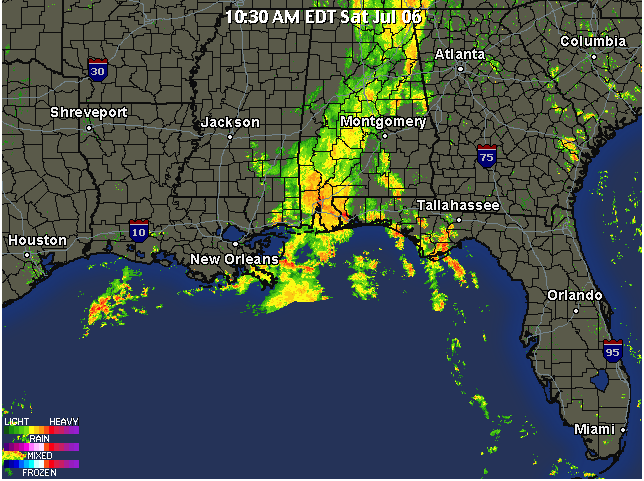
Our entire holiday was retrograde. Which, for people like AdventureMan and I, is not too bad. It’s a good thing we married one another; we are not to good with same-same all the time, if things get too tame, we shake things up a little bit. It’s not good or bad, it’s just the way we are wired.
One of the first differences was that we weren’t leaving early in the morning to drive down Highway 98 along the beach road; we were picking up our adorable grandson, going to his house, and as soon as our daughter-in-law got off work we would hit the interstate.
It all went well; cloudy skies but light traffic, all was well until we left the highway headed south . . . and started hitting the “Roads Under Water” signs. We didn’t see any roads under water until the car in front of us hit what looked like a shiny spot on the road and went almost a foot deep. AdventureMan cooly slowed and drifted steadily through the lake in the road – and we thanked God to be in a vehicle a little higher off the ground than a sedan.
After the lake in the road, it started raining, a little sprinkling, and then a steady rain.
The temperatures dropped.
Here is what we had planned – dinner with family and friends, a day of fun and heading out for sun downers on the boat to watch the fireworks on the 4th. Heavy applications of insect repellant and sunscreen.
Here is what happened – the deluge.
Here is what was cool about the deluge – the temperatures were the coolest, 24 hours around the clock – that we’ve seen in a month. We could sit out on the screened porch looking at the bayou, listening to the rain fall – it was heavenly! No insect repellent needed. No sun screen needed.


Our hostess is a wonderful and creative cook; unafraid to try new recipes. Dinner after our rainy drive in: Red snapper, baked in a crust of crumbs with butter and parsley, so delicious. Green beans and mushrooms; so good I had them for breakfast another day 🙂 Holy smokes, desserts. The best pound cake ever, topped with peaches in their own juice and whipped cream, or chocolate red velvet brownies.
It was a fabulous lazy day. In the afternoon, our friend got an emergency call; friends whose husband was out of town were facing a flooding situation. Loading up his Kubota, he and AdventureMan went over and (manly manly) DUG A DITCH! getting all dirty and wet in the process, coming home with those grins that only activities like a good hunting trip, a successful fishing trip or digging a good ditch can create.
We had great plans that night to visit The Blue Fig (“They have mohammara!” my hostess said, knowing my weakness) but when we got there, it was closed . . . and, oddly every restaurant along that strip seemed to be closed. And side roads were flooded, more big lakes of water in the roads. It had rained so much and for so long that the runoff had no where to go.

Our little grandson fell asleep while we were searching for a restaurant that was open, and slept in my arms through dinner. I know this might be the last time; he is getting to be such a big boy, so I just treasured the time and listened to him breathe.
I know it may not seem like such a great holiday to you, but it was fun. We focused on conversations and laughed a lot. AdventureMan thinks every man might need a Kubota. We listened to the rain fall on the leaves, the roof, the bayou. We listened to the frogs celebrate the 4th of July. We really had a great time.
The Hot Spot BBQ in Pensacola
“Have we seen that place before?” AdventureMan asked as we headed down 9th Avenue en route to the beach.
“I think it’s new!” I responded.

The next day was his day to choose where we would go for lunch, and without hesitation, he said “that new place over on 9th.”


When we got there, we discovered that while the Hot Spot may be news to us, it was well discovered by others – we got the last table. It’s a family owned place, they make their own sauces, smoke their own meats – just the kind of place we like to find and support.
I had the chicken sandwich, AdventureMan had the pulled pork. We split a piece of that homemade lemon pie. The service was great, so attentive that I could not discretely take any photographs of the food. Prices are reasonable.
Get to the Hot Spot early if you want a table! They are at 901 East LaRua; you can go south on 9th off of Cervantes to get there easily.
Florida Man Shot in Case of Mistaken Identity
U.S. News
Suspect denied bond in I-4 shooting death in Florida
-
Published: July 2, 2013 at 9:32 PM
TAMPA, Fla., July 2 (UPI) — The suspect in the Interstate 4 shooting death in Florida was denied bail Tuesday and authorities now say it’s a case of mistaken identity, not road rage.
Jerome Edward Hayes will have another bail hearing next week, WFTS-TV, Tampa, reported.
Hayes is charged with first-degree murder in the slaying of Fred Turner, 47, Saturday. He turned himself in Monday.
His attorney described Hayes as a “soft-spoken, nice guy.”
“You take a look at him, you talk to him, he does not seem like the kind of person that could possibly commit this kind of crime,” Nick Matassini Jr. said.
The TV station said police have obtained the gun and car involved in the shooting. Investigators say Turner was in the wrong place at the wrong time.
“The victim was mistaken for an individual who was involved in an altercation with the suspect’s friend inside the Gold Club,” Col. Donna Lusczynski said.
Hayes and a friend allegedly were in a fight at the strip club and waited outside for their opponent. But they mistakenly followed the wrong person, who had been in an adjacent business.
“Mr. Turner was followed from the location by the suspect to the interstate, where he was shot several times,” Lusczynski said.
Turner was on the phone with a 911 operator, telling the dispatcher he was being followed and had not done anything to precipitate a confrontation when he was shot, she said.
“It’s Just Like Living in Alaska, Mom . . . or Kuwait . . . “

My Mom was concerned; the temperatures are approaching 90°F in Seattle, and most of Seattle does not bother with air conditioning. At night, the temperatures go down into the fifties, cooling everything off, but the day time highs can be more than a little uncomfortable.
“How do you manage?” she asks. “I see the temperatures in (nearby) Mobile are in the 90’s almost every day.”
“It’s not that hard; it’s like living in Alaska – or Kuwait,” I tell her. “When it gets cold in Alaska, you dress warmly, you turn on the heat, you stay inside, and when you need to go out, you get into your car in the heated garage, go in your heated car to a heated store, and you come back home. You don’t spend a lot of time outside.”
I do pretty much the same thing I did in Qatar and Kuwait. I get up and do my devotional readings, and on some days I go to my aqua-aerobics class. on other mornings I volunteer. If I need something, I stop at a store on the way home. Sometimes, I clean house, or do laundry. We often go out for lunch, from the air conditioned car to the air conditioned restaurant and back 🙂 In the afternoons, I quilt or I read, or I quilt and I read.
AdventureMan grew up in the South, he is comfortable with the heat and the humidity. He works out in his gardens; once the temperatures go over 80° I rarely even visit the gardens, maybe when October comes and the temperatures drop. Yesterday morning I looked out as the sun was rising over the gardens and all I could see was swarms of insects rising. I don’t think they were mosquitoes, they looked like little no-see-up kind of things, all speeding around in the rising sun. I don’t do insects, the same way I really don’t do heat and humidity.
The Qatari Cat loves the heat. Part of his daily routine is to eat, then to go into the garage and sleep on one of the cars. It’s like an oven in the garage; it must remind him of living on the streets of Qatar when he was just a tiny thing. He is no longer a tiny thing. When we have international guests over for dinner, they always ask to take photos of him; he has grown to be a very long, tall cat, kingly but gracious.
Yesterday morning, as I headed out, there was a hint of – well, it was not coolness, but it was just not blasting me with heat. It was a respite from the relentless heat. I don’t begin to think it was a hint of winter to come; the summer torment has really just begun and is unlikely to end before late October, but I treasure even a hint of “not a blast of heat.”
AdventureMan asks me if I miss Seattle. Not so much, really, traffic has gotten so bad there, but I miss the climate. I feel energized by the cool mornings, even rain doesn’t bother me. I love the sound of the wind whistling around, I love taking a walk along the waterfront after lunch or dinner. I don’t find it at all surprising that diabetes is associated highly with countries with hot climates; heat makes you lethargic, inactive, all the things that encourage sloth.
Torrential rains are forecasted for this 4th of July weekend; in Pensacola there is a possibility they will diminish just in time for the fireworks. Hmmm. Heat. Humidity. Mosquitoes . . . I love fireworks . . . weighing my options 🙂
Jeannette Walls and The Silver Star and Negligent Mothers

The first time I read anything by Jeannette Walls, I had not read her autobiographical best-seller, The Glass Castle. If I had, when I read the opening pages of one of my all-time-favorite books, Half Broke Horses , three young children out checking on the cows in America of the mid-1800’s, I would have said “Oh, yes, this is Jeannette Walls” instead of being so shocked that these three children were so far from home with a storm approaching. Not only does the storm approach – the oldest sister pushes her younger sister and brother up a tree and they are stuck there through a violent storm all night. No adult comes looking for them.
“Where is their mother?” in shock I thought, “a mother with three children out in the storm goes looking for them!”
Not if you are a Jeannette Walls mother. To ‘get’ Jeannette Walls, you really have to start with The Glass Castle, and learn about how she and her siblings are at the mercy of an alcoholic mother and father, both big liars, maybe with some attendant mental problems. Half Broke Horses is fiction, based on her own grandmother, who, at 15 rides 28 days across Indian territory to teach at a far-away school (What mother lets her 15 year old DAUGHTER ride for a month across dangerous country ALONE??)
I was on the send-as-soon-as-it’s-published list for Silver Star. And even once it arrived, I waited until I knew I might have a few free hours in the evening to read it – once you start Jeannette Walls, you can’t put it down. Her heroines in this novel are 15 year old Liz and 12 year old Bean (Jean) whose mother ran away from her hometown in Virginia to pursue a career in music. The mother has a small inheritance to sustain them; when life sours, as it often does for her, she packs the girls into her worn Dodge Dart and takes off. She isn’t always good about paying her bills. She talks to her girls about what a great team they are, and then takes off for a day or two, usually with some man, leaving them to eat chicken pot pies. Then, she abandons them with no sign of when she will be back.
The girls are pistols. They are survivors, much like Jeannette Walls grandmother in Half Broke Horses. When social services start coming around asking where their mother is, they take off headed for their Mom’s old home town, across the continent, in Virginia.
The heart of the story finds the girls living in the old family mansion, scouting for odd jobs, learning more about themselves and their heritage, and learning how a small community can smother, judge and support their community members in unexpected ways.
If you are a negligent, man-oriented, self-absorbed mother, you don’t want to have a writer for a daughter. Jeannette Walls is having a ball; her books are both sad and hilarious, and she has utter scorn for mothers who do not take the reins of motherhood and behave like grown-ups.
Language of Flowers by Vanessa Diffenbaugh

I didn’t expect to like this book as much as I did; from the first chapter I was hooked, so hooked I didn’t want to go to water aerobics of go to sleep until I had finished it. The title sounds girly and romantic, big yawn, but the book is anything but. The book is tough, and edgy, and tackles the foster care system without using sexual assault or out-of-the-ordinarily-cruel foster parents to bludgeon the point. She botches her one great chance at happiness when she sabotages her adoption by Elizabeth, who loves her dearly. The system can even be caring, but the effect of warehousing unwanted and neglected children damages their ability to trust, and to form relationships. We watch her as a child, self-destructive, angry, undermining her own chances of happiness.
Victoria even has a girly name to go with the title, but she is tough, and self-reliant, and very, very vulnerable, in spite of her toughness. Aging out of the system, she emerges a waif, with a hunger that stems more from emotional needs than physical.
She is greatly blessed to cross paths with people who look at her and truly see her, see her possibilities and her vulnerabilities, people who are willing to work with her, even to love her patiently, in spite of her prickliness and tendency to push people away. One of these is a florist, Renate, who recognizes in Victoria a gift for floral arrangement and is willing to work around her eccentricities. She gives Victoria a part-time job, in which Victoria flourishes.
In her emotional life, however, Victoria still has a lot of unresolved issues, stemming back to the very beginning when she was given up by a mother who, for whatever reason, didn’t want her. While she is hungry for love, she fears it as much as she wants it. Relationships overwhelm her. She abandons the love of her life, and then has to live with the consequences.
Watching her resolve her issues is cliff-hanging. You can’t stop reading. It’s not like watching a train-wreck; you know this girl has inner resources she has not yet tapped; you can read it in the loving evaluation of those who surround her. Every page of the way you are rooting for her to succeed.
Recent Comments
Kitchen on Isiais: Winding Down intlxpatr on Shampoo Ginger tigerbutterya0c5ff1d… on Shampoo Ginger intlxpatr on British Soldier Kidnapped, Esc… John on British Soldier Kidnapped, Esc… Wikipedia Donate Button

Amazina


Early Voting in Florida


