Driving in Qatar
Almost every day, the two articles garnering the greatest number of hits have to do with new traffic rules in Kuwait and in Qatar. I think I wrote the posts in 2009. Here is what the US Department of State has to say to US Nationals about driving in Qatar:
TRAFFIC SAFETY AND ROAD CONDITIONS: While in Qatar, you may encounter road conditions that differ significantly from those in the United States. The information below concerning Qatar is provided for general reference only and is subject to change at any time. Current traffic regulations may be obtained through the Ministry of Interior’s Traffic Police.
Short-term visitors should obtain a valid International Driving Permit prior to arrival and should not drive in Qatar on a U.S. driver’s license. New and prospective residents should obtain a permanent Qatari Driving License immediately after arrival. To obtain a Qatari driver’s license, U.S. citizens need to pass a driving exam, including a road test. Short-term visitors and business travelers can also obtain a Temporary Qatari Driving License by presenting their U.S. driver’s license at any branch of Qatar’s Traffic Police.
Traffic accidents are among Qatar’s leading causes of death. Safety regulations in Qatar are improving, thanks to a more stringent traffic law adopted in October 2007 and a country-wide traffic safety campaign. However, informal rules of the road and the combination of local and third-country-national driving customs often prove frustrating for first-time drivers in Qatar. The combination of Qatar’s extensive use of roundabouts, many road construction projects and the high speeds at which drivers may travel can prove challenging. The rate of automobile accidents due to driver error and excessive speed is declining but remains higher than in the United States. In rural areas, poor lighting, wandering camels and un-shouldered roads present other hazards.
Despite the aggressive driving on Qatar’s roads, drivers should avoid altercations or arguments over traffic incidents, particularly with Qatari citizens who, if insulted, have filed complaints with local police that resulted in the arrest and overnight detention of U.S. citizens. Drivers can be held liable for injuries to other persons involved in a vehicular accident, and local police have detained U.S. citizens overnight until the extent of the person’s injuries were known. Due to its conservative Islamic norms, Qatar maintains a zero-tolerance policy against drinking and driving. Qatar’s Traffic Police have arrested Americans for driving after consuming amounts of alcohol at even smaller levels normally accepted in the U.S.
Any motor vehicle over five years old cannot be imported into the country. For specific information concerning Qatari driver’s permits, vehicle inspection, road tax and mandatory insurance, please contact either the Embassy of the State of Qatar in Washington, DC or the Consulate General of the State of Qatar in Houston, Texas.
There are things that the Department of State is too diplomatic to tell you, and that people living there will not write for fear of having a travel ban put against them, a case filed against them for ‘insulting’ a national or the government.
The beautiful roads in Qatar were wonderful when they had a tenth of the cars on the road they have now. There are two categories of “most dangerous.” One category is the expat $200 car held together with gum and rubber bands that breaks down in the worst possible place, or has a blow-out, or hits someone because the driver not only doesn’t have a license, he also doesn’t know how to drive.
Although there are rules about what trucks are allowed to haul and how it is to be tied down, the laws are ignored and unenforced. It is still important never to travel behind or beside a truck carrying cement blocks. They look like they are not secured. They are not secured. Watch out, too, for any truck delivering bottled water (that makes a huge mess all over the roundabout) or sheep or cows, which regularly overturn.
The worst hazard of all is Qatari male drivers between 11 and 35 years old. They own the roads. They will drive on the sidewalks, down the wrong way of a six lane highway to get to the roundabout, through red lights. They will push you into an unsafe roundabout with the Hummer daddy bought for their 12th birthday. If you insult a Qatari young male driver in any way, they may block you, stop you and threaten you, and no one, least of all the police, will come to your aid. They know no speed limits, blow through stop lights, harass female expat drivers, and they pay no fines for traffic violations. For a short time, the law was applied somewhat equally to all, but there were so many outraged Qataris paying the humungous fines that no one enforced the law against the Qataris anymore, and you rarely see the police stopping anyone except the poorest of the poor.
If you want to drive in Qatar, you will want a sturdy car to get over the unpaved areas and the roads torn up for infrastructure improvements, as well as for protection against the aggressive Qatari male drivers and the accidents that may not be your fault but cannot be avoided. You will want to drive only during the lowest traffic times of the day, if possible. Even during the summer, when much of the population goes elsewhere, anywhere, to avoid the heat, night traffic on the major ring roads, the major arterial roads and on the Corniche is gridlock.
The Department of State will also not tell you that if you are ever in trouble on the road, you are certain to have many kind older Qatari men stop and render assistance. They will insist on giving you water, and fixing whatever they can fix, or at the very least waiting with you until help comes. If they think you are lost as you journey around Qatar, they will make sure you get where you are going. There is a long tradition of taking good care of the guest, and of civility among the Qataris, but mostly it seems to kick in when they mature – like around 35 or so.
This may not be the truth for everyone; we all have our own stories, horror stories and stories of kindness. It’s a little bit of the wild west, driving in Qatar.
Solar Storm Hits Today – How it will effect us
From the Huffpost Science:

Solar Flare, Solar Storm, Sun Storm: Whatever It’s Called, Sun Activity May Yield Stellar Aurora Borealis
By SETH BORENSTEIN
WASHINGTON — The largest solar storm in five years was due to arrive on Earth early Thursday, promising to shake the globe’s magnetic field while expanding the Northern Lights.
The storm started with a massive solar flare earlier in the week and grew as it raced outward from the sun, expanding like a giant soap bubble, scientists said. When it strikes, the particles will be moving at 4 million mph.
“It’s hitting us right in the nose,” said Joe Kunches, a scientist for the National Oceanic and Atmospheric Administration in Boulder, Colo.
The massive cloud of charged particles could disrupt utility grids, airline flights, satellite networks and GPS services, especially in northern areas. But the same blast could also paint colorful auroras farther from the poles than normal.
Astronomers say the sun has been relatively quiet for some time. And this storm, while strong, may seem fiercer because Earth has been lulled by several years of weak solar activity.
You can read the rest of the article here (click on blue text)
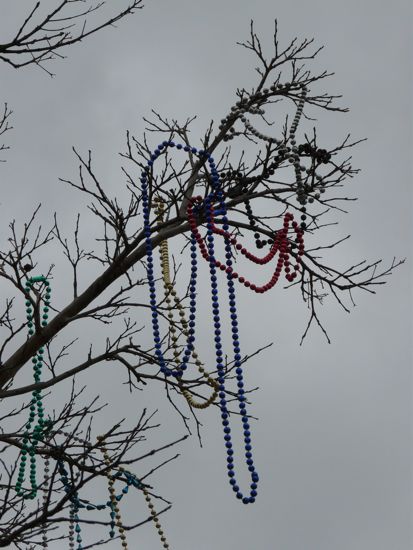
Mardi Gras Legacy
We had almost a full week of grim, grey skies and little sunshine, during which I saw the sad reminders of Mardi Gras valiantly trying to sparkle in the trees:
Idiots Walk Among Us
My friend Hayfa sent these to me. Although they are written in the “I” form, these things did not happen to me, they happened to someone else – many someone else – who wrote them down.
I handed the teller @ my bank a withdrawal slip for $400.00
I said “May I have large bills, please”
She looked at me and said “I’m sorry sir, all the bills are the same size.”
When I got up off the floor I explained it to her….
IDIOT SIGHTING
When my husband and I arrived at an automobile dealership to pick up our car, we were told the keys had been locked in it. We went to the service department and found a mechanic working feverishly to unlock the driver side door. As I watched from the passenger side, I instinctively tried the door handle and discovered that it was unlocked. ‘Hey,’ I announced to the technician, ‘it’s open!’ His reply:
‘I know. I already got that side.’
This was at the Ford dealership in Canton, MS
IDIOT SIGHTING
We had to have the garage door repaired.
The Sears repairman told us that one of our problems was that we did not have a ‘large’ enough motor on the opener.
I thought for a minute, and said that we had the largest one Sears made at that time, a 1/2 horsepower.
He shook his head and said, ‘Lady, you need a 1/4 horsepower.’ I responded that 1/2 was larger than 1/4.
He said, ‘NO, it’s not..’ Four is larger than two.’
We haven’t used Sears repair since.
IDIOT SIGHTING
My daughter and I went through the McDonald’s take-out window and I gave the clerk a $5 bill.
Our total was $4.25, so I also handed her a quarter.
She said, ‘you gave me too much money.’ I said, ‘Yes I know, but this way you can just give me a dollar bill back.
She sighed and went to get the manager, who asked me to repeat my request.
I did so, and he handed me back the quarter, and said ‘We’re sorry but we could not do that kind of thing.’
The clerk then proceeded to give me back $1 and 75 cents in change.
Do not confuse the clerks at McD’s.
IDIOT SIGHTING
I live in a semi rural area.
We recently had a new neighbor call the local township administrative office
to request the removal of the DEER CROSSING sign on our road.
The reason: ‘Too many deer are being hit by cars out here!
I don’t think this is a good place for them to be crossing anymore.’
From Kingman , KS
IDIOT SIGHTING IN FOOD SERVICE
My daughter went to a local Taco Bell and ordered a taco.
She asked the person behind the counter for ‘minimal lettuce.’
He said he was sorry, but they only had iceburg lettuce.
— From Kansas City
IDIOT SIGHTING
I was at the airport, checking in at the gate when an airport employee asked,
‘Has anyone put anything in your baggage without your knowledge?’
To which I replied, ‘If it was without my knowledge, how would I know?’
He smiled knowingly and nodded, ‘That’s why we ask.’
Happened in Birmingham , Ala.
IDIOT SIGHTING
The stoplight on the corner buzzes when it’s safe to cross the street.
I was crossing with an intellectually challenged coworker of mine. She asked if I knew what the buzzer was for.
I explained that it signals blind people when the light is red.
Appalled, she responded, ‘What on earth are blind people doing driving?!’
She was a probation officer in Wichita , KS
IDIOT SIGHTING
At a good-bye luncheon for an old and dear coworker who was leaving the company due to ‘downsizing,’
our manager commented cheerfully, ‘This is fun. We should do this more often.’
Not another word was spoken. We all just looked at each other with that deer-in-the-headlights stare.
This was a lunch at Texas Instruments.
IDIOT SIGHTING
I work with an individual who plugged her power strip back into itself
and for the sake of her life, couldn’t understand why her system would not turn on.
A deputy with the Dallas County Sheriffs office, no less.
IDIOT SIGHTING
How would you pronounce this child’s name?
“Le-a”
Leah?? NO
Lee – A?? NOPE
Lay – a?? NO
Lei?? Guess Again.
This child attends a school in Kansas City, Mo.
Her mother is irate because everyone is getting her name wrong.
It’s pronounced “Ledasha”.
When the Mother was asked about the pronunciation of the name, she said, “the dash don’t be silent.”
SO, if you see something come across your desk like this please remember to pronounce the dash.
Tell dem de dash don’t be silent.
STAY ALERT!
They walk among us……and they VOTE
Record High
Today the high temperature in Pensacola, FL was 87°F. It was a record high temperature for this date, March 2. The temperature yesterday was also a record high, 82°F.
It is also raining. So it is hot, and it is humid. And it is only the beginning of March. At the beginning of February, I celebrated. We didn’t have to use the heat or the air conditioning for the entire month, and our electric bill was a mere $100. You need lights. You need to use the oven now and then, and the washer and dryer, computers and TV’s. If you could see our other electric bills (the heat and air run on electricity) you would know why I celebrate $100. for January.
Earlier this week, it was in the 60°’s (F) in the mornings, and I weeded! It was foggy and cloudy, and it felt a whole lot like Seattle, where the temperatures are around 40 something this week. Give me cold any day. You can always put on more clothes when it gets cold, but when it is hot and humid, even with the AC, it is still hot and humid.
It is still raining, and humid. There is a tornado watch on until midnight. I was near a tornado once, living further south in Florida, and the sky turned green and it sounded like the biggest loudest freight train in the world, and it didn’t even hit in my neighborhood. You could hear it anyway. It is a terrifying sound.
Our pomegranate tree is leafing out, our blueberries have blossoms and it really is time for a spring clean up, if only we can have a few more cool days in March before the serious heat sets in.
Bullying and Community
I found this on AOL/Huffpost Parenting: it contains a line – I italicized it – that I need to think about. In America, we tend to think of the individual over the community. For the most part, we don’t encourage our children to continue with an activity they don’t like ‘for the good of the group,’ we tend to take them out of the activity. I’ve lived in cultures where obligations to the group are much stronger, and I’ve always felt confined and constricted by the burden of those expectations, but it does make for a more peaceful situation when we consider the needs of others and the needs of the group.
Preventing Bullying Begins With Us
Richard Weissbourd and Stephanie M. Jones
On Feb. 29, Lady Gaga will launch a foundation dedicated to creating caring communities and stopping bullying. Hosted by the Harvard Graduate School of Education and Harvard’s Berkman Center, Lady Gaga will be joined by Oprah and other celebrities. A powerful new film, “Bully,” will be widely released at the end of March, and many Americans in recent years have been galvanized by a blizzard of tragic bullying stories.
Yet too often in the past a problem plaguing children like bullying has received huge waves of public attention that simply never translates into any positive changes in kids’ lives. What will it take to capitalize on this attention? How can we curb this problem once and for all?
We can start by recognizing where the main solution lies. There is a tendency to simply blame bullying on “bad” kids or peer groups or destructive media. But bullying often has deep roots in parents’ attitudes and behavior, and stopping bullying begins with us.
How can parents prevent bullying? Parents in recent years have been flooded with articles and books that guide them in shielding, or “bully-proofing,” their own child. But just protecting our own kids won’t stop bullying, and this guidance reinforces the damaging tendency of many parents to just focus on their own children. The best way to prevent bullying — and many other forms of cruelty and harassment — is to encourage and enable children to care for and take responsibility for each other. Research indicates that bullying is greatly reduced in particular when children who witness bullying stand up for the victim. Bullying brings home to parents our fundamental moral responsibilities. How can we help our children widen their circle of concern and stand up for other children? How can we help our children build more just and caring communities?
Bullying, unlike more typically developmental teasing and hurtful remarks, is commonly defined as prolonged or frequent cruelty to others, often characterized by imbalances of power. This kind of cruelty can produce intense and often lasting feelings of shame in children, a sense that they are defective in some core way. About 30 percent of children are bullied each year on school property alone. Adults’ understandable reflex is to curb this kind of bullying by punishing perpetrators. Yet this strategy alone usually fails to stop bullying, and sometimes it backfires.
On the other hand, bystanders — especially a friend of the bully — tend to be far more effective. A bystander is present in 85 percent of bullying situations, and bystanders who intervene appear to prevail over half the time. Yet in the vast majority of cases bystanders elect not to intervene.
What can we do as parents to help our children stand up for others? Research suggests that parents bolster their children’s ability to act independently and to withstand disapproval when they respect their children’s capacity as independent thinkers from early ages and give them input into family decisions. All the things parents do to build in their children a sturdy sense of self make it easier for children to hold their ground against a powerful peer. As parents we strengthen the self, for example, when we praise appropriately, know and appreciate who our children are and maintain their trust and respect. Nurturing empathy in children from early ages certainly matters as well. That means in part helping children appreciate people who may not be on their radar, whether a bus driver, a custodian or a new child in class. It means helping children consider the perspectives of those they’re in conflict with as well as people who are different from them in customs or background or other characteristics.
While it’s vital that we convey high moral expectations and underscore the importance of sticking up for others, we also must listen carefully to our children and understand the complexity of their social worlds and ethical decisions. We as parents will be more real and valuable to children if we pay careful attention to their perceptions and experiences of bullying and discuss when and how to stand up for someone else. We need to talk to them about the complexities of balancing our needs with others and what consequences are worth and not worth bearing. We need to help them figure out how to challenge someone else constructively.
But perhaps most important, stemming bullying will require us to seriously examine our parenting priorities. As a good deal of research now indicates, we live in an era when many parents are intensely focused on their children’s self-esteem, happiness and achievements, not on how well they care for others. And in all sorts of subtle ways we can prioritize happiness over taking responsibility for others. Too many of us, for example, don’t push our children to fulfill obligations that might distress them. We let our children write off friends they find annoying, or fail to reach out to a friendless child on the playground, or quit a team or chorus without asking them to consider what it means for the group. How many of us simply tell our children that their classrooms, schools and neighborhoods are communities to which they have obligations?
Just as worrisome, many of us as parents are failing to model for our children a sense of responsibility for others. Over and over we have heard from teachers that many parents are occupied with their own child and care little about other children in the classroom. “It’s a dog fight,” one recently retired teacher says, driven out of the profession in part by his fatiguing battles with parents. “Parents are out of control. They’re always seeking an advantage for their own kid… they lobby for a gifted class or they want their kid to get extra attention… and they don’t care how they might be hurting other kids.” Some parents say they want kids with behavior problems immediately removed from the classroom because they believe their own child’s learning is compromised. But that message certainly doesn’t convey responsibility for others and the community. At least for some period of time, we as parents ought to encourage teachers to work with that child and ask our own child how she/he might support the struggling child.
It is, of course, a great deal easier and tidier for us as parents to simply wrap our attention around our own child or to periodically remind our child to respect others. But such bland reminders will never get us where we need to go. Our children’s moral development is deeply interwoven with our own. If we want our children to be fair, courageous and humane, we have to take a close, hard look at whether those values are priorities in our parenting, and whether we are living those values day to day.
Qatar’s Balancing Act (from National Post)
Fascinating article on Qatar – thank you, John Mueller, who sends me these great news articles.

From the National Post
Qatar’s balancing act
Fadi Al-Assaad, Reuters Files
Qatar’s Emir, Sheikh Hamad bin Khalifa Al-Thani, has steadily built a reputation for mediation and seeks to be regarded as an “honest broker” in the Middle East.
TwitterEmail
inShare
Peter Goodspeed, National Post · Feb. 25, 2012 | Last Updated: Feb. 25, 2012 5:16 AM ET
The tiny country of Qatar used the slogan “Expect the Amazing” when it successfully bid to host soccer’s 2022 World Cup.
It’s a phrase that could summarize the reign of Emir Sheik Hamad bin Khalifa Al-Thani, who in just 17 years has turned a small Arabian peninsula of salt and sand flats, once one of the poorest countries in the Persian Gulf, into the world’s richest country and possibly the Middle East’s most influential state.
A former British protectorate, which was noted for its declining pearl fishery when it became independent in 1971, Qatar was once described by the Lonely Planet Travel Guide as “possibly the most boring place on Earth.”
Now, according to the World Bank, its 250,000 citizens and 1.5 million foreign workers have the highest per capita income in the world (US$84,000, twice that of the United States) and an economy that outstripped China by growing 15.8% last year.
Since 2006, Qatar has been the world’s largest exporter of liquefied natural gas and the kingdom is transforming its new wealth into worldwide influence.
Qatar recently led the Arab League’s expulsion of Syria and, on Friday, called for the creation of an Arab military force to open humanitarian corridors to protect civilians in Syria.
Last month, it allowed Afghanistan’s Taliban to open an office in Doha to facilitate peace talks with the U.S.
And in the spring, it was the first Arab country to recognize the rebel government in Libya.
The emirate sent six Mirage fighters to Crete to help NATO enforce a no fly zone over Libya.
It also supplied rebels with the fuel, weapons, cash and the training they needed to overthrow dictator Muammar Gaddafi. Qatari special forces provided basic infantry training in the Nafusa Mountains, west of Tripoli and some helped lead the final assault on Col. Gaddafi’s compound in the capital.
They were so proud of their achievement, they hung a Qatari flag from the wreckage of his palace.
“The Qataris have really adopted a kind of adventurous foreign policy in the last couple of years and shown a willingness to send special forces to these kind of areas of conflict,” said Andrew McGregor, senior editor of the Global Terrorism Monitor for the Jamestown Foundation.
“They’ve used their considerable wealth to supply arms and whatever else is needed.
“I would be keeping a close eye on what they are doing [in Syria]. They are rapidly emerging as a real power in the Arab League, despite their size. They are very influential and very wealthy, and they have shown a willingness to be engaged.”
The Emir, Sheikh Hamad bin Khalifa Al-Thani, sometimes referred to disparagingly as the “Arab World’s Henry Kissinger,” has steadily built a reputation for mediation and seeks to be regarded as an “honest broker” in the Middle East.
“Since the mid-1990s, Qatar has pursued an activist foreign policy, using its affluence, unthreatening military position and skills as a mediator to interject itself in conflicts around the Middle East and beyond,” said David Roberts, deputy director of the Royal United Services Institute’s Doha Centre.
In recent years, Sheikh Hamad has carefully inserted himself in conflicts in Libya, Lebanon, Gaza and the West Bank, Sudan, Syria, Yemen and Afghanistan.
In 2008, an agreement negotiated in Doha averted another civil war in Lebanon by establishing a power sharing agreement between the country’s different factions. Around the same time, Qatar helped negotiate a short-lived ceasefire in Yemen, mediated a border dispute between Djibouti and Eritrea, and hosted peace talks between Sudan and rebel groups in Darfur.
A regional actor with international reach, Sheikh Hamad has pursued a foreign policy that is ripe with conflicts and contradictions.
Qatar maintains good relations with Iran, while still offering the U.S. its biggest and most important air base in the Middle East at al-Udeid, a few kilometres outside Doha.
Unlike most Arab states, Qatar has generally had good relations with Israel and allowed the Israelis to maintain a commercial office in Doha until the 2009 Gaza invasion.
At the same time, it has warm relations with Israel’s enemies Hamas and Hezbollah, and provides safe haven to hardline Islamists from all over the Arab world.
Leaders of the Muslim Brotherhood in Egypt and Syria fled to Qatar in the 1960s and 1970s, even though the kingdom’s rulers frown on organized political Islam and ban all political parties.
Qatar “has a reputation for ‘omni-balancing’ between seemingly incompatible policies,” said Kristian Coates Ulrichsen, a Gulf expert at the London School of Economics.
“Qatar’s rise, seemingly from nowhere, is rooted in deeper political, economic and security shifts and, in turn, is reconfiguring the balance of regional power.”
Those changes highlight Sheikh Hamad’s own rise to power and his reign in Qatar, where his family has ruled since the 19th century.
Raised by a maternal uncle’s family, after his mother died young, the Emir attended the Royal Military Academy at Sandhurst, west of London, graduating in 1971, the year Qatar won its independence and when its first natural gas field was discovered.
He was made a lieutenant colonel in Qatar’s army and, after his father deposed an uncle to become emir in 1972, he rapidly rose to become commander-in-chief of its armed forces.
As crown prince, Sheikh Hamad was gradually given the power to run the country day-to-day, while his father cultivated a taste for extravagance and spent most of his time on the French Riviera.
Sheikh Hamad oversaw development of Qatar’s oil and gas industry and carefully planned an economy that provides Qataris with free education, health care, housing and utilities – and no taxes.
But when his father returned home briefly in 1995 and arbitrarily demoted another son from his position as prime minister, Crown Prince Sheikh Hamad staged a bloodless coup. He informed his father by telephone while he was holidaying in Switzerland.
The old emir returned to the Gulf the following year, publicly disowning his son and trying to drum up support for a countercoup, but Sheik Hamad snuffed out the plot by freezing billions of dollars in his father’s overseas bank accounts.
Then, just 44 and the youngest ruler in the Gulf, he set about to reform and redefine Qatar.
Surrounding himself with young, Western-educated advisors, he drew up a longterm plan to develop a post-oil knowledge-based economy.
He has allocated 40% of Qatar’s budget between now and 2016 to massive infrastructure projects, including an $11billion international airport, a $5.5-billion deep-water seaport and a $1-billion transport corridor in Doha, as well as $20billion in new roads.
He has also invited foreign universities to establish Middle East campuses in a $100-billion Education City in Doha.
Without an elected parliament to advise him, the Emir has final say in the disposition of the country’s $70-billion to $100-billion sovereign wealth fund, which has made it a financial powerhouse internationally by investing heavily in everything from German carmakers Porsche and Volk-swagen to the Agricultural Bank of China, Harrods department store in London, a Brazilian bank, Chinese oil refineries, a Spanish soccer team and a French fashion house.
The Emir’s most influential investment was his creation of the 24-hour Arab-language Al Jazeera television network in 1996.
Granted a level of editorial independence unheard of in the Arab world, Al Jazeera is encouraged to report freely and aggressively on everything but Qatari politics, and is the most watched TV network in the Middle East.
The broadcaster was widely regarded as one of the driving forces behind the spread of the Arab Spring.
“Qatar hopes to insert itself as the key mediator between the Muslim world and the West,” Mr. Roberts said.
“Qatar sees its role as a highly specialized interlocutor between the two worlds, making – from the West’s point of view – unpalatable but necessary friendships and alliances with anti-Western leaders.”
Sheikh Hamad Bin Jasem Al-Thani, Qatar’s Prime Minister and a distant cousin of the Emir, likes to say his country is small and has to be proactive to protect its interest and avoid being run over by more powerful neighbours.
“Our policy is to be friendly with everybody,” the Emir said recently in a television interview. “We are looking for peace. It doesn’t mean if two parties turn against each other, we have to go to one party. No, we would like to stick with the two parties.”
– Formerly a British protectorate, Qatar has been ruled by the Al-Thani family since the mid-1800s. The current Emir, Hamad bin Khalifa Al-Thani, overthrew his father in a bloodless coup in 1995.
– Oil and natural gas revenues have enabled Qatar to attain the highest per-capita income in the world (US$84,000 according to a report this year by Global Finance).
– Oil output at current levels should last 57 years, according to the CIA World Factbook.
– It has a zero unemployment rate and zero percentage below the poverty line.
– The mostly flat and desert land is 11,586 square kilometres – only slightly larger than Jasper National Park.
– It has a population of 848,016 – similar to the population of Edmonton.
SOURCE: NATIONAL POST NEWS SERVICES
JONATHON RIVAIT / NATIONAL POST
pgoodspeed@nationalpost.com
Snow Quilt in Steamboat, CO
People are SO creative!
Unity in Diversity
As so often happens, when I read Forward Day by Day, an illumination of the daily readings in the Lectionary, I think “Oh! This is meant for me.”
My heart is heavy as the Syrian peoples in Homs and Hama are bombarded, and babies, children, mothers, non-combatants – all are killed, whether they are fighting or not. I remember the shivers as we would pass the headquarters of the Mukhabarat, or secret police, which we called ‘the fingernail factory’ and I am shamed at our shallowness and callowness, as the reality of people tortured and damaged just for the example of it. While I know that the troubles are political, they are following religious lines. Homs and Hama have always resisted the rule of the Alawites, and have suffered horribly, 30 years ago, at the hands of Bassam Al-Assad’s father, who almost leveled Hama. I know, because I visited there shortly afterwards. It was a silent ghostland, a beautiful city, deserted and haunted.
Who is next, Assad? After the cities of Homs and Hama – oh, and don’t forget Deraa – will you start hitting the Christian villages, even though the Syrian Christians are at the very least, neutral, and many support you? The monster of tyranny is not easily sated, and to survive, there must be constant sacrifices to keep the people in fear, or else they won’t be obedient.
This is all heavy on my heart. I lave loved Syria, all of it, not just Damascus. When will we learn to live in peace with one another?

(Image of Hama from WikiMedia)
John 17:20-26. The glory that you have given me I have given them, so that they may be one, as we are one, I in them and you in me.
This verse is taken from the so-called high priestly prayer of Jesus for the unity of the church. What is our understanding of unity in the church? From the outset there was a great diversity of Christian groups. Diversity arose from differing practices and religious customs as well as from the difficulty of interpreting authentically the mystery of the person of Jesus.
What is meant by the unity of all Christians? An imposed uniformity in which everyone must bow their heads and obey without freedom of expression and cultural variations? That would be more harmful than beneficial. That idea persisted for a long time and led to the imposition of strict uniformity in religious practice worldwide. It was pernicious.
Today we realize that there can be unity in diversity. It is important to highlight the diversity of cultures while maintaining unity. The unity that Jesus wanted was based on love, compassion, and mercy—not uniformity.
PRAY for the Diocese of Bukuru – (Jos, Nigeria)
Ps 30, 32 * 42, 43; Ezekiel 39:21-29; Philippians 4:10-20
Recent Comments
intlxpatr on Give to Those Who Ask ExpatAlien on What Country am I Living … intlxpatr on Yellowstone: Old Faithful to C… Michelle on Yellowstone: Old Faithful to C… Cathy on No Grown-Ups in Charge Wikipedia Donate Button

Amazina


Early Voting in Florida


 Here There and Everywhere