Qatar, the Magical Kingdom
I just finished watching the 13 minute segment 60 minutes showed this last weekend on Qatar:
Oh, to be in the Souk al Wakif in January / February. My Doha buddies and I are getting together next weekend; if only we could have breakfast once again together at the Beirut. We truly enjoyed our years in Qatar.


It was fun seeing the shiny sparkly skyline, only five or six of those buildings were there when we arrived in January of 2003. When my husband used to travel to Doha in the ’80’s, it was called “sleepy little Doha” or even “Doh-ha-ha-ha” but no one is laughing at Doha any more, and sleepy little Doha has gone uptown in a big way.

The Emir used to carry a lot more weight – literally. He looks good, he looks healthier and more fit, and consequently younger, and more vital. I’m betting he has the Sheikha Moza to thank for that; don’t we all nag our husbands a little to encourage them to take care of themselves? We want them to live a long, healthy life.

Not a single mention of the Sheikha Moza in the entire segment, nor of her influence in the creation of the Qatar foundation, bringing reputable American and Canadian universities to Qatar, the creation of the Islamic Museum of Art, the face-lift to the Souk al Waqif, the creation of the symphony. Not a mention of her influence on the schools, the health system, the modern face of Qatar.

Only a passing reference to the appalling conditions under which the laborers work in Qatar, treated like animals, worked to the bone. Not a mention that many of those glorious buildings don’t meet any codes, that proper building standards have not been enforced, and that the standards for safety are noticeable in their absence. Not a mention of the malls where the laborers are not allowed on Fridays, their only day off, or the beatings they get if they wander into the Souk al Waqif. The miracle of this richest city on earth is built on the back of the Indians, Philipinos, and Nepalese who sacrifice health, family and comfort to be able to send something back in hopes that their children will be educated and live better lives.

Not a mention of the concerns among the conservatives that Qatar has modernized too fast, that traditional standards are not being respected, that English is the language spoken in all the stores, not Arabic. Not a mention that this ‘richest nation on earth’ is now also the fattest nation on earth, that the Qatari children are suffering obesity, and are greatly raised by the household help. Not a mention of the crisis of intermarriage, and the tragic health problems the children suffer from inbreeding. The 6 minute segment showed a Qatar that was all shine and glitter, and none of the dark underbelly.

Martin Luther King Day
From A Word a Day, in honor of Martin Luther King Day:
A THOUGHT FOR TODAY:
I prayed for freedom for twenty years, but received no answer until I prayed with my legs. -Frederick Douglass, Former slave, abolitionist, editor, and orator (1817-1895)
Grandparents Move Near Children and Grandchildren
Fascinating article published this week in the AOL News Huffpost section on Life and Style on a growing trend for people in the grandparent stage of their lives to uproot, sell the family home and move to be near their children and grandchildren while the grandchildren are little.
Karin Kasdin, Author, ‘Oh Boy, Oh Boy, Oh Boy: Confronting Motherhood, Womanhood and Selfhood in a Household of Boys’
Grandparents Uprooting Their Lives to Move Near Grandchildren
Edye was the first to leave. In her late 50s, she sold her home, packed her belongings and her cats, and left her close circle of friends to pursue a relationship and a job three states away from those who love her most. My inelegant and somewhat selfish response was, “Seriously? In late middle age you’re going to LEAVE ME AND START ALL OVER?”
Apparently her answer was “yes,” because she lives in Chicago, and I live near Philadelphia. She owns a house that she renovated from the floorboards up, and she has meaningful work she loves. It’s been a decade since the big move, so it’s almost time for me to accept the fact that this could be a permanent situation. And I would accept it, if it weren’t for another fact … the fact that she now has a grandson on the East Coast. She’s talking about how nice it would be to live near him. Grandchildren trump everything else, even best friends.
I know this because Elayne moved next. She moved to California permanently in order to enjoy her grandchildren’s formative years. After managing a bicoastal relationship with the kids for nine years, she simply could not bear the distance any longer. So off she went, leaving me bereft and confused.
“I suddenly realized I have very few years to spend with the kids before they become teenagers,” she explained to me one day as I sat in her kitchen crying into my tea. “When that day comes, they will prefer to spend time with their friends and I will become irrelevant.”
She was right. The frequency of her grandchildren’s visits had dwindled considerably over the years as the kids became engaged in school and neighborhood activities.
Gathering the fragments and memories of one’s entire adult life to begin anew in an unfamiliar place is not on most middle-agers’ to-do lists. But those lists were most likely compiled before we thought about grandchildren, and today baby boomer grandparents are moving in droves.
A recent AARP study revealed that 80 percent of adults 45 and older believe it is important to live near their children and grandchildren.
Nancy and Harm Radcliffe are among this number. After spending much of their adult lives living abroad, they returned to the United States and established a happy home in Bethesda, Maryland. In the 13 years they resided in Bethesda they made lifelong friends, became very involved in their church, and looked forward to spending their retirement years there.
Their plans were discarded in the blink of an eye when their daughter and son-in-law called from Philadelphia and hinted that they could use some help with their 7-year-old special needs son and his two siblings.
For Nancy, the decision was a no-brainer. She said, “As soon as I was off the phone, I asked myself, ‘Why am I here in Maryland when my daughter and three kids need me in Philadelphia?'”
Convincing her husband, Harm, to leave the Washington, DC area, was a bit challenging. He was retired and had fashioned a contented life for himself in Bethesda. Reluctantly, he agreed to the move and now says he has no regrets.
For the first two months the Radcliffes babysat 12 hours a day, five days a week. Their daughter, Laurel, works fulltime as a doctor. Today the Radcliffes spend three days a week engaged with their grandchildren. They like to give each child one full day alone with them.
Friends have been plentiful in their new neighborhood. “I don’t wait for people to come to me,” Nancy said. “I extend invitations to the neighbors. You have to be proactive with regard to making new friends.”
Sally Fedorchek followed her grandchild from Yardley, Pennsylvania to Austin, Texas when her son-in-law’s job took him there. It was a move she never expected to make, and it happened so quickly that she and her husband had little time to find a house.
“We found something reasonable. It’s not the perfect house, but the longer I’m in it, the more I like it,” she said. “At first it felt like this was just an extended visit. I had to keep reminding myself that I’m here permanently. I miss my friends back home, but not as much as I missed the kids when I was living in Yardley. I’m not worried about a new life. So far the kids have included us in everything. I’m well aware that won’t last and I’ve already made a list of activities I’d like to try.”
We boomers encouraged our kids to be independent. In many cases we sent them to college far from home. Our children have traveled more than we ever did at their age. Cellphones, Skype and email have made it possible for them to feel close to us even when they live a continent or two away. Sometimes the price we pay for the independence we granted our children is the disappointment we feel when they decide to leave the homestead for other adventures. If we want major roles rather than cameo appearances in our grandchildren’s lives, it becomes our burden to make that happen. Some of us choose to move. Others practically live on airplanes and manage their lives around their frequent flyer miles.
Susan Newman, PhD, a social psychologist and author of 13 books about family life, asks grandparents to consider the following questions before making the big move:
Is your child or his/her spouse likely to relocate in a year or two? Will you continue to follow them if their careers involve living in several different places?
How jarring would it be for you to move in terms of your own social network? Do you make friends easily? Can you give up the friends you already have?
Remember your adult children will have lives of their own. When they have commitments that don’t include you, will you feel cut off?
If you’re still working, what does the employment picture look like in the new location?
If you’re single, what activities will be available to you?
I am no longer confused by Elayne’s move. Still sad, but not confused. I know exactly why she did it. At the moment, I have a 6-month-old granddaughter and a one-month lease on an apartment in California. We’ll see how it goes.
We did this. After carefully planning our retirement, when our son told us they were going to have a baby, suddenly all our former plans paled in comparison to being near our son, his wife and coming baby. Within months, we had bought a house in an area we had never considered living, and had begun a life totally different from that we had envisioned.
There are risks. Especially in this economy, things can change. For us, it was a calculated risk – we kept our house in Seattle, because it’s there, if we ever want to live in Seattle, and meanwhile brings in income as a rental house. We calculated that while our son and his wife have adventuresome spirits, that she also has a lot of family in this area, and the odds are, at least in the early years of marriage and child-bearing, that they will stay put long enough for our investment in living here to pay off in terms of growing a solid relationship with our son as an adult, his wife, and our grandchild(ren), before he/they hit(s) those independent pre-teen and teenage years.
We had actually spent some time in Pensacola, through the last five years, visiting our son. We knew there was a church here we liked, and I knew there was a quilting group. We knew the cost of living was within our means, and that there were military resources nearby. There were a lot of factors to consider, which we did, but the deciding factor was our commitment to being a part of an extended family.
My next younger sister and her husband recently made a similar decision, and I know they are as happy with their decision as we are with ours. Time passes so quickly, and we want to know our grandchildren, and to be a part of their lives. We are thankful that they feel the same way. 🙂 I find it interesting to know that we are part of a growing trend; we thought it was the influence of the Arab world on us, but it appears to be a part of a generational shift in paradigm.
Men Things
Last night, we had such a fun evening. Our son called, we talked about weekend happenings and he said “Hey, why don’t you and Dad come over and hang out, maybe we can order out or something” so we did.

We figured out what to order, ordered, and then while the guys were sitting on the couch (AdventureMan, our son, and our grandson) watching Thomas the Train films (LOL) the daughter-in-law and I drove over and picked up dinner. We always have a lot to talk about.
When we got back, the men were everywhere. Train parts were everywhere. Tractors, cars, fire engines, were everywhere. The chairs from the chair and table set were carefully placed on their back, each in it’s proper place. It was bedlam!
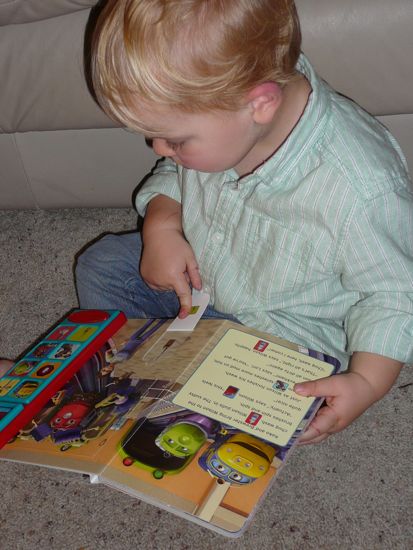
And hilarious! The Happy Toddler is catching on to so many things. He can feed the cats, he can imagine, he is better able to say what he wants. His ideas are, for the most part, unfettered by our conventions. Playing trains is not just making trains go around the track, it can also be making them go around the track and crash! Why can’t he take his ‘motorbike’ (Big Wheel) up the stairs? Why don’t the cats want to play with him? Why is Mommy sleeping when she could be up and playing with him? The world is a wonderful place when seen through the eyes of an almost-two year old. 🙂

It is also amazing to me how even as a tiny baby, this little boy was conventionally all boy – loves mechanics, loves anything with wheels, loves to make things go, loves to make things crash. Loves to rumble, loves to run, loves to jump and doesn’t much get why anyone would want to sleep, even at bedtime. He also knows how cute he is, and exploits it shamelessly. 🙂 He’s already a little man, into men things.
I suddenly realize how while I am talking about how active he is, all my photos show him sitting and doing a quiet activity. . . but have you ever tried to shoot a two-year-old in action? ? ?
Saudis Investigate Dancing Nurses
Unfortunately, I can no longer find the video sent me by John Mueller on U-Tube; it has been removed, but you can see it for yourself here:
What the Saudis are investigating – and yes, there were men and women present – is a game of musical chairs, a game even children play at birthday parties.
Hospitals are a high stress environment – and these are sweet young people having a good time. Lord have mercy, and “investigation.”
Saudi health authorities have opened an investigation into three films published on U-Tube showing Asian nurses dancing at a mixed-gender birthday party inside a government hospital.
The three separate films showed several male and female nurses were involved in the concert that included music and dances, which are strictly banned at Saudi hospitals and other public facilities.
The films showed the party was held at King Fahd Hospital in the eastern town of Hofouf and the participants were apparently from the Philippines and Indonesia, according to Saudi newspapers.
One film was titled in Arabic “a scandal at King Fahd Hospital in Hofouf” while the heading of another video read “in the absence of supervision at King Fahd Hospital”. The third read “a dancing party for a nurse’s birthday.”
“We have been instructed to open an investigation into these films to determine whether this party was really held at King Fahd Hospital,” said Ibrahim Al Hajji, information director at the Health Department.
Hajji, who was quoted by Sharq newspaper, did not elaborate on what measures would be taken against those involved in the party.
Emergency Message for U.S. Citizens 1-2012- Possible Gathering at the U.S. Embassy
Kuwait City, Kuwait
January 11, 2012
Please circulate the following message without additions or omissions
immediately to all U.S. Citizens within your area of responsibility.
There are reports of a possible gathering in front of the U.S. Embassy on
Wednesday, January 11, 2012 at approximately 7:00pm. The gathering may take
place near the main Embassy gate. An increased police and security presence
around the Embassy compound is expected.
Spontaneous and planned demonstrations take place in Kuwait from time to time in
response to world events or local developments. At times, even demonstrations
intended to be peaceful can turn confrontational and possibly escalate into
violence. Please avoid areas where demonstrations occur or are planned and
exercise caution if within the vicinity of any large gatherings. Please stay
current with media coverage of local events, be aware of your surroundings, and
practice personal security awareness at all times.
U.S. citizens traveling and residing abroad should enroll in the Smart Traveler
Enrollment Program (STEP) at the following website: https://travelregistration.state.gov.
U.S. citizens without internet access may enroll directly at the U.S. Embassy or
Consulate at their destination. By enrolling, U.S. citizens make it easier for
the Embassy to contact them in case of emergency.
Updated information on travel and security may be obtained from the Department
of State by calling 1-888-407-4747 toll-free in the United States and Canada or,
for callers outside the United States and Canada, a regular toll line at
1-202-501-4444. These numbers are available from 8:00 a.m. to 8:00 p.m. Eastern
Time, Monday through Friday (except U.S. federal holidays). For further
information, please consult the Bureau of Consular Affairs Internet website at
http://travel.state.gov where the Worldwide Caution and Country Specific
Information can be found. In addition, the Embassy encourages U.S. citizens to
review “A Safe Trip Abroad,” which includes valuable security information for
those traveling or living in foreign countries. You can also follow the Bureau
of Consular Affairs on Twitter and on Facebook.
The U.S. Embassy is located at Al-Masjid Al-Aqsa Street, Block 6, Plot 14,
Bayan, Kuwait. If you are a U.S. citizen in need of emergency assistance in
Kuwait, you may reach the U.S. Embassy by calling +965-2259-1001 and requesting
the duty officer.
U.S. citizens in Kuwait who would like to receive future Emergency and
Informational Messages from the Embassy directly by e-mail may sign up for this
service by sending an e-mail to the following address: join-wardenmessagekuwait@mh.databack.com
This message may be accessed on the Embassy website, http://kuwait.usembassy.gov
Please note that the Consular Section is closed for U.S. and most local
holidays. The current holiday schedule for 2011 is posted on
http://kuwait.usembassy.gov/holidays.html.
Yeh, Right
From today’s mail:
Your account has been closed because of too many failed login
attempts.
Please download and fill out the form below to reactivate your
account.
Amazon
Qwon Chi Sushi
I was on a mission. This wasn’t one of those leisurely trips through the supermarket, this was one of those four-things-on-the-list trips – grab, pay and go.
But I had to pass the sushi section en route to the chicken section, and they were offering free samples. I took one; it looked interesting.
“New sushi” he said with a grin.
“What kind is it?” I asked
“Qwon Chi Roll” he said confidently.
“”Qwon Chi?” I asked.
“No, Qwon Chi Roll” he said, but this time the accent was on the first syllable.
“Qwon’-Chi” I repeated, trying to figure out what it was.
He kept smiling but he was not happy; I wasn’t getting it. He reached behind him and pulled out a sign:
CRUNCHY ROLL
I thought of all my “Woh is der bahnhof” moments, when I have spoken to people in their own language and they couldn’t understand me, and I just had to laugh. What goes around truly comes around, doesn’t it?
Tinker Tailor Soldier Spy

We couldn’t wait. We saw the earlier version of Tinker Tailor Soldier Spy, you know, the one with Alec Guiness, and we couldn’t wait to see this new version, with Gary Oldman playing the Smiley role. He was awesome.
The LeCarre’ books featuring George Smiley are grim and grey, and the opening captures that exactly. The entire movie has a bureaucratic, institutional bleakness, with all the power plays, the petty snobberies, the jockeying for position that these bureaucracies seem to nurture. The only times in the movie when there is color and life is the annual bureau party, once done entirely in Russian, once in French.
The movie is faithful to the book, which I think I need to go back and read once again. It all seems so historical now.
One of the things we noticed was that the theatre was utterly quiet as the movie progressed. A lot of the action is in the mind, figuring things out, and trying not to get caught, so the suspense is of the subtle kind, not the car-crashing and jumping off buildings kind. It was as if the entire theatre were holding its breath; noticeable because of its rarity.
We were oddly jangled as we left the theatre, and over dinner we talked about how we never thought we would be obsolescent, but the Cold War has passed; the soldiers of today weren’t even alive when the Berlin Wall came down and the Iron Curtain parted and the cars flowed east. Life goes on.
There were several quotes, one that made us laugh was spies talking about recruiting other nationalities “You can hire an Arab but you can’t buy ’em.”
Helping Others, Help Yourself
I found this article this morning in an e-mail from Bottom Line, and it rings true to me. When AdventureMan was in the military, there were social events I was obligated to attend. I often felt so much reluctance I just wanted to go to bed; just the thought of the events made me tired. Then I discovered a secret – when I got there, to look for someone shy, and to go over and talk with them. There was always someone, and it made all the difference – to me!
It feels good to be a Good Samaritan, of course. But there’s more to the story—because science reveals that being of service to others brings numerous health benefits. Maria E. Pagano, PhD, an associate professor of psychiatry at Case Western Reserve University School of Medicine in Cleveland, has investigated the helper therapy principle (HTP), which is based on the concept that when people help others, they are also helping themselves—particularly when the helper and the recipient of that help share a common malady. Alcoholism Treatment Quarterly published her recent review article on the topic. Among the evidence cited were studies showing that…
- People with chronic pain who counseled other pain patients reported a significant decrease in their own symptoms of pain and depression.
- Multiple sclerosis (MS) patients who were trained to have monthly 15-minute supportive phone conversations with other MS sufferers showed improvement in self-confidence and self-esteem as well as reduced depression.
- Alcoholics who helped other alcoholics were almost twice as likely to stay sober in the year following treatment…had lowered levels of depression in the three months after they started helping other alcoholics…and had significantly improved self-image. Dr. Pagano explained, “Helping others with a desire to live sober transforms the helper’s dark past and pain to greater good and enables him or her to be uniquely helpful to a fellow sufferer.”
While service to fellow sufferers is a cornerstone of 12-step programs of recovery, such as Alcoholics Anonymous, Dr. Pagano noted that it is not necessary to share a common health problem in order to benefit from doing good. For instance, helping others in general has been linked with longer life, less depression, higher self-esteem and greater life satisfaction.
Bottom line: For a “helper’s high” and a significant health boost, lend a helping hand to someone in need.
Maria E. Pagano, PhD, is a psychologist and an associate professor of psychiatry at Case Western Reserve University School of Medicine in Cleveland. She also is a recipient of a career development award funded by the National Institute on Alcohol Abuse and Alcoholism. www.HelpingOthersLiveSober.org
Recent Comments
intlxpatr on Shampoo Ginger tigerbutterya0c5ff1d… on Shampoo Ginger intlxpatr on British Soldier Kidnapped, Esc… John on British Soldier Kidnapped, Esc… intlxpatr on British Soldier Kidnapped, Esc… Wikipedia Donate Button

Amazina


Early Voting in Florida


 Here There and Everywhere