Hilarious French Video / Ad
Thank you, Hayfa!
Spoiling Your Grandchildren
I found this today on AOL’s What to Expect:
When Grandparents Spoil Your Little One

Question:
“My parents are constantly spoiling my toddler — they’re always giving him treats and toys and sometimes they even let him skip naptime, which I pay for later. What’s a polite way to ask them to stop?”
Grandparents have been spoiling their grandbabies forever, and the reason is pretty simple — it makes them happy. Your parents and in-laws have done the heavy lifting raising you and your partner, and now — no surprise — they want to enjoy the fun parts of parenting. That’s why they’re so willing to indulge your sweetie when he begs for a scoop of ice cream for snack, one more story before bedtime, or a new toy. And they’re not alone: One recent study found that grandparents in this country spend a staggering $50 billion annually on their grandkids.
Still, all that generosity doesn’t get them off the hook. After all, they don’t have to suffer the consequences of plying your toddler with cotton candy or depriving him of z’s — you’re the one who has to deal with your cranky critter when their visit’s over. Also, if you’re choosing a grandparent as a relative caregiver, you want to make sure your child-care philosophy is still (somewhat) in practice when you leave your little one in Mom Mom’s arms. So how can you keep grandparents from spoiling your sweetie too much and get them to show respect for the rules you’ve worked so hard to set? Here’s how:
Enlist their help. Simply asking your parents to stop the spoiling probably won’t get you very far. Instead, find a quiet time to talk — preferably when your tot is out of the room — and make them feel part of the solution, not the problem. Acknowledge that you totally get that they like to indulge their grandchild, but you need to set a few ground rules. Then ask for their input. For example, if you’re peeved that your parents don’t think twice about the unhealthy snacks they serve, you can say that the dentist has noticed some tooth decay, and you all need to come up with a sound plan for taking good care of your tot’s teeth.
Let a few things go… If the grandparents’ spoiling is relatively minor — e.g., your mom slips your toddler a dollar every time she stops by — rethink whether it’s really worth making a fuss over (especially if they live far away and don’t see the grandkids all that often). After all, if they respect your most sacred limits (no scary or violent TV shows), you should be prepared to be flexible on a few things, too.
…but don’t compromise on health and safety. If your parents’ or in-laws’ treats include toddler choking hazards like hard candy or popcorn or they’re lax about buckling him up in the car seat or stroller, speak up. If necessary, print out articles, cite a higher authority (the pediatrician), and then lay down the law: No more treats at their house or no more rides in their car until they agree to take safety seriously.
What happens at Grandma’s, stays at Grandma’s. In addition to your anti-spoiling efforts, explain to your child that there are different rules at Grandma and Grandpa’s house, and that’s okay. Even little kids can begin to realize that staying up late or eating sugary cereals at breakfast is a special, only-at-Grandma’s-house treat that they shouldn’t expect at home.
Quarantine the loot. If your home is overflowing with the goodies your sweetie scores after visiting Grandma and Grandpa, tell your parents (and in-laws) that from now on, the stuff they buy has to stay at their house. Once the clutter starts to pile up there, they might understand your complaints and shut down the swag wagon.
Get tough. If your parents still aren’t getting the message after several (respectful) conversations, take a firmer tone. Tell them their behavior is causing chaos at home — and it’s harder to settle your sweetie down after every visit. You might also remind them that they had rules when they were raising you and now it’s your turn to set them.
Here’s to the joys of grandparents,

LOL, I wonder if our son will read it!
Emergency Message for U.S. Citizens 2011-17 (Kuwait)
Kuwait City, Kuwait
October 13, 2011
To: All American Citizens
From: U.S. Embassy Kuwait-Consular Section
Subject: Emergency Message for U.S. Citizens 2011-17
Worldwide Travel Alert
U.S. Department of State
The Department of State alerts U.S. citizens of the potential for anti-U.S.
actions following the disruption of a plot, linked to Iran, to commit a
significant terrorist act in the United States. This Travel Alert expires on
January 11, 2012.
An Iranian-born U.S. citizen, working on behalf of the Iranian Islamic
Revolutionary Guard Corps Qods Force -designated by the Treasury Department in
2007 for its support of terrorism – is suspected of conspiring to assassinate
the Saudi Arabian Ambassador to the United States. The U.S. government assesses
that this Iranian-backed plan to assassinate the Saudi Ambassador may indicate a
more aggressive focus by the Iranian Government on terrorist activity against
diplomats from certain countries, to include possible attacks in the United
States.
U.S. citizens residing and traveling abroad should review the Department’s
Worldwide Caution and other travel information when making decisions concerning
their travel plans and activities while abroad. U.S. citizens are encouraged to
enroll in the Smart Traveler Enrollment Program
(STEP). U.S. citizens without internet access may enroll directly at the
nearest U.S. Embassy or U.S. Consulate. By enrolling, U.S. citizens make it
easier for the embassy/consulates to contact them in case of emergency.
Up-to-date information on security can also be obtained by calling
1-888-407-4747 toll-free in the United States and Canada or, for callers outside
the United States and Canada, on a regular toll line at 1-202-501-4444. These
numbers are available from 8:00 a.m. to 8:00 p.m. Eastern Daylight Time, Monday
through Friday (except U.S. federal holidays).
Stay up to date by bookmarking our Bureau of Consular Affairs website, which
contains the current Travel Warnings and Travel Alerts as well as the Worldwide
Caution. Follow us
on Twitter and the Bureau of Consular Affairs page on Facebook as well.
The U.S. Embassy Kuwait is located at Al-Masjid Al-Aqsa Street, Block 6, Plot
14, Bayan, Kuwait. If you are a U.S. citizen in need of emergency assistance in
Kuwait, you may reach the U.S. Embassy by calling +965-2259-1001 and requesting
the duty officer.
American citizens in Kuwait who would like to receive future Warden Messages
from the Embassy directly by e-mail may sign up for this service by sending an
e-mail to the following address: join-wardenmessagekuwait@mh.databack.com
This message may be accessed on the Embassy website, http://kuwait.usembassy.gov
Please note that the Consular Section is closed for U.S. and most local
holidays. The current holiday schedule for 2011 is posted on
http://kuwait.usembassy.gov/holidays.html.
Ballet Pensacola Does Dracula
A good friend invited us to the Pensacola Ballet when we were newly arrived, not once, but twice. My friends ask in amazement “Pensacola has a ballet?” “We do, indeed!” I respond, “and they have had a ballet for years!”
The first ballet I saw in Pensacola was The Nutcracker. Who could not love The Nutcracker? I’m never sick of it, every year I see it is a little different. I have my favorites, but I always enjoy The Nutcracker.
The second ballet we went attended was WAY more avant garde. They did a ballet about the African American South, and I totally loved it. It was breathtaking, and innovative, with drums and intense music. I was impressed.
When I saw this years schedule, we bought season tickets. Dracula. Imagine! I can hardly wait to see what they do with this.

DRACULA
Ballet Pensacola’s season will open in dramatic fashion with a gripping performance of Dracula based on the 1897 novel by Irish author Bram Stoker. Wear your best costume to experience an updated take on the world’s most famous vampire.
Friday, October 21, 2011 at 7 p.m.
Saturday, October 22, 2011 at 7 p.m.
Saturday, October 22, 2011 at 11 p.m.
Single ticket prices are $18 – $30 (plus applicable fees) and are available now by calling the Pensacola Cultural Center Box Office at 850.432.2042.
Also join us for drinks and hors d’oeuvres at the Transylvanian Throwdown Saturday, October 22 at 9:30 p.m. in the Atrium of the Pensacola Cultural Center. Tickets are $10. For more information, please call 850.432.9546 or visit http://www.balletpensacola.com.
Generously Sponsored By
Emerald Coast Smiles by Design | Hancock Bank
Media Sponsors
Cox Communications | WUWF | Independent News | Ballinger Publishing
Update 21 October 2011: We saw Dracula tonight. We were not disappointed. While I enjoy the campy Vamps on True Blood, the vampires imagined by Bram Stoker were creepy, subhuman creatures, degrading with every century. From the opening, the Pensacola Ballet Corps caught it perfectly. The vampires were hungry, and spidery, and tumbled around on stage like the sub-humans they are. The bats streaked and twittered. The ‘brides’ leered at the audience, and Dracula was louche and hypnotically seductive, but in a very creepy way.
As usual, the costuming was brilliant.
Jungle Bell Rock in Kuwait :-)

If you remember, the Qatari Cat is a former street cat, a rescue cat. I wish I could be there to support this wonderful event and the good work that K’s Path in Kuwait is doing. They have some illustrious sponsors, and a host of great volunteers supporting their efforts.
“The Circle of Death”
Every now and then, AdventureMan and I are talking about life issues, and I will say something about it all being a part of the Circle of Life, and he, ever the cynic, will say “That’s another way of saying The Circle of Death.” It makes me laugh when he says it, but it sort of illustrates a difference in the way we think. I anticipate a happy outcome – and for the most part, I may go through some unhappiness, but the outcome is generally happy. AdventureMan anticipates the worst outcome, and is always happily suprised when things come out well. 🙂
Today, I don’t know how he is going to handle the circle.
His first chrysalllis was set around last Saturday, i.e. a fat caterpillar crawled off the milkweed where he had been born and had feasted a couple weeks. He became a bright, shiny green drop, but you could sort of see where his feet used to be, and you could watch things happening inside, like wings starting to form.

We don’t know where some of the catarpillars went. We know there were six or seven, and maybe some of them crawled off to cryssalize somewhere else. The second chrysallis was malformed; we knew it wasn’t going to turn into a butterfly. Maybe it was a normal defect, maybe a bird had pecked it or a wasp had laid an egg inside.
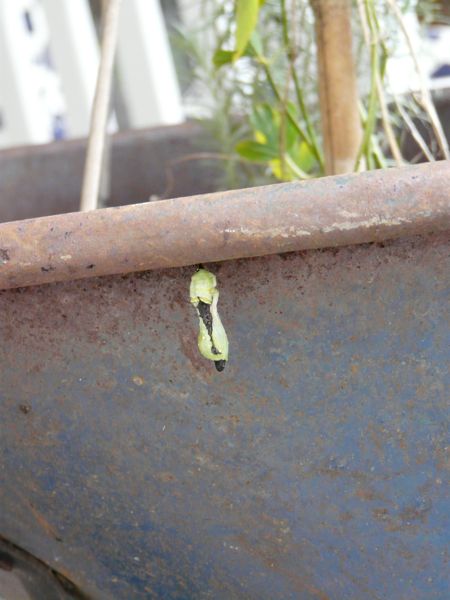
Yesterday, we watched the third caterpillar who had attached. Just an hour and a half after this photo was taken, he turned into that bright green container that the first had turned into.
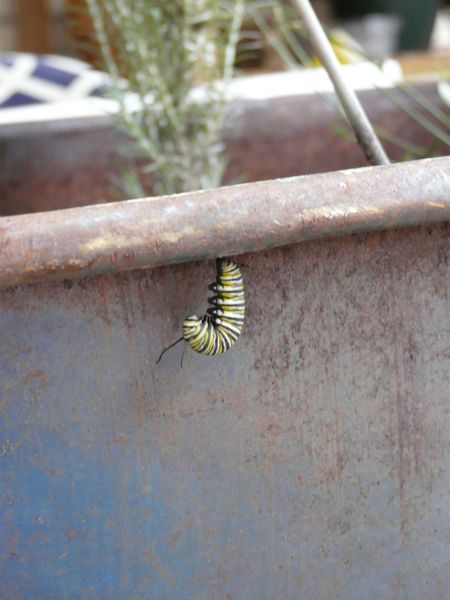
As I was fixing dinner, I could swear I saw the first chrysallis moving, and I thought it was hatching, but AM thinks I was just imagining something, and that might be.
Today, both the deformed chrysallis and the two perfect chrysallis are gone. I saw a small bird on the wheelbarrow yesterday, and it might be that the birds like to feast on the chrysallis.
Poor AdventureMan. His babies got run over by the circle of death. (I prefer to think that the first one hatched into a Monarch butterfly, but it is unlikely that is what happened to the other two, so this time, this one rare occasion, AdventureMan may be right . . . )
In the Garden
The temperatures have fallen, and even ten degrees make all the difference. You feel like going outside again. The heat doesn’t slap you in the face.
Sure, with temperatures still up in the 80’s most days you still work up a sweat if you are digging, planting and weeding, but being outside on the cooler days – and there have been a couple – is sheer joy.
We’ve done some work in the garden, and had some work done with Garden Gate, who are such a delight to work with. They have a landscaper, Carole Simpson, who when we first moved here advised us to do nothing big for a year, but to live with our gardens and see what was working and what we wanted to change.
As it turned out, we have one garden that is nearly perfect – save for the weeding, but even the weeding in that bed is not that hard. We knew we wanted a native plant and grass area, and we had an area where we were concerned about erosion, so we asked for some help with that. I wanted to try some hydrangeas near our back fence. Carole had a couple other ideas, and we liked them, and added them in.
This is our new herb garden, designed to help the area not to erode – and for the sheer joy of the herbs and flowers. 🙂 Two kinds of rosemary! Sage, thyme and oregano!

These are the new hydrangeas; the center back one is an oakleaf hydrangea and the three surrounding it are more compact. I am hoping they will grow into big sprawling shrubs like I had in Seattle.
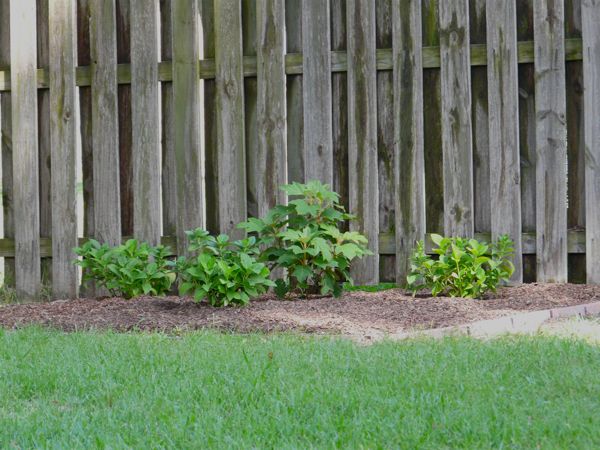
This is the grassy area, which will take a while to establish and fill out. Years! But we have the time . . . 🙂

This is a vine in its second year in out backyard; it is so happy. The flowers are white. We like it so much we have planted a second one to keep it company on the fence.

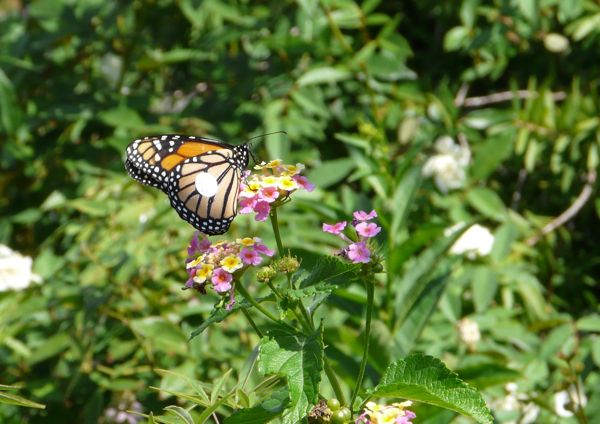
AdventureMan has his own project – a butterfly garden. He found all the right plants at Garden Gate and planted them in an old wheelbarrow we found at a yard sale. The very next day, we watched a butterfly come and lay eggs in the milkweed. Since then, AdventureMan has checked the results daily (sometimes hourly, depending on the stage.) We have watched the eggs develop into hungry, hungry caterpillars, and are now watching the caterpillers attach to the underside of the wheelbarrow to become chrysalis, and we hope to be able to see one (or more) become full Monarch butterflies.

When we planted the pomegranate tree in the Spring, we never dreamed it would put forth a fruit the first year, but we are watching our pomegranates (we have two on our small tree) with the same joy we are watching for the butterflies.

Today we awoke to clouds and drizzle – perfect weather for helping our new additions settle in comfortably, establish their roots, get comfortable. We need a good spell of moderate weather before the colder weather sets in.
Non-Profits: Something From Nothing
Here is what I love – people who get an idea, and make the world a better place because they have a vision and make a plan so that the vision can become a reality.
The Gulf Coast Citizens Diplomacy Council
I volunteer for the Gulf Coast Citizens Diplomacy Council. The one in Pensacola was started from nothing by a young woman with a vision, Gina Melancon Gissendanner. Her organization, her Board of Directors, her members and her resources deep within the Pensacola community have welcomed several hundred of the US Department of States International Visitor’s Leadership program delegates, bringing awareness – and dollars – to Pensacola.
When the visitors come into town, they have activities, tours and visits with professional counterparts that give them new strategies and resources to take back with them to their home countries. While here, they meet local people, shop in local stores and dine in local homes.
I love this program. From nothing, this young woman has created an organization with a far-reaching legacy. Thanks to her innovative and relevant programs, the international delegates leave here with happy memories of their time in Pensacola, and they go home and tell their friends and neighbors about their time here.
This weekend, we crossed paths with three more organizations, creating a better world, each in their own way.
The Master Gardeners
“You have to come to the sale at the County Extension Office!” our aqua aerobics friends told us. “It is so much fun, and they have Florida-hardy plants available at really good prices.”
OK! Finding ourselves awake and ready to hit the road early on a Saturday morning, we headed for the County Extension office, and the Master Gardener’s Sale. Now, I may get some of the details in this story wrong, but this is what I think I have been told. . . Several years ago, county extension offices (who answer questions about soil and growing things) found themselves deluged with questions, with too few people to answer them. They started a program – and I believe it is nation wide – training people in all aspects of growing things in the local area.
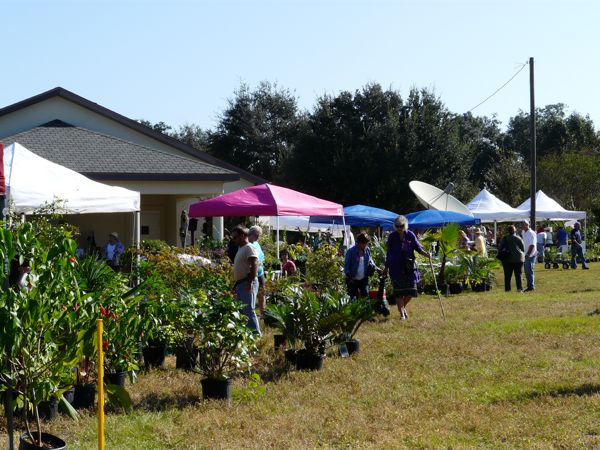
People who signed up for the training also signed up for a commitment to volunteer, and pass their knowledge along. Slowly, slowly, we have begun to know these people.
The sale was a lot of fun. While gardeners love a challenge, like growing flowers in Florida that aren’t supposed to grow here (like me, I am trying to grow bougainvillea, which isn’t really good at getting through cold winters, but maybe if I find the right protected spot, I can get it going and keep it going until it develops a deep root system and an ability to withstand the minimally cold winters we have in Pensacola) and they also love to share their knowledge.
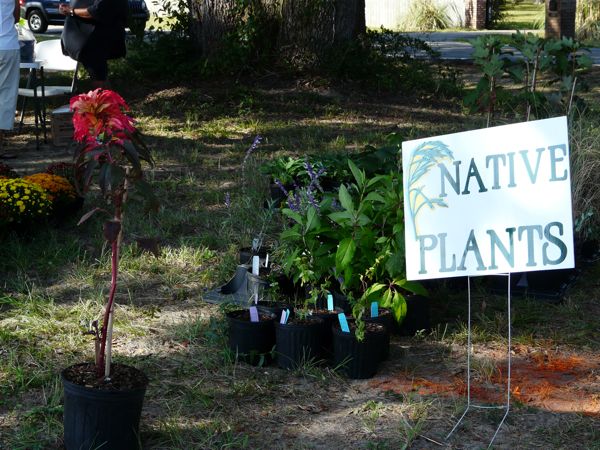
There was an experienced, knowledgeable and enthusiastic Master gardener about every ten steps at the sale, and we could ask all the questions we ever wanted, and they just loved talking with us and giving all the answers. Free! There was no admission charged, the plants were reasonably prices (and many were very cool plants) and it was just a great place to pass a Saturday morning.
We’ve been told the Spring Sale is THE best sale – we can hardly wait.
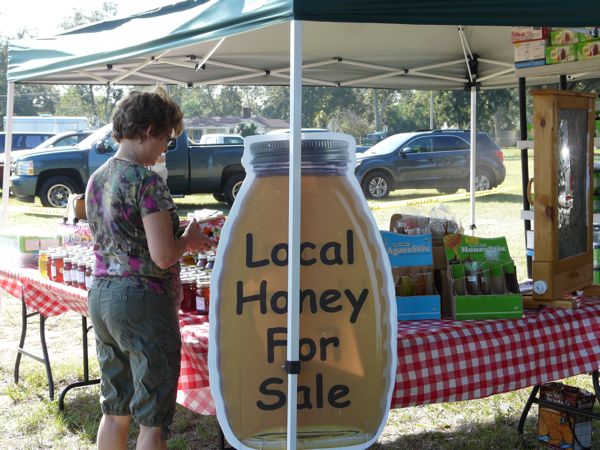
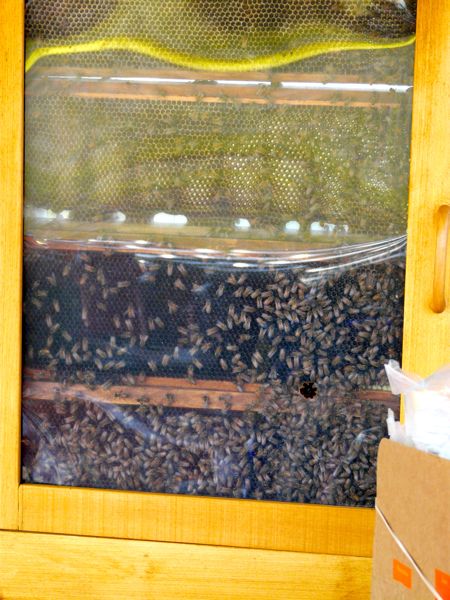

When we left, AdventureMan said “Every one of them seemed so comfortable in their own skin.” I think he is right. I think working in the earth with your hands helps ground you. 🙂
The Master Gardeners are those people you find in Home Depot and Lowes, giving information on gardening in Florida, and at special booths at Arts Fests, in the schools, and working the beds at the County Extension office. They are volunteers. They do this work for the love of making the world a more beautiful place.
The Butterfly House
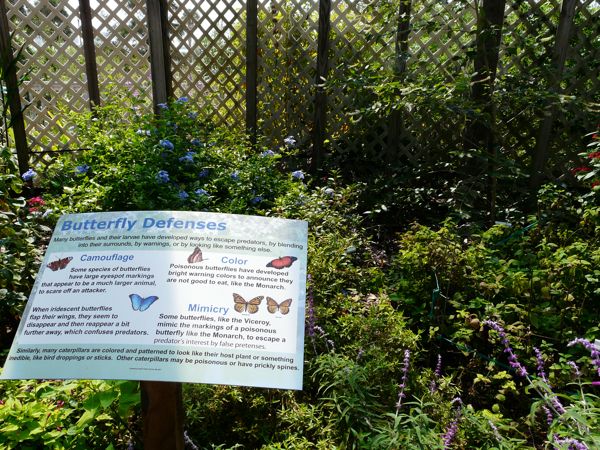
Our next stop was the Monarch Madness festival at the Panhandle Butterfly House in Navarre, where there was also an Arts Fest in progress. The volunteers at the Butterfly House all wore these terrific T-shirts with a caterpiller on the front and Monarch butterfly on the back. They had a great system, too, for getting a lot of people through the butterfly house in an organized and civil way, still giving people a lot of time to ask questions, and with lots of really cool activities for children to do, to help them understand the life cycle of these beautiful and short-lived creatures.




The Manna Food Pantries, Pensacola
I’m lucky. I work on a church committee where the chair brings in representatives from all the major charities in Pensacola to talk with us about what they do. The Manna Food Pantries is, in my humble opinion, a poster-child for how a non-profit should operate. Providing food for those who are hungry, for those going through tough times – and there are more than you might think – is truly part of God’s work for us here on earth. Manna Food Pantries collect and distribute food to the hungry. This morning, we had two Manna vans at the church and people were bringing in their full bags to donate.
It’s been a very tough year in Pensacola. The tough times just go on and on. You can prepare for tough times, save your money, gather your resources, but when tough times linger, sometimes those resources run dry. Manna has been faced with just such a time; resources are drying up, donations were down and the need is greater than ever. Manna hit the front page this week two days in a row, and is getting great coverage on radio, in the churches, in social groups – they are very very good at getting the message out, and the message is clear: We need your continued support, food, money, now more than ever.
They are brilliant at managing their volunteers, and many have been with them for years and years.
All these organizations are only able to exist because people believe in giving of their time and efforts in the hopes of making the world a little better, a little more beautiful, a little more peaceful, a little more hopeful – one person at a time.
Where are you going to put your efforts? What organizations do you support – and why?
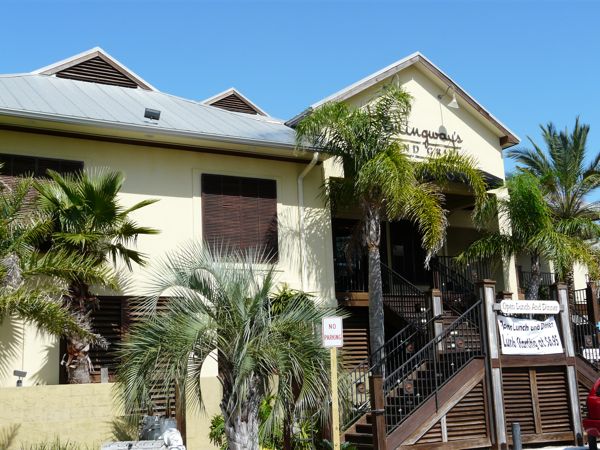
Hemingway’s on Pensacola Beach
“How about Peg Leg Pete’s?” I asked, as we were contemplating where to eat lunch.
“We haven’t eaten at Hemingway’s for a while,” he responded, “let’s go back there.”
I had to grin. There is so much that goes into where a person chooses to eat, and I suspect my husband is yearning, on some deep level, for some exotic taste of the life we left behind. Hemingway’s is built like a lodge, could be a hunting lodge in Montana or a hunting lodge in Africa, you know, a lot of wood, open construction, heavy wood beams in a high gently peaked roof, a vast balcony (like where you could have a Samburu Sunset and watch game wandering in to the watering hole)
Hemingway’s it was. As we waited for our meals to arrive, we tried to figure out when the last time we had eaten there had been, and we think it was back . . . more than five years ago, when our son was getting married. We had flown into town a week early to have time to get adjusted to local time and to arrange for a rehearsal dinner. We flew in, had a weekend with our son and his bride-to-be, including a meal at Hemingway’s, and then we headed up the coast to make our arrangements, and to get out of their hair during an exceptionally busy and stressful pre-wedding week.
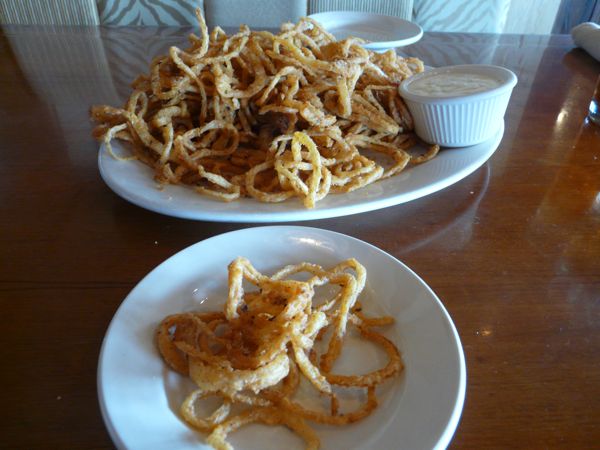
I love that Hemingway’s has some really good special menus for lunch; AdventureMan had the Hurricane Shrimp and I had the Salmon Caesar. We started with the onion straws, but there was so much, we barely touched them. They were the thin little onions, so each tiny little ring was a lot of crisp batter and fat, and not a lot of onion. A little tasty, but not a lot. Most of the taste was in the Ranch Dressing type dip that accompanied them. I’d skip them next time.
I made a mistake; there was a Caesar salad with something and there was a spinach salad with salmon, so I asked for a Salmon Caesar and he said “Oh! Yes, we can do that, just put it on Caesar instead of the spinach.” I like that flexibility, and I found their Caesar salad very tasty; not bland.

AdventureMan really enjoyed his Hurricane Shrimp and particularly loved the way they were skewered, so that on the grill, you can flip them without shrimp slipping off.


At the end, we succumbed to sharing a rum brownie, very delicious. I wish I could say we didn’t finish it, but we did leave most of the whipped cream behind. 😉

All in all, a nice meal in a great atmosphere. Service was attentive without being too intrusive. We will probably go back soon and take our son and his wife. 🙂
Pumpkin Patch Frenzy
We’ve had the most wonderful Saturday. You’d think we’d be sleeping in, but we surprised ourselves – awake and happy at seven in the morning, out the door by eight. Our second stop was the Pumpkin Patch, an annual arts event featuring glass pumpkins.
“Why pumpkins?” you might ask. It’s pumpkin season. Pumpkins are traditional for Halloween. These are beautiful, made of glass, nice for a Fall seasonal decoration in your house. It’s an arts fest, held in the Belmont Arts and Cultural Center. (If you look closely, you can see 5 Sisters Blues Cafe across the street.)
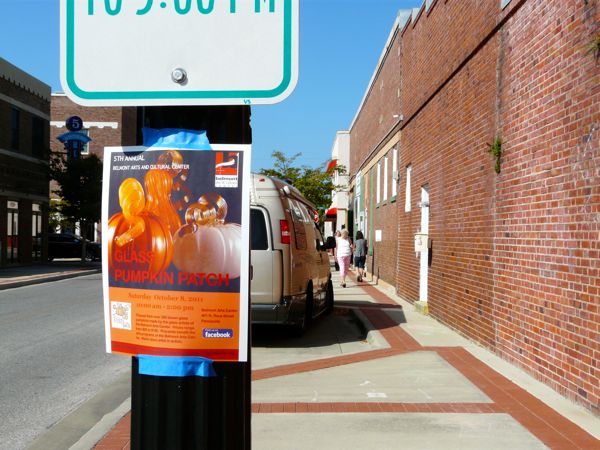
BIG mistake. No parking spots, so AM let me off to fight the crowds while he looked for a parking spot. There had been a huge line; none left as I get close to the door, but inside, it is a frenzy and it is a turgid stream of people. Many are carrying boxes and people are grabbing at pumpkins, beautiful glass pumpkins of all colors, but I knew I wanted a big orange pumpkin. I only found one orange pumpkin, a small pumpkin, but I never did see a big pumpkin, so this one will have to do.
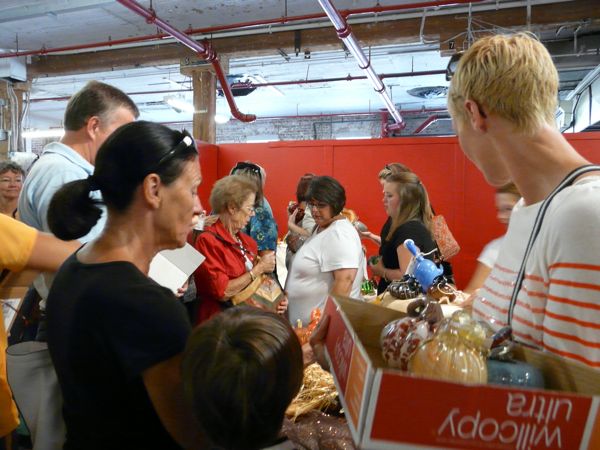
You cannot imagine; this was not a nice crowd. This was a mob, this was the worst shopping crowd I have ever been in, and I have been in some frenzied shopping crowds in my life. This one was rude and pushy and many of the pushiest were also very vulgar, and used vulgar language as they tried to push others out of their way.
I went straight to the “pay with cash or check” line, which moved fairly quickly. At one point, a guy called for anyone paying by check, and I could do either so I got in that line figuring it to be faster. I was at the end of the line, and the very last guy at the “pay with cash” table said “if you can pay with cash, I can take you here, now.” I said “YES!” and whipped our my cash and was out in a flash.
I’m going to have to find another strategy for finding a large orange pumpkin. I’m not going to that Pumpkin Patch Sale again.
Here is my little orange pumpkin:
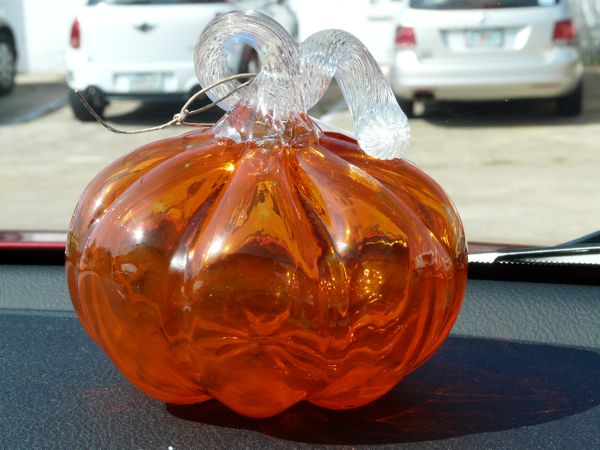
And here it is, with the little green pumpkin I bought last year, on my beautiful green Damascus tablecloth in the dining room:

Recent Comments
intlxpatr on Shampoo Ginger tigerbutterya0c5ff1d… on Shampoo Ginger intlxpatr on British Soldier Kidnapped, Esc… John on British Soldier Kidnapped, Esc… intlxpatr on British Soldier Kidnapped, Esc… Wikipedia Donate Button

Amazina


Early Voting in Florida


 Here There and Everywhere