“You Seem Happy Here – Are You?”
The landscape designer and I met last year as she toured our garden and helped us identify the plants we have in our garden. She had great ideas, and gave us a lot of help caring for a mature garden. She suggested we live with our yard for a year, and then decide how we want to move forward.
It was the best advice. What looked like a wreck of a garden after last year’s very cold winter came back back with a vengeance. We had fabulous plants, plants the birds and bees and butterflies and hummingbirds all loved to visit. We had a chance to visit other gardens and to see what we like. This year, we have more of a plan, and this lovely lady who has been gardening in Pensacola all her life, helps us fine tune our plans.
We’ve been going around the yard, figuring out where to put a pomegranate tree, a lime tree, a couple hydrangea bushes.
“You seem happy here,” she starts, “Are you?”
“You sound surprised!” I laughed, thinking how many moves I’ve made, and how I really like living near our son, his wife and son. We’ve been here a year now. I make friends slowly, but I actually have a few now.
“I wasn’t sure you would be able to handle the heat,” she confided.
I laughed. “I can’t. There is this wonderful thing called air conditioning. When it gets too hot, I don’t spent much time outside. I’m doing fine.”
It’s been almost a year since we bought the house here. It seems like so much longer, so much has happened. Last night, AdventureMan made a fabulous Bermuda Fish Chowder. Our son’s wife and little Baby Q came by for dinner while our son waited in line at Best Buy for a new iPad2, wooo hooo. He came by as soon as finished the purchase. Life is sweet, and yes, I think I am happy.
Avoid US Embassy
Kuwait City, Kuwait
March 11, 2011
To: All American Wardens
From: Consular Section
Subject: Warden Notice 2011 – 7
Please circulate the following message without additions or omissions
immediately to all U.S. citizens within your area of responsibility.
According to the Kuwait Ministry of the Interior, demonstrations may take place
today, March 11, at the U.S. Embassy in Kuwait City. The embassy therefore
recommends that the Bayan neighborhood be avoided.
Spontaneous and/or planned demonstrations take place in Kuwait from time to time
in response to world events or local developments. At times, even
demonstrations intended to be peaceful can turn confrontational and possibly
escalate into violence. Avoid the areas of demonstrations if possible, and
exercise caution if within the vicinity of any demonstrations. Please stay
current with media coverage of local events, be aware of your surroundings and
practice personal security awareness at all times.
For the latest security information, U.S. citizens living and traveling abroad
should regularly monitor the Department of State’s Bureau of Consular Affairs
Internet website, where the current Worldwide Caution, Travel Warnings, Travel
Alerts, as well as the Country Specific Information for Kuwait can be found.
Up-to-date information on security can also be obtained by calling
1-888-407-4747 toll-free in the United States and Canada or, for callers outside
the United States and Canada, a regular toll line at 1-202-501-4444. These
numbers are available from 8:00 a.m. to 8:00 p.m. Eastern Time, Monday through
Friday (except U.S. federal holidays).
If you are a U.S. citizen in need of emergency assistance in Kuwait, you may
reach the U.S. Embassy by calling +965-2259-1001 and requesting the duty
officer.
U.S. citizens living or traveling in Kuwait are encouraged to enroll in the
Department’s Smart Traveler Enrollment Program (STEP) so that they can obtain
updated information on travel and security. U.S. citizens without internet
access may enroll directly with the nearest U.S. Embassy or Consulate. By
enrolling, U.S. citizens make it easier for the Embassy or Consulate to contact
them in case of emergency. For additional information, please refer to “A Safe
Trip Abroad”.
This message may be accessed on the Embassy website, http://kuwait.usembassy.gov
Please note that the Consular Section is closed for U.S. and most local
holidays. The current holiday schedule for 2011 is posted on
http://kuwait.usembassy.gov/holidays.html.
Outrageous Mortgage “Servicing”
We have had our most recent mortgage with PHH, thanks to AdventureMan’s hard work, and this morning, my husband is on the phone with their bureaucratic, less-than-helpful customer service agent.
I hate them. I know it is a sin. I hate these practices.
AdventureMan sent them a check with more than enough to pay off the mortgage. When we checked the status online, we still owed a small amount. Then we saw that although the check was clearly marked “principal only,” PHH had applied part of it to another monthly payment, and then the rest to the principal. (Sleaze bag practice to prolong payment periods.)
“You cannot pay off the loan with a personal check,” the customer service representative says.
“You sent the check to the wrong address; that address is for principal only,” she says, and you can tell she is reading off a script.
AdventureMan asks to speak to her supervisor. She says that is not possible.
This is just an outrage. Every day they can postpone the final payment, they get interest from us. When we have sent more than enough money to cover the principal and all the escrow payments, we get this brick wall.
Personal check? They’ve already cashed the personal check! They have the money! This is outrageous!
We had to deal with the company once before, with another mortgage. Their practices are disgusting. God willing, we will never have to deal with them again.
A Very Dark Joke; not for the squeamish
Thank you, KitKat, for this very dark Alaska joke:
Tale form Alaska (where life is tough & humor is dark )
The day after his wife disappeared in a kayaking accident, an Anchorage man
answered his door to find two grim-faced Alaska State Troopers…”We’re
sorry Mr. Wilkens, but we have some information about your wife,” said one
trooper. “Tell me! Did you find her?” Wilkens shouted.
The troopers looked at each other. One said, “We have some bad news, some
good news, & some really great news. Which do you want to hear first?”
Fearing the worst, an ashen Mr. Wilkens said, “Give me the bad news first.”
The trooper said, “I’m sorry to tell you, sir, but this morning we found
your wife’s body in Kachemak Bay .”
“Oh no!” exclaimed Wilkens. Swallowing hard, he asked, “What’s the good
news?”
The trooper continued, “When we pulled her up, she had a dozen 25 pound
king crabs & 6 good-size Dungeness crabs clinging to her, & we feel you are
entitled to a share in the catch.”
Stunned, Mr. Wilkens demanded, “If that’s the good news, what’s the great news?” The trooper said, “We’re going to pull her up again tomorrow.”
The Dressmaker by Posie Graeme-Evans
When I wrote up this book for another site, I could not even remember the main character’s name. (Ellen Gowan) I found the book annoying, and most of the time, when a book annoys me, I don’t even tell you about it, I just don’t bother reviewing it at all.

I find the plot thin. I find the characters unmotivated. I find many of the choices of the characters unbelievable. We haven’t been given enough back-story to make the characters truly live.
Ellen has a real streak of bad luck. On her 13th birthday, a well-born young man gets fresh with her and in rural Victorian England, it becomes her problem – her reputation is damaged by a callow young man from a wealthy family. On the same day, an earthquake strikes her village, killing her father, and she and her mother subsequently lose their home.
They take up residence with Ellen’s aunt, her mother’s sister, and it is a happy time, all except for her aunt’s husband, a cruel man who isolates and beats his wife, who can do nothing about it. A wife is property. Her marriage was arranged; she has no where to go if she were to leave. She works hard at keeping her husband happy, so he won’t beat her or take it out on anyone she loves.
When you are dealing with an abusive manipulator, however, there is no pleasing, right? Ellen and her mother are thrown out, but also thrown a lifeline, and take up residence with a dressmaker, where Ellen hones and develops a talent for costume design (meaning evening dress, calling clothes, mourning clothes – wealthy Victorian women had huge wardrobes of ever-changing fashionable clothes.)
Ellen makes some really bad choices – in my opinion. I’m not going to tell you what those choices are, because I don’t want to give you too much of the story, in case you want to read it yourself.
Long story short, she ends up a very successful fashion designer/producer in London, only to face ruinous blackmail because of her past.
OK, here is what I really liked about the book. While I found the characters, descriptions, plotlines and dialogues pretty awful, I loved reading about the fashions, and I found reading about the social status of women – not all that long ago – where women in England had few choices and fewer opportunities – fascinating. I have friends in Kuwait and Qatar who face some of the same limitations. How soon we forget; it wasn’t that long ago that we faced the same challenges, the same limitations.
The freedom to live on our own. The freedom to earn and manage our own money. The rights to our children. All these issues are fresh in The Dressmaker, and too easily taken for granted in our own.
Ash Wednesday in Pensacola 2011
Luke 18:9-14
9 He also told this parable to some who trusted in themselves that they were righteous and regarded others with contempt: 10‘Two men went up to the temple to pray, one a Pharisee and the other a tax-collector. 11The Pharisee, standing by himself, was praying thus, “God, I thank you that I am not like other people: thieves, rogues, adulterers, or even like this tax-collector. 12I fast twice a week; I give a tenth of all my income.” 13But the tax-collector, standing far off, would not even look up to heaven, but was beating his breast and saying, “God, be merciful to me, a sinner!” 14I tell you, this man went down to his home justified rather than the other; for all who exalt themselves will be humbled, but all who humble themselves will be exalted.’
(From the Lectionary readings for today)
“I forgot to set my alarm” AdventureMan said, coming down the stairs, “we missed the first service.”
Today is Ash Wednesday, the day Lent begins for Christians. We go to church, the priest puts a cross on our forehead in ash, to remind us “ashes to ashes, dust to dust”, that our life here on earth is only temporary, and that our true home is heaven.
It’s easier to believe that in your gut when you are an expat.
My cousin wrote to me, and in his email, he wrote that I write about my own culture the same way I wrote about Germany, about Qatar, about Kuwait – as an expat, as an outside observer. Pensacola is like my foreign assignments; I could live here for twenty years (God willing) and I will never be a native, I will always be from somewhere else, the kind of person about whom others will say “she must not be from around here.” I am guessing I will get more comfortable, more confident, but I will always be not-quite-right among the natives.
And that is how we are supposed to be living here on earth – as people not-quite-right, as people eager to return to our true heavenly home.
Lent in my own country is odd to me, now. In a foreign country, you are accustomed to thinking of yourself as a minority; your differentness makes you more aware or who you are, and what you value. There is a part of me that thinks Lent would be a lot easier if, like Qatar, and like Kuwait, and like Saudi Arabia, religious practices were state enforced, like everyone in the USA fasted at the same time, maybe nobody would sell meat or chocolate or alcohol. And then, I think “but what is the point?” The point is our own sacrifice. Is it a sacrifice if it is enforced from the outside?
I can’t sacrifice cussing in traffic this year. Pensacola traffic, by the grace of God, is nearly non-existent, and it is mellow. I’m not even tempted. I’m trying to figure out what I will sacrifice.
Father Neal Goldsborough at Christ Church Episcopal told us on Sunday how all the children come in from the Episcopal Day School to have the ashes imposed, and how poignant it is for him, and I can’t help but think of all the soldiers he has been with at their death, mere children, children of God, and how he must see the faces of these soldiers in the faces of these tiny children. My heart would weep, even knowing they are on their way home.
Chamber Music Concerts at Old Christ Church
AdventureMan and I have discovered a concert series we really like. The University of West Florida Music Department has a chamber music series, giving students a chance to play publicly, and offering chamber music lovers (moi) a chance to see and hear them perform in a delightfully intimate setting, old Christ Church in downtown Pensacola. It’s so far downtown that it’s almost on the waterfront.
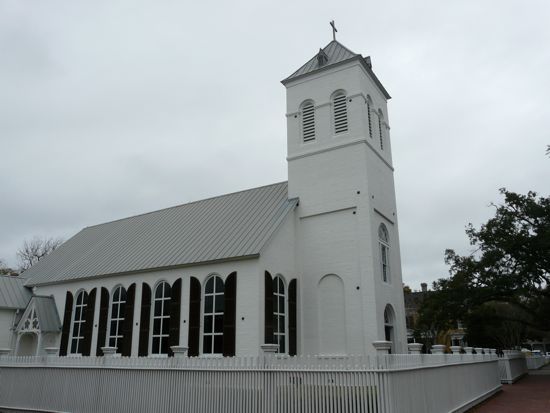

The concerts take place once a month, Wednesdays at noon, and are FREE. There is a donation container in the entry at Christ Church but there is no one shaking it or looking at you meaningfully. If you can’t make a donation, the donation police are not going to hunt you down.
Meanwhile, if you show up for these concerts, you are in for a treat. The Director of the chamber music program, Hedi Salanki-Rubardt, gives her students a lot of leeway, and a lot of inspiration, and you can see they truly love what they are doing, and enjoy being a part of the program.
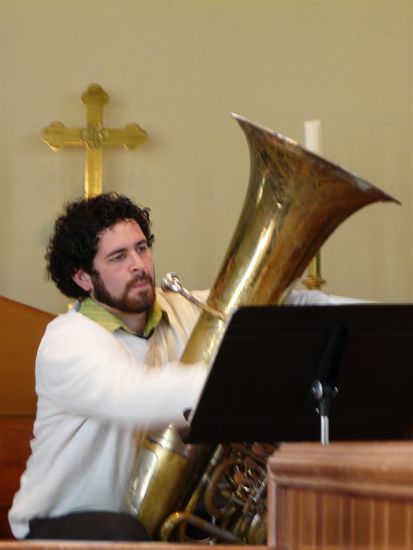
Giustino Carrano – tuba
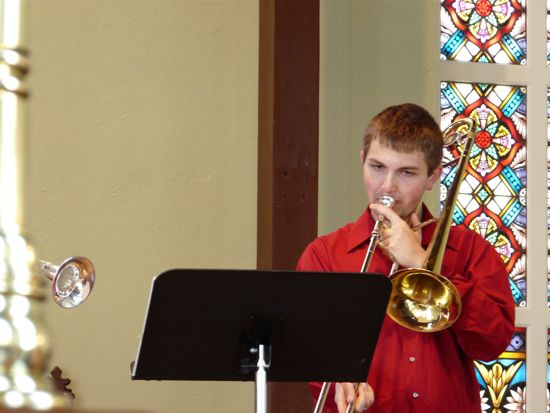
Matthew DeDowell – trombone
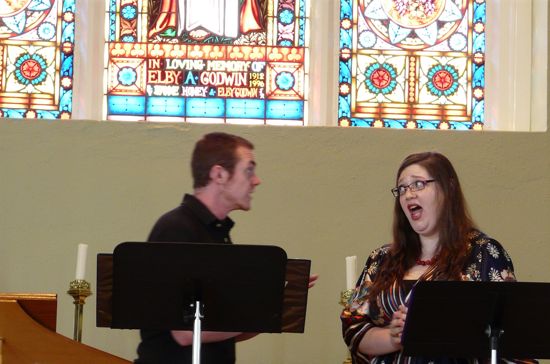
Allison Gilliard- soprano Marshall Corzette – baritone
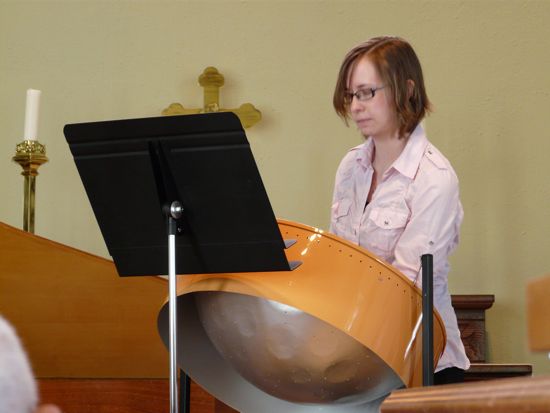
Lynsey Boothe – steel drum
You don’t usually think of a steel drum as a traditional chamber music instrument, but Hedi Salanki played the harpsichord, and Lynsey Boothe played the steel drum and they rocked Vivaldi. It was a lot of fun.
Where is Determination Square?
Kuwait City, Kuwait
March 7, 2011
To: All American Wardens
From: Consular Section
Subject: Warden Notice 2011 – 6
Please circulate the following message without additions or omissions
immediately to all U.S. citizens within your area of responsibility.
According to the Kuwait Ministry of the Interior, public gatherings may take
place March 8, at Safat and “Determination” Squares in downtown Kuwait City.
The embassy therefore recommends that these areas be avoided.
Spontaneous and/or planned demonstrations take place in Kuwait from time to time
in response to world events or local developments. At times, even
demonstrations intended to be peaceful can turn confrontational and possibly
escalate into violence. Avoid the areas of demonstrations if possible, and
exercise caution if within the vicinity of any demonstrations. Please stay
current with media coverage of local events, be aware of your surroundings and
practice personal security awareness at all times.
For the latest security information, U.S. citizens living and traveling abroad
should regularly monitor the Department of State’s Bureau of Consular Affairs
Internet website, where the current Worldwide Caution, Travel Warnings, Travel
Alerts, as well as the Country Specific Information for Kuwait can be found.
Up-to-date information on security can also be obtained by calling
1-888-407-4747 toll-free in the United States and Canada or, for callers outside
the United States and Canada, a regular toll line at 1-202-501-4444. These
numbers are available from 8:00 a.m. to 8:00 p.m. Eastern Time, Monday through
Friday (except U.S. federal holidays).
If you are a U.S. citizen in need of emergency assistance in Kuwait, you may
reach the U.S. Embassy by calling +965-2259-1001 and requesting the duty
officer.
U.S. citizens living or traveling in Kuwait are encouraged to enroll in the
Department’s Smart Traveler Enrollment Program (STEP) so that they can obtain
updated information on travel and security. U.S. citizens without internet
access may enroll directly with the nearest U.S. Embassy or Consulate. By
enrolling, U.S. citizens make it easier for the Embassy or Consulate to contact
them in case of emergency. For additional information, please refer to “A Safe
Trip Abroad”.
This message may be accessed on the Embassy website, http://kuwait.usembassy.gov
Please note that the Consular Section is closed for U.S. and most local
holidays. The current holiday schedule for 2011 is posted on
http://kuwait.usembassy.gov/holidays.html.
Smokin’ in the Square: BBQ in Pensacola
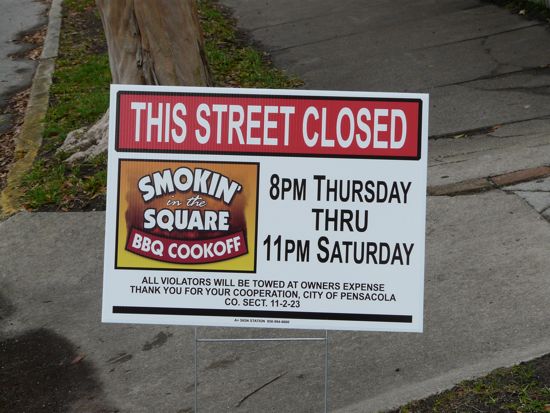
One of the most fun weekends of the year, and after weeks of beautiful weather, Saturday dawns cold and rainy, and the big barbecue contest and the big Pensacola Mardi Gras Parade are scheduled for this day. Fortunately, the skies held back until late in the day, and both barbecue cook-off and Mardi Gras were a big success.
AdventureMan and I hit the cook-off after a spring vegetable growing class out at Garden Gate Nurseries. Oh, what fun. People from all over the barbecue-ing states of the nation competing to produce the best barbecue. Heaven!

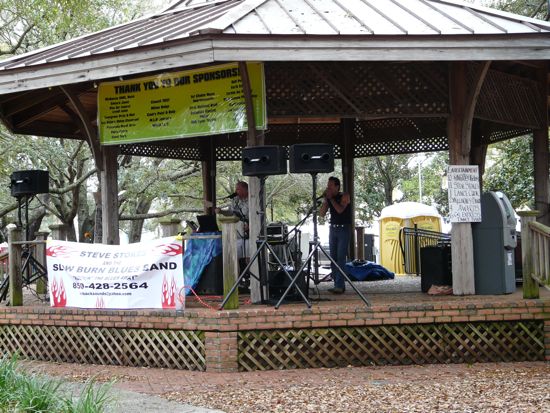
Live music at the fest



This is what we had to eat – Tennessee Tacos; pulled pork with baked beans and cole slaw on top of a flour taco shell, with your choice of barbecue sauce. YUMMMMMMMMM.
Gas Price Nightmare
In Qatar and in Kuwait, every time I filled my gas tank, I smiled. Gas runs around 70 cents a gallon. 🙂 🙂 🙂
Gas prices in Pensacola are putting a real burden on the population, but especially on the poor.

Actually, this is from a couple days ago. The price has gone up again since then. 😦
Recent Comments
intlxpatr on Shampoo Ginger tigerbutterya0c5ff1d… on Shampoo Ginger intlxpatr on British Soldier Kidnapped, Esc… John on British Soldier Kidnapped, Esc… intlxpatr on British Soldier Kidnapped, Esc… Wikipedia Donate Button

Amazina


Early Voting in Florida


 Here There and Everywhere