This is the Way We Wash Our Clothes . . . Wash our Clothes . . .”
We grew up, in America, singing a song about washing clothes:
“This is the way we wash our clothes, wash our clothes, wash our clothes,
This is the way we wash our clothes, all on a Monday morning.”
Tuesday we iron our clothes, Wednesday we mend our clothes. You can read the entire week at Mulberry Bush. Just click the blue type.
Today, Letitia Long will be named as head of the US National Geospatial-Intelligence Agency. It makes me smile to think that these two news articles appear on the same day. Women used to die young, worn out from bearing too many babies, and working themselves to the bone to keep their houses and clothes clean. Just washing clothes was an entire day event, heating huge pots of water, using a washing board, drying clothes by laying them over bushes and rocks, only the very luckiest had a clothesline.

These humble machines save hours of time. You can read the entire story of the earliest washing machines Here, At AOL News.
(Aug. 8) — “Thor” has been the name of several powerful forces in history, including a Norse god and a Marvel Comics superhero. But the strongest Thor might just be an electric-powered machine born 100 years ago that brought laundry into the modern era.
The first known washing “machine” is thought to be the scrub board, created in 1797. New-fangled hand-powered washers were introduced in 1851, but it wasn’t until a century ago that a drum-type machine with a galvanized tub and an electric motor, dubbed Thor, revolutionized the way people deal with dirty clothing.
Invented by Alva J. Fisher and introduced by Chicago’s Hurley Machine Co., the washing machine — which was patented on Aug. 9th, 1910 — is important for three distinct reasons, according to Thor Appliances vice president of marketing Michael Lee.
“First, it celebrates the birth of one of the oldest and most innovative brands/companies in home appliances,” Lee told AOL News. “Second, it represents the beginning of the washing machine industry. And third, it marks the date that clothes washing was transformed from an arduous physical task to an automated task.”
Happy Birthday, Happy Baby!
Today the Happy Baby is 6 months old. He is sitting, and pre-talking, and laughing and about to start school! He will be in a start-up program that actually begins educational formats at a very early age.

My son and his wife are having a birthday party today. 🙂 No, I haven’t heard of a 6-month-birthday party before, but what a great idea! Most grandmamas loves opportunities to give her grandbabies presents!
I found one book that is hilarious – and since we are all readers, and we want Happy Baby to be a reader, too, we start early. I have found that one of the secrets is buying books that adults will like, too. This one is about a zookeeper, whose zoo follows him home at night after closing. 🙂

If you teach a child the habit of reading, you get a bonus. You get a child who can keep him or her self occupied, and you get a child who can discuss books, ideas and characterization. It may be a challenge sometimes, but it’s a good challenge.

And this one, I am sure, is the kind of toy a grandmama can give a baby because she knows he will love banging on it, even while I suspect mama and papa will groan in horror:

Rainbow to the Rescue in Pensacola
This post is about an amazing blessing. You won’t think it is a blessing at first, you will think it borders on disaster, but stop. Think about it.
Late this afternoon, our contractor friend was in putting bars in the guest suite that people can use to help navigate around, help lift themselves off the toilet, etc. We were busy looking for a stud for the shower bars when it started raining.
“That’s raining pretty hard.” he said.
“It rains like that all the time,” I said blithely.
But it really was coming down, and it wasn’t just for a few minutes, it poured, and it kept pouring. The lightning was really close and we heard a loud CRACK! and then BANG and the power transformer on the post near my house was hit, but my power must come from somewhere else because, by the Grace of God, we didn’t lose power.
“Oh no! This has never happened before!” I exclaimed as I saw water seeping in the guest suite where we were working. (This has been cleaned up a little bit for this family blog.)

I thought it was coming in under the French doors, but when I grabbed the old towels for soaking up purposes, I saw that there was more . . . coming from under the walls! Horrors! I was almost stopped still in my tracks – there aren’t enough towels in Pensacola to handle the amount of water seeping in!

“This is a task for Rainbow!” my contractor said, and ran for his truck, to exchange it for his Rainbow truck (he is both a contractor and a Rainbow franchise operator).
While Dave was gone, his assistant, Bobby, used their wet vac to get as much water up as he could, dumping the full tank several times out the window as we struggled. Finally, the rain slowed, and we could mop up the remaining wetness. He started a fan.

Dave came back with the big Rainbow truck and an intimidating amount of equipment. Now I will go into a parenthetical gripe about men and their toys. The biggest part of me is incredibly grateful to have this resourceful man who helps us with our construction and renovation needs, and then is there, like Superman, to the rescue, when disaster strikes. Another part of me wishes he didn’t have that excited gleam in his eye. My problem is his challenge – he loves the adrenalin.
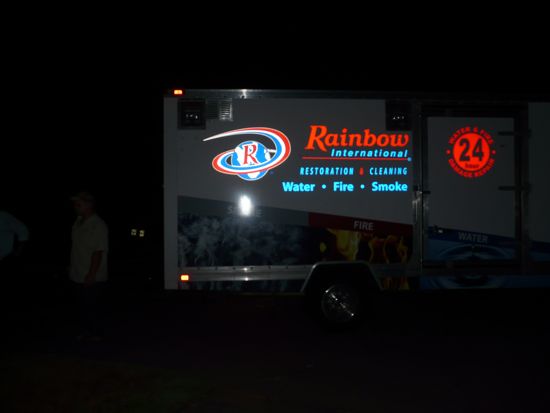
Honestly, it’s only a small part, and mostly it’s because I wish I didn’t have any problem at all. Dave has a meter that shows where water is still sitting in the grout between the tiles, and how it has soaked the baseboards and begun to creep up the sheet rock. He explains how in Florida, where the humidity is so high, the sheet rock can’t always dry out fast enough to avoid mold formation, and that even though it eventually may dry on its own, the mold can survive until the next moisture hits. Oh aarrgh!
Hours later, we have huge fans running, and we have dry air in oscilations being wafted into our walls to insure they dry thoroughly, but not too much. We have machines taking readings. Our insurance company says we are doing all the right things and the adjuster will come by on Monday or Tuesday.
This was supposed to be a quiet Saturday night. If it had been a normal quiet Saturday night, we might have been upstairs, watching some TV, listening to the lightening and not worrying too much about it. We would have gotten up in the morning and gone to church. We might not have even known our guest suite was flooded for days!
So honestly, I feel blessed. I am blessed that if this disaster had to happen, I had people with me who knew exactly what to do, and did it.
As they left, the Gulf Power people were out fixing the exploding power transformer, and I thought how many heroes there are on this earth, people who do their job under the worst circumstances, people who leave their families to serve because there are jobs that must be done.

God bless you, all of you, health workers, police, firemen, electricians, plumbers, emergency services, soldiers and sailors and airmen – all who sacrifice and serve. May you sleep well at night, and may God bless you and your families who support you.
I had a disaster, but I was surrounded by every resource I needed to deal with it. Thanks be to God.
If you have a disaster, and you live in the greater Pensacola area, I can recommend:
Rainbow International Restoration Services
David Murphy
O: 850-994-4411
Cell: 850-281-0232
Moonsighting
For my Islamic friends, there is a wonderful website called Moonsighting.com which shows the exact phase of the moon to determine when Ramadan will begin.
Nokia has also created a website with Ramadan applications including a gorgeous PrayerTime app:

One Thing I Really Like About Pensacola
As I was driving along an unfamiliar highway around 11 on a Friday night in Seattle, it occurred to me how tame the driving in Pensacola is. For some reason, the traffic lanes on the highway in Seattle are narrower than in other countries. You get used to it, but it’s like the whole personal space thing; when first invaded, the adrenalin starts rushing.
In Seattle, there are just too many cars for the roads to handle with grace. Same as Kuwait. When I first got to Qatar, the roads were adequate, but no longer.
Pesacola is sweet. You can get anywhere you need to be in under half an hour. From the airport to my house is like 8 minutes, max. My house to the shops, my house to the YMCA, my house to church – all about eight minutes. There are a lot of stop signs and a lot of stop lights, and I rarely see anyone run them. I never see traffic gridlock. There is one really dangerous intersection in town, and I rarely see a problem there.
It’s not that driving in Pensacola is so consciously mannerly, as in Seattle. It’s just more laid back. No one seems to be in that great a hurry to get anywhere. Every child is in a car seat. People are careful, even if they are driving while impaired.
You can get spoiled. When you get used to calm driving, then just about anywhere you go with real traffic seems chaotic. Once you have a large number of people on the road, you increase the chances of running into a cowboy (or cowgirl), or an inexperienced driver, or a half-blind older driver, etc.
Driving in Pensacola is just uneventful. 🙂
Mars and the Moon

(From Astronomy Photo of the Day.com)
I got this wonderful e-mail that even had photos, showing that Mars – in a once in a multi-lifetime event would appear as large as the moon, around August 11. I’ve been waiting to tell you about it until closer to the date, which is also close to the beginning of Ramadan.
When I googled it today, I learned that same e-mail has been floating around for years, updated every year, and is a fraud.
The truth is less dramatic, but equally fun, if you like astronomical events:
August 2010: Mars and Saturn make a dramatic trio with brighter Venus on August 12th. Skywatchers will enjoy seeing of the three planets closely gathered on August 8th. On the 12th and 13th look for the slender crescent moon near the trio of planets. Venus is the brightest, Saturn is the next brightest, and Mars is smaller and fainter. Mars is 185 million miles from Earth this month.
This information is from Old Town Astronomy.com
God Loves a Cheerful Giver
“So let each one give as he purposes in his heart, not grudgingly or of necessity; for God loves a cheerful giver” (2 Corinthians 9:7)
I’ve always thought of this verse as the secret to a wealthy life. Whatever you give, with open hands and open hearts, comes back to you multiplied. When you give cheerfully, gladly, you see the riches in your life, and you have the gift of a grateful heart.
Warren Buffett and Bill Gates know that money doesn’t buy happiness – but giving it away does. 🙂
From AOL Business Roundup
Billionaires To Donate Fortunes: The Sage of Omaha, Warren Buffett, said Wednesday he and 39 other of America’s wealthiest people have agreed to donate a bulk of their wealth to charity either during their lifetimes or upon their deaths. As DailyFinance’s Carrie Coolidge reports, the initiative, known as Giving Pledge, is a moral commitment to give, not a legal contract. “At its core, the Giving Pledge is about asking wealthy families to have important conversations about their wealth and how it will be used,” says Buffett, chairman and CEO of Berkshire Hathaway (BRK.A).
See full article from DailyFinance: http://srph.it/dxRFZx
A Wing and a Prayer
We are taught to pray for all things, great and small. I really take that to heart; I pray for the smallest things, and most of the time, my prayer is answered (with a ‘yes’ although sometimes the form the answer takes gives me a grin at God’s great sense of humor.) Today, I had to drive an unfamiliar stretch to return my loaned car – a wonderful Lexus – Little Diamond had loaned me, and that was good for some serious and lengthy prayer, and then I was also praying that the check-in people would overlook the fact that my bag was seriously heavy. Like 60 lbs.
Both prayers were answered. I only got minorly lost and got it worked out fairly quickly, and the guy who checked my bag in didn’t bat an eye, just put a tag on it that said ‘heavy’.
What I had forgotten to pray about was security, but since I was only flying within the US, I didn’t think I would have any trouble.
But here’s the thing. For a long time, I thought we would be retiring to Seattle, so slowly over the years, I would take things to Seattle and store them at my Moms or in a storage locker I rent there. So when I went to my Mom’s this last week, I took few clothes, and a big suitcase, so I can start shifting some of these household items to Pensacola. It wasn’t enough, but I packed it really really full, and then I also had stuff packed in my backpack.
So forgetting to pray about security was a big mistake. The security scanner girl kept squinting at the innards of my backpack, and then called others over, always a bad sign.
Sure enough, they went through my things with the explosives tester and their fine tooth combs.
“Are these silver plates?” the security guy asked incredulously.
“Serving plates,” I responded, and gave no further explanation. I don’t believe in telling people too much, it just confuses them and complicates things.
“What is this??” he asked, holding up two cans that said clearly on the side “smoked salmon”.
“Smoked salmon,” I replied.
Back to the scanner. Twice, back to the scanner. When he brought back all my stuff he asked if I wanted him to repack it.
“No,” I said with sheer disgust. No one can get everything back the way I had it packed but me. Even without the two cans of smoked salmon, which they confiscated. Damn.
Other than that, it was a smooth trip, and my son was there to meet me at the Pensacola airport, and I was home within 20 minutes of landing, how cool is that? Sure wish I had those cans of smoked salmon . . .
“How Do You Want to Die?”
I had taken my mother to her internal medicine specialist, she had an earache, and as an aside, had mentioned she no longer is taking Lipitor, because it gave her problems with her legs, but should she go back on it?
“How do you want to die?” asked the doctor, and we just looked at her with our mouths hanging open. It seems kind of a bald question, doesn’t it? But the doctor was entirely serious.
“Doctors ask themselves this all the time,” she continued. “Do you want to end up in a nursing home, or living with your children, as your body continues to fail and your money dwindles away and you can do less and less every day?”
“I want to die in my sleep, at home” my 87 year old Mom responded.
“Then you want to have a heart attack,” the doctor said. “That’s what really happens when a person dies in their sleep, their heart fails.”
“That’s your choice,” she said. “Doctors discuss it all the time. Most of us want to go while life is still good, and we want to go quickly. We see too many people prolonging their lives and regretting it.”
I’ve never heard a doctor speak so bluntly before. We’re still kind of in shock. It has definitely given us something to think about.
Recent Comments
intlxpatr on Shampoo Ginger tigerbutterya0c5ff1d… on Shampoo Ginger intlxpatr on British Soldier Kidnapped, Esc… John on British Soldier Kidnapped, Esc… intlxpatr on British Soldier Kidnapped, Esc… Wikipedia Donate Button

Amazina


Early Voting in Florida


 Here There and Everywhere