Long Term Care for The Aged: Hidden In Plain Sight
One of the most amazing things that happened to me while I was living in Doha was a conversation I had with a group of Qatteri and Palestinian women. We were talking about our summer plans, and when it was my turn, I told them I was going back to the US to take care of my Dad while my Mom had a knee replacement. They all looked at me in stunned silence, and I wondered what I had said wrong.
“You do this?” one of them finally asked me, “You take care of your parents?”
“Yes, of course,” I replied, not understanding her puzzlement.
There was a burst of excited chatter I couldn’t follow, and then one of the younger women said to me “but we NEVER see this on TV.”
Things have probably changed by now, with all the cable stations available, with Lifetime and a broader spectrum, but what they think of as America is Dynasty and – well, think of what your favorite programs are, and then imagine an alien culture watching and trying to figure out your culture from what you watch. If you are living with the aliens, they way we portray our own culture on television and in movies is appalling!
Long story short, most adults want to stay independent as long as possible. They never want to be a burden on their sons and daughters and grandchildren. I am willing to bet that this is almost universal. For one thing, from the point of view of the aging, if you live with someone else, you know you will increase their work load, and if you go to a facility, you lose a lot of options to choose. Being able to have someone to come into your own house allows you to remain independent as long as possible. If you live with one of your children, you still get to have home-care, which relieves a lot of the burden on those with whom you are living.
Here is an AOL Health News article on a ‘hidden’ provision of the new health care act which will make it possible to keep our elders at home longer. Believe me, this is a very good thing, if you have ever dealt with a rehab facility, or a residence for the aged.
Health Care Reform Will Impact Long-Term Care
From AOL News: HealthCare
Robert W. Stock
Contributor
(March 26) — As health care reform became the law of the land this week, a huge bloc of Americans with a unique interest in the outcome sat watching on the sidelines.
The 49 million people who care for older family members were hidden in plain sight, as usual, quietly shouldering a burden that so often takes a heavy toll on their finances and their physical and emotional well-being. Many of them — I know a few — are opposed to the new health care law, even though it includes one of the most important steps ever taken to improve caregivers’ lot, especially those of the middle-class persuasion. Of course, hardly any of them are aware of that.
The Community Living Assistance Services and Supports Act, otherwise known as CLASS, provides for a national insurance program to help cover the cost of long-term care — something 70 percent of people over 65 will need at some point along the way. The premiums will be much lower than those for private plans, and you won’t get screened out because you’ve already had some health problems. Once vested after five years, enrollees unable to care for themselves will be able to claim cash benefits for as long as needed.
Joe Raedle, Getty Images
A health aide helps a patient at his home in Miami. The new health care reform law could “transform long-term care” and make it possible for more patients to stay at home, said the chief of the National Council on Aging.
If you’re rich, you don’t require much financial help with long-term care. If you’re poor and can no longer fend for yourself, Medicaid pays the bills, often at a nursing home. For the rest of us, long-term care — at home or in an institution — now requires that we, or our caregivers, choose from among some unpleasant options.
We can spend down our retirement savings until we’re eligible for Medicaid funds. We can protect our savings by taking out expensive long-term care insurance — it costs my wife and me more than $5,000 a year. Or, depending on how dependent we are, we can throw ourselves, or be thrown, on the mercy of our families.
My friend — I’ll call him Frank — was a retired lawyer and in great shape until four years ago. He had just turned 90 when emergency surgery laid him low for months on end. Then his sight and hearing began to go. “I’m one of the lucky ones,” his wife, Helen, told me. “His mind is fine. But he can’t get around on his own — he falls, even with a walker. He can’t make a cup of tea or shower by himself.”
For now, Helen can afford to hire an aide for a few hours a day to help with Frank and allow her to get out of the apartment. “James gives me a life,” she said. The future looks darker.
Surveys show that 90 percent of Americans want to age at home. Frank is no exception, but he never signed up for long-term care insurance. “If I couldn’t keep taking care of him, I don’t what I’d do,” Helen said. “If he went into assisted living, it would use up all our money. It’s very scary.”
CLASS, one of the legacies of the late Ted Kennedy, offers caregivers and care recipients another option. “If it’s successful, if a large enough number of people sign up, it will transform long-term care,” says James Firman, president and CEO of the National Council on Aging. “It will create a market-based economy for keeping aging people at home.”
That’s an important “if,” since the program, by law, must be self-sustaining. Premiums will generally be collected as part of workers’ payroll deductions unless they opt out. The younger the worker, the smaller the premium.
There is a vicious circle built into the current arrangements. Many caregivers must hold down a job and maintain their own separate family household while also watching over an aging parent. That kind of pressure can have consequences.
In recent studies, workers 18 to 39 years of age who were caring for an older relative had significantly higher rates of hypertension, depression and heart disease than non-caregivers of the same age. Overall, caregivers cost their companies an extra 8 percent a year in health care charges and many more unplanned days off.
In other words, the strains of family caregiving can hasten the caregiver’s need to be the recipient of care.
CLASS bids to crack if not break that vicious circle. Its benefits would make it much simpler and less expensive for families to make sure Mom gets the support she needs to be able to spend life’s endgame where she wants — in her own home. Good news for Mom, and good news for the future health of her caregivers.
In the last few days, I’ve conducted a poll of a dozen friends who have been closely following the health care reform debate. I wanted to find out how much they knew about CLASS.
Not one among them had even heard of it. It somehow seemed fitting that this major program, just like the caregivers themselves, was hidden in plain sight.
Before and Now
No, my house is not undergoing a ‘remodel.’ It is undergoing a rewiring. About the best that will happen is that when it is finished, it will look a lot like it looked before, except with invisible copper wiring instead of aluminum wiring, which, as it turns out, is problematic.
Sigh. And then again, what better time to have this all done than BEFORE you move in? If it had to happen, it couldn’t have happened at a better time, and we have some truly great contractors. How many times have you ever heard someone say that?
Today I went by the house to pick up the mail and holy smokes – the garage is full of ceiling, and my house is bare bones!
Here are some before and after shots:
Family Room Before:

Family Room Now:

Kitchen Before:

Kitchen Now:

Living Room Before:

Living Room Now:

And last but not least – the Garage before:

And the Garage now:

Dubai Easter Camel
LLOOLL, saw this in the Dubai Airport and could not resist taking a photo. I would have loved to bring some back for Easter basket surprises on Easter morning, but they are surprisingly bulky, as much fun as they are:

Publix Helps Us Cook At Home
Through blogging, I became a fan, and then in the way things happen in this wonderful virtual world, a friend of another blogger, John Lockerbie, who writes about many things, my favorite of which is Islamic design. He writes about the architecture, the boats, development in the Gulf, and behind the blogs, we have had our own correspondence.
Recently he commented on the post I wrote about how American health problems are mostly self-inflicted, and could be turned around with proper diet, exercise and preventive visits to the doctor to deter the serious illnesses from showing up. He sent me a reference to a speech made by Jamie Oliver, when he won the TED prize, on changing one small thing in the modern world – teaching us to cook once again in our own homes instead of eating out, eating highly processed, highly salted, highly sugared and highly fatted foods.
There is a Florida chain of supermarkets called Publix, and they are marvelous. Publix is making it easy for people to cook at home. They have a program where they do cooking demos, give out the recipes, and have all the ingredients gathered in one place – at the same price as throughout the store, just located conveniently in this one place – to encourage people to cook at home.
All the ingredients for several recipes:

Close up:

The signage:

Pick a recipe!

I find I am enjoying cooking a lot more here, where shopping is so easy and everything looks so good. Oh yes, and the prices are so low!
Barbie Turns 50
LLOOOLL, my sweet Kuwaiti friend is also sharp, with a sharp edge, and sends me some of the funniest things I have ever seen: Barbie Turns 50, LLOOLL

About a year ago, when I first moved back to Doha, I decided to use up a bunch of pink scraps that had collected over the years – baby girl quilts, friend quilts – pink isn’t my favorite color, but I hate waste. I chose a pattern I thought would be easy, but then . . . I started playing. I always associate pink with Barbie, you know, that Pepto-Bismo pink? Bubble-gum pink? And then I thought “What if Barbie got an edge? What would Barbie look like in real life, the light innocent pinks of girlhood? The hot passion of teen-age crushes? The elegant reds of romance and the purples of betrayal? What would she look like when menopause hits?”
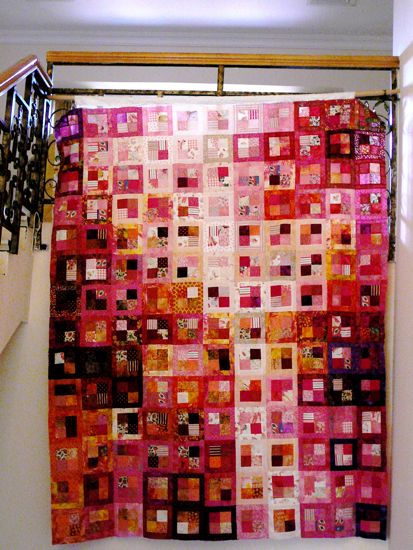
I ended up taking a lot of time, finding just the right colors and trying them out in different places. I grouped similar pinks in different areas, with a light rent down the center – aren’t our lives often divided by events? As it turned out . . . I had a lot of fun playing with the idea of Barbie growing up, becoming a real person, and experiencing all the things women experience. Maybe men too, but I wouldn’t know, LOL! (I still have a pile of pink scraps left over, aaarrgh!)
Every Monkey Gets His Turn in The Barrel

AdventureMan and I have this phrase, and I cannot imagine where it came from (from where it came, for you grammar sticklers!) “Every Monkey gets his turn in the barrel.” It’s particularly true in the workplace, or at least almost every workplace where I have worked – it’s like the stock market, sometimes your stock is high, sometimes your stock can fall, and often, it is not so much your performance as the PERCEPTION of your performance.
Often, in the work place, stocks rise and fall based on little or nothing at all. In fact, if you are really really good at what you do, you are sometimes more at risk, because those who are less accomplished always need to focus the attention anywhere but on their own work, and if you are doing well, they will often find something to criticize to keep their own lackluster accomplishments from coming into focus.
But every monkey getting his/her turn in the barrel applies in almost all factors of life. Sometimes you’re up. Sometimes you’re down. Sometimes it has nothing to do with you, it’s just the way things are.
So my trip home was sort of my turn in the barrel. I was a little late getting to the airport, which was not crowded, but there was a long back-up going through passport control to get to the departure gates. They had plenty of staff, but for some reason, they were SO SLOW. When I got to the front, the woman ‘taking care’ of me was busy texting! I asked if the computers were slow today – honestly, she had already stamped my passport, she was just killing time – and she said “No, why?” as if she were unaware of all the people standing in line, waiting to get through.
When I got to Dubai, I had to do this 2 km run from the gate where Emirates comes in to the Delta check-in counter. I always think of it as good exercise, but the humidity in Dubai is particularly high, or else the air conditioning is going out, and at the end of the trek, I am almost soaked with sweat and thinking ‘OMG I need a shower.’ I went to the lounge, but there was a sign “opening at 2100 hours’ and it was 15 minutes after nine. I could see someone in there, but later she stuck her head out and said she couldn’t let anyone in until the ‘attendants’ came, which they did, about 15 minutes later – they had been shopping!
And then I discovered that I had to go to the Air France lounge, not nice at all, near the smoking station so even inside the Air France lounge it smells stale and smokey. I am spoiled. I love the Emirates lounge in Dubai, where they even have tiny small containers of Haggan Daaz ice cream for their clients. 😉 This lounge was filled with American contractors. Yes, we are also American contractors, but this was the other kind – great big fat loud-voiced men, bragging about their salaries and demeaning their wives. I couldn’t wait to get out of there, which I did quickly after checking my e-mails.
The flight from Dubai to Atlanta is just long – more than 15 hours – and started inauspiciously. As we took off, as the plane’s nose lifted, some cupboard fell open and we could hear china and cutlery falling and breaking, a lot of it. I felt so sorry for the flight attendants; they have a lot to do during those flights, and now it was complicated by a disaster at the beginning of the flight. I got through it, mostly by escaping into sleep.
As we arrived in Atlanta, everything had changed. I just did this trip six weeks ago, but there is a new traffic pattern, a longer trek, sterner instructions about how and where to get into line. My bags, marked “priority’, were, as often is the case, nearly the last off the plane, and I trundled them through customs, and then had to run (honestly, this is like a herd of cattle) to get into another long, snaking line to go through security again – this time in Atlanta, where you have to take off your shoes, take out computers, can only use a 1 quart zippering plastic bag, etc.
I had thought I had plenty of time, but a large troop flight came in from Afghanistan, and we all had to move aside to give them priority. That is the one inconvenience I did not mind at all – I am so proud everyone moved over with no grumbling and let our servicepeople through, to get them on their way for R&R.
Security found me very interesting, and this is my own fault. I have a little Waterford crystal sugar jar that I took with me. I’ve had it since the early years of our marriage, and I often hand carry it to the next post. It’s too bad that lead crystal goes opaque in the scanners, and that the shape was a little like that of a hand grenade. I also had my wireless router with me, and this led to a long, long, very long inspection of everything I was carrying.
As I griped later to my son, he said “And I am sure it never occurred to you that you were arriving from the Middle East on a one-way ticket.”
LLLLLOOOOLLLL @ me. Nope. It had never occurred to me. I guess I was thinking about other things – farewells, clearing out the house, packing, mortgage papers, insurance papers, TAXES (Oh aaaAAARRRGGHHH, yes we have an extension, but we still have to get them done!)
So this trip, I was the monkey. I rolled around in that barrel. Actually, because I had no real agenda, other than be in P’cola by Monday to close on a house, I could roll with it and figure that I have had so many breaks, so many times, that if I needed to take this roll in the barrel, so be it, God is good and needed to give the breaks to that old guy in the wheel chair and that family with two kids in strollers, and all those fine young people who serve our country in strange and alien lands . . .
And, at the end of my journey is my son, his wife, and our grandson, and a sweet, relaxed day with them, doing not much but catching up. 🙂 The real chaos starts this coming week, early on Monday morning. Think I’d better get to church, get some fortification for the demands of this coming week.
Who Is the Terrorist?
Sent by my Kuwaiti friend; I almost died laughing and I hope you will, too:
Foods That HELP You Lose Weight
Wooo HOOOO! Eat AND Lose!
This is from AOL + That’s Fit
7 Foods That Help You Lose Weight
Posted on Mar 18th 2010 12:00PM by That’s Fit Editors
by Melanie Haiken, Senior Editor, Caring.com
Don’t get sucked into the idea that food is your enemy when you’re trying to lose weight. In fact, it’s just the opposite: Befriend the right foods, and the pounds are much more likely to peel off than if you just try to cut calories across the board. Here, seven foods known to nutritionists to boost your body’s fat-burning potential.
1. Oats
Wait a minute; aren’t oats a carb? Yes and no. Oats are a whole grain, and they’re high on what nutritionists call the “satiety index,” meaning oats have tremendous power to make you feel full. Not only that, they’re also high in soluble fiber, so they cut cholesterol and blood fat. Oats digest slowly, so they don’t raise your blood sugar, and they keep you feeling filled up well into the late morning. Old-fashioned steel-cut and rolled oats, with up to 5 grams of fiber per serving, are best, but even instant oatmeal has 3 to 4 grams of fiber per serving.
2. Eggs
Nutritionists have been trying for some years to restore the reputation of the lowly egg. No longer thought to be a cholesterol-booster (eggs contain a different type of cholesterol than that in humans), eggs are a concentrated form of animal protein without the added fat that comes with meat. Dietary studies have repeatedly found that when people eat an egg every morning in addition to (or instead of) toast or cereal, they lose twice as much weight as those who eat a breakfast that’s dominated by carbs.
3. Skim Milk
Studies in reputable publications such as the Journal of Obesity (in addition to the controversial ones funded by the National Dairy Council) show that the combination of calcium, vitamin D, and low-fat protein in skim milk and nonfat yogurt trigger weight loss and help build and maintain lean muscle.
4. Apples
To keep the pounds at bay, eat an apple — or two — a day. Numerous studies have found that eating an apple a half hour to an hour before a meal has the result of cutting the calories of the meal. Why? The fiber in the apple makes you feel full, so you eat less. Recent research suggests eating apples has other benefits, too; the antioxidants in apples appear to prevent metabolic syndrome, the combination of high cholesterol, high blood pressure, and prediabetes that tends to accompany thickening around the waist.
5. Red Meat
Not exactly what you think of as a diet food, right? But research in the American Journal of Clinical Nutrition compared diet results for women who ate red meat and those who didn’t, and the meat-eaters lost more weight. Experts think the dense protein in lean red meat helps you maintain muscle mass — but of course this assumes you’re exercising to build that muscle.
6. Cinnamon
This simple spice appears to have the power to help your body metabolize sugar, according to surprising data that came out of a USDA study involving diabetics. Eating as little as 1/4 to 2 teaspoons of cinnamon a day was found to reduce blood sugar levels and cut cholesterol from 10 to 25 percent. So add cinnamon to smoothies, sprinkle it on your cereal, or flavor your coffee with it — particularly if you take your coffee with cream and sugar. The cinnamon will boost the health benefits of the coffee while helping your body rid itself of the added sugars.
7. Almonds and almond butter
Another counterintuitive choice; aren’t nuts and nut butters supposed to be incredibly fattening? Well, almonds are calorie-dense, but they also pack a huge nutritional punch — and they’re particularly effective in counteracting cholesterol and triglycerides. One study in the American Journal of Clinical Nutrition found that eating almonds was as effective as taking a statin. Spreading almond butter on your morning toast gives you a nice protein boost while preventing the carbs in the toast from spiking your blood sugar.
“Health Care Could be Fixed Overnight . . .”
Today, AOL ran commentaries on American health care and whether the new proposals will make a difference. The comment of one CEO who runs an enormous health provider, caught my eye. As I read it, I thought “he is talking about the USA, but the exact same thoughts apply to Qatar, to Kuwait, to Germany, where an epidemic of self-inflicted health problems is growing wildly.” And it also occurs to me that he is laying the accountability squarely where it belongs – on our shoulders.
David Feinberg, M.D., M.BA.
CEO, UCLA Hospital System
“The debate they’re having now in Washington is the wrong discussion,” says Feinberg. “They’re not talking about health-care reform. They’re talking about health insurance reform. The bill in Congress has nothing to do with health care.” He explains that health care could be fixed overnight if people would stop using alcohol and drugs, eat right and exercise.
“I have 800 patients in this hospital today, and I bet 50 percent of them have illnesses that could have been completely prevented,” Feinberg says. “That situation is not going to get better with a ‘public option.'”
He points out that even people without health insurance can receive care when they need it in the emergency room, and, while it’s not ideal, they’re not being denied care because they don’t have health insurance. “It’s impossible to give high quality, low cost care to everyone. What we need is to decrease demand for health care.”
According to Feinberg, some 75 percent of illnesses are treated at home, whether that’s a bad cold or a sprained ankle, and he says that health-care reform should be focused on home care. “When you compare us to other countries with similar Gross Domestic Products, they spend half what we do on health care because they have a different lifestyle,” he says. “We either need to change our lifestyle, or it’s going to be very expensive.”
“With all due respect,” he adds, “the surgeon general is obese. I don’t think the President of the United States should be solving this.” Rather, he says, each individual needs to come to terms with the fact that eating right, exercising, and avoiding smoking and alcohol will transform not only their own lives but the ever increasing cost of health care in this country.
You can read all the commentaries on AOL Health News. I know most of us in my age group need more exercise (not you, Big Diamond!) and are beginning to stave off the common age-related problems of high cholesterol, high blood pressure, obesity, diabetes, aches and pains, etc. We all KNOW we could be eating better and exercising more. We are smart educated people – but do we do what we know is best for ourselves? NNoooooooooooo!
I see the same epidemic striking in Germany, in Qatar and in Kuwait, people who have enough to eat are eating too much. Yes. Yes. I’m guilty. And I exercise a lot less than I need to. I was so happy to get back into a house, with stairs, so at least I would get the exercise of going up and down stairs a few times a day.
Japan has instituted a national policy of health, measuring citizens waists and penalizing them for carrying too much weight. I will be interested to see how it works out, if it pays off in health benefits and lowered costs down the road. It’s an inspired mandate.
Recent Comments
intlxpatr on Give to Those Who Ask ExpatAlien on What Country am I Living … intlxpatr on Yellowstone: Old Faithful to C… Michelle on Yellowstone: Old Faithful to C… Cathy on No Grown-Ups in Charge Wikipedia Donate Button

Amazina


Early Voting in Florida


 Here There and Everywhere