New Qatar Traffic Violations and Fines
Update: LLOOLL, I went to QatarLiving.com and discovered that these “new” laws came out in 2007. These are great laws, deterrents to bad driving and aggressive driving, but the laws mean nothing without enforcement. Do I still see many many children sitting in the front seat? Are people driving while talking on their mobile phones? And not a word about one of the worst offenses these days – texting.
A recent study showed texting is even more dangerous while driving than talking on a mobile phone:
The crash risk attributable to texting is substantial. One possible explanation is that drivers who text tend to decrease their minimum following distance and also experience delayed reaction time. For example, in the Drews et al. study, drivers’ median reaction time increased by 30% when they were texting and 9% when they talked on the phone, compared with their performance in a driving-only condition.
Notwithstanding the safety risk of texting while driving, previous research by Drews and colleagues at the University of Utah — not to mention crash data and widespread legislation — makes clear that using a phone while driving is dangerous.
(To check my source, just click on the blue type, above)
We were talking about people who were saying “Qatar is the most dangerous place to drive in the world” and wondering where this is coming from? Most of us have driven in more dangerous places, but this is the new quote floating around, with no foundation, no statistics, no studies, at least not any I can find with a simple Google.
The topic of new laws came up next over Christmas dinner. New laws? New fines?
“I never saw a word about this in the paper,” I said, peevishly.
“Oh, didn’t I tell you?” said AdventureMan.
People who have been married a long time will understand the urge to kill . . .
Someone else jumped in,
“I think the different companies are passing it around. The Education Foundation has it. Some of the universities have it. That’s the way it is in Qatar, news of new laws filters out.”
LLLOOOLLL. News of new laws “filters out?”
I found it online HERE, at Team BPH and it looks exactly like the copy AdventureMan brought home yesterday, but there is no attribution. Who put this out? There is no kind of official marking on it at all.
IF ENFORCED, these laws would have a serious effect on Qatar traffic.
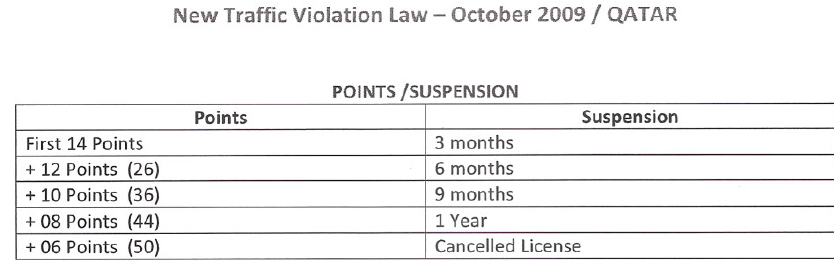

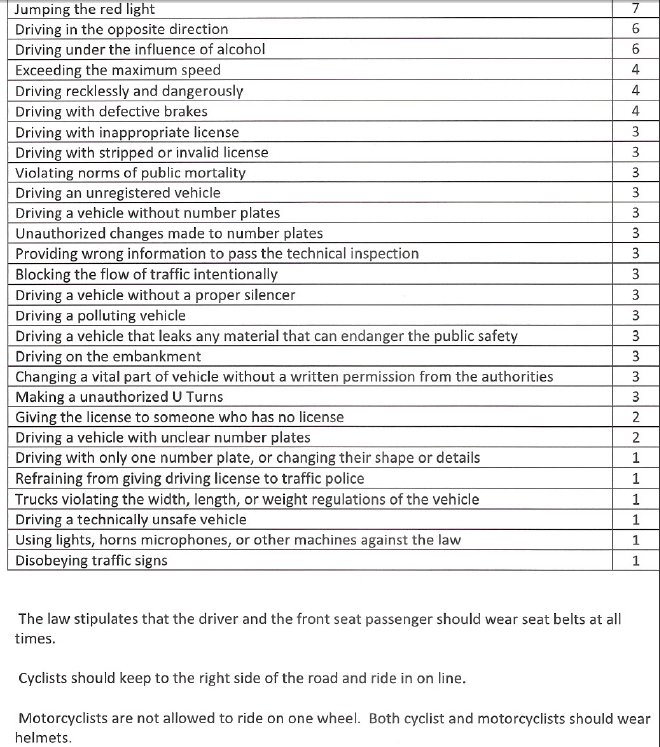
In theory, these went into effect in November 2009, just last month. Who issued these? Has there been any coverage in the newspapers? TV? How can people be held accountable for violating laws of which they are not aware? Or is this something one of the companies printed up, anticipating new laws?
Three Market Trends for 2010
From The Peninsula Business Section
Three market trends to watch for in ’10
Web posted at: 12/27/2009 11:51:49
Source ::: LAT-WP
Washington: In case you missed it, Treasury Secretary Timothy F Geithner this week promised America that there won’t be another financial crisis in 2010.
“We’re not going to have a second wave of financial crisis,” Geithner said in an interview with National Public Radio. “We’ll do what is necessary to prevent that. We cannot afford to let the country live again with a risk that we’re going to have another series of events like we had last year.”
Well, there it is. And you wonder why the stock market is at 14-month highs? Anyone who has deep-seated doubts about the financial system’s health may view Geithner’s explicit guarantee as a sign of dangerous government hubris, or simple naivete.
But his promise does address what is for some investors the pre-eminent question about 2010: Can the world avoid another calamity on the scale of what fueled the markets’ meltdown from September 2008 to March 2009?
To put it another way: Your financial planning for the new year would be a lot easier if you knew that the chance of another collapse was remote even if markets were likely to be volatile.
The strongest evidence against a second collapse is that the credit crisis has eased dramatically. That may not be evident in banks’ lending. But by many key barometers, including new issuance of corporate bonds and the rates banks charge each other for short-term loans, credit has begun to flow again worldwide.
If we assume that Geithner is right about the absence of another mega-crisis in 2010, I think there are three important financial trends that either got under way or accelerated in 2009 that also will be critical for investors and savers in the new year:
The Great Deleveraging rolls on. Many Americans piled on excessive debts in the 1980s, 1990s and first half of this decade. On that much, everyone agrees. Now, that total household debt load of $14 trillion is being worked down — voluntarily, as people pay off credit cards, for example, or involuntarily, as banks force foreclosures. Consumer credit excluding mortgages fell for a ninth straight month in October, a record stretch of declines, according to Federal Reserve data.
But debt reduction has a “long, long way to go,” says Ian Shepherdson, chief US economist at High Frequency Economics in Valhalla, New York. The question is whether it can proceed without tipping the economy back into recession.
One ticking time bomb: a jump in 2010 in the number of homeowners with so-called option ARM loans who will see their loan rates reset at higher levels.
An obvious implication of consumers’ need to reduce debt is that people will save more and consume less than before. That will be a continuing drag on the economic recovery. I know we’ve all heard that a million times, but that doesn’t make it less true.
The upshot: no imminent rate relief for savers who now are lucky to earn 1 percent or 2 percent on their cash.
Corporate earnings keep improving. Expectations of a profit recovery helped stoke the stock market’s turnaround in March. Wall Street has been pleasantly surprised since then.
Starting with the current quarter, earnings are forecast to begin rising, albeit from extremely depressed year-earlier levels.
Sales have edged up for many companies this year as the global economy has begun to rebound. But a big part of the profit-recovery story has stemmed from companies’ slashing of their payrolls, driving the US unemployment rate above 10 percent for the first time since 1982.
Many investors keep looking for a middle ground on risk-taking. That means cash probably will keep pouring into bonds — at least until some people discover, to their surprise, that it’s possible to lose money in fixed-income securities, too.
Small investors usually are prone to chasing hot stock markets. Not this year. Even as the US stock market has continued to rally Americans have shunned domestic stock mutual funds. Each week since late August more cash has been pulled from them than has flowed in via new purchases, according to the Investment Company Institute’s data.

Mixed Forecast
Interesting article from today’s Peninsula Business Section on rising mortgage trends in the United States. The views are so mixed; is the economy recovering? Are there going to be buyers for all those houses on the market? Will they find a way to forestall the next round of foreclosures as ARMs come due and new rates kick in?
US mortgages on upward trend
Web posted at: 12/27/2009 11:52:57
Source ::: LAT-WP
WASHINGTON: After hitting an all-time low in early December, the average rate on a 30-year, fixed-rate mortgage rose to 5.05 percent this week and could climb to 6 percent by the end of 2010, if not sooner, according to giant mortgage financier Freddie Mac.
The results are noteworthy because rates have not topped 5 percent since the last week of October, when they reached 5.03 percent, based on the results of this closely watched survey, which polls lenders during the first three days of every week.
Many firms regularly track interest rates and come up with slightly different numbers because they survey different lenders at different times of the day or week. But several have reported the upward trend in recent weeks. They attribute it in part to the effects of the holiday season, when demand for buying and refinancing homes dies down and financial markets coast through the end of the year.
“However, this is also a glimpse of what we’re going to see in 2010,” said Greg McBride, a senior financial analyst at Bankrate.com, a personal finance Web site.
The key catalyst for interest rates going forward will be the end of a Federal Reserve program that buys a sizable chunk of mortgage-backed securities issued by firms such as Fannie Mae and Freddie Mac. That program succeeded in immediately pushing mortgage rates well below the 6 percent mark when it was announced last year.
But the Fed has committed to winding down the program by March. The central bank is betting that by gradually tapering its purchases, private buyers of mortgage-backed securities, who have largely been absent from the market, will return and rates won’t rise much.
But Amy Crews Cutts, deputy chief economist at Freddie Mac, said interest rates are bound to rise to six percent by the end of 2010 because private buyers will demand a higher rate of return on the securities than the Fed did. Lenders may have to raise the rates they charge to consumers in order to make that happen.
“Extraordinary resources have been put into keeping the rates down and supporting the mortgage markets and it’s hard to imagine that the rates can go much lower than they are,” Crews Cutts said. “Anything we get at or below five percent is a gift at this point.”
This week’s Freddie Mac survey found that the 5.05 percent average on 30-year fixed-rate loans (with an average 0.7 point) was up from 4.94 percent the previous week but down from 5.14 percent at the same time last year. The all-time weekly low since the firm started tracking the numbers in 1971 was in the first week of December, when rates fell to 4.71 percent.
Many borrowers have not been able to secure the best rates because they lack the stellar credit scores and hefty down payments that many lenders now demand. Some who have tried to refinance have not been able to qualify because their home prices have plummeted to the point where they now owe more on their mortgages than their homes are worth.
But anyone who can secure a loan should not wait much longer, especially if they are looking to refinance, McBride said. Homeowners are more sensitive to interest rates when they refinance than when they buy a home. “The difference between 5 percent and 5.5 percent could mean the difference between refinancing or not,” he said.
But the interest rate is less critical to people who want to buy a home, McBride said. In that case, price and affordability should trump interest rates.
From the Fireworks Crew

As a reply to one of the comments on an earlier post about the Qatar National Day Fireworks Program, the crew that planned, organized and executed the fireworks display commented:
21 crew, 8 x 40 foot shipping containers of equipment, 2 weeks setup, 3 days of bloody rain, 17 pontoons over 3.2km, 1 island with 25 firing positions, kilometers of cable, countless hours of programming, 18 minutes of show, 4 days to pack it all back up and then fly home…great show, but exhausting! Very glad you enjoyed it!
Imagine! Imagine the work that goes into those 18 minutes. . . .
And I bet they are off soon to do New Year’s in some other fabulous location. Imagine, what a life that must be!
A Child Is Born!
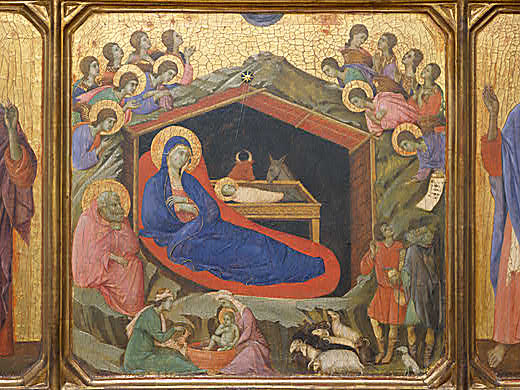
Duccio di Buoninsegna
detail: The Nativity with the Prophets Isaiah and Ezekiel, 1308/1311
Andrew W. Mellon Collection
May the Peace of God fill our hearts with love and compassion, and may it inspire us all to be better neighbors to one another.
Christmas Eve Hilarity
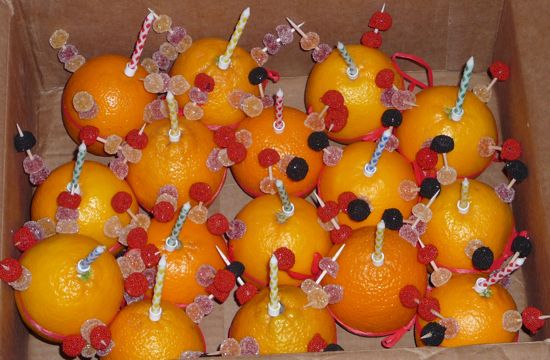
All of a sudden, life slows down and friends can gather, relax, share stories and share laughter. We were full of hilarity as we sat down to make Christingles, which, as it turns out, none of us have ever made before and none of us have a clue what they are supposed to look like.
Here is an explanation of a Christingle from NationMaster.com encyclopedia:
A Christingle is a symbolic object used in advent services in churches of many Christian denominations. It has its origins in the Moravian Church , with the first recorded use, in Germany, in 1747.
This is the story of the first Christingle:
One Christmas time back in 1747 at a town in Germany, Pastor John sat at home in front of his fire. He was thinking how he could explain the love of Jesus, and what Christmas really meant to the children in the church. He decided to prepare a simple symbol to help make the message of Christmas fresh and lively for them. Pastor John gave each child a lighted candle wrapped in a red ribbon, with a prayer that said “Lord Jesus, kindle a flame in these dear children’s hearts”. This was the first ever Christingle service.
Many years later, in 1968, Christingle services were introduced to the Anglican Church in Britain, and the custom spread quickly; each year there are more and more Christingle services in England and Wales, although today’s Christingles are a little different.
The Christingle consists of:
- an orange representing the world with
- a red ribbon around it representing the blood of Jesus
- fruits and sweets (usually dolly mixtures) are skewered on 4 cocktail sticks which are pushed into the orange representing the fruits of the earth and the four seasons
- and a lighted candle is pushed into the centre of the orange representing Christ, the light of the world
Here are some illustrations I found online:

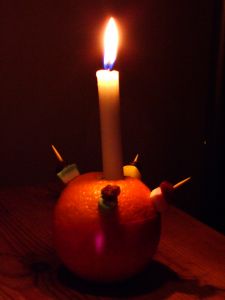
Here is where the hilarity begins – have you ever tried to tie a red ribbon around a sphere? Have you ever tried to determine the proper “Anglican angle” for the fruit filled cocktail picks? Worst of all, how can such a simple assignment end up looking more like Sputnik than an object to teach children lessons in holiness? We struggled to meet the challenge, and, in the end, had fulfilled our mission, but not one of us was confident that we had produced the real thing. Our results:
 After so much stress and hilarity, we needed to unwind, so off to the Ritz Carlton once again, where we discovered that the disappearing Christmas Tree is back in all its glory:
 You can opt for a plate from the Ritz Carlton Christmas food yummies buffet:
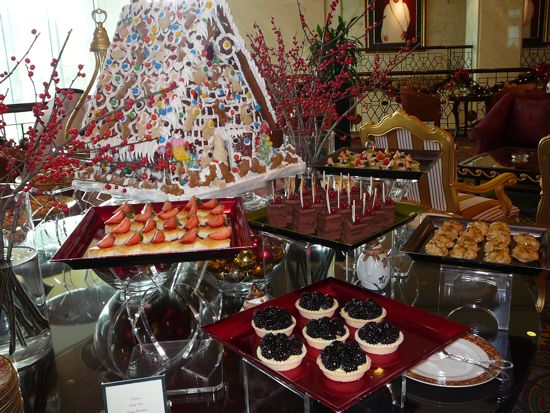 Or you can order the Ritz special Christmas Tea, which comes in towers (and you can actually order coffee with it if you prefer coffee to tea)

A lovely beginning to Christmas.
We wish you a Merry Christmas, and unexpected joy in the coming year.
Souk al Waqif: Men’s Souks
AdventureMan and I have a tradition, and that is we like to go shopping together before Christmas, helps him help Santa Clause with things to put in my Christmas stocking, and gives us precious time together in a relaxed setting.
So of course, we headed to our favorite place, the Souk al Waqif, where I discovered that the place I love the most to buy scarves – he always has things no one else has – was totally out of scarves! Well, he had six hanging up, but they were not special. I said “Where are the scarves??” and he laughed and said “Sold out!” and I said “Well that is good for you but not so good for me!” and we both laughed. He said he will be getting more early in January, but that is no help to Santa!
Then we wandered over into the older area of the souks, closest to Grand Hamad street. There is a new shop with beautiful misbah (worry beads) and unusual treasures. We wandered further, and came upon the falcon souk.
OK, I get it, the rest of you knew all about it, but I think because I usually go early in the morning, maybe this area isn’t open when I go – I have seen the seats outside, the majlis area, but I never saw the falcons before, not in the new souks. What fun! But aside from tourist women, there are no women in this area – the falcon souk, the camping souk, the hunting souk – these are very masculine domains, Guy Souks.
And they are equally lovely:


In this hallway, everything is giant. Hanging up above is a giant falcon glove, a giant falcon hood, and at the end of the hall, where the men with falcons are entering, are two gigantic falcon stands.
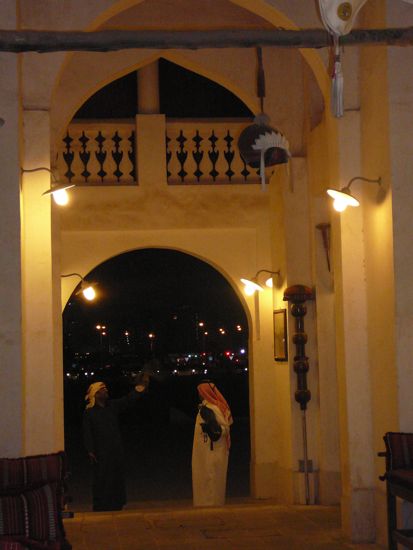
Look at this beautiful space! I think there are some offices around this space, as well as shops:

The camping and hunting souks have all kinds of tentings, bedrolls, washing up fixtures, etc, not so good for camping in the Pacific Northwest, but great for desert camping and hunting:

When the hardware souks and shoe repair souks were cleared out of the main street, I wondered where they had gone, and last night we found them. To my joy, I also found the scribes! I had been told they dispersed, went to various police stations to do their translations, fingerprints, etc. but last night I found them here! Right next to the police station! How have I missed them, all these evenings in the souks? I didn’t see them!
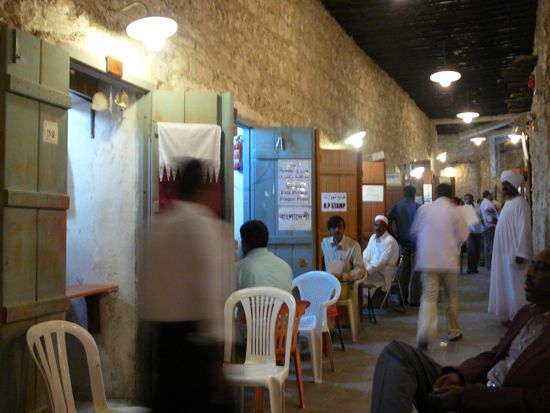
When first in Doha, where there is not one single modern hardware store, and before I had discovered my neighborhood hardware area, (remember, my secret vice is that I love hardware? and hardware stores?) I would go to the Souk al Waqif and start at one store saying “I need 3/4 inch masonry nails” and I would show them one. The man would leave his shop and take me to whichever of his buddies carried those nails. Or chains. Or bungee cords – they always had what I needed, or something close I could use. I’m glad to see the hardware shops are still there, along with the fishing and boating supply stores, and those huge pot and griddle stores.
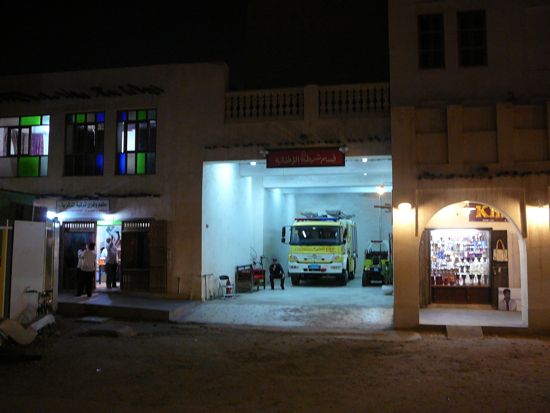
Did you know Souk al Waqif had it’s own fire truck? Neither did we!
Christmas in the Doha LuLu
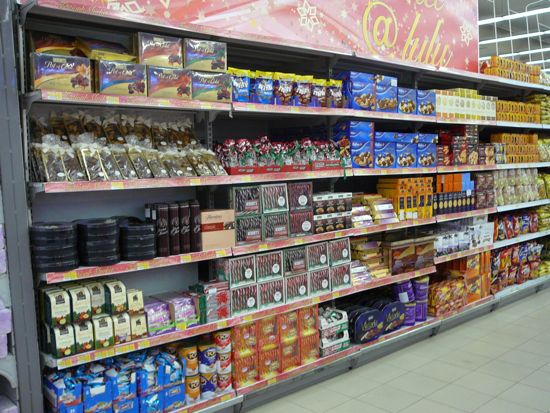
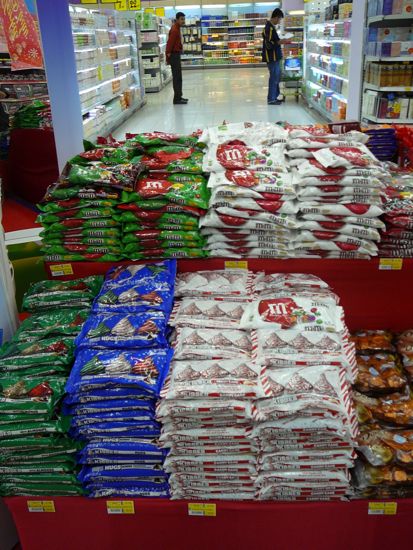
I think many of the shops were waiting to put out Christmas until after the revelry of National Day (Week). Suddenly, this week, things are showing up. There were a few things before, but now, it is the week for CHRISTMAS!
I was early to the LuLu to pick up a few things and ended up with a lot of things, including some wonderful fresh shrimp. The lines at the seafood vendor formed early, and I was glad I got there when I did – I wanted shrimp, bought a kilo, and while I was waiting for it to be cleaned, a couple bought almost all the rest of the shrimp, and also some crab, and I don’t know what else. I wondered if they owned a restaurant.
As I waited, I was able to watch how different people did business. The men setting out the fish do a beautiful job, and they do it with people yelling at them “Three kilos Shari!” “10 Kilos shrimp!” and they ignore everyone and go on with the setting up. They seem to be keeping track of who is waiting, and go for the person who has been there the longest, not the person who has been shouting most imperiously. I can see some people get really upset when their orders are not taken immediately, even though they have been yelling the loudest.
I can’t help but wonder what it is like to work in that environment every day? People all yelling at you and wanting to be first?
After I had taken these photos, a woman approached me and told me the manager had said no photos in the LuLu. Glad he waited until I had three to show you. 🙂

Shaking Things Up

First, you have to understand how quietly AdventureMan and I live. He works long hard hours. He gets home, we eat dinner. Most nights we watch some TV together, usually some season of a program we enjoy.
But after dinner last night, we decided to take a walk, instead. While our family in the states is braving out a variety of winter storms, the weather here has become – WONDERFUL! There is a hint of freshness in the morning and evening, and while days are warm, they are comfortable. We walked our compound, enjoying ourselves thoroughly, looking at all the Christmas decorations, and Eid decorations still up. It was a great walk.
Once we came home, we settled in – or so we thought. We were about 15 minutes into the newest season of Lost when our doorbell rang, and a group arrived to give us a very special caroling session. It was so much fun – and thank goodness, I had some cookies on hand to share with the people who came caroling! It was a delightful and moving evening.
We settled down once again, and once again the doorbell rang, neighbors coming to tell us some very good news, a miracle, really, something we had all prayed for, and that they were going home briefly, and would see us in a week or so. We had a wonderful visit with them, were able to send them off with joy.
We looked at each other and grinned. All this was so totally out of the ordinary for our usual week-day nights, but wonderfully out of the ordinary. We like it when things get shaken up a little bit. 🙂
Recent Comments
intlxpatr on Shampoo Ginger tigerbutterya0c5ff1d… on Shampoo Ginger intlxpatr on British Soldier Kidnapped, Esc… John on British Soldier Kidnapped, Esc… intlxpatr on British Soldier Kidnapped, Esc… Wikipedia Donate Button

Amazina


Early Voting in Florida


 Here There and Everywhere