Saturday Night Live Does Tiger Woods
There are mixed reviews on this hilarious Saturday Night Live take-off of the Tiger Woods situation. Some people feel it is tasteless, and that if the batterer were a man, it would be seriously unfunny.
They are right. And who on earth expects Saturday Night Live to stay within the boundaries of good taste? Or any boundaries at all?
As for me – I find it tastelessly hilarious.
( I will try to keep posting ones that work until they get taken off)
Week of Celebrations For Qatar’s National Day
Wouldn’t you think these celebrations would want lots and lots of observers, helping celebrate? So . . . where and when is the camel dressage? (I really, REALLY want to see that!) Which day is the parade? When are the fireworks?
Announcements like this are tantalizing, and hard information often difficult to come by.
Gala planned for National Day
Web posted at: 12/7/2009 1:27:32
Source ::: The Peninsula
BY HUDA N V
DOHA: Qatar is set to celebrate National Day, which falls on December 18, on a grand scale this time. A series of exhilarating programmes have been lined up for the week-long celebrations starting six days ahead of the landmark date.
Beginning from December 12, various competitions, symposiums, parades and other events meant for family and children would mark the celebrations. The first day would witness two traditional Qatari sporting events — the Masseela Horse Race and Pure bred Arabian Camel Race.
Highlighting the country’s penchant for Arab horse racing and camel dressage, the National Day Masseela Horse Race will take place at the Darb-a-Saai Camp in Rawda Umm Rouman (Al Rayyan).
The horse race will be organised in the traditional Qatari way, whereby pairs of riders will challenge each other in a test of courage with the winning rider advancing to the next round.
The Masseela Horse Race, featuring both Arabian horses and Qatari riders dressed in the traditional attire of the ancestors is an apt way to introduce the young generation to the traditions of their ancestors.
Arabian camels from Qatar’s leading stables will compete in two contests — camel dressage and ‘Best Behaved Camel’. In the dressage, a camel has to complete a routine within a specific time and it is to be judged on the way it has been dressed up.
The ‘Best Behaved Camel’ competition will judge a camel on its ability to overcome obstacles and distractions such as water and food. Other events include a poetry competition for Qatari men and women focusing on their recitation skills. Various Qatari tribes will also showcase the traditional sword dance — Ardha — accompanied by music composition using traditional musical instruments. A symposium will also be held on the occasion.
Al Dawha satellite Channel, which was launched during the National Day in 2008, will be on air again this time with documentaries highlighting the progress, history and culture of the nation. On day, the Corniche will witness a huge military parade and a colourful rally. The 5km stretch of will be bejewelled in light. The grand finale of the week-long celebrations would be marked by a spectacular pyrotechnic.
Qatar University will also celebrate the occasion. Over 500 students have signed up for various activities to be held on December 16. A huge parade showcasing the history of Qatar, the visions of various rulers right from the first to Qatar Vision 2030, some of the greatest events in Qatar such as the Asian Games and the Qatar’s World Cup bid 2022 will also take place.
“Rain Lashes Doha!”
After lunch and a good visit, my friends were leaving. Sauntering to the car, the very few small raindrops didn’t even touch us, but we were exhilarated by the joy of these first drops, the first we had seen after long, dry months.

“Rain lashes Doha!” one of the quipped, parodying the local press, exaggerating the tiny things while leaving out major crimes. They danced toward their cars, yes, it’s a western compound and once in a while you might find one or two of us dancing in the street, we wild women of the West.
Desalinated Water, Hair Loss and Rashes
Hair fall, allergies: Blame them all on desalinated water
Web posted at: 12/5/2009 2:13:32
Source ::: The Peninsula
By MOBIN PANDIT
DOHA: Have you ever wondered why being in this part of the world for a while some people, including those who are quite young, complain of hair loss and problems of dry skin, allergies and rashes.
Experts attribute all these malaise to the hardness of water which is desalinated. Desalinated water is good for use and even potable but the only problem is that its PPM (particles per million) multiplies when it is channeled for distribution through the pipelines.
PPM refers to Total Dissolved Solids (TDS) present in water. The more the TDS the harder is the water. Seawater which is the hardest and saline, has 10,000 PPM, for instance, while the normal treated water has PPM between 40 and 50.
TDS refers to different types of minerals present in water such as calcium, magnesium, potassium, nitrate and sodium, to name a few. Experts say over-presence of these minerals in potable water is not desirable as it can lead to problems like kidney stones.
Their over-presence in the water used for other purposes can lead to other problems like skin allergies, rashes and hair fall, say experts.
While the normal treated water for drinking and other uses in countries outside of the GCC region has 40 to 50 PPM, which is described ideal for drinking and other uses, the PPM of desalinated water in this part of the world is usually between 100 and 150.
Questions are often raised about the PPM of some local bottled water brands and experts swear they are also not up to
the mark.
Affluent families here use imported potable water and half-a-litre of a bottle can cost up to a whopping QR25, if sources in the water industry are to be believed.
According to them, there is a general misconception that bottled water is better than tap water. “The tap water which we get in Doha is, in fact, better,” said a source, adding that their PPM is almost the same.
The tap water is clean and pure and its PPM is much lower when produced, but it increases when channeled into the pipelines for distribution.
“In fact, in the GCC the cleanest desalinated water we get is in Qatar,” said the source.
There is another misconception that the tap water here can be boiled and made potable. Water, say experts, is boiled to kill bacteria, germs and virus, and not to reduce PPM.
“There are hardly any microbiological impurities in the desalinated water in Qatar, so boiling tap water doesn’t help. The pipelines here are cleaner as compared to other countries and it is where water gets its impurities from,” said Sunil Goykar, from the water treatment division of Qatar Oilfield Supply Centre, in remarks to The Peninsula.
He claimed that devices are, however, available locally to treat the tap water here and reduce its PPM for drinking as well as for other uses.
Pink Glove Dance Reaches Millions :-)
Remember the Pink Glove Dance? Today, in AOL News, is a report that over three million people have clicked on the U-Tube Video promoting free mammograms for women who can’t afford them:
Pink Glove Dance Reaching Millions
AOL News
(Dec. 5) — A video showing hundreds of dancing hospital employees wearing pink gloves in support of breast cancer awareness has become an Internet sensation.
The video, put together over two days with the help of 200 employees at a Portland, Oregon hospital, has more than 3 million hits and thousands of comments on YouTube.
Martie Moore, nursing manager at Providence St. Vincent Medical Center, told CNN the hospital has received hundreds of calls, e-mails and notes about the video.
The idea for the video came from Medline Industries Inc., the company that makes the pink gloves. The company said it would donate a portion of its glove sales to fund mammograms for women who would struggle to pay for them, ABC News reported.
The employees dance to “Down” by singer Jay Sean. Moore said many of the employees had been personally affected by breast cancer.
The janitor who closes out the video with a solo performance had a mother who battled with breast cancer. Moore said he told her, “This is just a disease that just keeps touching lives.”
Cheaters Leave Digital Tracks
No, not another post about cheetahs – this is about cheaters.
Today in AOL: Sphere
(Dec. 3) — Tiger Woods has long since mastered the use of every club in his golf bag. Yet he, like many Americans, apparently is still learning the hazards of communicating too openly by modern methods such as text messaging.
Woods is certainly not alone. As communication technology continues to evolve, unfaithful partners are finding it easier to keep in touch with their illicit lovers — but it’s also a lot easier to get caught.
The golf champion has said only that “I have let my family down” through unspecified “transgressions.” But one of his alleged mistresses, Jaimee Grubbs, says she still has 300 text messages sent to her by Woods. In one, Grubbs tells RadarOnline.com, Woods says, “Send me something very naughty. … Go to the bathroom and take [a picture].”
Us Weekly magazine has also posted a voice mail Grubbs says is from Woods, warning that his wife has examined his cell phone and may have discovered the former cocktail waitress’ name via caller ID.
“Any electronic means of communication — a cell phone call, an e-mail or a text message — will leave some sort of trail behind,” said Ed Edmister, a private investigator and computer forensic expert at Integrity Security & Investigation Services, which has branches in California and Virginia. “Even if you toss your phone in an incinerator or dump your computer in a lake, there are still records kept by phone and Internet companies. Digital forensics has become a huge field.”
Of course, not every spouse needs to hire a private investigator, or send in a partner’s cell phone to one of the dozens of companies that specialize in recovering deleted text messages and call logs. Sometimes, the evidence is hiding in plain sight.
Take the case of Tony, a 38-year-old Jacksonville, Fla., man who did not want to use his real name for this article. After eight years of marriage, Tony began an affair with a younger woman. “We sent text messages to each other all the time,” Tony said. “I carried my cell phone with me wherever I went.”
After staying out late one night with his mistress, Tony slept in while his wife and two sons ate breakfast together in the kitchen. His cell phone, carelessly left in a coat pocket, chirped to indicate a text message had been received. “My 8-year-old son picked it up and read the message aloud,” Tony recalled. “It said, ‘Good morning, honey. Have a good day.'”
Tony’s wife snatched the phone from her son’s hand, headed into the bedroom and confronted her husband. Six months later, the couple divorced.
“Infidelity is so much easier today,” said Ruth Houston, author of “Is He Cheating on You? 829 Telltale Signs” and a widely cited infidelity expert. “In the past, a potential cheater would go to a bar or a nightclub — very risky stuff when you’re in a marriage. Now you can sit down in your home and click on a mouse and find willing partners.”
Thanks to unreliable self-reporting, trustworthy infidelity statistics are difficult to come by. But a recent study sponsored by the National Science Foundation, and reported in The New York Times, showed marked increases in infidelity among both men and women from 1991 to 2006.
“Infidelity is definitely on the rise because of technology,” Houston said.
Even in innocuous ways, the Internet can bring together aspiring adulterers. After all, the Web is quick to sort users into affinity groups. Two people who meet in a dedicated chat room already have some interest in common, and that can foster a rapid sense of intimacy.
“Women, especially, crave emotional intimacy,” Houston said. “E-mail or chatting can start off innocently, but if there are actual connections, relationships develop quickly.”
In any case, adulterers are slow to grasp that modern communication devices are not nearly as private and secure as many people believe. Just ask South Carolina Gov. Mark Sanford, whose e-mails to his mistress, Maria Belen Chapur, were first made public by The State, a Columbia, S.C., newspaper.
Kwame Kilpatrick, the former mayor of Detroit, suffered a similar turn in the electronic pillory. Some 6,000 text messages from his mistress’ pager were posted online by The Detroit Free Press and helped lead to his conviction on perjury charges.
Those politicians are certainly not the only ones to be caught with their virtual pants down. Digital technology, which has democratized almost everything it touches, is making adultery accessible to the masses.
St. Nicholas Eve
I’m putting out a little bit of Christmas, and came across these lovely, Palestinian embroidered towels. I’ve had them for around thirty years, and I still love them:

I’m also thinking – we in the west never hear about Palestinian Christians, of which there are / or used to be (?) many. I know there are groups in Jerusalem, working towards the use of Jerusalem as an inter-faith city, and I know they work closely with Palestinian Christians, but are the numbers of Palestinian Christians as large as they used to be?
Advent is a little like Ramadan, or it is supposed to be. The four weeks leading to Christmas are a time for thoughtful meditation, repentance of wrongful things we have done, and contemplating the birth of that special baby, the Gift of God, in Bethlehem. I love Advent; I love the whole peaceful focus and world-holding-its-breath-waiting-for-this-birth aspect.
A mosaic portrait of St. Nicholas:

Round 2, Why You Should Always Carry Your Camera in Doha
“HOLY COW!” I shouted at AdventureMan, as I am already digging for my camera. He hates it when I do that, he things maybe I have spotted some danger or something and it gets his adrenaline going. I couldn’t help it. I was shocked, and I said “There’s a CHEETAH in that car!”
We love cheetah. Anyone who has ever seen a cheetah in the wild knows the awesome measure of God’s creativity and wonder. The cheetah is a speed machine, a glorious hunter, born to run. The cheetah is a glorious creation.
AdventureMan didn’t believe me, not for two or three full seconds and then – he saw it, too:
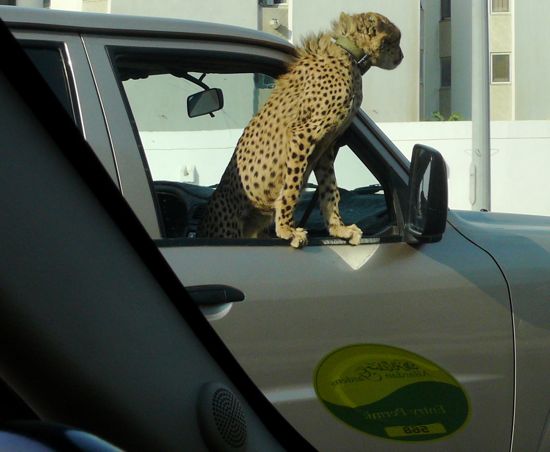

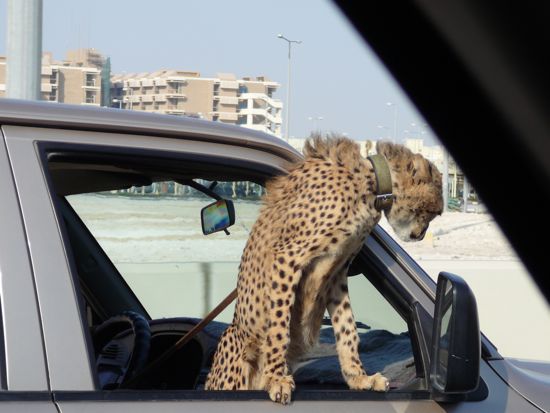
The man with the very young cheetah on a leash under very loose control was having a ball. The cheetah looked very happy to be out in the car with him, even on a leash.
It is a shame, and it should be a crime.
A cheetah, even when snatched away from his mother early in life, is not a toy, not an accessory. A cheetah can eat your innocent babies. A cheetah can bite you or scratch you badly, and think it is just playing. Taking a cheetah out of the wild is probably not a really good thing for the cheetah. How long with this man find him novel and fun and pay attention to him? And then what?
This is what a cheetah is meant to do, and this is how a cheetah is meant to live:
My friends, if you love wildlife, no matter how rich you are, leave the wildlife in the wild. Please.
Qatar Population on Monday is 1,580,050
This gave me a grin – as of a certain date, Qatar has a number, not an approximate number, a fairly fixed number – for its population.
You know what? I believe it. I have seen the way the computers here operate; they seem to have some inter-operability, and quick ways of accessing information back and forth between departments. I can believe they are tallying people leaving, people coming, people being born, people dying, as fast as the data can be entered.
I wouldn’t have believed it six years ago. I believe they have this capability now. They must have made a significant investment in this infrastructure, and it’s continuous upgrade.
From today’s Peninsula
Doha: The population of Qatar till Monday is 1,580,050, according to statistics released by Qatar Statistics Authority (QSA) yesterday. These data represent the number of individuals of all ages (Qataris and non-Qataris) within the state on Monday, excluding Qataris and residents who were outside the borders of the State at the time of the statement monitoring. The total number of males according to these data, is 1, 225,487 compared to 354,563 females.
These figures indicate a decline in population within the state with 86,803 people compared to last October, which recorded the highest rise in population during the year. It is noteworthy that QSA started presenting data on its website showing total population at the end of each month since October last year.
British Mom Continues Qatar Court Battle for Abducted Son
Ayb! Ayb! (Shame! Shame!) Tricking a young woman by having her sign papers purporting to be inheritance papers but signing over custody of her son to his grandmother. Now he sits, idle, bored, confused and lonely, in his grandmother’s house, yearning to be with his mother, friends and classmates, and leading a normal life. She sounds like a reasonable young woman; coming to visit the “sick” grandmother, agreeable that he should visit with his father’s family. Why did they need to high-handedly take it to this level? What were they thinking?
He wants to come with me, says mom in custody battle
from today’s Gulf Times
A British mother, who has been fighting a custody battle for her son with her late husband’s Qatari family, was on Monday briefly reunited with the boy for the second time, Bahrain’s Gulf Daily News yesterday said.
Rebecca Jones claims her son Adam has been “kidnapped” by the Qatari relatives. She saw him for the first time last Thursday, after the Cassation Court in Doha agreed to let her visit him.
“It was a bit better tonight, still very upsetting. I brought Adam some presents and he seemed happy with that,” Bahrain resident Jones told the GDN.
“He keeps telling me he wants to come home with me so it’s really terrible. It’s difficult to leave him, he was very tearful tonight when I left but I get to see him twice a week now. I will be back to see him in two days. I think that has made it easier for both of us.
“I told Adam I’d bring some movies next time and we can just pretend we are back in Bahrain, just the two of us.
“He spoke to his friends tonight. He hasn’t spoken to them since he left Bahrain. Some of them were upset. He also spoke to his grandmother and Barrie (stepfather) and Alex (younger sister),” Jones said.
“I’m desperate to see my son. I wouldn’t care if it was even for one hour at this stage. He said he’s very bored and has got nothing to do during the day, he just plays the Playstation from morning to night. He said he can’t sleep at all,” GDN quoted her as saying.
“He knows I love him and he knows I’m not going to leave him until we can go back to Bahrain together and get back to our lives.
“I’m going to keep going until I can go to a judge and get my son back. I’m waiting for the day when they have to let him go.”
Jones claims Adam was abducted on October 3 after she was “duped into travelling with him to visit his sick Qatari grandmother.”
Meanwhile, Bahrain Human Rights Watch Society secretary-general Faisal Fulad, who has been central to the campaign to bring Adam home, is in London to meet British
non-governmental organisations.
“I have been making contacts with Amnesty International, Save the Children and the children’s rights committee in British Parliament. I hope to meet them for discussions tomorrow,” he told the GDN.
“I am also trying to get a hold of people in BBC, Sky News and some big British newspapers because we need to generate more awareness, more media coverage and more support for Adam’s campaign.”
A Facebook group demanding Adam be reunited with his family in Bahrain, meanwhile, has attracted more than 7,000 members in almost four weeks.
Those who set up the group has organised a sponsored swim at St Christopher’s Senior School in Isa Town, and raised about BD1,000 for the campaign.
Divorced from Rebecca Jones for a number of years, Adam’s Qatari father, Jamal al-Madhaiki, died in 2005. Adam had remained in Bahrain with his mother, stepfather and younger sister until he and his mother travelled to Qatar.
Jones claims that in Qatar, her late ex-husband’s family requested her to sign some documents relating to what they said was Adam’s inheritance.
According to Jones, the papers in Arabic turned out to be custody documents in the name of Adam’s grandmother.
Since the alleged “abduction”, Jones has remained in Qatar to win back Adam’s custody, which was granted to his 77-year-old grandmother by a Qatari court almost three weeks ago.
Recent Comments
intlxpatr on Shampoo Ginger tigerbutterya0c5ff1d… on Shampoo Ginger intlxpatr on British Soldier Kidnapped, Esc… John on British Soldier Kidnapped, Esc… intlxpatr on British Soldier Kidnapped, Esc… Wikipedia Donate Button

Amazina


Early Voting in Florida


 Here There and Everywhere