Dr. Kessler and The Power of a Chocolate Chip Cookie
This is an excerpt from an article in The New York Times; Health and you can read the whole article by clicking on the blue type. Dr. Kessler has written a book about how food is engineered to be irresistible. Yes, we all need to develop a little self-discipline. And yes, the decks are stacked against us.
Did you know that almost the entire taste of a potato chip is on it’s surface, designed to give you an immediate impact of taste?
This article talks about Dr. Kessler’s new book, and it’s implications for our food choices:

(photo from Bon Appetit magazine chocolate chip cookie and strawberry gelato sandwiches)
As head of the Food and Drug Administration, Dr. David A. Kessler served two presidents and battled Congress and Big Tobacco. But the Harvard-educated pediatrician discovered he was helpless against the forces of a chocolate chip cookie.
In an experiment of one, Dr. Kessler tested his willpower by buying two gooey chocolate chip cookies that he didn’t plan to eat. At home, he found himself staring at the cookies, and even distracted by memories of the chocolate chunks and doughy peaks as he left the room. He left the house, and the cookies remained uneaten. Feeling triumphant, he stopped for coffee, saw cookies on the counter and gobbled one down.
“Why does that chocolate chip cookie have such power over me?” Dr. Kessler asked in an interview. “Is it the cookie, the representation of the cookie in my brain? I spent seven years trying to figure out the answer.”
The result of Dr. Kessler’s quest is a fascinating new book, “The End of Overeating: Taking Control of the Insatiable American Appetite” (Rodale).
During his time at the Food and Drug Administration, Dr. Kessler maintained a high profile, streamlining the agency, pushing for faster approval of drugs and overseeing the creation of the standardized nutrition label on food packaging. But Dr. Kessler is perhaps best known for his efforts to investigate and regulate the tobacco industry, and his accusation that cigarette makers intentionally manipulated nicotine content to make their products more addictive.
In “The End of Overeating,” Dr. Kessler finds some similarities in the food industry, which has combined and created foods in a way that taps into our brain circuitry and stimulates our desire for more.
When it comes to stimulating our brains, Dr. Kessler noted, individual ingredients aren’t particularly potent. But by combining fats, sugar and salt in innumerable ways, food makers have essentially tapped into the brain’s reward system, creating a feedback loop that stimulates our desire to eat and leaves us wanting more and more even when we’re full.
Dr. Kessler isn’t convinced that food makers fully understand the neuroscience of the forces they have unleashed, but food companies certainly understand human behavior, taste preferences and desire. In fact, he offers descriptions of how restaurants and food makers manipulate ingredients to reach the aptly named “bliss point.” Foods that contain too little or too much sugar, fat or salt are either bland or overwhelming. But food scientists work hard to reach the precise point at which we derive the greatest pleasure from fat, sugar and salt.
The result is that chain restaurants like Chili’s cook up “hyper-palatable food that requires little chewing and goes down easily,” he notes. And Dr. Kessler reports that the Snickers bar, for instance, is “extraordinarily well engineered.” As we chew it, the sugar dissolves, the fat melts and the caramel traps the peanuts so the entire combination of flavors is blissfully experienced in the mouth at the same time.
Foods rich in sugar and fat are relatively recent arrivals on the food landscape, Dr. Kessler noted. But today, foods are more than just a combination of ingredients. They are highly complex creations, loaded up with layer upon layer of stimulating tastes that result in a multisensory experience for the brain. Food companies “design food for irresistibility,” Dr. Kessler noted. “It’s been part of their business plans.”
Gross!
Our son asked how the baby pigeons are doing. They are doing fine. They are huge! Yesterday, I saw the largest one stretch his legs and take a couple steps!
I also know now how pigeons feed their babies. Pigeons are just gross, or at least these wild pigeons who have chosen my villa are gross. (I am sure that Bu Yousefs pedigreed pigeons are much more refined than these wild pigeons. 😉 ) They poop on my front porch. To feed their babies, they eat and then they come back and shake all over and make themselves throw up and the babies go wild and eat right out of their beaks.
I know, I know, it is all part of God’s perfect plan and nothing is gross . . . but it FEELS gross to me!


As we were entering the compound the other night, we saw one of the compound wild cats, young, skinny, and oh-so-proud, head high, carrying a pigeon almost as big as he/she was. You couldn’t help but laugh, even though the pigeon was sadly dead, but that cat was strutting! He/She knew he was going to have a great meal in just a minute, once he got that pigeon to a safe, secret place!
Kodak Retires Kodachrome
This is from AOL’s Wallet Pop / Financial News
Kodak retires ‘film that captured youth of Baby Boomers’
Sarah Gilbert
Jun 22nd 2009 at 3:30PM
As the Paul Simon song goes, “Mamma don’t take my Kodachrome away…” But Kodak is doing it anyway, retiring its iconic Kodachrome color film, effective immediately.
I shoot film. (Much to the shock and chagrin of friends and casual acquaintances and family members who see the receipts for processing.) And a few months ago, I was shopping for my favorite, Kodak Portra VC.
I went to photo lab after photo lab, finding only one roll of 100-speed film at a Wolf’s Camera that was going out of business; and nothing at my regular haunt, Citizen’s Photo. Are they retiring my film? I wondered, panicky.
Finally at a huge camera store I spied a totally empty film shelf, but for a five-pack of expired portrait film. Bingo! I rushed home to make sure it was still available at B&H Photo Video, the New York-based photo store of record. Thank the gods of photography, it was still being produced.
But for fans of Kodak’s famous first commercially-successful color film, introduced in 1935, the hunt will now begin in earnest. Kodak is retiring Kodachrome, saying it’s too complex and expensive to produce. Other films — such as my fave, Kodak Portra, and commercial heavyweights Kodak Max and Kodak Gold — now account for greater than 99% of Kodak’s still-picture films. Due to its complexity, only one commercial lab in the world, Dwayne’s Photo, in Parsons, Kan., still processes it.
The lab, which has committed to continue processing the film through 2010, has a sad message on its homepage, saying how sorry the lab’s owners are to see it go. “Kodachrome was truly an icon of the 20th century and has certainly been a very important part of Dwayne’s business for many years. Once it’s gone, nothing will ever capture “those nice bright colors” in quite the same way,” they write, referring to the Paul Simon song “Kodachrome.”
Kodak will stop producing the film, which was only made at one plant, immediately and expects retail stocks will last through the fall, unless fans stockpile. As for me: I’m headed to buy a roll or two, so I can capture a bit of my film heritage before it, too, is gone
Doha Museum of Islamic Art – Summer Visit
The Doha Museum of Islamic Art is open during the hottest part of the day. It must be that everyone else is travelling, or at home having lunch, taking a snooze or that they don’t know the museum is open – we had almost the entire museum to ourselves, and we felt like honored guests!
The museum is just beautiful, as beautiful as before. This time, without the crowds of people, I really had time to appreciate the interior, the beauty of the materials that went into this building, and the sound of water throughout, making you feel cool and refreshed.
And then, there is that never-ending view of the Doha skyline, seen through the windows overlooking the Gulf:

It just boggles my mind that we are encouraged to take photos, that photos are not forbidden. I love this photo; I am sorry it is not so sharp but if I had used a flash, I would have spoiled the moment. These two men had no idea I was taking their photo; I figure it is OK because you don’t know who they are, you can’t see their faces. I just loved these grizzled warriors examining an even earlier warrior.

I tried so hard not to breathe, still, there was some shake. Sometimes the shot you get is the shot you get.
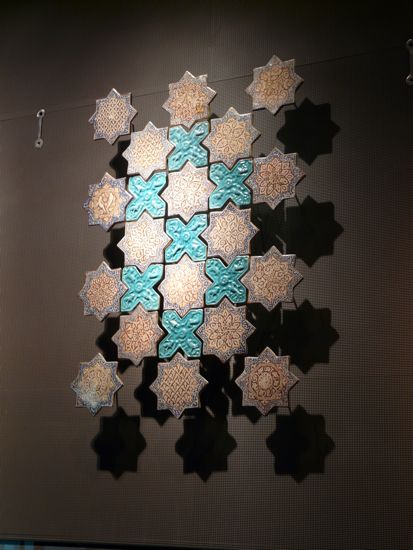
These tiles draw me back to the museum again and again; I love the intersection of cross and star:
I used it in placemats for my mother, and in a quilt for my youngest sister:
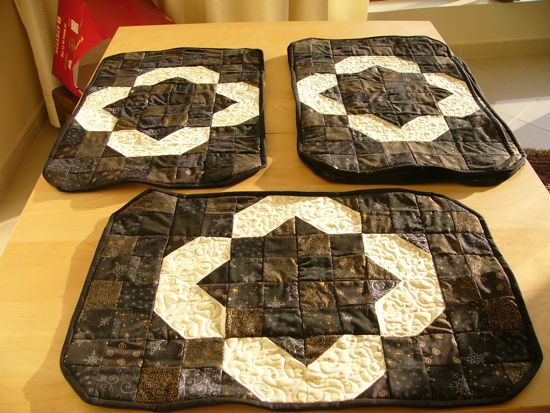

The pattern still draws me, and I have some other ideas of how to use it . . . 🙂
If you have ever thought of visiting this museum, oh WOW, the summer is the time to do it at your leisure. It is quiet, and cool and calm; you can stop and reflect on the beauty of the collected pieces, you are not rushed, there is no one around but you and the guards. Go now! It is the perfect time to visit.
It’s also free. It’s free, it’s open to the public for free, no charge, just come enjoy the beauty. What an amazing gift to the people of Qatar. And to the rest of us!
First Visitor to Doha; Souk al Waqif
We are very happy in Doha. This has to be one of the easiest moves we have ever made, even though I had to sell my car. 😦 We moved back into the same house on the same compound where we lived before. There is a whole learning curve I have already mastered – city layout, major roads, grocery stores, book stores, fabric stores, and major sights – been there! done that!
And yet, Doha has changed enough to still be stimulating and exciting.
Nonetheless, when I was contacted by a friend coming to Doha, with a little time to fill, I felt slightly daunted. We have had lots of visitors here; I tell them to come in November – February, March at the latest, except for Little Diamond, who has lived several places in the Middle East and knows exactly how hot it can be, and who copes with the differences.
I got to the hotel exactly as she and her husband were coming down – perfect timing. I had some suggestions, but what she wanted to do was what I love to do – see Souq Waqif and if we have time, see the new museum. Since they are only yards apart, I had a huge smile on my face.
The smile kept getting bigger – as we drove up to the Souq al Waqif, a truck left in the most perfect, shaded parking spot; THAT is God smiling, it has to be, parking places like that just don’t happen without help.
And, as it turn out, not only does she love the Souq Waqif, she also loves taking photos, so we had ourselves a wonderful time.
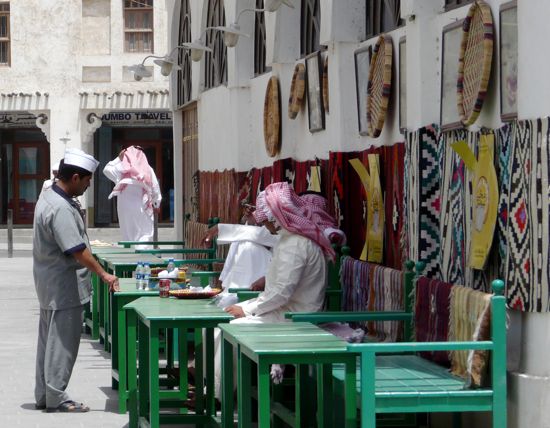
Not one single photograph with a person was taken without that person’s permission; not one single person said “no.” They were all “ahlen wa sahlen” (Welcome! Welcome!) It was a sweet morning, and although it was one of the hottest days of the year, it was dry, and the heat was bearable.
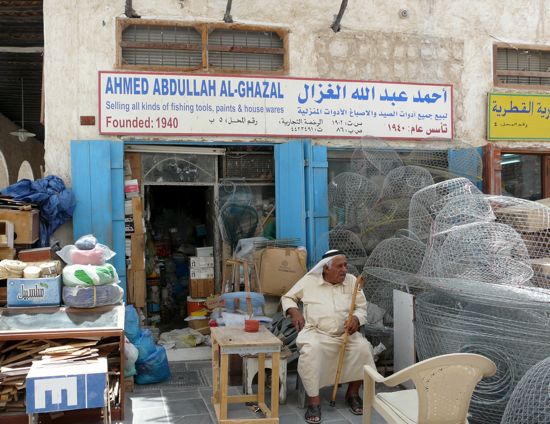
One of my favorite shops in the Souq al Waqif; he has all the things fishermen really need – from traps to twine:
The bird souk is active and beautiful:

It’s a real working souk, offering all kinds of household goods:
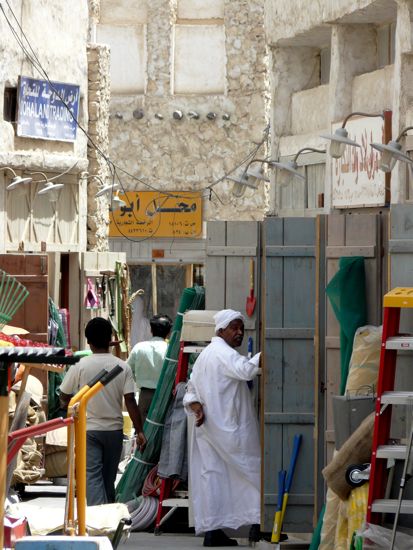
Look at the huge serving platters in the background – imagine them piled high with rice and mutton, or rice and chicken! Delicious!
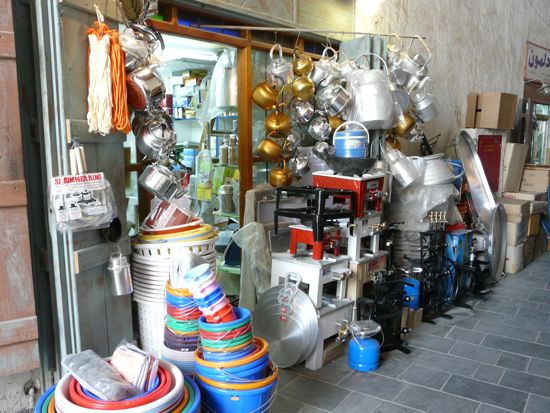
This is the first time I have ever seen this store – it has only been open one month. Everything in it is made in Doha:


This was one of the nicest stops on our tour. The eqal maker and his helper are so gentle and full of good information.

We had a great time, a wonderful lunch at the Ispahan:

No time for a nap! On! On!
Drink White Tea, Lose Weight
New article from Real Age suggests we drink white tea to blast the fat cells and keep the weight off:
Drink This to Fight Fat
Have a little fat you’d like to lose? Maybe now is a good time to turn on the kettle and pour yourself a cup of this: white tea.
Made from the buds and early leaves of the same plants used to make green and black teas, white tea may have special fat-thwarting powers, a new study suggests.
Fat-Blasting Brew
Fat cells increase or decrease in size, according to your weight. And in a lab study, human fat cells treated with white tea extract accumulated significantly less fat. In fact, the white tea extract reduced the incorporation of fat by as much as 70 percent! The tea also seemed to stimulate the breakdown of fat from mature cells.
Family Food Center, Doha, Qatar
Today I went back to one of my favorite old shopping places, the Family Food Center. I have to go early in the morning, as there is hardly anywhere to park. I only needed three things, but I always find cool things there that I forgot I needed.
It was really a quick trip, a reconnaissance, mostly to see what was there, but also because I want to make something special for AdventureMan and I haven’t found the key ingredient anywhere else. Almost all the stores have corn flour, but only Family Food Center has Corn Meal, which is the critical ingredient for corn bread, true comfort food if you are from the Southern part of the United States.

Not only did they have corn meal – but they have Bob’s Red Mill Corn Grits / Polenta, which I was bringing back by the suitcase full from Seattle – at not much less than the price they are charging here! 15QR comes to $4.13 and it seems to me I was paying between $2.99 and $3.59 in Seattle. Crank in the shipping factor, and the space factor, and the “paying for extra baggage” factor, and the mess factor – I am willing to pay 15QR to have it conveniently HERE when I need it to make cornbread for my husband, who will think I am amazing! Wooo HOOOO!
They are also the only store in town where I found my sweet friend that I can hardly do without to get my day started:

Vanilla Caramel, I think I’ve died and gone to heaven! 🙂
Because most days I have lunch by myself, AdventureMan eats at work, I found another old friend that I can’t eat when he is around because he can’t bear the smell. He has Southern roots, I have a lot of Swedish in my background, and oh how I love pickled herring.

I make a salad with it, and use the juice it comes in for salad dressing. It soothes the Swedish part of my heart. No, you don’t have to like it, you just have to tolerate that there are people in the world who like to eat pickled herring. You might be like AdventureMan, he finds it very difficult to believe:
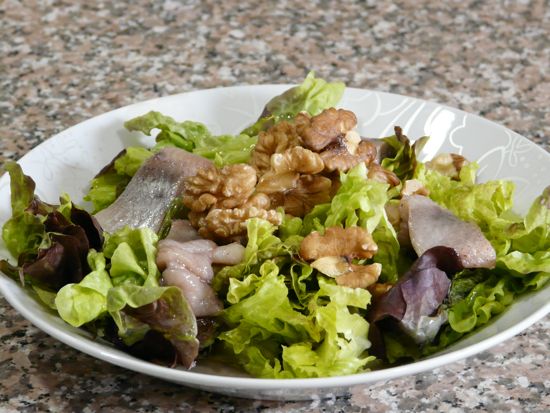
The sweetest part of the trip was just icing on the cake. I found everything I needed, the store was uncrowded when I got there, and as it started filling up, I was able to walk right up to the checkout and leave. I didn’t really need help with the bags, I only had three or four, but the bagger-guy was already out the door, so oh well, I guess God just wants me to be generous today. As he was putting the groceries in the car, he said “Madame, we have not seen you for a long time!”
I was shocked. It’s been three years since I was there. I said “I’ve been living in Kuwait, but now I am living again in Doha,” and he said “Welcome back, Madame, we have missed you!”
Men Hate Discussing Prostate Cancer
One possible reason women live longer than men is that woman pay attention, and when they think something might not be quite right, they take action – they do research on the internet, they talk with their friends, they go to the doctor and get checked out.
Poor men. The stronger sex is so shy! They are shy to discuss any problems with reproduction, with sexual activity. In effect – they would rather die than go to the doctor!
(So who, really, is the stronger sex? The one who avoids looking at the problem, or the one who faces up to it?)
It’s why we women have girlfriends. We can talk about ANYTHING. Yep, even you. It doesn’t mean we are betraying your secrets, most of the time we are trying to figure you out, or trying to help you. We talk about the things that scare us – like cancer, or being abandoned, or our latest blood tests.
Because you big strong hunks can’t admit there might be something going wrong, I am highlighting two articles – hot off the BBC press – on prostate cancer. (KTDP, please consider this an invitation to blog about this)
‘Surprise’ prostate result probed
Prostate cancer kills 10,000 men in the UK each year
Researchers are probing an unexpected success in a study of an experimental treatment for prostate cancer.
In three men with advanced disease, use of an immune drug called ipilimumab, shrank their tumours to such an extent surgeons were able to operate.
The Mayo Clinic team in the US said the “startling” results in the study of 108 men had prompted them to set up a second trial using higher doses.
One UK expert said there were currently few treatments for advanced disease.
In men with advanced prostate cancer, which has spread outside the prostate, surgery cannot usually be done.
Hormone therapy is usually given to try to shrink the tumour to some degree and buy some time.
The trial was set up to see if MDX-010, a type of drug called a monoclonal antibody, would improve on hormone treatment.
The idea is that the drug will encourage a strong immune response to attack the cancer cells.
Half the men had normal therapy and half also received MDX-010.
In three cases, where the experimental drug was given, the tumours shrank dramatically, enabling surgeons to operate and remove the tumour.
You can read the entire article by clicking here: BBC Health News Prostate Cancer
Green tea ‘slows prostate cancer’
Green tea has already been linked to health benefits
A chemical found in green tea appears to slow the progression of prostate cancer, a study has suggested.
Green tea has been linked to a positive effect on a wide range of conditions, including heart disease, cancer and Alzheimer’s disease.
The research, in the US journal Cancer Prevention Research, found a significant fall in certain markers which indicate cancer development.
A UK charity said the tea might help men manage low-risk tumours.
Although previous studies have shown benefits from drinking green tea – including some positive findings in relation to prostate cancer, there have been mixed results.
In this study, Philadelphia-based researchers tested a compound called Polyphenon E.
They were looking for a number of biomarkers – molecules – including vascular endothelial growth factor (VEGF) and hepatocyte growth factor (HGF) which are indicators of developing cancer.
They also looked for prostate specific antigen (PSA) – a protein only found in the prostate. Levels can rise if cancer is present.
’12 cups’
The study included 26 men, aged 41 to 72 years, who had been diagnosed with prostate cancer and who were scheduled for radical prostate surgery.
Patients took four capsules containing Polyphenon E for an average of 34 days, up until the day before surgery – the equivalent of around 12 cups of normally brewed concentrated green tea.
The study found a significant reduction in levels of HGF, VEGF and PSA, with some patients demonstrating reductions of more than 30%.
Dr James Cardelli, from the Feist-Weiller Cancer Center, who led the study, said the compound, which was provided by the company Polyphenon Pharma, “may have the potential to lower the incidence and slow the progression of prostate cancer.”
There were only a few reported side effects associated with this study, and liver function remained normal.
You can read the full article about the relationship between green tea and reduction of prostate cancer by clicking here: BBC Health News Green Tea
Blink Your Eye; Doha Changes
We know we are “old hands” in Doha, because now we say things like “this was taken from the spit where the Bandar restaurants used to be” and “you turn left at old Parachute roundabout.”
We drove around, noting the amazing expansion of the city and the changing character of the downtown. As I did in Kuwait, I am trying to photograph a lot of it before it goes away, but the urgency is greater in Doha, where change of enormous magnitude can happen almost overnight.

I watched these guys for a long time; I had a safe parking spot and the view was great. I don’t think there is any such thing as a grown man when it comes to heavy machinery. Guys that operate bulldozers and steamshovels always make it look like WAAAYYYY too much fun, don’t they? I wonder if they can hear their Mamas in their heads saying things like all Mamas say: “Don’t you go up on that building in that heavy tractor, that’s DANGEROUS! !”
Look – no underpinnings in the floors beneath, nothing to stop a collapse, and these guys are making dust swirl and sparks fly with their big-boy toys. They ARE wearing helmets.
This is old Dhow roundabout. (You can see the dhow in the center of the roundabout over there on the left, see it?) Everything is changing in this area, but Dhow roundabout hasn’t changed – yet. The traffic pattern has changed a little; you can no longer turn off Dhow roundabout to enter the souk area. It is all for the best. Traffic runs more smoothly now, and when you do get to the souk parking, there is more of it. 🙂

This is old Al Ashmakh; this is what most of Doha used to look like back when it was “sleepy little Doha” – not so long ago, like seven years ago.
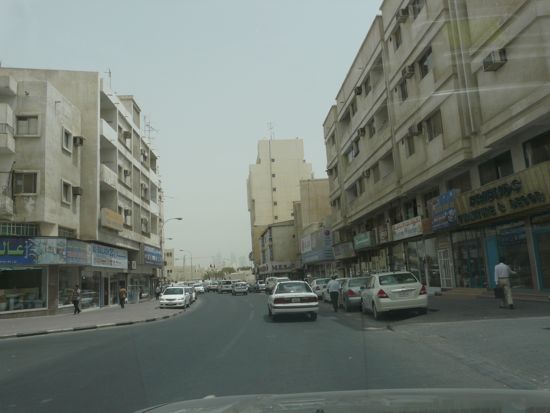
I know you are thinking “why is she taking photos of things like that?” because it still looks like this in parts of Kuwait, too, like Maidan Hawally and Hawali, and some of the back streets in Subaihiya, but these parts of Doha are disappearing, with all the little tiny stores and their colorful signs and merchandising.
I was in Al Ashmak because I want to have some new kneelers made for our church, and the priest thought the idea of having them done in the sadu-like upholstery fabric was a good one. It would add a more local flavor, and, insh’allah, hold up a little better than the current cotton, which is wearing a little thin.
I went to a shop and waited patiently while two Sudanese women bought beds and mattresses, and when the clerk came to wait on me, some very important gentleman rushed in, interrupted us, and took the clerk away to wait on him. I waited about five minutes – about 4 minutes and 30 seconds too long – before I walked out. I should have known better. I will find a place in my own neighborhood.
When I saw this truck, I shuddered. My household goods should be coming any day. This is how I am afraid they will show up, and maybe a box or two fell off on the way 😦

When I moved to Kuwait, three boxes got lost, the first time that has ever happened to me. Here is what is amazing to me – two of the boxes were full of book. Not just books, but books on quilting. I keep thinking “who on earth would want these books???” The problem is, quilting books are expensive, and some of the ones I had were old, not just out of print, but limited edition books, so they are priceless – and irreplaceable. I used them for teaching, and I shared them generously. It broke my heart to lose them. I almost don’t want my goods to show up; I am almost too afraid, wondering what might go missing this time?
Doha Friday Sandstorm
As we were eating, there was a sudden change in the weather. On our way back to the car, we could see a sandstorm blowing in. It didn’t look too bad, and we wanted to drive around before the traffic got too bad later in the day, so we did.

Recent Comments
intlxpatr on Shampoo Ginger tigerbutterya0c5ff1d… on Shampoo Ginger intlxpatr on British Soldier Kidnapped, Esc… John on British Soldier Kidnapped, Esc… intlxpatr on British Soldier Kidnapped, Esc… Wikipedia Donate Button

Amazina


Early Voting in Florida


