Prayer Reshapes Your Brain
This is a very small excerpt from a much longer article I found on National Public Radio News, a special series on The Science of Spirituality. This article (you can read it all by clicking on the blue type, above) talks about measuring brain activity while a person is praying, how the brain changes. Fascinating stuff.
A Sense Of Oneness With The Universe
Newberg did that with Michael Baime. Baime is a doctor at the University of Pennsylvania and a Tibetan Buddhist who has meditated at least an hour a day for the past 40 years. During a peak meditative experience, Baime says, he feels oneness with the universe, and time slips away.
“It’s as if the present moment expands to fill all of eternity,” he explains, “that there has never been anything but this eternal now.”
When Baime meditated in Newberg’s brain scanner, his brain mirrored those feelings. As expected, his frontal lobes lit up on the screen: Meditation is sheer concentration, after all. But what fascinated Newberg was that Baime’s parietal lobes went dark.
“This is an area that normally takes our sensory information, tries to create for us a sense of ourselves and orient that self in the world,” he explains. “When people lose their sense of self, feel a sense of oneness, a blurring of the boundary between self and other, we have found decreases in activity in that area.”
Newberg found that result not only with Baime, but also with other monks he scanned. It was the same when he imaged the brains of Franciscan nuns praying and Sikhs chanting. They all felt the same oneness with the universe. When it comes to the brain, Newberg says, spiritual experience is spiritual experience.
“There is no Christian, there is no Jewish, there is no Muslim, it’s just all one,” Newberg says.
The Richest Man in Town
This is from AOL’s WalletPop, their how to manage money series.
As I read through this very American tale of building wealth, I wonder . . . how does this apply cross-culturally? Do you think the richest men in the Gulf follow these guidelines? The richest in the EU? The richest Asians? Indians?
Review: The Richest Man In Town by W. Randall Jones
Tom Barlow
May 20th 2009 at 7:30PM
Filed under: Wealth
Some people dream of getting rich. Instead of dreaming, W. Randall Jones, author of The Richest Man In Town, set out to talk to the richest person in each of the 100 U.S. towns he visited for his study to see what commonalities he could find. From these interviews he found 12 attributes that ran rich within these mostly self-made magnates. Apparently, while God could get by with 10 commandments, the rich need a dozen; thus the subtitle, The Twelve Commandments of Wealth.
Let’s get those 12 on the table first (I paraphrase)-
Don’t seek money for money’s sake
Find your perfect niche
Be your own boss
Get addicted to ambition
Be early
Execute or get executed
Fail so you can succeed
Location doesn’t matter
Don’t compromise your morals
Embrace selling
Learn from the best and the worst
Never retire
I have the last one nailed.
Book after book about wealth and entrepenuership seem to boil down to these same points, usually derived from the same inductive reasoning that seems to underlie this book; watch what rich people do, then figure out the principles behind their success. What is missing, imho is the study of failed businesspeople. I often wonder if, for every multimillionaire that followed these commandments, there might not be a hundred who followed them yet failed. Everyone talks to the winners, but until you study the losers, it’s hard to know which commandments are the important ones.
Although the “secrets of the millionaires” genre is well mined, Jones does a particularly deft job of weaving the stories of a hundred people within the commandments structure. His many years of experience as a writer and founder of Wealth magazine are evident in the book’s engaging storytelling and brisk pacing. Many writers of similar books have taken the easier person-by-person approach,
which gives the reader more of the personality of the people interviewed but obscures the insights that the readers seek. Kudos to Jones for taking the hard road.
He also manages to land some very colorful subjects to interview, such as Hartley Peavey of Meridian, Miss. who told him “I believe that life is a test to see how much BS you can take.” Ron Rice of Daytona Beach was fired from six teaching jobs in eight years. Phil Ruffin of Wichita wants his tombstone to read, “This is his last real estate deal.”
For readers who are curious about how the richest man (Jones is apologetic about the use of the word man, but sadly, the richest person in most towns is one) in town came by his fortune, this book may well be best in class. And these commandments leave you free to covet all you want.
WordPress Special – Post by E-mail
New function out today by WordPress: Post by e-mail where you create a secret address, and can send a message to that secret address WITHOUT OPENING A SPECIAL SERVER – like from your office, you can send a post from your office computer, even when WordPress is blocked. It gets published, just like that.
Pretty imaginative new function!
Investment in Africa
This was in the morning’s e-mail. Unlike the e-mails I post inviting me to get lots and lots of free money, this one seems to have some interesting information. Here is one excerpt from their opening page, The Conversation Behind Closed Doors:
To make itself more attractive for US investment, Africa should:
Invest in education , health and infrastructure
Ensure the rule of law and a business-friendly climate for all investing companies
Show it is serious about attracting foreign investment
Market itself as aggressively as other regions of the world
Demonstrate opportunity cost of not investing
I would have to say there is nothing I disagree with there. I have not explored the whole site, but it looks legitimate, and interesting, if you, like me, are interested in Africa, and future solutions.
Hi
I’m reaching out to you because I thought you and the readers of here there and Everywhere would be fascinated by what my firm has recently uncovered about the attitudes toward corporate investment in Africa among leading U.S. corporations — according to senior officers of 30 American Fortune 100 corporations we interviewed. Why has Africa not attracted more interest from the U.S. business community? We have collected all of the answers and case studies into a news release introducing a study that launched yesterday commissioned by the US Chamber of Commerce:
http://www.usafricainvestment.com
We’re very excited about the revelations in this paper and would love it if you could let your readers know about what we’ve uncovered through a post or a tweet. If you are able to post please let me know so that I can share it with the team. If you have any questions or would like to speak to the partners who wrote this paper, let me know and I will set it up.
Thank you so much,
Fabiane
—
Fabiane Dal-Ri
fabiane@usafricainvestment.com
What Would You Take?
As I say farewell to all my current earthly possessions (I say current, because an entire other life has been in storage for the last 11 years, with all my European collection, early Tunis, early Amman, early Damascus – looking forward to retiring is kind of like heaven, I will be re-united with old friends, some of whom I’ve even forgotten. 🙂 ) which will be packed for the move to Doha, AdventureMan and I have a few things which we always take with us.
Of course, our first concern is the Qatteri Cat. He walks around crying as his environment changes daily, pieces disappear, rooms are re-arranged. He will go on the plane with us.
AdventureMan has a quilt, which takes almost one entire suitcase all by itself. His clothes, of course, his computers, and his camera equipment. He has already taken a suitcase full of my hobby gear down to Qatar, and it is waiting for me in his new office.
I will have my computer and Airport, my favorite clothes, my favorite shoes, my favorite jewelry, my small cameras – and my earring tree.
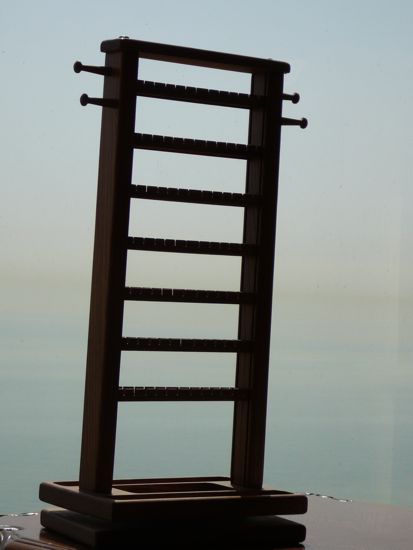
I think being mildly obsessive/compulsive doesn’t hurt me. I like order. Moving to a new place, being able to unpack my earring tree and place my earrings in careful order (stones together, gold together, pearls together, dangles together, etc.) gives me a small illusion of control over my environment.
I found this earring tree at the annual Street Fair at the University of Washington about 15 years ago – there were many larger, more glorious ones, and this one was on the sales table. It is made of oak, swivels on its base, is very finely made and has served me well all these years. It doesn’t even take up that much room in the suitcase, it is so flat.
If you knew that life, being what it is, is all about the unexpected, and if you knew you might never see most of your worldly goods again, what would you take with you? (Photos welcome :-), send to Intlxpatr@aol.com.)
What did Ezekiel See?
How would our flea-bitten, superstitious ancestors in Europe of the 1100’s describe a car, if it were to appear in their midst? How would they describe a gas stovetop? How would they describe a toilet? How would they describe a mobile phone, or a camera? Would they immediately understand its use, and how it works?
Many times we don’t understand what we see, not at first, sometimes not at all. When I read of Ezekiel’s vision, I wonder what he saw? I wonder if this is his interpretation of something else, something actually very different, but he used the words he had? It’s a mystery to me.
Ezekiel 1:1-14,24-28
1In the thirtieth year, in the fourth month, on the fifth day of the month, as I was among the exiles by the river Chebar, the heavens were opened, and I saw visions of God. 2On the fifth day of the month (it was the fifth year of the exile of King Jehoiachin), 3the word of the Lord came to the priest Ezekiel son of Buzi, in the land of the Chaldeans by the river Chebar; and the hand of the Lord was on him there.
4 As I looked, a stormy wind came out of the north: a great cloud with brightness around it and fire flashing forth continually, and in the middle of the fire, something like gleaming amber. 5In the middle of it was something like four living creatures. This was their appearance: they were of human form. 6Each had four faces, and each of them had four wings. 7Their legs were straight, and the soles of their feet were like the sole of a calf’s foot; and they sparkled like burnished bronze. 8Under their wings on their four sides they had human hands. And the four had their faces and their wings thus: 9their wings touched one another; each of them moved straight ahead, without turning as they moved. 10As for the appearance of their faces: the four had the face of a human being, the face of a lion on the right side, the face of an ox on the left side, and the face of an eagle; 11such were their faces. Their wings were spread out above; each creature had two wings, each of which touched the wing of another, while two covered their bodies. 12Each moved straight ahead; wherever the spirit would go, they went, without turning as they went. 13In the middle of* the living creatures there was something that looked like burning coals of fire, like torches moving to and fro among the living creatures; the fire was bright, and lightning issued from the fire. 14The living creatures darted to and fro, like a flash of lightning. 24When they moved, I heard the sound of their wings like the sound of mighty waters, like the thunder of the Almighty,* a sound of tumult like the sound of an army; when they stopped, they let down their wings. 25And there came a voice from above the dome over their heads; when they stopped, they let down their wings.
26 And above the dome over their heads there was something like a throne, in appearance like sapphire;* and seated above the likeness of a throne was something that seemed like a human form. 27Upwards from what appeared like the loins I saw something like gleaming amber, something that looked like fire enclosed all round; and downwards from what looked like the loins I saw something that looked like fire, and there was a splendour all round. 28Like the bow in a cloud on a rainy day, such was the appearance of the splendour all round. This was the appearance of the likeness of the glory of the Lord.
When I saw it, I fell on my face, and I heard the voice of someone speaking.
From Frequent Flyer Re US travel
This is from Frequent Flier, a newsletter for travellers that I get in the e-mail. I did not know this – and it could save hours of time and energy if you get caught up in it. Your name on your ticket must exactly match your travel ID:
New Travel I.D. Policy
“With the upcoming changes to name requirements starting May 15th, I’m surprised you didn’t include anything about it in the newsletter sent out on the 13th. As I’m sure you are aware, beginning May 13th, all air travelers must have a photo I.D. that exactly matches the name on their airline ticket. For example, if the name on your I.D. reads ‘Robert Edward Smith,’ the name on your ticket ‘cannot’ read ‘Robert Smith.’
“However, if the name on your driver’s license reads ‘Robert E. Smith,’ you will not be required to obtain a new license that shows your complete middle name. You would need to ensure your flight reservation is made using the exact name that appears on the driver’s license: ‘Robert E. Smith.’ I just thought this would be valuable information for everyone that reads your newsletter.” [Mathew E.]
[FrequentFlier.com replies – While the new TSA policy is certainly noteworthy, it’s a bit off-topic for this publication. But since you’ve raised the subject, the least we can do is provide a link to the official TSA announcement, and include a particularly relevant excerpt: “In the near future, small differences between the passenger’s ID and the passenger’s reservation information, such as the use of a middle initial instead of a full middle name or no middle name/initial at all, will not be an issue for passengers. Over time, passengers should strive to obtain consistency between the name on their government issued ID and the travel information they use for booking flights.”]
Map of HIV Spread in Europe by Vacationers
Fascinating news from BBC Health News:
Scientists who have mapped HIV’s spread across Europe say holidaymakers infected abroad are largely to blame.
By analysing samples from 17 European countries, the international team tracked the movement of the virus around the continent.
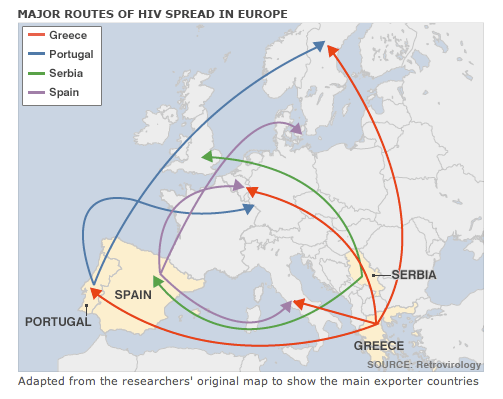
Their map shows Greece, Portugal, Serbia and Spain are big HIV exporters, with many tourists to and migrants from these countries leaving with the virus.
The UK is an exporter and importer, Retrovirology journal says.
The same is true of Israel, Norway, the Netherlands, Sweden and Switzerland, while countries like Austria, Belgium, Denmark, Germany and Luxembourg are largely importers of HIV, the researchers say.
In Poland, HIV is contained but is spread among its inhabitants because of injecting drug-users, the research group found.
To construct their map, the researchers looked at the most common type of HIV circulating in Europe, known as HIV-1 subtype B.
They tracked its migration by creating a family tree for the virus, looking at detailed genetic characteristics that reveal how the virus has been evolving over time.
DIRECTION OF HIV SPREAD
Exporters: Greece, Portugal, Serbia and Spain
Both exporters and importers: Israel, Norway, the Netherlands, Sweden, Switzerland and the UK
Importers: Austria, Belgium, Denmark, Germany and Luxembourg
Lead author Dimitrios Paraskevis, of the University of Athens, said: “Popular tourist destinations like Greece, Portugal and Spain probably spread HIV with tourists infected during their holidays.”
In the case of Serbia as an exporter, it is most likely down to its inhabitants travelling to other countries and carrying the virus with them, he said.
“To a large extent HIV spread within Poland is due to injecting drug-users, who make up around half of the HIV-infected population.
“Viruses move around with travellers – thus health programmes within countries should not only target the national populations, prevention efforts must also be aimed at migrants, travellers and tourists – who are both major sources and targets of HIV.”
Rowan Harvey, of the Terrence Higgins Trust, said: “HIV isn’t constrained by borders, it’s a global epidemic and there are bound to be patterns of transmission between countries.
“Tourists travelling abroad should definitely pack condoms, but people should also be aware that HIV is at its highest level in the UK as well.
“To protect yourself from HIV and other sexually transmitted infections, safer sex is essential both at home and abroad.”
Weather: Kuwait and Qatar
You’d think, these two countries being in the same time zone and just up the road from one another, you’d think that the temperatures would be almost identical.
You’d think wrong.
Kuwait gets both hotter – and colder – that Qatar. When Kuwait gets blazing hot in the summer, the temperatures may be as much as 10° cooler in Qatar. You’d think that would be a sizeable difference, but you’d think wrong. Kuwait’s climate is so dry, the humidity so rare, that it FEELS hotter in Doha.
In Doha, it feels like the sea evaporates and leaves a coat of salt on your face. I always had to carry wipes and face cream with me in the summer. Even in the earliest hours of the day, the humidity drips off you. You change clothes frequently, to stay fresh. And yes, all this takes air-conditioning into account. If you have never lived in the Gulf, you cannot begin to imagine 1) how hot it gets and 2) what the heat and humidity together can be like.
The temperatures swing past one another in April/May, October/November. The swing has occurred a little later this year, but it definitely has occurred:
Kuwait Forecast

Qatar forecast

Beaten Because of High Asparagus Prices
BitJockey, I love your eye for the eccentric. This is an article from
Woman beaten up over asparagus prices Reuters News Service
BERLIN (Reuters) – German police are searching for a motorist who beat a 24-year-old woman selling white asparagus because he was upset about her asking price for the coveted springtime vegetable, police said on Monday.
The prices for white asparagus, sometimes called “edible ivory” in Germany, fluctuate wildly during the short springtime season, peaking early in the season at 10 euros per kilo.
The man screamed at the woman that her asparagus was overpriced. He then punched her in the face and threatened to unleash his attack dog at her. She fled and called police.
“The motorist said her prices were totally over the top,” said Dietmar Keck, police spokesman in the Havelland district west of Berlin, without saying how much she was asking.
Prices for asparagus now range from 1 to 5 euros per kilo, he said. Some 55,000 tons valued at 175 million euros are harvested annually.
(Writing by Jacob Comenetz; Editing by Louise Ireland)
Recent Comments
intlxpatr on Shampoo Ginger tigerbutterya0c5ff1d… on Shampoo Ginger intlxpatr on British Soldier Kidnapped, Esc… John on British Soldier Kidnapped, Esc… intlxpatr on British Soldier Kidnapped, Esc… Wikipedia Donate Button

Amazina


Early Voting in Florida


