Re-Entry
When I first arrive back in the United States, I always have to transition slowly. I have no sales-resistance. I usually have a list for Target, supplies I will need immediately while I am traveling; not glamorous things, but things like shampoo and underwear and scotch tape and wrappings, that sort of thing, useful things. We always come out with way more than our list. No resistance.
I won’t even let myself go into the Apple Market until I have been back for a while. When I get to their spices aisle, my heart just starts going pitty-pat:
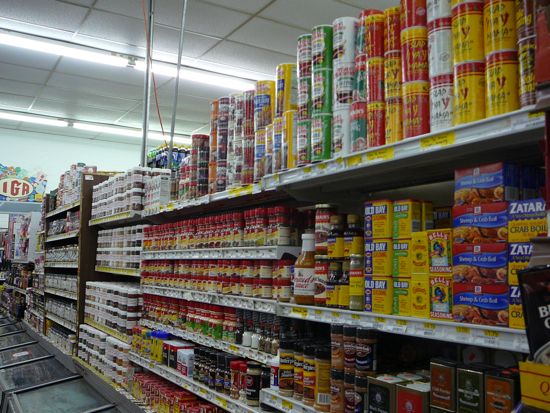
One entire aisle, entirely devoted to seasonings – and so many things we never see in Kuwait – poppy seeds! File’! A variety of Chili mixes, seasoned shrimp boils . . . It’s all I can do not to buy one of everything.

And the irony? What do I bring back for my friends in the US from Kuwait? Kuwaiti spices – that biriyani mix, pine nuts, saffron, and those little red dried pomegranate seeds. They are always a huge hit – it’s always about what you can’t get your hands on, isn’t it?
Butterfly Award

“I’m choosing three blogs to pass it on to and asking that they tell us why they started blogging and then pass the love on to three of their favorite blogs.”
I was nominated for the Butterfly Award by Scars and Souvenirs (I always have a problem spelling “souvenirs!”) and of course, right now while I am travelling and my posts are sporadic and erratic and varying in quality, I feel totally unworthy! Scars and Souvenirs is a very intelligent Syrian blog, written by a woman with a lot of insight and interesting thoughts who lives and works in Damascus, one of my favorite places on earth. I am totally honored she would nominate me.
I discovered blogs when I was moving to Kuwait. I was particularly fascinated by two women bloggers, Jewaira and 1001 Nights (another articulate and intelligent blog; she is, unfortunately, no longer blogging.) I started blogging when my comments began to be longer than the original blog entry and I figured it was time. It was very scary for me, and I made a lot of mistakes with the new technology, but persevered.
There are new bloggers showing up all the time. I would like to nominate three that have fresh, original voices, authentic voices, and from whom I learn more about Kuwait:
Kill the Damn Patient
Danderma’s Blog
Confessions of a Love-Struck Flana
The Feast of St. Andrew
This is the Feast of Saint Andrew, one of my favorite of all the Saint’s Days, and the Saint’s feast closest to my very favorite season of the church or all – Advent, during which we prepare our hearts for the arrival of the little baby Jesus.
I learned things I never knew, reading James Kiefer’s write up for The Lectionary including that Andrew is known for bringing others to Christ. He was one of two of the very first Apostles, and while not often mentioned individually, is mentioned as one who brings others to the knowledge of Christ.

ANDREW THE APOSTLE
(30 NOV NT)
Most references to Andrew in the New Testament simply include him on a list of the Twelve Apostles, or group him with his brother, Simon Peter. But he appears acting as an individual three times in the Gospel of John. When a number of Greeks (perhaps simply Greek-speaking Jews) wish to speak with Jesus, they approach Philip, who tells Andrew, and the two of them tell Jesus (Jn 12:20-22). (It may be relevant here that both “Philip” and “Andrew” are Greek names.) Before Jesus feeds the Five Thousand, it is Andrew who says, “Here is a lad with five barley loaves and two fish.” (Jn 6:8f) And the first two disciples whom John reports as attaching themselves to Jesus (Jn 1:35-42) are Andrew and another disciple (whom John does not name, but who is commonly supposed to be John himself — John never mentions himself by name, a widespread literary convention). Having met Jesus, Andrew then finds his brother Simon and brings him to Jesus. Thus, on each occasion when he is mentioned as an individual, it is because he is instrumental in bringing others to meet the Saviour. In the Episcopal Church, the Fellowship of Saint Andrew is devoted to encouraging personal evangelism, and the bringing of one’s friends and colleagues to a knowledge of the Gospel of Christ.
Just as Andrew was the first of the Apostles, so his feast is taken in the West to be the beginning of the Church Year. (Eastern Christians begin their Church Year on 1 September.) The First Sunday of Advent is defined to be the Sunday on or nearest his feast (although it could equivalently be defined as the fourth Sunday before Christmas Day).
Several centuries after the death of Andrew, some of his relics were brought by a missionary named Rule to Scotland, to a place then known as Fife, but now known as St. Andrew’s, and best known as the site of a world-famous golf course and club. For this reason, Andrew is the patron of Scotland.
When the Emperor Constantine established the city of Byzantium, or Constantinople, as the new capital of the Roman Empire, replacing Rome, the bishop of Byzantium became very prominent. Five sees (bishoprics) came to be known as patriarchates: Rome, Alexandria, Antioch, Jerusalem, and Byzantium. Now, the congregation at Rome claimed the two most famous apostles, Peter and Paul, as founders. Antioch could also claim both Peter and Paul, on the explicit testimony of Scripture, and of course Jerusalem had all the apostles. Alexandria claimed that Mark, who had been Peter’s “interpreter” and assistant, and had written down the Gospel of Mark on the basis of what he had heard from Peter, had after Peter’s death gone to Alexandria and founded the church there. Byzantium was scorned by the other patriarchates as a new-comer, a church with the political prestige of being located at the capital of the Empire, but with no apostles in its history. Byzantium responded with the claim that its founder and first bishop had been Andrew the brother of Peter. They pointed out that Andrew had been the first of all the apostles to follow Jesus (John 1:40-41), and that he had brought his brother to Jesus. Andrew was thus, in the words of John Chrysostom, “the Peter before Peter.” As Russia was Christianized by missionaries from Byzantium, Andrew became the patron not only of Byzantium but also of Russia.
Andrew is the national saint of Scotland. George (23 Apr) is the national saint of England, Patrick (17 Mar) of Ireland, and Dewi = David (1 Mar) of Wales. George, who was a soldier, is customarily pictured as a knight with a shield that bears a red cross on a white background. This design is therefore the national flag of England. It is said that Andrew was crucified on a Cross Saltire — an ‘X’ -shaped cross. His symbol is a Cross Saltire, white on a blue background. This is accordingly the national flag of Scotland. A symbol of Patrick is a red cross saltire on a white background. The crosses of George and Andrew were combined to form the Union Jack, or flag of Great Britain, and later the cross of Patrick was added to form the present Union Jack. Wales does not appear as such (sorry!). Whether there is a design known as the cross of David, I have no idea.
by James Kiefer
Books Behind the Counter
“Hey Mom, take a look” said Law and Order Man as we were about to walk out of the local Barnes and Noble. He was pointing to the selection of books by Chuck Palahniuk, all on shelves behind the counter.

I had noticed he has a collection of Chuck Palahniuk books, and I have read reviews by Kuwait bloggers, so I had asked him about the books, would he recommend them.
“You wouldn’t like them” he said. He knows me pretty well, and often recommends authors I might like. I do the same with him. If he says not to bother, I won’t bother.
“I asked the clerk why all the Chuck Palahniuk books were behind the counter, if people steal them,” my son went on, “and she wouldn’t exactly say that people walk off without paying for them, but she said that they are VERY popular books, so I assume that’s what she meant.”
Breakfast at Andy’s Flour Power
We love this place, a local bakery where everything served is fresh cooked. No matter what I order, I always love that it smells of cinnamon when it arrives, because of the home baked walnut-raisin toast on the plate. Normally, I can pass on toast, it is just filler. When it is Andy’s Flour Power walnut-raising toast – I groan, and eat every bite.

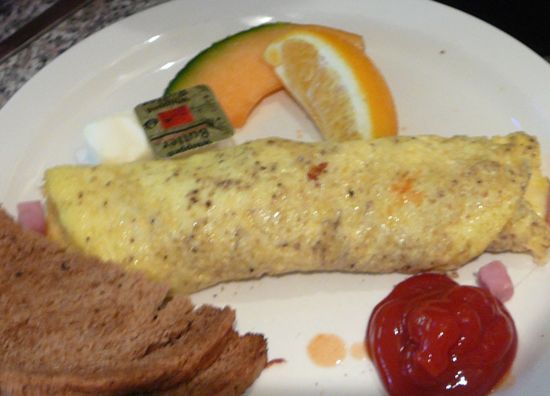
After Thanksgiving Dinner, we thought we would never eat again. But after fasting from afternoon until the next day, we find that, after all, we are hungry for breakfast. Here is what we had for breakfast – I had a spinach – swiss cheese omelette:

AdventureMan’s biscuits and gravy were to die for (he says):

Law and Order Man’s Ham and Cheese Omelette:
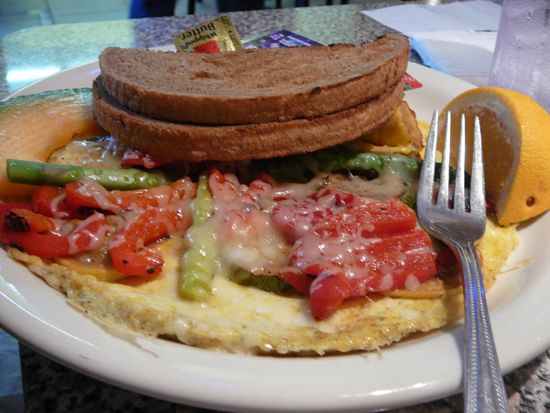
EnviroGirl got the most beautiful dish of all – a vegetable frittata:
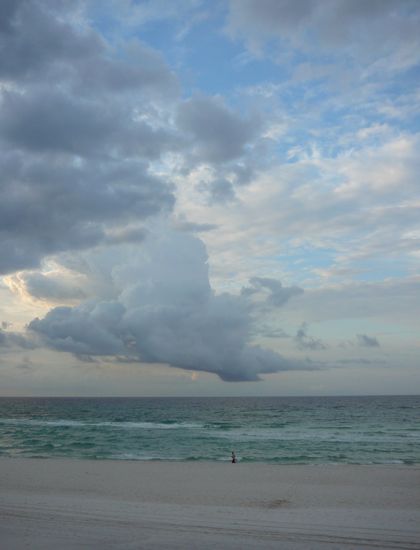
It was thundery and a little rainy on Black Friday, the day after Thanksgiving:
Southern Thanksgiving Photos
First, apologies – No matter how many photos I take, you can’t begin to imagine the scope of this event. Three sisters, out of a family of ten brothers and sisters, gather the clan and provide a truly old fashioned Southern Thanksgiving on a large country estate. While the photos are mostly of food, the most important element of the gathering is the love that brings and binds this family together.


The weather was magnificent, allowing people to be inside and out, the kids out playing chase, football, exploring the grounds, sitting on the old swing, etc. Out in the way-back, men started shucking oysters for the pre-meal appetizers around 9 in the morning.

While the three sisters are pulling together all the last minute details, there is already an abundance of food to keep people nibbling while anticipating the main meal, served around 1:00 in the afternoon.
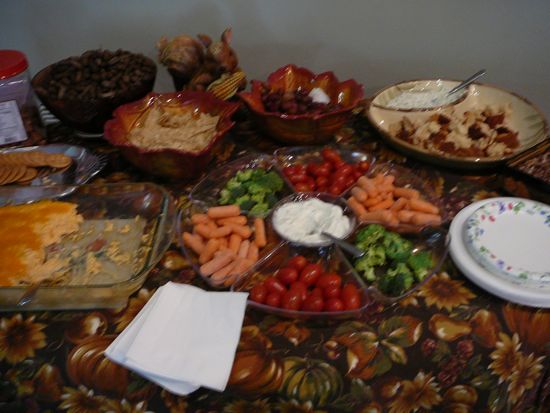
As people arrive, they bring more food – mashed potatoes, sweet potato casseroles, green beans, turnip greens, collard greens, creamed corn, creamed onions, all in slow cookers to keep them warm until dinner-time.

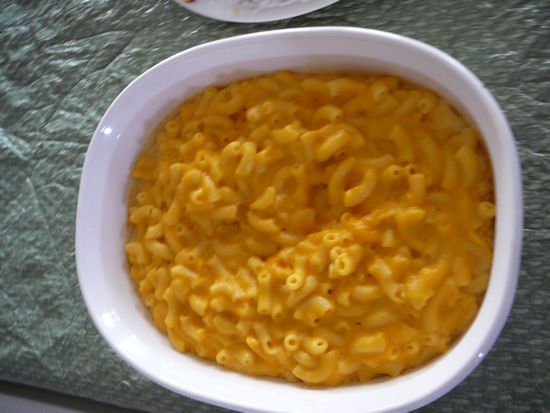
Meanwhile, things are heating up in the command center (kitchen) as time nears to get the food on the groaning tables:
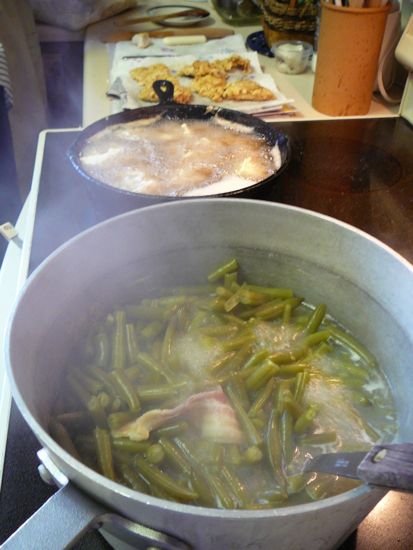
Frying up turkey breast meat:

Usually, the men carve the turkeys – this year, a smoked turkey and a deep fried turkey:
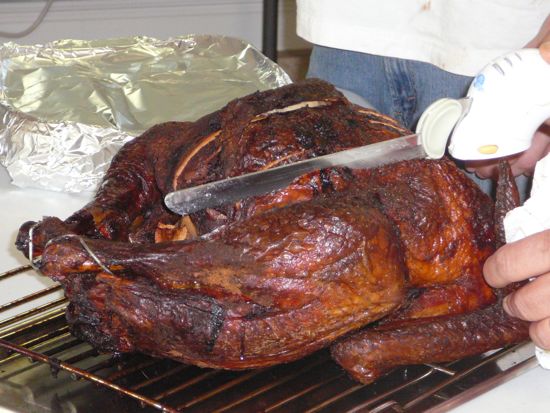
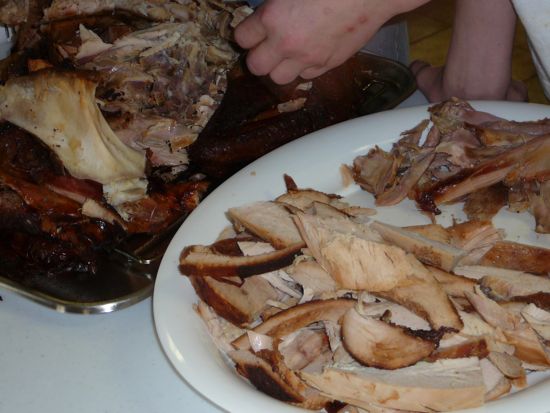
Getting close to dinner time, people start gathering closer to the house:

Just before the dinner is served, the organizers thank the guests for coming and the food is blessed. Now here is where I really need to apologize – there are no dessert photos, and the desserts were magnificent. But once you have filled your place with turkey, dressing, vegetables, salads – and you have to take a little bit of everything so you don’t hurt anyone’s feelings – then you need to sit a while before you think about dessert. Actually, I didn’t even have any room for dessert! So I missed out on taking dessert photos, and for that, I totally apologize.
Then, about an hour after dessert, the family photos are taken. First, all the surviving and attending brothers and sisters, then each family, with various children and their families attending. This tradition is a lot of fun, but takes another hour or so. At the very end, we take photos of the three sisters who spend weeks and hours organizing the annual event, coordinating all the food, cooking for days and cleaning up afterwards. These women are my heroes – it is an unbelievable amount of work, and they do it out of love for their family:

Never Ending Sunset 27 Nov 08
If you think I am crazy about sunrises (and I am) just wait until you see these sunsets. They are all minutes apart during the same sunset. I can’t watch a sunset and not have religious feelings – but see for yourself.
Just before sunset – can’t you almost hear the clink clink of those horseshoes hitting the metal pole?


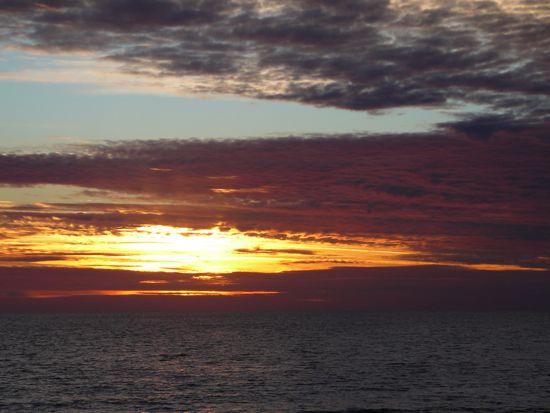
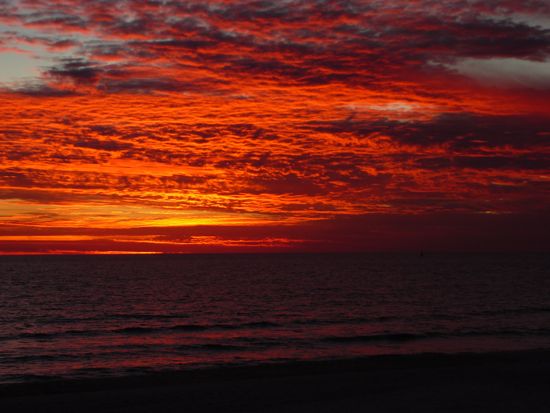
Awesome – or what?



Merchants Struggle for Survival
This is from today’s New York Times. You can read the rest of the article by clicking HERE.
By STEPHANIE ROSENBLOOM
Published: November 27, 2008
Black Friday, long the Super Bowl of shopping, is at hand, but it may have become nearly irrelevant. Check out the deals that were already on offer earlier this week:
Diamond earrings at Macy’s were chopped to $249 from $700. A Marc Jacobs bag at Saks, originally $995, fell to $248.45. And for men, a Ted Baker suit at Lord & Taylor was selling not for the usual $895, but for $399.99.
Such crazy prices are a sign of the times, and analysts expect many more such deals during one of the toughest holiday seasons in decades.
Laden with excess inventory, hungry for sales and worried because of five fewer shopping days between Thanksgiving and Christmas this year, the nation’s retailers went into a price-cutting frenzy long before the day after Thanksgiving, the traditional start of the holiday shopping season. For weeks, they have been trying to outdo one another to capture the attention of consumers who have become numb to run-of-the-mill discounts. As the latest T. J. Maxx slogan goes: “Every day is Black Friday.”
In fact, retailers have had so many early “doorbusters” — jaw-dropping deals usually reserved for Black Friday — that “it’s almost not necessary to get up at 5 in the morning,” said Bill Dreher, a senior retailing analyst with Deutsche Bank Securities.
But the retailers are just getting warmed up.
The Toys “R” Us chain is planning the deepest discounts in its history on Friday, with 50 percent more doorbusters than last year. Other retailers are promising that their deals will be even more striking than the sales they have already unveiled — with Wal-Mart, for instance, promising large flat-panel televisions for less than $400.
Such bargains are likely to set the tone for the shopping season to come.
“There’s no reason to suspect this will end,” said Dan de Grandpre, editor in chief of Dealnews.com, which has been tracking Black Friday deals for about a decade. “This kind of heavy discounting will continue until we see some retailers start to fail, until they start to go out of business.”
Indeed, the intense competition could erode profits at many chains. Some retailing analysts even fear it could condition consumers to shop only when merchandise is deeply discounted.
Still, stores plan to pull out all the stops on Friday and through the weekend. After all, November and December sales make up 25 to 40 percent of many retailers’ annual sales, according to the National Retail Federation, an industry group. (The day after Thanksgiving is called Black Friday because it was, historically, the day that many retailers moved into the black, or became profitable for the year.)
The deals were laid out in circulars tucked into newspapers on Thanksgiving Day, on retailers’ Web sites and on sites dedicated to sales and shopping strategies, like bfads.net and gottadeal.com. Many stores planned to open just after midnight Friday morning, and others — including Wal-Mart, Sears, Macy’s, Best Buy, Circuit City, Toys “R” Us and Old Navy — set their openings for 5 a.m. Target will open at 6 a.m. and BJ’s Wholesale Club at 7 a.m.
Read the entire article HERE.
Black Friday
Black Friday – the Friday after Thanksgiving – bargain hunters in the USA head to the stores. Some stores opened as early as midnight to attract bargain hunters. Many more open around 5 or 6 in the morning. Most have loss leaders – i.e. specially priced items, maybe even below cost – hoping people will come in looking for the bargains and buy something else.
Not me.
Not in a million years.
I did it one year; we had just come back to the US after living for years on Germany. I needed 110v Christmas lights, so I went to a store at 0530 and stood in line until it opened at 6 and got many packages . . . but not enough. Later in the day I went back to see if there were any of the bargain priced lights left, and there were stacks and stacks of them. I learned my lesson.
We also learned that many things go on sale a couple days before in some stores, or are still on sale and in good supply the following Monday.
I hate lines. I hate competitive shopping. I have seen women grab things out of one another’s hands, I have seen them race down the aisles . . . and I just ask myself “What is this all about?” I have that primitive instinct too, hunting down that elusive bargain, bagging it and getting it home – but at what cost?
Anomaly – while gas prices have dropped back to reasonable rates here, fewer Americans are traveling this year. Normally, Thanksgiving is the holiday with the highest accident rate of all the holidays because of the road traffic, but because Americans are holding tight to their purses this year, fewer are on the road or in the air.
We are packing up today and moving on to the next stop. We will stop and see good friends en route to our destination, have a meal and a good visit with them . . .
yes, yes, thank you, we had a truly wonderful and memorable Thanksgiving, a truly Southern Thanksgiving, with family, with friends, and I will share it with you as soon as I get a card-reader so I can upload to the computer. 🙂 There were three kinds of turkey – a deep fried turkey, a smoked turkey, and turkey breast pieces pan-fried in batter, like chicken nuggets only fresher, and tasty. My favorite was a big bucket of venison stew, one of the hunters had bagged a big buck up in Kentucky.
I don’t believe there was a steamed vegetable or un-sauced vegetable in sight! Lots of gelatins made with sour cream or cream cheese, macaroni and cheese, three or four different kinds of stuffings and sweet on sweet sweet potatoes . . . and then came dessert, oh my. The tables – separate stations for meats, stuffings, vegetables and salads – were groaning, but then again, there were many many people to feed. My Southern husband was in heaven, eating all the foods I don’t know how to make and never dreamed of making.
The very best part of Thankgiving was the visiting. It was like one great big diwaniyya, with people in the kitchen and living room, people way out back shucking oysters and peeling shrimp, loads of ice tea all made up, sweet, unsweet, Splenda, lemondade . . . young people playing football or running around. . . it was a very sweet family day, beautiful weather, you couldn’t order a nicer Thanksgiving, and we were so delighted to be included.
Recent Comments
intlxpatr on Shampoo Ginger tigerbutterya0c5ff1d… on Shampoo Ginger intlxpatr on British Soldier Kidnapped, Esc… John on British Soldier Kidnapped, Esc… intlxpatr on British Soldier Kidnapped, Esc… Wikipedia Donate Button

Amazina


Early Voting in Florida


