20% Chance of Rain!
Wooo HOOOO, Kuwait! Look what the next five days have in store for us! On the fifth day – a 20% chance of rain!

I know, I know, it’s only 20% – but it is the first HINT of rain we have seen in lo, these many months. I will rejoice at 20% and hope that rain will come soon, God willing. Kuwait needs rain.
Here is how it looks this morning, as the sun comes up from the horizon:

Yesterday, we had fishing boats, strung from right to left, so beautiful. This morning, we have Coast Guard boats. These guys seem to me to be one of the best equipped and maintained outfits in Kuwait. If I were a young Kuwaiti male, I would join the Coast Guard. They have some really, really fast boats, and some other boats that look like a lot of fun. They get to do testosterone-filled things like interdict people trying to come into Kuwait illegally, and drug runners, rescue picnic-ers and people whose boats catch on fire or fishermen whose boats sink. Wouldn’t that get your blood running a little faster?
All Female Ministers Must Cover Hair, or Female Ministers are Unconstitutional? Or?
I am pretty good at reading the news, but all this is a little too Byzantine, even for me. This is from today’s Al Watan. I think it says that females who do not cover their hair can still be ministers, in spite of some members of parliament saying that females who do not cover their hair are not allowed to be ministers. You read it and tell me what YOU think it says.
Maybe some of the Ministers of Parliament lack so much self contol that they fear the sight of the hair of Nouriya AlـSubaih and/or Moudhi AlـHumoud will impede their performance?
There is an Islamic dress code? Like if you do not wear an abaya and niqab, or hijab, you cannot be Moslem?
Panel brands female ministers” appointment ”unconstitutional”
Court freezes MPs” suspension from Parliament
Al Watan staff
KUWAIT: Parliament”s Committee for Legislative and Legal Affairs, during its meeting on Sunday, signed off on a report stating that the appointment of female Cabinet ministers Nouriya AlـSubaih and Moudhi AlـHumoud is unconstitutional. The decision is said to stem from the fact that both women do not conform to the Islamic dress code because they refuse to cover their hair.
The committee”s convener, Ali AlـHajeri, announced that the report has been unanimously endorsed by the committee”s members, which include, among others, MPs Nasser AlـDuwailah, Mohammed AlـHatlani and Mohammed Hayef, and that it is backed up by Article 82 of the Constitution and Article 1 of the Elections Law that stipulates that women should adhere to the Islamic dress code.
On the eve of the inauguration of the new parliamentary term on Tuesday, the National Assembly is expected to grapple with a wide range of burning issues, including a decision by the Constitutional Court to strip two former MPs of their parliamentary seats.
Sources have reported that there has been a bizarre twist concerning this particular issue with Speaker of Parliament Jassem AlـKharafi announcing that he has received a letter from the Administrative Court informing him about a decision to suspend the Constitutional Court”s verdict that revoked the membership of Mubarak AlـWalaan and Abdullah AlـAjmi. He also revealed that the Administrative Court is due to look into the case today.
AlـKharafi affirmed that he will take measures in accordance with the ruling issued by the Administrative Court.
A constitutional expert affirmed that the newly reinstated MPs should be allowed to take their seats in Parliament unless the Administrative Court issues another verdict ruling in favor of the lawmakers whose membership was revoked.
Reacting to this new development, MP Askar AlـEnezi affirmed that verdicts issued by the Constitutional Court are final and unchallengeable.
He argued that the Administrative Court has no jurisdiction to look into constitutional matters.
Last updated on Monday 20/10/2008
Update 21 October
Female minister reacts to panel decision
Comply with Islamic attire or resign, urges MP
Al Watan staff
KUWAIT: The Chairman of Parliament”s Legislative and Legal Committee Nasser AlـDuwailah has described comments made on Monday by the Minister of Housing and Minister of State for Housing Affairs Moudhi AlـHumoud as “unacceptable”, after she attacked a decision by the committee that considers the appointment of the two female Cabinet ministers as unconstitutional because they do not follow the Islamic dress code.
“The minister”s remarks are irresponsible and unacceptable,” he firmly said, while calling on the minister to tender her resignation immediately.
Noting that the committee has thoroughly looked at the legal aspects of the female ministers” appointment, he pointed out that the members have concluded that the duo have failed to comply with regulations regarding the Islamic dress code that is deemed acceptable inside the Abdullah Salem Chamber (Parliament).
He explained that the ministers are free to wear to whatever they want outside the Parliament, noting that the law which gave women their full political rights stipulates that female candidates or appointees comply with certain set regulations.
Insisting that the law was passed by Parliament rather than the committee, he explained that the committee”s response is consistent with the spirit of the Constitution.
He concluded by expressing hope that the government will express regret over the minister”s remarks.
Last updated on Tuesday 21/10/2008
Sweet October Morning
Goooooood Morning, Kuwait!
It is a sweet morning, a beautiful morning. You can see almost all the way to the horizon, and the lethal layer that hangs over it is somehow thinner this morning:
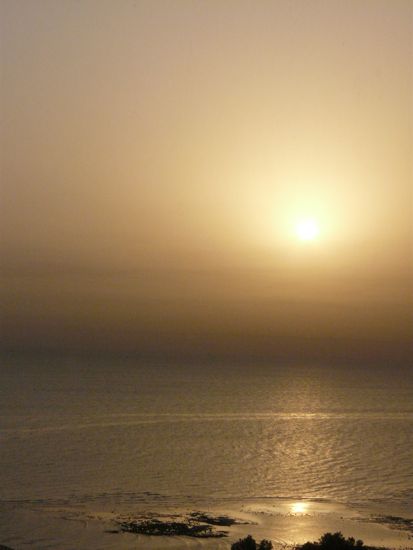
One of my favorite places, Weather Underground: Kuwait tells us we have five more days below 100°F coming up and here is what it looks like this morning:

The house still smells of cinnamon and clove and Mom’s Fruit Cakes which I spent all day yesterday chopping, pitting, baking, and wrapping in the crisp Kuwait Autumn weather. 😉 I fell into bed last night around eight, and slept almost straight through until 0600 this morning, an exhausted Qatteri Cat snuggled up between AdventureMan and me. No, no, we don’t eat the fruitcakes yet. You make them around the end of October and you store them, heavily wrapped, in the refrigerator until Thanksgiving (4th Thursday in November) when you are allowed to taste the first one. They mellow as they age in the refrigerator.
In other countries, not Kuwait, you wrap them in cheesecloth soaked in brandy, and you can open them now and then and brush on a little more brandy with a pastry brush. Sigh. I am not much for drinking, but I miss the smell of the brandy soaking into the fruitcakes.
Sand Relocation Program
As you are driving along, or stopped in the gridlock of school’s-out traffic, have you noticed the bags of something along the road?
AdventureMan was asking me what that was all about. I said I didn’t know, but I had seen a bunch in front of our place, too. I thought they were full of sand. In Seattle, it might be about getting ready for winter, like sand for when there is a freezing rain or heavy snowfall or something, but that is so not remotely possible in Kuwait.
AdventureMan thought they might be full of trash cleaned off the streets, but they are packed too solidly or it to be trash.
We finally figured it out – it is sand, sand and grit removed from the streets AND, more importantly, from the drains, so that when it rains, the drains will be clear and the water from the (Insh’allah) heavy rainfall will have a way to run back to the sea without puddling in lower areas, as it did several years ago when a couple people actually drowned in Kuwait.
Kudos for the ministry in charge, for anticipating the problem and getting the drains in top condition now, in case it rains. Which ministry, I wonder? Public Works? Highways?
AdventureMan speculated, as he is known to do – what do you think happens to these bags of sand? Are they used as sandbags somewhere? Are they dumped in the desert? What would happen if you could tag a grain of sand, the way you tag an animal, and you could track it through it’s lifetime, where would it take you?
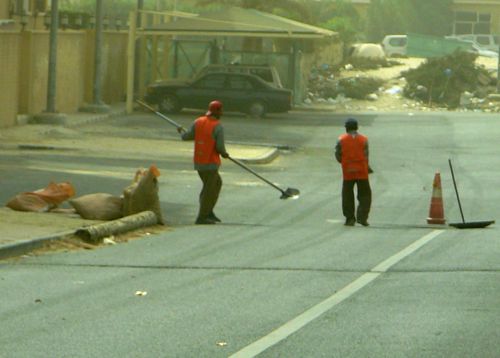
He calls this the government Sand Relocation Project.
The Great Kuwait Sunset Challenge Poll
I have to tell you honestly, I didn’t think this through. One day, I realized I did not have one single sunset shot from Kuwait. I took one, and it was awful and it got me started. I had no idea when I started how much fun it was going to be – for me – and I sure hope for you, too.
As the submissions started rolling in, I found great joy in the recognition you were all getting with your beautiful, sometimes funny, often soulful contributions. I was delighted with your enthusiasm, and your graciousness in participating. And I also struggled with “Holy Smokes, how do I end this? How do I choose a winner?”
If I tell you what I really think, you will think I am copping out. I think we all ended up winners. I felt like a winner, seeing all those beautiful sunsets through your eyes. I felt such joy seeing the compliments you paid one another’s photos. I loved spotlighting your talent, and I know there are a lot of non-photo-takers out there who enjoyed checking in every day to see what had been posted. But how to resolve the question: who won the challenge?
Then, a few days ago I started seeing an orange ball I didn’t recognize on my write-a-new-post page, and yesterday there was an announcement about something new at WordPress, PollDaddy, which means I can now put a poll right on my blog (this is new for WordPress; I know some of the others of the Kuwait bloggers have had this capability for AGES) but I am thankful to have it now, just when I need it.
You get to vote. YOU get to choose the winner of the Great Kuwait Challenge Poll. You will have one week to vote (and hurry! I already have an idea for the next challenge!)
I don’t really care who wins; the fun for me was in seeing all the photos that came in, seeing such beauty through your eyes. In my eyes, we are all winners – you who submitted beautiful shots and we who got to see them.
But – just because I can – I am going to turn the vote over to you: Who took the best Kuwait Sunset photo? (Go to The Great Kuwait Sunset Challenge and click through to other’s blogs, also visit individuals posted who sent me photos):
Poll is closed!
You will note – because I can – I chose a very sunset-y polling device to help you make your choice.
I truly hope I have included everyone who submitted a photo (of a KUWAIT sunset!) and forgive me if I have made a mistake. I think I got you all. My initial photo doesn’t count; it was just to show you how bad my sunset photo was and to encourage you to do better.
Thank you, WordPress, for showing up with a polling device, like a Deus ex machina to solve the dilemma of how I was going to give bragging rights for the best Kuwait sunset.
Ready? Set? VOTE!
Blogging About AdventureMan
AdventureMan and I were having dinner out and I was telling him how a friend had mentioned reading something in my blog. I was surprised, because although I told her a long time ago – when I first started blogging – she had never mentioned the blog. She has a lot on her hands and I always thought she might have forgotten about it. We always have a lot to talk about and it had never come up.
“It’s not like people who know you blog HAVE to read your blog.” AdventureMan said.
“I totally agree,” I agreed.
“I don’t have any expectations that anyone read just because they know I write it. Even YOU!” I said to AdventureMan.
“But I do read it, most of the time!” he said, and I am glad, because he keeps me honest, more or less, and he also keeps me from saying anything too inflammatory, or giving away too much personal information.
But his eyes were laughing.
“What’s so funny?” I asked, and he couldn’t answer, he was laughing so hard. His eyes started watering, you know how when you are laughing and can’t stop.
“I can’t tell you!” he gasped. I just kept silent and kept looking at him expectantly with a big smile on my face, because I was pretty sure he would give in if I just gave him a chance.
“OK! OK! I’m just so embarrassed to tell you this!” he started, but again, he was laughing so hard he could barely continue.
“OK, OK, I know your blog is YOUR thing, it’s not all about m – m – m – m . . . ” He could not continue, he was laughing so hard.
“It’s not about m – m – me!” He choked out thinly, breathless from so much laughing.
“But the first thing I do. . . . (laugh laugh laugh, swipe at eyes) . . . the first thing I do when I go to your blog is to do a quick scan to see if you mentioned ME!”
At his point we are both laughing. It really is funny. He loves being AdventureMan.
So, AdventureMan, here is one whole entry, entirely about YOU. 🙂
Antannae Garden
As we are zooming down the highway, my friend says to me “Have you noticed all the new antannae going up? It’s like a very strange garden crop.”
I hadn’t really noticed, but as soon as she said it, my antannae went up.
She was right. They are everywhere. Sometimes just one, sometimes two or three – new – all in the same place.
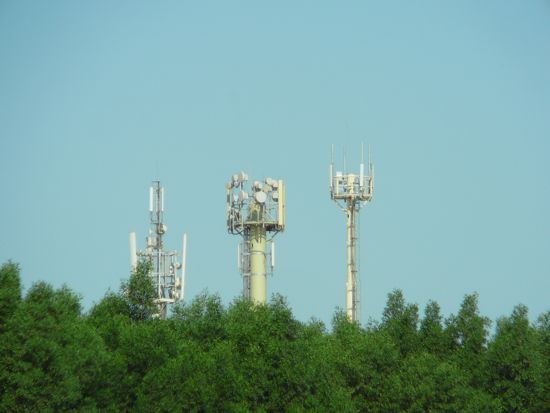

Her theory is that the Ministry of Communication is putting them up to monitor our phone calls and to eliminate the use of all the VOIP calls we are making.
I know there is a new mobil phone operator that has been authorized, so that these may be new mobil towers . . .
but that is all speculation. Does anyone know for sure what these new towers are, growing up almost overnight all over Kuwait?
Sunrise Struggle
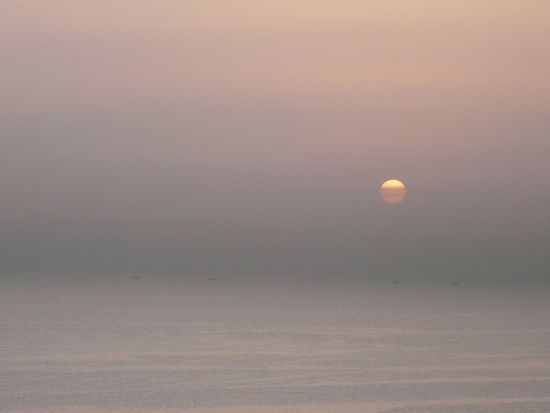
I wasn’t any struggle to be up for sunrise this morning; sunrise is getting later and later every morning. It seems to be very close to 6 a.m. now. But look how the sun has to struggle this morning to break through the murky horizon. Yesterday we had blue sky! Today the haze and murk are back, and the sun’s rays are dim and pallid.
Greetings From Kinan
Our blogging friend Kinan sends his Hellos to the Kuwait blogging world, and regrets he cannot participate in the Great Kuwait Sunset Challenge, as he is doing his graduate studies in Sweden, but he sends along his greetings and this photo for us from sunny Sweden:

To my readers who have never lived in Kuwait – you cannot imagine how it feels to feast your eyes on so much GREEN when you live in Kuwait. Kuwait is greener than Qatar, there are more native trees (Daggero calls them Athels) which seem to need very little water and provide a beautiful feathery green – but they are far and few between.
Kinan’s photo is LUSH with green, it’s like life gone abundantly wild. Total WOW, Kinan, and thank you for sending!
Andorra, Smoking and Life Expectancy
This little illustration was part of an e-mail a friend sent this week, but it reminded me of a special I heard a couple weeks ago on BBC about Andorra.

Andorra has the highest life expectancy of any country in the world. When people try to figure out why, they think it must be because people are physically active there, all their lives. The elderly are encouraged to go to the gyms, prices are greatly subsidized for all citizens, like gyms and water aerobics classes and EVERYBODY stays fit.
They have the longest life expectancy in spite of the fact that many many of the Andorrans are also smokers. Go figure.
Recent Comments
intlxpatr on Shampoo Ginger tigerbutterya0c5ff1d… on Shampoo Ginger intlxpatr on British Soldier Kidnapped, Esc… John on British Soldier Kidnapped, Esc… intlxpatr on British Soldier Kidnapped, Esc… Wikipedia Donate Button

Amazina


Early Voting in Florida


